

Infinite Bamboo
AN EDUCATION CENTER AND WORKSPACE : GROWING THE BAMBOO SOLUTION

TASK: Design a center with bamboo at the heart = an interesting challenge.
RESEARCH: bamboo structures, climate, site challenges, vernacular, bamboo codes.
Addis Ababa: The capital city of Ethiopia, and the largest, surrounded by the Oromia Special Zone (essentially a melting pot of many peoples, created to support a sustainable future). The shared socio-economic gains have nurtured many new businesses and a thriving fashion and arts scene.
Concept: In researching contemporary bamboo architecture - we utilized the internet, design competitions, and books - it is easy to become mesmerized by examples in Bali and other parts of Asia, many with soaring rooflines and few walls; however, we had limitations to inform our final product, including bamboo species.
"Ethiopia has the largest resource of bamboo in Africa, estimated at around one million hectares, accounting for 67 percent within the continent and seven percent of the world total [10]. There are two types of bamboo in Ethiopia: highland and lowland bamboo." 1
There are two primary species of bamboo especially suited to the climate and terrain of Ethiopia. While local traditional building techniques have utilized stone, we wanted to recognize a type of structure composed of bamboo and enset leaves - the Dorze hut. The Dorze people have not always resided in Addis Ababa, however their Dorze huts are a perfect union of traditional Ethiopian building methods meeting contemporary profiles.
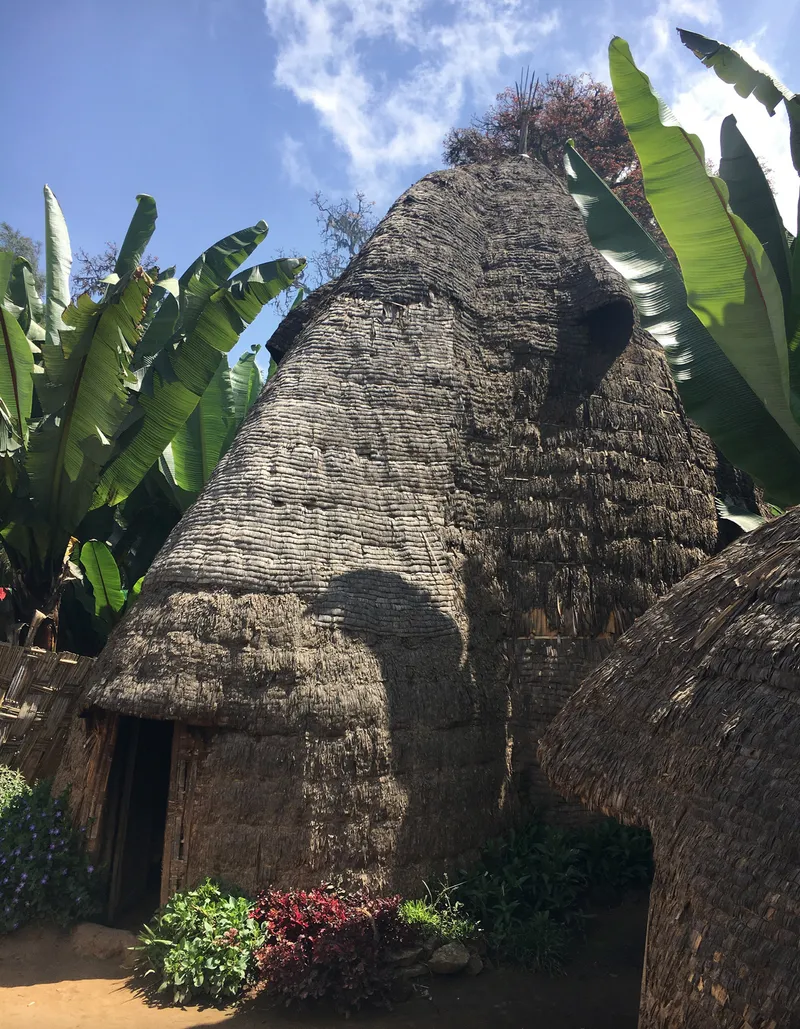 Traditional Dorze Hut 2
ORIGINS:
- Nature Response: Rounded hut, roof becomes walls creating shade and insulation
- Interior Layout: Divided into specific uses including room for sleeping, cooking, etc.
- Material Reflections: Departure from stone and embrace of local sustainable crops
- Site Considerations: Lightweight to be moveable, escape termites; serviceable to repair weather damage
- Vernacular: Created from natural resources on site, adjacent to fields producing materials
Going Further: Starting off, our structures were too tall for height restrictions, and too large with roof slope to meet the footprint restrictions. Working through at least eight studies we arrived at the hut-inspired form. Still, we wanted to consider the terrain of the slope and the challenges therein, as well as provide a moment of reflection, of relative quiet. That became integral to the program.
Condensing the Information: The dual plinths of textured concrete elevate the building to allow air flow and rainwater passage and to deter insects and animals from the interiors. The piers that support the plinths are ready to receive the bamboo structure. Developing the teaching component requires examples of old and new, both represented in the structure as well as the interior finishes. Glazing is placed to enhance views and reconnect back to the city, as well as to provide natural lighting and ventilation moments.
Final Program: Our result is a space that is ready to educate upon the many building uses of bamboo. Separating the volume into two creates distinct zones -- administration, community and education in one and laboratories and workspace in the other. This separation also opens the site for a sustainable material source, a Bamboo River that can renew the teaching material. This green also flows into the void and fills it with fresh air, space to create and discuss, room to plan, a regularly renewing urban garden. Materials selected transition to inform the educational discussions and to define spaces. A secondary bamboo grid provides modular spacing and storage and circulation opportunities.
EVOLUTIONS:
- Nature Response: End walls of bamboo timbers and glass admit more natural light
- Interior Layout: Organized and equipped to educate future generations
- Material Reflections: Created using traditional and non-traditional methods
- Site Considerations: Elevated on plinths, allows rain to flow under and away; deters mold and insects
- Vernacular: Responds to angles of adjacent buildings with interior curves and a bamboo river for inspiration and urban green space
Needs Met: Our objective to showcase bamboo's many faces and uses, while teaching about the local growing cycle and species is realized in this initial phase. Educational spaces are designed for flexibility of layout and potential to evolve with technology. Work labs are offset through lighter flooring and clean lines - bamboo-encased laboratories, equipped to manipulate bamboo on site - with a storage bench wrapping one wall, so that students can view and participate in demonstrations. The relationship between this new facility and the adjacent structure is a play on geometry initiating a dialogue that will continue to inform the architectural discourse.
Expansion: Incorporated into the design is a 1.5 meter grid. This grid enables growth along any axis but provides a standardized measurement for the irregular forms. The uncovered grid allows vertical circulation and storage of bamboo members. Utilizing the curvilinear with the rigid angular in one volume, we created opportunities for Phase 2 and beyond: flip a volume to add a new wing; plant another local species for a second garden/river continuing the botanical exploration. This playful geometry also allows for alternate roofing choices on future iterations.
Time / Elements: The bamboo, treated to the specifications of the Ethiopian Standards Agency and INBAR, will be able to withstand many decades of weather and use. The labs will contain equipment for various treatments, including hot and cold dipping and the boucherie processes: a cycle of growing and tending, harvesting and preparing, working and creating - evolving the many gifts of bamboo.
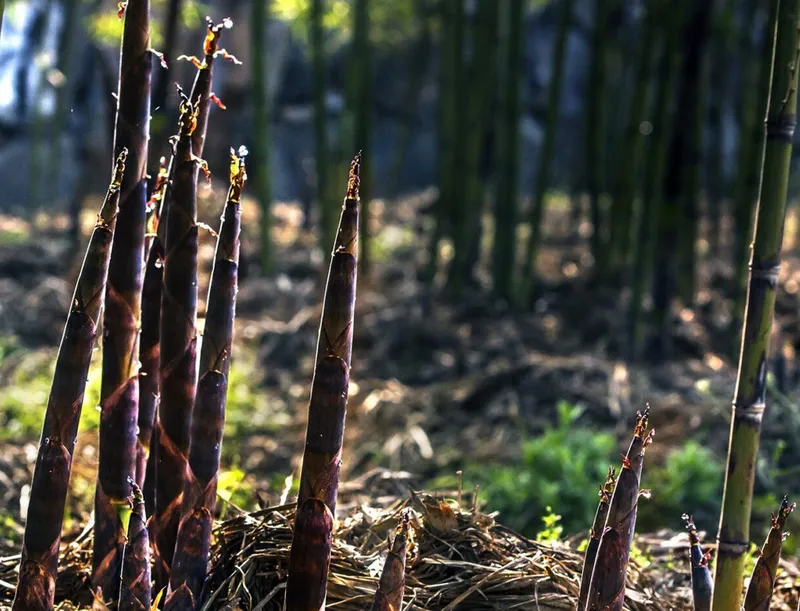 The fastest growing building material in the world. 3
References (3)


Popular Articles
Popular articles from the community


Opera by the Sea Estonia: Three Shells Dissolving Architecture into Tallinn's Coastline
A winning opera house proposal replaces monumental form with interconnected shells that blur the boundary between building, park and Baltic Sea.

The Amber Palace Opera: A Geological Fiction Surfaces on Tallinn's Baltic Waterfront
Pierre Brillard reimagines a Baltic legend as a public landscape, opera house, and waterfront promenade rooted in Tallinn's coastal identity.

Cloaked Colonization: A Mobile Underwater Habitat That Moves Like a Fish
Micah Abaya's shortlisted EHC Pacific entry reimagines ocean settlement as a dispersed network of self-sustaining architectural organisms.

Temporary Home for Dogs: A Reversed Zoo Rethinks Animal Shelter Architecture
In Bucharest, a sinuous corridor and freed landscape flip the logic of containment, designing a shelter that works to make itself unnecessary.

Similar Reads
You might also enjoy these articles

Day and Night Park: A Time-Based Urban Newsstand in Beijing
A temporary urban newsstand in Beijing blending travel, light, and reading through poetic colors, compact form, and community-focused design.

Modernist Patio Renovation in El Masnou, Barcelona by Oliver Segura Arquitectura + Cebrià Arquitectura
Modernist patio renovation blending tradition and innovation with a movable pool, leveled floors, and Catalan materials in El Masnou.

Alto Residencial Coop: Cooperative Housing Development in Santiago de Compostela by Carbajo Barrios Arquitectos
A linear cooperative housing complex blending white volumes and perforated metal façades, enhancing community living, natural light, privacy, and urban integration.
Vil Genis School by BPA ARCHITECTURE – Massy, France
Vil Genis School in Massy, France, features sustainable design, south-facing classrooms, community integration, accessible spaces, and modern educational architecture.

Explore Bamboo Construction Competitions
Discover active competitions in this discipline


Challenge to design public laboratory

Challenge to reimagine the Iron Throne

Photograph architecture without architects

Illustrate the lost glory of Angkor Wat - Render Challenge
Comments (0)
Please login or sign up to add comments
No comments yet. Be the first to comment!