
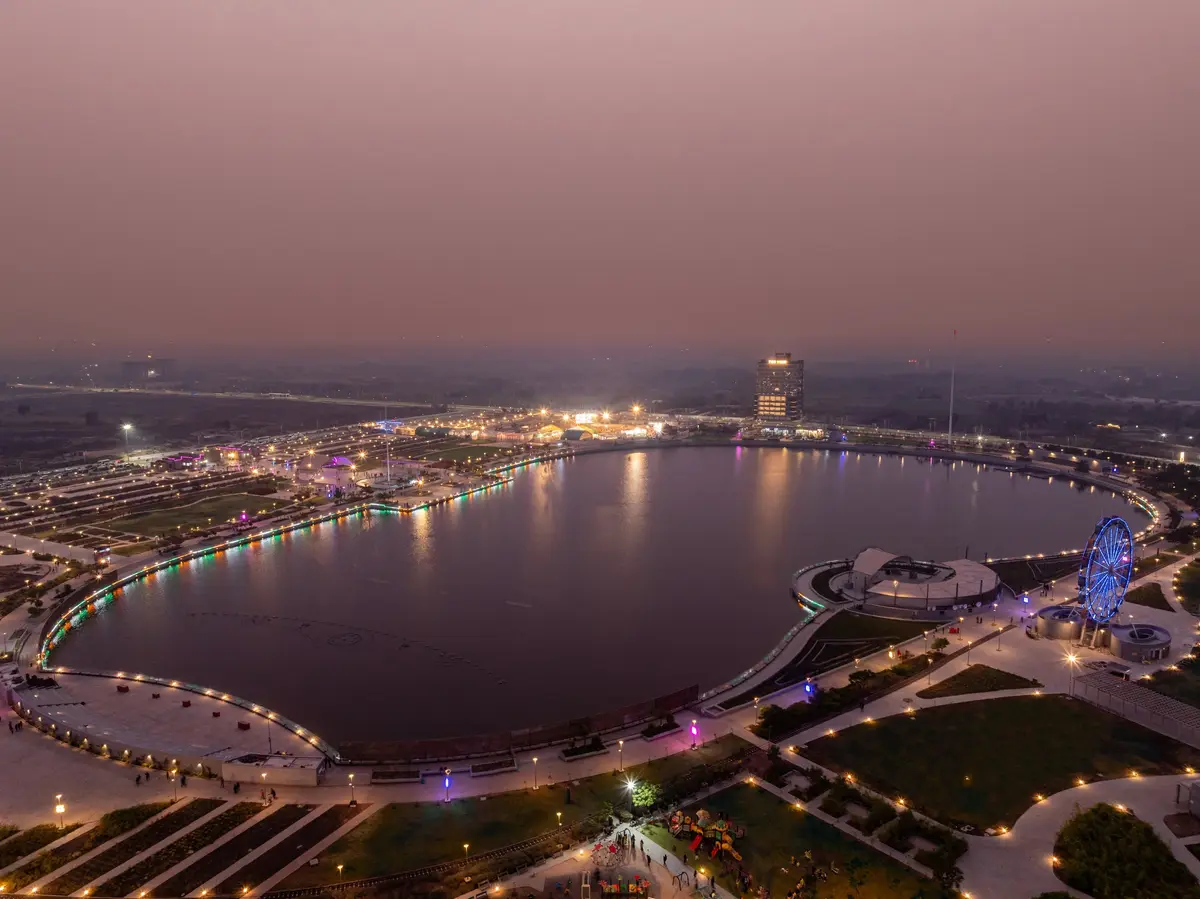
INI Design Studio Transforms a Neglected Depression into a 75-Acre Urban Lake for Rajkot
Atal Sarovar applies water-sensitive urbanism to turn a low-lying wasteland in Gujarat into a civic anchor for a smart city.


Cities in arid western India rarely get to reinvent their relationship with water. Rajkot, Gujarat's fourth-largest city, has done exactly that with Atal Sarovar, a 75-acre public landscape that converts a neglected natural depression into a functioning urban lake ringed by promenades, amphitheaters, tensile canopies, and native planting. Designed by INI Design Studio and inaugurated on May 1, 2024, the project is the centerpiece of Rajkot's Smart City initiative, and it is far more ambitious than the label suggests. Rather than defaulting to cosmetic beautification, the design is rooted in water-sensitive urban design (WSUD), integrating sustainable drainage systems that mimic natural hydrology, recharge groundwater, and handle 100-year flood scenarios.
What makes Atal Sarovar worth watching is not merely its scale, which at over 300,000 square meters is enormous, but the way it fuses infrastructure with public life. Three low-lying areas within a 930-acre greenfield precinct have been reimagined as interconnected waterbodies, linked by storm drains that ultimately overflow into an adjacent canal connecting to Nyari Dam. Tertiary-treated water from a nearby sewage treatment plant feeds the system. The result is a landscape that does genuine hydrological work while also functioning as Rajkot's most popular public space. That dual identity, utility and spectacle, is rare in Indian urbanism and worth examining closely.
Reading the Site from Above
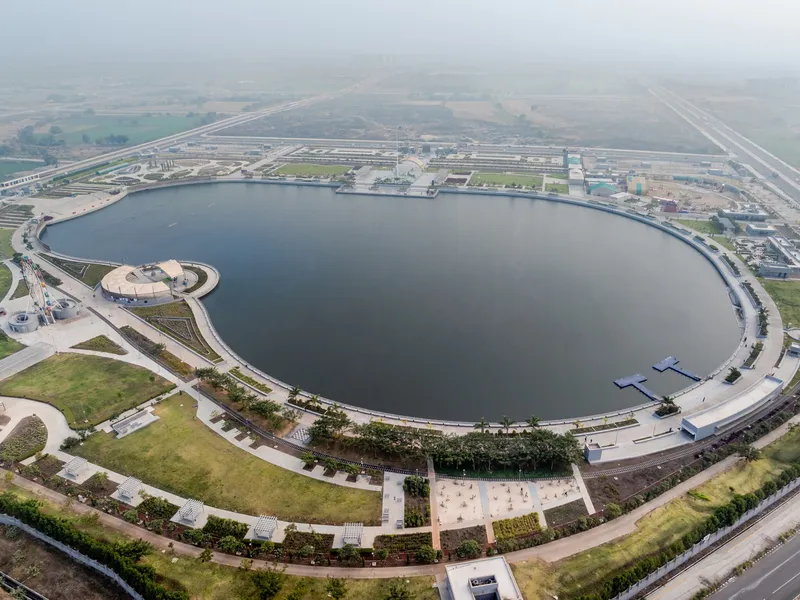
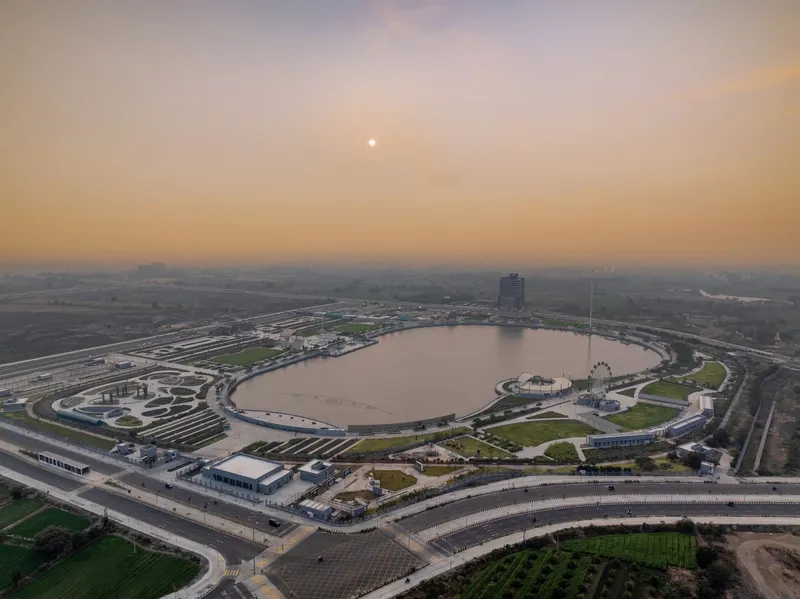
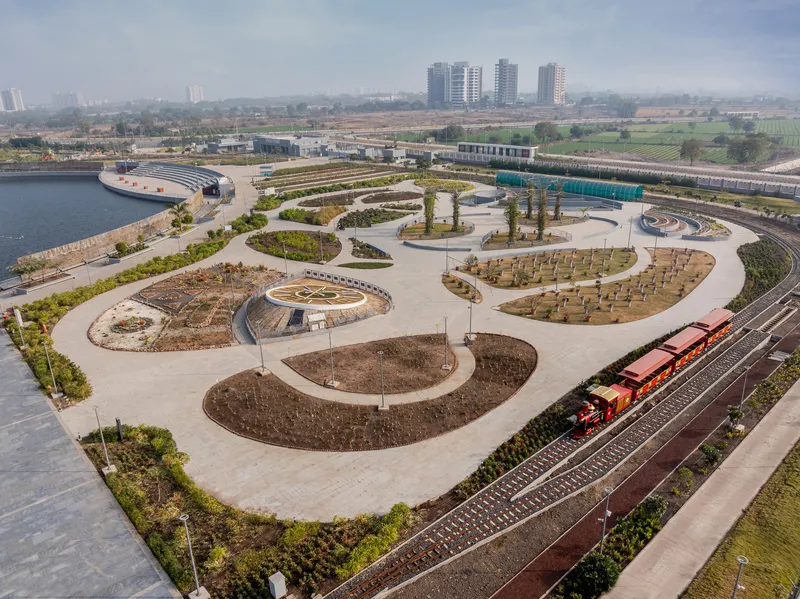
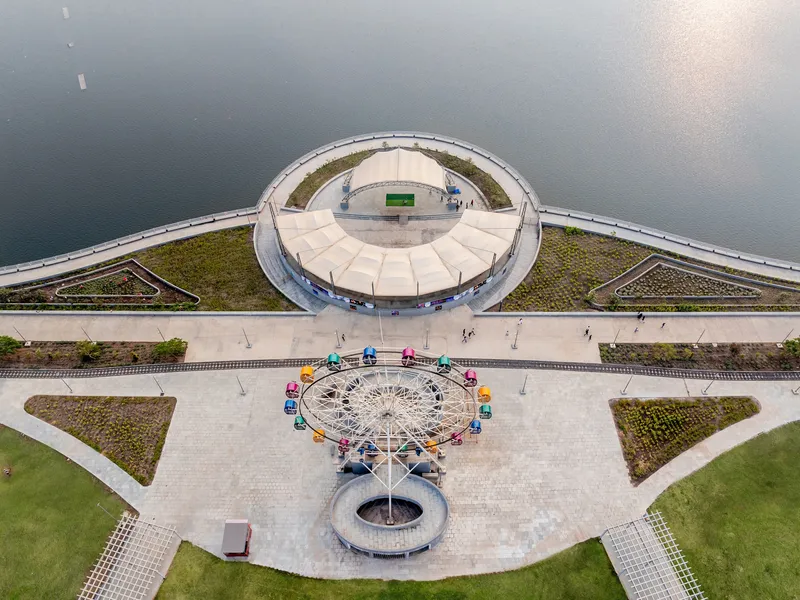
The aerial photographs reveal the project's formal logic immediately. The main waterbody is roughly circular, reinforced at its edges and deepened to hold stormwater. Around it, a thick band of curved parkland, paved promenades, and interlocking circular planting beds creates a layered buffer between road infrastructure and the lake itself. The geometry oscillates between organic naturalism and structured arcs, a design language INI describes as deliberate: separating noise-intensive zones like the rides area from quieter contemplative edges.
The concentric organization does more than look tidy from a drone. It channels pedestrian movement, controls runoff through permeable pavements, and positions bioretention cells at strategic intervals. The 0.90-square-kilometer catchment area drains into the lake through a network of these cells, meaning every planted bed and paved ring is doing double duty as filtration infrastructure.
The Waterfront Promenade as Civic Spine
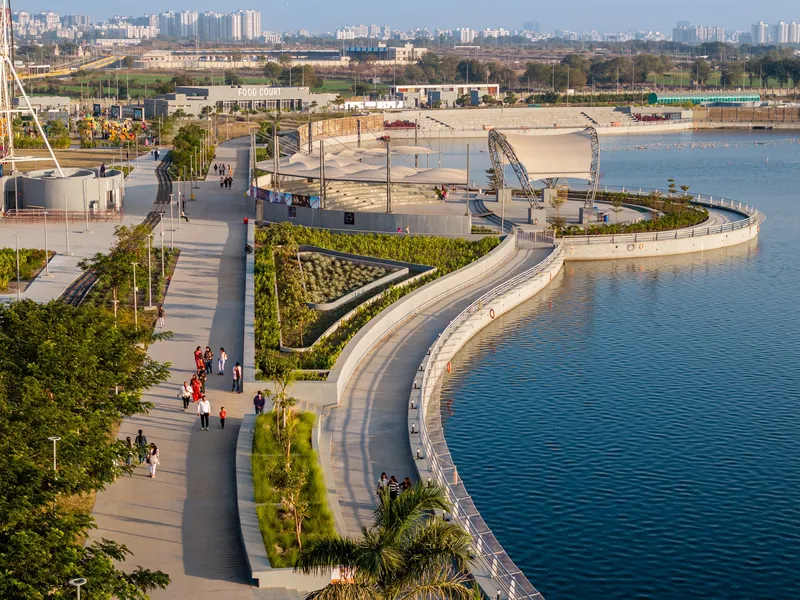
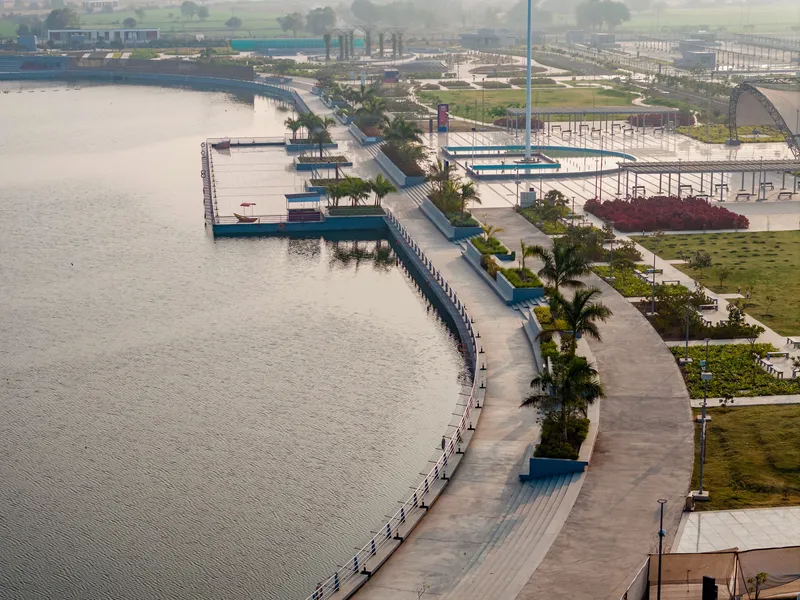
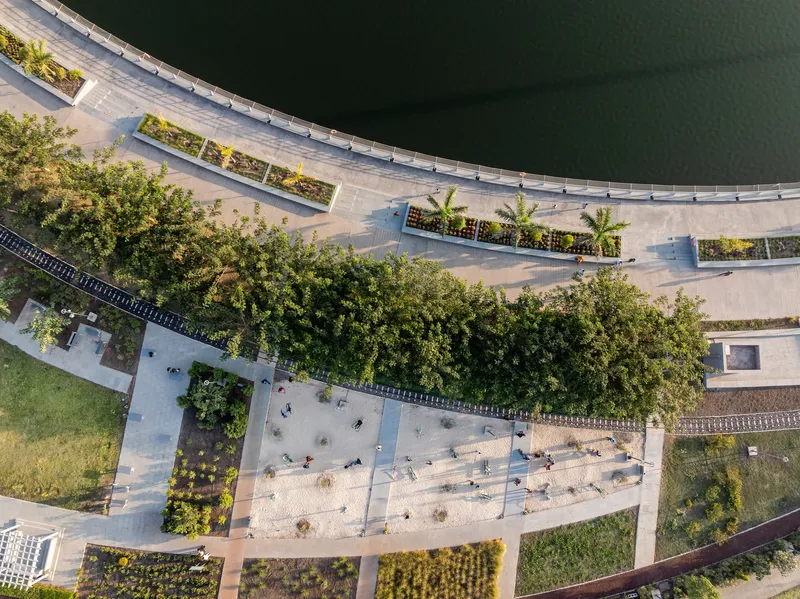
The curving waterfront promenade is the project's most legible public gesture. Lined with palms, ornamental grasses, and concrete planters, it wraps the lake in a continuous loop punctuated by pier structures that jut out over the water. The material palette is restrained: locally sourced stone, concrete retaining walls, metal railings. Nothing competes with the water itself for visual attention.
The images captured in afternoon and evening light show the promenade already heavily used, by schoolchildren, joggers, families. That immediate adoption is significant. Indian public landscapes of this scale often struggle with maintenance and footfall once the inauguration photos fade. Here the program variety, from jogging tracks to shaded seating to cultural nodes, appears to generate enough reasons to return.
Tensile Canopies and Thermal Comfort
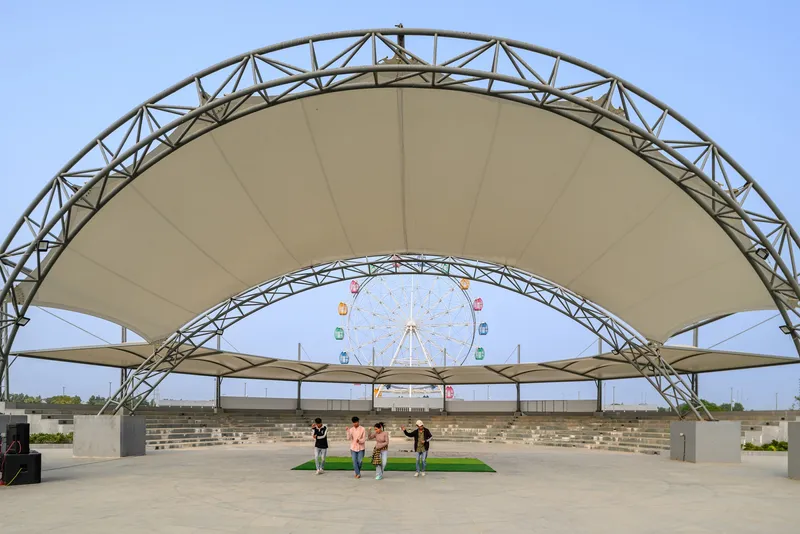
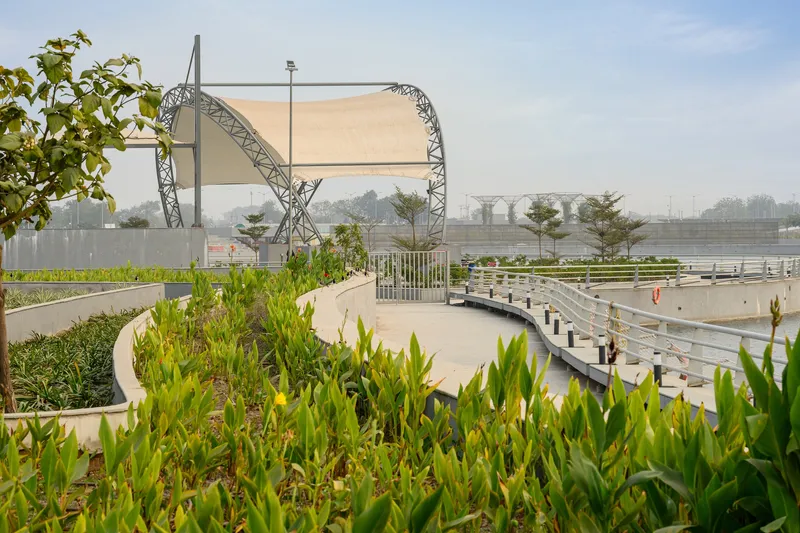
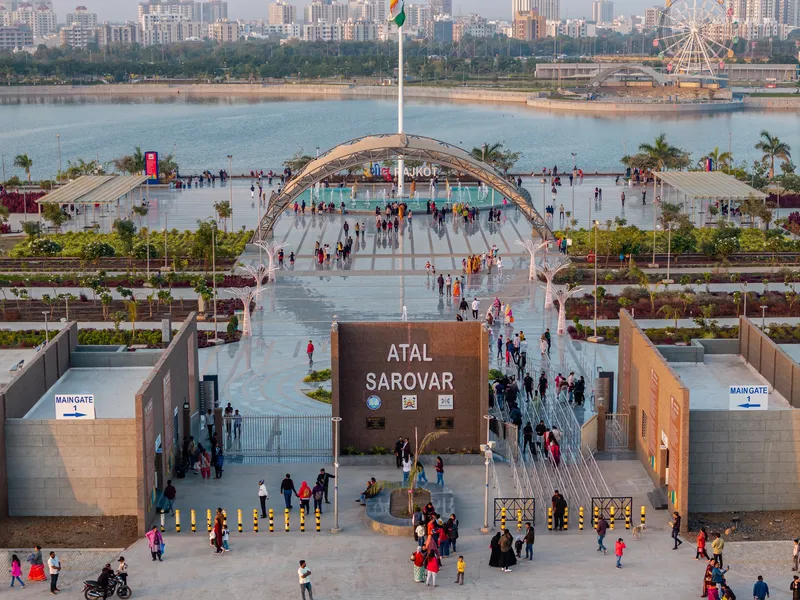
Rajkot's climate is punishing. Summer temperatures routinely exceed 40°C, and shade is not a luxury but a prerequisite for any outdoor space that hopes to function year-round. INI's response is a series of lightweight tensile fabric canopies supported by exposed steel trusses, spanning large areas without heavy columns that would clutter the ground plane. The arched canopy visible along the central axis and at the entry plaza creates a gateway gesture that is simultaneously structural and experiential.
The curved lattice canopy along the waterfront walkway is a more delicate variant, filtering light while sheltering planted beds of palms and grasses. These structures were engineered, fabricated, and installed as end-to-end tensile solutions, and they read as the most architecturally resolved elements in the project. They also demonstrate that climate-responsive design in Indian public space does not have to default to trees alone.
Central Plaza and Fountain Geometry
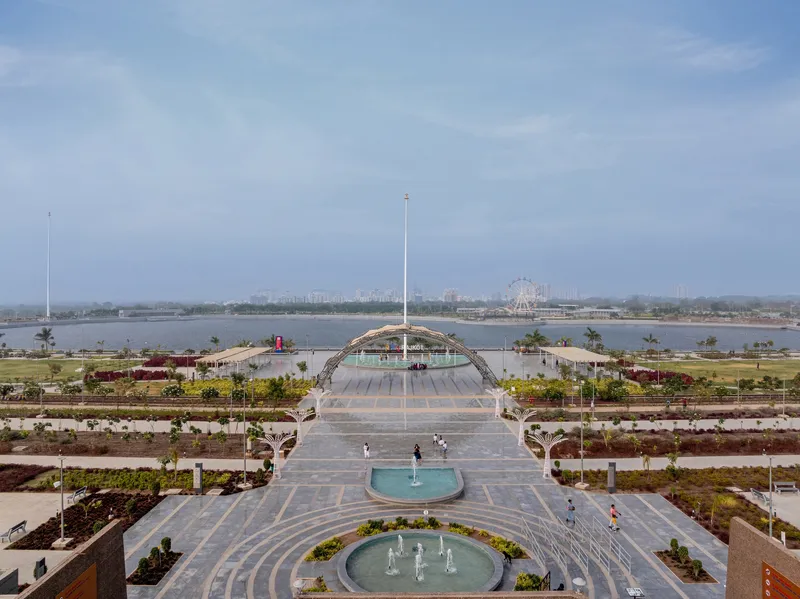
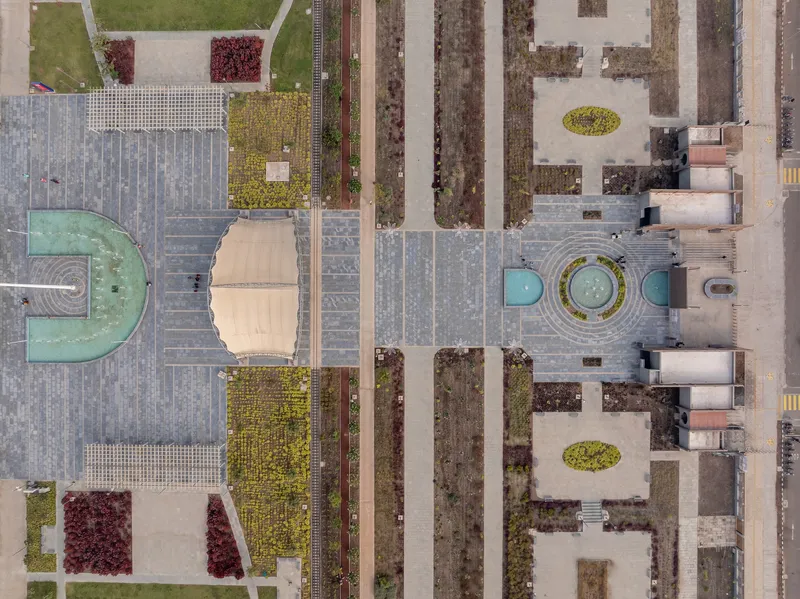
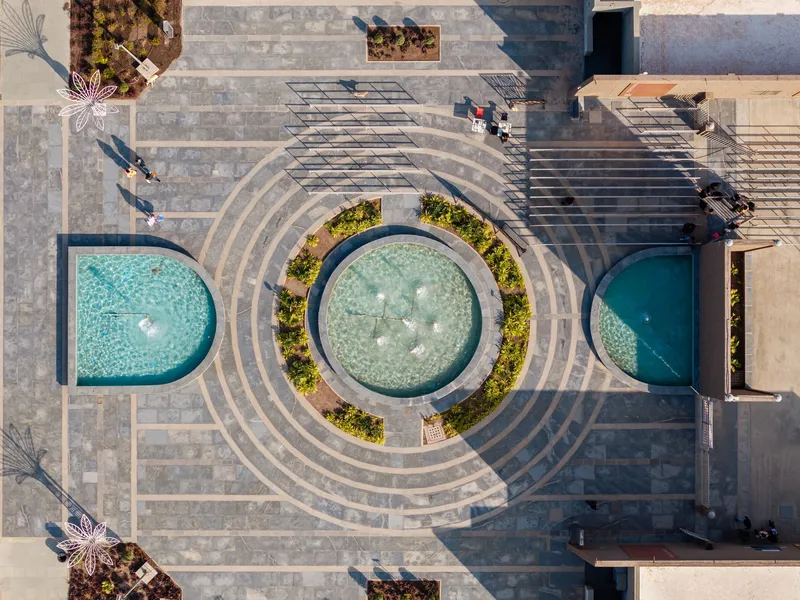
The central plaza operates as the formal heart of Atal Sarovar, organized around a circular fountain ringed by concentric paving bands. Semicircular water features flank the main axis, and the arched canopy structure terminates the vista. The geometry here is more assertive than elsewhere in the project, closer to civic monumentality than landscape naturalism.
Whether you find this register successful depends on your tolerance for spectacle in public space. The U-shaped fountain, the symmetrical planted beds, the radial paving pattern: these are legible, formal, and unapologetically designed for social media as much as for strolling. In a context where public gathering spaces are scarce, though, this kind of clarity works. People know where to sit, where to photograph, where to meet.
The Amphitheater and Leisure Edges
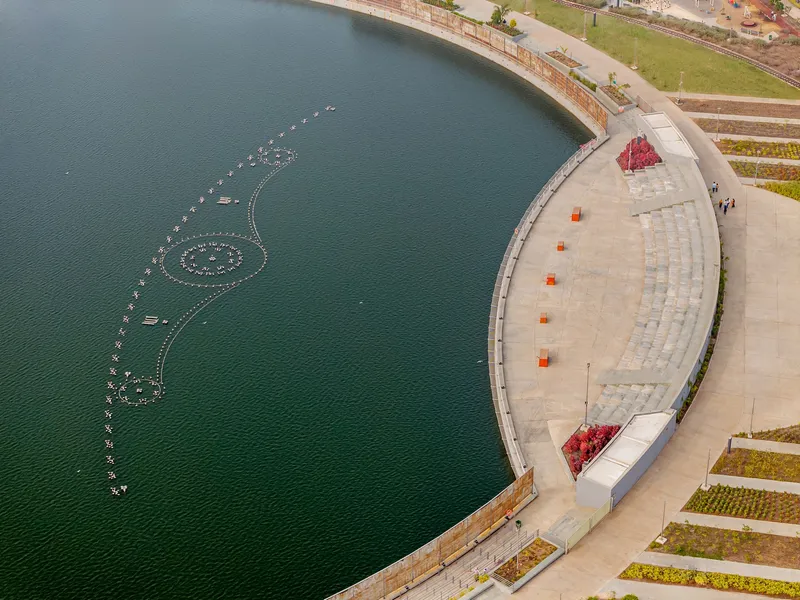
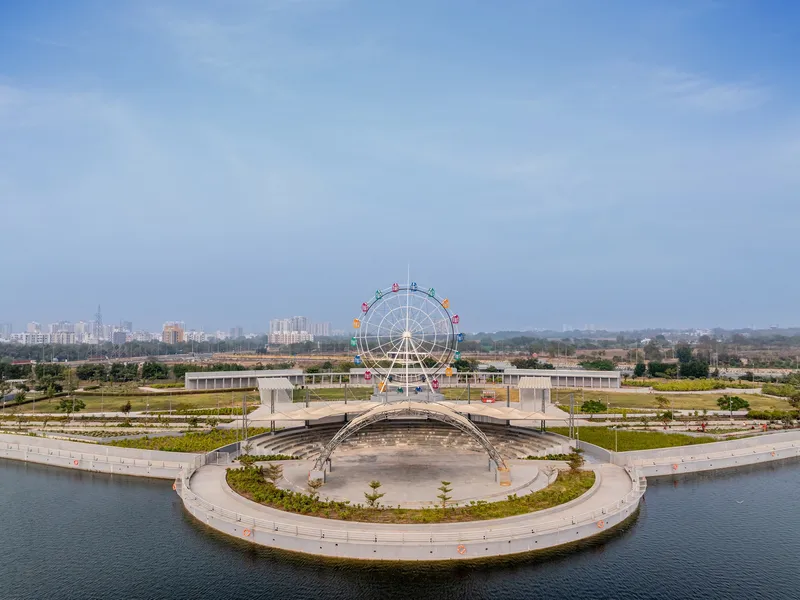
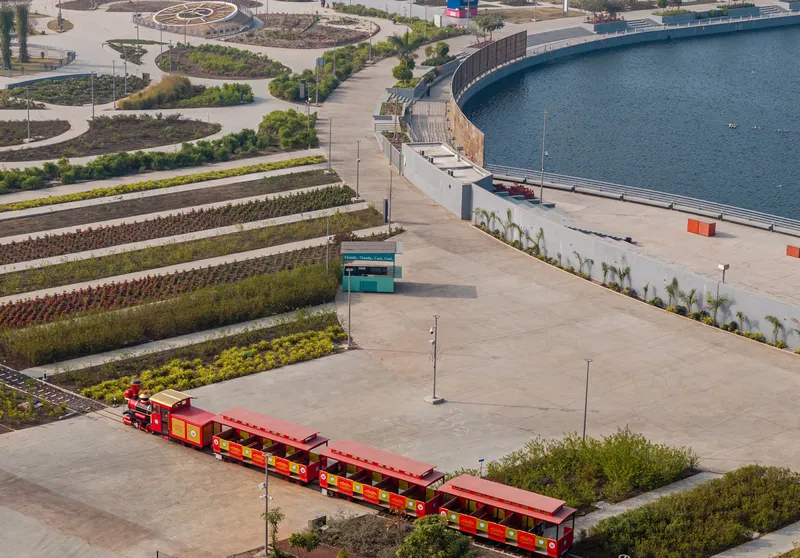
The curved amphitheater seating steps directly down to the water's edge, with a floating light installation hovering over the lake surface. It is one of the project's most evocative spatial moments: the hard geometry of stone terracing meeting the soft horizontal plane of water. Nearby, a ferris wheel and miniature tourist train signal the entertainment zone, a deliberate programmatic decision to separate carnival energy from the quieter contemplative stretches.
This zoning strategy is quietly smart. Rather than scattering attractions uniformly and diluting everything, INI clusters the noise-intensive uses on one edge and lets the rest of the lake perimeter breathe. The red tourist train on the paved plaza, visible in several shots, introduces a playful circulation element that connects zones without requiring cars.
Ground-Level Encounters
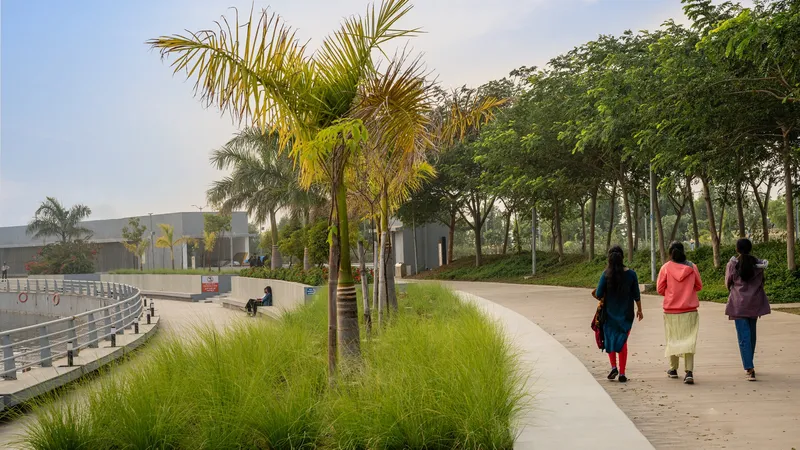
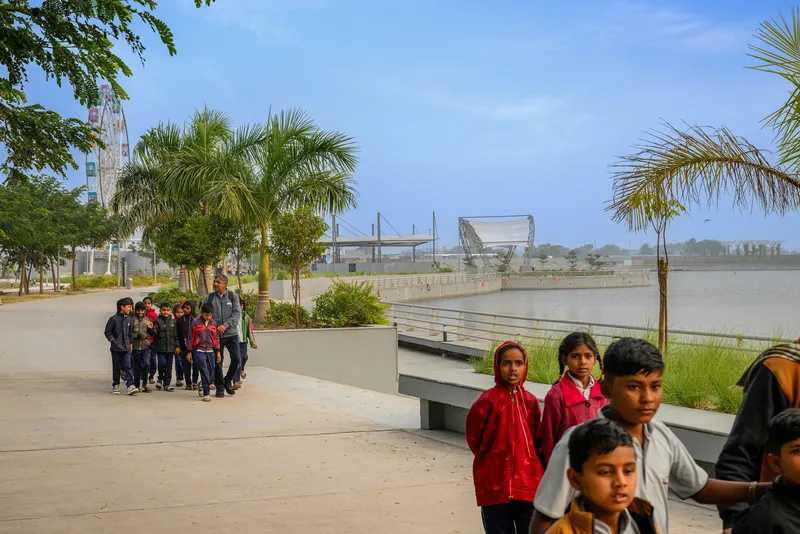
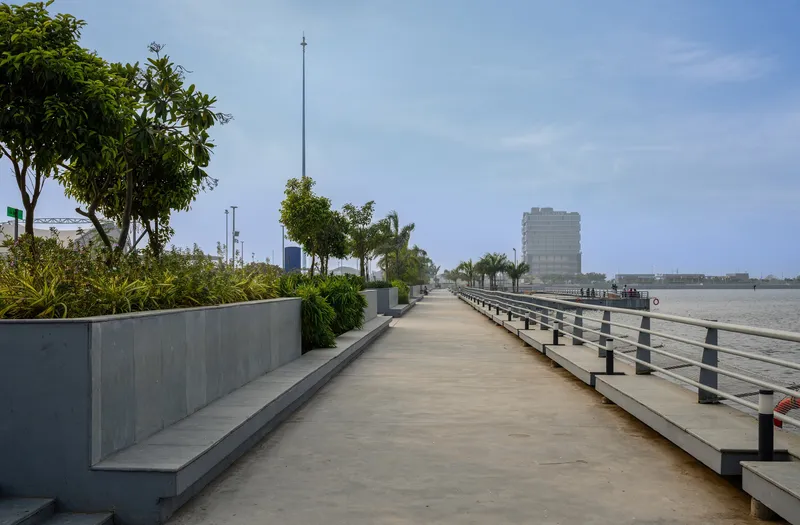
At eye level the project reveals its material discipline. Concrete retaining walls, stabilized earth embankments, and permeable paving underfoot define a tactile environment that feels durable rather than decorative. The planting, native species selected to restore biodiversity, softens the hardscape without overwhelming it. Ornamental grasses and palms line the pedestrian paths, providing scale and rhythm.
The photographs of schoolchildren walking past the retaining walls and visitors strolling at dusk are the most telling. They confirm that the space has already been claimed by the city. The non-motorized blue-green infrastructure network INI envisioned is not theoretical; it is generating daily foot traffic, urban cooling, and, critically, a sense of ownership.
After Dark

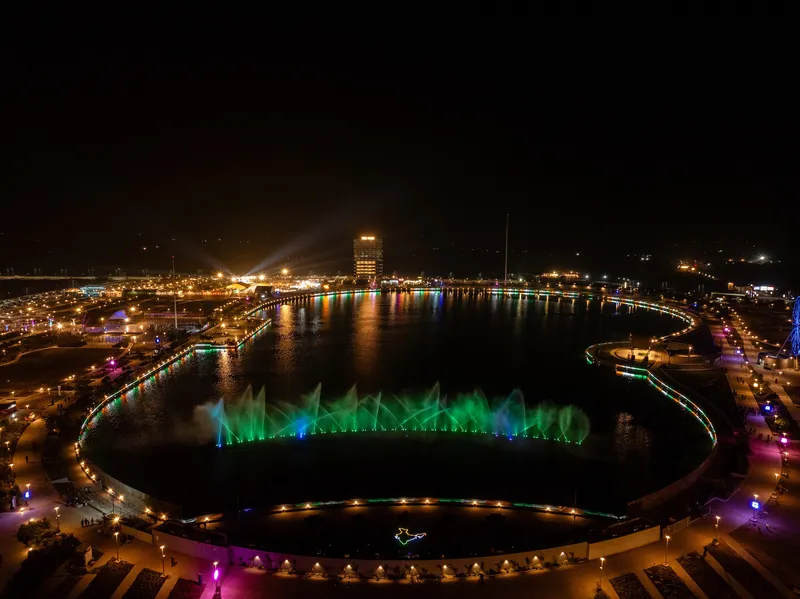
The nighttime images transform the project. Green-lit fountain jets arc across the lake surface, the illuminated promenade traces a glowing ring around the water, and the ferris wheel becomes a lantern against the twilight sky. Lighting design in Indian public spaces is often an afterthought or, worse, a garish overlay. Here the illumination is calibrated to extend the usable hours of the park while reinforcing the circular geometry that organizes everything by day.
The overhead view of the circular pavilion with its curved canopy and the lit ferris wheel is perhaps the project's signature image: infrastructure made festive. It captures the essential ambition of Atal Sarovar, which is to make stormwater management, groundwater recharge, and flood mitigation look and feel like celebration.
Terraced Entry and Arrival Sequence
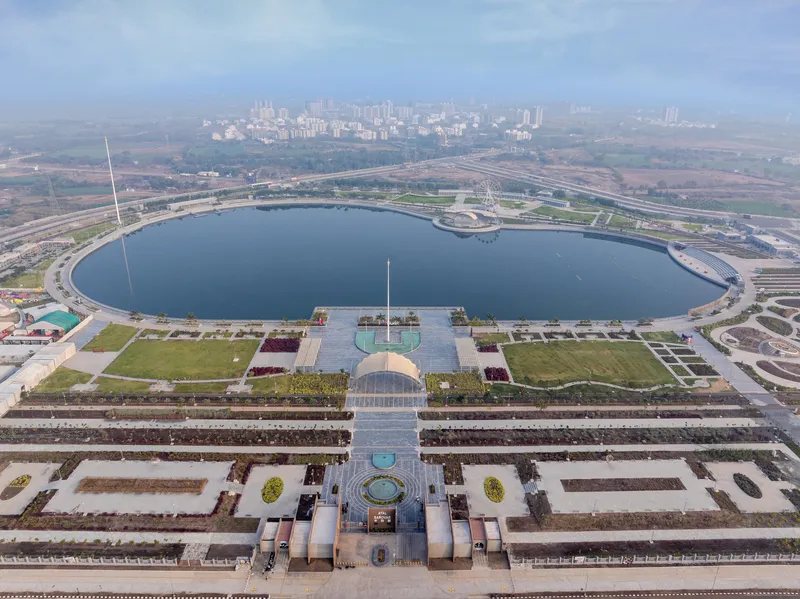
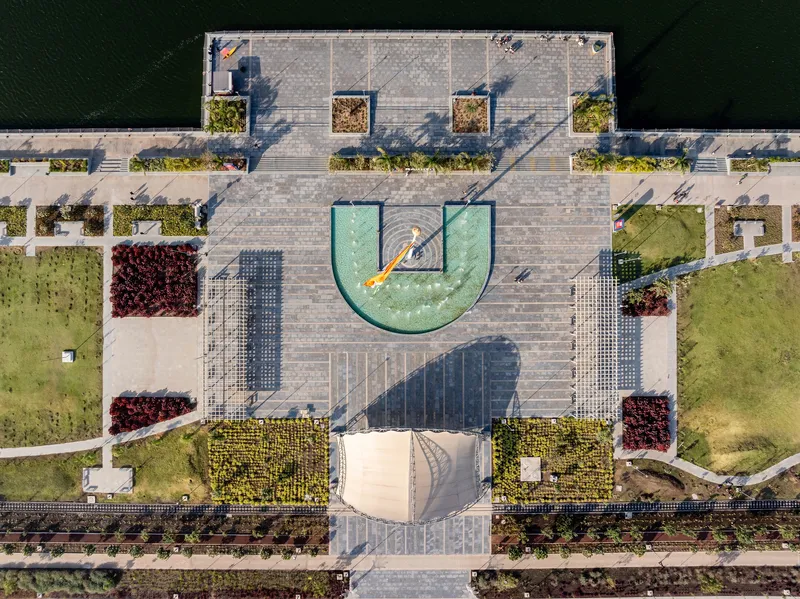
The terraced entry plaza steps down toward the circular waterbody in a sequence that gradually reveals the lake. It is a classic landscape architecture move, controlling the line of sight so that the full expanse of water arrives as a spatial release rather than an immediate given. Planted beds and a U-shaped fountain mark intermediate moments, slowing the approach and giving visitors reasons to pause before reaching the promenade.
Why This Project Matters
India's Smart City Mission has produced no shortage of renderings, masterplans, and pilot projects. Most remain on paper or materialize as isolated tech overlays on existing urban fabric. Atal Sarovar is notable because it is built, operational, and tackling a genuinely systemic problem: urban water management in a semi-arid city. The integration of bioretention cells, permeable pavements, stormwater filtration, and tertiary-treated water reuse into a public park that people actually want to visit is a design achievement that transcends the usual smart city rhetoric.
INI Design Studio's contribution here is not formal invention so much as disciplined synthesis. The tensile canopies, the zoned programming, the concentric geometry, none of these are unprecedented. What is uncommon is their assembly into a cohesive 75-acre landscape that performs hydrologically, socially, and aesthetically at once. For a country urbanizing at staggering speed and facing acute water stress, Atal Sarovar offers a replicable proof of concept: that water-sensitive urbanism can also be popular urbanism.
Atal Sarovar at Rajkot Smart City, designed by INI Design Studio. Located in Rajkot, Gujarat, India. 303,514 m². Completed 2024. Photography by Vinay Panjwani.
About the Studio
Share Your Own Work on uni.xyz
If projects like this are the kind of work you want to make, uni.xyz is a place to publish your own, find collaborators, and enter design competitions.


Popular Articles
Popular articles from the community


FCC Arquitectura Expands a Portuguese Granite House with a Board-Marked Concrete Wing
In Portugal, JV House pairs a cleaned-up whitewashed and granite dwelling with a timber-shuttered concrete extension, courtyards and a garden pool.

Cube Design Draws an Ecological Corridor Between Two Shenzhen Hills with the Nankai Building
Beside Shenzhen's container docks, the Nankai Building pairs stacked balconies with a climbing green screen to connect two hillsides across its height.


The Amber Palace Opera: A Geological Fiction Surfaces on Tallinn's Baltic Waterfront
Pierre Brillard reimagines a Baltic legend as a public landscape, opera house, and waterfront promenade rooted in Tallinn's coastal identity.

graciastudio Turns a Viewless Tijuana Lot Inward Around a Courtyard of Concrete, Timber and Trees
In Tijuana, Jorge Gracia's GA2 House stacks a timber-clad private floor over exposed concrete and replaces a missing view with a planted interior patio.

Similar Reads
You might also enjoy these articles

LAVA Architecten Gives Vocational Education a Sawtooth-Roofed Face on a Mechelen School Campus
In Mechelen, Belgium, a 2,053 m² STEM school on a 6×6 m grid turns workshops and classrooms into rooms that can be rearranged as teaching changes.

KEMA Studio Turns a Derelict Marvila Attic into a 60 m² Lighthouse Apartment Above Lisbon
In Lisbon's Marvila district, a rebuilt roof, four skylights and two plywood volumes turn an unlivable attic into a bright home facing the Tagus.

Pixel Gardens: One Repeated Module Stacked Into a Terraced Social Housing Tower for Famagusta
Salem Bader's shortlisted housing tower builds a vertical neighbourhood from one repeated module, offsetting units to carve terraces, light and air.

Bao Huynh Watercolor Atelier: A Serene Art Retreat in Hội An
Bao Huynh Watercolor Atelier in Hội An blends multifunctional art spaces, sustainable design, local materials, and family-friendly living in a serene environment.

Explore Smart City Competitions
Discover active competitions in this discipline

Challenge to design a portable theatre

Challenge to design a portable music platform

Challenge to design an open learning module for the elderly
Comments (0)
Please login or sign up to add comments
No comments yet. Be the first to comment!