

Rubik's Cube Home: Plugin Housing Assembled from Independent Modules Around a Central Axis
A shortlisted plugin housing entry treats each home as an independent module, combined freely around a central axis like the pieces of a Rubik's Cube.


A Rubik's Cube is a set of independent pieces held together by a core. The puzzle is never really solved, only reconfigured. Rubik's Cube Home borrows that logic for urban housing. Each residential unit is a self-contained module, and the modules gather around a central axis to form a larger structure. Because the parts can be disassembled and reassembled, the building does not have to stay in one final configuration. It can change as its residents' needs change.
Designed by He Linna and Zhiyang Zheng, the project was shortlisted in the Plugin Housing Challenge 2020. The competition asks entrants to rethink dense housing through prefabricated, pluggable units. The designers answer with a system in which different housing types can be combined freely, and their stated aims are adaptability, efficient land use, scalability and shared community space.
A Tower of Offset Boxes Framed in Yellow
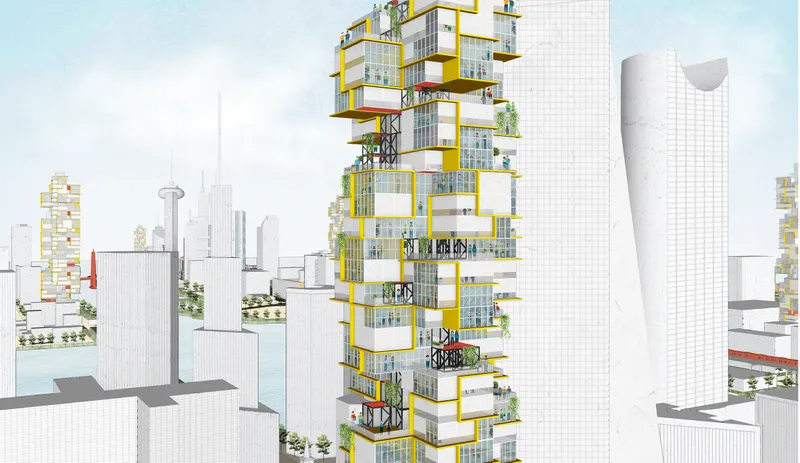
The opening render places the scheme in a city of white blocks beside a river. Against that backdrop the tower reads as a stack of shifted boxes, each outlined by a yellow frame, with plants hanging from the gaps. The offsets are the important move. Instead of extruding a uniform slab, the designers let each module show at the facade, so the building's construction logic is visible from the street.
This legibility supports the core claim of the project. If units can be added, removed or swapped, the elevation should be able to absorb those changes without looking broken. A staggered profile does that. A missing or extra box looks like part of the composition, not a gap in it, and the voids left between modules become room for planting and outdoor edges.
Clustered Blocks and a Shared Ground
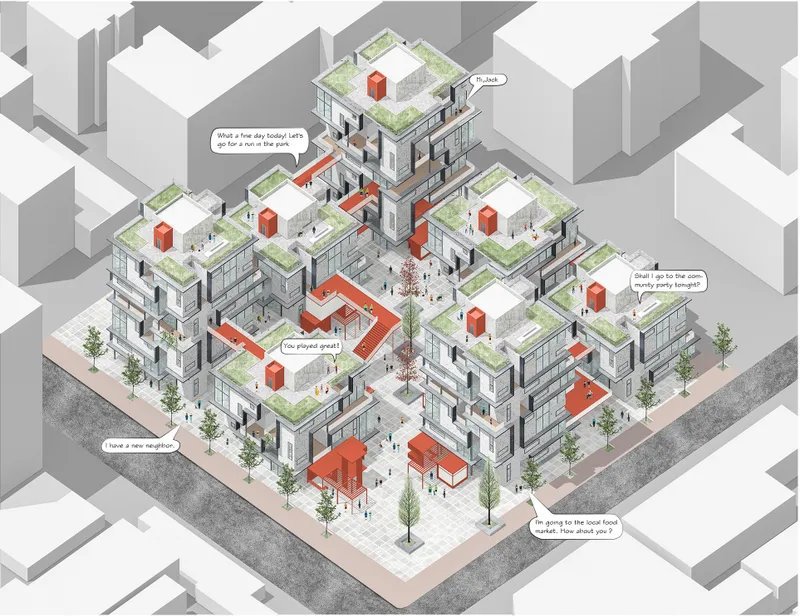
The isometric view pulls back to show the scheme as a cluster of mid-rise blocks rather than a single object. Green roofs cap the volumes, red stairs climb the outside, and a tree-lined paved courtyard sits between them. Speech bubbles from residents point to the community focus the designers describe: the modules are private, but the ground they share is collective.
This is where the land-use argument comes through. Stacking units around a central axis keeps the footprint compact, which frees space at grade for a courtyard. The red circulation is a smart detail. Placing stairs on the exterior keeps the module interiors clear, and it gives the rotating, plug-in logic a fixed armature that residents can read and navigate.
Red Bridges Over the Courtyard
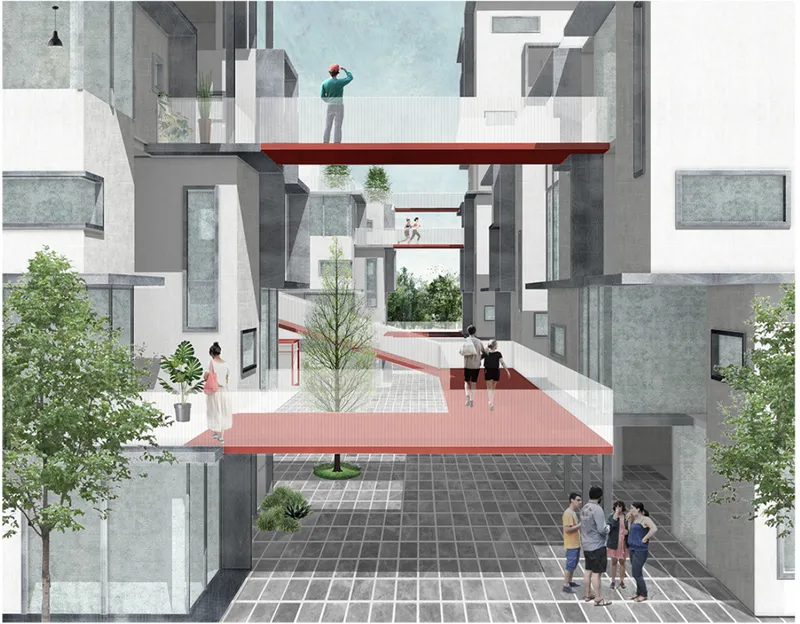
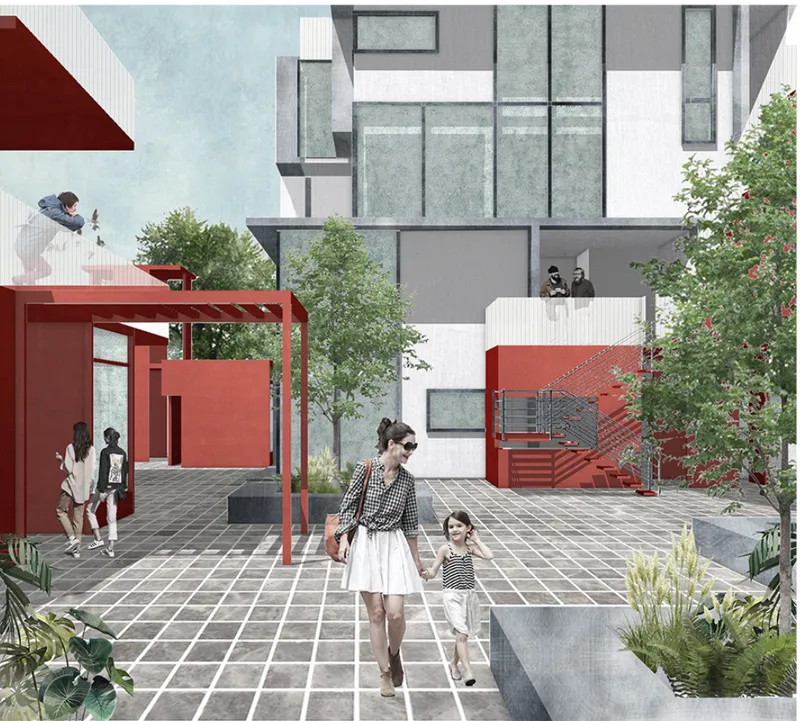
The collages bring the shared spaces down to human scale. Red bridge walkways cross above a tiled courtyard, couples stroll below, and a man looks down from an upper level. In the second view, a red pergola and stair frame planters, and a woman walks with a child beneath leafy trees. The palette is consistent: red marks the shared structure that ties the modules together, while the courtyard stays green and calm.
These images do more persuasive work than the diagrams. Modular housing often fails at the in-between, leaving corridors and leftover gaps that belong to no one. Here the bridges and pergolas turn movement into a social event. Crossing from one block to another becomes a chance to see neighbours and be seen, which gives the phrase "community-centric" a spatial meaning.
Gridded Windows and Rooms That Change Use
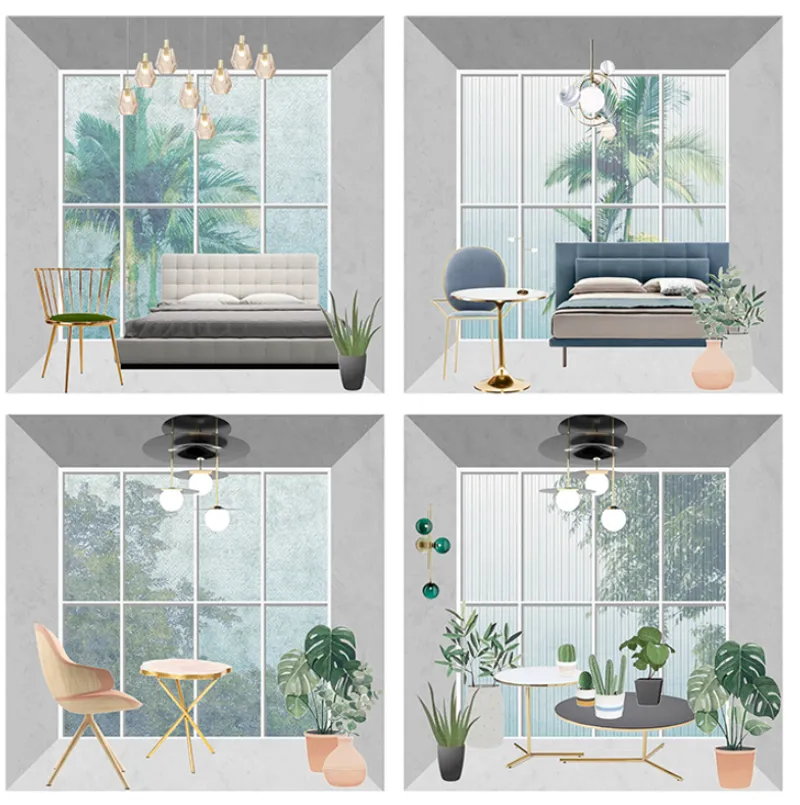
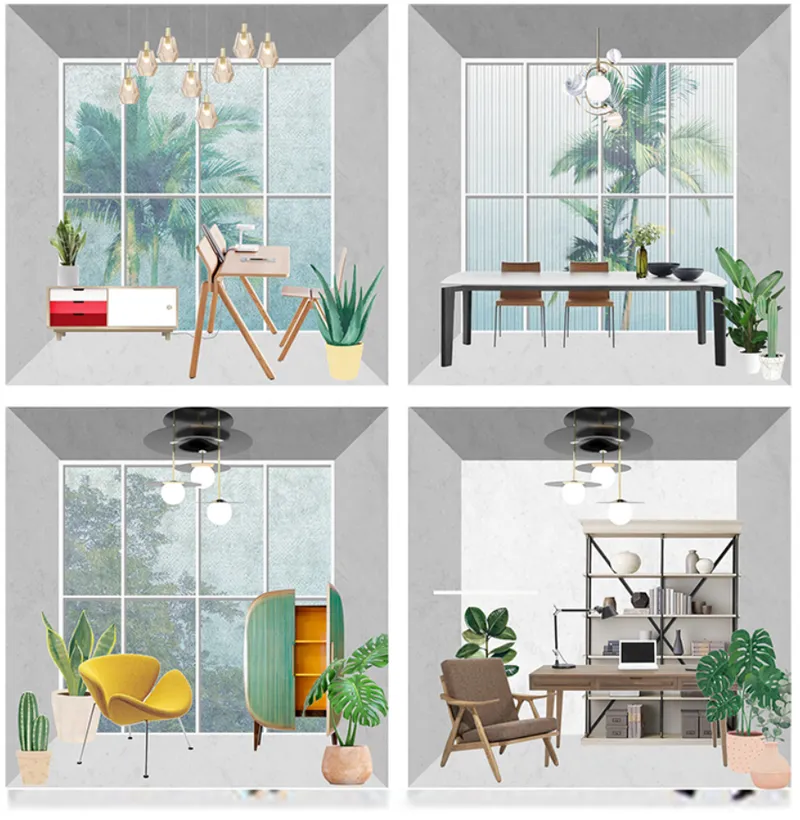
Eight interior collages show what a module can hold. In the first set, bedrooms and sitting rooms open onto large gridded windows with palm views, pendant lamps and potted plants. In the second set, the same framed outlook backs a study, a dining table, a lounge chair and a bookshelf desk. The window grid stays constant while the programme behind it shifts.
That constancy is the point. A standardised module needs a standard opening, and the gridded glazing does that job while still letting each room feel generous and planted. Showing one shell furnished in many ways is the clearest way to illustrate the project's promise of adaptable living: the module is fixed, and the life inside it is not.
A Coral Spiral Stitching Two Levels Together
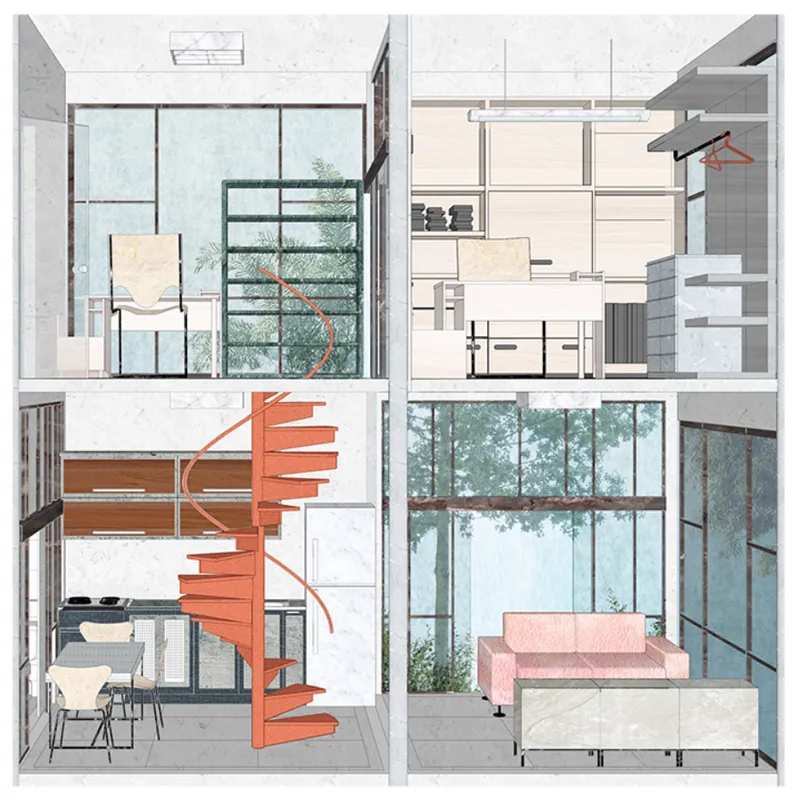
The coloured section is the most revealing drawing in the set. It shows a two-level interior in which a coral spiral staircase links a kitchen and dining area to an upper study, with a pink sofa below and trees beyond. It shows that units can be stacked vertically to form larger homes, which is how the scheme expands from a single room to a household.
The spiral is a practical choice. It takes up little floor area, which matters when every module has fixed dimensions. It also reads as an object in the room rather than a piece of infrastructure. The warm colours carry the red of the exterior circulation into the home, connecting private and shared spaces through a single visual language.
Why This Project Matters
Plugin housing proposals often stop at the diagram: a frame, a box, an arrow showing the box sliding in. Rubik's Cube Home goes further and tests the idea at three scales: the city skyline, the shared courtyard and the furnished room. The central-axis organisation gives the system a fixed core, and the offset modules, exterior red circulation and constant window grid make that core work as architecture rather than only engineering.
The larger lesson concerns time. Most housing is designed for the household that moves in first. He Linna and Zhiyang Zheng design for the households that come after, letting units be added, removed or recombined as demand shifts. The images leave open questions about how that reconfiguration would be managed and built, but the premise is clear: a dense building can be treated as a puzzle that keeps being rearranged.
View the Full Project
About the Designers
Designers: He Linna, Zhiyang Zheng
Enter a Design Competition on uni.xyz
uni.xyz runs architecture and design competitions year-round that reward proposals with spatial conviction and real site intelligence.
Project credits: Rubik's Cube Home??plugin housing design. by He Linna, Zhiyang Zheng Plugin Housing Challenge 2020 (uni.xyz).


Popular Articles
Popular articles from the community

Manzana Morphosis: Stretching Barcelona's Grid into a Living Landscape for 2050
A radical reworking of the Eixample manzana turns density into a tool for generous public space, vertical ecology, and environmental performance.
Tsunami Convergenics: Turning Catastrophic Ocean Forces into Underwater Housing Infrastructure
A speculative underwater settlement off the coast of Onagawa, Japan, treats tsunamis and typhoons as energy sources rather than threats.

Singing Woman: An Opera House That Performs Before the Curtain Rises
Ovidiu Cristian Pavel's conceptual opera house translates Estonia's choral identity into a sculpted waterfront landmark facing the Baltic Sea.
Opera by the Sea Estonia: Three Shells Dissolving Architecture into Tallinn's Coastline
A winning opera house proposal replaces monumental form with interconnected shells that blur the boundary between building, park and Baltic Sea.

Similar Reads
You might also enjoy these articles

FAMM Arquitectura Organizes Ten Villas Around Courtyards and Jungle in Nosara, Costa Rica
El Molino pairs two elongated volumes with deep overhangs and timber louvers to build a compact coastal community five minutes from the beach.
Oscar Niemeyer's Ibirapuera Park Pavilions Define São Paulo's Cultural Identity in Concrete and Curve
A constellation of modernist volumes set within São Paulo's most important urban park, conceived for the city's 400th anniversary in 1954.
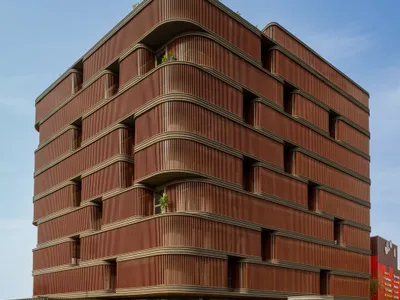
Sanjay Puri Architects Wraps a Jaipur Office Tower in Capsule-Shaped Green Buffers
A nine-level climate-responsive workplace near Jaipur Airport uses stacked planter terraces and aluminium screens to fight 40°C heat.
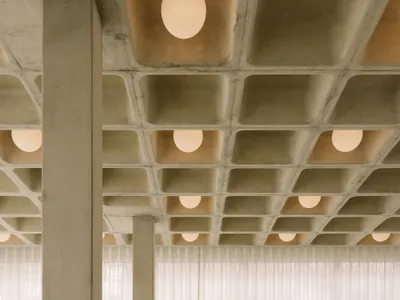
RHO Converts a Berlin Spree-Side Industrial Courtyard into Enkime's 1,000 m² Agency Headquarters
A social media agency's new home in Charlottenburg trades glossy branding for concrete waffle ceilings, glazed tile, and sheer curtains.

Comments (0)
Please login or sign up to add comments
No comments yet. Be the first to comment!