
JK-AR Resurrects East Asian Bracket Joinery as a Fractal Timber Canopy in South Korea
The Tree Series reimagines centuries-old dou-gong and gong-po wood joinery through algorithmic design and digital fabrication.


Somewhere between reverence and reinvention lies the most productive territory in architecture. JK-AR, led by Jae K. Kim, occupies that territory with the Tree Series, a sequence of temporary installations completed in 2022 that take the wooden bracket system of East Asian architecture, known as dou-gong in China and gong-po in Korea, and push it through algorithmic logic and digital fabrication until it blooms into something entirely new. The bracket system is not decoration; it is the structural DNA of traditional East Asian buildings, the element that connects roof, column, and beam into a single continuous load path. JK-AR treats that DNA not as a museum artifact but as living code, capable of mutation.
What makes these installations genuinely provocative is that they refuse the easy binary between tradition and technology. The joints still rely on friction rather than metal fasteners or bolts. Discrete wooden members still interlock through joinery. But the geometries they produce, fractal-like canopies radiating from single trunk columns, belong to a spatial imagination that traditional carpenters never had the computational tools to explore. The result is a series of structures that look like trees precisely because the underlying structural logic has always been arboreal: load splitting into branches, branches splitting into smaller branches, each fork a joint absorbing both tension and compression.
A Single Trunk, a Thousand Branches
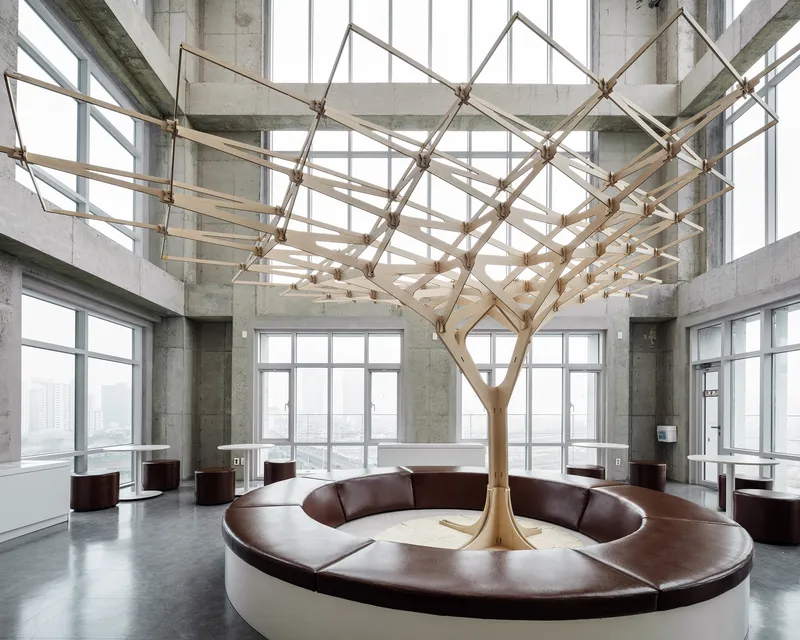
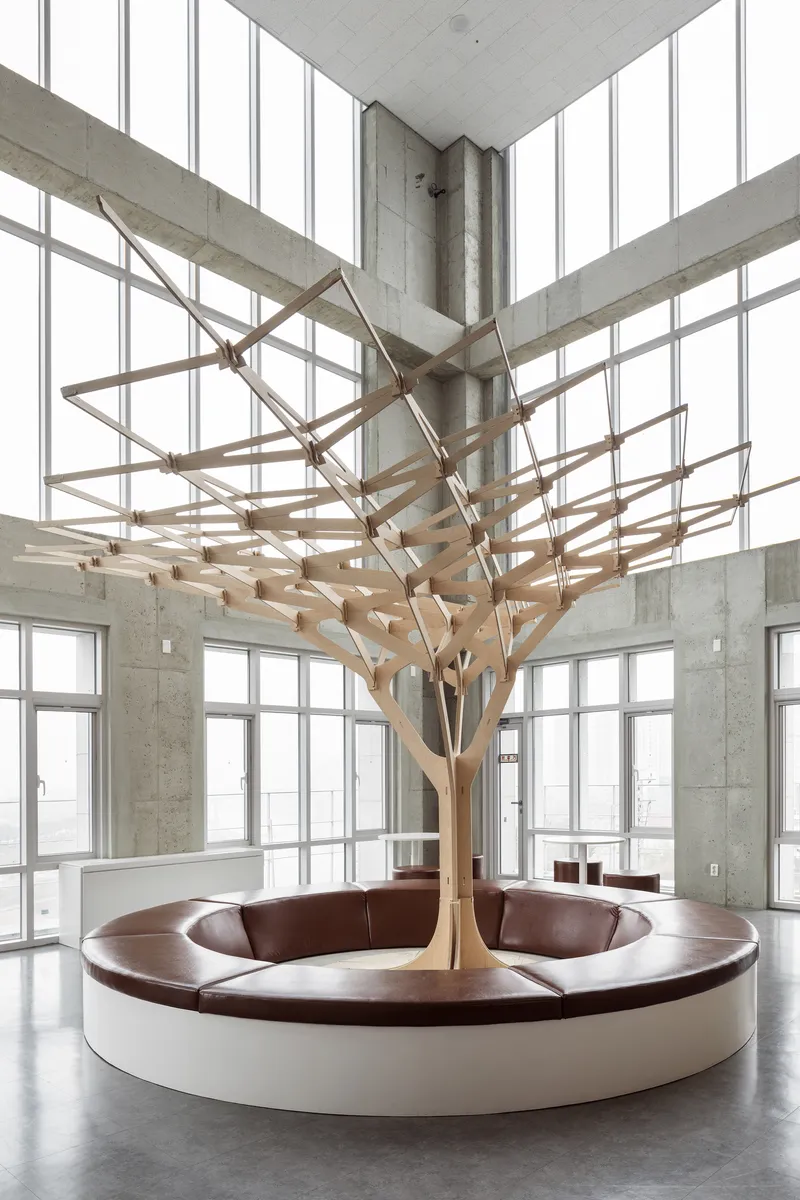
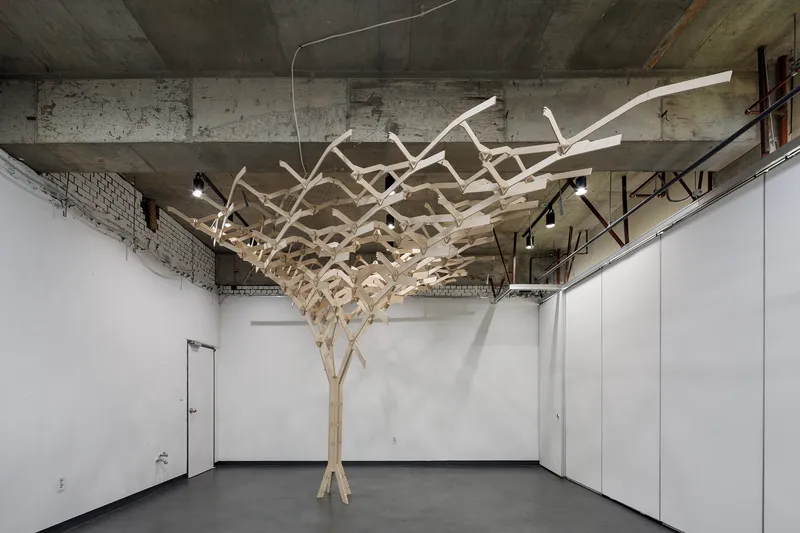
The installations share a fundamental formal logic: a single vertical element, a trunk, rises from the floor and proliferates into a radiating lattice canopy overhead. In one iteration, the structure sits inside a concrete-framed room with floor-to-ceiling windows, its branching timber lattice hovering above a circular bench. In another, it spreads beneath a folded concrete soffit, the geometry of the wood playing against the monolithic ceiling. A third version occupies a white-walled gallery, free-standing and sculptural, the canopy's edges dissolving into air.
Each context reveals a different character. Against concrete, the timber reads as warm, organic, almost subversive. In the white gallery, it reads as pure structure, an engineering proposition stripped of any atmospheric crutch. JK-AR understands that the same object changes meaning when its frame changes, and the series format exploits that awareness deliberately.
The Joint Is the Architecture
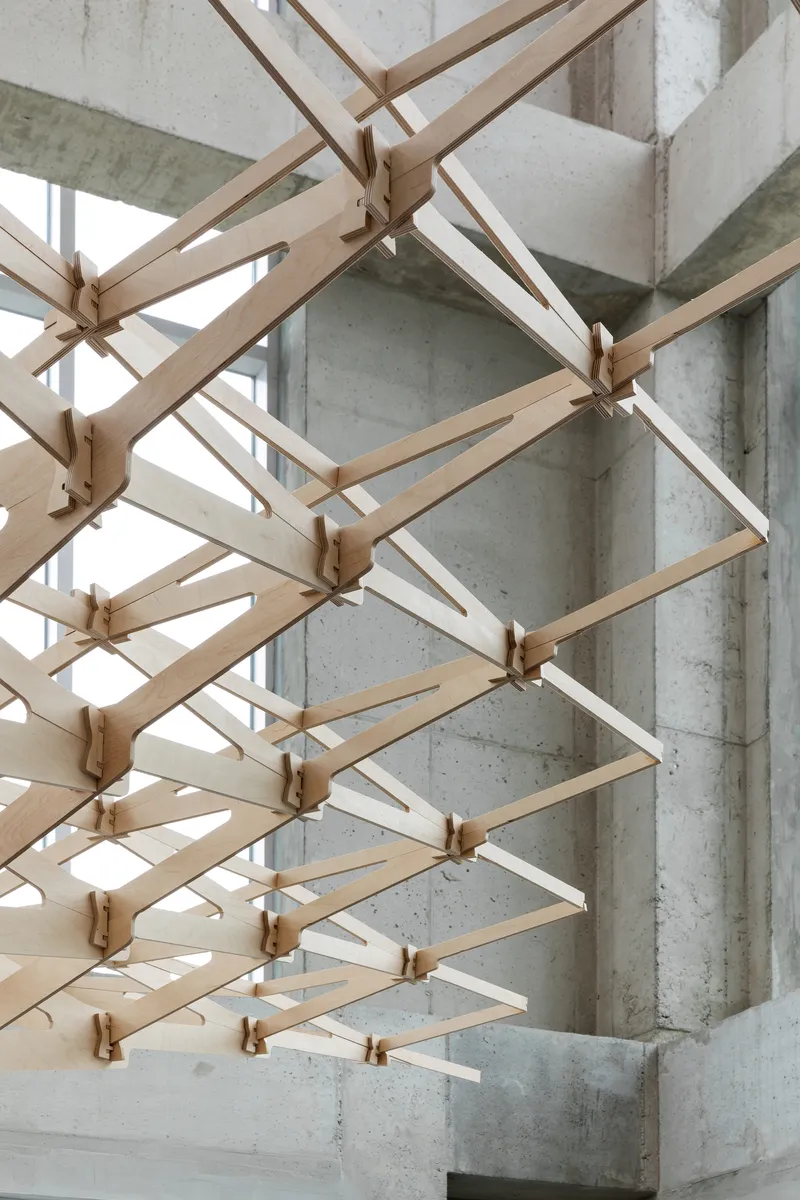
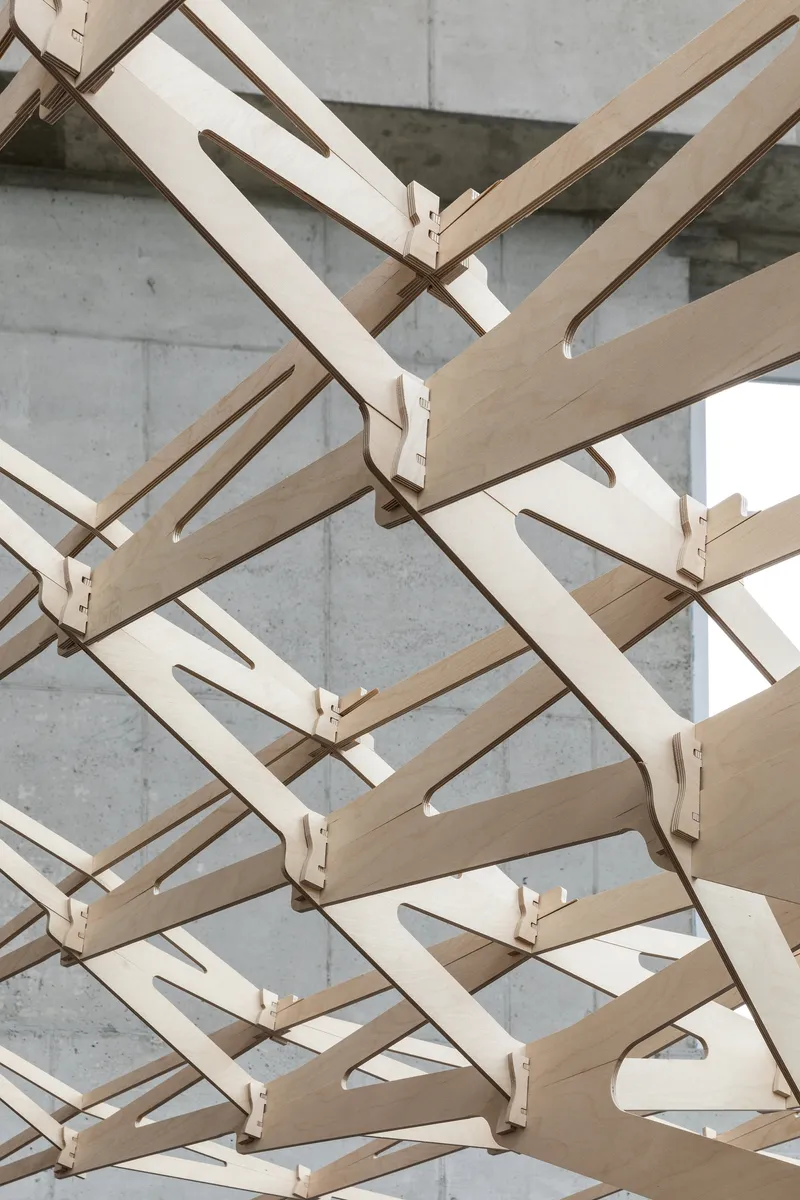

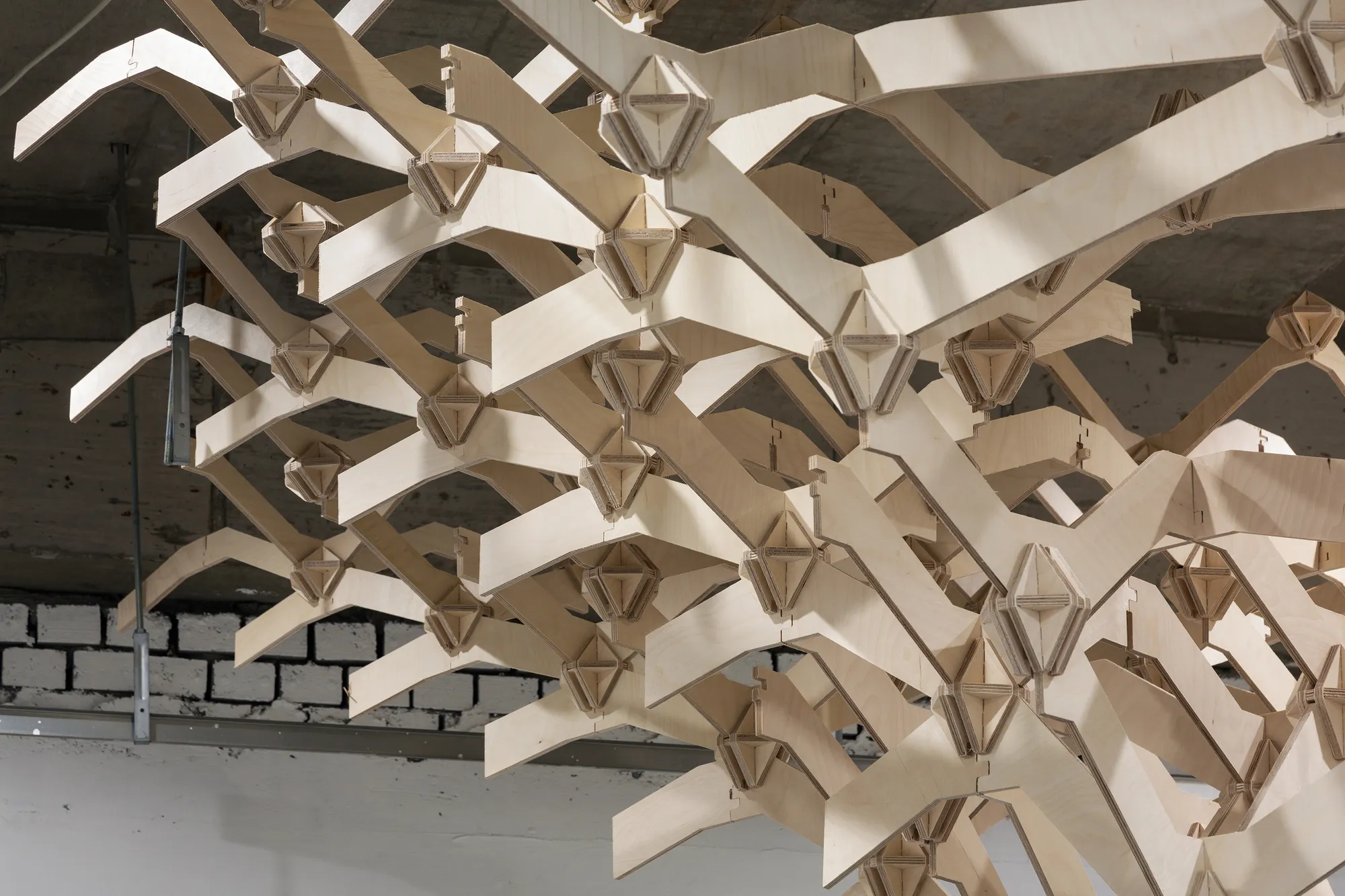
Zoom in and the installations reveal their real subject: the joint. Every connection is a puzzle, a three-dimensional interlocking of timber members through slotted, notched, and friction-fit joinery. No screws, no bolts, no adhesive. The structural integrity comes entirely from the geometry of the cut and the precision of the fit. This is where the project's debt to traditional bracket systems is most legible and most honest. The gong-po bracket works because each piece is shaped to receive force from the piece above and transmit it to the piece below; JK-AR's joints operate on the same principle, just in more directions at once.
The close-up details show interlocking diagonal members meeting at complex nodes, laminated curves slotting into rectilinear grids, and plywood panels notched to accept perpendicular partners. These are not decorative connections. They are doing real structural work, receiving both tensile and compressive forces along continuous load paths. The fact that they are also beautiful is a consequence of their logic, not an addition to it.
Canopy as Ecosystem
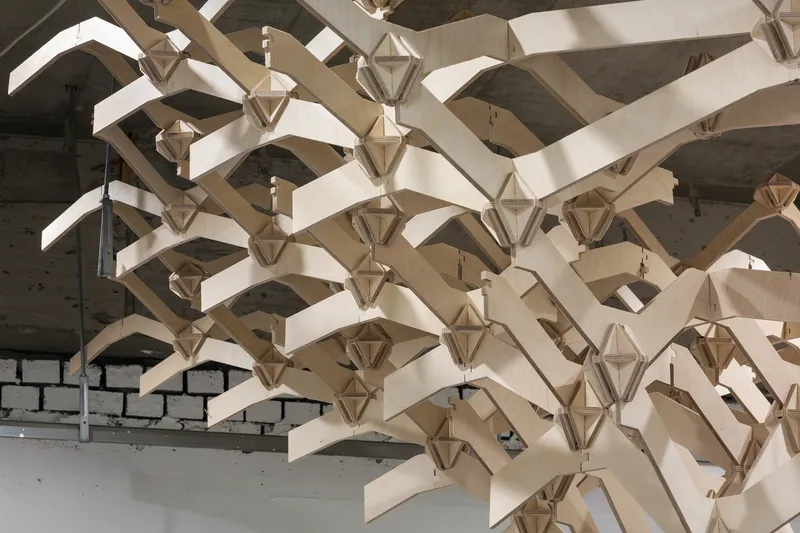
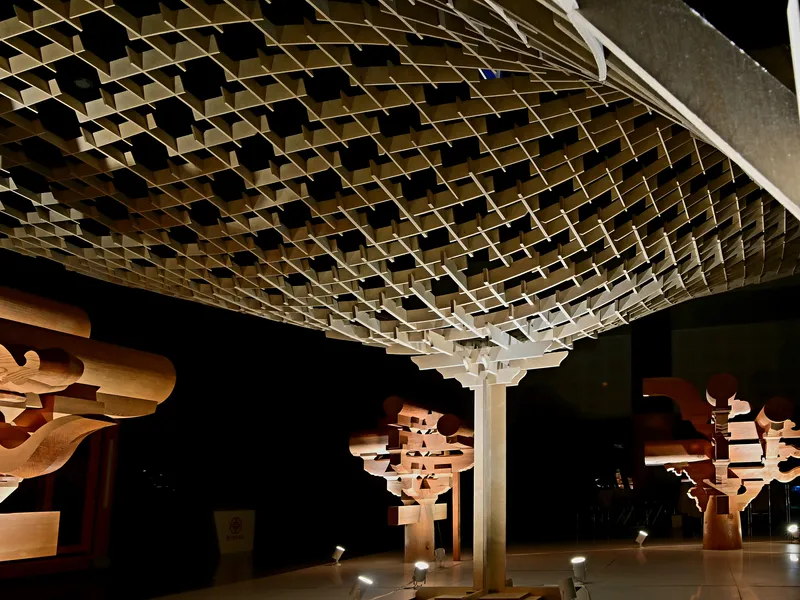
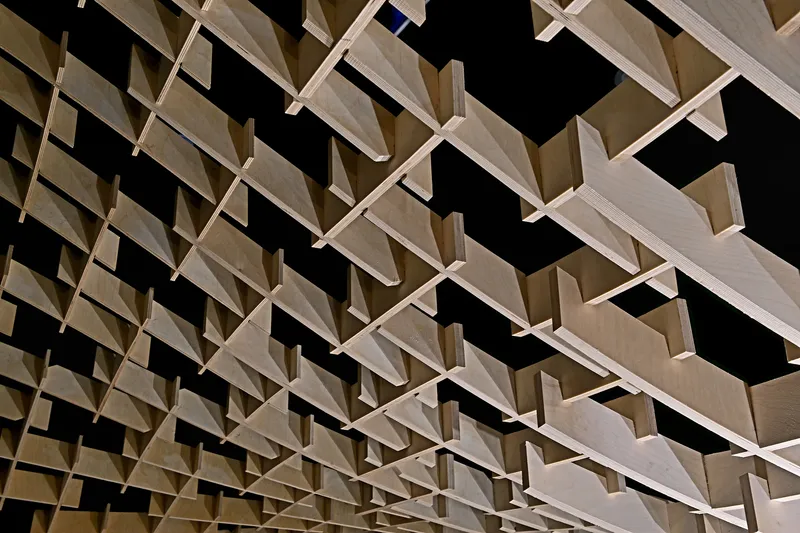
Seen from below, the canopies have the quality of forest cover: a dense, interwoven lattice that filters light and creates a sense of enclosure without walls. The polyhedral node connections and curved branch elements visible in the underside view recall the fractal geometry of actual tree crowns, where each fork follows roughly the same branching angle regardless of scale. JK-AR's algorithmic approach makes this self-similarity explicit, generating variations that proliferate outward from the trunk with mathematical regularity.
At night, the effect intensifies. One installation reads as an undulating timber surface suspended from a central column, its woven lattice casting complex shadows. The parametric grid visible against the darkness strips the work down to pure geometry, and the resemblance to a natural canopy becomes almost uncanny. There is a lesson here about why traditional bracket systems looked the way they did: they were solving the same problem as a tree, distributing load from a concentrated source into a broad horizontal plane, and the formal similarity was never coincidental.
Suspended and Grounded


Not every iteration in the series follows the same structural strategy. One version introduces cable supports that meet at the central trunk, acknowledging that the cantilever has limits and that tension elements can extend the canopy's reach without betraying the material logic. Another version inverts the direction entirely: a funnel-shaped timber form descends from a diagrid ceiling, the canopy reading as something between a stalactite and a root system. The willingness to invert, to let the tree grow downward, shows a designer who understands the principle well enough to play with it.
These variations are not arbitrary. They represent systematic exploration of how the same joinery logic and branching grammar perform under different gravitational and spatial constraints. The series is, in effect, a research program conducted in timber rather than in text.
Model Studies and Material Thinking

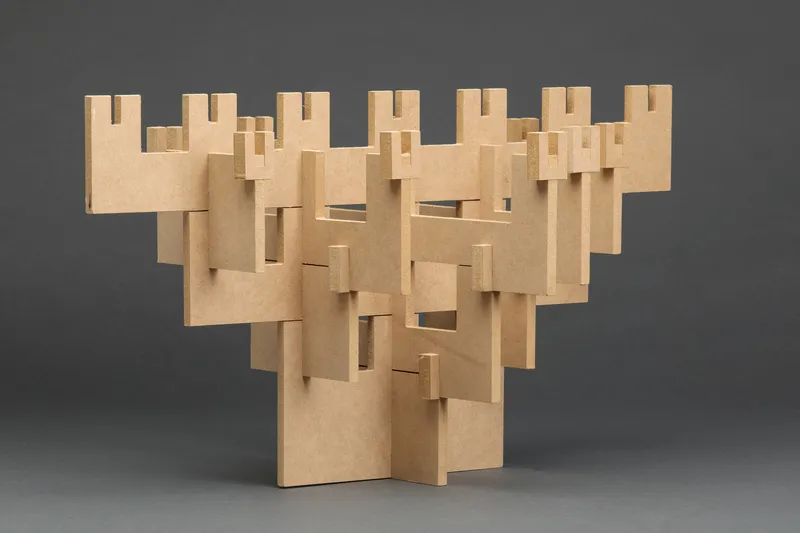
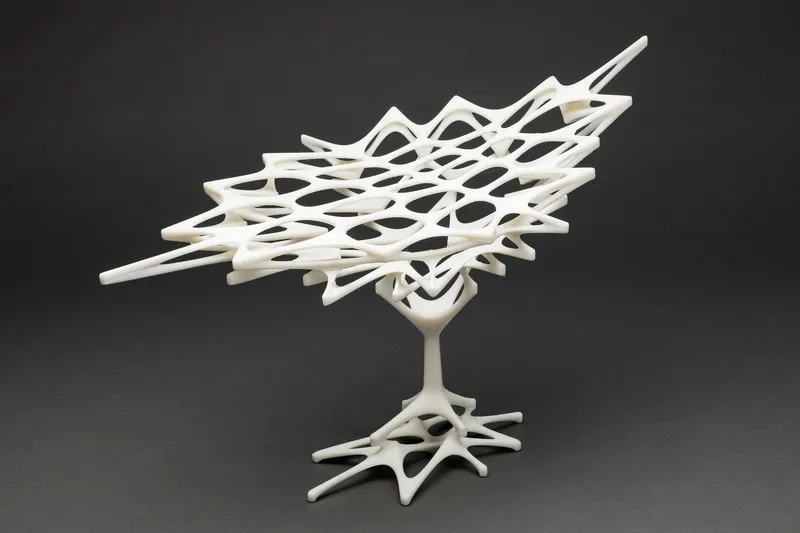
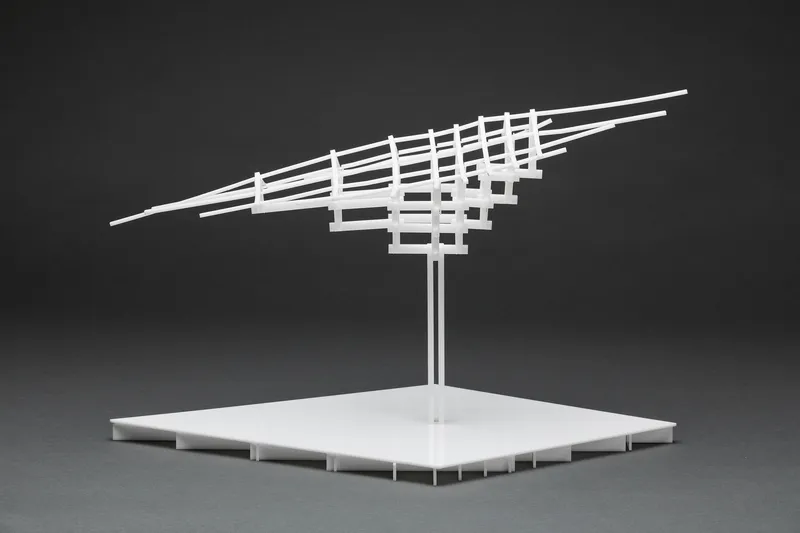
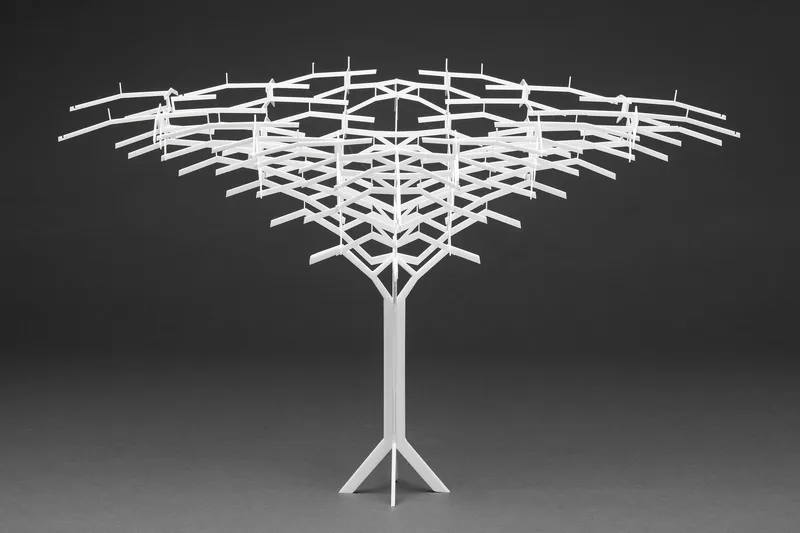
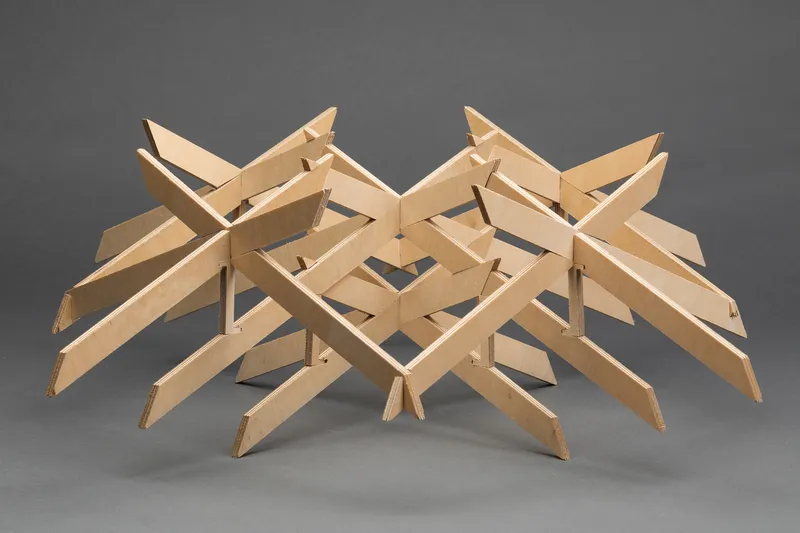
The physical models tell a story about process. Transparent acrylic reveals the branching logic in frozen clarity. Cardboard study models with notched apertures test spatial enclosure at small scale. White models isolate the organic roof morphology from material texture, letting form speak alone. Plywood prototypes at larger scale test actual joinery, proving that the interlocking connections work not just in digital space but in the grain and tolerance of real wood.
What these models collectively demonstrate is that JK-AR's design process is iterative and material. The algorithm proposes; the model tests; the next iteration adjusts. The joinery prototype showing four interlocking plywood panels meeting at a central notched connection is not a miniature of the final installation but an argument about how forces should meet. The latticed canopy model with intersecting beams radiating from a central column is a spatial hypothesis. The series format allows each hypothesis to become a built installation, turning the gallery into a laboratory.

Plans and Drawings

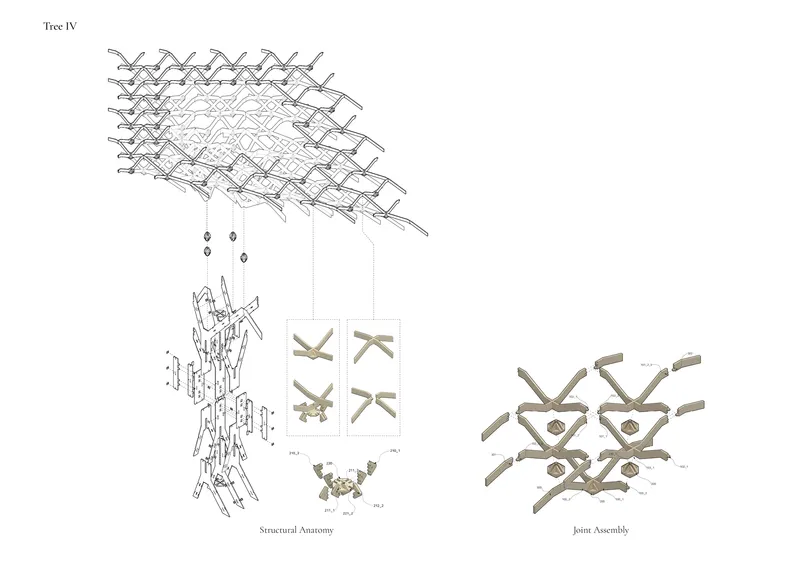

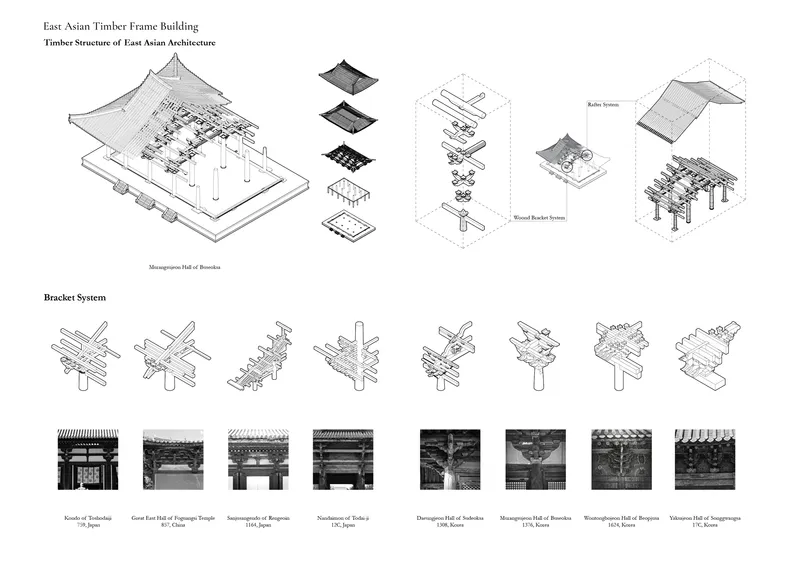
The axonometric drawings are where the intellectual ambition of the project becomes most legible. One drawing dissects the structural anatomy of a shell roof, pulling apart the timber joinery details to show how each member contributes to the whole. An exploded axonometric illustrates the layered assembly of a branching canopy, revealing the sequence of construction: which piece goes in first, which locks the others in place. A comparative sheet presents eight variations of tree-inspired timber structures in isometric, cataloguing the formal range that one joinery system can produce.
Most revealing is the drawing that documents traditional East Asian bracket systems alongside JK-AR's contemporary interpretations. Placed side by side, the ancestral dou-gong and the algorithmic offspring share clear structural DNA: the same logic of stacking, cantilevering, and load-splitting, translated through centuries and through computational tools. The drawing makes the lineage explicit without sentimentalizing it. Tradition here is not a style to be quoted but a structural intelligence to be extended.
Why This Project Matters
The Tree Series matters because it demonstrates that heritage and innovation are not opposing forces but mutually accelerating ones. The gong-po bracket system survived for centuries because it was structurally brilliant, not because it was culturally protected. By extracting the structural principle, freeing it from the specific proportions and hierarchies of traditional temple construction, and redeploying it through algorithmic variation and digital fabrication, JK-AR proves that the system still has unrealized potential. The friction-fit joint, the boltless connection, the continuous load path: these are not anachronisms. They are strategies that contemporary timber construction, with its renewed interest in mass timber and low-carbon building, desperately needs.
What sets this work apart from the many projects that invoke "tradition" as a vague gesture is its specificity. JK-AR does not borrow the look of East Asian architecture. It borrows the logic, and then it runs that logic through a process rigorous enough to produce genuinely new forms. The tree metaphor is not a conceit layered on after the fact; it emerges from the structural behavior of the bracket system itself. That convergence between metaphor and mechanics is rare, and it is why these temporary installations carry a weight that outlasts their physical presence.
Tree Series Installation by JK-AR (Jae K. Kim), South Korea, 2022. Photography by Rohspace.
About the Studio
Share Your Own Work on uni.xyz
If projects like this are the kind of work you want to make, uni.xyz is a place to publish your own, find collaborators, and enter design competitions.



Popular Articles
Popular articles from the community

How Henri Picq's 1889 Paris Pavilion Traveled 11,000 Kilometers to Become Santiago's Artequín Museum
A prefabricated iron and glass pavilion built for the Paris Universal Exposition found a second life as a children's art museum in Chile.

A Reinforced Cocoon: Vernacular Architecture for Security, Healing and Community in Qandahar
A Reinforced Cocoon reimagines Afghan vernacular architecture as secure community space for widowed women, families, healing and resilience.
FAMM Arquitectura Organizes Ten Villas Around Courtyards and Jungle in Nosara, Costa Rica
El Molino pairs two elongated volumes with deep overhangs and timber louvers to build a compact coastal community five minutes from the beach.

Riyadh For All: Intergenerational Urban Design for Active Aging in Rabat
Riyadh For All reimagines urban design in Rabat with intergenerational co-living, adaptive courtyards, and Moroccan cultural exchange today.


Similar Reads
You might also enjoy these articles

Bao Huynh Watercolor Atelier: A Serene Art Retreat in Hội An
Bao Huynh Watercolor Atelier in Hội An blends multifunctional art spaces, sustainable design, local materials, and family-friendly living in a serene environment.

Atelier Macri Concept Store Interior Design by CASE-REAL
Atelier Macri store features a "ko" counter, walnut wood details, cork displays, blending retail, gallery, and seamless customer experiences.

Manuel Vargas Izquierdo Stadium and High-Performance Sports Center: Architectural Excellence in Jalpa de Méndez
The Manuel Vargas Izquierdo Stadium blends sustainable design, inclusive sports facilities, and cultural-inspired architecture, revitalizing Jalpa de Méndez’s public spaces.

KAKR Buluh Awar Hall: Revitalizing Community and Ecology Through Bamboo Architecture
Community built bamboo hall revitalizes Buluh Awar village, empowering youth, restoring ecology, celebrating vernacular craftsmanship through sustainable architecture and culture.

Explore Installations Competitions
Discover active competitions in this discipline



The Global Benchmark for Architecture Dissertation Awards

The Global Benchmark for Graduation Excellence

Challenge to design a portable theatre


Challenge to design a portable music platform
Comments (0)
Please login or sign up to add comments
No comments yet. Be the first to comment!