
Kakadu Cultural Center: Biomimetic Forms That Channel Aboriginal Wisdom and Geological Memory
Hexagonal modular volumes inspired by Kakadu's rock formations become a platform for cultural storytelling, scientific inquiry, and environmental resilienc


What happens when you derive a building's geometry directly from the stone formations that surround it? In Kakadu National Park, the answer is a cultural center whose hexagonal modular volumes read less like architecture and more like a geological event. The massing mimics the angular ridgelines and topographic shifts of Twin Falls and Jim Jim Falls, grounding every facade in the specificity of place. But the ambition here extends well beyond contextual mimicry: the project positions itself as a storytelling device, channeling Aboriginal symbolism, holographic exhibits, and parametric daylighting into a spatial narrative about human evolution and adaptation.
Designed by Michael Barnard, this shortlisted entry in the We Australia competition proposes a cultural center that is simultaneously a museum, a research village, and an educational laboratory. Sited within one of Australia's most ecologically sensitive landscapes, the project confronts a difficult question: how to build at the intersection of Indigenous heritage and futuristic sustainability without trivializing either. Barnard's response is a biomimetic architecture that takes its cues from the land itself, then layers on programmatic complexity that ranges from paleo-biology labs to a rotating ride-exhibit simulating genetic evolution and space colonization.
Hexagonal Clusters Rising from a Sculpted Landscape
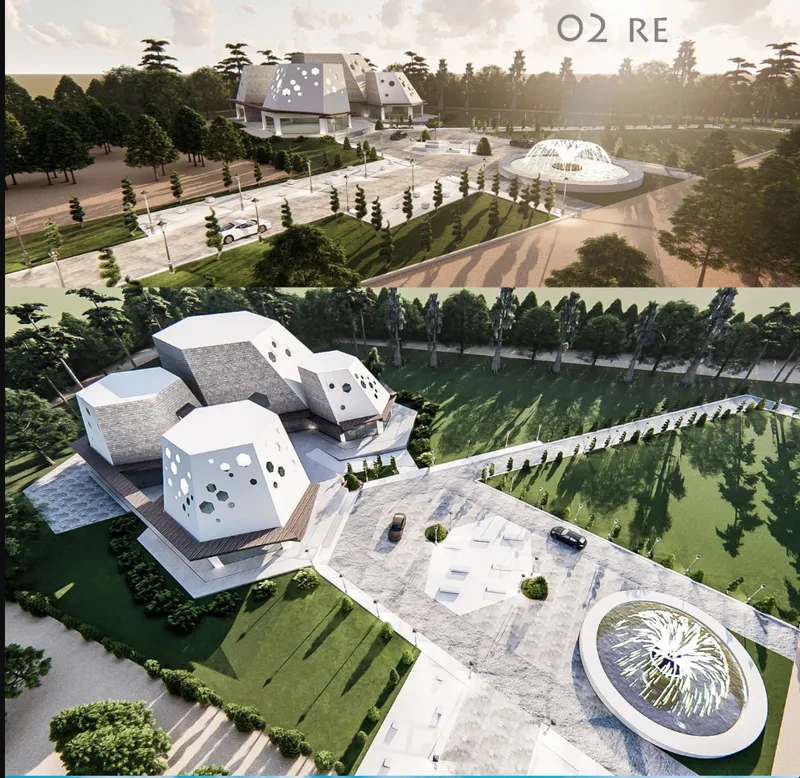
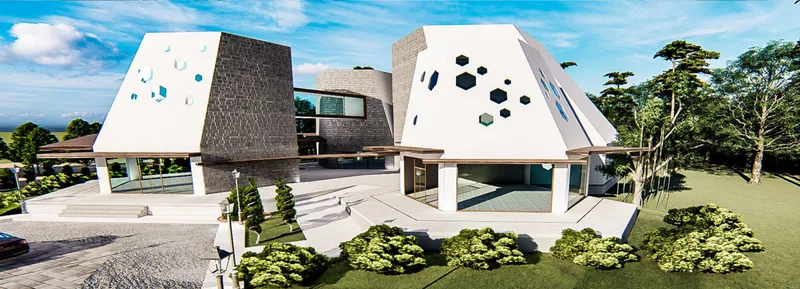
From above, the center reveals itself as a tight cluster of hexagonal volumes punctuated by carefully placed windows, terraced into a landscaped site that includes parking areas and planted buffers. At eye level, the interlocking angular masses become more dynamic: circular perforations break up the facades, modulating light and shadow in ways that recall the parametric strategies described in Barnard's design rationale. These perforations are more than decorative. They invoke the idea of "light as knowledge," casting fluid shadow patterns across interior surfaces that echo tribal motifs. Elevated floor plates lift key volumes above grade, mitigating site glare while opening panoramic views toward Kakadu's ridgelines and inviting passive ventilation through the complex.
A Site Plan Organized Around Water and Ceremony
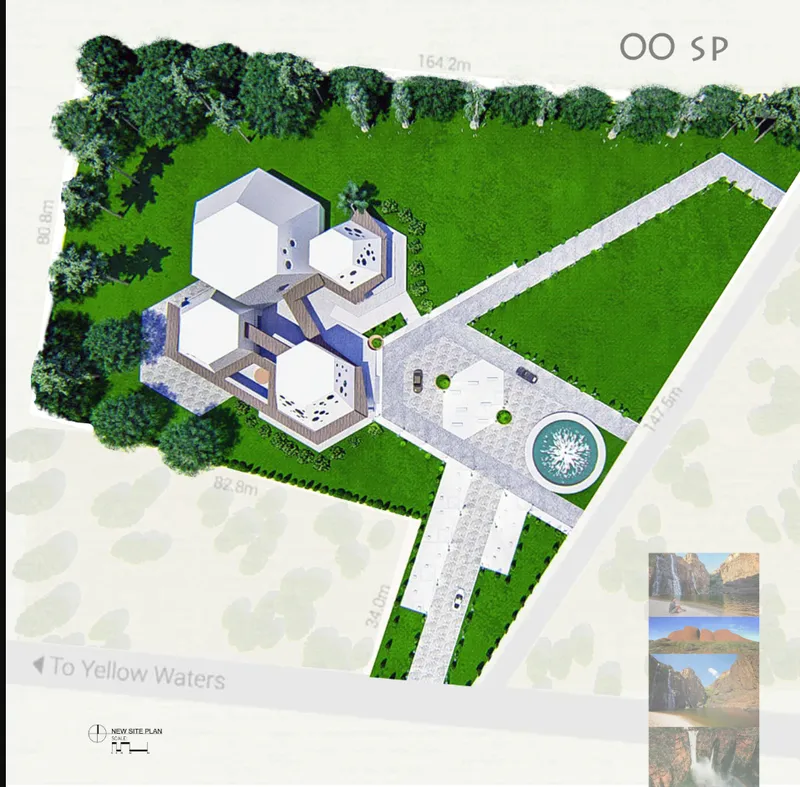
The site plan clarifies the organizational logic: the hexagonal building cluster sits adjacent to a circular water feature and a paved plaza, with generous greenspace wrapping the perimeter. A ha-ha line, that classic landscape architecture device, surrounds the site to create a protective boundary without obstructing visual flow. It functions simultaneously as security measure and social catalyst, encouraging congregation within the green courtyards that thread between volumes. The circular water element anchors one edge of the composition, offering a reflective counterpoint to the angular geometry of the buildings and reinforcing the project's dialogue between natural systems and constructed form.
Stone, Light, and the Procession from Intimacy to Panorama
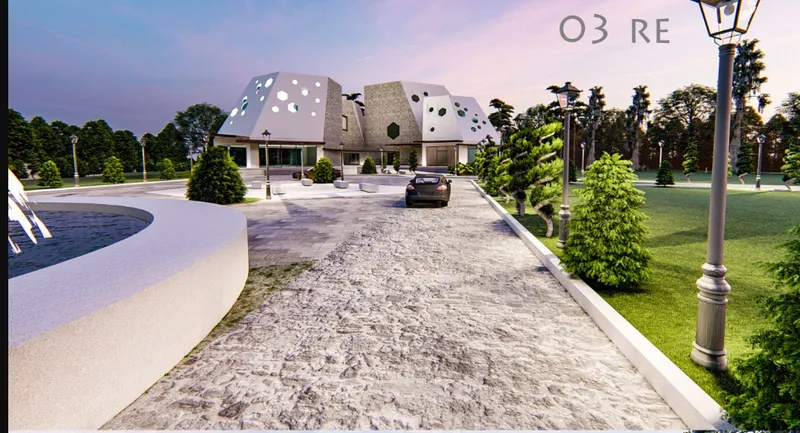
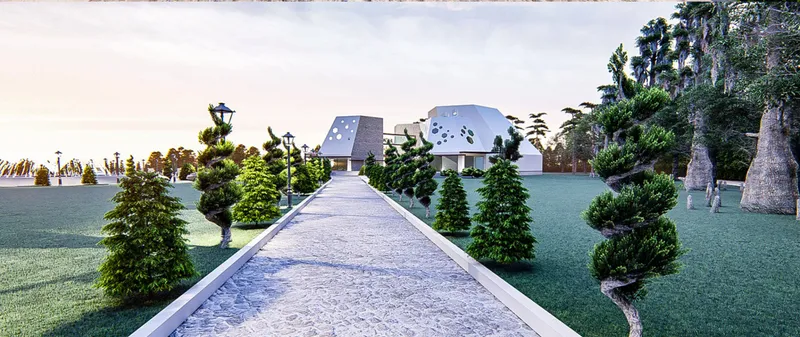
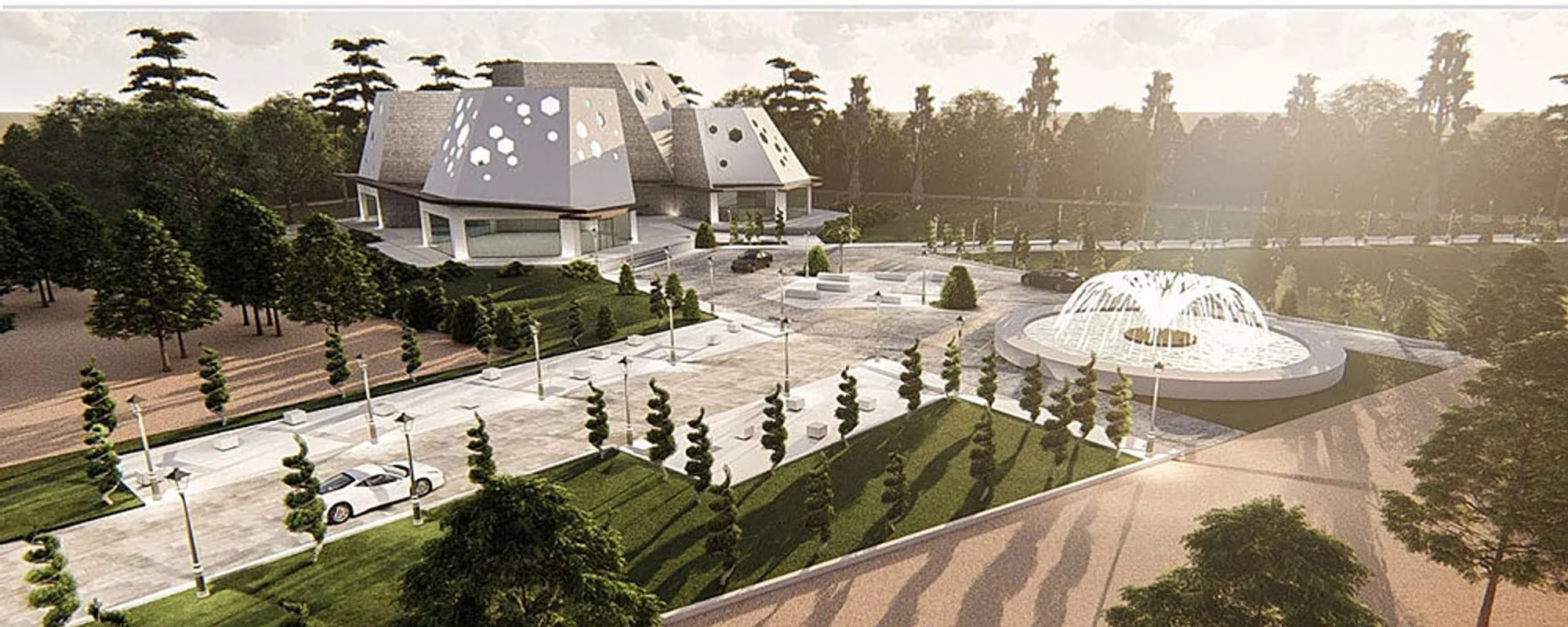
The approach sequence is deliberate. Textured stone paving leads visitors toward the white hexagonal volumes, establishing a material relationship with the geological context before anyone enters a door. At dusk, the buildings glow against the fading sky, their perforated surfaces filtering interior light outward. In early morning, a long pathway framed by topiary trees extends toward the clustered pavilions, creating a processional experience that mirrors the spiritual narrative embedded in the plan. Barnard describes the building sequence as a journey from enclosed, shaded, intimate spaces to expansive panoramic views, mapping the inner journey "from self to society, from local wisdom to global insight."
At the spiritual core of the plan sits a courtyard enclosed by megalithic stone walls adorned with reinterpreted Aboriginal symbols. These are not decorative appliqués but spatial thresholds: they create a visual and symbolic dialogue with the past that orients the visitor before the educational programme unfolds. Sunlight, modulated through the parametric perforations, completes the storytelling, making the architecture itself a medium for cultural transmission.
A Research Village Powered by Renewable Infrastructure
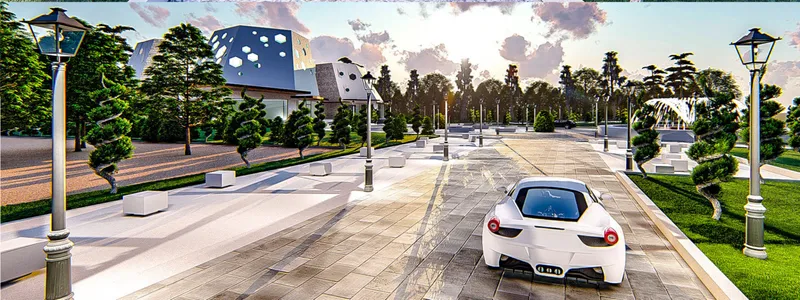
The wide plaza that fronts the complex signals the project's public ambition. Beyond the cultural center's museum and exhibit spaces, Barnard envisions surrounding expansions that transform the site into a research-driven village: a mesh of architectural typologies unified by renewable technologies and scientific inquiry. Programmatic elements include paleo-biology labs, meteorite study centers, and nano-tech secure archival spaces. Solar water heaters, rainwater harvesting systems, and photovoltaic canopies power the complex sustainably, positioning the center not as a static monument but as an evolving habitat that can adapt its energy and water systems over time.
The rotating ride-exhibit, perhaps the most speculative element, simulates genetic evolution and space colonization scenarios. It is a bold programmatic choice that risks pulling the project away from its grounded, site-specific logic. But within Barnard's narrative framework, it makes a kind of thematic sense: the architecture traces a continuous line from Aboriginal understanding of land and adaptation through to desalination technologies, DNA science, and interstellar speculation. The building becomes a timeline you walk through.
Why This Project Matters
The Kakadu Cultural Center operates on a premise that most cultural buildings avoid: that heritage and futurism are not opposites but points on the same evolutionary arc. By extracting its geometry from local geological formations and its symbolism from Aboriginal tradition, then folding in holographic exhibits and renewable energy systems, the project refuses to choose between reverence and innovation. The result is a design proposal that treats architecture as a medium for immersive learning rather than passive display.
Michael Barnard's shortlisted entry for the We Australia competition demonstrates a willingness to take conceptual risks, stacking ambitious programmes onto a site that demands ecological sensitivity. Not every element will survive the scrutiny of buildability, but the core proposition is compelling: that biomimetic design, when rooted in specific cultural and geological context, can generate architecture that educates, conserves, and provokes in equal measure. The center reaches for the stars, but it keeps its feet on Kakadu's ancient stone.
View the Full Project
About the Designers
Designer: Michael Barnard
Enter a Design Competition on uni.xyz
uni.xyz runs architecture and design competitions year-round that reward proposals with spatial conviction and real site intelligence.
Project credits: Kakadu Cultural Cente by Michael Barnard We Australia (uni.xyz).




Popular Articles
Popular articles from the community

EW PARK: Sustainable Architecture Reimagines the Future of Urban Parking
EW PARK reimagines city parking as a modular wooden tower combining automation, solar energy, electric mobility, and adaptable urban design.

The Musturak Paradise: Senior Living Architecture for a Connected Future in Temara, Morocco
The Musturak Paradise reimagines senior living architecture in Temara via private homes, social spaces, culture, community, and shared care.

AL-JANNAH: Sustainable Architecture and Permaculture for Afghan Widows
AL-JANNAH uses sustainable architecture and permaculture to create resilient oasis of housing, learning, work and renewal for Afghan widows.

The Ocean Hive: Sustainable Architecture for a Self-Sufficient Civilization at Sea
The Ocean Hive imagines sustainable architecture at sea, where modular habitats, algae, wave power and ocean waste sustain a growing colony.

Similar Reads
You might also enjoy these articles

Day and Night Park: A Time-Based Urban Newsstand in Beijing
A temporary urban newsstand in Beijing blending travel, light, and reading through poetic colors, compact form, and community-focused design.

Modernist Patio Renovation in El Masnou, Barcelona by Oliver Segura Arquitectura + Cebrià Arquitectura
Modernist patio renovation blending tradition and innovation with a movable pool, leveled floors, and Catalan materials in El Masnou.

Alto Residencial Coop: Cooperative Housing Development in Santiago de Compostela by Carbajo Barrios Arquitectos
A linear cooperative housing complex blending white volumes and perforated metal façades, enhancing community living, natural light, privacy, and urban integration.

Vil Genis School by BPA ARCHITECTURE – Massy, France
Vil Genis School in Massy, France, features sustainable design, south-facing classrooms, community integration, accessible spaces, and modern educational architecture.

Explore Kakadu Competitions
Discover active competitions in this discipline


Design a brochure to showcase the effects of the technosphere

Challenge to illustrate ‘A tale of Two Cities’

Deconstructivism - Illustration Design Challenge
Comments (0)
Please login or sign up to add comments
No comments yet. Be the first to comment!