

KalaSetu: A Cultural Bridge That Turns Transit into Art on the Sabarmati River
Spanning Ahmedabad's Sabarmati River, KalaSetu reimagines the pedestrian bridge as a living cultural institution of galleries, studios, and performance spa


What happens when a bridge stops being a thing you cross and becomes a place you inhabit? KalaSetu answers that question by stretching a hybrid cultural institution across the Sabarmati River in Ahmedabad, layering galleries, auditoriums, artist studios, and an amphitheatre into the structural logic of a pedestrian crossing. The result is an architectural promenade that refuses to separate movement from exhibition, turning every step into a potential encounter with art.
Designed by Palash Trivedi and Ravi Thacker as their architectural thesis, KalaSetu is sited in a UNESCO World Heritage City where the river historically divides old Ahmedabad from its newer districts. The bridge serves as both a physical and symbolic juncture, connecting not just two banks but two urban identities, while embedding public cultural infrastructure directly within the civic realm of the Sabarmati Riverfront.
Two Decks, One Continuous Cultural Landscape


The axonometric drawing reveals how KalaSetu organizes its programme across two primary deck levels. The upper deck accommodates temporary exhibitions, performances, and open-air galleries, while the lower level houses permanent display zones, auditoriums, and digital installations. Circulation flows organically between them, inspired by natural movement patterns rather than a rigid linear path, so visitors are constantly invited to explore rather than simply transit. Every pause point along the bridge opens a new sightline, sometimes toward the river, sometimes toward the artwork.
The south elevation, overlaid against a photograph of the bridge spanning calm water, shows just how low-slung and restrained the structure reads from a distance. A lightweight steel framework integrated with concrete platforms achieves the long spans necessary to clear the river while maintaining minimal visual obstruction. The bridge does not impose itself on the riverfront; it settles into it, its horizontal profile echoing the quiet surface of the water below.
The Promenade as Public Room


From the waterfront promenade, the undulating form of KalaSetu rises beyond clusters of pedestrians, its profile fluid enough to register as landscape rather than building. The designers treat the bridge's envelope as an active surface, alternating between translucent and opaque panels that respond to shifting sunlight and reflections on the water. The effect, visible in the rendering, is a structure that appears to float within its context, its materiality constantly renegotiated by the time of day.
Beneath a curved canopy, striped shadows fall across the white deck where visitors gather. Skylights and open terraces punctuate the roof, pulling natural light deep into the interior and generating a dynamic play of shadow and texture that keeps the space alive from morning exhibitions through afternoon workshops to evening performances. The architecture does not just house art; it performs alongside it, creating conditions where the boundary between gallery and corridor dissolves entirely.
A Sunken Amphitheatre Framing the River
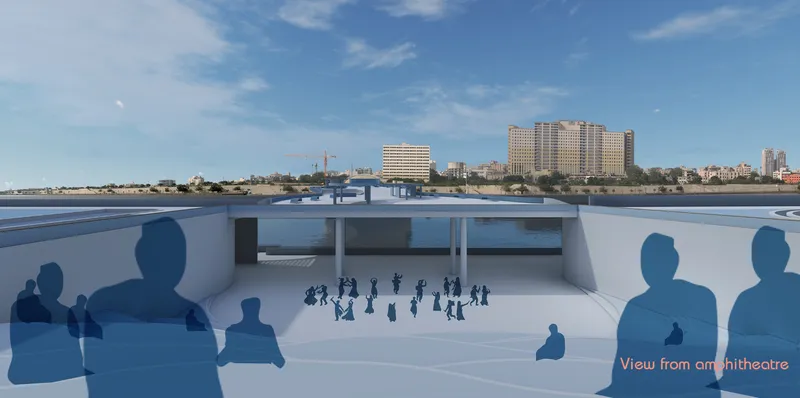
One of KalaSetu's most compelling spatial moves is a sunken amphitheatre carved into the bridge's section, its stepped seating oriented toward horizontal openings that frame the river and the Ahmedabad skyline beyond. The rendering captures how this space operates simultaneously as a performance venue, a civic gathering spot, and a viewing platform. It connects the interior cultural programme to the riverfront's public life, ensuring the bridge never turns inward or becomes exclusive. Cafés, open plazas, and this amphitheatre together form the social infrastructure that keeps the institution accessible and inhabited throughout the day.
Mapping a Hybrid Cultural Ecosystem

The axonometric site plan nests rendered glimpses of interior gallery spaces within the broader waterfront layout, revealing the sheer density of programme Trivedi and Thacker pack into the bridge's linear footprint. Display galleries for rotating exhibitions sit alongside media rooms for immersive digital art, workshops and studios for artist residencies, and an auditorium for talks and film screenings. Rather than designing a singular building, the pair conceived KalaSetu as a hybrid cultural ecosystem where each zone adapts to multiple art forms, from visual and digital to performing and interactive arts. The flexibility is deliberate: it allows the institution to stay responsive to Ahmedabad's evolving creative community.
Why This Project Matters
KalaSetu is compelling because it takes a piece of infrastructure that most cities treat as purely functional and loads it with cultural ambition without sacrificing its primary role as a river crossing. The programme is genuinely diverse, the spatial strategy is rooted in the specific conditions of the Sabarmati Riverfront, and the two-deck section creates real architectural variety within a constrained linear typology. It argues, convincingly, that public art institutions do not need to be destination buildings sealed behind lobbies and ticketing desks.
For a thesis project, the scope is ambitious. Trivedi and Thacker address structure, materiality, programme, and urban context with a coherence that holds together across scales, from the macro gesture of bridging two halves of a heritage city to the micro detail of shadow patterns on a canopy deck. KalaSetu proposes that the most powerful cultural spaces might be the ones people encounter by accident, mid-stride, on their way somewhere else.
View the Full Project
About the Designers
Designers: Palash Trivedi, Ravi Thacker
Enter a Design Competition on uni.xyz
uni.xyz runs architecture and design competitions year-round that reward proposals with spatial conviction and real site intelligence.
Project credits: KalaSetu by Palash Trivedi, Ravi Thacker.


Popular Articles
Popular articles from the community


U.GA Architects Wraps an Oval Rooftop Pool in Curved Board-Formed Concrete on Busan's Jeollidan-gil
In Busan's Jeonpo-dong, a 454 m² mixed-use block stacks a neighborhood facility, guest rooms and an oval rooftop pool inside spiraling concrete walls.

GROUP A Strips a 1969 Rotterdam Harbor Headquarters to Its Frame and Wraps It in Timber Louvers
In Rotterdam's M4H harbor district, Ferro Offices reuses a 1969 frame, adds one timber storey and reaches BREEAM-NL Outstanding.

David Ortega Stacks a Two-Story Mexico City Penthouse Around a Steel Stair and a Pergola-Shaded Roof Terrace
In Colonia Roma, a 300 m² penthouse uses oak joinery, a planted steel stair and a slatted roof pergola to make a new-build apartment feel like a house.

longwave studio Reorganizes a 112 m² Tainan Apartment Around the Daily Routines of a Family and Two Cats
In Tainan, Taiwan, birch plywood, rust-red furniture and a freestanding plaster wall link arrival, storage, work and family life in one apartment.

Similar Reads
You might also enjoy these articles


Aquadapt: An Underwater Habitat That Rewrites Its Rooms by the Hour
Curved modules ring the seabed while one shell shifts from breakfast room to cinema, farm and football pitch as residents' needs change.

Play: Fragments of Their World: Remembered Architecture Rebuilt as a Modular Playground for Refugee Camps
Tom Gardner abstracts domes, arches and towers from the homelands of displaced families into a kit of child-scaled play parts for camp settlements.
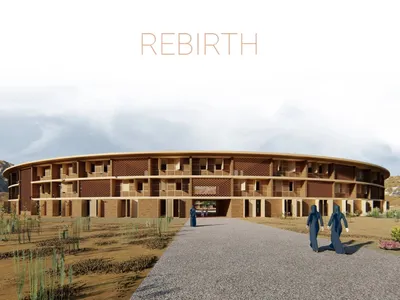
REBIRTH: A Circular Settlement Where Afghan Widows and Their Children Rebuild Life Together
A shortlisted Resile entry turns the circle into a protective ring of timber and brick, gathering homes, classrooms and gardens around a shared landscape.
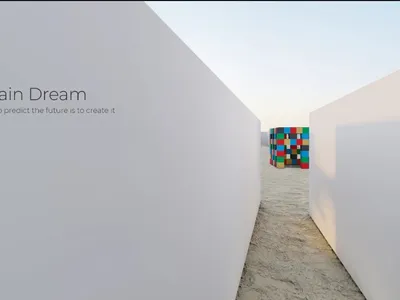
The Main Dream: A Recycled Plastic Kit That Lets Refugee Children Build Their Own Playground
Thirty-centimetre interlocking cubes that connect on three axes turn play into construction, letting children author the spaces they occupy.

Explore Urban Design Competitions
Discover active competitions in this discipline

Design challenge to equip cities with modern furniture

Challenge to reimagine the Iron Throne

Photograph architecture without architects

Illustrate the lost glory of Angkor Wat - Render Challenge
Comments (0)
Please login or sign up to add comments
No comments yet. Be the first to comment!