
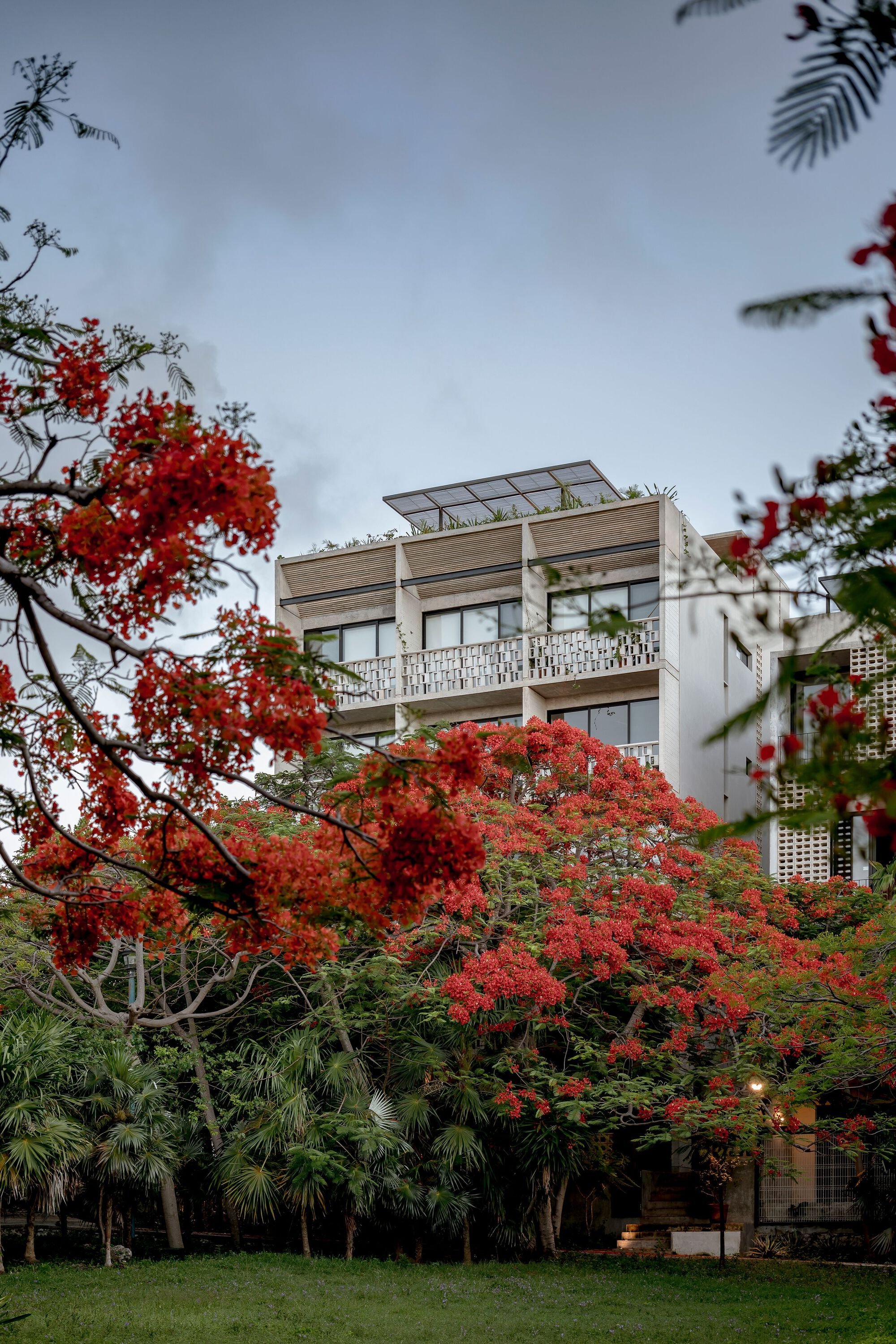
Kiltro Polaris Arquitectura Builds an Honest Concrete Housing Block in Central Cancún
Sixteen units, a renewed public plaza, and perforated screens bring density back to a Caribbean city center losing its residents.

Cancún's center has been bleeding residents for years. Population growth and urban degradation pushed inhabitants to the outskirts, hollowing out a core that was once defined by generous lots, green space, and walkable streets. Huachinango 36, designed by Kiltro Polaris Arquitectura under lead architect Victor Imre Ebergenyi Kelly, treats that problem as a design brief: bring people back downtown with 16 housing units stacked over ground-floor commercial space, all built with low-cost concrete and an almost militant reduction in construction complexity.
What makes the project worth studying is not what it adds but what it refuses. There are no fences. The ground floor opens directly onto the street and a renewed adjacent plaza, stitching the building into the public realm rather than walling itself off from it. Balconies double as sun and rain protection, cross-ventilation replaces mechanical cooling where possible, and the material palette never tries to be more than concrete, timber, and perforated screen. The result is a five-story building that feels specific to its Caribbean latitude and honest about its budget.
A Facade That Works for Its Climate
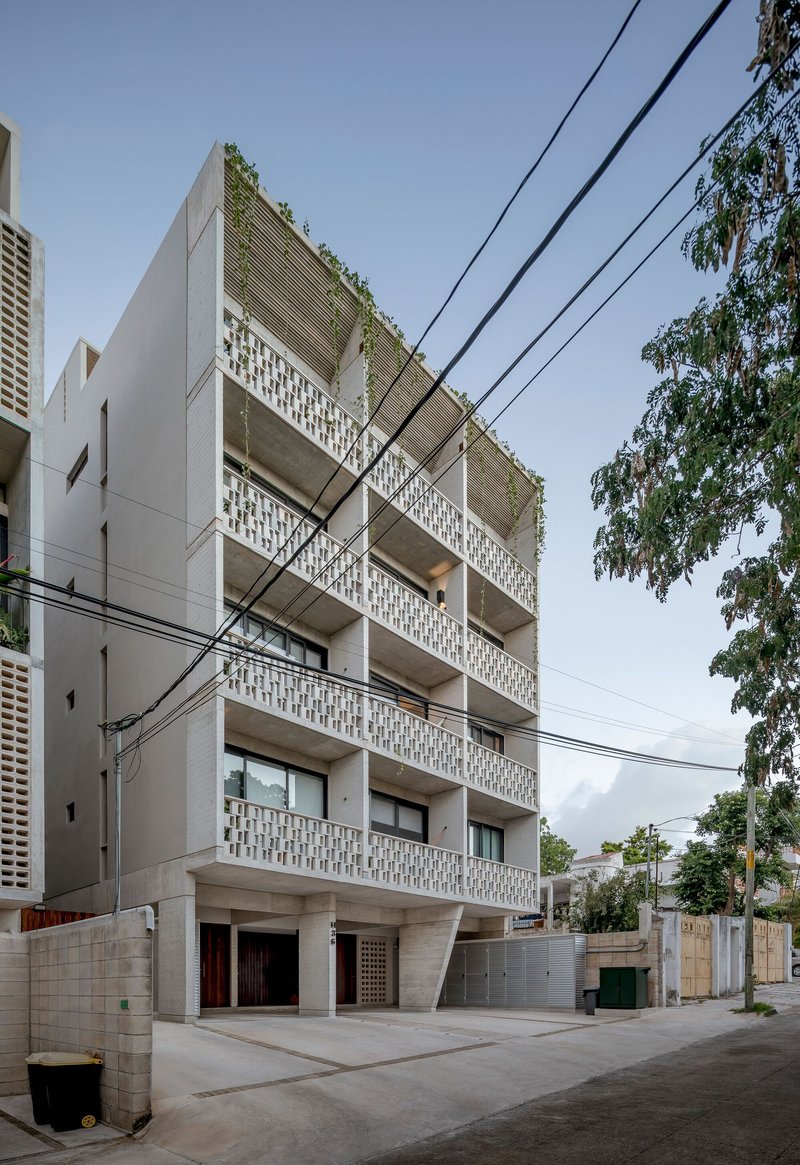
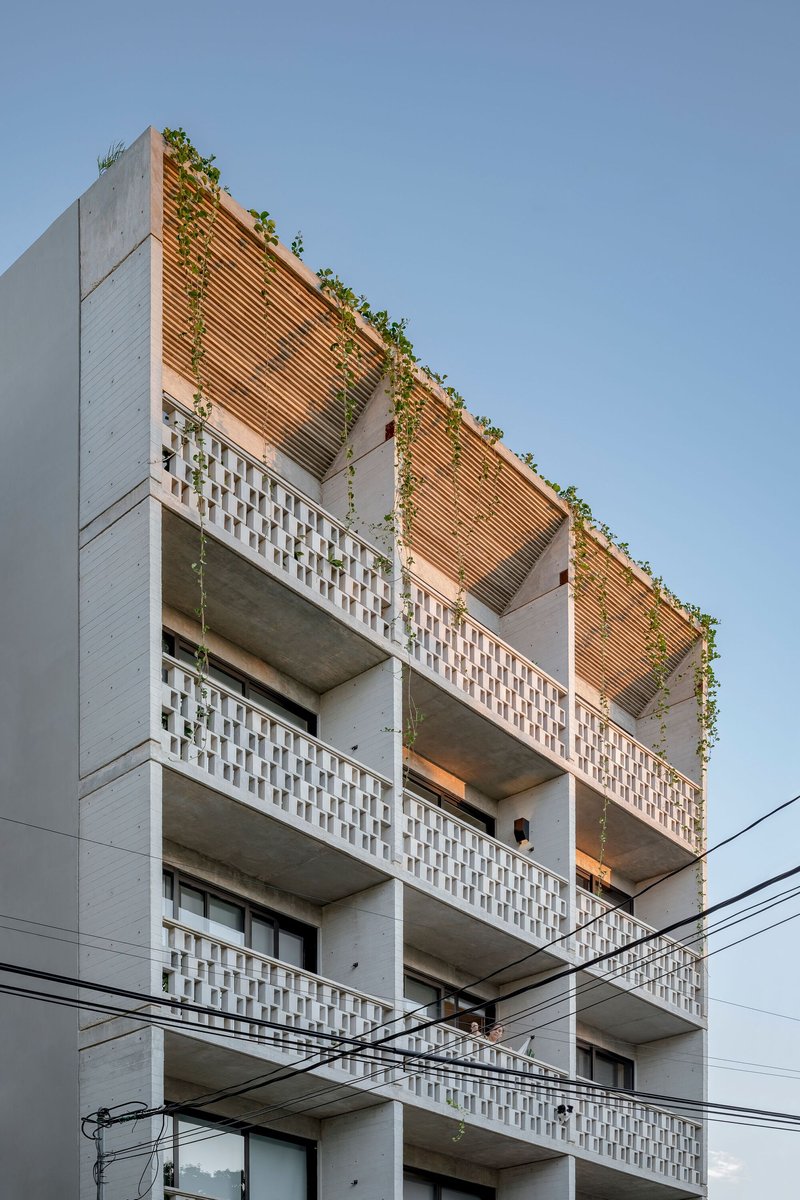
From the street, Huachinango 36 reads as a layered composition of screens. Perforated concrete panels, timber louvers, and open balcony railings wrap the upper floors, filtering the intense Caribbean sun while allowing air to move through every unit. The effect is textural without being decorative. Each screening element has a job: shade, privacy, or ventilation, and often all three at once.
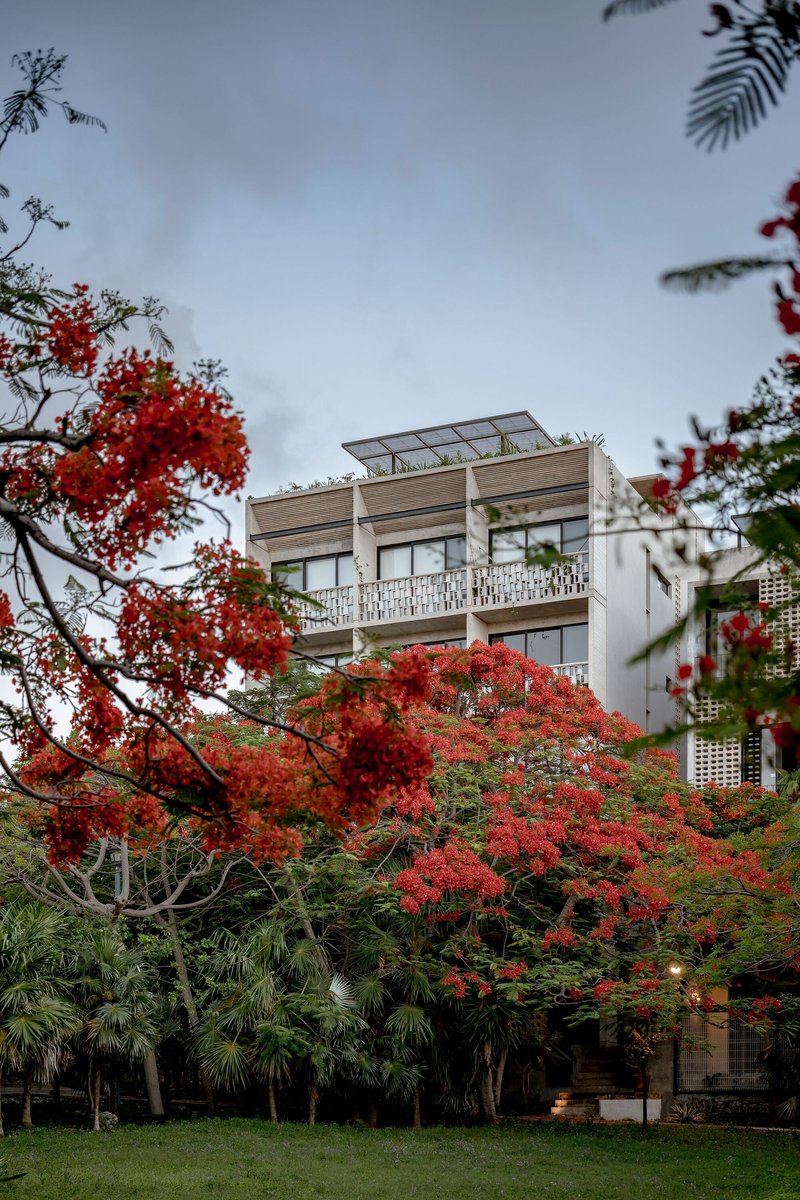
The flame trees framing the building in several views are not incidental. They are part of a deliberate landscape strategy that renewed the adjacent plaza and pushed vegetation right up to the building edge. Rooftop planting softens the top of the volume from the street, while the tree canopy below gives the facade context it would otherwise lack against the low-rise neighborhood.
Ground Level: Commerce, No Fences
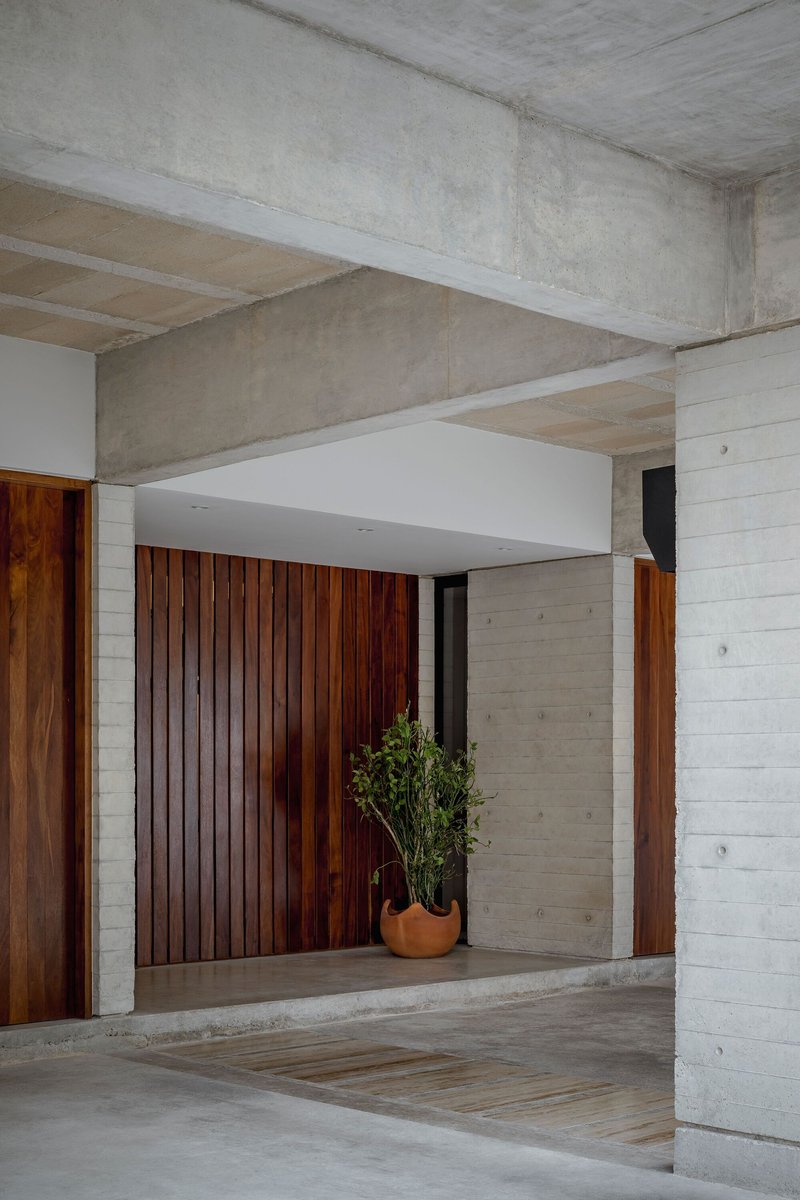
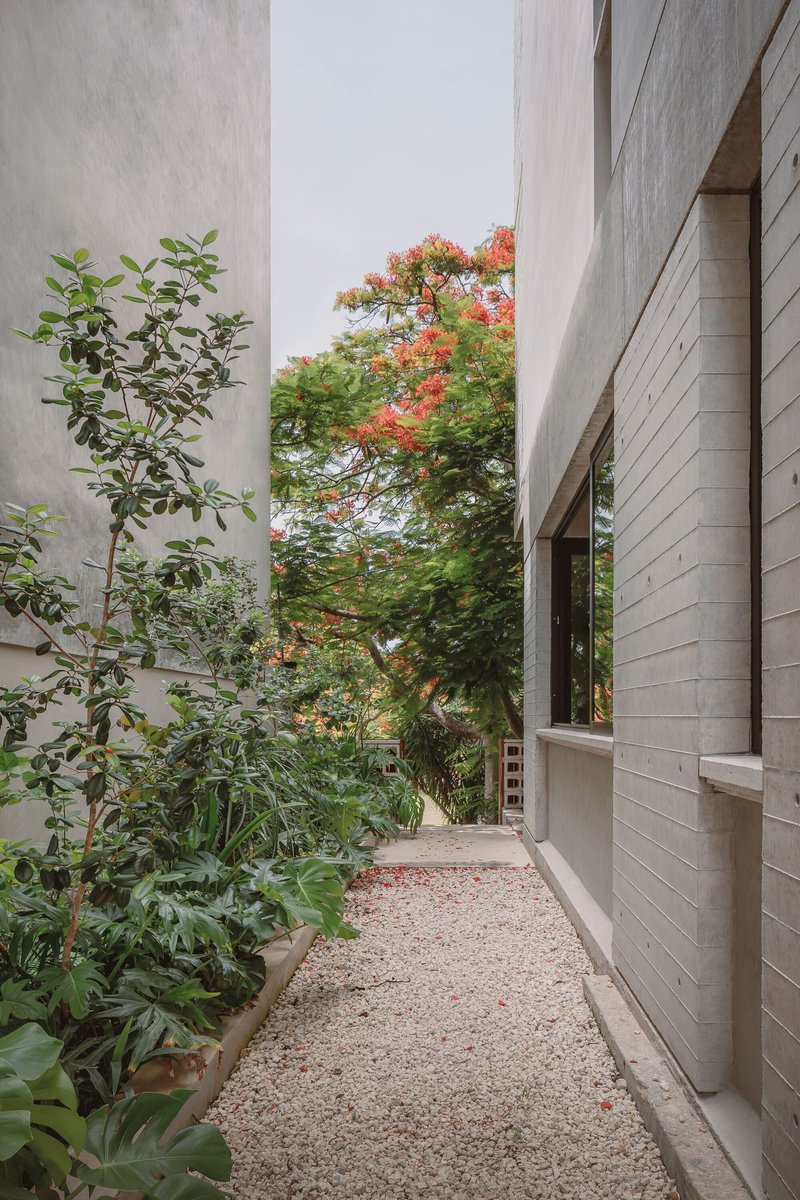
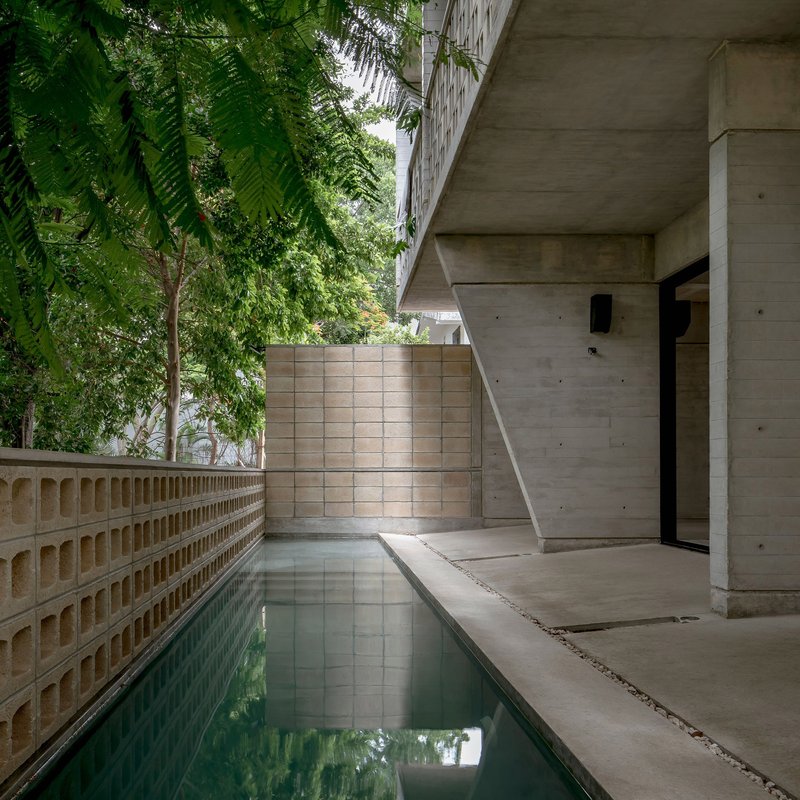
The decision to eliminate fences at grade is the single most consequential move in the project. In a Mexican city where gated perimeters are standard, opening the ground floor directly to the street through commercial space is both a social statement and an urban strategy. The building does not merely sit on its lot; it connects two public spaces by making its own ground plane continuous with them.
Board-formed concrete walls define the thresholds between public and private at ground level. Vertical timber door panels, potted plants, and gravel paths create a sequence of compression and release as you move from the sidewalk into the building's interior circulation. The narrow lap pool, tucked against a perforated brick wall under a mature tree canopy, belongs to the residents but visually participates in the landscape. It is a semi-public amenity that makes density attractive rather than claustrophobic.
Living Spaces and the Logic of 30, 60, 90
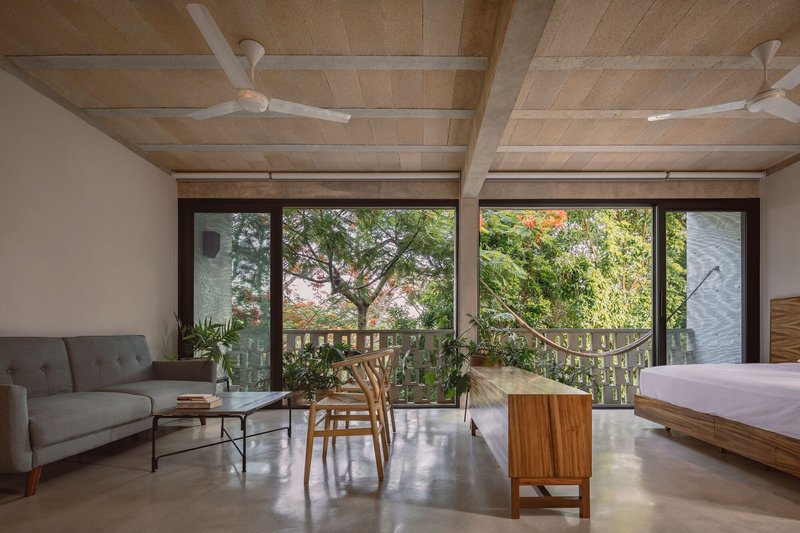
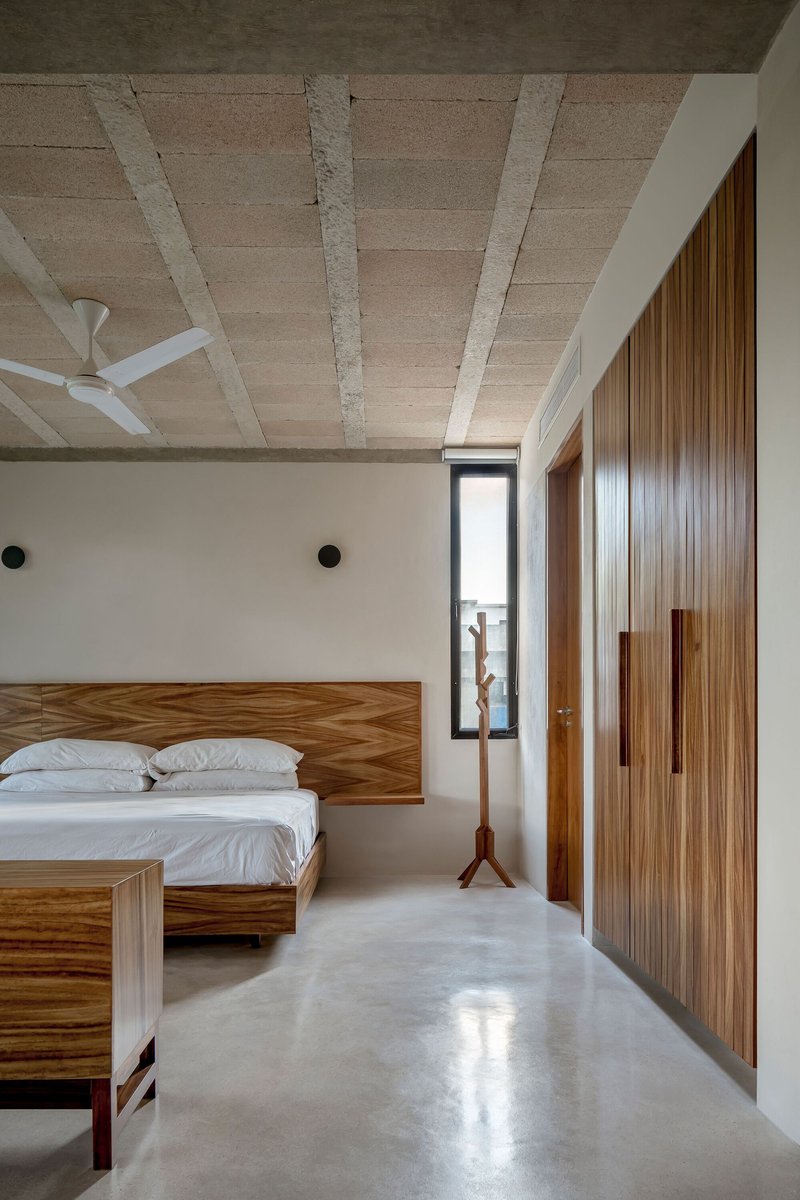
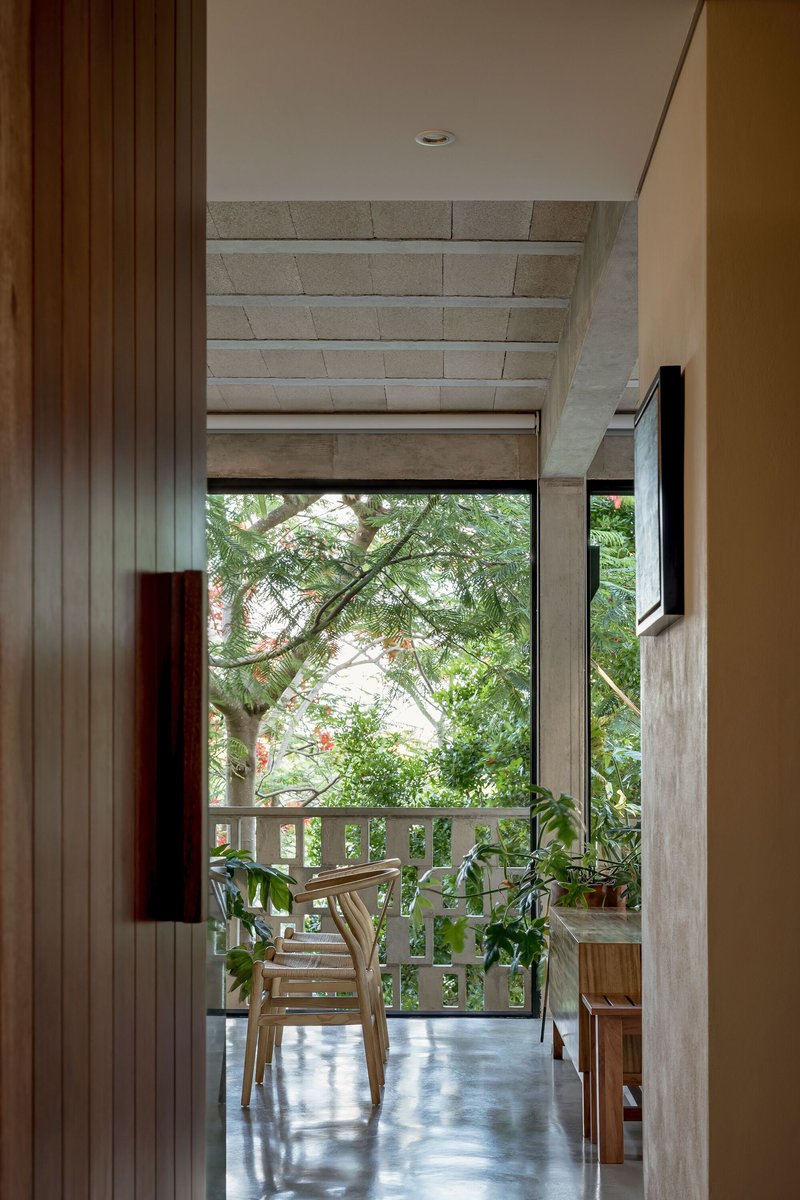
Kiltro Polaris sized the 16 units at 30, 60, and 90 square meters, creating a mix that can absorb singles, couples, and families within the same structure. That variety of unit sizes within a single building is unusual for speculative housing in Cancún, and it reflects a deliberate commitment to social diversity rather than market optimization.
Inside, the units are spare. Exposed concrete beams run across ceilings, polished concrete floors extend from bedroom to terrace, and vertical timber paneling provides warmth without drywall. The real luxury is spatial: each unit opens onto a lattice-screened terrace that functions as an outdoor room, extending the livable area and framing views of flowering tree canopy. Natural light reaches deep into the plans through these open edges, and cross-ventilation works because every unit has exposure on at least two sides.
Terraces and Screens as Environmental Infrastructure
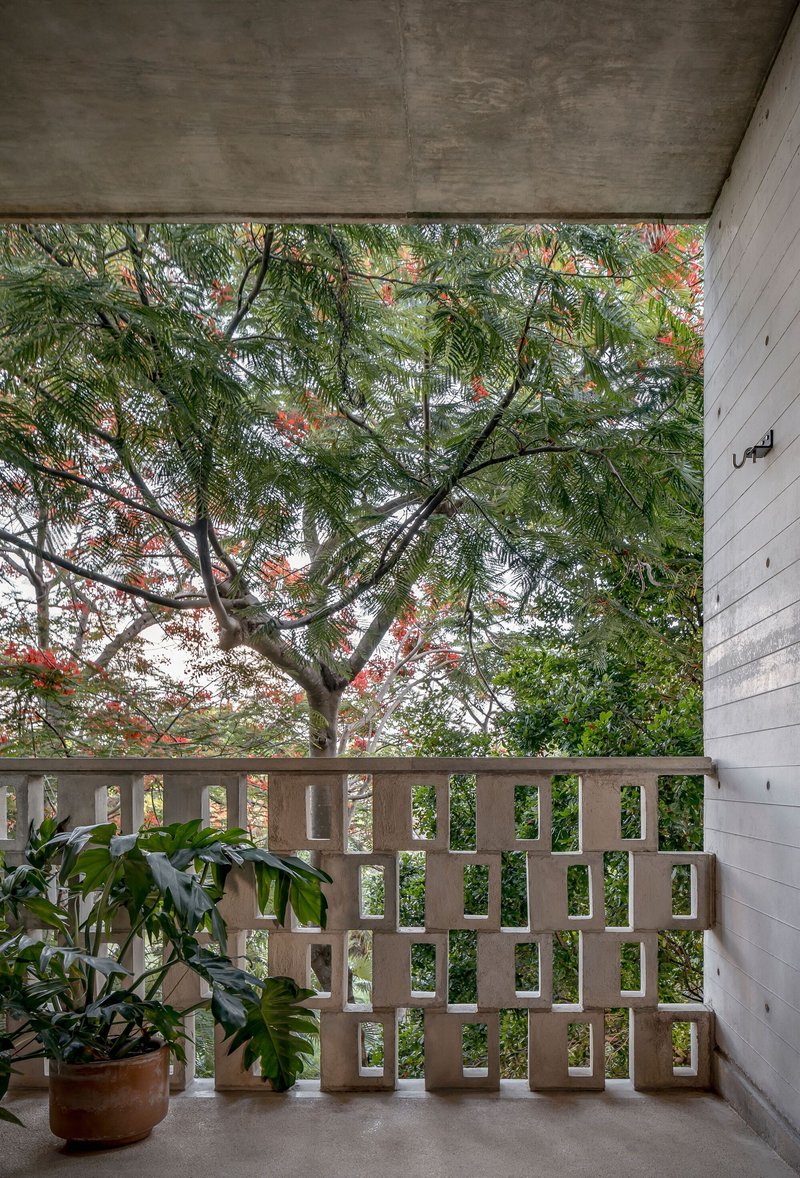
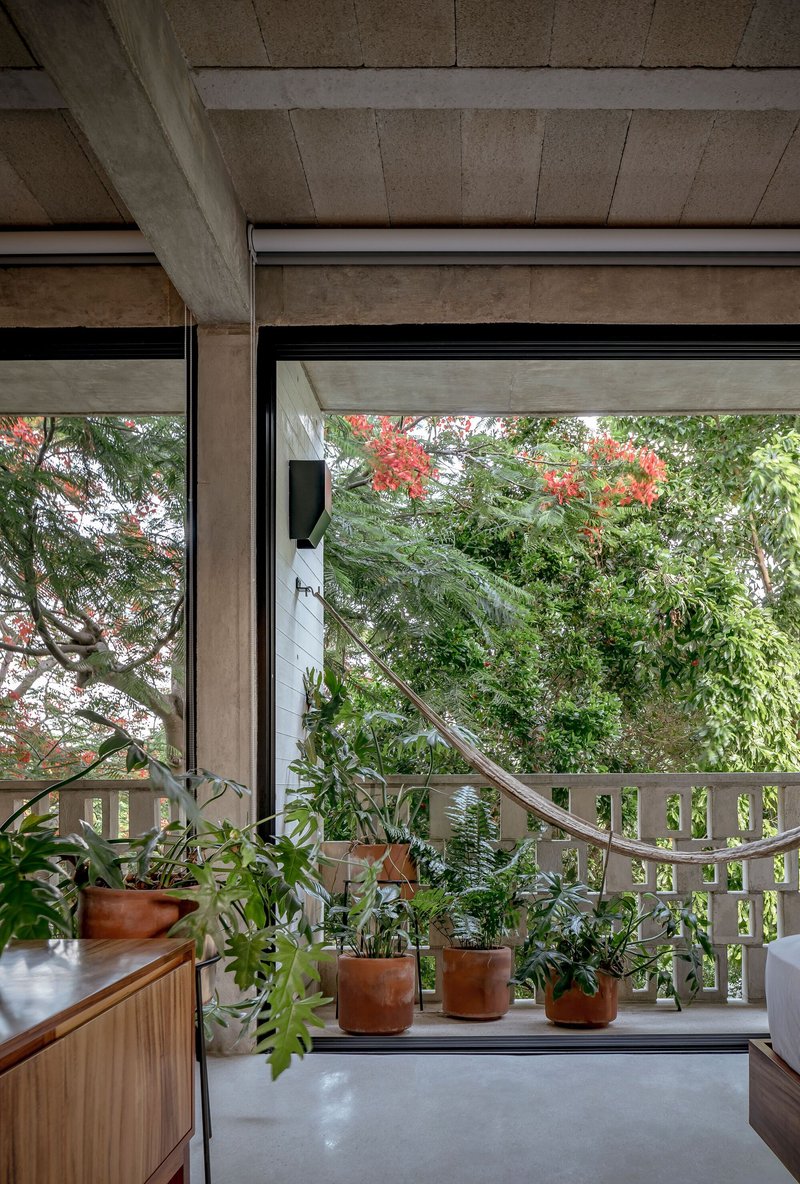
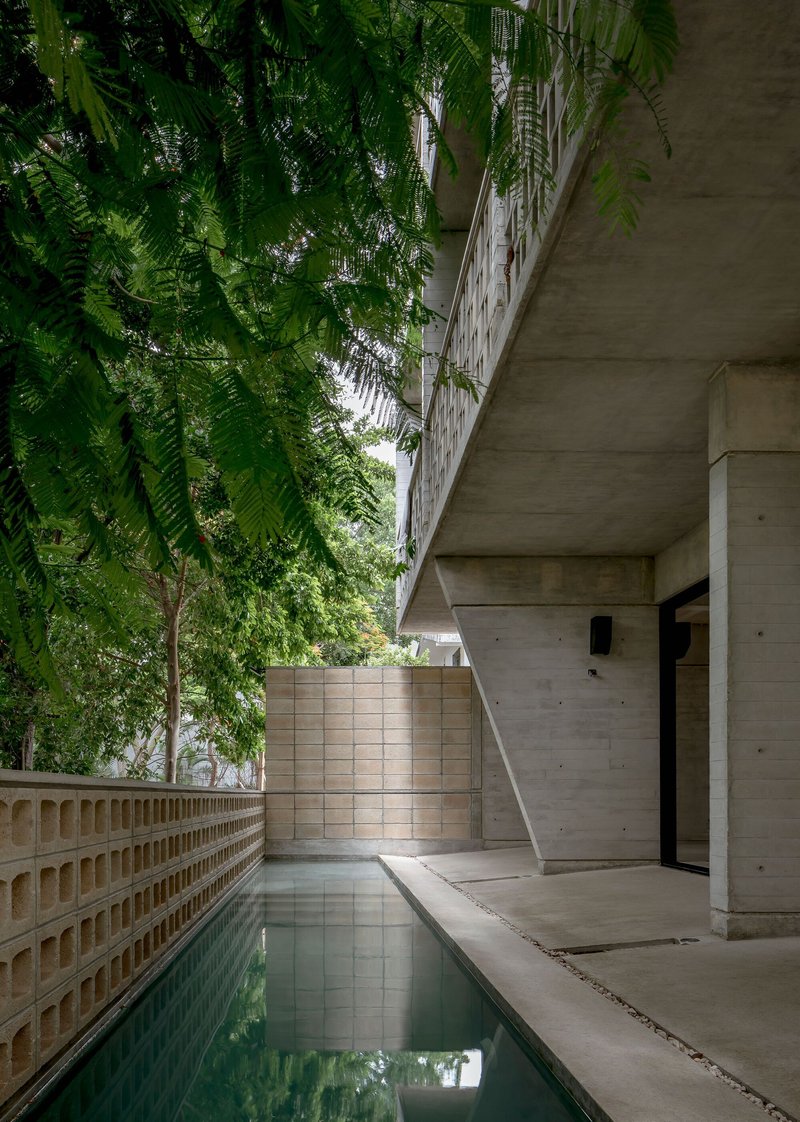
The balconies on Huachinango 36 are not decorative appendages. They are the building's primary environmental strategy. Projecting from the facade, they shade the glazing below; wrapped in perforated screens, they cut direct solar gain while maintaining airflow. In a city where air conditioning is the default response to heat, these balconies are doing measurable work.
The precast lattice screens deserve particular attention. They appear in different configurations across the facade, sometimes dense, sometimes open, creating a visual rhythm that changes with the angle of view. Potted plants colonize the sills and screen openings, softening the concrete and adding a layer of organic texture that will only deepen over time. The pool area below uses the same lattice language, unifying the ground-level landscape with the upper residential floors.
The Rooftop and the City Above
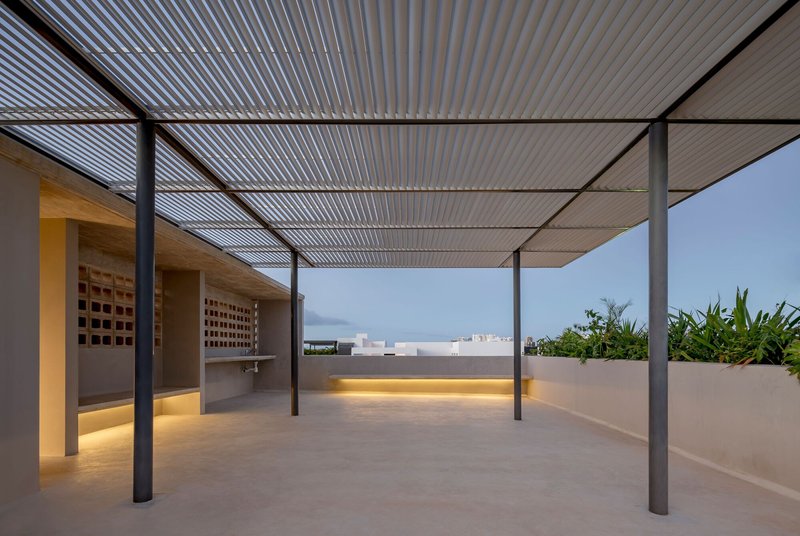
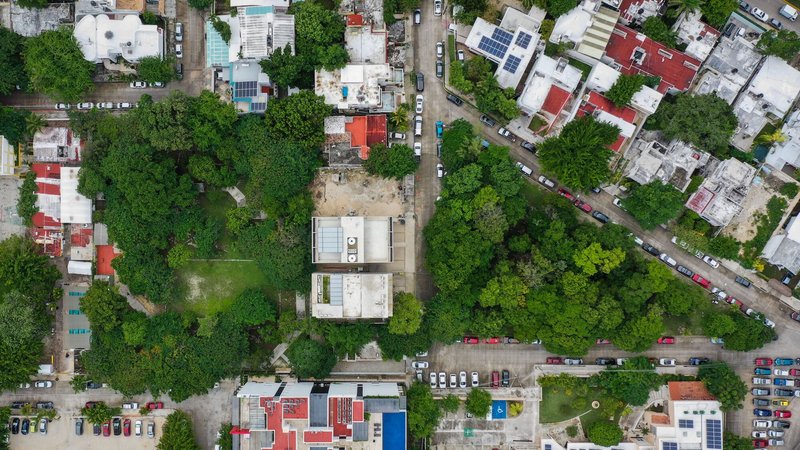
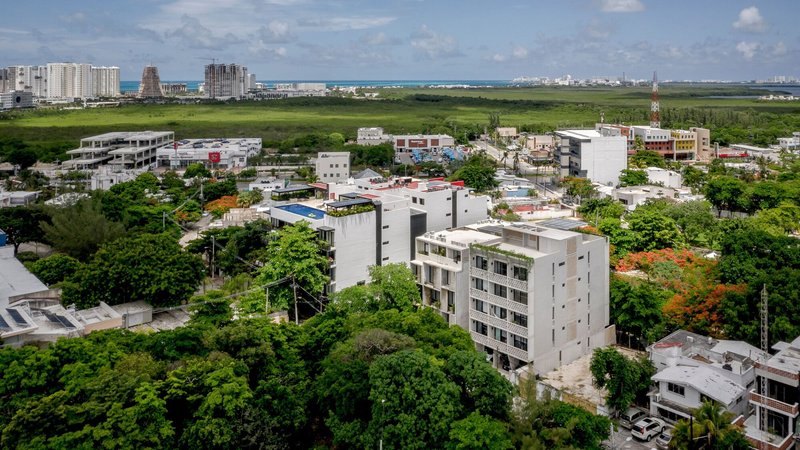
The rooftop terrace, visible at dusk with its slatted metal canopy on slender steel columns, extends the communal program upward. Integrated planters with tropical foliage frame the perimeter, and the canopy provides shade without enclosing the space. From above, the aerial views reveal how tightly the building sits within Cancún's dense tree canopy, its white volume reading as a precise insertion among the colored rooftops and green cover of the surrounding neighborhood.
These aerial perspectives also clarify the project's urban argument. Cancún's center still has the bones of a well-planned district: trees, walkable blocks, modest scale. What it needs is density delivered at that same scale, not suburban sprawl at the edges. Huachinango 36 adds 16 households to the center without breaking the existing grain, and the renewed plaza adjacent to the building recovers public space that had been lost to neglect.
Plans and Drawings
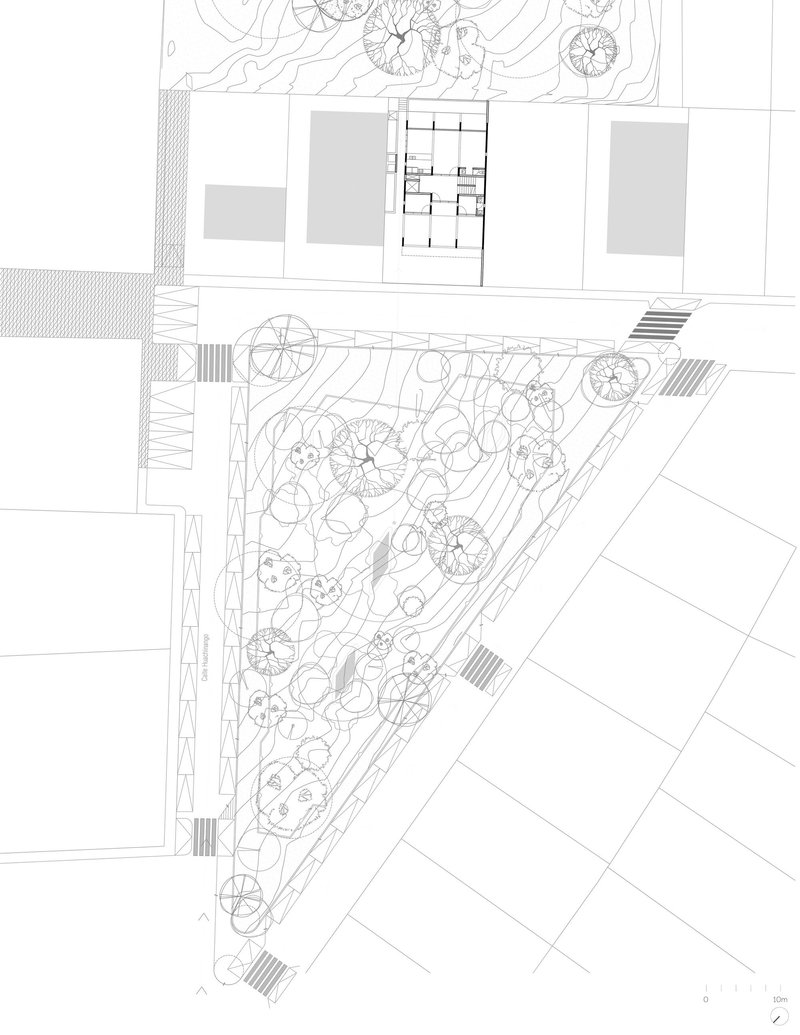
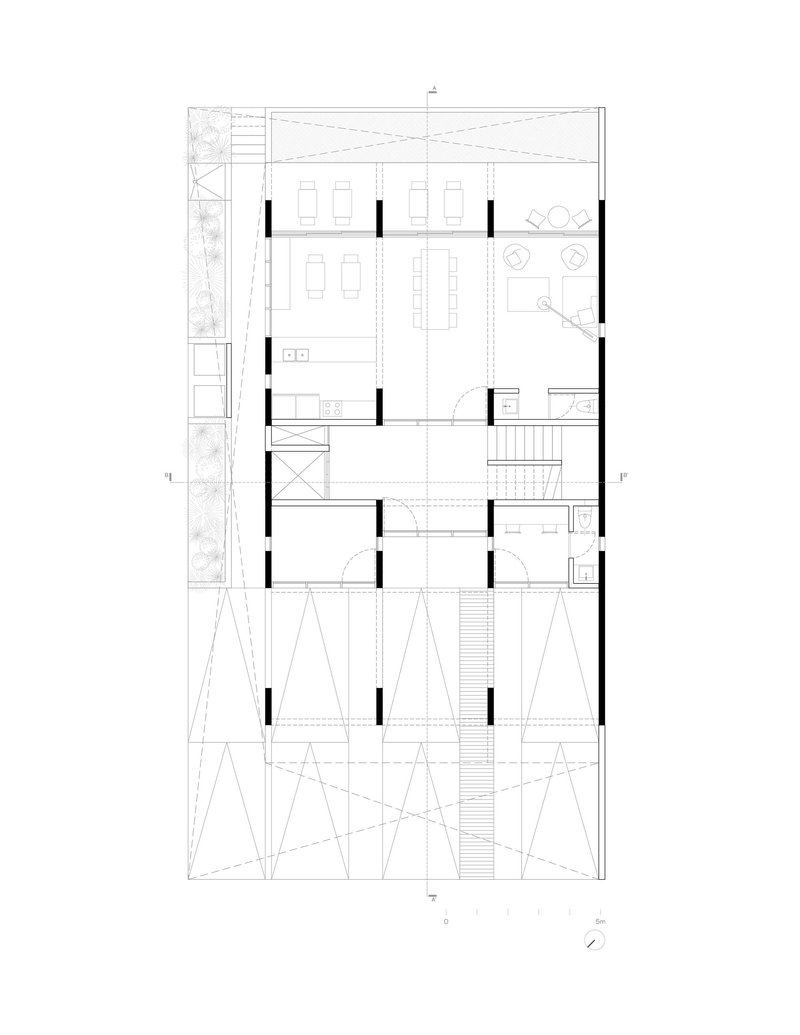
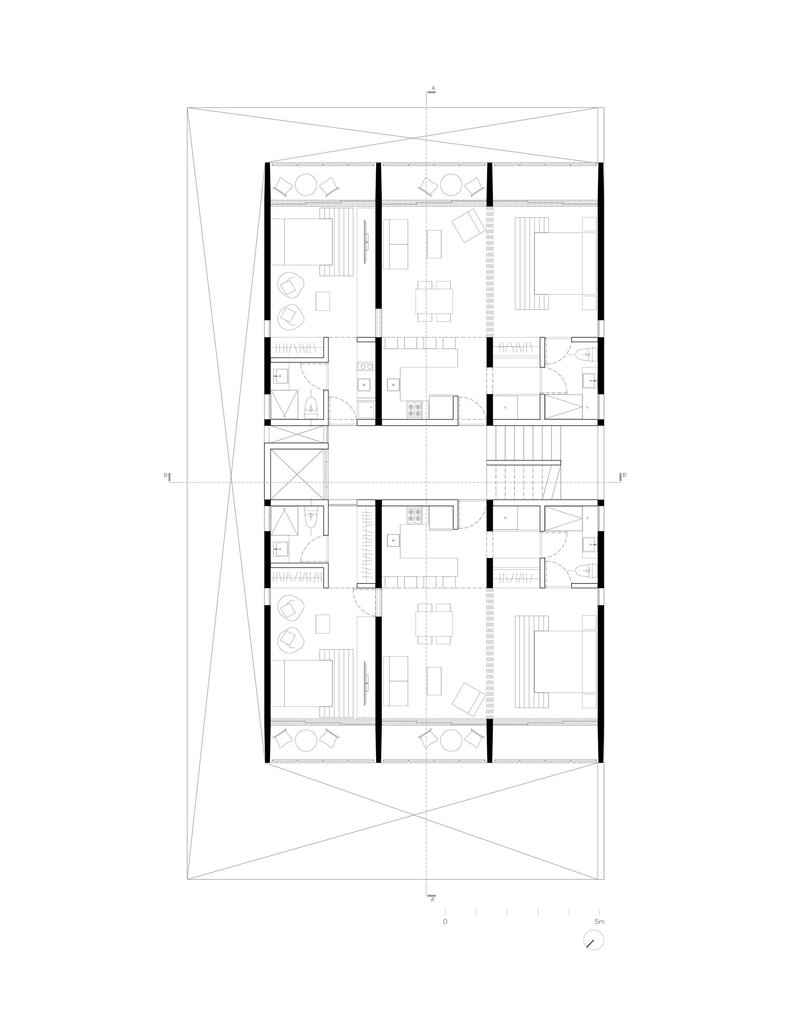
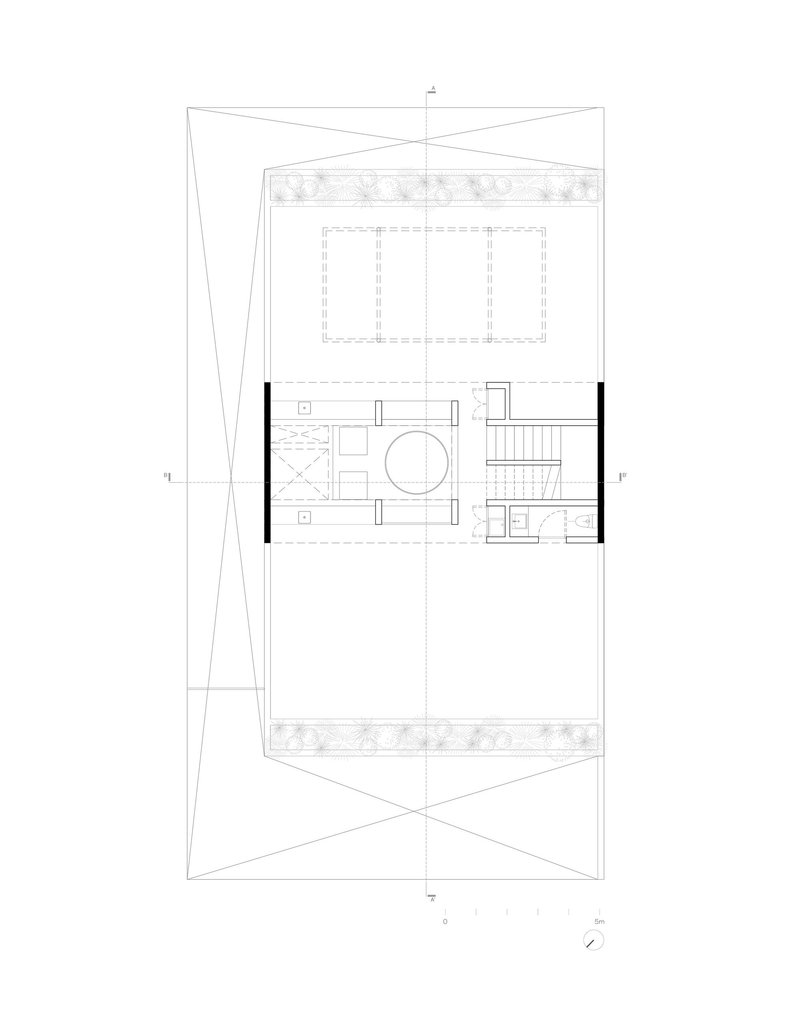
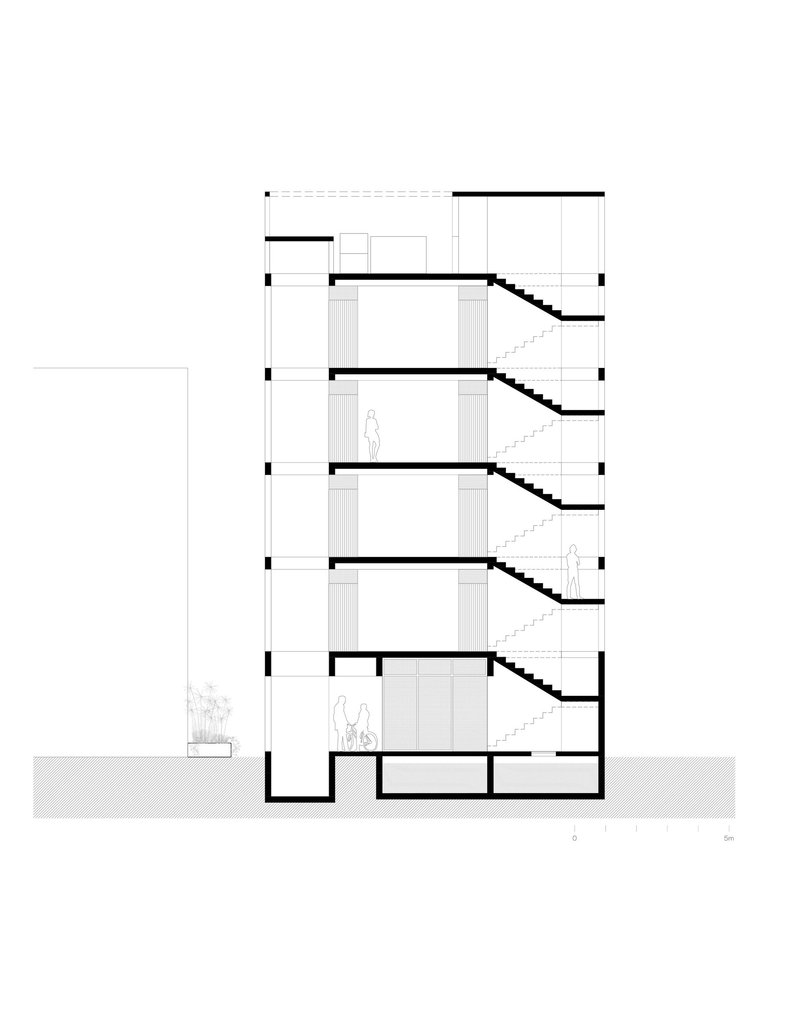
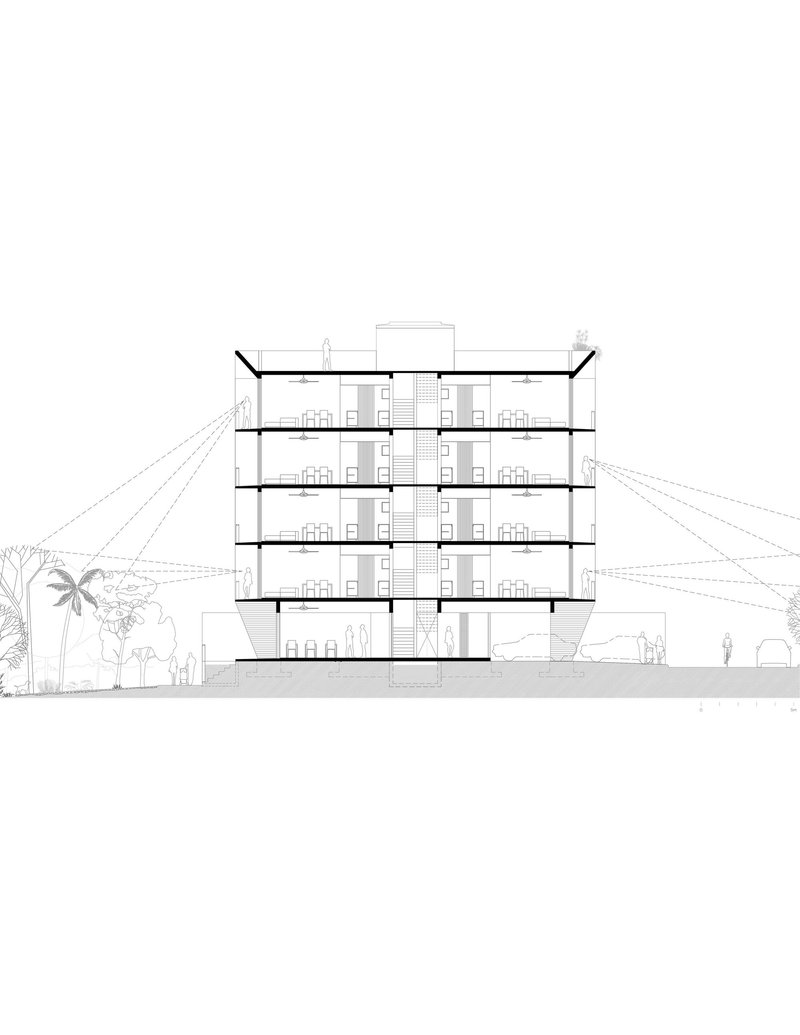
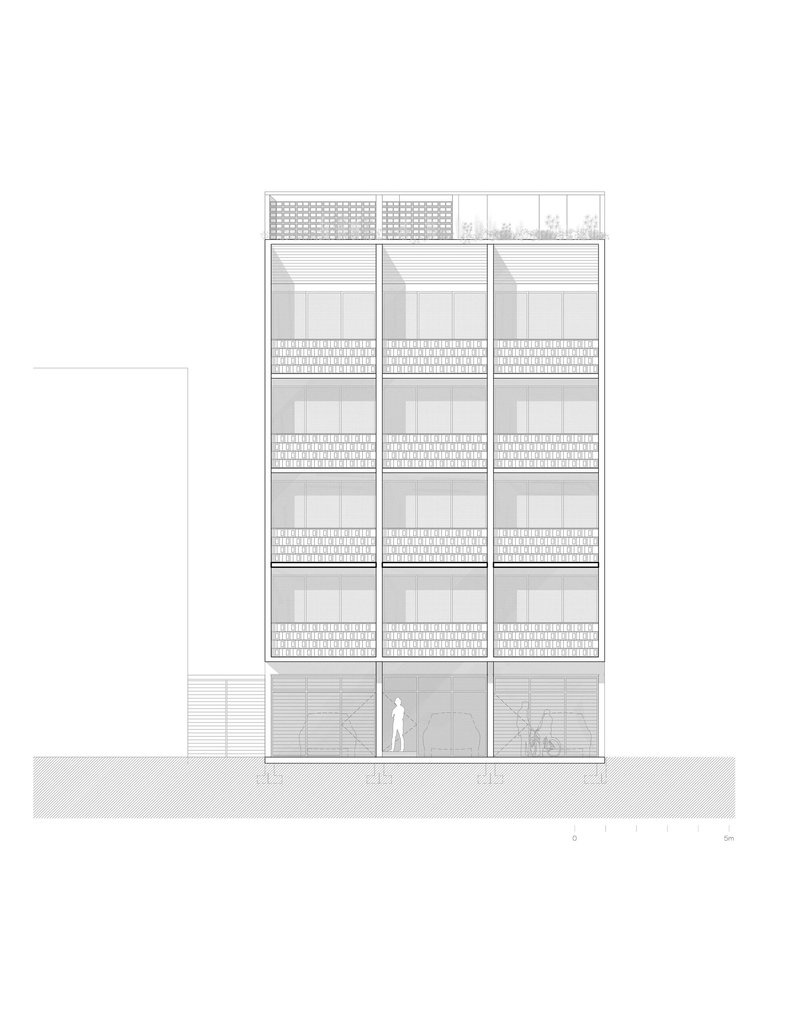
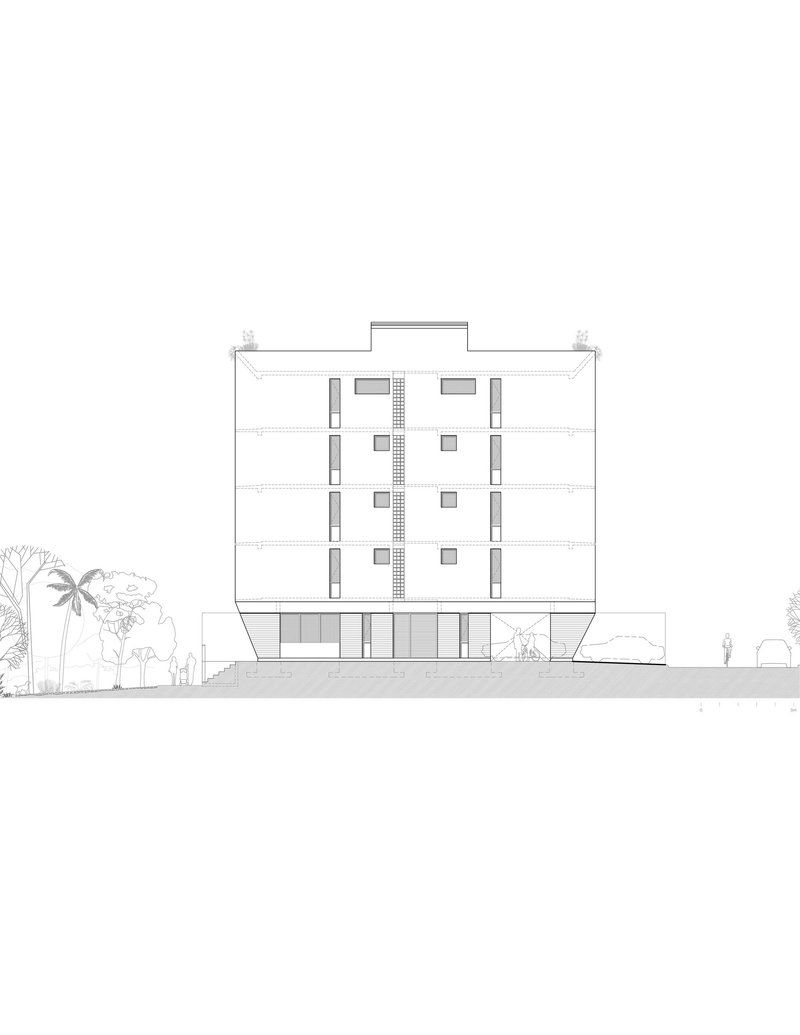
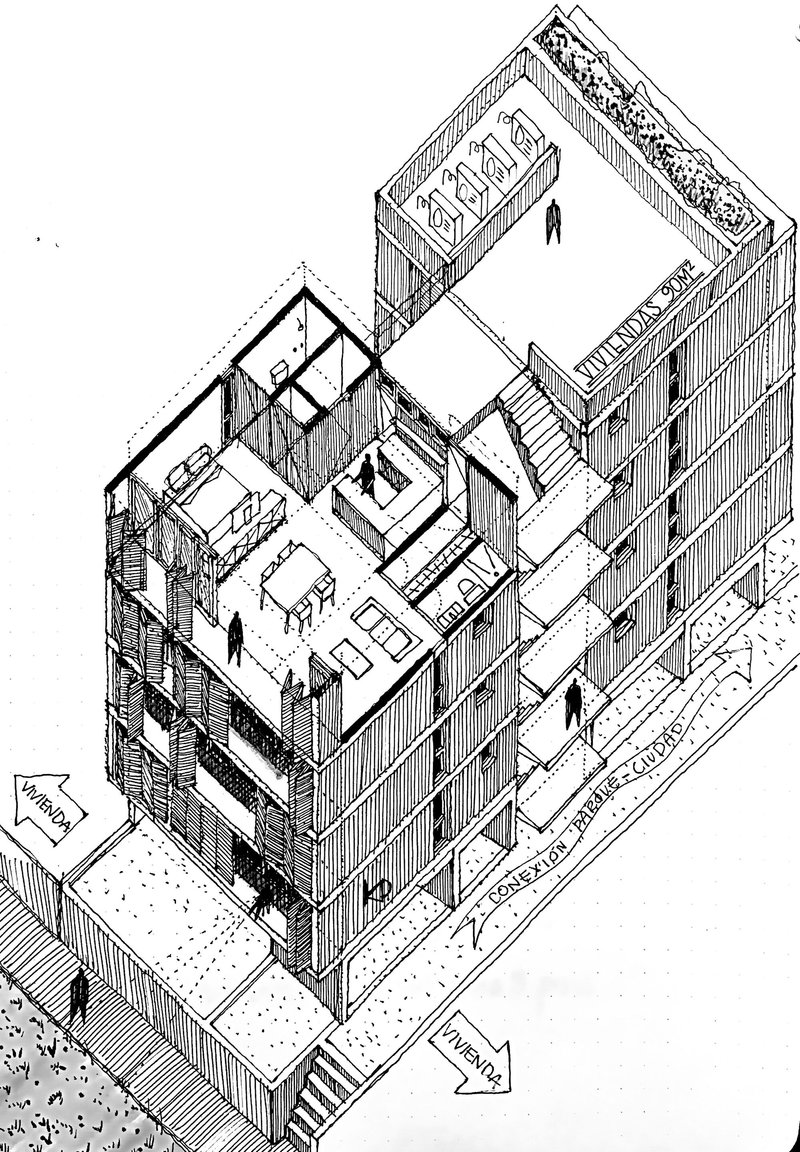
The site plan shows the triangular landscaped garden that defines the building's public interface, with the building footprint held tight against the street edge. Floor plans reveal units organized symmetrically around a central circulation core, with diagonal structural bracing visible on one facade. The variation across floors is clear: the lower levels accommodate the 60- and 90-square-meter units while upper floors shift in layout to accommodate the smaller 30-square-meter apartments.
The sections are telling. Five levels of open floor plates are connected by zigzagging staircases, and the proportions confirm that the balconies project far enough to shade the floor below. The elevation drawings document the alternating bands of glazing and patterned screenwork that give the facade its layered depth. The isometric drawing, with figures populating the terraces and rooftop, communicates the social ambition of the project as clearly as any photograph.
Why This Project Matters
Huachinango 36 matters because it demonstrates that re-densification in a tropical city does not require imported typologies or inflated budgets. Kiltro Polaris Arquitectura built 16 units with concrete, timber, and perforated screens, and the result performs environmentally, socially, and urbanistically. The absence of fences, the mix of unit sizes, the renewed public plaza: these are not aesthetic choices but policy positions embedded in architecture.
Too many housing projects in Mexican resort cities default to gated compounds that turn their backs on the street. Huachinango 36 does the opposite. It opens itself to the city and, in doing so, makes a case that the center of Cancún can be a place people choose to live, not just a zone they pass through on the way to the beach. That argument, built in honest concrete at a cost its context can sustain, is worth more than any rendering.
Huachinango 36 Building by Kiltro Polaris Arquitectura, lead architect Victor Imre Ebergenyi Kelly. Cancún, Mexico. 11,840 sq ft. Completed 2019. Photography by Cesar Béjar, Oscar Hernández, Wacho Espinosa.
About the Studio
Share Your Own Work on uni.xyz
If projects like this are the kind of work you want to make, uni.xyz is a place to publish your own, find collaborators, and enter design competitions.




Popular Articles
Popular articles from the community

IDIN Architects Wraps a Hua Hin Hotel Around a Private Courtyard to Escape the City
Dusit D2 Hua Hin turns an urban infill site in Thailand's family vacation heartland into a self-contained resort through courtyard planning.
VEIVE Architects Builds a Mountain Hostel That Disappears into a Hangzhou Hillside
On the Huihang Ancient Trail in Xiangjian Village, a shelter of wood, steel, and rammed earth roots itself in the rural landscape.
BLDUS Turns a 250-Square-Foot Screened Porch into a Pine Forest Temple in East Hampton
A gabled cedar pavilion mimics the rhythm of surrounding pines, anchoring a 1990s wooded home to its hollow in Long Island.
Indiesalon Carves a Plywood Cave into a Seoul Bistro's Second Floor
Munhwa Bistro's second Seongsu branch wraps diners in a laminated timber vault laced with colored light and mirror illusions.


Similar Reads
You might also enjoy these articles

127af Flips a Tiny Bagnolet Rowhouse Upside Down with a Handcrafted Roof Extension
A 55-square-meter terraced house on the edge of Paris gains a luminous upper living floor through lightweight timber and steel.
1.61 Design Workshop Wraps a 600-Square-Meter Café in Vietnam in Sculptural Burgundy Drama
Reden Café & Bistro pairs a helical staircase, mosaic floors, and deep red interiors to rethink Vietnamese hospitality space.

The Unbound Brain: A School Shaped by Cognitive Architecture
Cylindrical learning pods radiate like neurons from a central cortex, turning the floor plan into a spatial model of human thought.
Revival Vernacular Architecture: Rammed Earth Settlements for the Sahara
A modular desert community in Mauritania that fuses passive cooling techniques with earthen construction and local craftsmanship.


Explore Landscape Design Competitions
Discover active competitions in this discipline




The International Standard for Design Portfolios


The Global Benchmark for Architecture Dissertation Awards


The Global Benchmark for Graduation Excellence


Challenge to reimagine the Iron Throne
Comments (0)
Please login or sign up to add comments
No comments yet. Be the first to comment!