
Kim Lenschow and Pihlmann Architects Float a 58 m² Summerhouse Among Danish Birches
A foundation-free timber cabin in Northern Sealand treats lightness as both an ecological principle and an architectural aesthetic.

Most summerhouses claim to respect their sites. Between Birch House actually does. Designed by Kim Lenschow and pihlmann architects, this 58 m² cabin in Northern Sealand, Denmark, sits on helical pillars rather than poured concrete, leaving the forest floor essentially intact beneath it. The move is quiet, almost invisible, but it defines everything else about the project: a building that touches the ground as lightly as possible and treats reduction not as sacrifice but as strategy.
What makes the house genuinely interesting is how it weaponizes smallness. From the outside, the gabled profile reads as modest, nearly retreating. Step inside and the rooms are unexpectedly tall, the vaulted plywood ceilings pulling the eye upward and the generous glazing pulling it outward. Selective material application, birch plywood only where the body contacts walls, leaves the construction layers exposed elsewhere, turning economy into ornament. The result is a building that feels provisional in the best sense: present but not permanent, part of the grove rather than imposed on it.
Touching the Ground Lightly
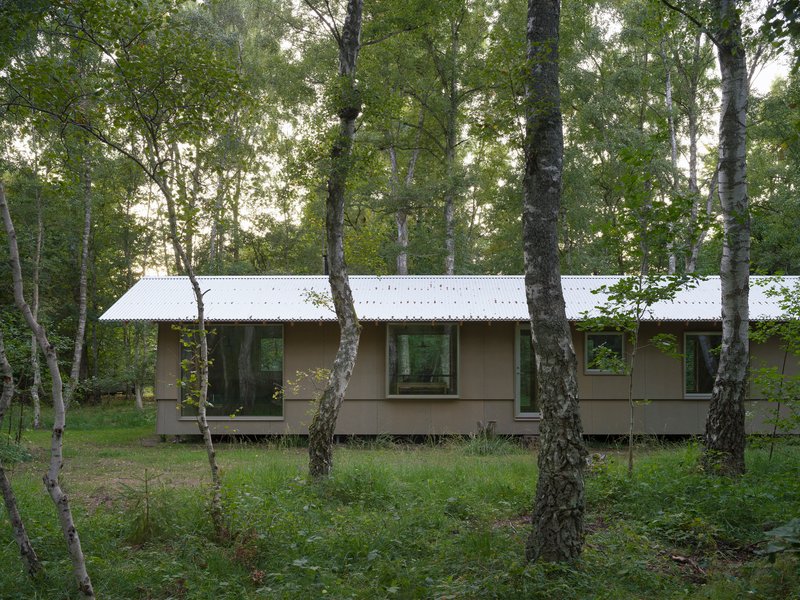
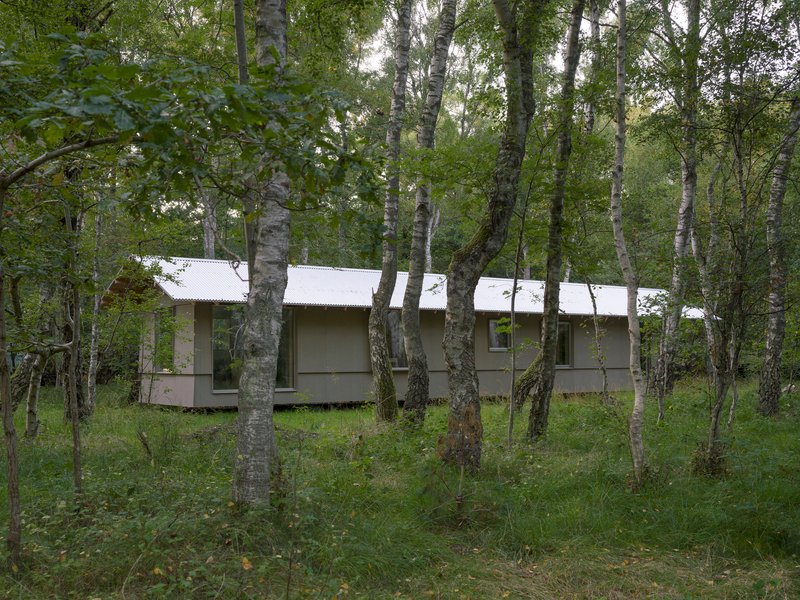
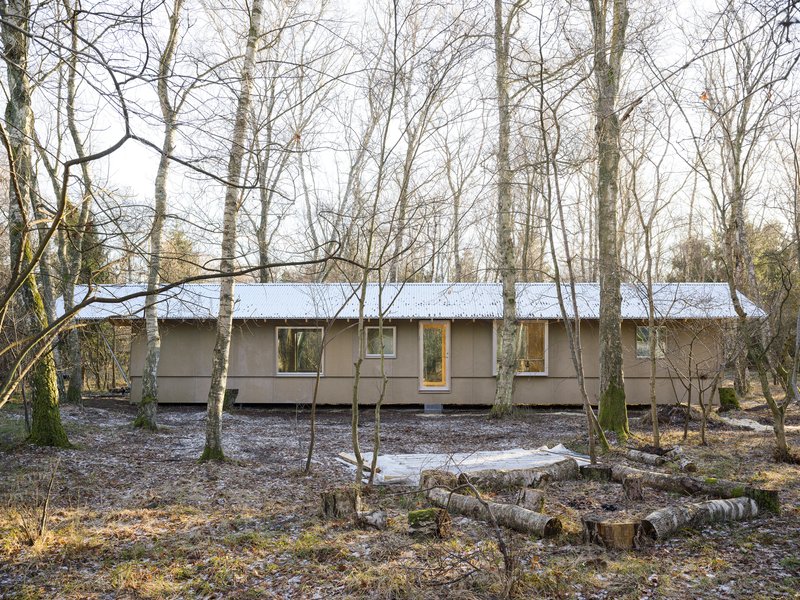
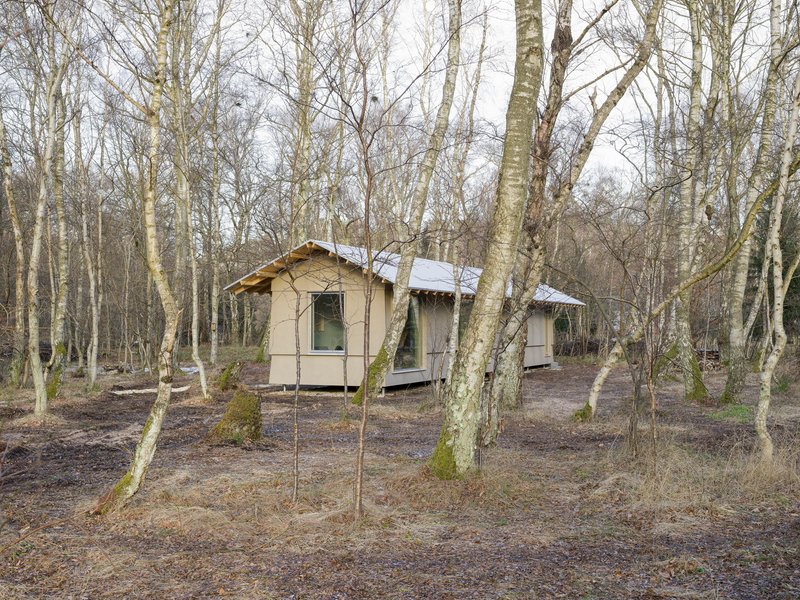
The long elevation tells you most of what you need to know. A corrugated metal roof sits low over timber-framed walls, its horizontal profile weaving between birch trunks with an almost accidental rhythm. The helical pillar foundation is invisible in these views, which is precisely the point: the house appears to have simply arrived among the trees. No excavation scars, no concrete plinths, no grading. The forest floor runs uninterrupted beneath the structure.
The corrugated roofing, far from feeling industrial, registers as appropriately lightweight. It belongs to the category of sheds and outbuildings, structures that do not demand permanence. That association is deliberate. Lenschow and pihlmann are positioning the summerhouse as a guest in the landscape, something that could, in theory, be unbolted and removed without leaving a scar.
A Gable That Misleads
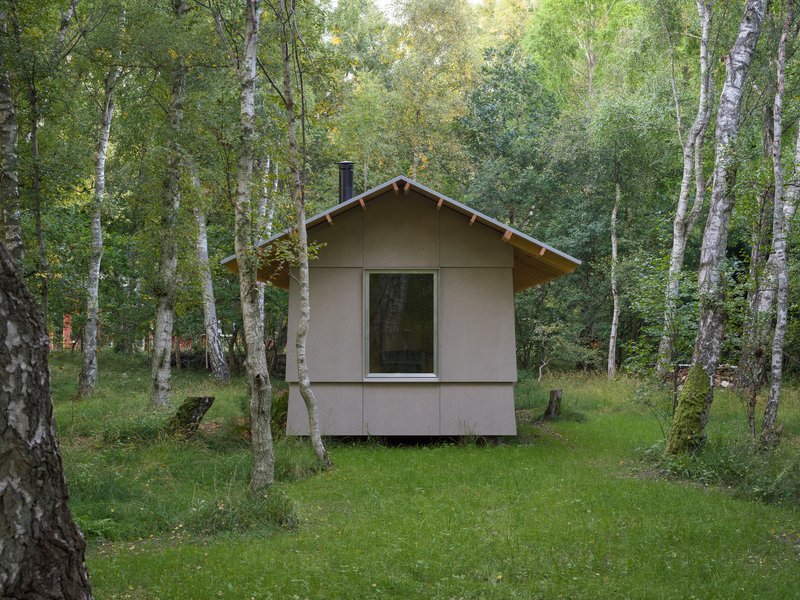
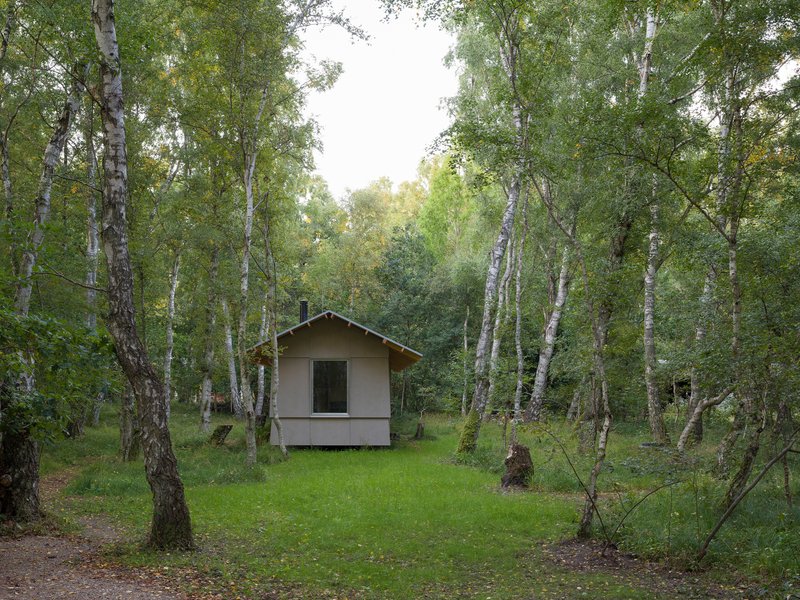
The gable end is the house's public face, and it deliberately undersells the interior. A single centered window, vertical panel cladding, a compact triangular profile: from this angle the building looks like a garden shed for a very tidy gardener. The surprise comes when you enter and discover rooms with real height, the pitched ceiling creating spatial generosity that the exterior promised nothing about.
The hempcrete and stucco walls visible in certain elevations contribute to the cabin's chameleonic quality. In winter, the pale tones merge with bare birch bark. In summer, foliage swallows the profile entirely. The architects seem uninterested in making the house photograph well from a distance; they want it to disappear.
Exposed Layers and Selective Lining
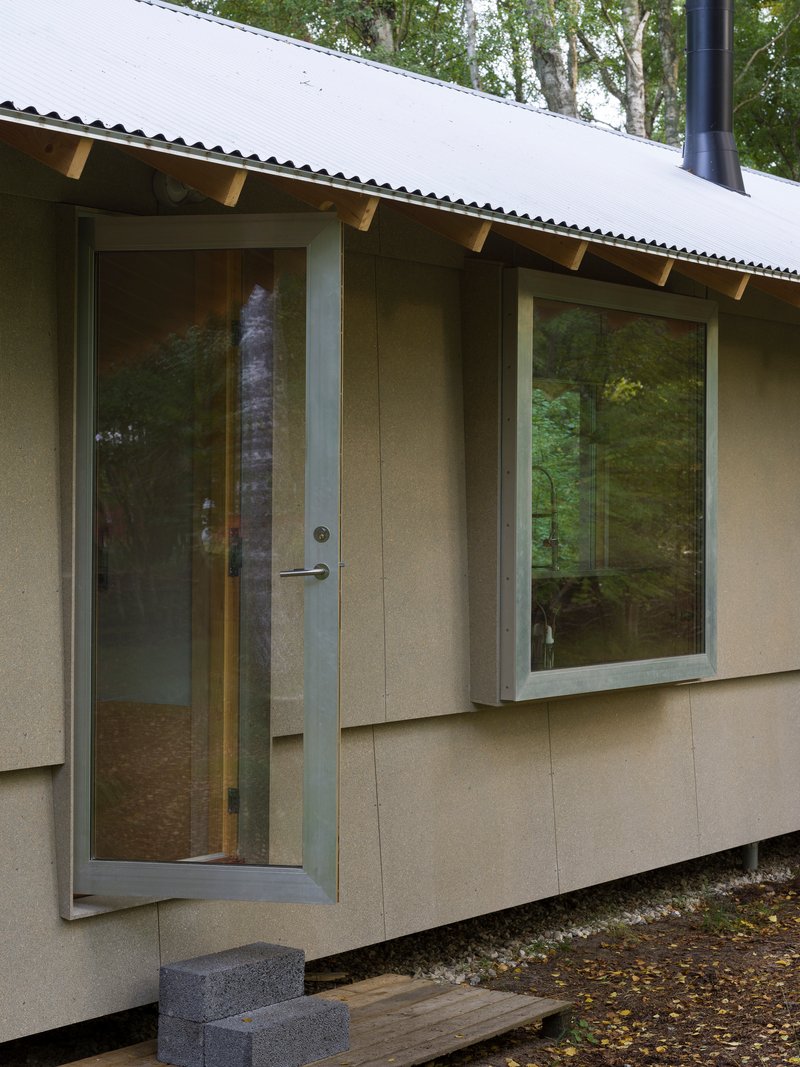
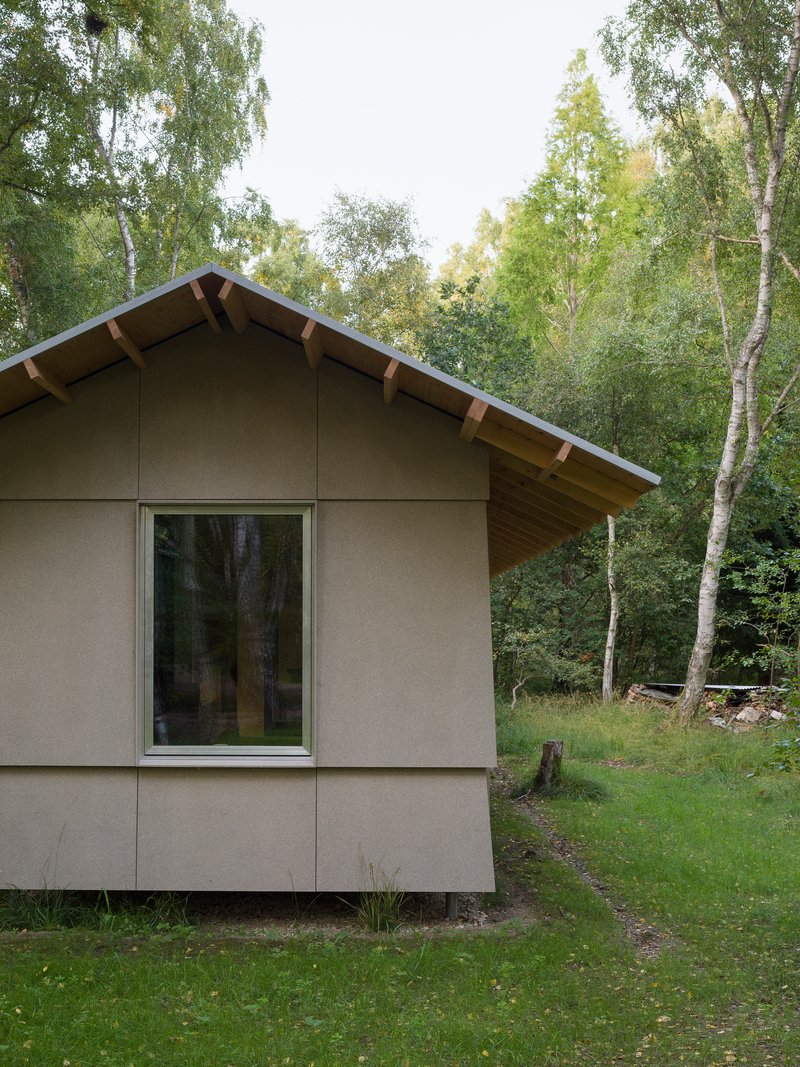
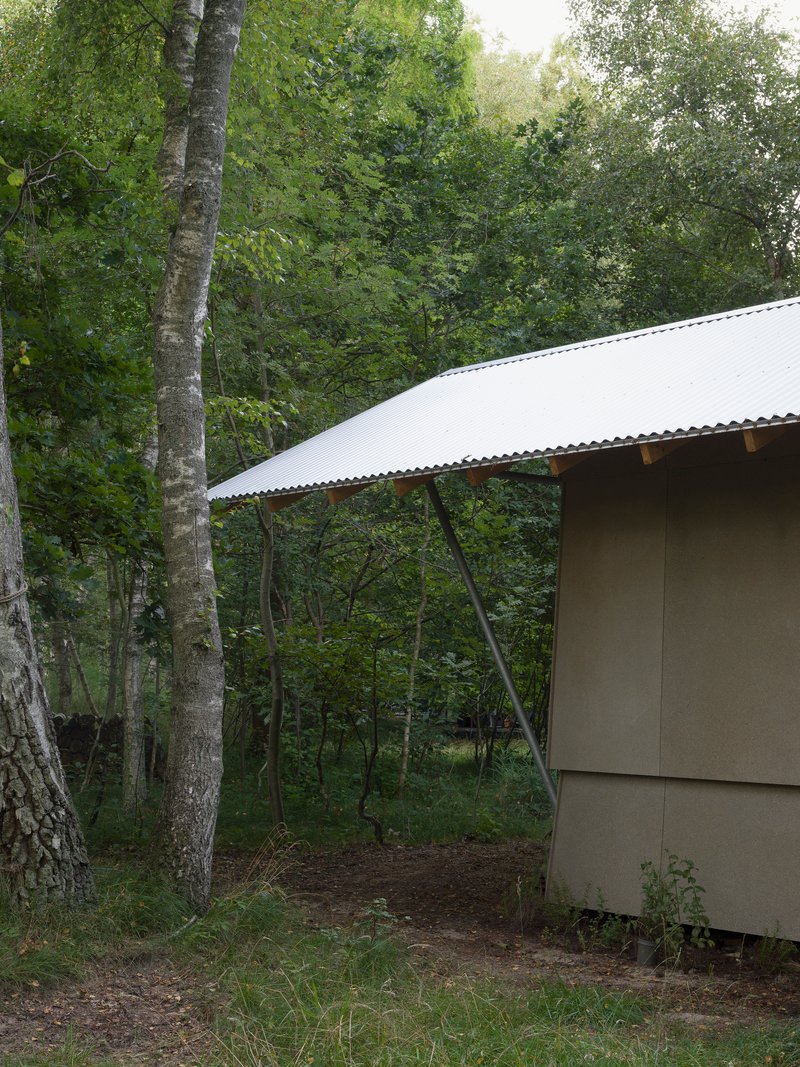
The detailing deserves close attention. Exposed rafter brackets, unfinished timber fascia, visible struts beneath the corrugated overhang: the architects have left the construction logic legible rather than concealing it behind plasterboard. Birch plywood is applied economically, only at the points where the inhabitant's body makes contact with the building. Walls you lean against, surfaces you touch, thresholds you cross. Everywhere else, the underlying timber structure remains exposed, creating a layered reading of the construction that shifts as you move through the house.
This selective application reduces material use without resorting to austerity. The plywood-lined zones feel warm and finished; the exposed zones feel honest and workshop-like. The two conditions coexist without friction, giving the interior a textural complexity that a uniformly finished house at this scale could never achieve.
Kitchen as Threshold
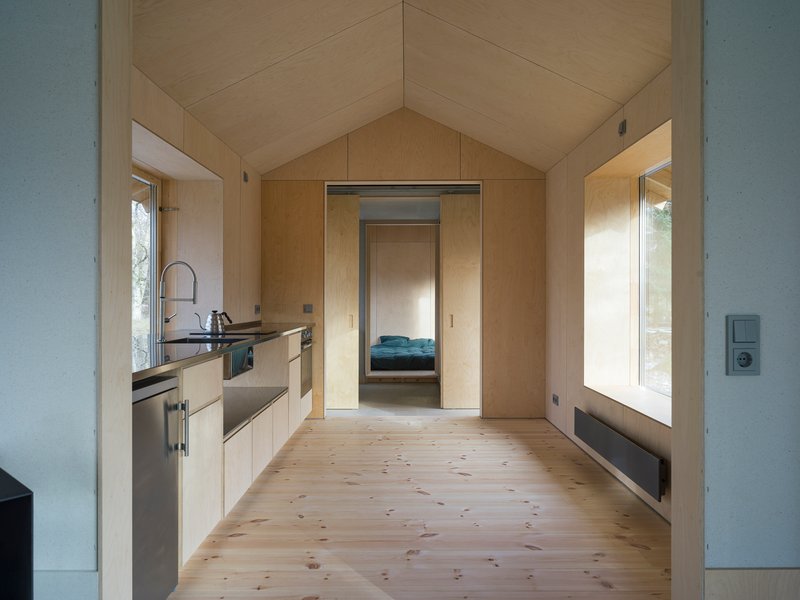
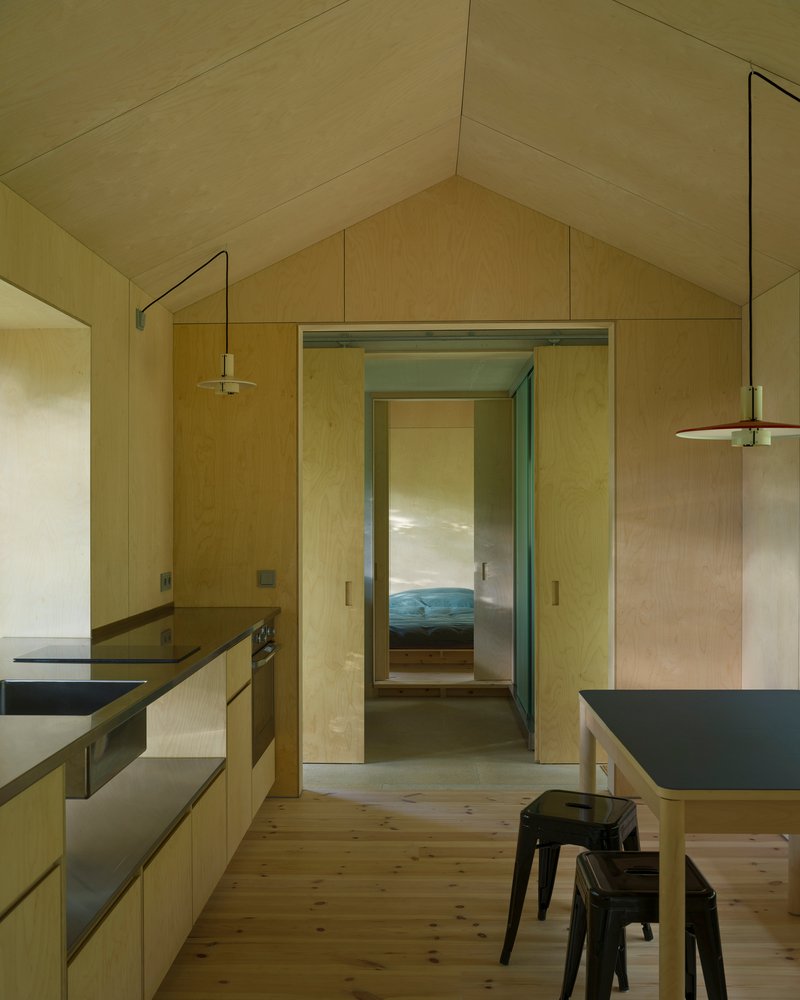
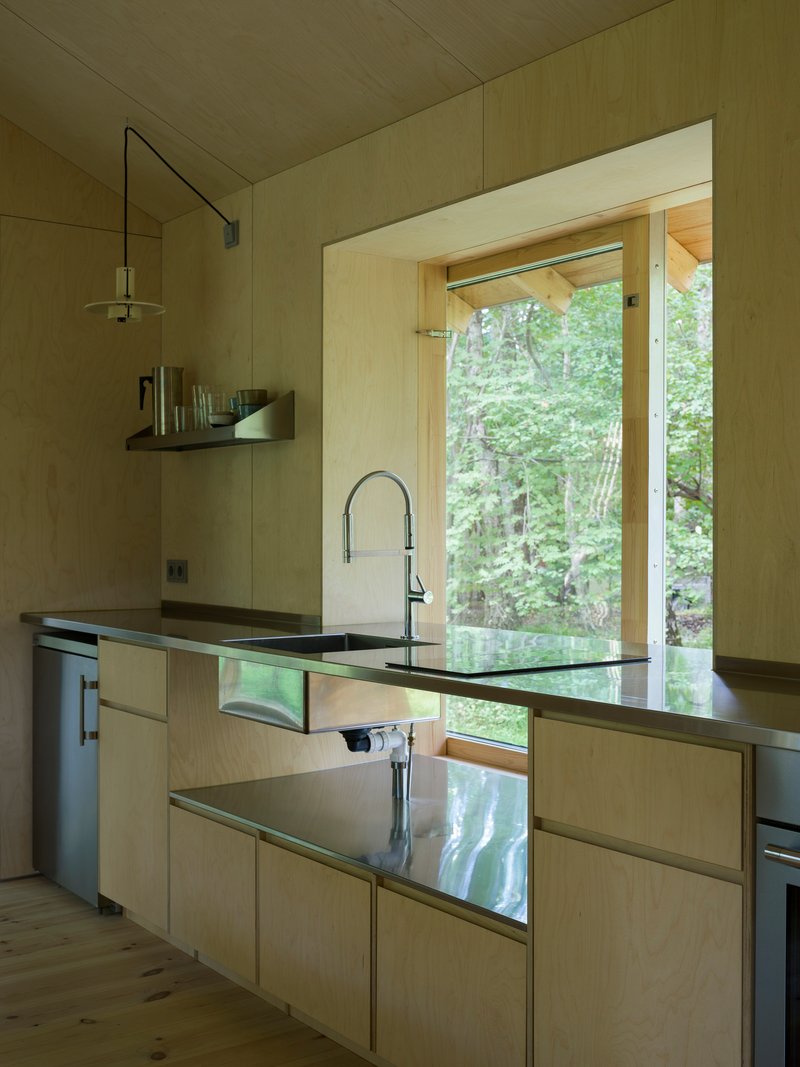
The kitchen sits at the heart of the linear plan, functioning as both a room and a corridor. Plywood cabinetry with dark countertops lines one wall, while doorways on either side frame views through to the bedroom and living spaces beyond. The vaulted ceiling runs continuously overhead, pulling the sequence of rooms into a single spatial experience despite the partitions.
Large windows frame birch trunks and summer foliage at counter height, making the act of cooking feel like standing in a clearing. The stainless steel sink and minimal hardware reinforce the cabin's ethos of functional sufficiency. Nothing decorative, nothing superfluous, but nothing missing either.
Rooms in Sequence
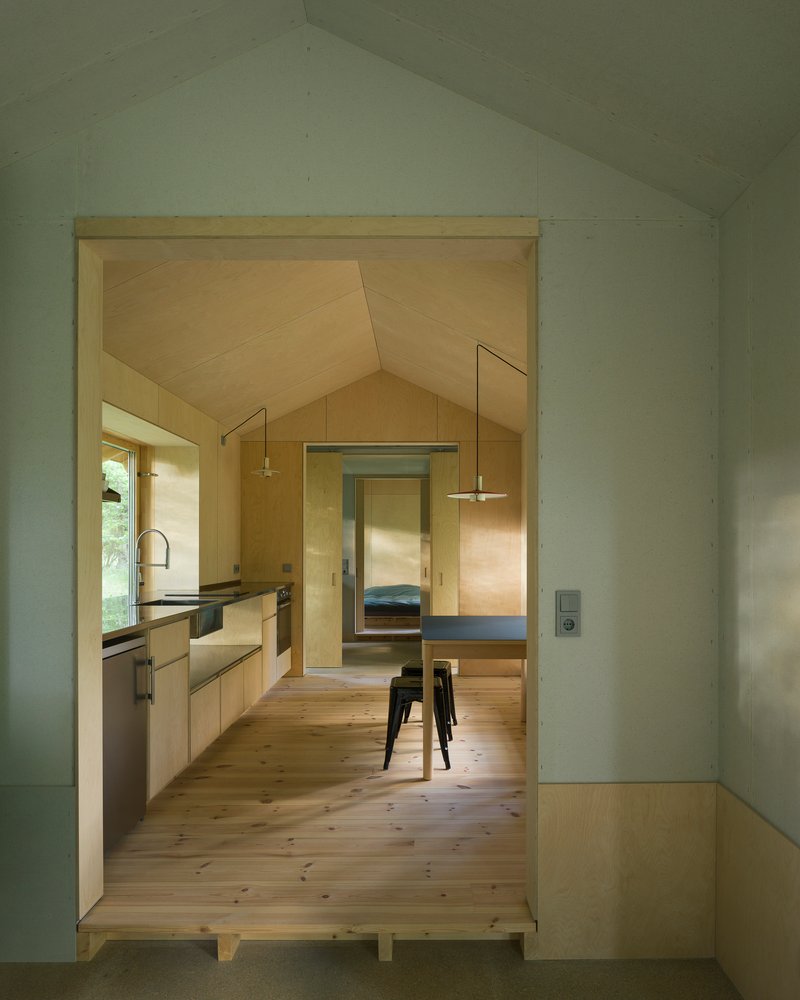
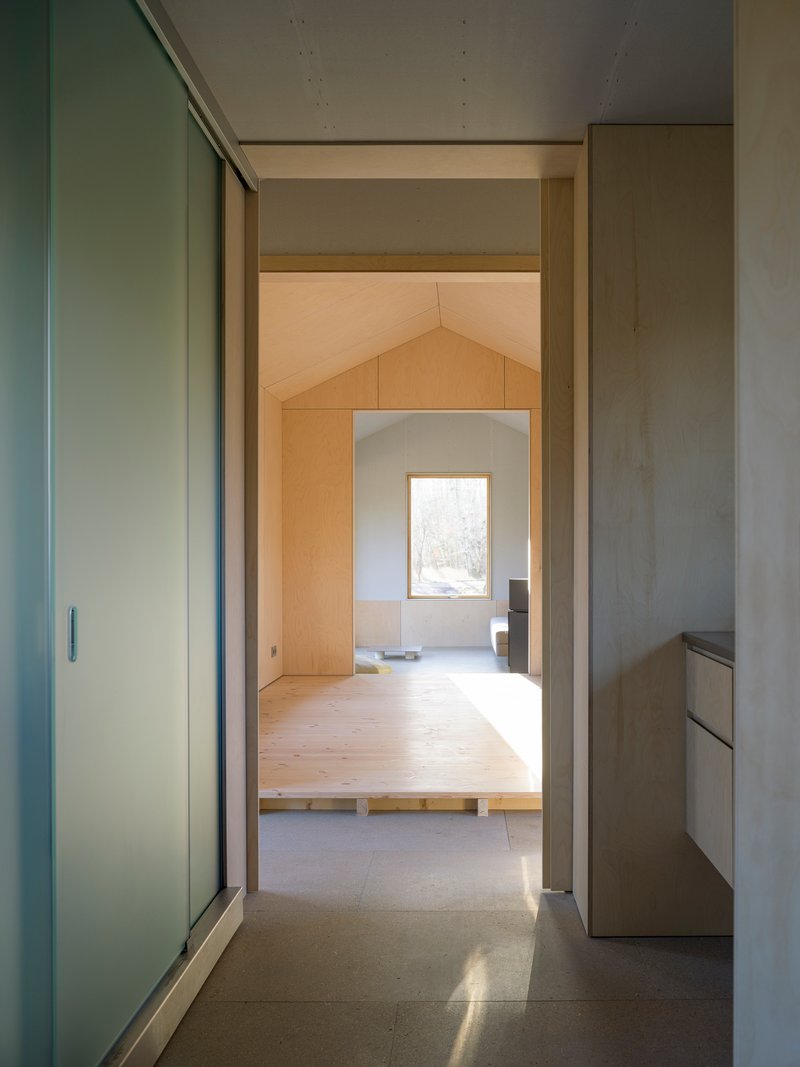
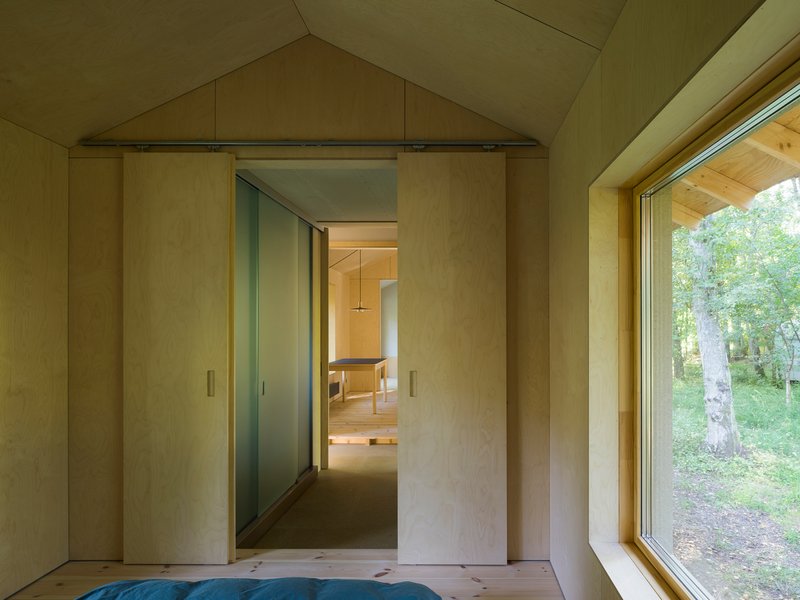
At 58 m², the plan has no room for a hallway. Rooms simply open into one another through a procession of doorways, each framing the next space and, beyond it, the forest. The plywood-lined pitched ceilings unify the sequence, but subtle shifts in wall color, a green plaster finish here, raw plywood there, differentiate each room without requiring doors or partitions.
The guest room, accessed from outside rather than through the main interior, is a clever concession to both spatial economy and social intelligence. It gives guests privacy without consuming precious corridor space, and it gives the host a measure of solitude. In a house this small, that separation is more valuable than an extra ten square meters.
Interior Character
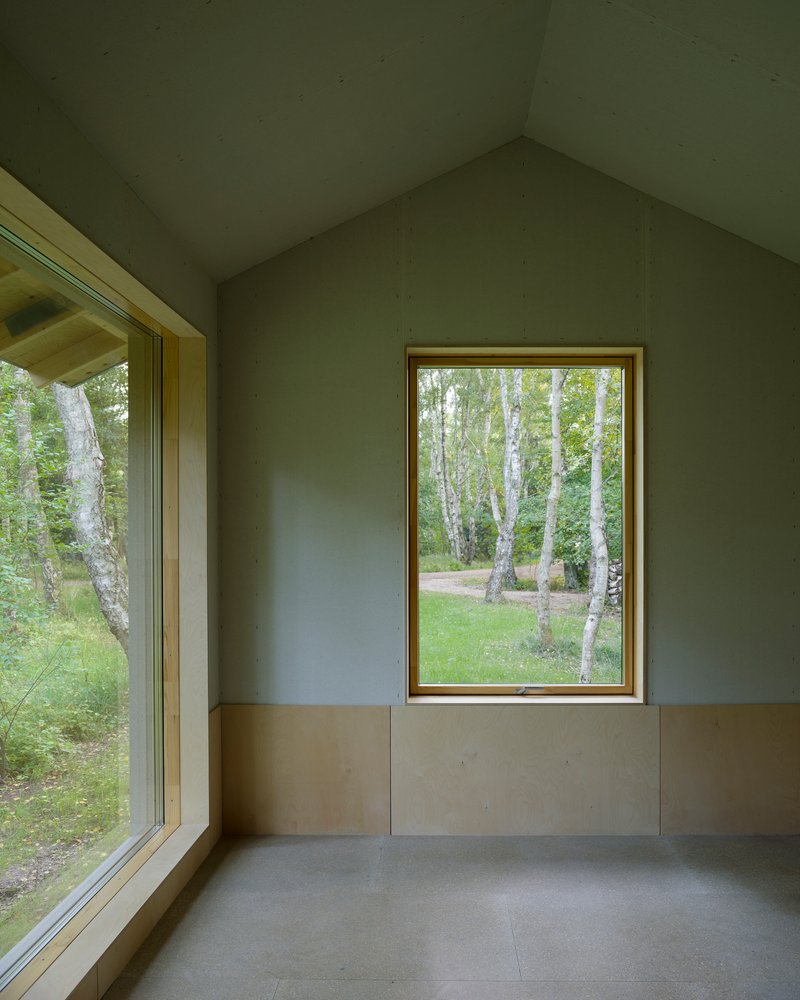
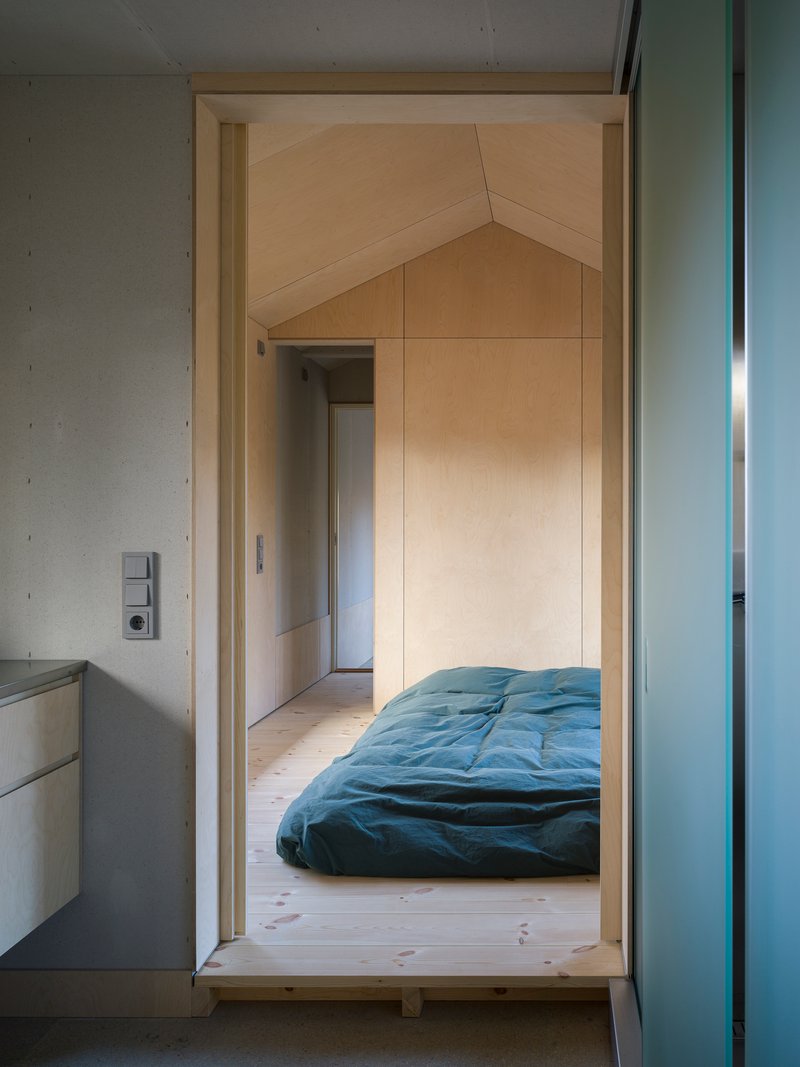
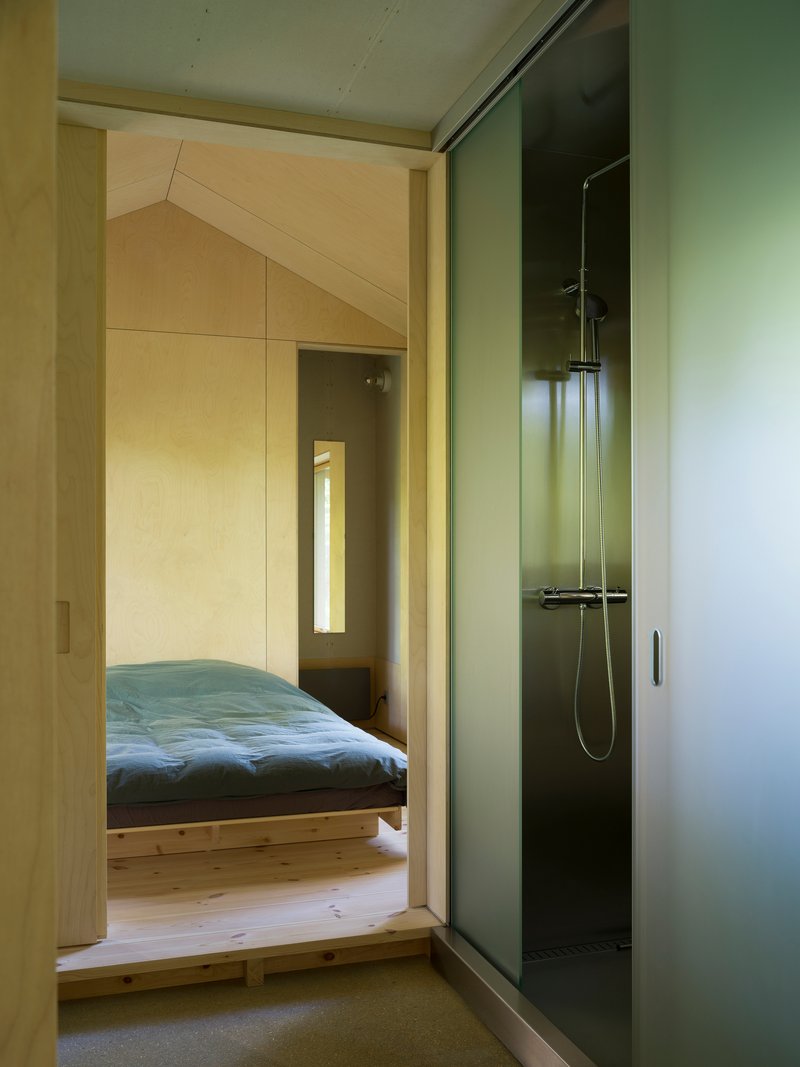
The green plaster walls in the living room are a deliberate counterpoint to the plywood palette elsewhere. They ground the space emotionally, adding a warmth and chromatic depth that raw birch ply alone cannot provide. Combined with the vaulted ceiling and the carefully placed window overlooking the grove, the room achieves a sense of enclosure that feels protective rather than confining.
The bedroom and bathroom are compact but not cramped. A raised sleeping platform, a glass shower enclosure with a view through to the bedroom, and a wall-mounted sink overlooking summer foliage: each element is placed with the precision of a boat interior, where every centimeter has been argued over. The result is a domestic space that works exactly as well as it needs to and not a millimeter more.
Dusk and the Window Wall
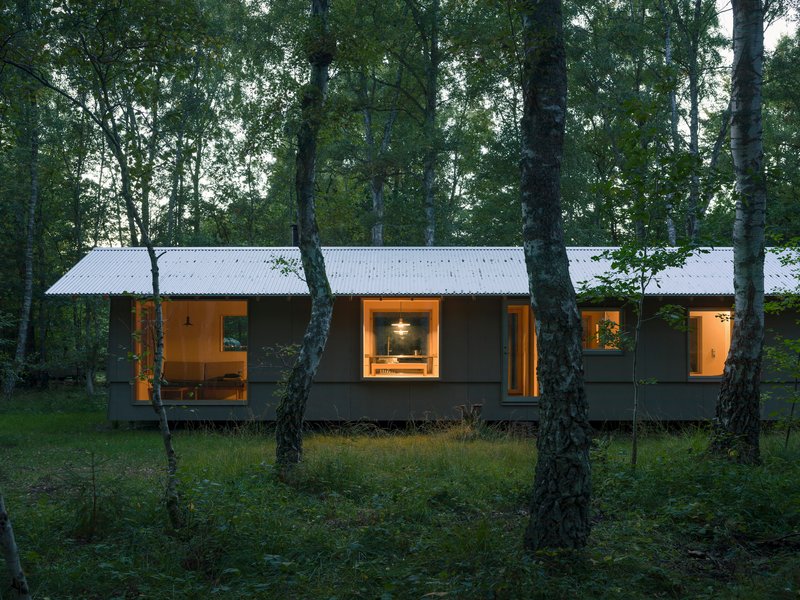
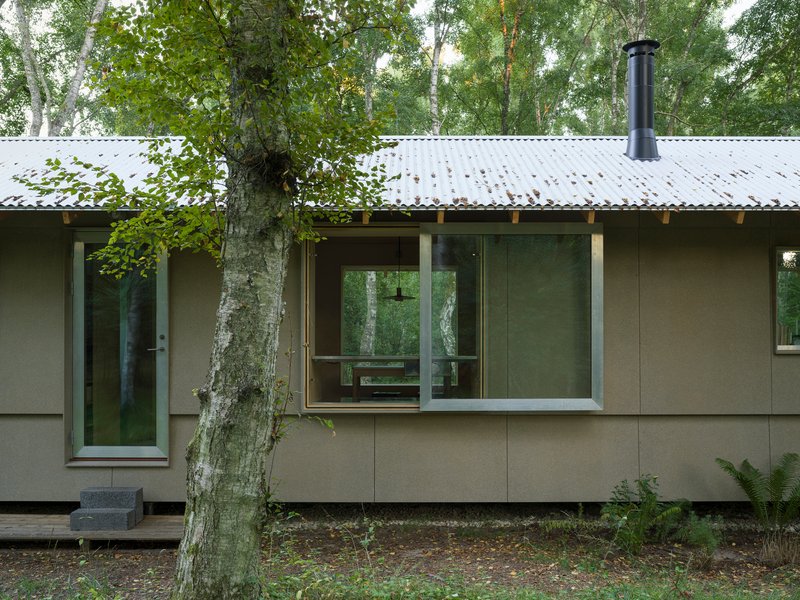
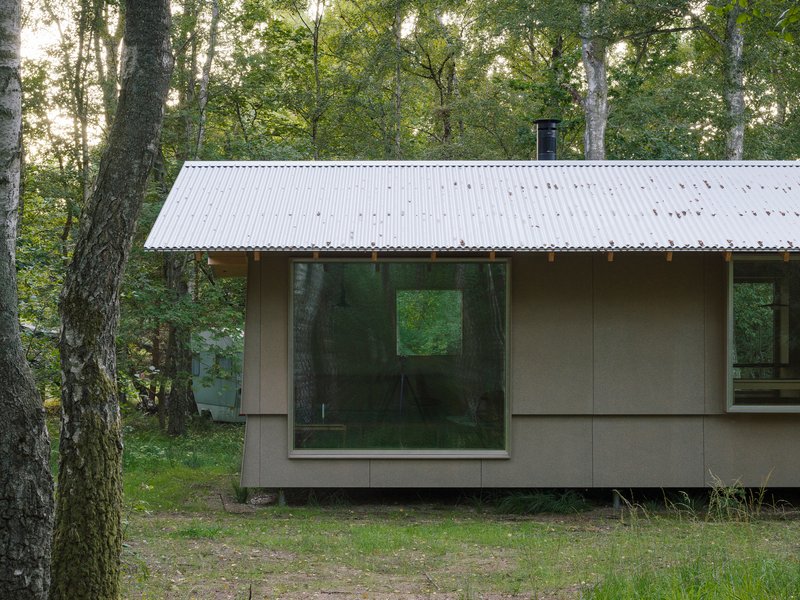
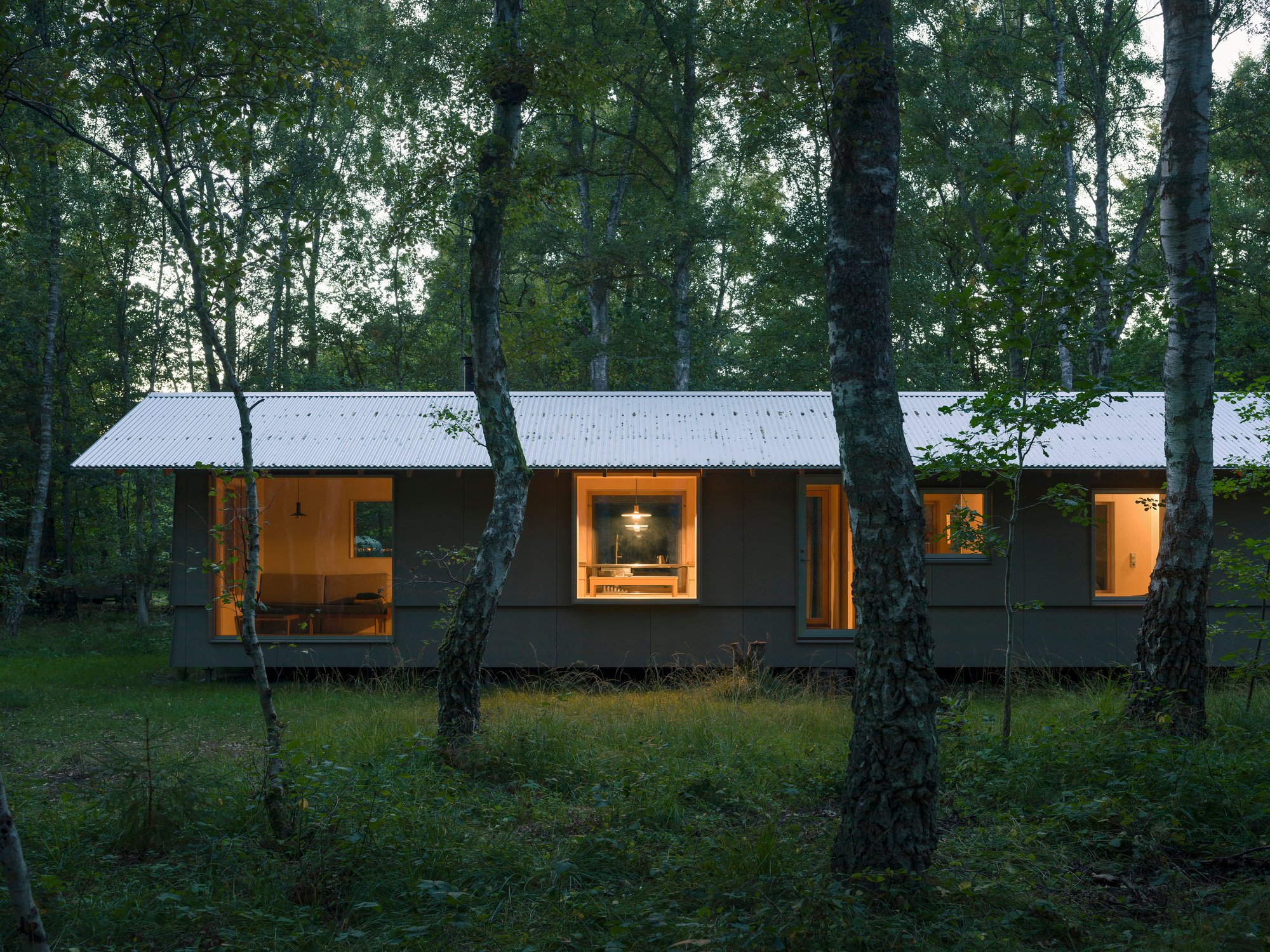
At dusk, the house inverts. The dark facade recedes into the trees while the lit interior becomes a lantern, its glazed openings projecting warm rectangles of light onto birch bark. The bay window projection, visible during the day as a modest functional bump, becomes a glowing vitrine at night. It is in these moments that the house most clearly reveals its ambition: not to dominate or to hide, but to participate in the daily rhythm of the forest, bright when the trees are dark, shadowed when the canopy is lit.
Plans and Drawings
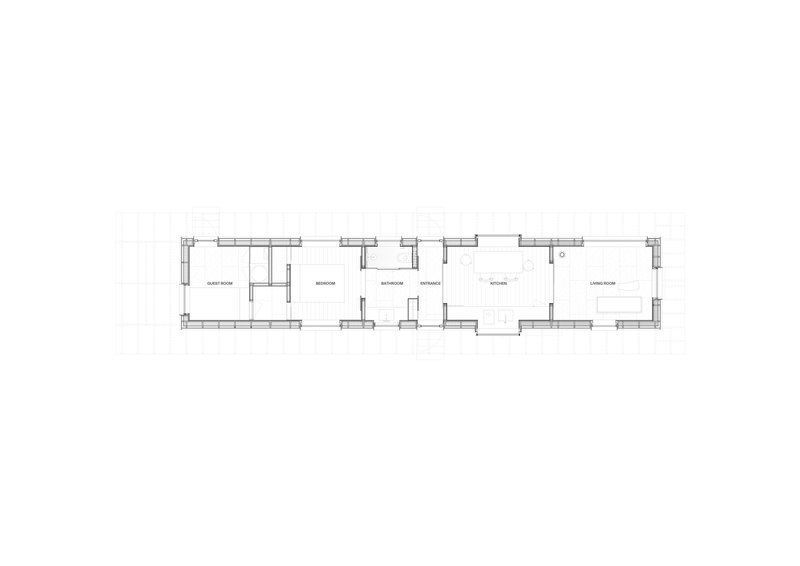
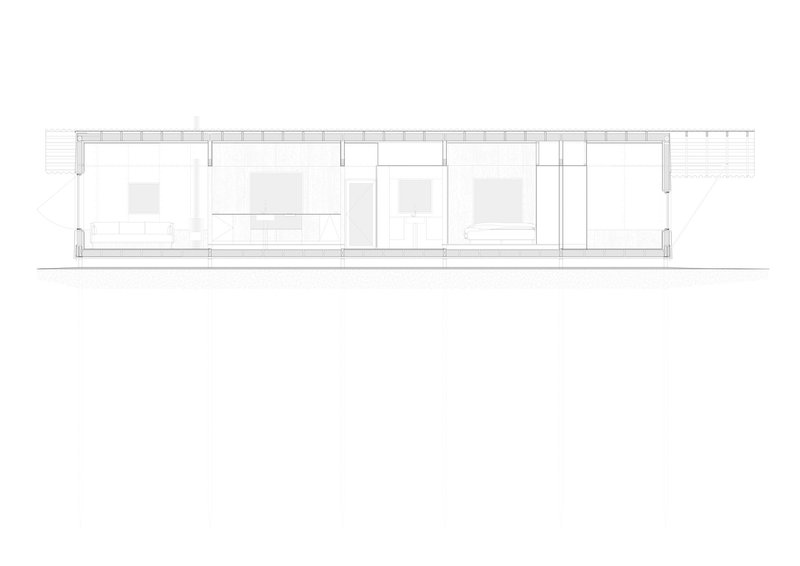
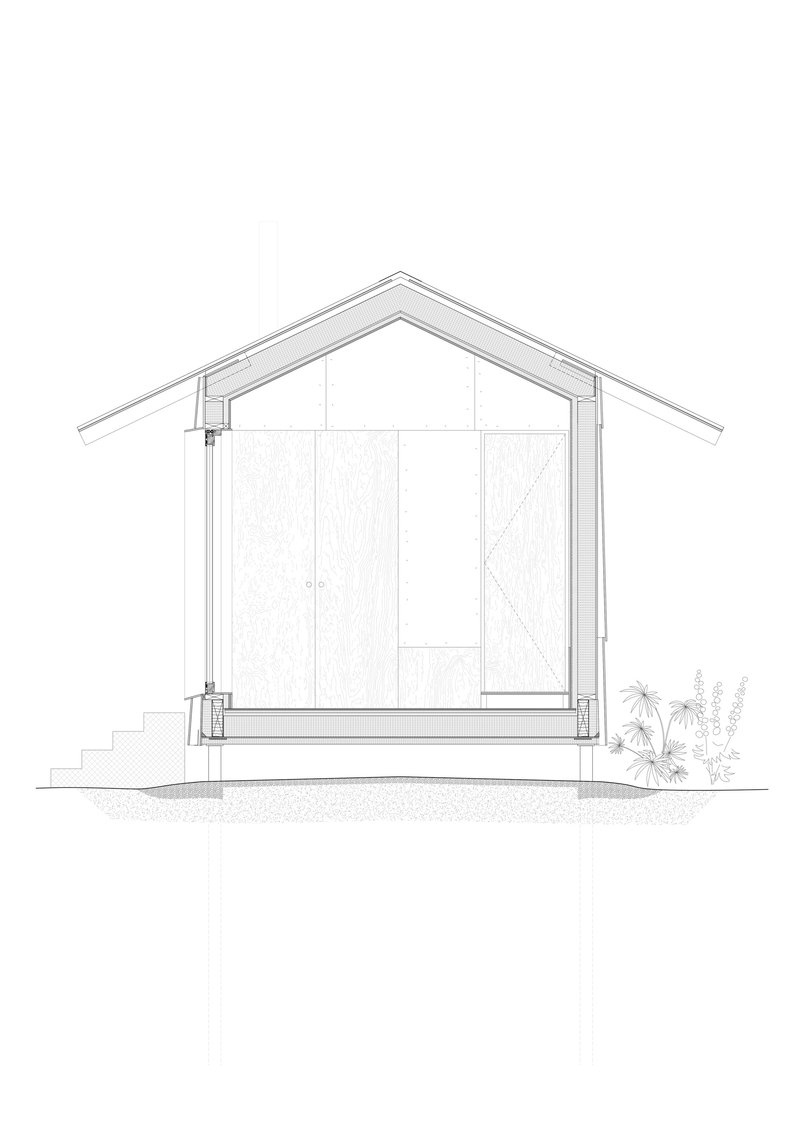
The floor plan confirms the strict linearity of the arrangement: five rooms stacked end to end, each the full width of the house. No wasted circulation, no ambiguous in-between zones. The section drawing reveals the interior volume's generosity, the gabled roof creating rooms that are taller than they are wide in places, contradicting the compressed exterior profile. The elevation drawing, with its planted groundcover notation, reiterates the architects' commitment to minimal site disturbance.
Why This Project Matters
Between Birch House is a useful corrective to the notion that ecological architecture must be technologically complex. There are no solar arrays here, no geothermal loops, no triple-glazed curtain walls. The environmental argument is structural: skip the concrete foundation, use less material, build small, and accept that a summerhouse does not need to outlast the trees around it. That argument, made in 58 square meters of plywood and corrugated metal, is more persuasive than most sustainability manifestos.
It also demonstrates that restraint and richness are not opposites. The selective use of birch plywood, the exposed construction layers, the color shift from plywood to green plaster, these are deliberate moves that give the house an interior life far more complex than its tiny footprint suggests. Lenschow and pihlmann have built a summerhouse that takes almost nothing from its site and gives back a quiet, considered lesson in how little a good building actually needs.
Between Birch House by Kim Lenschow and pihlmann architects. Located in Northern Sealand, Denmark. 58 m². Completed in 2022. Photography by Hampus Berndtson and Peter Dalsgaard.
About the Studio
Kim Lenschow
Official website of Kim Lenschow, one of the studios behind this project.
kimlenschow.comShare Your Own Work on uni.xyz
If projects like this are the kind of work you want to make, uni.xyz is a place to publish your own, find collaborators, and enter design competitions.




Popular Articles
Popular articles from the community

Three Studios Build 200 Affordable Units for Tulum's Displaced Hospitality Workers
Casa Selva embeds dark concrete housing blocks into Yucatán rainforest, offering dignified shelter to those priced out by the tourism they serve.


Cyber Oyster: A Visionary Adaptive Reuse Architecture Project Transforming Abandoned Oil Rigs Through Oyster Bionics
An adaptive reuse architecture concept transforming abandoned offshore oil platforms into self-healing marine ecosystems inspired by oyster bionics.
BAUEN Builds Two Rammed Earth Volumes in Paraguay Inspired by the Ovenbird's Nest
In San Bernardino, a house of compacted earth channels the instinct of a constructive bird to shelter life from the Paraguayan summer.
BAST Slots a Four-Story Glass House into a Narrow Gap Between Toulouse Townhouses
In the dense Bonnefoy district, a stepped infill building merges home and office while preserving a majestic hackberry tree.


Similar Reads
You might also enjoy these articles
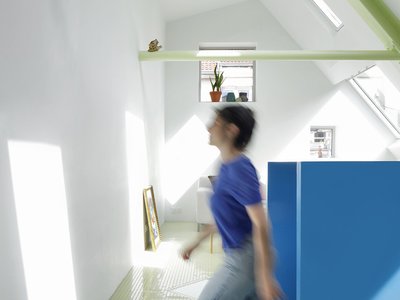
127af Flips a Tiny Bagnolet Rowhouse Upside Down with a Handcrafted Roof Extension
A 55-square-meter terraced house on the edge of Paris gains a luminous upper living floor through lightweight timber and steel.
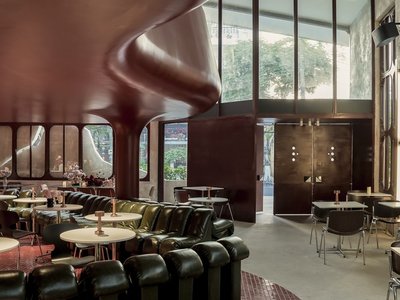
1.61 Design Workshop Wraps a 600-Square-Meter Café in Vietnam in Sculptural Burgundy Drama
Reden Café & Bistro pairs a helical staircase, mosaic floors, and deep red interiors to rethink Vietnamese hospitality space.

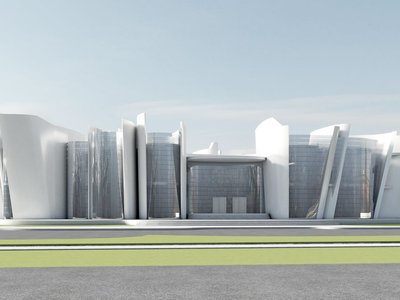
The Unbound Brain: A School Shaped by Cognitive Architecture
Cylindrical learning pods radiate like neurons from a central cortex, turning the floor plan into a spatial model of human thought.
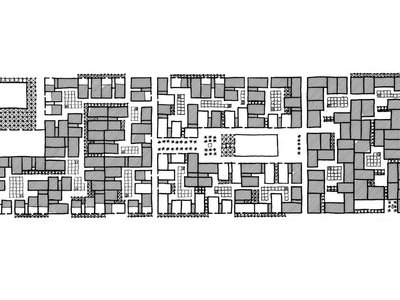
Revival Vernacular Architecture: Rammed Earth Settlements for the Sahara
A modular desert community in Mauritania that fuses passive cooling techniques with earthen construction and local craftsmanship.


Explore Architecture Competitions
Discover active competitions in this discipline




The International Standard for Design Portfolios


The Global Benchmark for Architecture Dissertation Awards


The Global Benchmark for Graduation Excellence


Challenge to design mud housing for contemporary communities
Comments (0)
Please login or sign up to add comments
No comments yet. Be the first to comment!