

kit Architects Stack a Timber Tower House on a Triangular Plot in the Swiss Rhine Valley
A prefabricated spruce dwelling near St. Gallen uses a concrete core and passive ventilation to rethink the rural archetype.


There is a particular kind of restraint that reads as confidence, and kit's Tower House in the Rhine Valley near St. Gallen has it. On a constrained triangular site close to a historic village center, the practice has placed a three-storey family dwelling that borrows the proportions of a rural gabled house, stretches them vertically, and then resolves the interior through a single organizational move: a board-formed concrete core that anchors structure, services, and airflow in one element.
What makes the project worth studying is not the pitched roof or the timber cladding, both of which are contextually expected in this part of Switzerland. It is the way the building treats prefabrication as a design discipline rather than a delivery method. Spruce panels for walls, floors, and ceilings were manufactured off-site and assembled in three days. The timber structure remains exposed internally, with no applied finishes, so the speed of construction becomes a permanent legibility in the finished rooms. The result is a house that feels simultaneously quick and considered, raw and precise.
A Familiar Silhouette, Deliberately Stretched
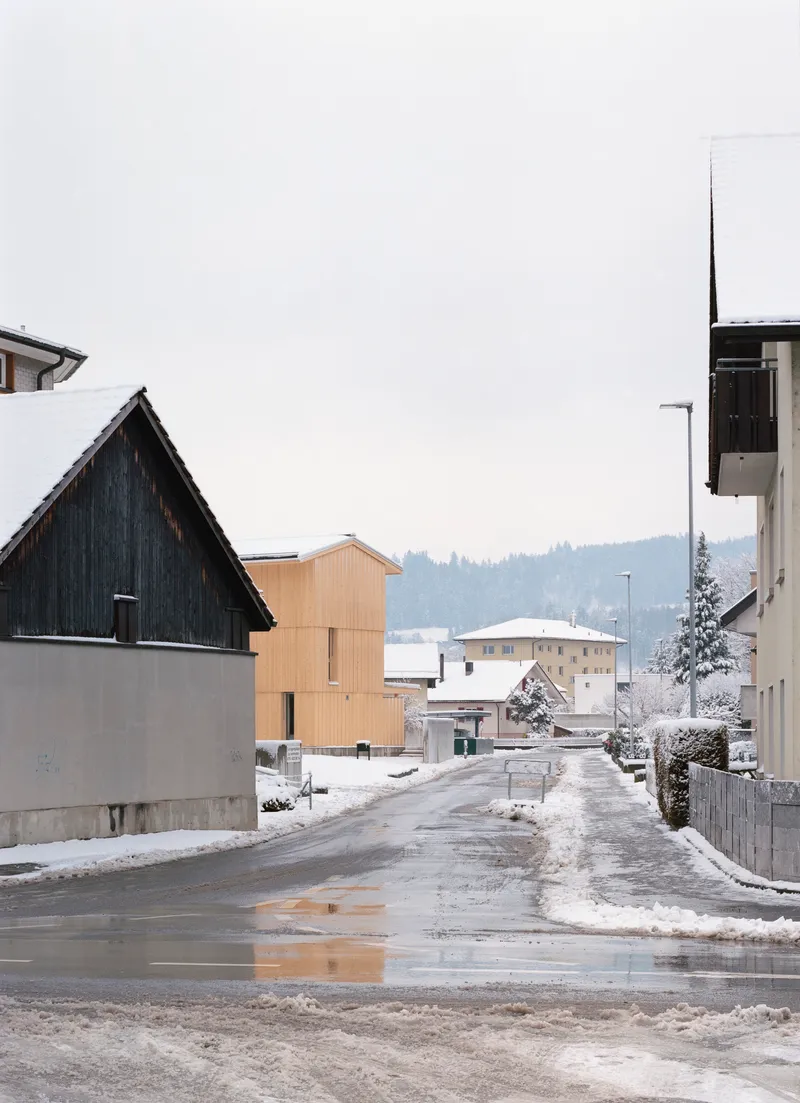
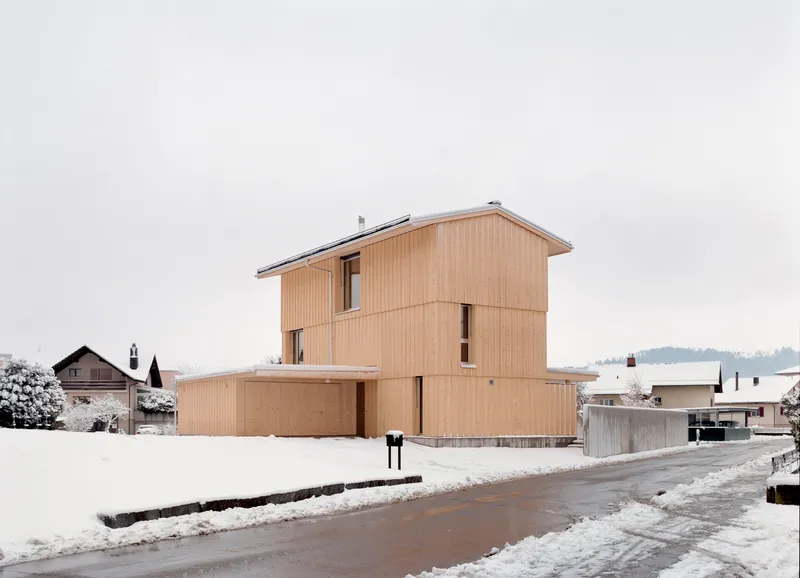
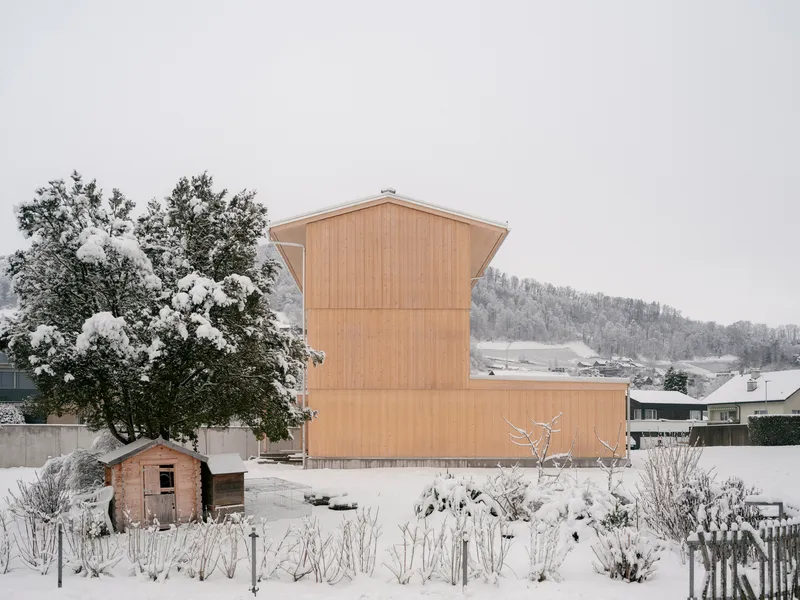
Seen from the village street, Tower House reads as a narrow, tall volume with a pitched gabled roof, close enough to the surrounding traditional buildings to feel native, different enough in proportion to register as new. The narrow plan and tall side elevations recall the archetype of a rural dwelling but push it vertically, creating a compact footprint that preserves outdoor space and anticipates future development. kit positioned the building to open views toward the surrounding landscape while reducing overlooking of neighbors, a site strategy that also reserves the southern portion of the plot for a potential second house of similar dimensions.
The ventilated timber facade wraps the entire volume in vertical spruce boards, with generous roof overhangs protecting the envelope. At the base, the building meets a weathered concrete boundary wall and a set of concrete steps, grounding the lightweight timber structure with a heavier material language at the threshold between site and street.
Timber and Concrete in Dialogue

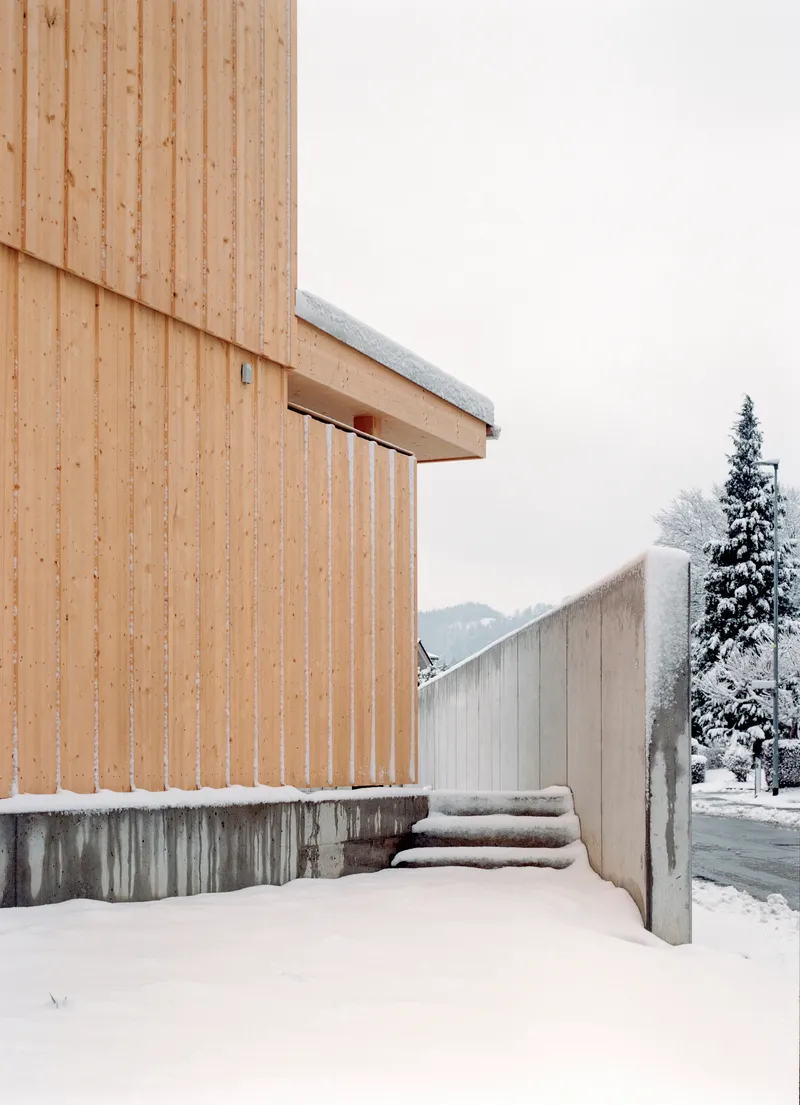
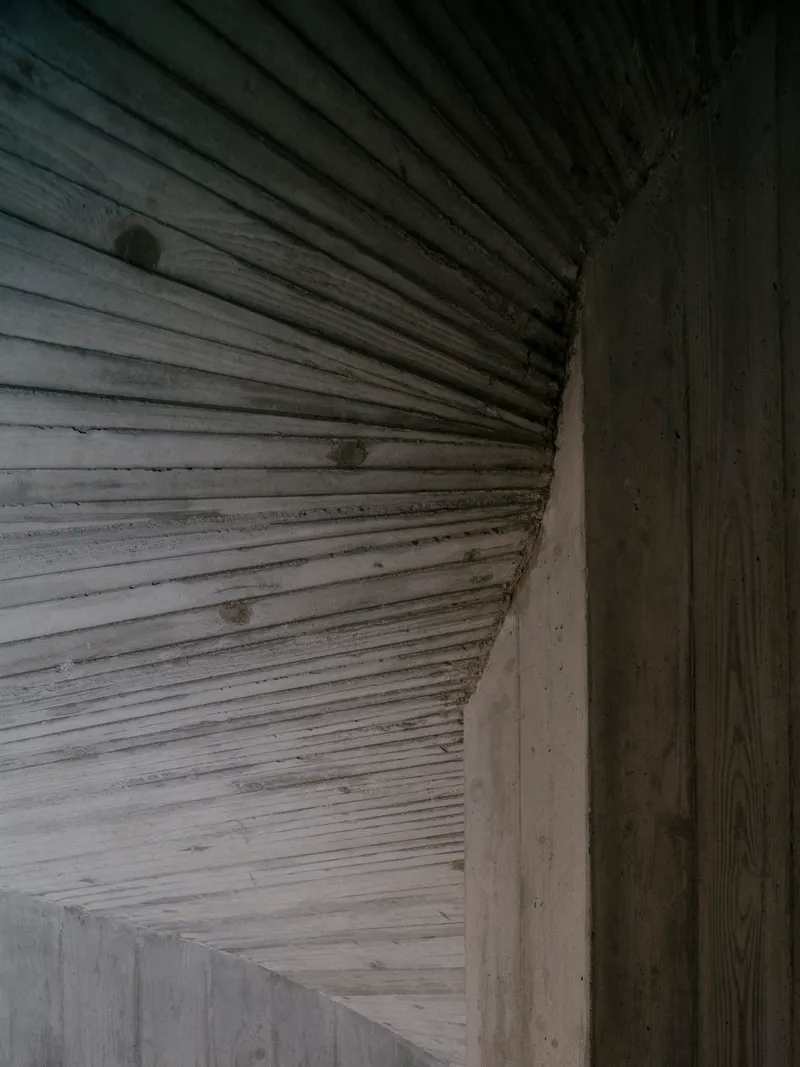
The exterior detail tells a story of two material systems working in tandem. Perforated timber screens sit beside horizontal windows, modulating light and privacy without resorting to blinds or shutters. Where the timber cladding meets the concrete steps and walls at ground level, there is a deliberate collision: warm, striated, lightweight wood against cold, board-formed, massive concrete. Neither material defers to the other.
Inside, this duality intensifies. The ribbed timber ceiling meets the board-formed concrete wall at precise corners, and neither surface carries any applied finish. What you see is what was built. The plywood panels and spruce structure read as warm and directional, while the concrete core reads as gravitational and still. It is a limited palette executed without compromise.
The Concrete Core as Organizing Spine


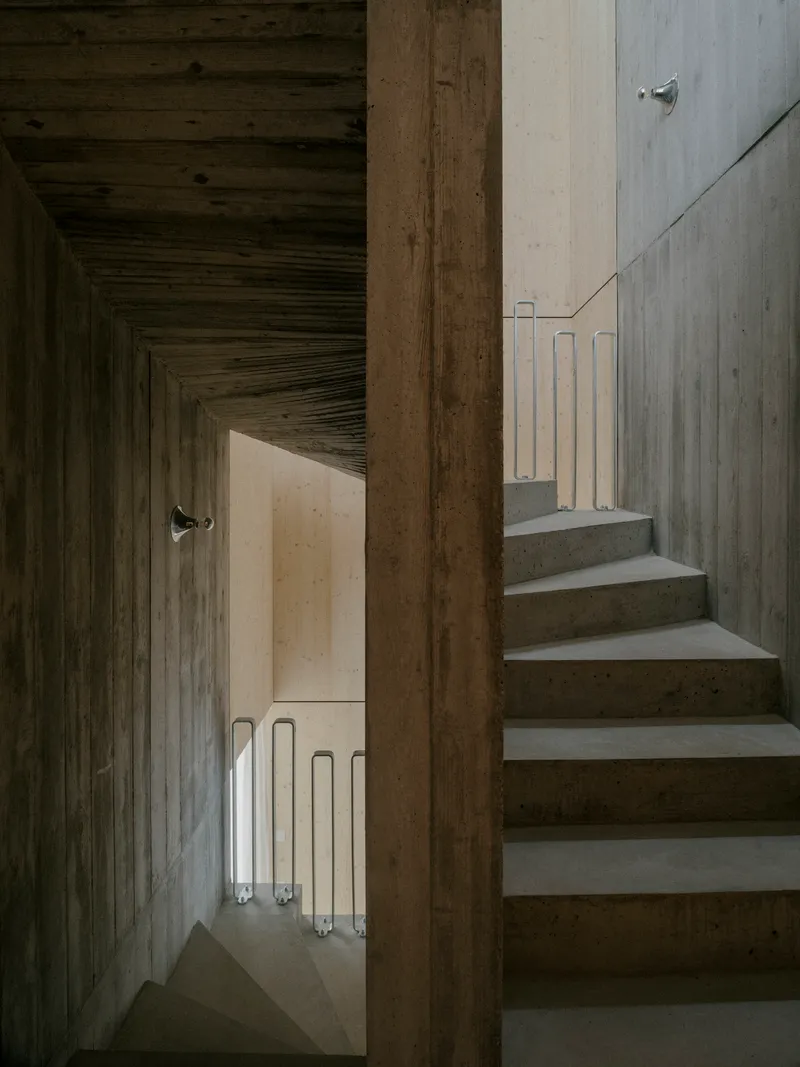
The central concrete core is the building's most consequential decision. It organizes vertical circulation, accommodates services, provides structural stability for the tall narrow volume, and functions as a vertical air shaft for natural ventilation. The staircase ascends through a double-height corridor with a galvanized steel pipe balustrade, and translucent tube lights line the wall, turning the circulation space into something that sits between infrastructure and inhabitation.
By concentrating all the heavy lifting, both literal and systemic, into one element, kit frees the surrounding timber rooms to be simple enclosures. The core draws air upward toward a rooflight, supporting passive cooling across all three levels. It is a chimney, a stairwell, and a service riser rolled into one.
Living on the Ground Floor
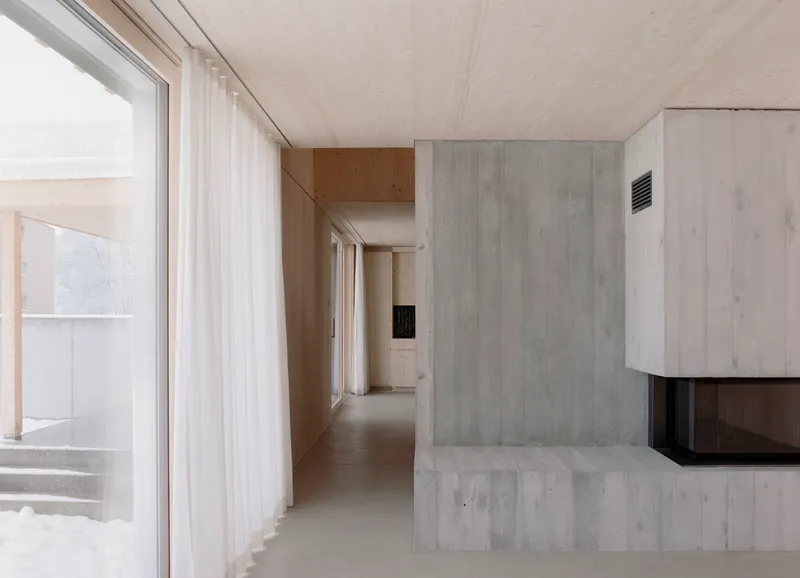
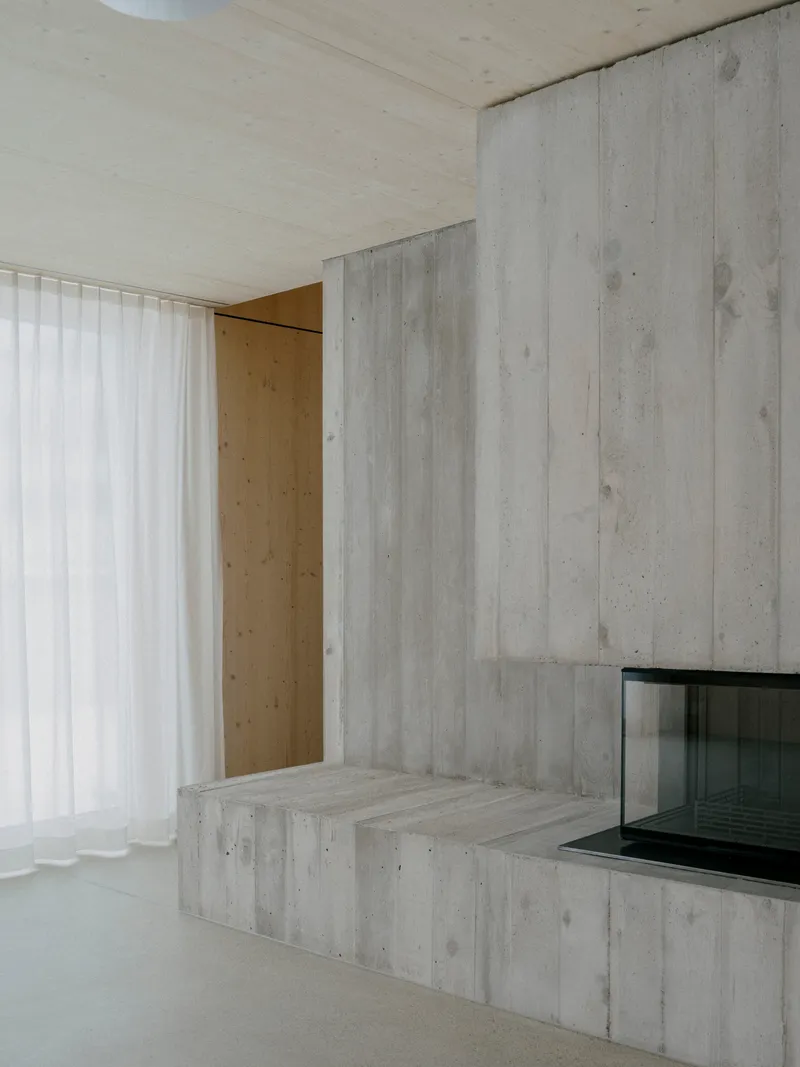

The ground floor contains two main rooms that open to the garden through sliding doors, collapsing the boundary between interior and exterior when weather allows. The exposed concrete fireplace mass sits beside floor-to-ceiling sheer curtains, creating a layered threshold: solid wall, translucent fabric, glass, garden. Ceiling heights in the living area are increased, reinforcing the sense of generosity despite the compact footprint.
A board-formed concrete bench extends from the fireplace wall, functioning as both seat and hearth. The detail is spartan but not austere: a single sconce above the bench provides the only applied element on an otherwise uninterrupted concrete surface. This is a house that trusts its materials to do the atmospheric work.
Upper Rooms and Framed Landscape
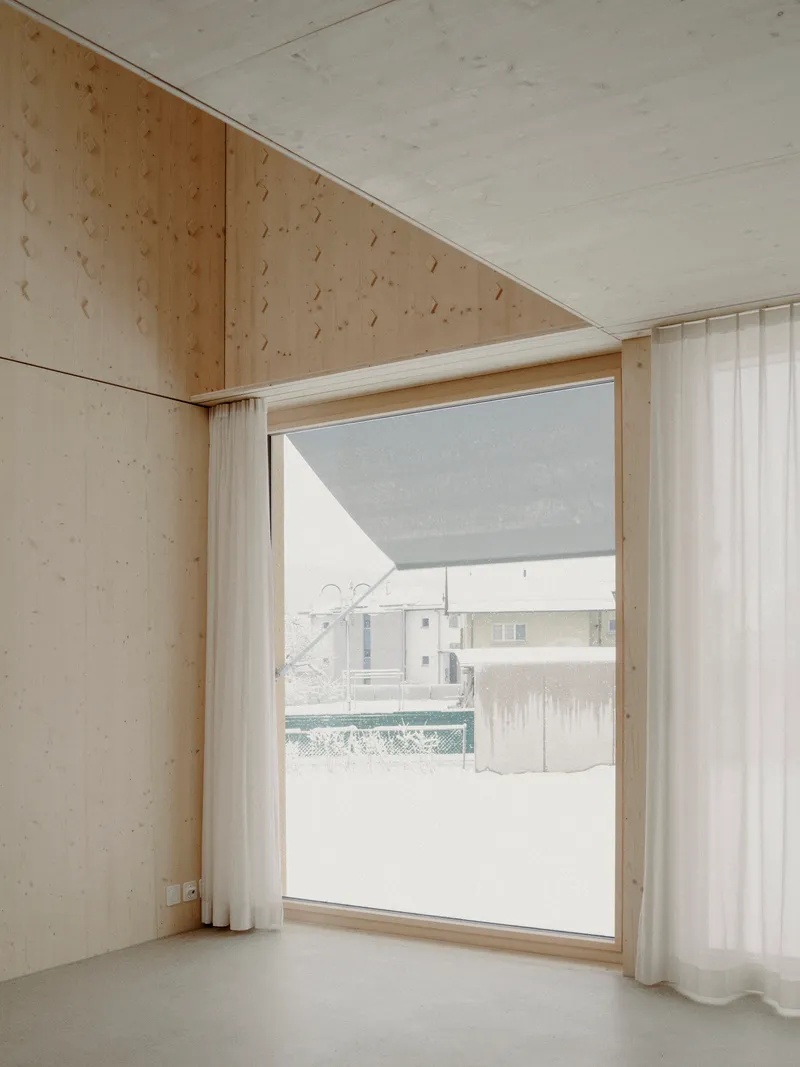
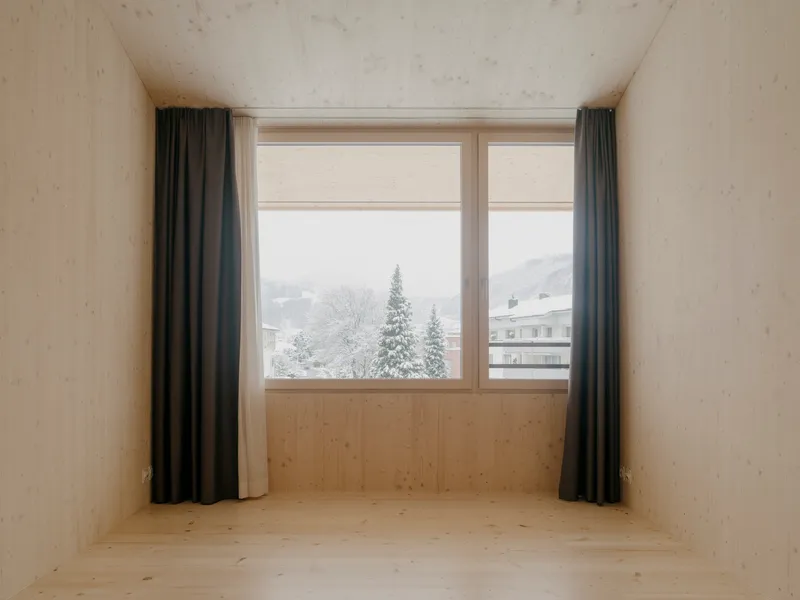
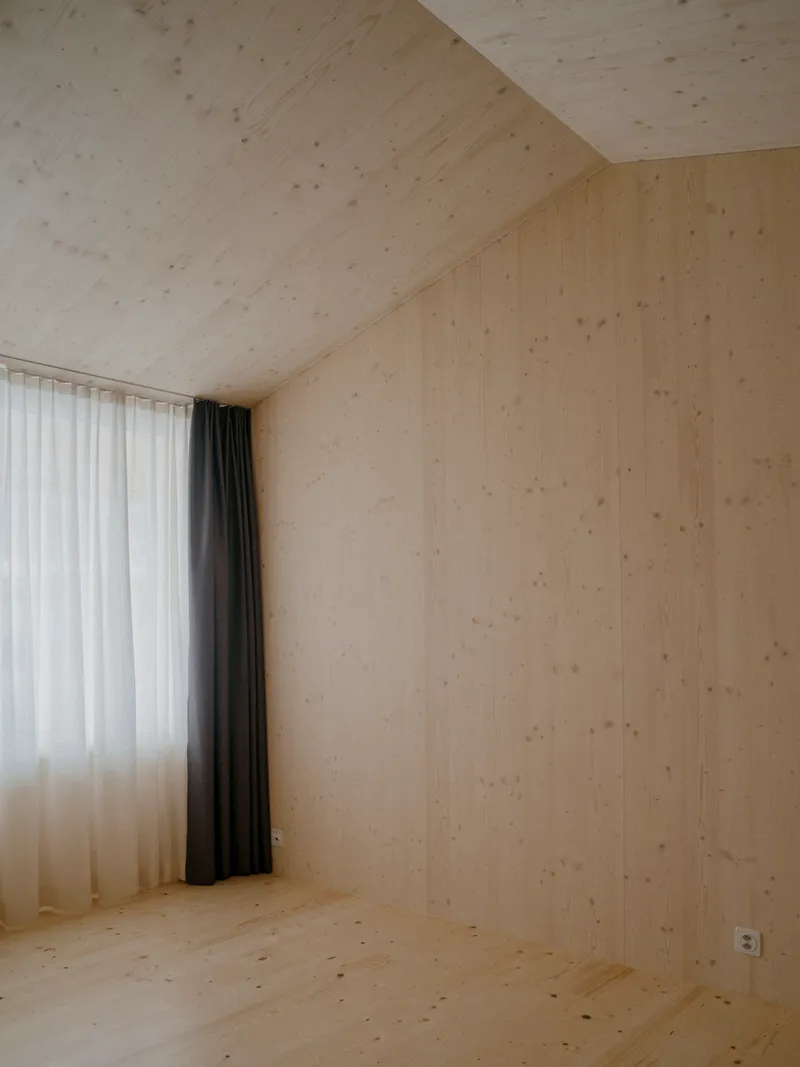
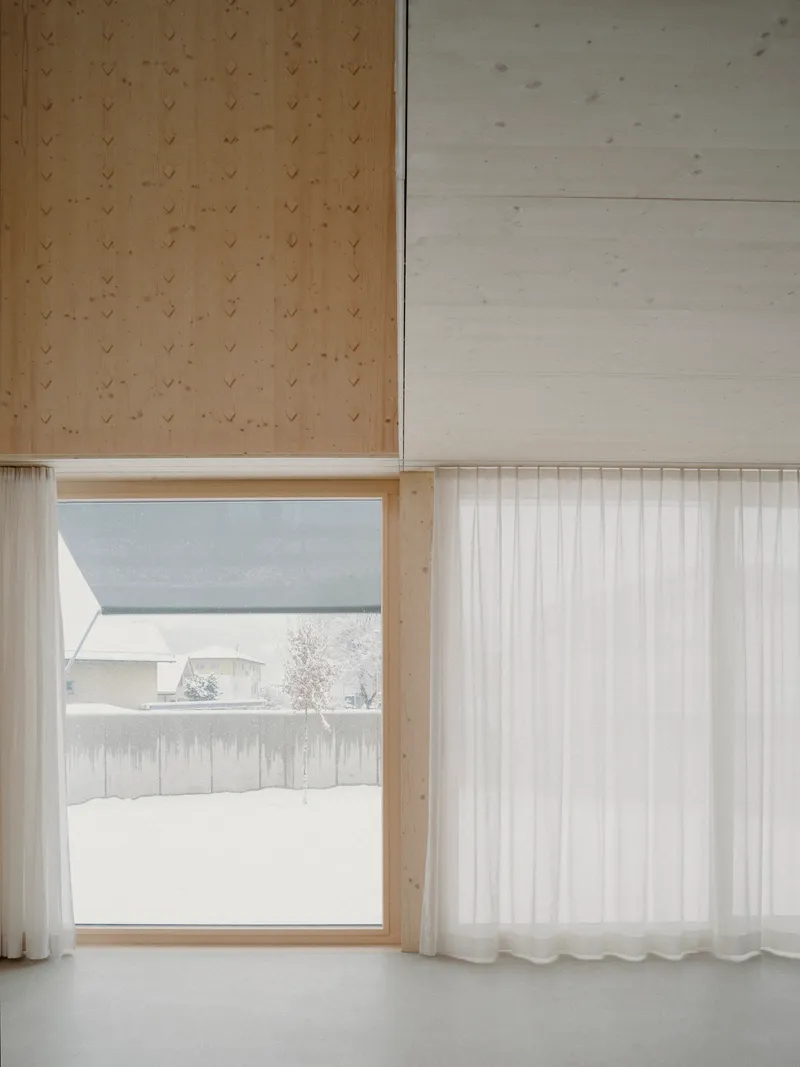
Bedrooms and shared spaces occupy the first floor, while the upper level includes a library, workspace, and an additional bedroom with ensuite. As you ascend, the rooms become more intimate and the views longer. Window alcoves framed in timber isolate specific fragments of the alpine landscape, turning the act of looking outward into something deliberate rather than panoramic.
Under the pitched roof, the sloped plywood ceiling compresses the space, and layered curtains in white and grey soften the geometry. The rooms feel calibrated for concentration: reading, writing, sleeping. The top of the house is quiet in a way that the more social ground floor is not.
Material Honesty at Close Range
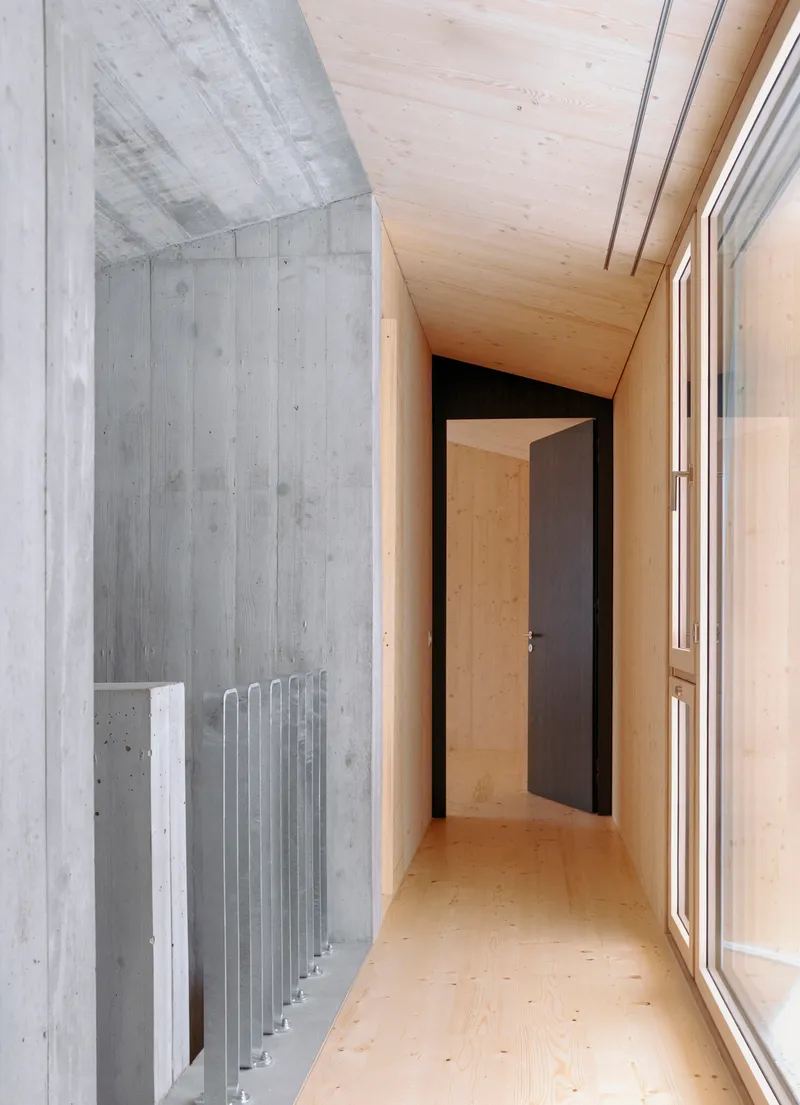
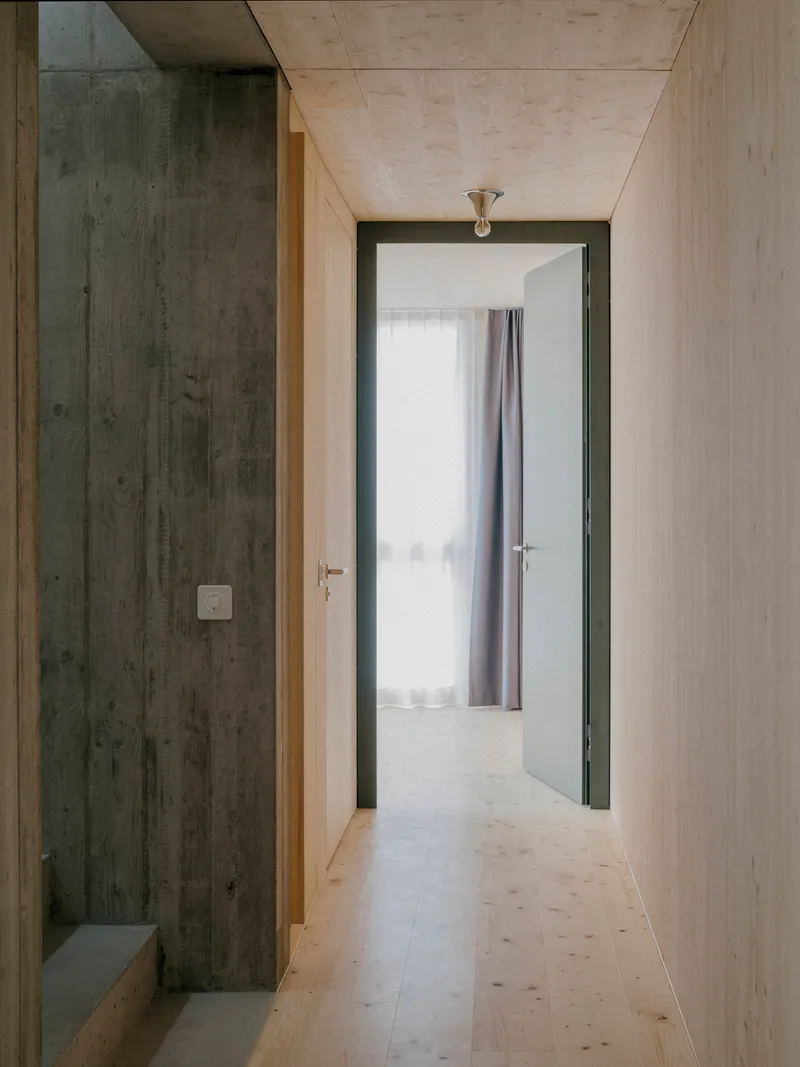
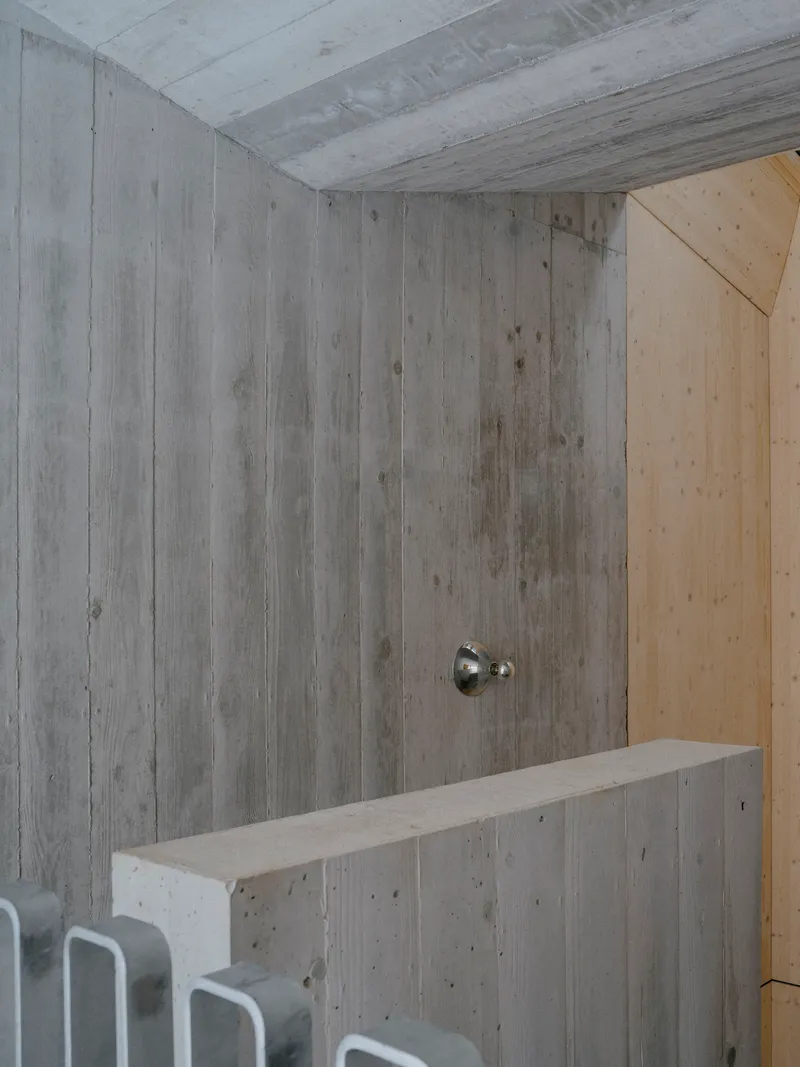
Narrow hallways lined in plywood and dark timber reveal the building's commitment to exposed construction. There is no plasterboard, no paint, no cladding over cladding. Vertical radiators sit flush against board-formed concrete walls. Doorways frame views through to the staircase and beyond, creating visual depth in a plan that is fundamentally narrow.
The absence of applied finishes is not a cost-saving measure but a design position. When the timber panels were assembled in three days, what went up is what stayed. The house argues that prefabrication, when detailed with care, can produce interiors that feel crafted rather than manufactured.
Plans and Drawings
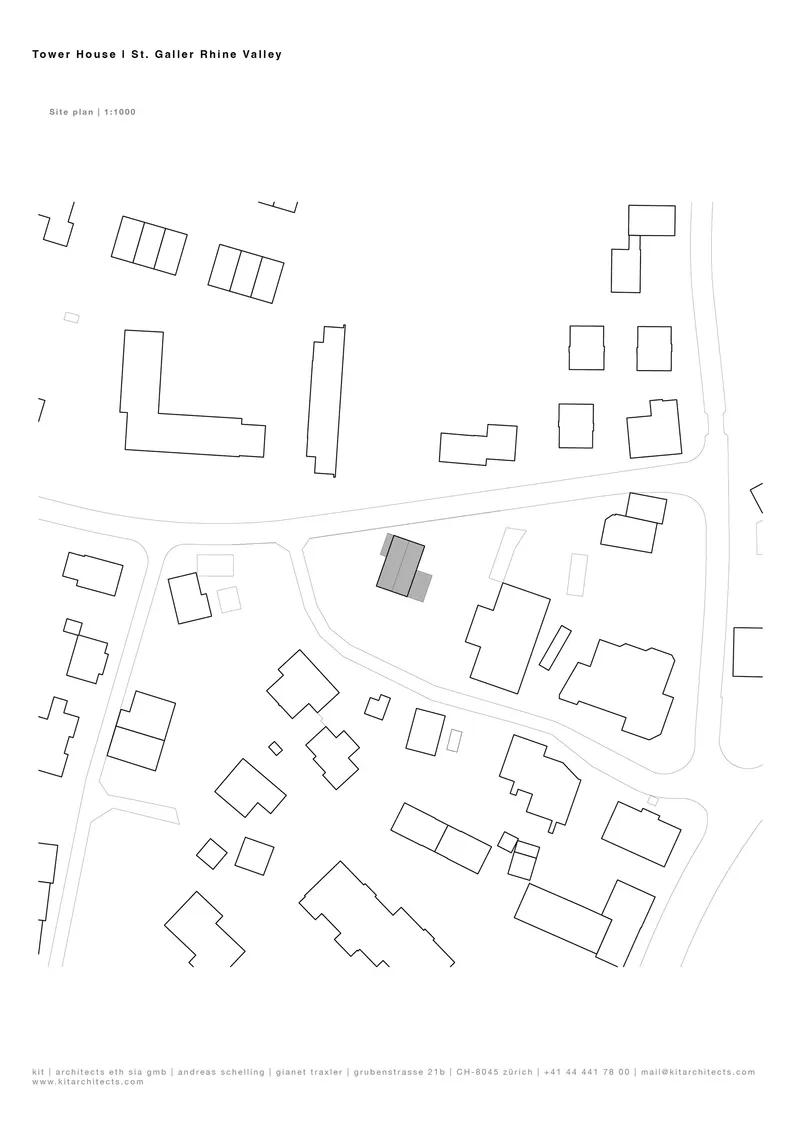
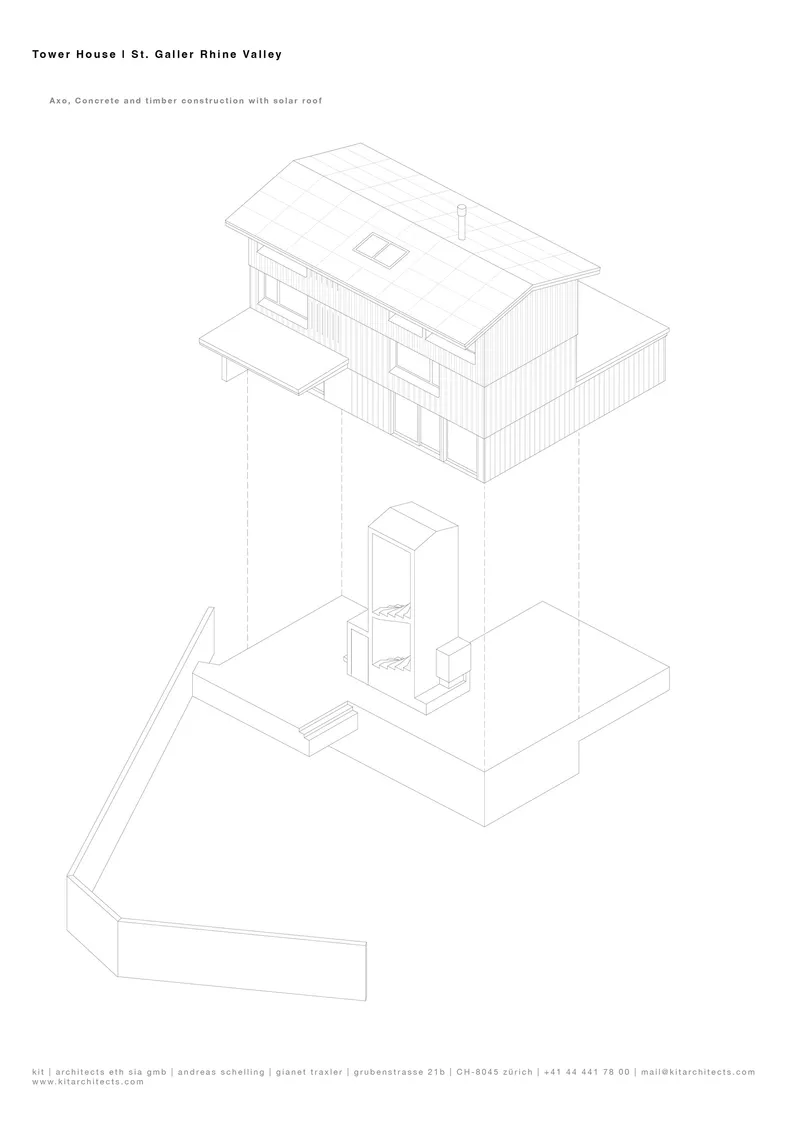
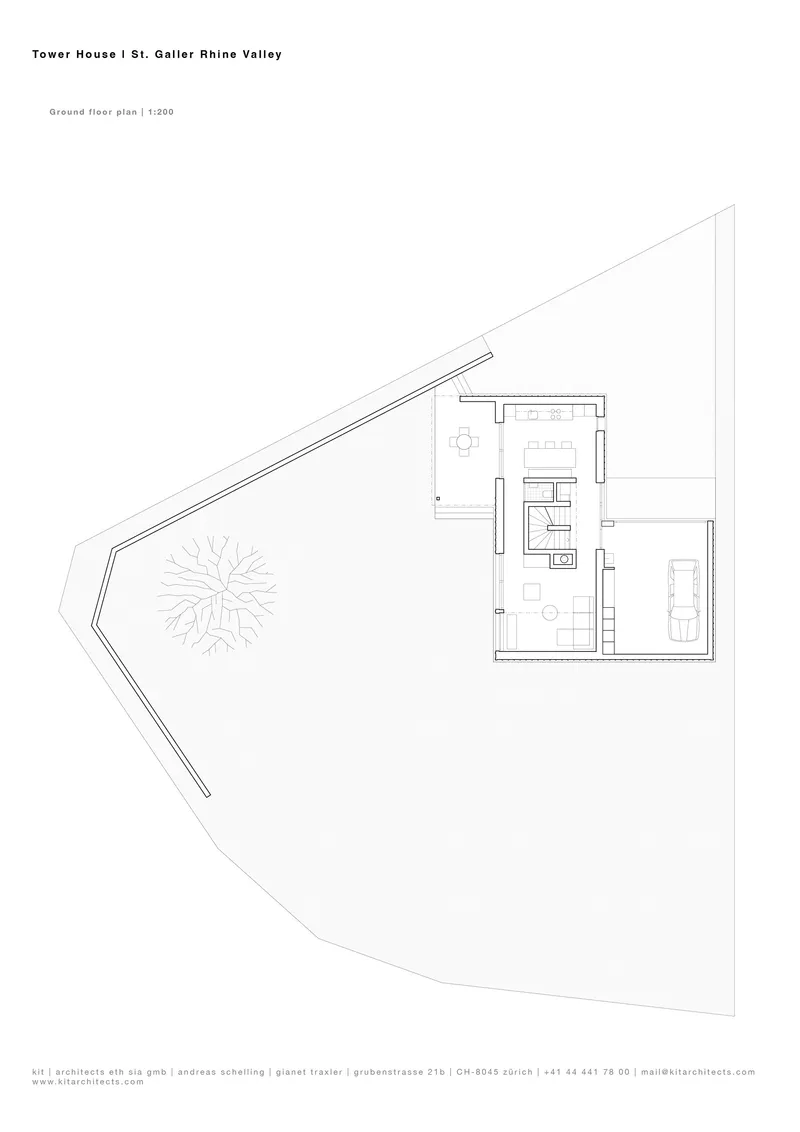
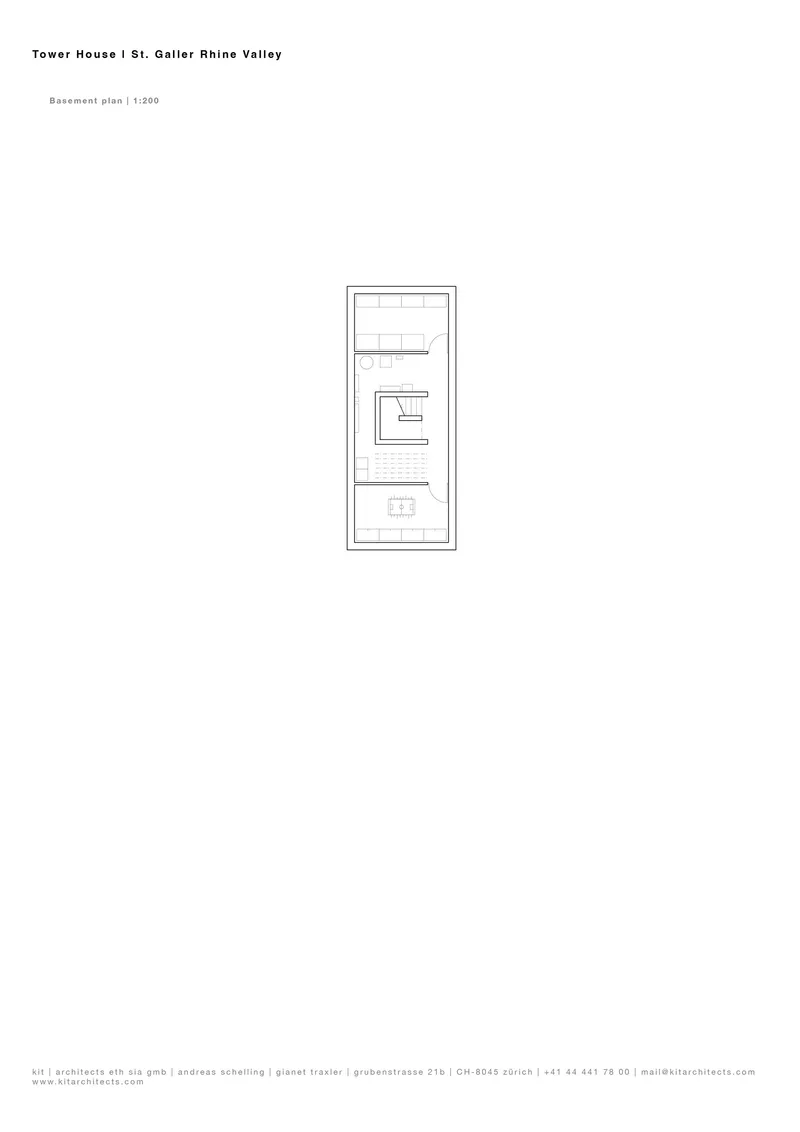
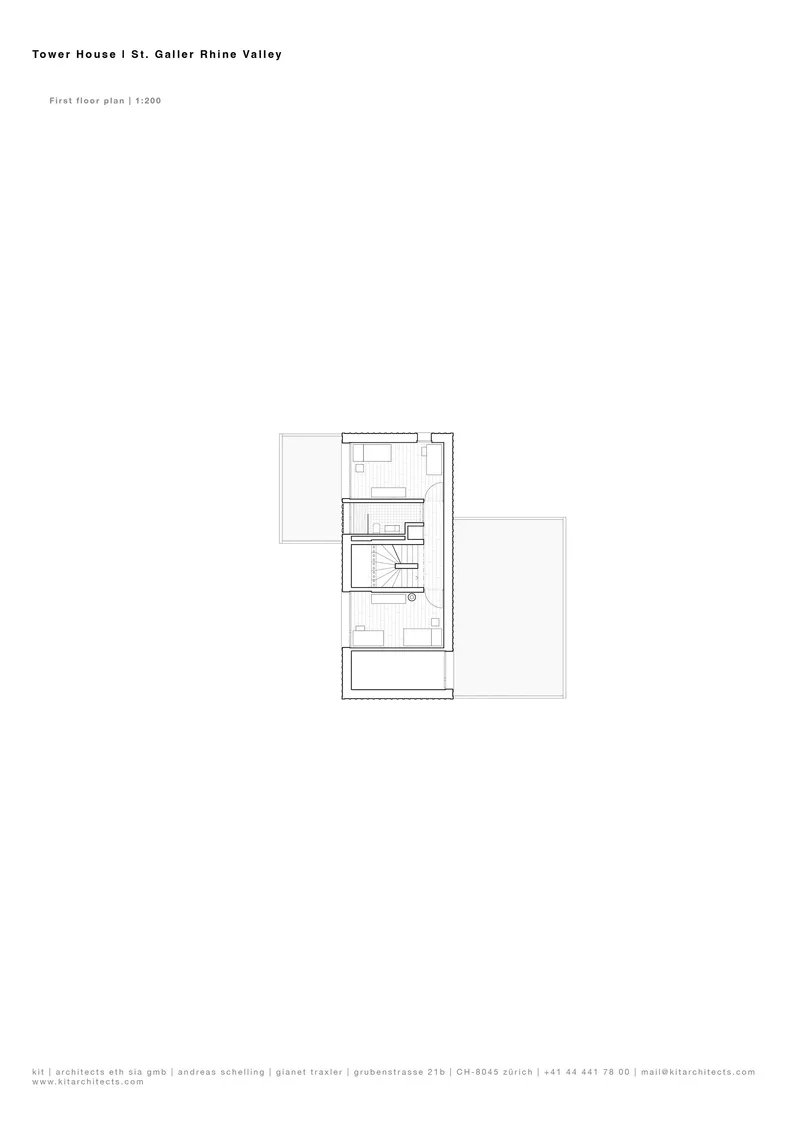
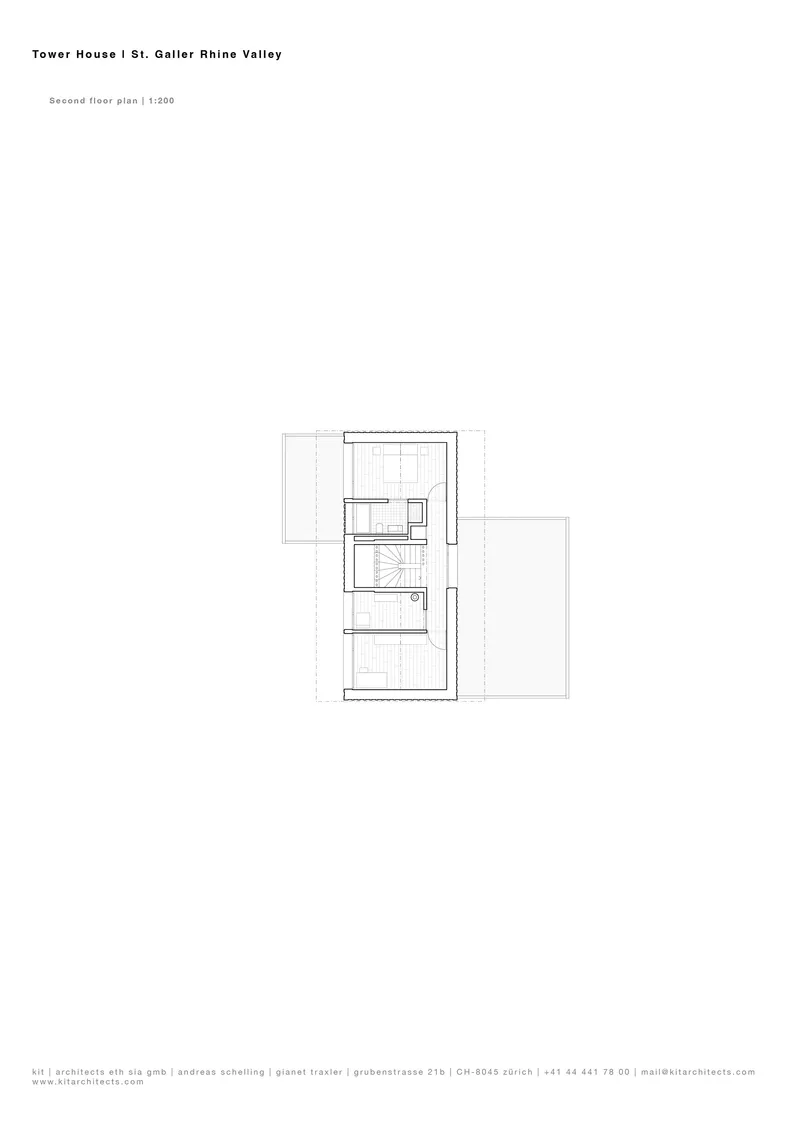
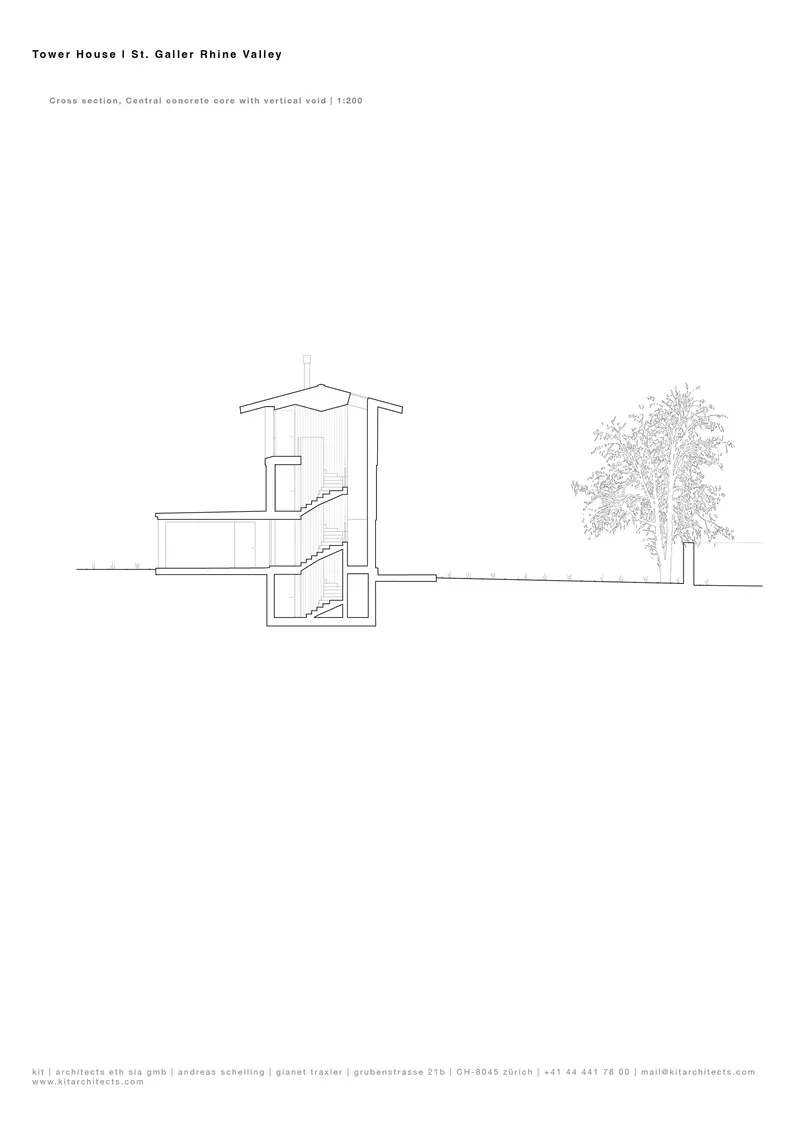
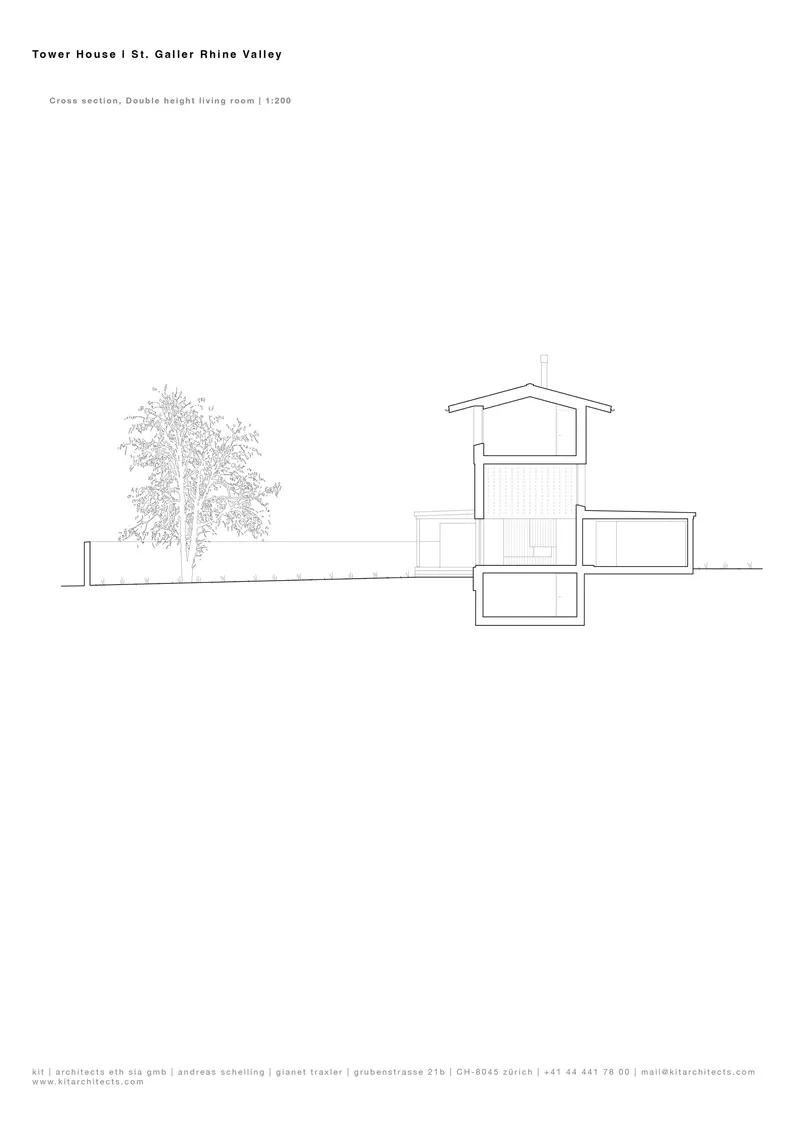
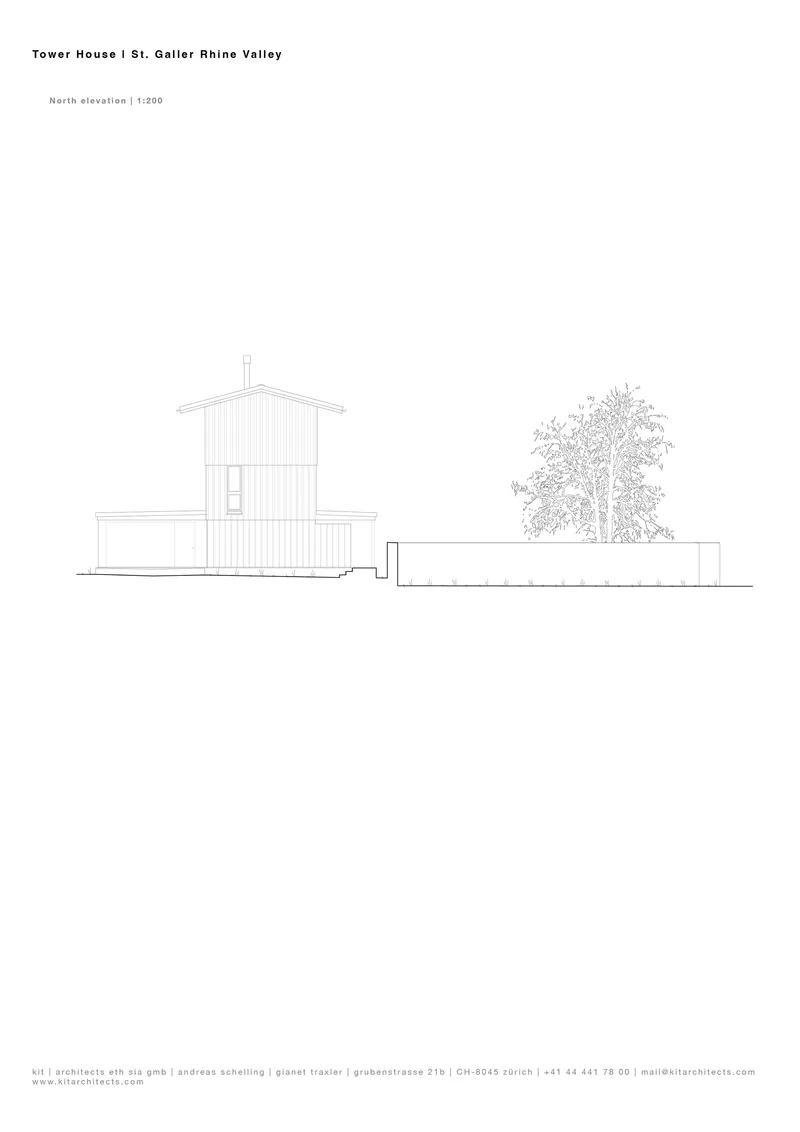
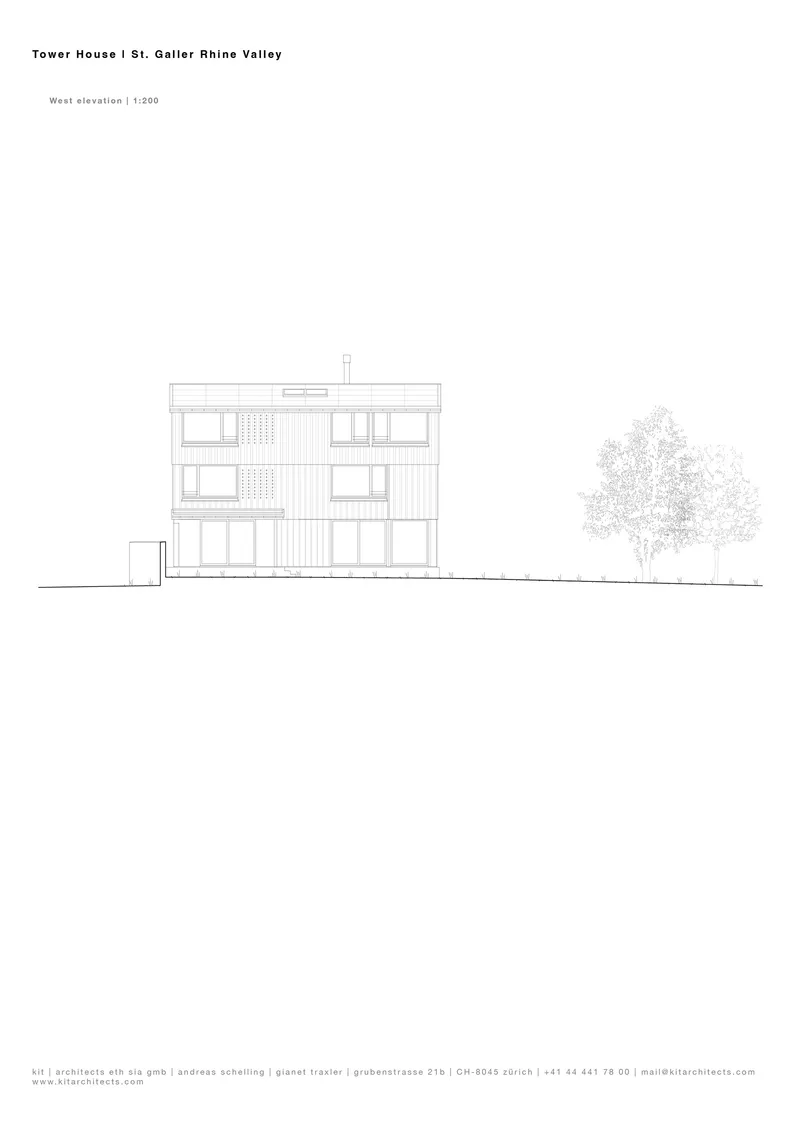
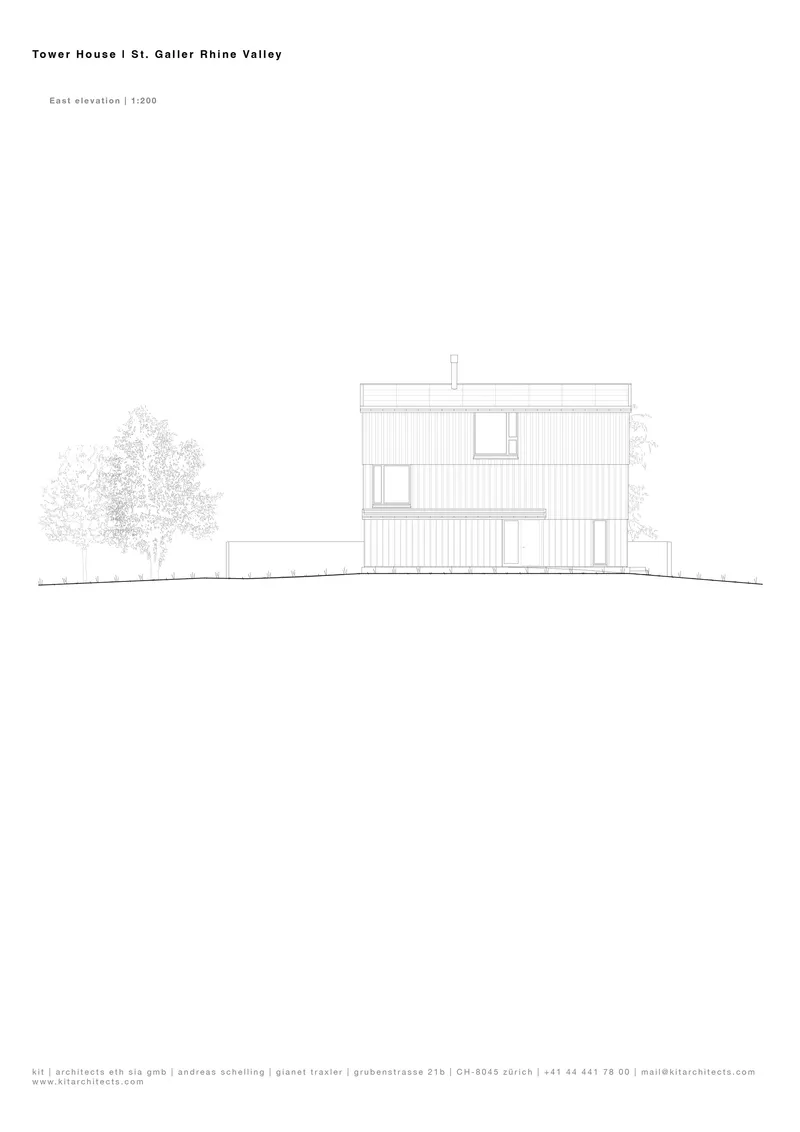
The site plan confirms the building's strategic positioning on the triangular plot, with the footprint oriented to maximize distance from existing structures and reserve space for a future companion volume. Floor plans reveal the narrow linear organization across four levels, with the concrete core consistently anchoring the staircase at the center. The cross sections are the most revealing drawings: one cuts through the concrete core to show the vertical void that drives ventilation, while the other exposes the double-height living room and the relationship between floor levels and the pitched roof above.
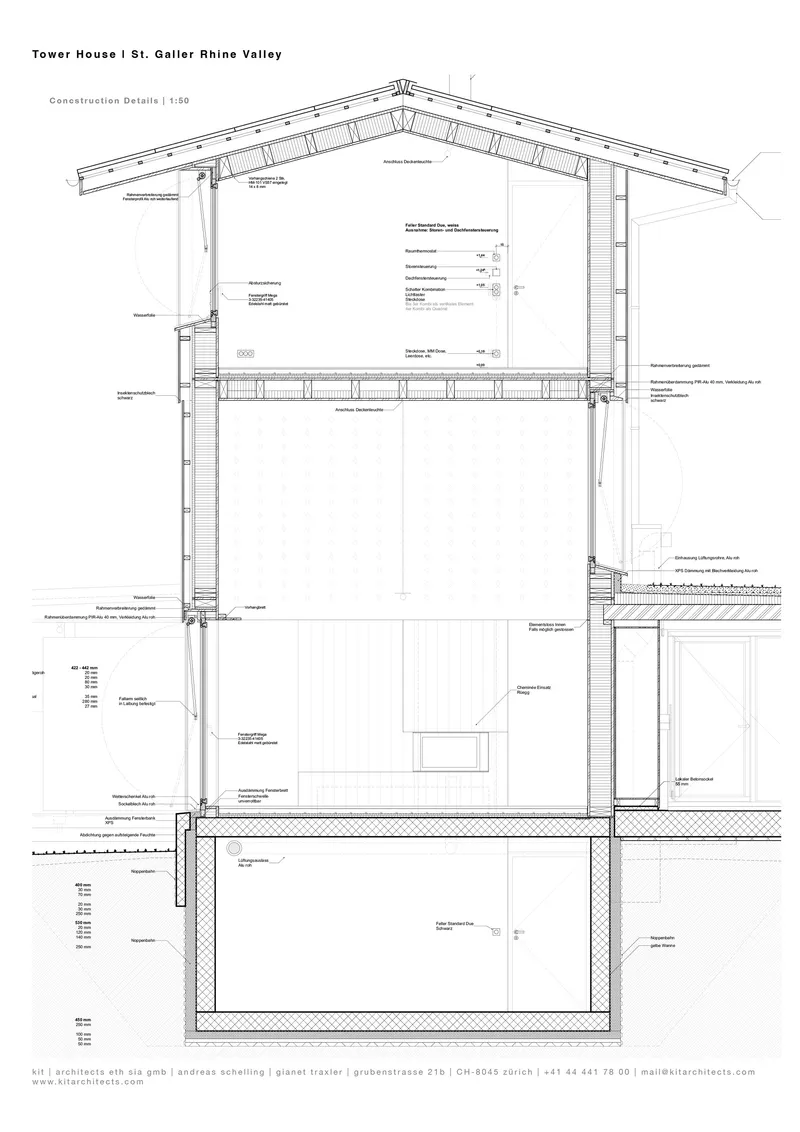
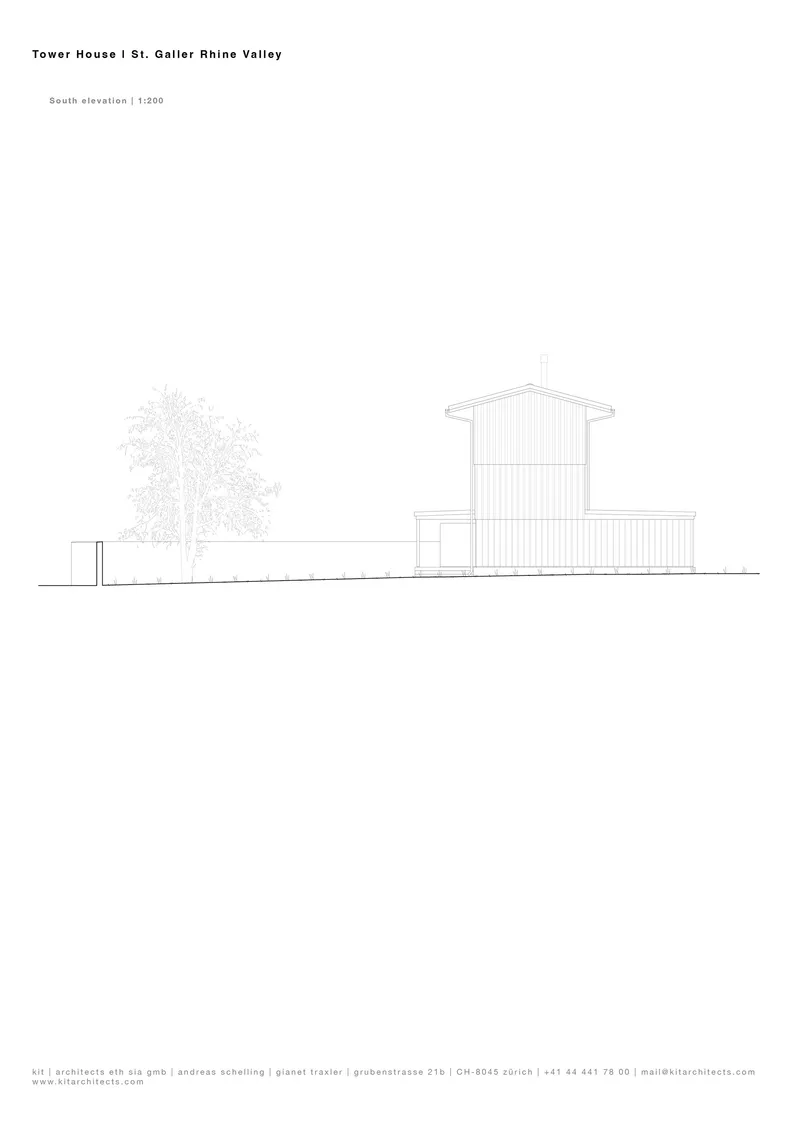
Elevations illustrate the building's different faces. The south elevation reads as a clean pitched form with vertical siding; the west elevation reveals balconies and a more open, layered facade. The construction detail section at the roof assembly, wall system, and foundation connections documents the interface between the prefabricated timber panels, the concrete core, and the ground, with the ventilated facade cavity clearly legible.
Why This Project Matters
Tower House makes a case that prefabricated timber construction does not need to look prefabricated. By pairing off-site manufactured spruce panels with a single cast-in-place concrete core, kit achieves both speed and spatial richness. The three-day assembly timeline is remarkable, but what matters more is that the resulting spaces feel resolved, warm, and particular to their site. The passive ventilation strategy, driven by the same concrete core that handles structure and circulation, demonstrates how a single architectural move can do multiple jobs without requiring complex mechanical systems.
In a Swiss context where timber construction is neither novel nor radical, the project distinguishes itself through proportion and conviction. The vertical stretch of the familiar gabled form, the unfinished interiors, the anticipation of future densification on the same plot: these are decisions that suggest a practice thinking beyond the brief of a single family home. Tower House is a four-person dwelling that also functions as a proposition about how to build quickly, lightly, and well on constrained village sites.
Tower House by kit, St. Gallen, Switzerland. 348 m², completed 2025. Photography by Till Forrer.
About the Studio
Share Your Own Work on uni.xyz
If projects like this are the kind of work you want to make, uni.xyz is a place to publish your own, find collaborators, and enter design competitions.


Popular Articles
Popular articles from the community


Faces of the Soviet Avant-Garde: Turning Moscow's Street Names into an Open-Air Museum
A network of sculptural installations across a Moscow residential district transforms forgotten architect names into spatial encounters with cultural memor

Extended Shell: Retrofitting Kolkata's Balconies as Living Urban Thresholds
A modular retrofit system recovers the social and environmental intelligence of Kolkata's historic verandas for contemporary Park Street residents.
Temporary Home for Dogs: A Reversed Zoo Rethinks Animal Shelter Architecture
In Bucharest, a sinuous corridor and freed landscape flip the logic of containment, designing a shelter that works to make itself unnecessary.

Singing Woman: Contemporary Architecture Inspired by Estonia’s Voice and the Sea
Singing Woman turns Estonia’s song culture into flowing opera house architecture, blending public life, landscape, sea, and national memory.

Similar Reads
You might also enjoy these articles

Bao Huynh Watercolor Atelier: A Serene Art Retreat in Hội An
Bao Huynh Watercolor Atelier in Hội An blends multifunctional art spaces, sustainable design, local materials, and family-friendly living in a serene environment.

Atelier Macri Concept Store Interior Design by CASE-REAL
Atelier Macri store features a "ko" counter, walnut wood details, cork displays, blending retail, gallery, and seamless customer experiences.

Manuel Vargas Izquierdo Stadium and High-Performance Sports Center: Architectural Excellence in Jalpa de Méndez
The Manuel Vargas Izquierdo Stadium blends sustainable design, inclusive sports facilities, and cultural-inspired architecture, revitalizing Jalpa de Méndez’s public spaces.
KAKR Buluh Awar Hall: Revitalizing Community and Ecology Through Bamboo Architecture
Community built bamboo hall revitalizes Buluh Awar village, empowering youth, restoring ecology, celebrating vernacular craftsmanship through sustainable architecture and culture.


Comments (0)
Please login or sign up to add comments
No comments yet. Be the first to comment!