
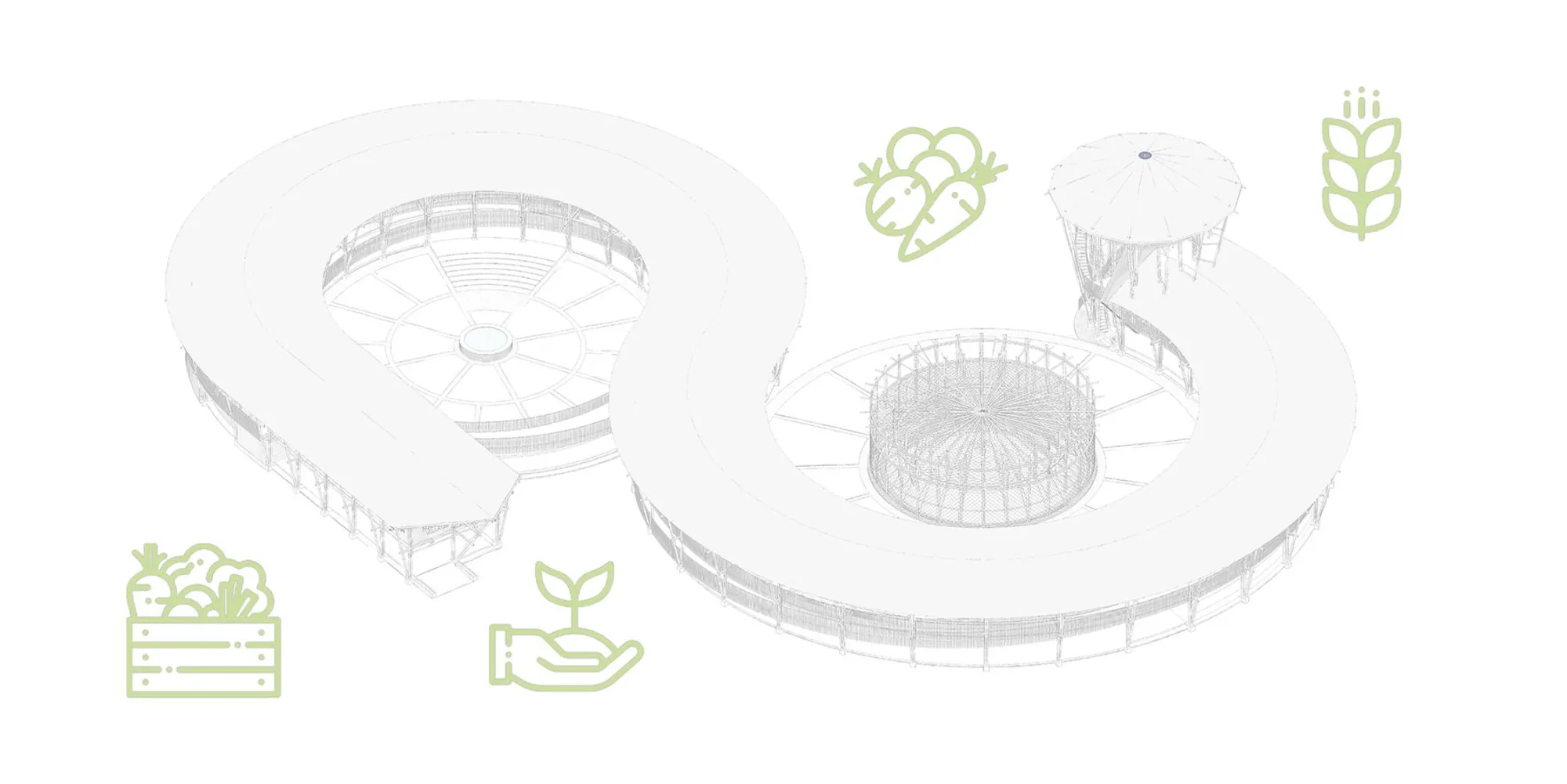
Kultura Village: Closed-Loop Ecology Meets Aboriginal Spatial Storytelling
A bamboo village in tropical Australia weaves permaculture systems and indigenous cultural narratives into a zero-waste community prototype.


What if a building could narrate 60,000 years of human presence on a continent while simultaneously growing food, generating its own energy, and producing zero waste? Kultura Village proposes exactly that: a bamboo settlement in tropical Australia where curvilinear corridors trace a timeline from the Pre-Human era through Aboriginal and Colonial Australia, and where every spatial decision feeds back into a closed-loop agricultural ecosystem. The architecture does not simply house community life; it structures a circular metabolism of food, energy, and cultural memory.
Designed by Yesim Serdar, Kultura Village is a winner entry in the We Australia competition. The project takes root in permaculture principles and Aboriginal knowledge systems, proposing a built environment where open courtyards inspired by indigenous symbols serve as gathering grounds, while enclosed pavilions operate as productive landscapes of hydroponic gardens, aquaponic fish tanks, and biogas-powered kitchens. It is a rare competition entry that treats sustainability not as an engineering overlay but as the cultural foundation of the entire design.
A Bird-Watching Tower as Temporal Anchor
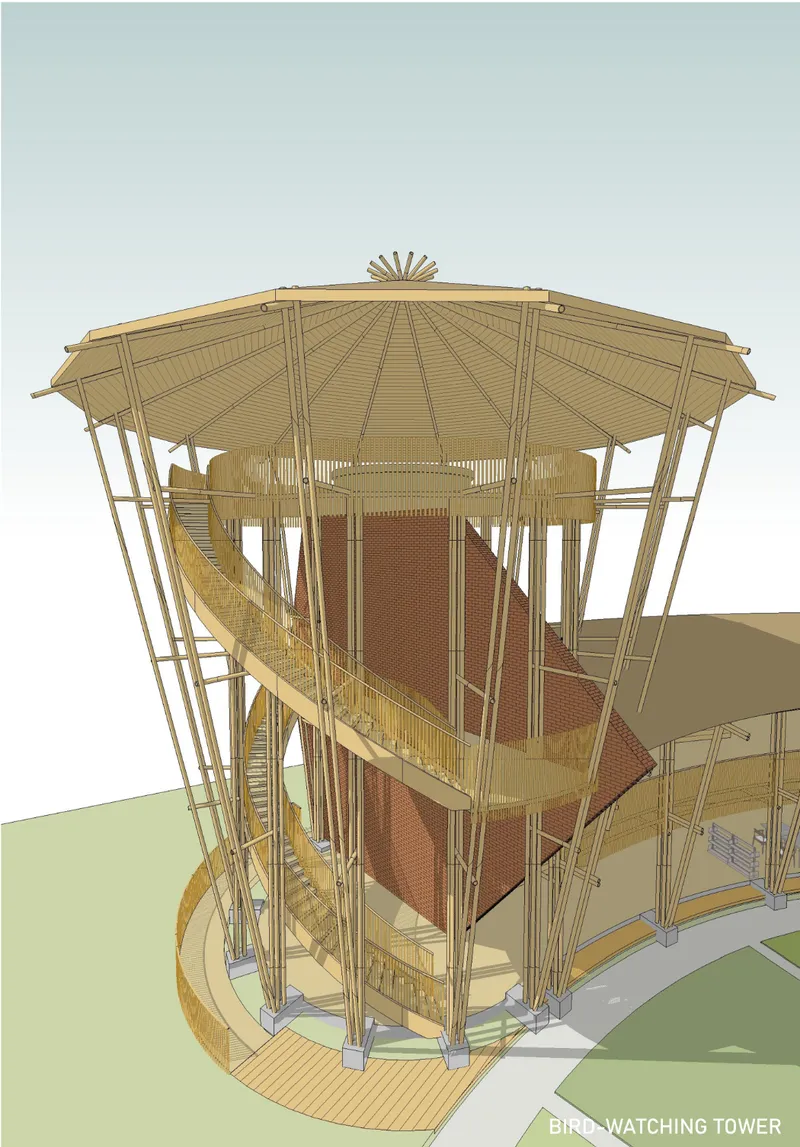
At the conceptual and physical heart of Kultura Village stands a bird-watching tower representing the Pre-Human era. The axonometric drawing reveals its logic: angled timber columns spiral upward to support a canopy roof, with a ramping path that lifts visitors above the site and reorients their attention toward the natural world. It is not merely an observation point but a conceptual anchor, establishing the village's central argument that sustainable design begins by acknowledging a deep ecological time far older than human settlement.
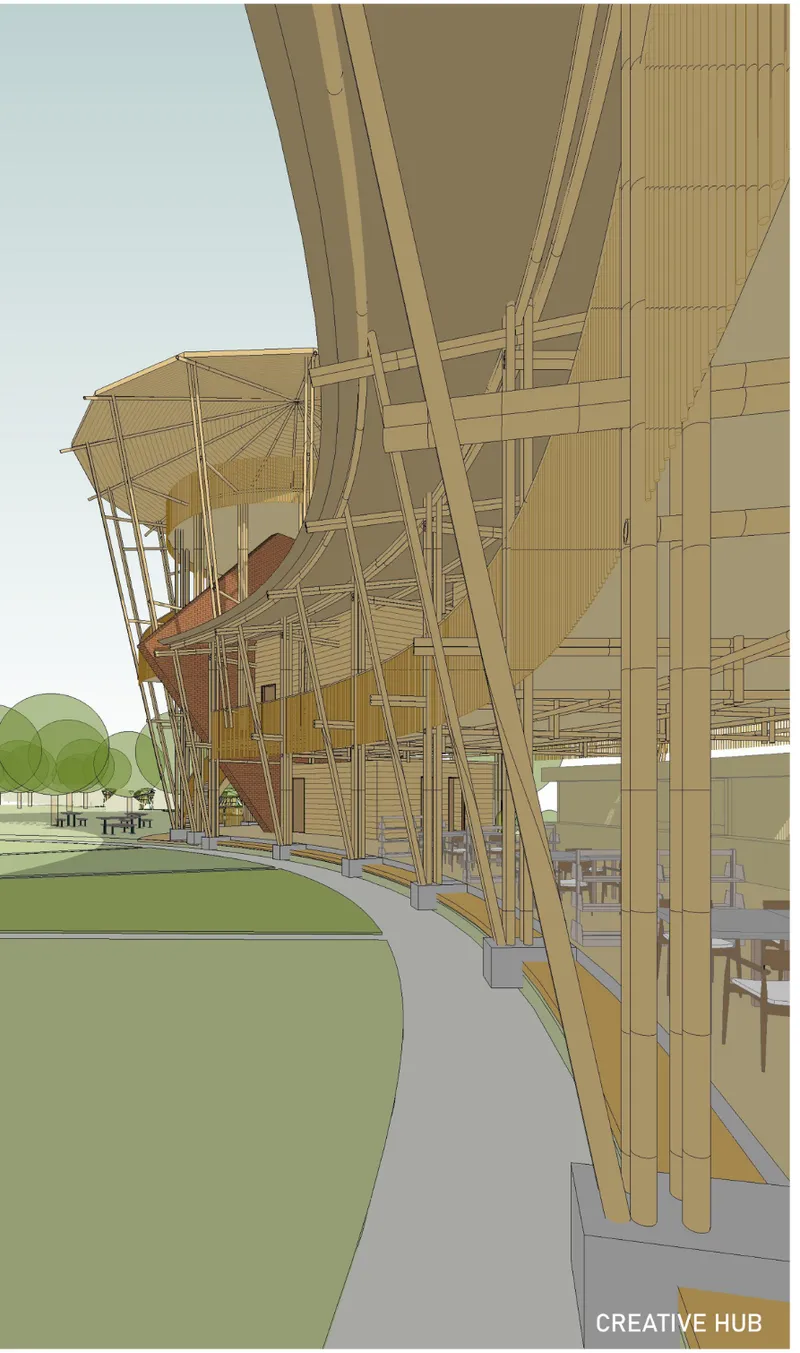
From the tower, elevated walkways radiate outward to connect multiple pavilions, as shown in the timber-framed perspective rendering. These connections are not just circulatory; they are narrative. Walking from the tower toward the periphery means moving forward through the timeline of human presence on the Australian continent, from pre-human ecology through Aboriginal land stewardship to the colonial era and, finally, toward a regenerative future.
Bamboo Frames and Open Landscape
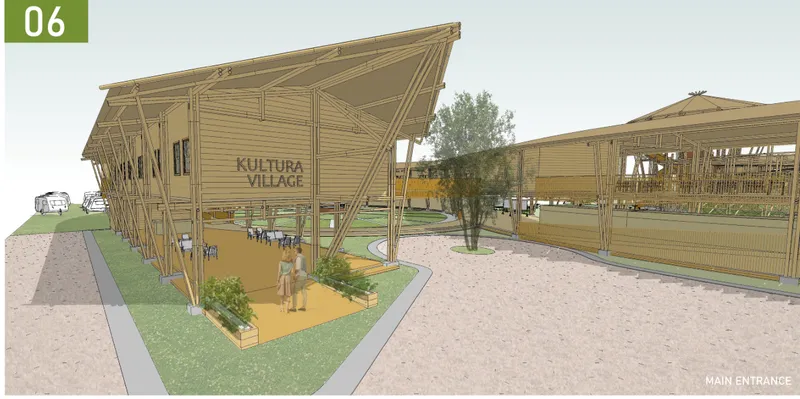
The entrance pavilion grounds the visitor in the project's material identity: bamboo as primary structure, with angled supports creating a rhythmic colonnade that opens generously to the surrounding landscape. Scattered trees and open ground reinforce the sense of a settlement that belongs to its tropical site rather than being imposed upon it. Bamboo was chosen not only for its tensile strength, renewability, and low embodied energy but also for its deep cultural resonance with tropical vernacular architecture. Combined with hardwood flooring and open frameworks, the material palette ensures breathability and thermal comfort without mechanical systems.
Section Logic: From Workshop Floor to Greenhouse Canopy
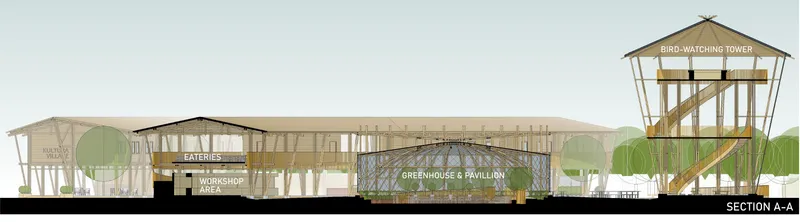
The sectional drawing cuts through the full programmatic range of the village. At ground level, semi-open community spaces organized as "spaces to do" and "spaces to engage" house indigenous marketplaces, workshops, exhibitions, and agricultural beds in a climate-sensitive layout. The upper level accommodates eateries and lodging, labeled "spaces to relax," offering panoramic views down onto the evolving landscape below. Connecting these zones, covered walkways thread between the tower, workshop pavilions, and a greenhouse structure, making legible the closed-loop system that ties food production, waste processing, and energy generation into a single spatial circuit.
The biogas system, powered by anaerobic digestion of organic waste, is not an afterthought tucked into a mechanical room. It is integrated into the site plan alongside composting stations and agricultural zones, visible and instructive. Food waste from the kitchens becomes energy that powers those same kitchens, reinforcing net-zero goals through a process that visitors can observe and understand.
The Greenhouse as Social and Ecological Engine
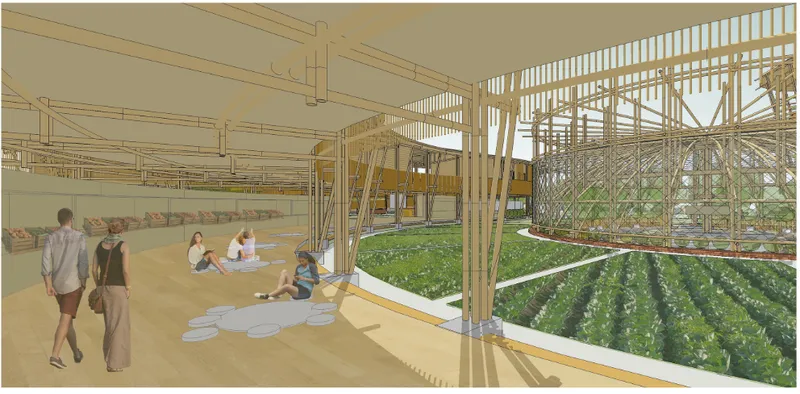
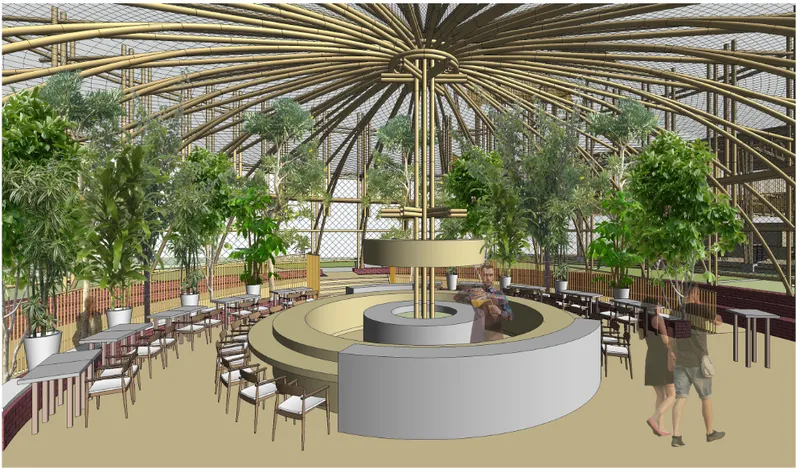
Perhaps the most compelling interior moment occurs inside the greenhouse, where visitors sit beside raised planting beds within a timber-framed enclosure suffused with green light. Hydroponic gardens and aquaponic fish tanks share floor area with seating and learning spaces, dissolving the boundary between production and leisure. The greenhouse plays a dual role: it is both a food-growing facility and a communal hub where the act of cultivation becomes a form of social engagement.
The central gathering space extends this idea further. Radiating timber roof beams converge on a circular counter surrounded by potted trees beneath a glazed canopy, creating a room that reads simultaneously as marketplace, cafe, and botanical garden. Natural ventilation moves through the semi-open structure, and the spatial generosity of the overhead canopy gives the interior a quality closer to a forest clearing than a conventional building. It is in moments like these that Kultura Village makes its strongest case: architecture shaped by ecological process can also be deeply pleasurable to inhabit.
Why This Project Matters
Many competition entries treat sustainability as a checklist of technical systems layered onto conventional spatial arrangements. Kultura Village inverts that hierarchy. Here, the closed-loop metabolism of food, energy, and waste is the generator of architectural form. The curvilinear bamboo corridors exist because they trace a cultural narrative. The greenhouse exists because growing food together is a social act. The tower exists because ecological awareness requires a shift in perspective, literally and figuratively. Every element serves double duty, structural and symbolic, productive and pedagogical.
What makes Serdar's proposal particularly resonant is its insistence that environmental resilience and cultural reparation are inseparable goals. By spatially mapping Aboriginal knowledge systems alongside permaculture infrastructure, Kultura Village argues that sustainable societies begin with the repair of broken links between food, land, and culture. As a prototype, it suggests a path forward that is not only technically viable but also socially restorative, a model where architecture serves as the medium through which a community remembers how to live with its land.
View the Full Project
About the Designers
Designer: Yesim Serdar
Enter a Design Competition on uni.xyz
uni.xyz runs architecture and design competitions year-round that reward proposals with spatial conviction and real site intelligence.
Project credits: Kultura Village by Yesim Serdar We Australia (uni.xyz).




Popular Articles
Popular articles from the community


Conexión: Biophilic Design Reimagines High-Rise Living in Hong Kong
Conexión reimagines high-rise living in Hong Kong through biophilic design, green facades, shared spaces, daylight, water and nature within.

Play: Fragments of Their World
Familiar architecture becomes modular playground design, creating safe spaces where displaced children can learn, connect, imagine and play.

The Musturak Paradise: Senior Living Architecture for a Connected Future in Temara, Morocco
The Musturak Paradise reimagines senior living architecture in Temara via private homes, social spaces, culture, community, and shared care.

Co-life: Sustainable Architecture for Age-Friendly Community Living
Co-life reimagines sustainable architecture for seniors through courtyards, rammed earth, shared gardens, and spaces designed for belonging.


Similar Reads
You might also enjoy these articles

Day and Night Park: A Time-Based Urban Newsstand in Beijing
A temporary urban newsstand in Beijing blending travel, light, and reading through poetic colors, compact form, and community-focused design.

Modernist Patio Renovation in El Masnou, Barcelona by Oliver Segura Arquitectura + Cebrià Arquitectura
Modernist patio renovation blending tradition and innovation with a movable pool, leveled floors, and Catalan materials in El Masnou.

Alto Residencial Coop: Cooperative Housing Development in Santiago de Compostela by Carbajo Barrios Arquitectos
A linear cooperative housing complex blending white volumes and perforated metal façades, enhancing community living, natural light, privacy, and urban integration.
Vil Genis School by BPA ARCHITECTURE – Massy, France
Vil Genis School in Massy, France, features sustainable design, south-facing classrooms, community integration, accessible spaces, and modern educational architecture.





Comments (0)
Please login or sign up to add comments
No comments yet. Be the first to comment!