

La Ruche: A Beehive Market That Grows With Its Community
A runner-up in Upcycling Retail 2019, La Ruche reimagines the urban marketplace as an adaptive, circular economy hub built around timber and collective exc


What if a market could behave like a living organism, adapting its structure and program to the shifting needs of the people it serves? La Ruche, French for "the beehive," takes that biological metaphor seriously. It proposes an adaptive marketplace where timber canopies shelter farmers, artisans, and entrepreneurs under one undulating roof, while interior programs, from libraries to co-working spaces, fill the honeycomb-like structure with overlapping uses. The result is not a static building but a framework for exchange, one designed to grow, contract, and evolve as its community does.
Designed by Roxanne d'Andrea, Huyensa Dam, and Giulia Rossetti, La Ruche was a runner-up entry in the Upcycling Retail 2019 competition. The brief asked designers to rethink retail architecture through the lens of upcycling and circularity. Rather than proposing a single building, the team delivered an interconnected system of spaces rooted in circular economic practices, where waste is minimized and resources are efficiently reused across programmatic layers.
Timber Trusses and Open Air: The Market Hall as Public Room
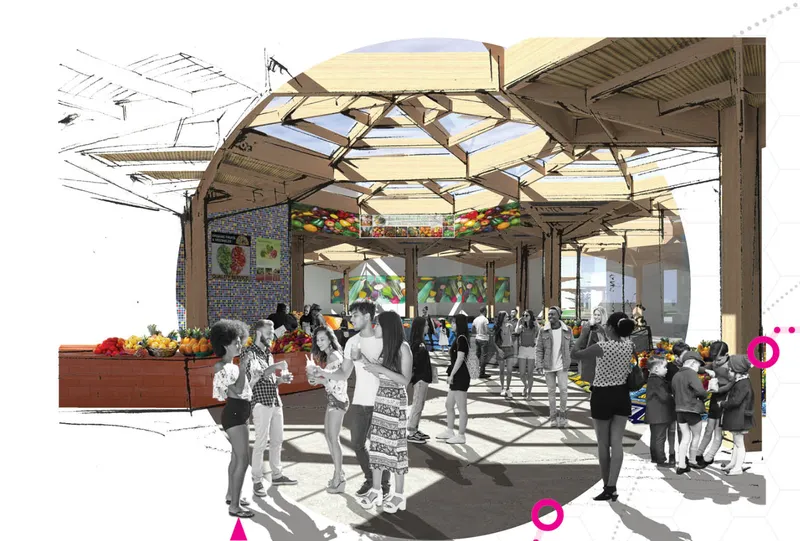
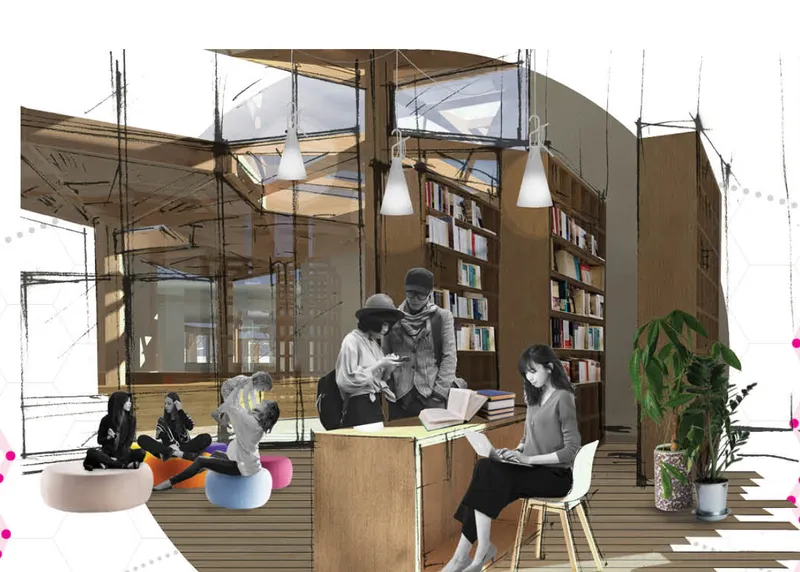
The primary gathering space takes the form of an open-air market hall covered by an expansive timber truss canopy. People cluster beneath it naturally, drawn by the legibility of the structure: tall enough to feel generous, open enough at the edges to dissolve into the surrounding landscape. The timber roof is both shelter and identity, signaling a civic space without resorting to monumental gestures. Adjacent to the market hall, a library occupies a quieter interior zone, fitted with timber bookshelves and pendant lights that cast warm pools across reading tables. The pairing is deliberate. Commerce and knowledge share the same structural logic, reinforcing La Ruche's ambition to serve a broad spectrum of users across generations.
An Undulating Canopy Across a Planted Landscape
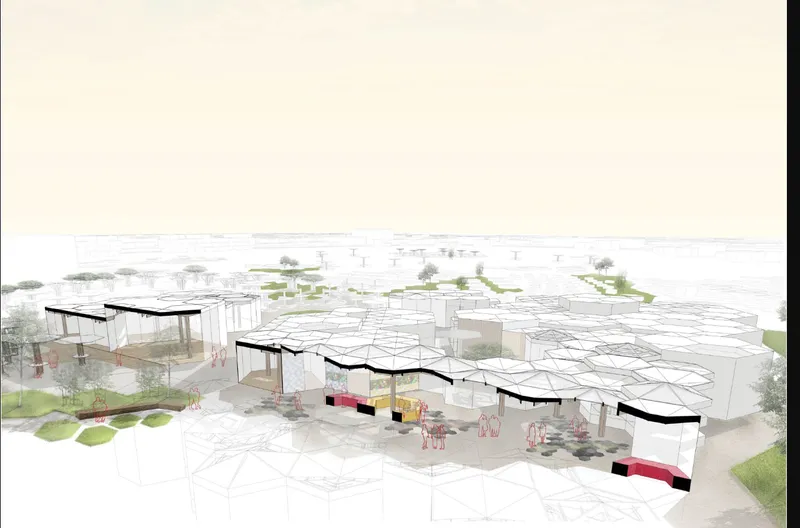
Seen from above, La Ruche reads as a low-rise structure whose roof canopy undulates gently across a planted site. The aerial perspective reveals just how much landscape is woven into the architecture: planting beds, permeable paths, and tree canopies merge with the building footprint to create a continuous green mat rather than a hard boundary between indoor and outdoor. This approach treats the site as a productive ecology, not merely an ornamental setting.
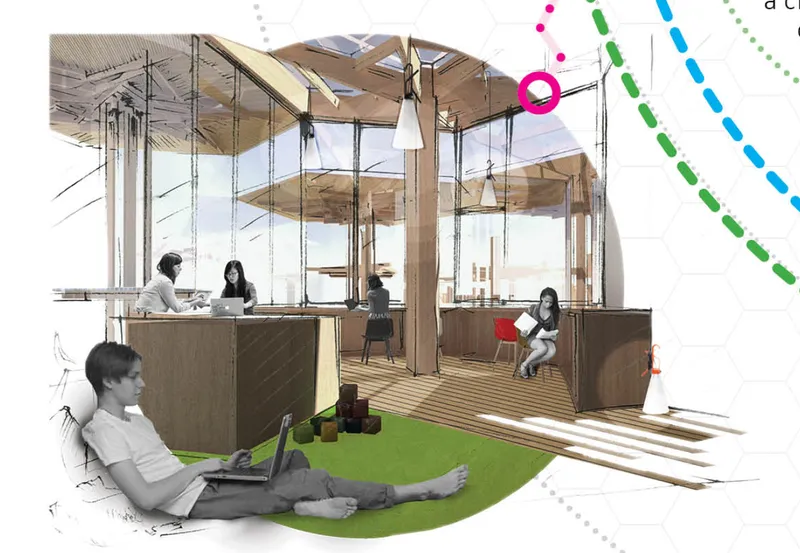
Inside, the co-working zones show how this ecological thinking extends to the interior program. Timber workstations are arranged behind glass partitions, offering visual permeability while maintaining acoustic separation. A green circular rug becomes a quiet signal: even within the work environment, organic materiality and softness are prioritized over the sterile palette of conventional offices. The space invites multi-generational participation, welcoming entrepreneurs alongside artisans and community members.
Red Canopies and Café Culture: Programming the In-Between
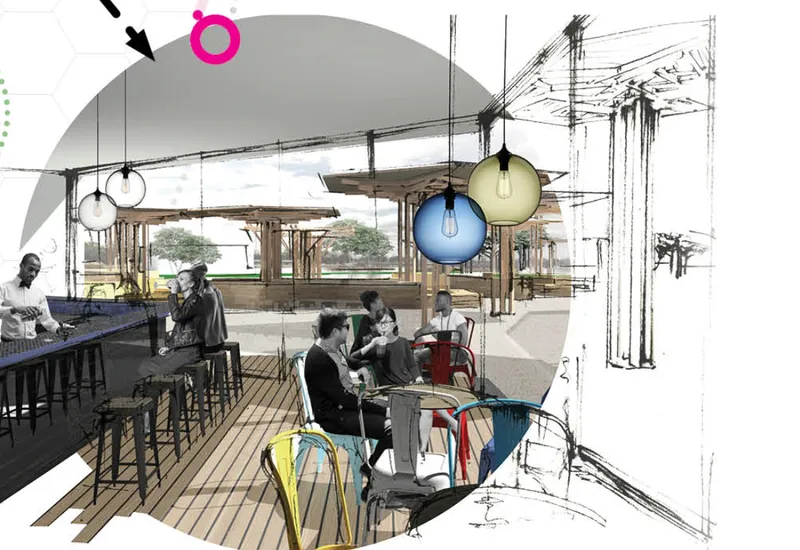
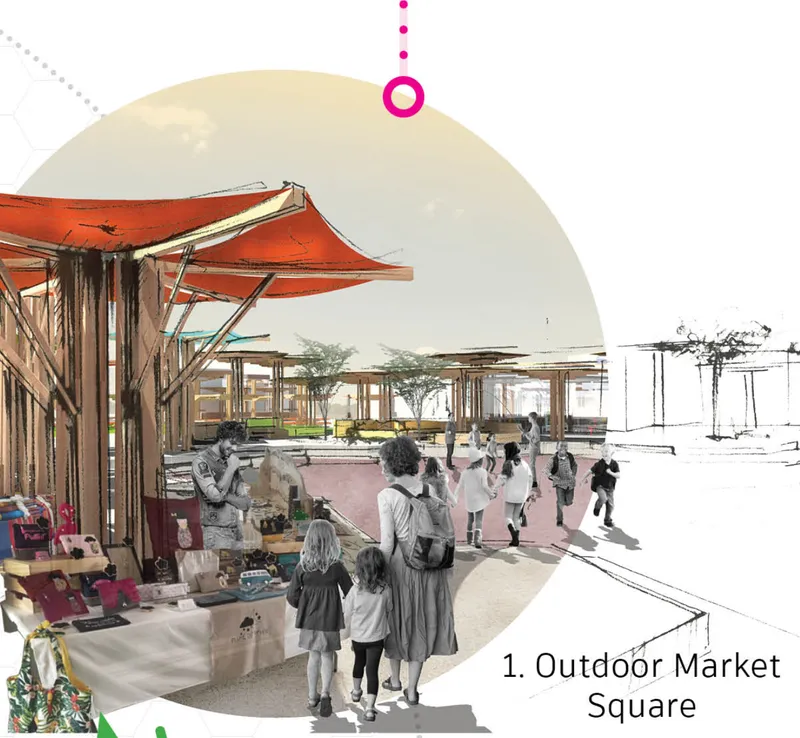
A café space punctuates the interior sequence with spherical pendant lights, bar seating, and the same exposed timber roof structure that runs throughout the project. It is a social node, positioned to catch foot traffic between the market stalls and the quieter programmatic zones. The consistency of the structural language, timber columns supporting lightweight canopies, allows visitors to navigate intuitively from commerce to leisure to learning without ever feeling they have crossed a hard threshold.
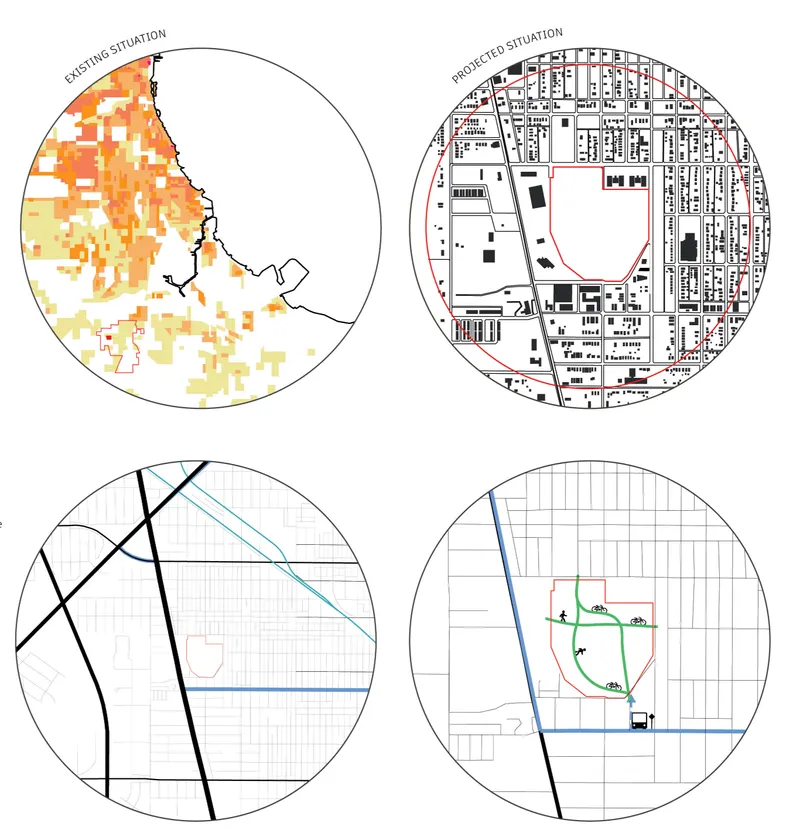
The analytical diagrams reveal the site intelligence behind these spatial choices. Four circular views compare existing density conditions with projected urban grid configurations and proposed interventions, demonstrating how La Ruche responds to its context rather than imposing a generic footprint. In the market square itself, red fabric canopies supported by timber columns create a festive, tactile atmosphere as visitors browse vendor stalls. The fabric is lightweight and replaceable, an upcycling-ready detail that aligns material choices with the project's circular economy ethos.
Layered Programming: From Vegetation to Pedestrian Flow
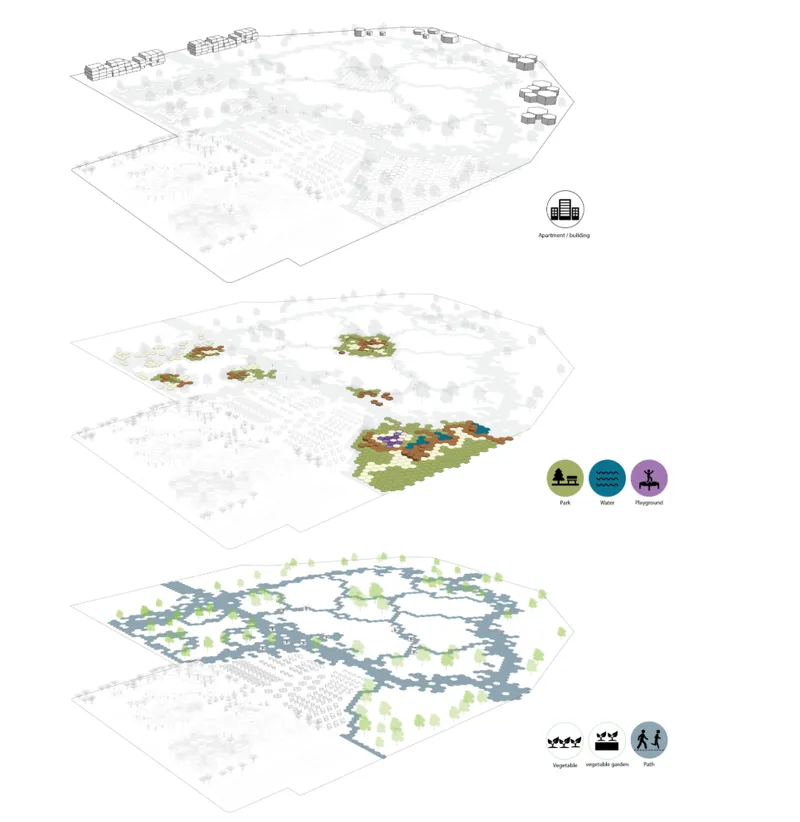
An exploded axonometric diagram breaks the project into three distinct layers of site programming: vegetation systems, water features, and pedestrian circulation routes. Each layer operates semi-independently but reinforces the others, creating a resilient framework where landscape infrastructure supports the market's economic and social functions. Water management, planting strategy, and movement patterns are not afterthoughts; they are foundational decisions that shape the architecture from the ground up.
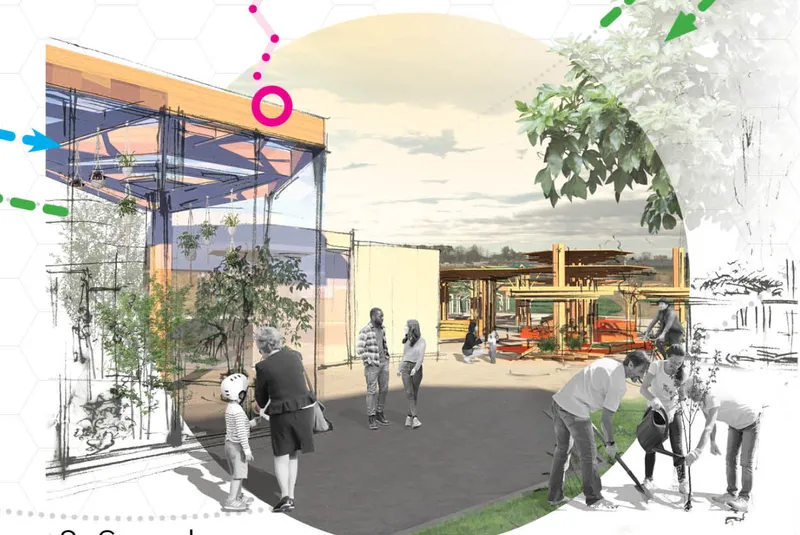
The final rendering grounds all of this analysis in human activity. A planted plaza hosts people gardening near young trees, with a steel-framed structure rising in the background. It is a scene of cultivation in both the literal and civic sense: community members tending to the landscape that, in turn, sustains their marketplace. The image captures the core premise of La Ruche: that a market should not simply serve a community but actively involve its participants in the process of building and maintaining it.
Why This Project Matters
La Ruche refuses the conventional dichotomy between architecture and landscape, between market and public space. By layering programs, from commerce to education to urban agriculture, within a single timber-and-fabric framework, the team demonstrates that adaptive design does not require technological spectacle. It requires careful attention to how people actually use space over time, and a structural logic flexible enough to accommodate change. The circular economy is not just a concept here; it is embedded in material choices, from replaceable fabric canopies to reusable timber construction, that make the building's lifecycle part of its design argument.
For a competition focused on upcycling retail, d'Andrea, Dam, and Rossetti offer something more expansive than a clever storefront. They propose that retail itself can be upcycled: transformed from a transactional program into a generative one, where the act of buying and selling becomes inseparable from growing food, sharing knowledge, and building community. That ambition, articulated through clear spatial moves and a restrained material palette, is what earned La Ruche its recognition and what makes it worth studying beyond the competition.
View the Full Project
About the Designers
Designers: Roxanne d'Andrea, Huyensa Dam, Giulia Rossetti
Enter a Design Competition on uni.xyz
uni.xyz runs architecture and design competitions year-round that reward proposals with spatial conviction and real site intelligence.
Project credits: La Ruche by Roxanne d'Andrea, Huyensa Dam, Giulia Rossetti Upcycling Retail 2019 (uni.xyz).




Popular Articles
Popular articles from the community


Co-life: Sustainable Architecture for Age-Friendly Community Living
Co-life reimagines sustainable architecture for seniors through courtyards, rammed earth, shared gardens, and spaces designed for belonging.

Hill & Cross Opera: Sculptural Opera House Architecture Shaped by Tallinn’s Landscape and Identity
Hill & Cross Opera reimagines opera house architecture in Tallinn through its sculptural hill, civic plaza, glass wave and a luminous cross.

Lunar Spiral: Space Architecture Shaped by the Mathematics of the Universe
Lunar Spiral reimagines space architecture through Fibonacci geometry, lunar regolith, levitating habitats, and self-sustaining Moon living.

The Ocean Hive: Sustainable Architecture for a Self-Sufficient Civilization at Sea
The Ocean Hive imagines sustainable architecture at sea, where modular habitats, algae, wave power and ocean waste sustain a growing colony.


Similar Reads
You might also enjoy these articles

Day and Night Park: A Time-Based Urban Newsstand in Beijing
A temporary urban newsstand in Beijing blending travel, light, and reading through poetic colors, compact form, and community-focused design.

Modernist Patio Renovation in El Masnou, Barcelona by Oliver Segura Arquitectura + Cebrià Arquitectura
Modernist patio renovation blending tradition and innovation with a movable pool, leveled floors, and Catalan materials in El Masnou.

Alto Residencial Coop: Cooperative Housing Development in Santiago de Compostela by Carbajo Barrios Arquitectos
A linear cooperative housing complex blending white volumes and perforated metal façades, enhancing community living, natural light, privacy, and urban integration.

Vil Genis School by BPA ARCHITECTURE – Massy, France
Vil Genis School in Massy, France, features sustainable design, south-facing classrooms, community integration, accessible spaces, and modern educational architecture.


Comments (0)
Please login or sign up to add comments
No comments yet. Be the first to comment!