

Labyrinth of Sanguinity: Modular Playground Architecture for Refugee Camps
A modular playground architecture transforming refugee camps into spaces of play, healing, and social connection through dynamic spatial design.


In contemporary discourse, modular playground architecture has emerged as a critical intervention in humanitarian design. The project Labyrinth of Sanguinity by Hrushikesh Shah and Madhav Joshi positions architecture not merely as shelter, but as an active agent in psychological recovery. Situated within the challenging context of refugee settlements, the proposal reframes play as a spatial and social catalyst.
Refugee camps are often characterized by monotony, instability, and emotional distress. Feelings such as struggle, despair, loss, and identity fragmentation define everyday life. This project responds by introducing an architectural system that shifts the experiential narrative from passive survival to active engagement.
Context: Refugee Camps as Spatial and Emotional Landscapes
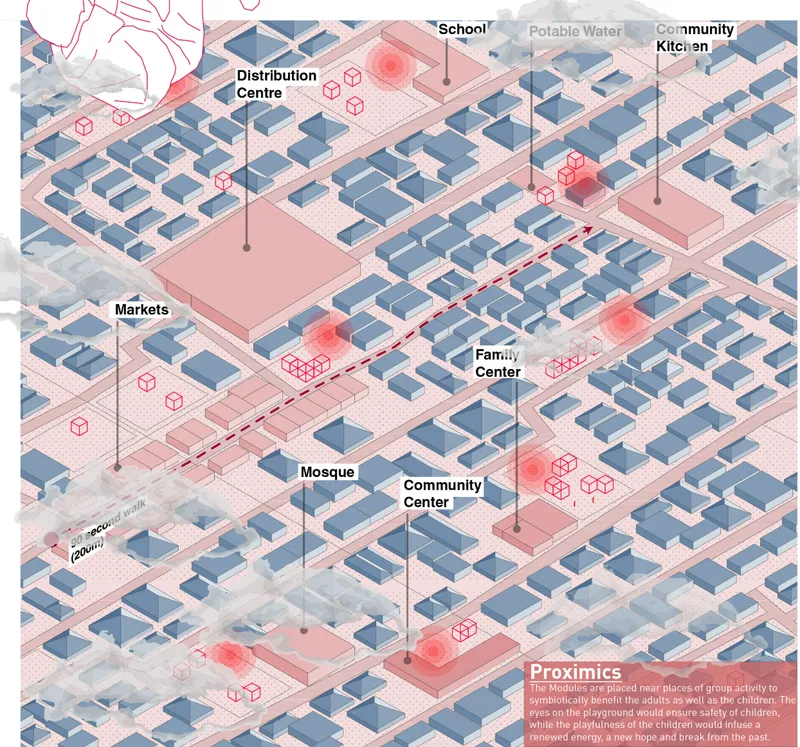
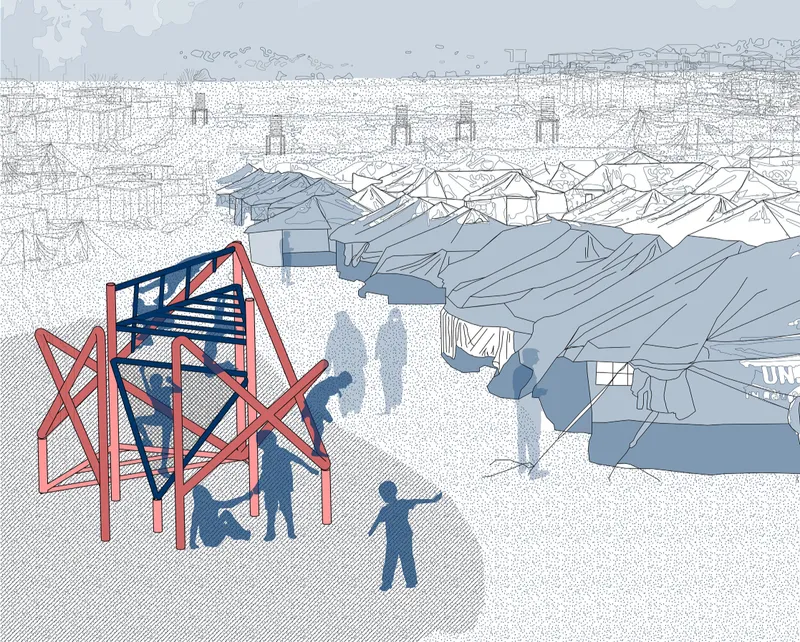
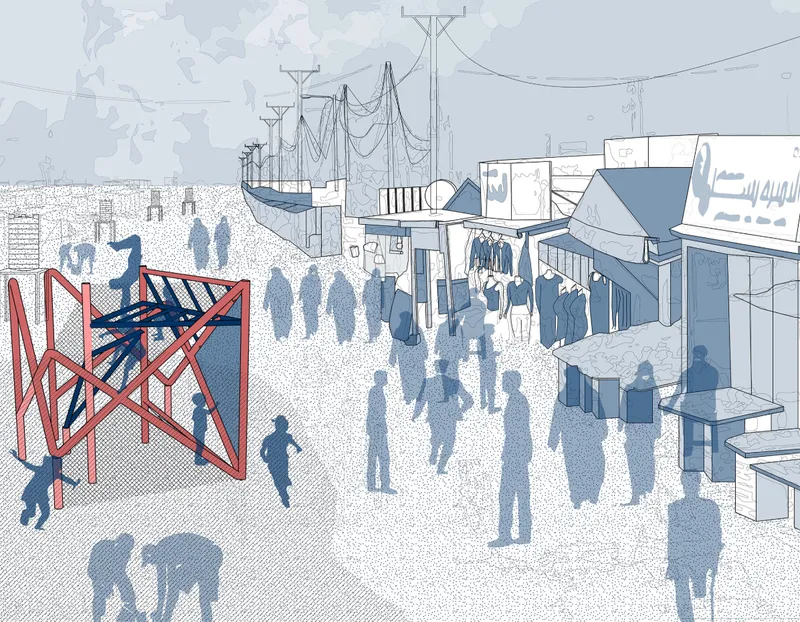
The design draws from the conditions of settlements such as the Zaatari Camp in Jordan, which has evolved from a temporary response into a semi-permanent urban fabric. These environments are marked by repetitive built forms, limited spatial diversity, and restricted opportunities for social and cognitive development.
Children, in particular, inhabit a critical intersection of vulnerability and adaptability. Their development is shaped not only by social conditions but also by spatial stimuli. The absence of engaging environments results in reduced opportunities for physical activity, imagination, and emotional resilience.
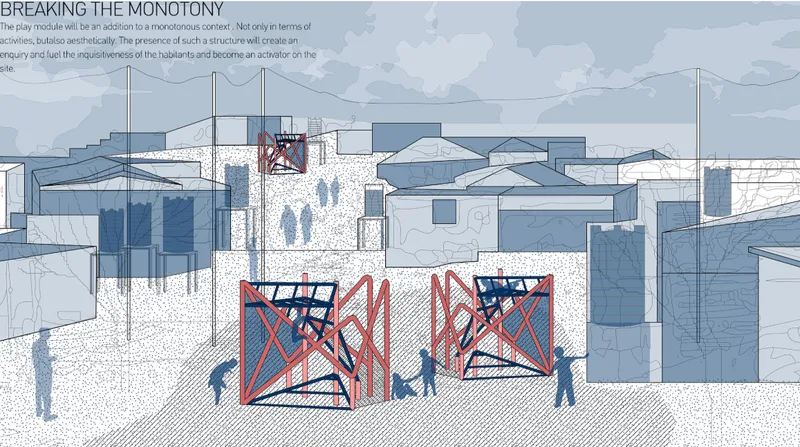
Here, modular playground architecture becomes a strategic intervention, capable of inserting micro-environments of stimulation within otherwise monotonous urban grids.
Concept: From Negative Chaos to Positive Chaos
At the core of Labyrinth of Sanguinity lies a conceptual inversion. The chaotic conditions of refugee life are not erased but reinterpreted. The project introduces a controlled, spatially rich form of chaos that encourages exploration, curiosity, and play.
The architectural language is deliberately non-linear and fragmented. Intersecting frames, inclined members, and triangulated geometries produce a labyrinthine condition. This complexity invites multiple pathways, perspectives, and modes of interaction.
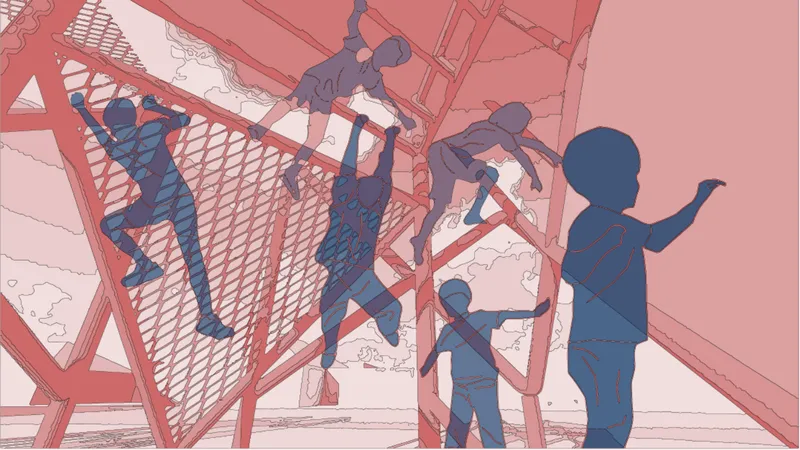
Rather than prescribing movement, the structure enables discovery. Children climb, crawl, balance, and pause within a system that continuously redefines itself through use.
Design Strategy: Modular and Scalable Systems
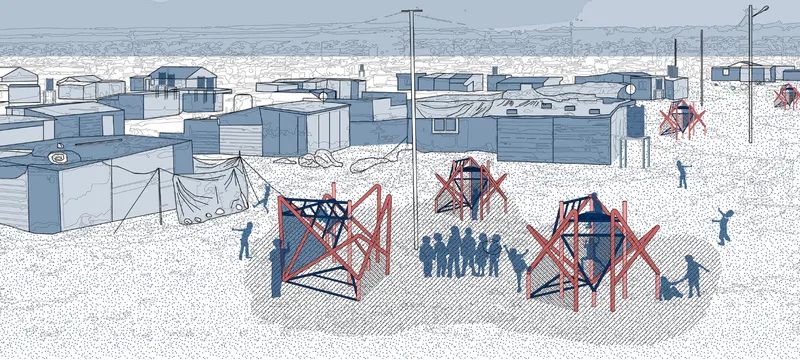
The project is conceived as a modular unit that can be replicated and adapted across different contexts. Each module operates as a compact yet dense spatial field, approximately two meters in scale, allowing ease of construction and deployment.
Key Architectural Features
- Three-dimensional play environment: Unlike conventional planar playgrounds, the structure extends vertically and diagonally, increasing spatial engagement.
- Soft and hard zones: Nets and rigid frames create varying tactile experiences, balancing safety with challenge.
- Dynamic circulation: The absence of a fixed entry or exit fosters non-linear movement patterns.
- Visual permeability: Open frames maintain visibility, ensuring safety while enhancing spatial connectivity.
The modularity ensures that these units can be distributed across camps, placed near community centers, markets, or educational spaces to maximize accessibility.
Learning Through Play: Cognitive and Physical Development
The project integrates educational principles within its spatial logic. Each interaction becomes an opportunity for learning and development.
Developmental Outcomes
- Motor skill enhancement: Climbing and balancing improve coordination and strength.
- Cognitive engagement: Navigating complex geometries enhances problem-solving abilities.
- Social interaction: Shared spaces encourage cooperation and communication.
- Emotional resilience: Play acts as a therapeutic medium, offering moments of relief and joy.
Importantly, the design avoids rigid programming. Instead, it embraces affordances, allowing children to define their own modes of engagement.
Construction Logic: Efficiency and Adaptability
The structural system relies on hollow metal pipes, bent and welded to form a network of inclined and vertical members. This approach minimizes material use while maximizing structural stability.
Construction Principles
- Ease of assembly: Components can be fabricated and assembled with minimal technical expertise.
- Durability: The use of metal ensures longevity in harsh environmental conditions.
- Foundation simplicity: Shallow concrete bases provide stability without extensive groundwork.
This pragmatic approach aligns with the constraints of refugee contexts, where resources, time, and skilled labor are limited.
Spatial Impact: Micro-Interventions with Macro Effects
While each module is small in scale, its impact extends beyond its physical footprint. When distributed across a settlement, these structures create a network of interactive nodes.
They act as:
- Social condensers, bringing children and families together
- Visual landmarks, breaking the monotony of repetitive housing
- Psychological anchors, offering familiarity and continuity
Over time, these interventions contribute to a more humane and engaging built environment.
Reimagining Humanitarian Architecture
Labyrinth of Sanguinity challenges conventional approaches to refugee architecture, which often prioritize efficiency over experience. By foregrounding play, the project reintroduces joy, agency, and imagination into spaces of crisis.
It demonstrates that even within constrained conditions, architecture can be speculative, expressive, and deeply human-centered. The project does not attempt to solve the complexities of displacement but offers a meaningful spatial response that acknowledges both trauma and resilience.
As a model of modular playground architecture, Labyrinth of Sanguinity expands the scope of humanitarian design. It positions play as infrastructure, not as an afterthought, and proposes a scalable system that can be adapted globally.
Through its dynamic form, material efficiency, and social intent, the project transforms fragments of space into catalysts for healing, interaction, and growth. In doing so, it redefines the role of architecture in contexts of uncertainty, proving that even the smallest interventions can generate profound impact.




Popular Articles
Popular articles from the community


The Ocean Hive: Sustainable Architecture for a Self-Sufficient Civilization at Sea
The Ocean Hive imagines sustainable architecture at sea, where modular habitats, algae, wave power and ocean waste sustain a growing colony.

The Musturak Paradise: Senior Living Architecture for a Connected Future in Temara, Morocco
The Musturak Paradise reimagines senior living architecture in Temara via private homes, social spaces, culture, community, and shared care.

Co-Life: Senior Housing Design That Reconnects Older Adults With the City
Co-Life reimagines senior housing design through healing gardens, shared streets, workshops, and a sustainable community across generations.
AL-JANNAH: Sustainable Architecture and Permaculture for Afghan Widows
AL-JANNAH uses sustainable architecture and permaculture to create resilient oasis of housing, learning, work and renewal for Afghan widows.


Similar Reads
You might also enjoy these articles

Eco Chapel: A Green Architecture Pavilion Designed in Symbiosis with the Forest
Eco Chapel uses green architecture to weave prayer, learning and reuse into a forest pavilion shaped by modular hexagonal canopies for life.
Kaffeebühnen: Coffee Shop Architecture Designed as a Civic Stage Between Vienna’s City and Park
Kaffeebühnen turns coffee shop architecture into a civic stage, linking Vienna’s park edge, urban life, warm timber yards, and coffee craft.
Healing Façade: Sustainable Architecture for Reforestation, Community, and Sacred Ecology in Ethiopia
Healing Façade reimagines sustainable architecture as a living wall that restores soil, catches water and renews Ethiopia's forest churches.


Urban Forest: A Vertical Ecosystem for 5,000 Workers in Singapore's Changi Business Park
Radially stacked pods and layered green decks turn a 7-acre plot into 47 acres of ecological workspace projected for 2040.




Comments (0)
Please login or sign up to add comments
No comments yet. Be the first to comment!