
Landfill to Landform: A Story of Sustainable Urban Regeneration
Transforming Ghazipur’s landfill into a regenerative urban landscape that restores ecology, empowers communities, and redefines sustainable design.

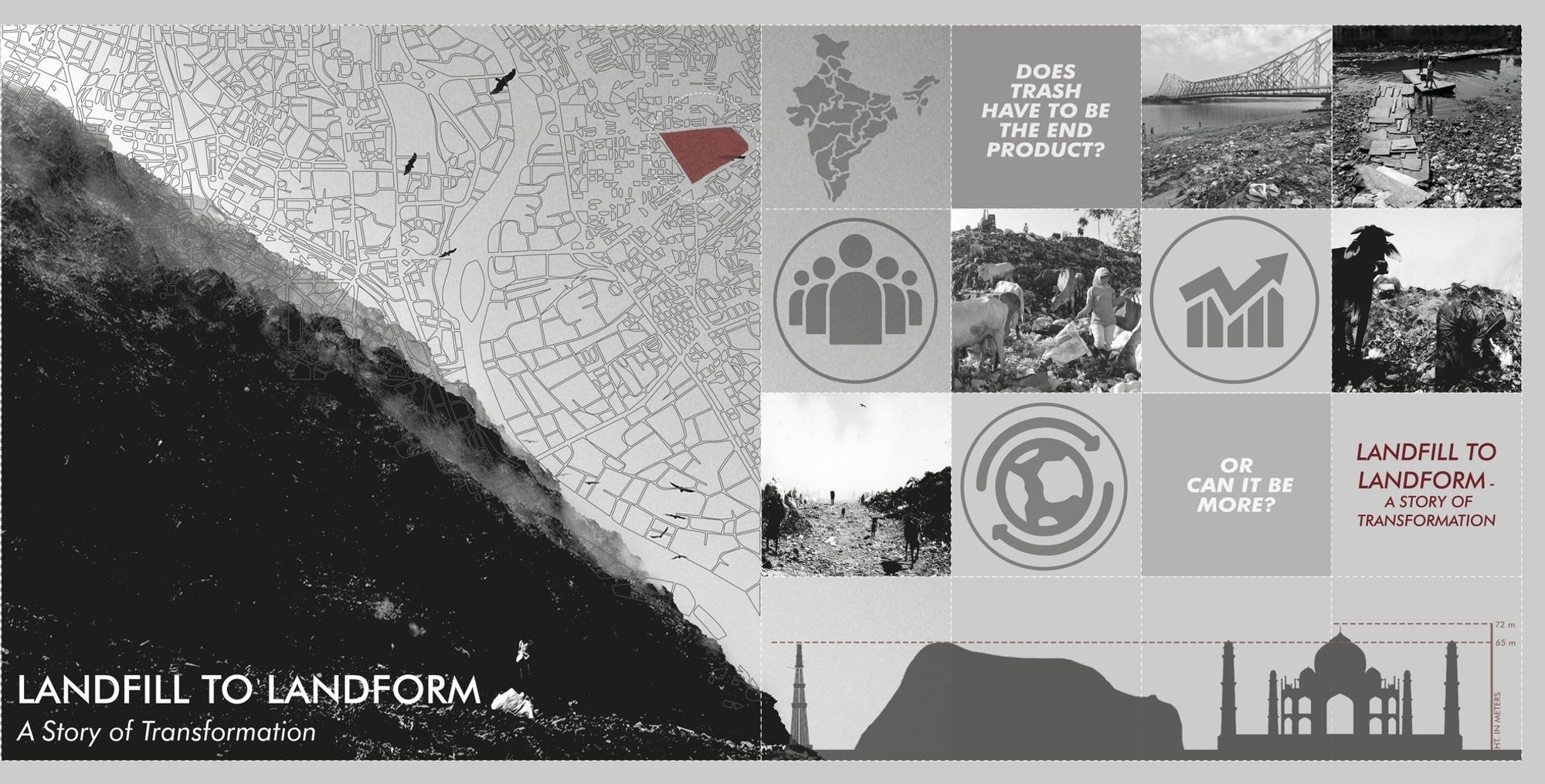
Across rapidly urbanizing cities, decommissioned landfill sites remain as environmental scars—monuments to unchecked consumption and inadequate waste management systems. The Ghazipur Landfill in New Delhi, often compared in height to the Qutub Minar and even the Taj Mahal, stands as one of India’s most visible symbols of this crisis. Its environmental, social, and economic consequences have made clear that temporary fixes are no longer enough.
Landfill to Landform: A Story of Transformation proposes a bold vision rooted in sustainable urban regeneration—a strategy that not only caps and stabilizes waste, but converts the site into a thriving ecological, educational, and public landscape. Designed by Sanskriti Jindal, Manali Jamgaonkar, and Linda Elsa Baby, the project redefines how architecture and landscape can collaborate to heal damaged territories and create long-term urban value.
Understanding the Context: From Environmental Burden to Urban Opportunity
Located along the Hindon Cut Canal and surrounded by dense residential and industrial fabric, the Ghazipur landfill influences water systems, air quality, and public health across a wide radius. Territorial and local scale analyses reveal:
- Proximity to high-density neighborhoods
- Impact on canal water systems and groundwater
- Industrial waste inflow from multiple sectors
- Limited green buffers and poor ecological resilience
Rather than isolating the landfill, the proposal integrates it into the city’s broader mobility, ecological, and social networks. This approach transforms the site from an urban liability into a strategic green infrastructure node.
Process and Strategy: Regenerating the Landfill
The regeneration strategy unfolds in layered phases combining environmental remediation, landscape restoration, and public programming.
1. Enhanced Landfill Mining (ELFM)
Selective extraction and stabilization reduce the landfill’s height and environmental risk while recovering reusable materials.
2. Conversion of Landfill Gas to Energy
Methane capture systems convert hazardous emissions into usable energy, contributing to local power generation.
3. Waste Cycle Integration
A structured waste segregation and recycling loop links nearby industries and communities, embedding circular economy principles into the masterplan.
4. Phytoremediation and Water Management
Detention basins and phytoremediation ponds treat leachate naturally, restore soil conditions, and recharge groundwater systems.
Masterplan Vision: Landform as Public Landscape
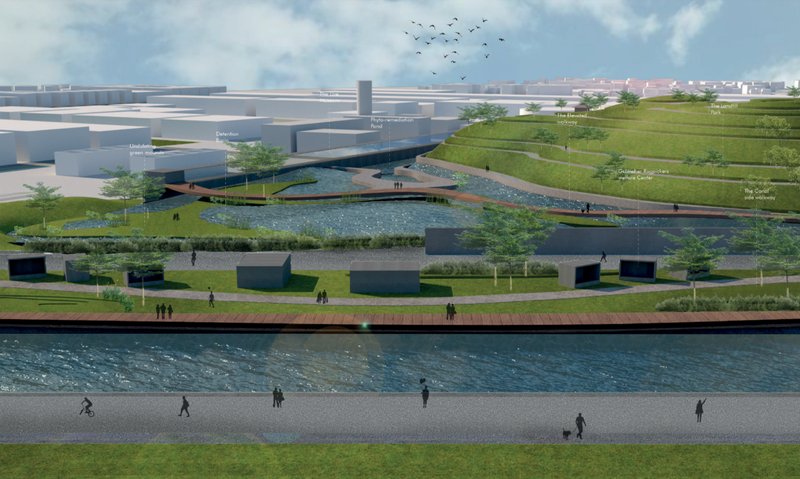
At the heart of the proposal lies a dramatic topographical transformation. The former “mountain of garbage” is reshaped into a terraced green landform supporting diverse public programs:
- The Hillside Plaza: A panoramic viewing point overlooking Delhi, designed as an amphitheatre-like public space.
- Live Museum Trail: An experiential pathway narrating the story of waste, regeneration, and biodiversity.
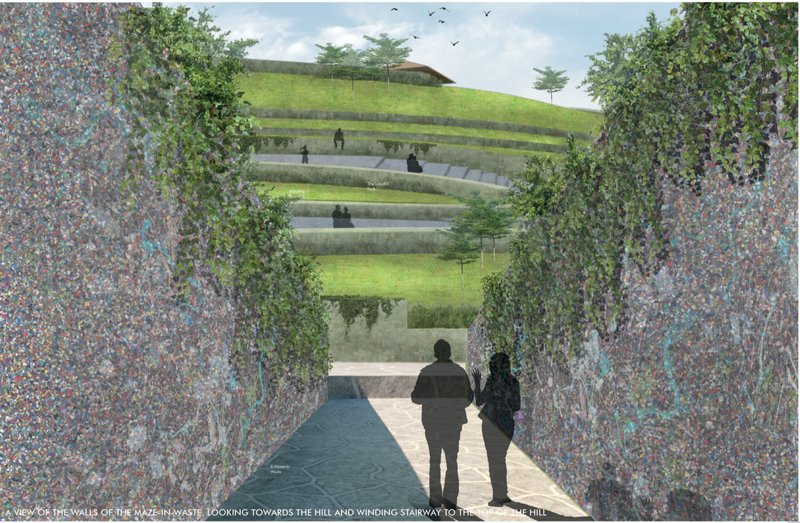
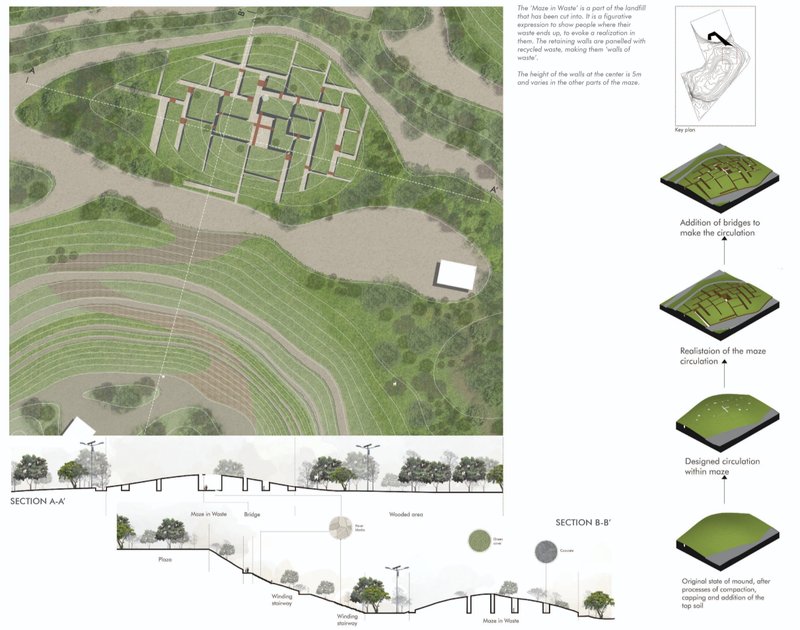
- Maze in Waste: A constructed maze built from recycled materials, symbolizing society’s journey through consumption and recovery.
- Urban Woods: Nitrogen-fixing and native species plantations that regenerate soil and foster biodiversity.
- Phytoremediation Pond & Detention Basin: Healing landscapes where ecology visibly performs restoration.
- Hindon Canal Walkway: A revitalized canal edge promenade encouraging recreation and ecological awareness.
The project shifts perception—from landfill as exclusion zone to landfill as civic destination.
Landscape Strategy: Designing with Ecology
Planting strategies are carefully calibrated to landfill conditions. Soil depth, slope stability, moisture retention, and compaction inform species selection. Buffer zones along highways mitigate noise pollution with dense foliage, while canal-side zones support flowering trees and shaded promenades.
Nitrogen-fixing species such as Acacia and Pongamia regenerate depleted soil, while grasses and shrubs stabilize slopes. The landscape is not decorative—it is performative, acting as a living remediation system.
Architectural Intervention: The Landfill Interpretation Center
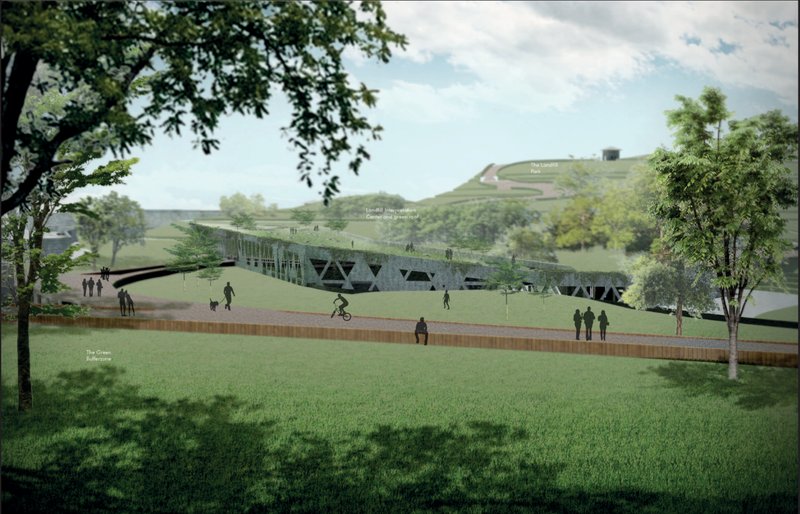
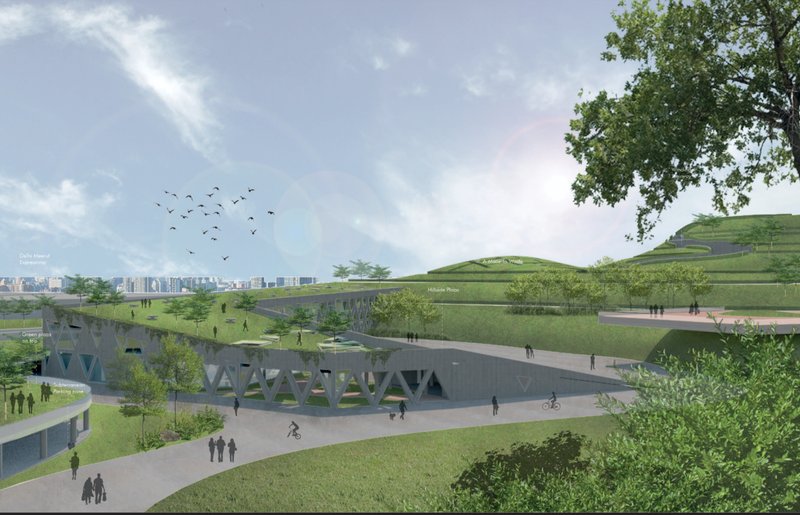
Embedded within the regenerated terrain, the Landfill Interpretation Center acts as an educational and cultural anchor. Designed with passive strategies including daylighting, natural ventilation, green roofs, rainwater harvesting, and low-E glazing, the structure demonstrates environmentally responsible architecture.
Material choices reinforce the regenerative ethos:
- Fly-ash bricks
- Recycled steel
- Permeable pavers
- Eco-concrete
- Recycled wood planks
A diagrid structural system minimizes material usage while creating a visually dynamic form that blends into the sculpted landscape.
Social and Economic Impact
The project generates revenue and employment through:
- Recycling workshops and production units
- Public events and exhibition grounds
- Increased urban footfall and tourism
- Integration with local waste-picker communities
By formalizing informal waste economies and creating educational platforms, the design aligns environmental recovery with social inclusion.
A Living Museum of Regeneration
The Live Museum concept reframes the landfill as a pedagogical landscape. Visitors move along trails that reveal ecological processes in action—biogas plants, detention basins, wooded patches, and constructed mounds. The site becomes a learning environment demonstrating how cities can transition toward circular systems.
The winding stairways and elevated walkways choreograph movement across the landform, offering changing perspectives of the canal, the city skyline, and the restored terrain.
Redefining Sustainable Urban Regeneration in India
This proposal demonstrates how architecture and landscape architecture can collaborate to reclaim environmentally degraded land. Rather than concealing waste beneath cosmetic landscaping, the project embraces transparency—revealing systems, educating users, and embedding circularity into spatial design.
By transforming Ghazipur from a symbol of crisis into a model of sustainable urban regeneration, Sanskriti Jindal, Manali Jamgaonkar, and Linda Elsa Baby propose a replicable framework for developing nations facing similar landfill challenges.
The narrative shifts from accumulation to restoration, from contamination to cultivation, and from neglect to stewardship.
Landfill to Landform is not merely a redesign of a site—it is a redefinition of urban responsibility. Through ecological restoration, renewable energy integration, circular waste management, and community programming, the project turns a monument of waste into a landscape of possibility.
In doing so, it positions sustainable urban regeneration as a powerful architectural response to one of the most urgent challenges of our time.



Popular Articles
Popular articles from the community

A Contemporary Take on Iranian Residential Architecture
A modern interior design in Mashhad that reinterprets brick, light, and spatial flow to create a warm, contemporary residential architecture.
Treehouse Apartment: A Warm Timber Interior Blending Craft, Play, and Contemporary Living
Warm timber apartment with integrated treehouse, combining natural materials, craftsmanship, and playful design to create a flexible, family-oriented living environment.


The Ken Roberts Memorial Delineation Competition (Krob)
As the most senior architectural drawing competition currently in operation anywhere in the world, it draws hundreds of entries each year, awarding the very best submissions in a series of medium-based categories.
An Miên Lumière Cafe by xưởng xép, Ho Chi Minh City, Vietnam
An industrial-inspired café where layered steel and warm light create a dynamic, immersive environment shaped by reflection, depth, and perception.


Similar Reads
You might also enjoy these articles

Digital Façade Design for our cities’ urban fronts
Prima Facie - Result Story
Protecting avian biodiversity: Bird observatories to help spread awareness & save rare bird species.
Results for ‘Fly’ - Landscape design competition out now
Connecting with nature: Forest interpretation center in Australia's Wollemi National Park
‘Asatti’ - Landscape design competition - Result story


Explore Sustainable Design Competitions
Discover active competitions in this discipline





Comments (0)
Please login or sign up to add comments
No comments yet. Be the first to comment!