
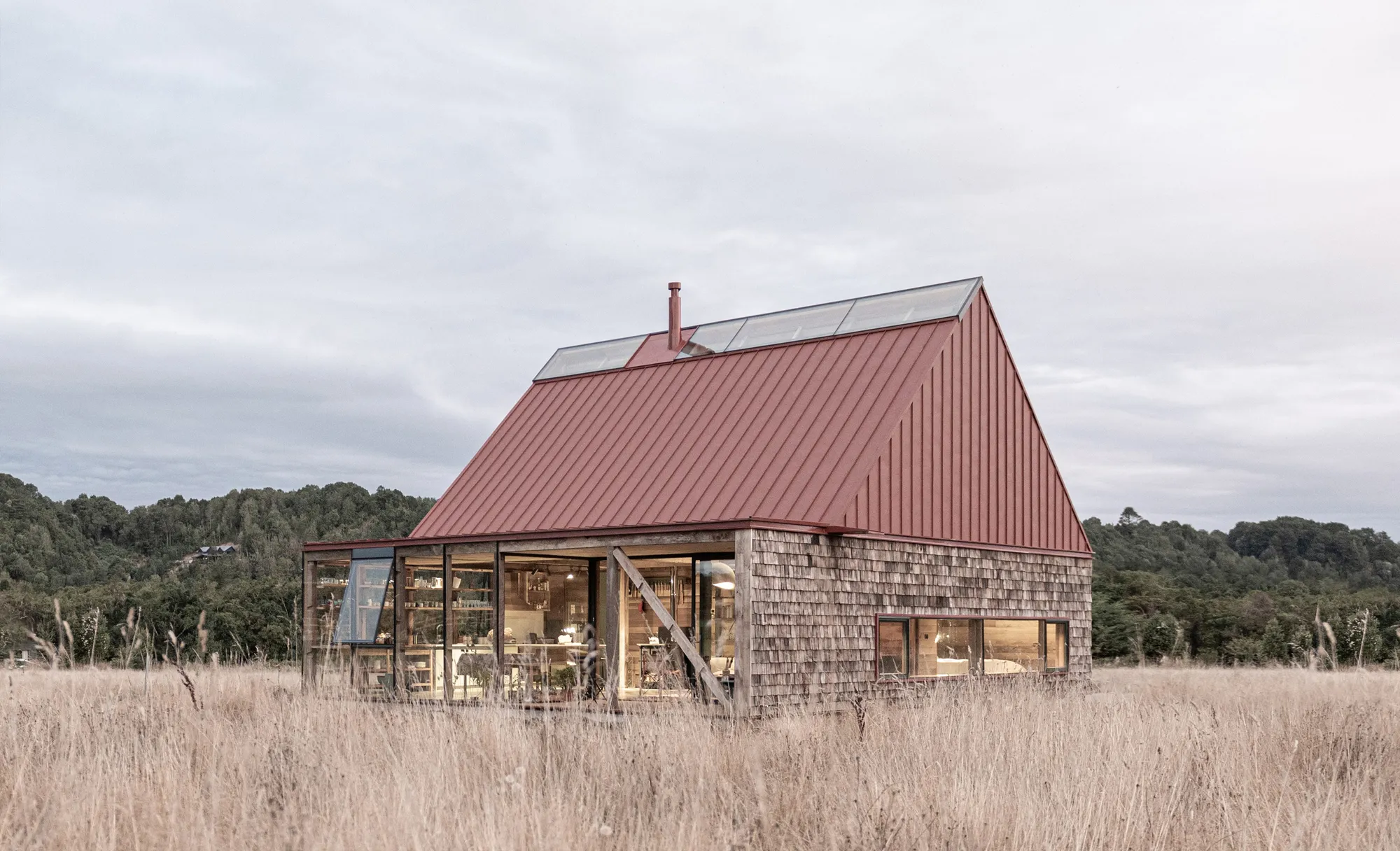
Lezaeta Lavanchy and Esteban Arteaga Build a Shingled Weekend House on Chile's Lake District
Key House pairs weathered timber shingles with a bold red gable roof on a dormant grassland near Puerto Varas, Chile.


Southern Chile's lake district carries a building tradition that runs deeper than most architects care to admit. Timber shingles, steep pitched roofs, and compact volumes are not stylistic choices here; they are responses to rain, wind, and a landscape that punishes pretension. Key House, a 150 square meter weekend retreat in Puerto Varas designed by Lezaeta Lavanchy and Esteban Arteaga, knows this well. It sits in a field of dry grasses and trees with the quiet confidence of a structure that belongs exactly where it is.
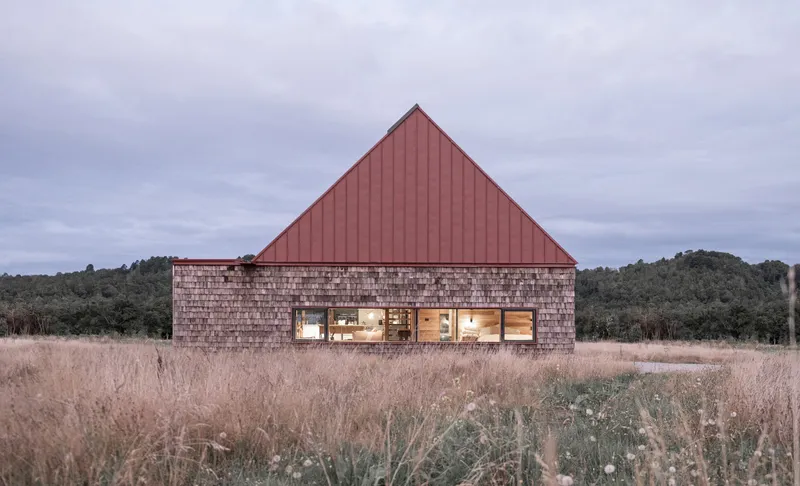
What makes the project worth studying is the discipline of its composition. A single gabled volume clad in weathered shingles is capped by a red metal roof that reads as both protective shell and chromatic signal. Between these two registers, a horizontal band of windows slices the facade, pulling light deep into the interior while breaking the mass into legible strata: base, aperture, crown. The house is compact, deliberate, and unapologetically regional without drifting into nostalgia.
A Red Roof Against the Grey Sky
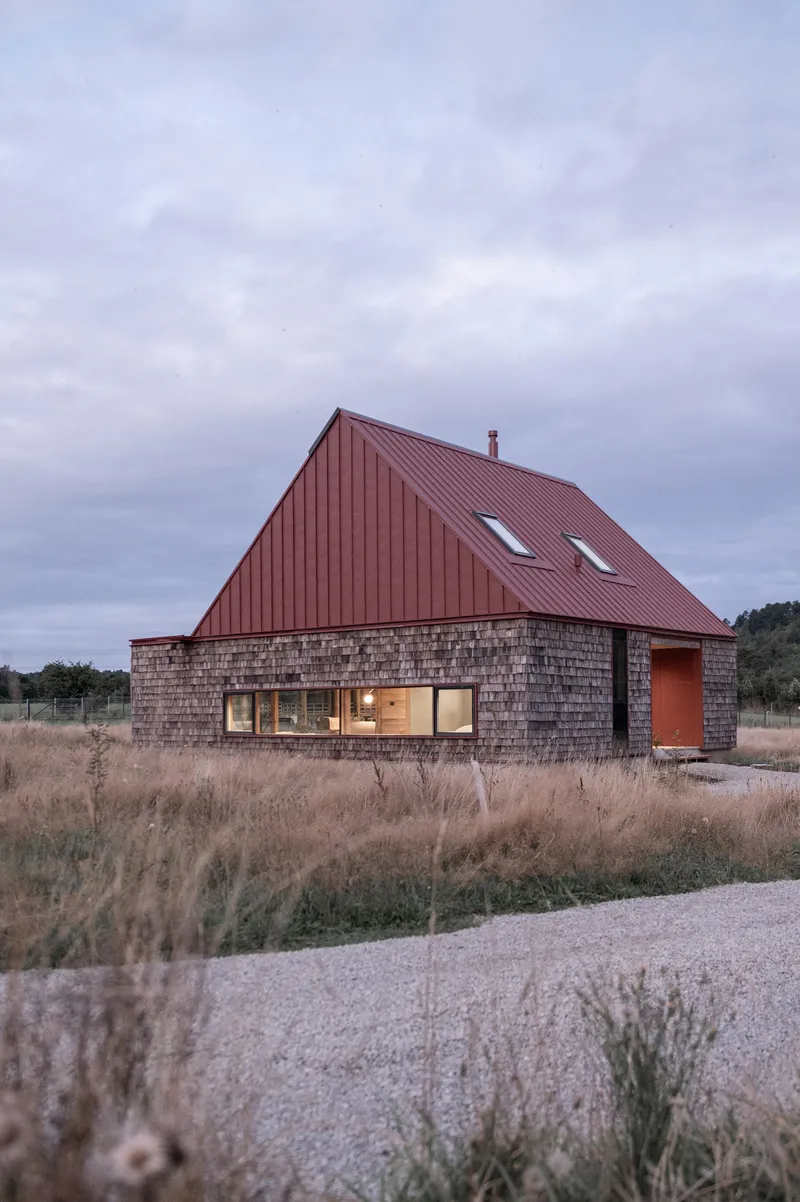
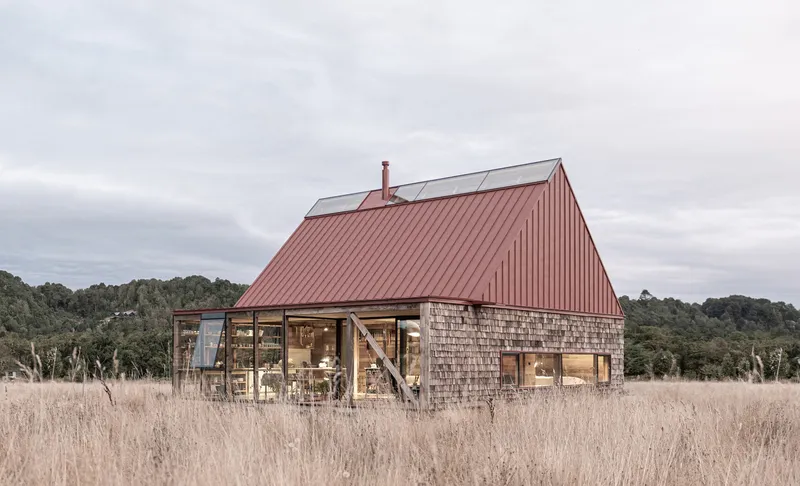
The red metal roof is the project's most assertive gesture. Against overcast skies and dormant grasslands, it operates as a warm focal point, anchoring the house in its flat terrain. The color is not arbitrary: red-roofed structures are a regional marker in southern Chile's German-influenced settlements, and Key House updates the convention with standing seam metal that catches dusk light in long, warm gradients.
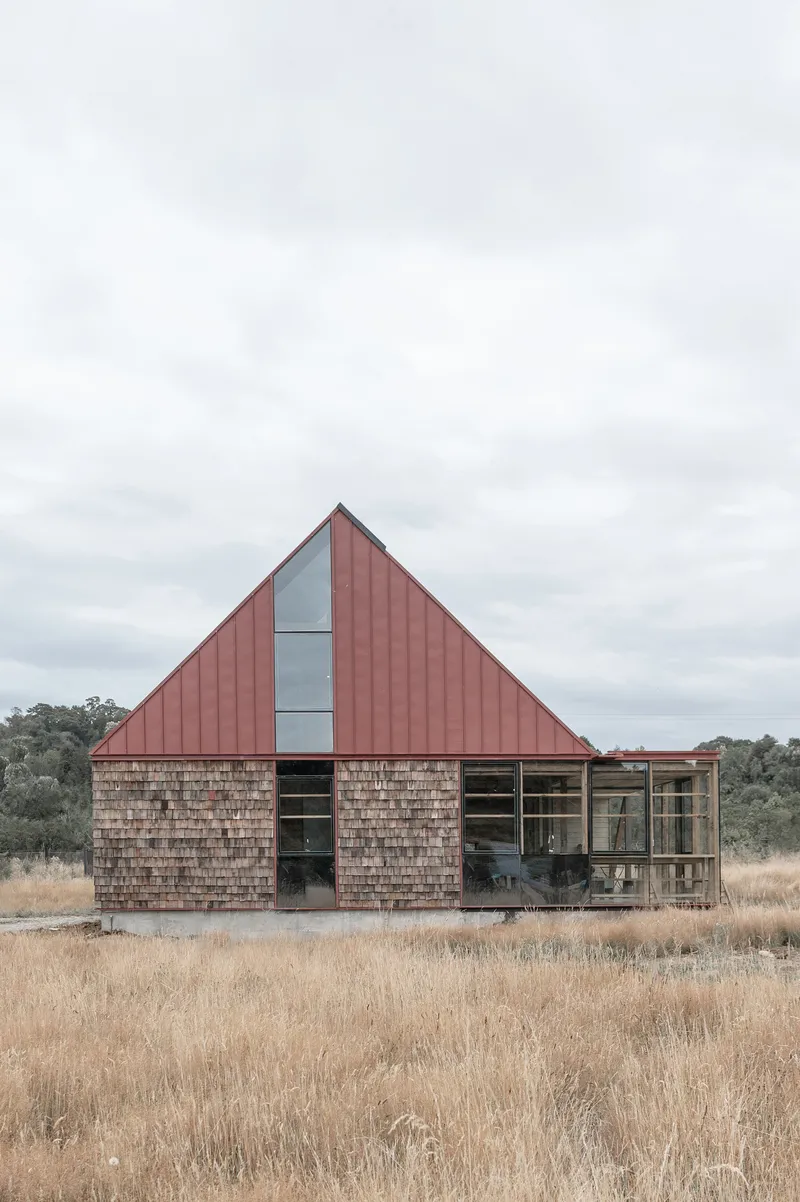
From the side elevation, the roof's pitch reveals itself as steep enough to shed the region's considerable rainfall, while the enclosed terrace beneath it creates a transitional zone between inside and out. A vertical glazing slot on one facade adds a secondary rhythm, puncturing the shingle wall with a sliver of transparency that hints at the interior life within.
Shingles, Glass, and a Horizontal Cut
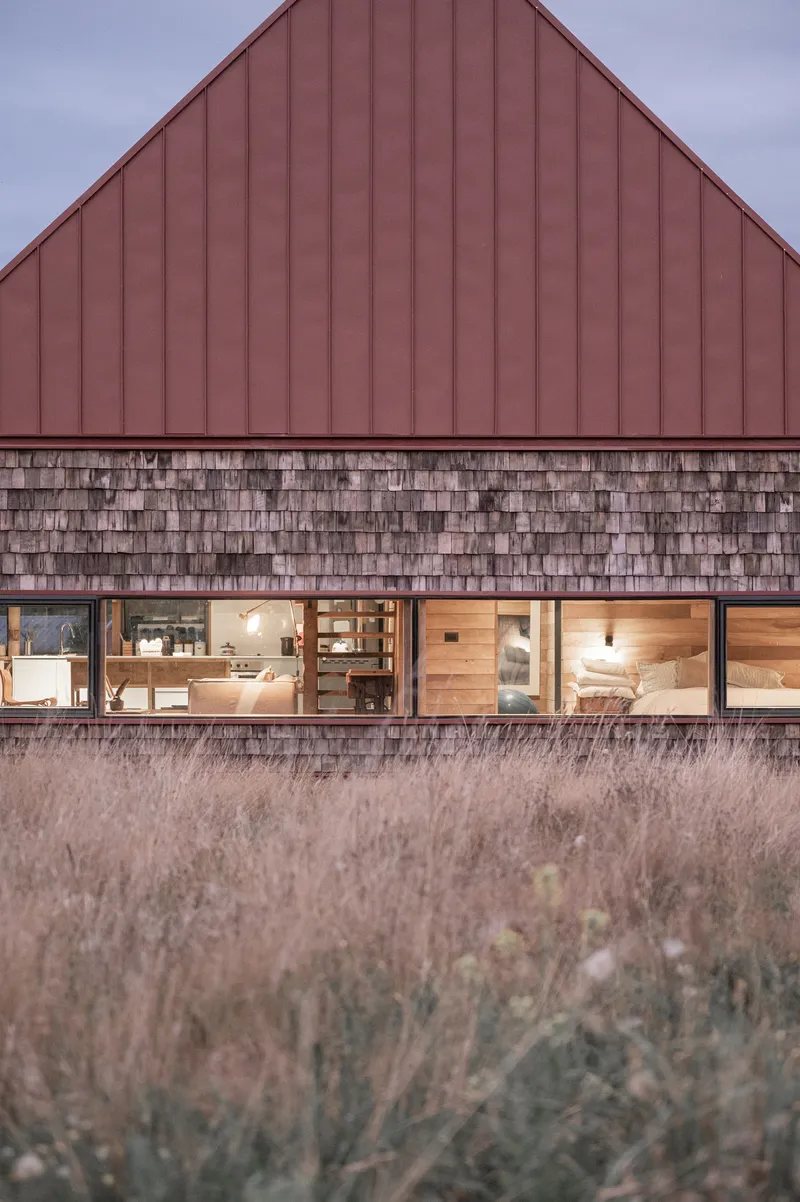
The facade's tripartite logic is best read at twilight, when interior light spills through the horizontal window band and the three layers separate cleanly. Below: shingles darkened by exposure, their irregular texture grounding the house to the earth. Middle: a continuous strip of glass that wraps the volume, lifting the roof visually off the base. Above: the crisp geometry of the red gable, floating on light.
This horizontal cut is the smartest move in the project. It prevents the shingle mass from becoming oppressive while delivering panoramic views of the surrounding field and treeline from nearly every room. The architects treat the window not as a hole punched in a wall but as a structural datum, a line that organizes the entire elevation.
Timber Interiors and the Double-Height Core
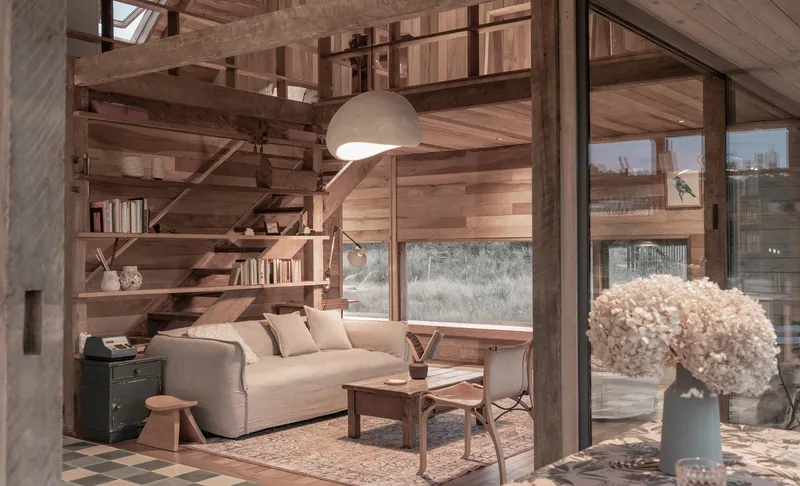
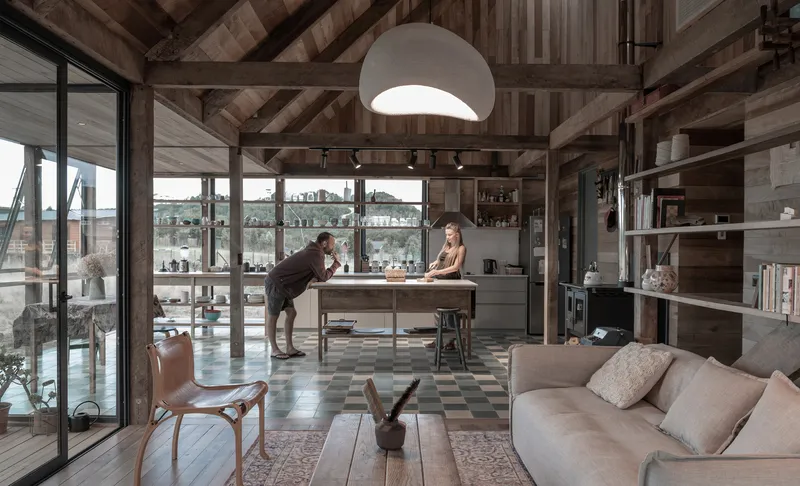
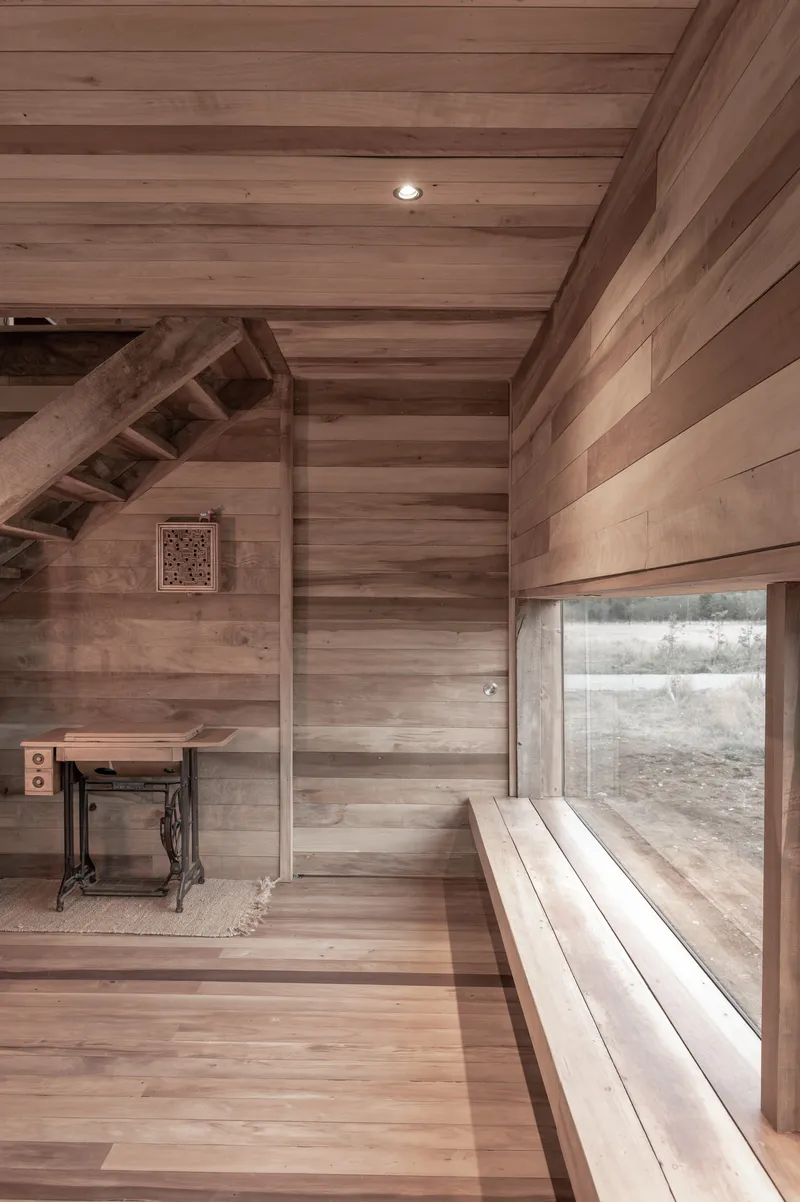
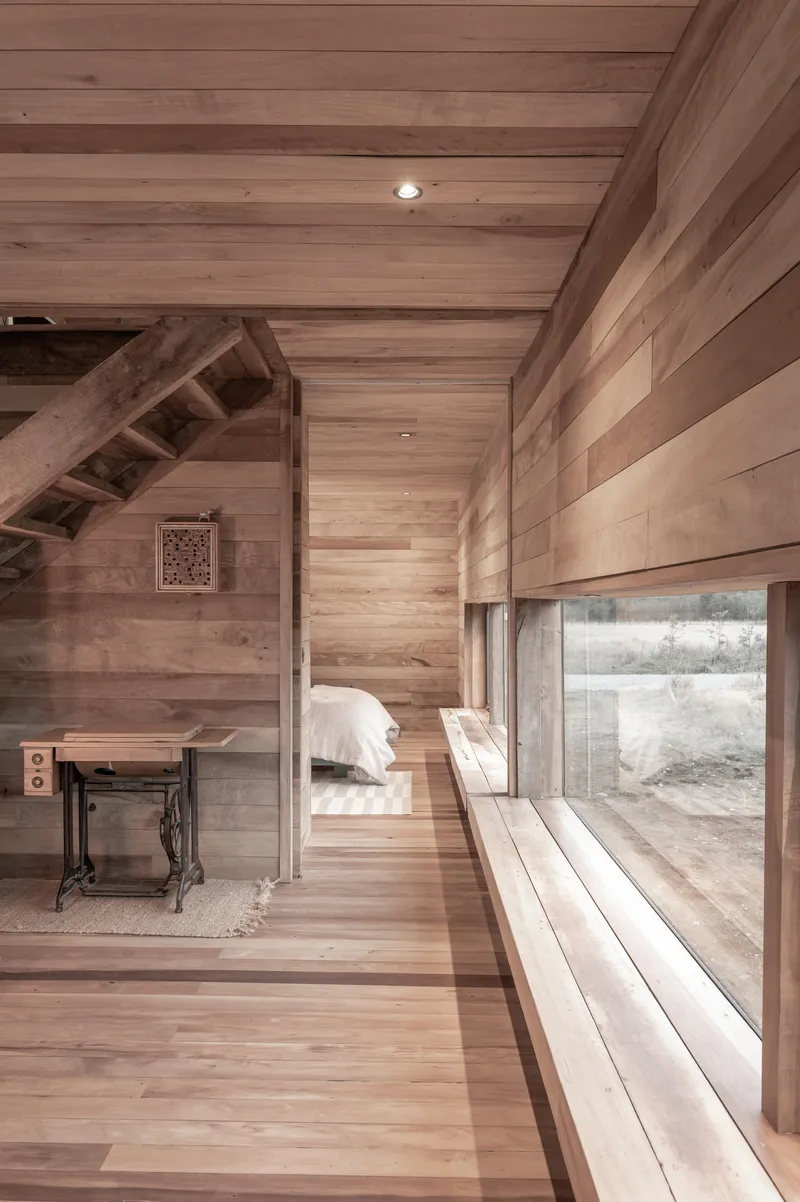
Inside, the house opens into a double-height living space lined entirely in timber. An open staircase climbs one wall, its treads and stringers left exposed as structural ornament. The material palette is restrained to the point of near-monochrome: warm wood tones, a floor lamp, a sofa, and little else competing for attention. It is the kind of interior that trusts its proportions to do the work.
The ground floor living area gathers cooking, dining, and sitting around a central island. Patterned floor tiles introduce the only significant non-timber surface, marking the kitchen zone and giving the feet a different texture underfoot. Exposed beams run the length of the ceiling, reinforcing the longitudinal axis and drawing the eye toward the glazed terrace at the far end.
The Terrace as Threshold
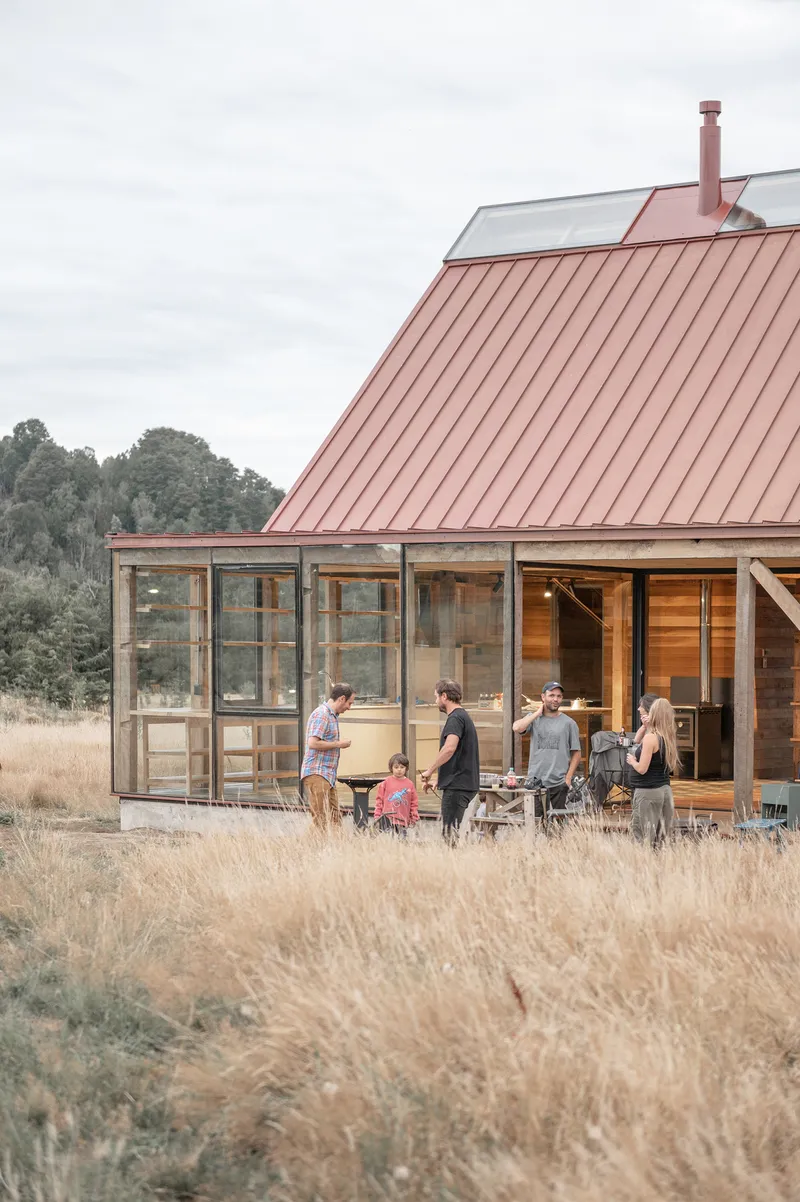
Golden hour reveals the terrace's true role. Sheltered under the red roof but open to the landscape through full-height glazing, it functions as the house's social heart, a space that is neither fully inside nor fully outside. A family gathered on the deck in low sun confirms what the drawings suggest: this is where the house wants you to be.
Upstairs, the bedrooms retreat into more intimate proportions. Timber-lined walls wrap around a low window bench that follows the horizontal aperture logic of the facade below. A wide landscape window frames the view at sitting height, encouraging rest rather than spectacle. The staircase rising through the section connects these two registers of domesticity, the communal ground floor and the private upper level, without ceremony.
Plans and Drawings
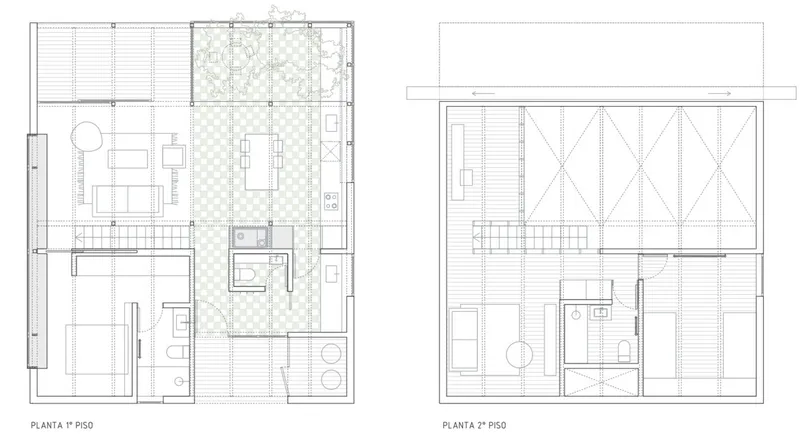
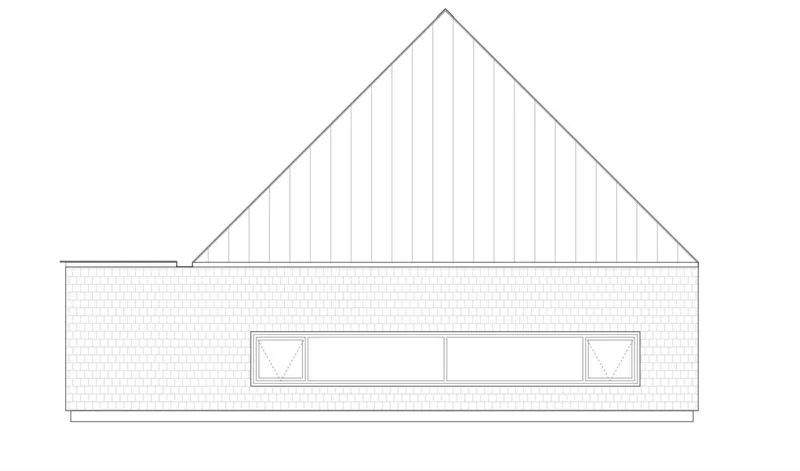
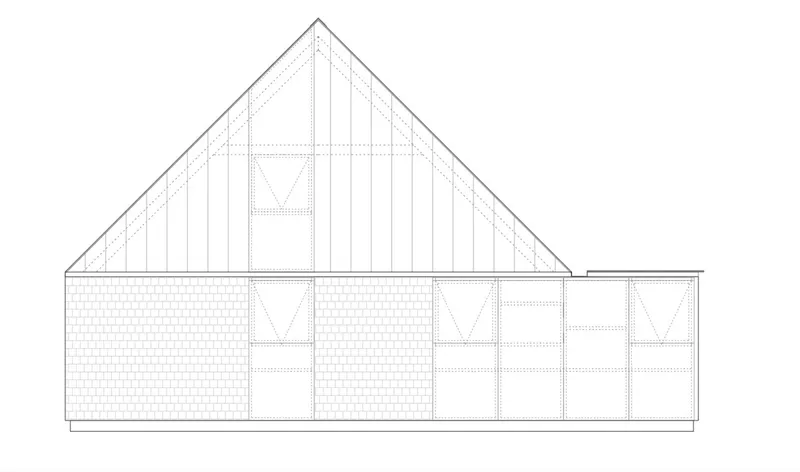
The floor plans confirm what the photographs suggest: a simple rectangular footprint organized around the central staircase. The ground level is largely open, with the kitchen island and living area flowing into the glazed terrace. Upper-level rooms tuck under the pitched roof, their ceilings following the slope. Elevations show the shingle cladding reaching up to the horizontal window band, with the red metal roof sitting above like a hat. One elevation reveals a patterned brick wall with vertical window openings, suggesting that the house's materiality is not uniform but shifts face by face, responding to orientation and privacy.
Why This Project Matters
Key House matters because it demonstrates that regional architecture does not need to be conservative. The shingle tradition of southern Chile is alive here, but it has been edited, abstracted, and sharpened. The horizontal window band, the chromatic punch of the red roof, and the double-height interior volume are all contemporary moves executed within a vernacular framework. The result is a house that could not exist anywhere else, yet speaks a language any architect can learn from.
For a weekend house of just 150 square meters, the project carries disproportionate lessons about proportion, material honesty, and the courage to work within constraints rather than against them. Lezaeta Lavanchy and Esteban Arteaga have built something that earns its place in the field, literally and architecturally.
Key House, designed by Lezaeta Lavanchy and Esteban Arteaga. Puerto Varas, Chile. 150 m². Completed 2025. Photography by Esteban Arteaga.
About the Studio
Lezaeta Lavanchy
Share Your Own Work on uni.xyz
If projects like this are the kind of work you want to make, uni.xyz is a place to publish your own, find collaborators, and enter design competitions.




Popular Articles
Popular articles from the community


Play: Fragments of Their World
Familiar architecture becomes modular playground design, creating safe spaces where displaced children can learn, connect, imagine and play.

The Musturak Paradise: Senior Living Architecture for a Connected Future in Temara, Morocco
The Musturak Paradise reimagines senior living architecture in Temara via private homes, social spaces, culture, community, and shared care.

Hill & Cross Opera: Sculptural Opera House Architecture Shaped by Tallinn’s Landscape and Identity
Hill & Cross Opera reimagines opera house architecture in Tallinn through its sculptural hill, civic plaza, glass wave and a luminous cross.

Conexión: Biophilic Design Reimagines High-Rise Living in Hong Kong
Conexión reimagines high-rise living in Hong Kong through biophilic design, green facades, shared spaces, daylight, water and nature within.


Similar Reads
You might also enjoy these articles

Bao Huynh Watercolor Atelier: A Serene Art Retreat in Hội An
Bao Huynh Watercolor Atelier in Hội An blends multifunctional art spaces, sustainable design, local materials, and family-friendly living in a serene environment.

Atelier Macri Concept Store Interior Design by CASE-REAL
Atelier Macri store features a "ko" counter, walnut wood details, cork displays, blending retail, gallery, and seamless customer experiences.

Manuel Vargas Izquierdo Stadium and High-Performance Sports Center: Architectural Excellence in Jalpa de Méndez
The Manuel Vargas Izquierdo Stadium blends sustainable design, inclusive sports facilities, and cultural-inspired architecture, revitalizing Jalpa de Méndez’s public spaces.

KAKR Buluh Awar Hall: Revitalizing Community and Ecology Through Bamboo Architecture
Community built bamboo hall revitalizes Buluh Awar village, empowering youth, restoring ecology, celebrating vernacular craftsmanship through sustainable architecture and culture.



Comments (0)
Please login or sign up to add comments
No comments yet. Be the first to comment!