
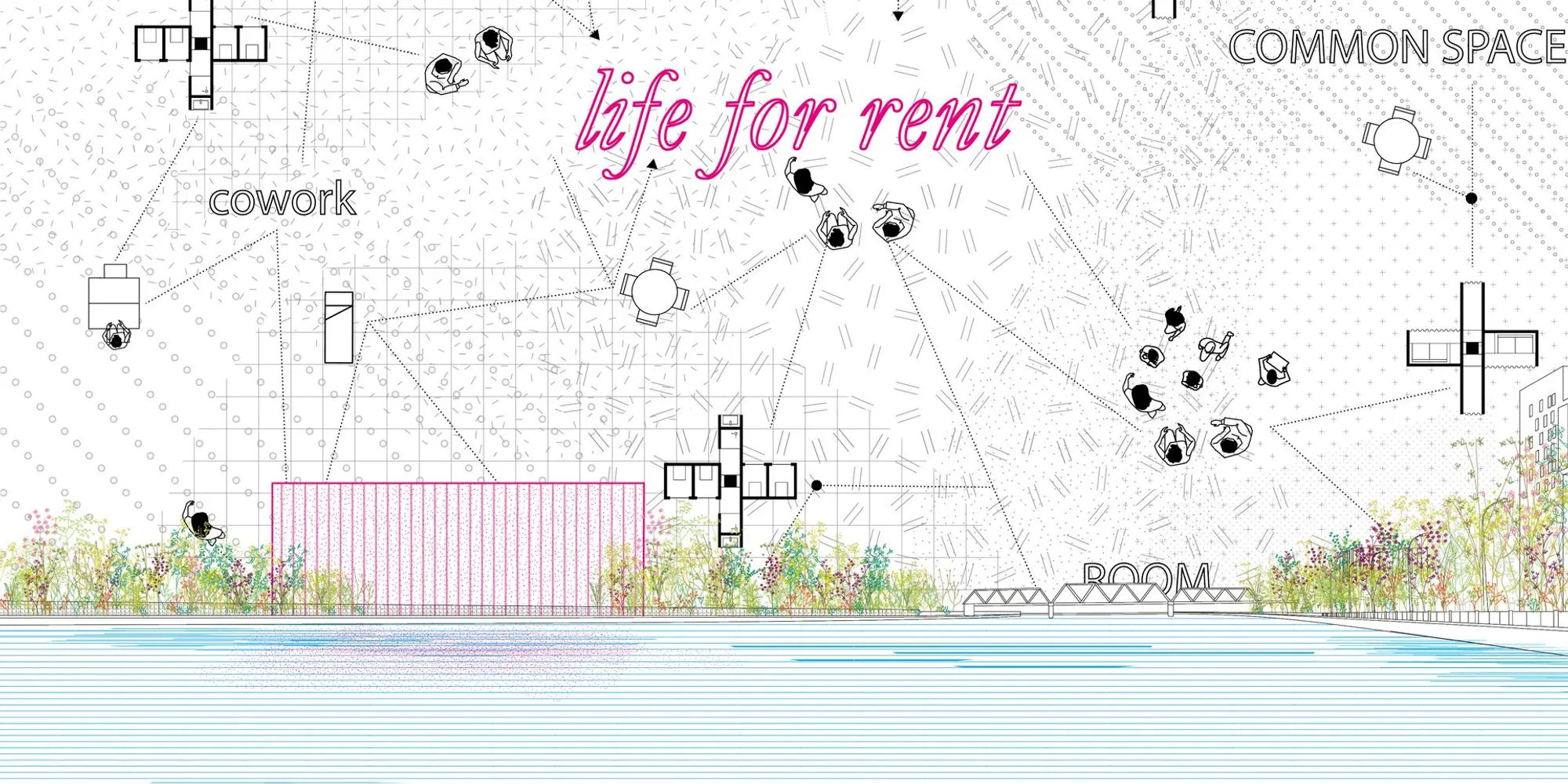
Life for Rent: Co-Living as a Skill-Sharing Platform
A perimeter block with a double courtyard where residents rent rooms, share skills, grow food, and connect to a European co-living network.


What if your home was not just a place to live but a platform? Life for Rent, designed by Giorgia Greco, Marta Giancane, and Elena Spadea, proposes a co-living building that doubles as a social and economic network. Residents do not just rent space. They share skills, offer services, and earn within the building itself. The architecture is the marketplace.
Shortlisted in the Hustle Hub '19 competition on uni.xyz, the project wraps residential units around a double courtyard: a formal garden on one side, a wilder woodland on the other. The perimeter is lined with programme: a film club, a bar, co-working spaces, meeting rooms, and a welcome desk. The plan reads as a village with a commons at its centre.
The Plan: Perimeter of Rooms, Centre of Green
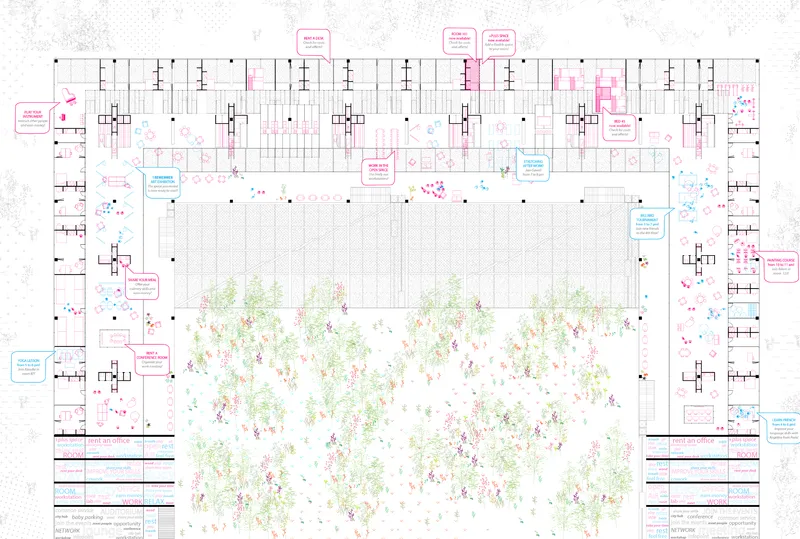
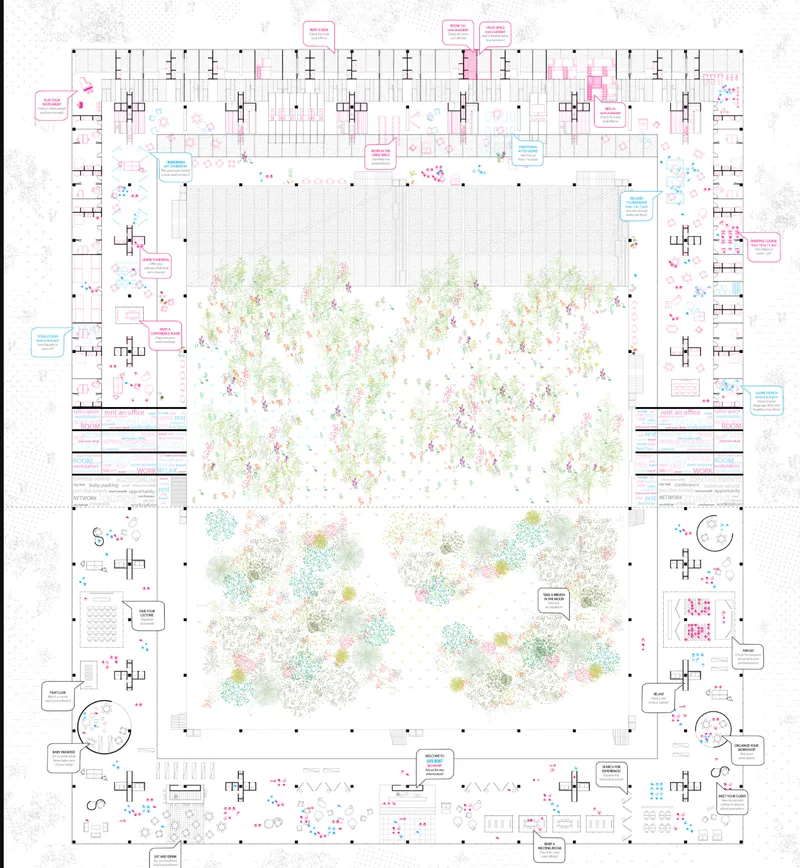
The two plan drawings show the building's logic at different levels. The upper floor wraps residential units around a large central garden courtyard. Pink labels identify each unit and its programme. The full building plan reveals the double courtyard: a structured garden above and a denser woodland below, with residential units on three sides and shared programme along every edge.
This perimeter-block-with-courtyard strategy is the oldest urban housing plan in Europe. Life for Rent updates it by making the perimeter permeable: every edge contains public programme that faces both the street and the garden. The building has no back. Every side is active.
The Ground Floor: A Village Commons
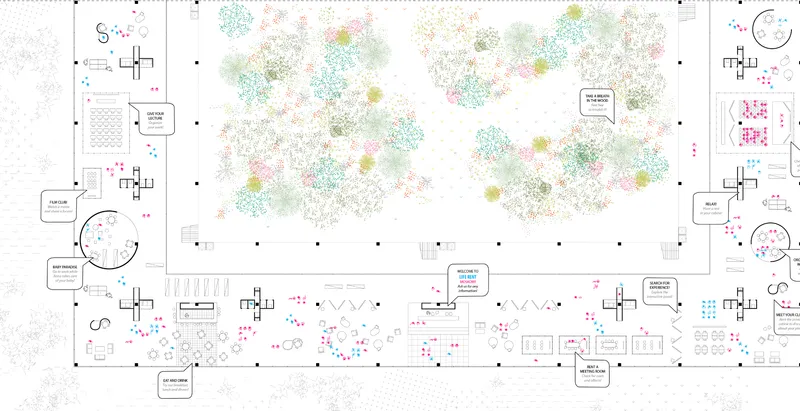
The ground floor plan is the project's most socially detailed drawing. A central woodland garden fills the courtyard. Around it, speech-bubble callouts label the programme: film club, bar and paradise, eat and drink, book a meeting room, welcome to Life for Rent, relax, meet your clan. The tone is informal, direct, and inviting. The labels address the resident, not the architect.
This ground floor is where the skill-sharing economy lives. Residents who cook can run the kitchen. Residents who teach can book the meeting room. Residents who perform can use the film club. The building provides the rooms. The residents provide the programme. This inversion, where the occupants generate the content rather than consuming it, is the project's most original contribution.
The Rooftop: Personal Plots, Shared Harvest
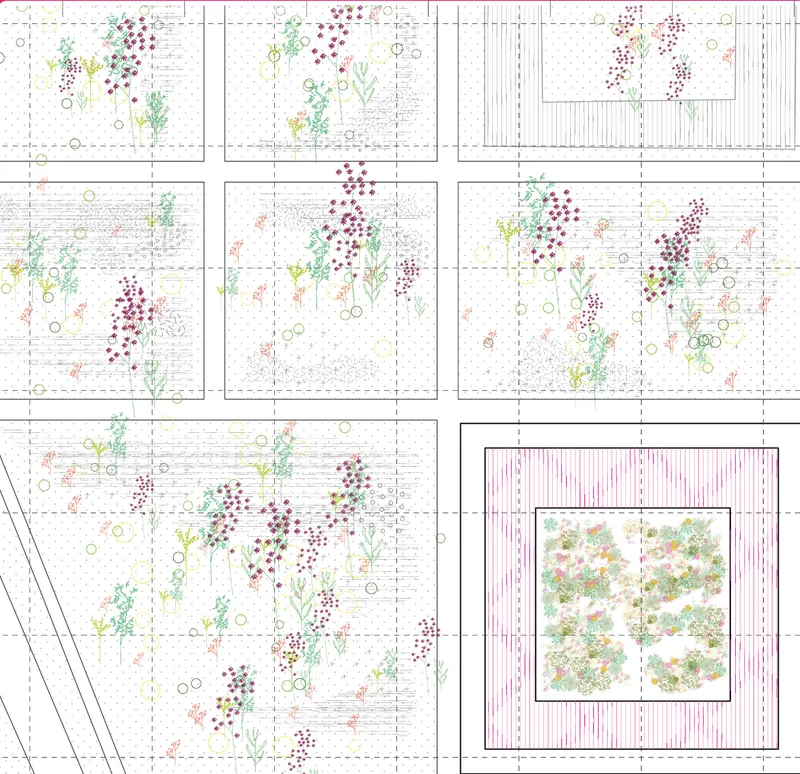
The rooftop plan shows a grid of individual planted plots. Each one contains different species: herbs, flowers, vegetables. One larger pink-bordered plot is communal. The rooftop is a productive landscape, not a decorative one. Residents grow food, tend plants, and share the harvest. The grid of plots maps directly onto the grid of units below: every resident has a plot.
This one-to-one correspondence between apartment and garden plot is the spatial equivalent of ownership. You do not just live in the building. You cultivate a piece of it. The rooftop makes the building feel like a settlement rather than a rental. It gives residents a stake in the place that goes beyond the lease.
The Network: A European Platform
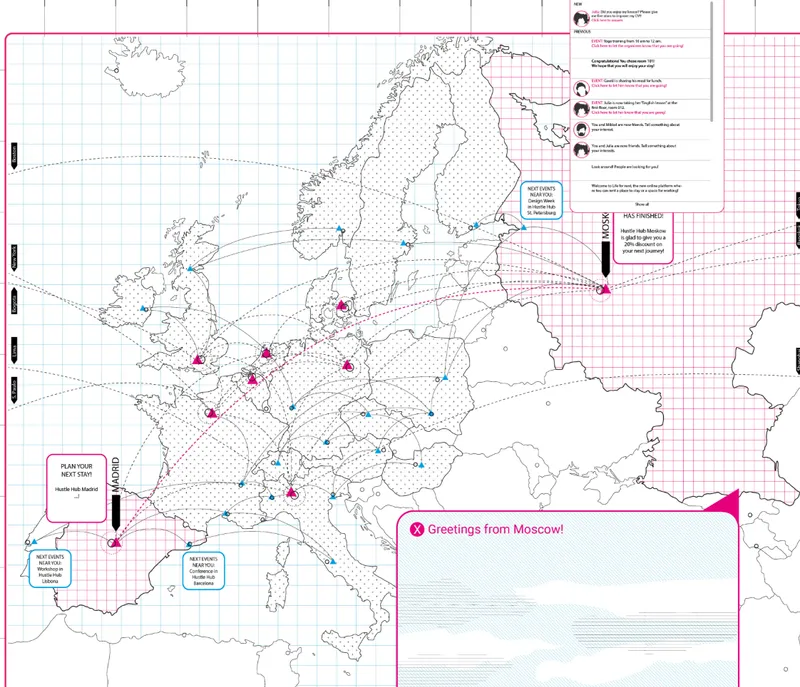
The European map shows Life for Rent locations connected by pink arrows across the continent. Moscow is marked with Greetings from Moscow, anchoring the competition site. The network implies that residents can move between hubs: live in Moscow this month, Milan next month, each time entering the same skill-sharing platform in a different city.
This networked model turns co-living into a subscription. You do not buy a home. You join a system. The building in Moscow is one node. The network is the product. This is the most scalable interpretation of the co-living brief in the competition: not one building but a continent of connected ones.
Why This Project Matters
The Hustle Hub competition asked for co-living. Life for Rent answered with a co-living platform. The building is the hardware. The skill-sharing network is the software. The plans, with their speech-bubble labels and individual garden plots, communicate a specific social contract: you contribute to the community, and the community supports you in return.
For anyone studying co-living as a platform business, skill-sharing economies, or the architecture of networks, this project demonstrates that the most interesting co-living proposals are not about the rooms. They are about what happens between the rooms.
View the Full Project
About the Designers
Designers: Giorgia Greco, Marta Giancane, Elena Spadea
Enter a Design Competition on uni.xyz
If platform co-living, skill-sharing architecture, or networked housing systems are the kind of work you want to explore, uni.xyz runs competitions year-round that reward proposals where the social model is as designed as the plan.
Project credits: Life for Rent by Giorgia Greco, Marta Giancane, Elena Spadea. Shortlisted, Hustle Hub '19 (uni.xyz).




Popular Articles
Popular articles from the community


Lunar Spiral: Space Architecture Shaped by the Mathematics of the Universe
Lunar Spiral reimagines space architecture through Fibonacci geometry, lunar regolith, levitating habitats, and self-sustaining Moon living.

Co-Life: Senior Housing Design That Reconnects Older Adults With the City
Co-Life reimagines senior housing design through healing gardens, shared streets, workshops, and a sustainable community across generations.

Conexión: Biophilic Design Reimagines High-Rise Living in Hong Kong
Conexión reimagines high-rise living in Hong Kong through biophilic design, green facades, shared spaces, daylight, water and nature within.

Co-life: Sustainable Architecture for Age-Friendly Community Living
Co-life reimagines sustainable architecture for seniors through courtyards, rammed earth, shared gardens, and spaces designed for belonging.

Similar Reads
You might also enjoy these articles

Day and Night Park: A Time-Based Urban Newsstand in Beijing
A temporary urban newsstand in Beijing blending travel, light, and reading through poetic colors, compact form, and community-focused design.

Modernist Patio Renovation in El Masnou, Barcelona by Oliver Segura Arquitectura + Cebrià Arquitectura
Modernist patio renovation blending tradition and innovation with a movable pool, leveled floors, and Catalan materials in El Masnou.

Alto Residencial Coop: Cooperative Housing Development in Santiago de Compostela by Carbajo Barrios Arquitectos
A linear cooperative housing complex blending white volumes and perforated metal façades, enhancing community living, natural light, privacy, and urban integration.
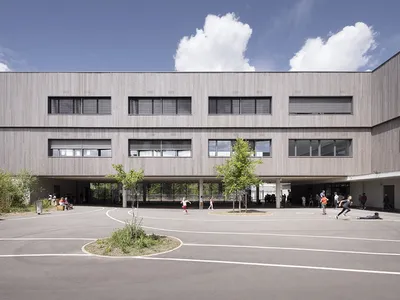
Vil Genis School by BPA ARCHITECTURE – Massy, France
Vil Genis School in Massy, France, features sustainable design, south-facing classrooms, community integration, accessible spaces, and modern educational architecture.




Comments (0)
Please login or sign up to add comments
No comments yet. Be the first to comment!