

Life Train: A Modular Bridge That Recasts the US-Mexico Border as a Place of Transition
A linear chain of modular volumes spans a border river, folding shelter, healthcare and a gamified routine into one adaptable piece of infrastructure.


Most border architecture is built to say no. Fences, checkpoints and holding facilities are designed around control and delay, and the people who pass through them are treated as a problem to be processed. Life Train starts from a different premise: if people are going to wait at the edge of a nation, the architecture of that edge should help them live, recover and move forward. The proposal takes the form of a linear, bridge-like chain of modular units that behaves less like a single building and more like infrastructure, a system that can expand, contract and reconfigure as demand shifts.
Designed by 岳 王 and published as a project on uni.xyz, Life Train sits on a crossing between the United States and Mexico. It addresses asylum seekers, migrants in transition, deported individuals and the volunteers who support them, and it organises shelter, healthcare, administration, social space and transitional housing along one continuous spine. The train metaphor is literal enough to be useful: each carriage is a self-contained module, yet none of them makes full sense without the others.
A Threshold Built as a Spine, Not a Wall

The axonometric shows the core move clearly. White framed volumes with curved roofs line up into a segmented structure that crosses the river, turning the line between two territories into an inhabited corridor. Where conventional border infrastructure separates, this spine gathers: the liminal zone becomes a place where movement and pause coexist. The repetitive modular language is a deliberate choice, since it allows the structure to scale without losing coherence, and the segmentation keeps each programme legible as its own carriage.
The history timeline running along the bottom of the sheet is a quiet but important framing device. It places the proposal within a longer story of the border, signalling that the design is reacting to accumulated policy and spatial conditions rather than inventing a crisis from scratch. That grounding gives the formal gesture of the bridge more weight than a symbolic image alone could carry.
Gamifying the Daily Path Through the Building
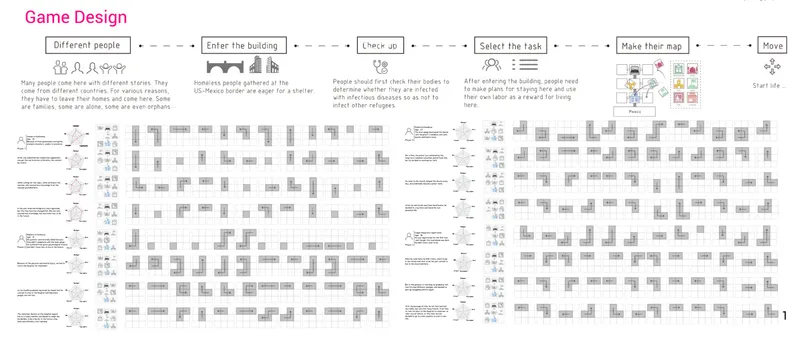
The most distinctive layer of Life Train is its gamified operating system. The diagram sheet lays out a sequence of steps, entry, health checks, task allocation and spatial navigation, above rows of grid-based plan layouts tailored to different occupants. Instead of reading the building as a static container, the designer treats it as an interface: residents move through stages, take on roles and contribute to running the community while advancing their own journey.
This is where the project earns its ambition. Waiting is one of the most corrosive experiences in any migration system, and giving people tasks and a visible structure to progress through is a direct response to that loss of agency. The grid plans also show that the modules are not one-size-fits-all; an asylum seeker arriving for the first time, a deported individual and a volunteer each occupy the system differently. The open question, worth pressing in further development, is how this game structure avoids sliding back into the logic of sorting and surveillance it sets out to resist.
Five Volumes, Five Operations Across the River

The aerial site plan reduces the proposal to a linear chain of five volumes spanning the water, with massing diagrams at the upper right explaining how that chain was formed. The design process runs through a set of operations named compliance, breaks, stretch, cut and connectivity, and each one leaves a trace in the plan: breaks articulate the carriages, stretch and cut adjust them to site and programme, and connectivity stitches them back into one continuous spine.
Seen from above, the strategy reads as incremental by design. Because the units are modular and lend themselves to prefabrication, the system can be deployed in stages and grow as needs change, responding to shifting demographics, policies and environmental conditions. The bridge also engages the landscape it crosses, treating the river as part of the infrastructure rather than an obstacle to be fortified.
Why This Project Matters
Life Train moves refugee housing beyond the emergency tent. By combining temporary shelter with longer-term habitation, skill development and community building, it proposes that the border can host a real stage of life rather than a void between departure and arrival. The modular, linear system is a pragmatic answer to uncertainty: it can be expanded when crossings surge and reconfigured when policy changes, which is exactly the kind of resilience migration contexts demand.
Just as valuable is the project's insistence that behaviour and space are designed together. The gamified sequence asks architects to think about what people do inside a humanitarian building hour by hour, not only how many beds it holds. Whether or not the specific mechanics survive scrutiny, the underlying argument holds: infrastructure at the edge of a nation can be built for care and transition, and the bridge is a fitting form for that idea.
View the Full Project
About the Designers
Designer: 岳 王
Enter a Design Competition on uni.xyz
uni.xyz runs architecture and design competitions year-round that reward proposals with spatial conviction and real site intelligence.
Project credits: Life Train by 岳 王.


Popular Articles
Popular articles from the community


GROUP A Strips a 1969 Rotterdam Harbor Headquarters to Its Frame and Wraps It in Timber Louvers
In Rotterdam's M4H harbor district, Ferro Offices reuses a 1969 frame, adds one timber storey and reaches BREEAM-NL Outstanding.

David Ortega Stacks a Two-Story Mexico City Penthouse Around a Steel Stair and a Pergola-Shaded Roof Terrace
In Colonia Roma, a 300 m² penthouse uses oak joinery, a planted steel stair and a slatted roof pergola to make a new-build apartment feel like a house.

LT2A and OPEN Architectes Thread a Brick and Glass High School Through a Wooded Belgian Campus
In Braine-l'Alleud, a 3,000 m² wing for Collège Cardinal Mercier pairs pale brick with a glazed colonnade, deferring to a small chapel and a dense wood.

Cube Design Draws an Ecological Corridor Between Two Shenzhen Hills with the Nankai Building
Beside Shenzhen's container docks, the Nankai Building pairs stacked balconies with a climbing green screen to connect two hillsides across its height.

Similar Reads
You might also enjoy these articles
Healing Façade: A Modular Chapel System That Restores Ethiopia's Sacred Forests
Winner of the Eco-Chapel competition, this circular timber façade collects water from air to rebuild soil and reforest degraded Ethiopian landscapes.
Kaffeebühnen: Where Coffee Shop Architecture Becomes a Civic Stage in Vienna
A linear sequence of timber boxes, transparent shells, and open yards turns the Viennese café tradition into a public performance space.
Eco Chapel: A Modular Forest Pavilion That Grows Like the Landscape It Protects
Hexagonal timber modules weave through existing trees, turning a chapel into a living system for prayer, education, and reforestation.


Urban Forest: A Vertical Ecosystem for 5,000 Workers in Singapore's Changi Business Park
Radially stacked pods and layered green decks turn a 7-acre plot into 47 acres of ecological workspace projected for 2040.

Explore Architecture Competitions
Discover active competitions in this discipline

Challenge to reimagine the Iron Throne

Photograph architecture without architects

Illustrate the lost glory of Angkor Wat - Render Challenge

Design challenge to reuse E-waste
Comments (0)
Please login or sign up to add comments
No comments yet. Be the first to comment!