
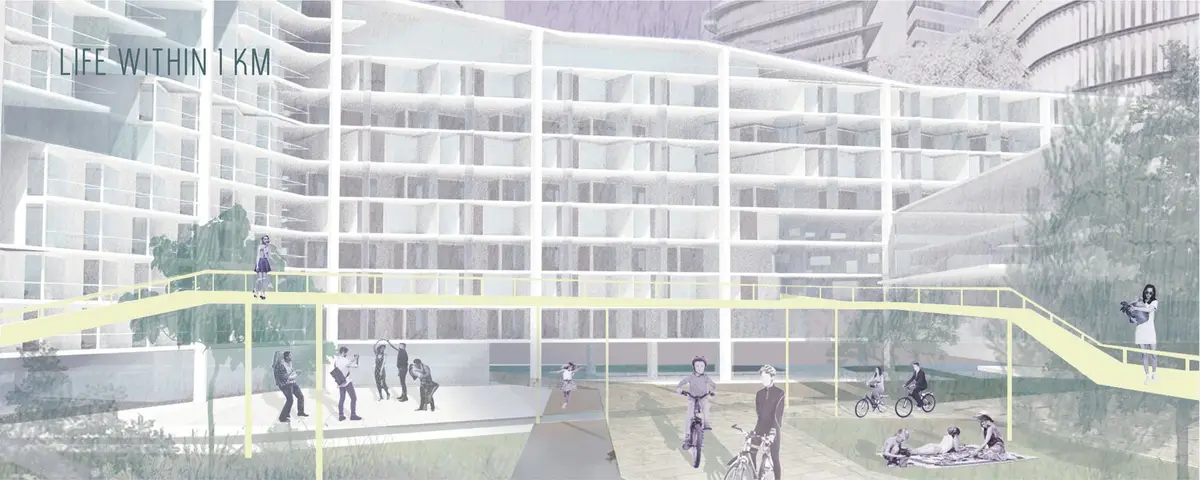
Life Within 1 KM: A Walkable Microtown Planted in Moscow's Post-Industrial ZIL District
A 40-30-30 live-work-play masterplan that folds aquaponics, passive solar design, and shared workspaces into a single walkable kilometer.


What if everything you needed existed within a one-kilometer walk from your front door? In a world where two-hour commutes are normalized and community ties fray under the weight of sprawl, Life Within 1 KM makes a pointed counterargument: the megacity doesn't need more expansion, it needs compression. Sited in Moscow's ZIL District, a post-industrial zone still recovering from its Soviet-era manufacturing past, this proposal stitches together housing, offices, recreation, and urban agriculture into a single walkable precinct. The ambition is nothing less than a prototype for how dense cities might reorganize themselves around human proximity rather than vehicular distance.
Designed by Brenda Liu, this shortlisted entry in the Hustle Hub 2019 competition targets a specific demographic: young immigrants and local residents looking for an affordable, socially engaged urban life. Rather than treating mixed-use as a marketing tagline, the project commits to a structured 40-30-30 distribution between living, working, and recreational functions, giving each program roughly equal weight in the masterplan. The result is a self-contained microtown where mobility is minimized and daily life gains back the hours typically surrendered to transit.
Terraced Courtyards and Climatic Block Setbacks
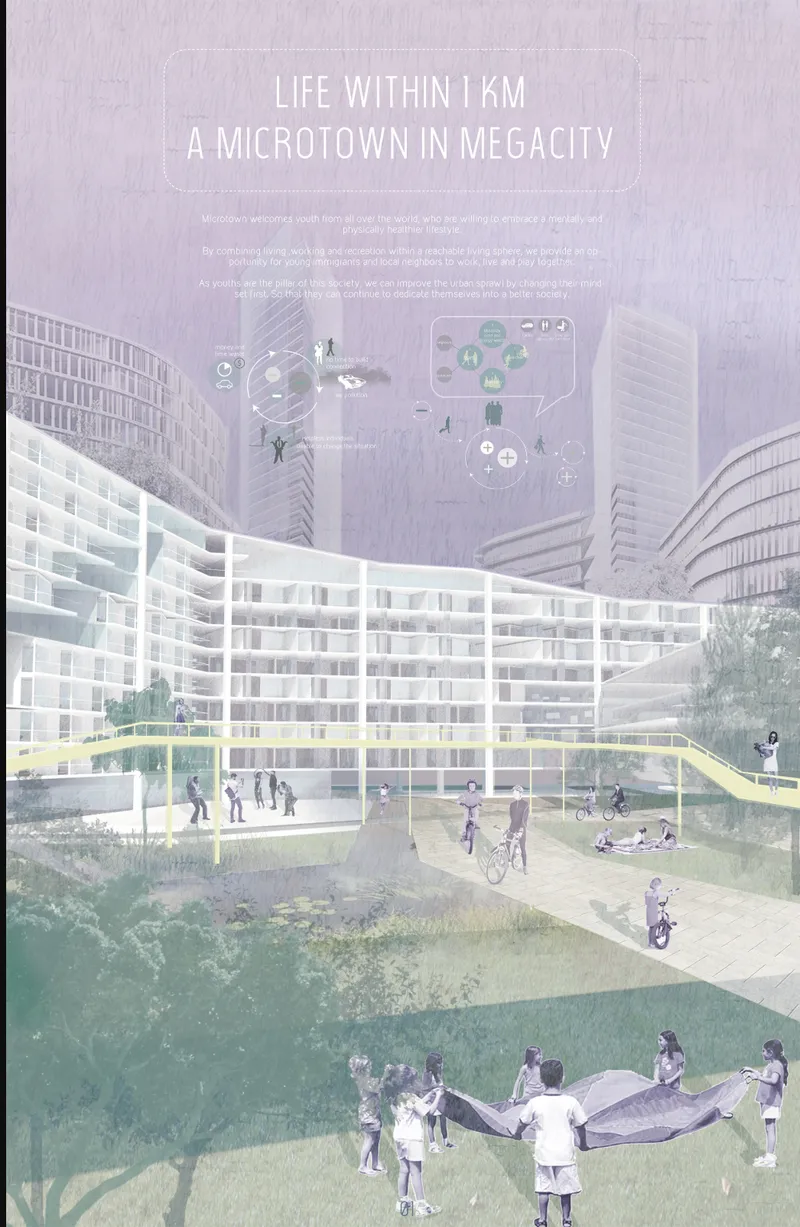
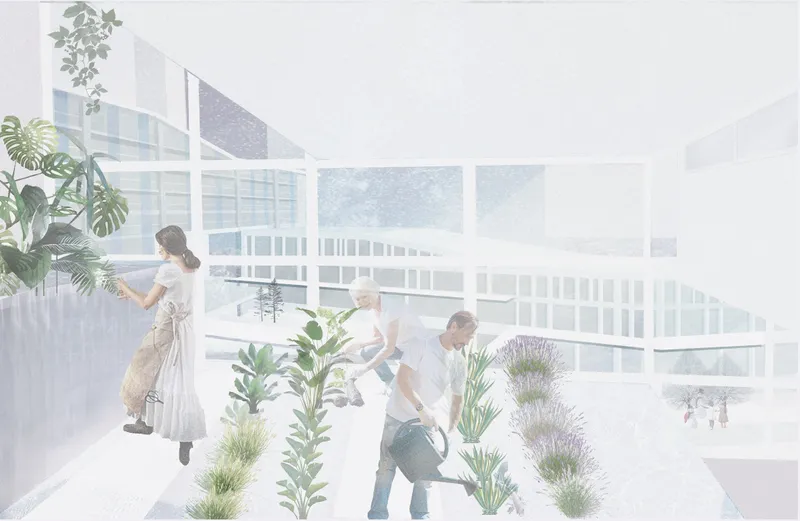
The aerial rendering reveals how the housing blocks step back in section, creating terraced courtyards that pull sunlight deep into the ground-level gathering spaces below. Moscow's climatic extremes, from dark winters to intense seasonal wind patterns, drove these decisions: shadow studies and rainfall analysis informed the precise setbacks that maximize solar penetration during the coldest months. At ground level, residents gather on open lawns framed by the building's curved geometry, while upper-level terraces become semi-private gardens where occupants tend potted plants with views across the district.
Two residential typologies share the housing blocks. Type A clusters units around shared amenities to encourage daily interaction between neighbors, while Type B offers greater privacy for individuals and couples. Both orient windows strategically for passive solar gain, treating energy performance not as an afterthought but as a generator of architectural form. The interior terrace view captures this philosophy in action: greenery, social life, and thermal comfort all occupy the same square meters.
Aquaponics and Closed-Loop Water Infrastructure
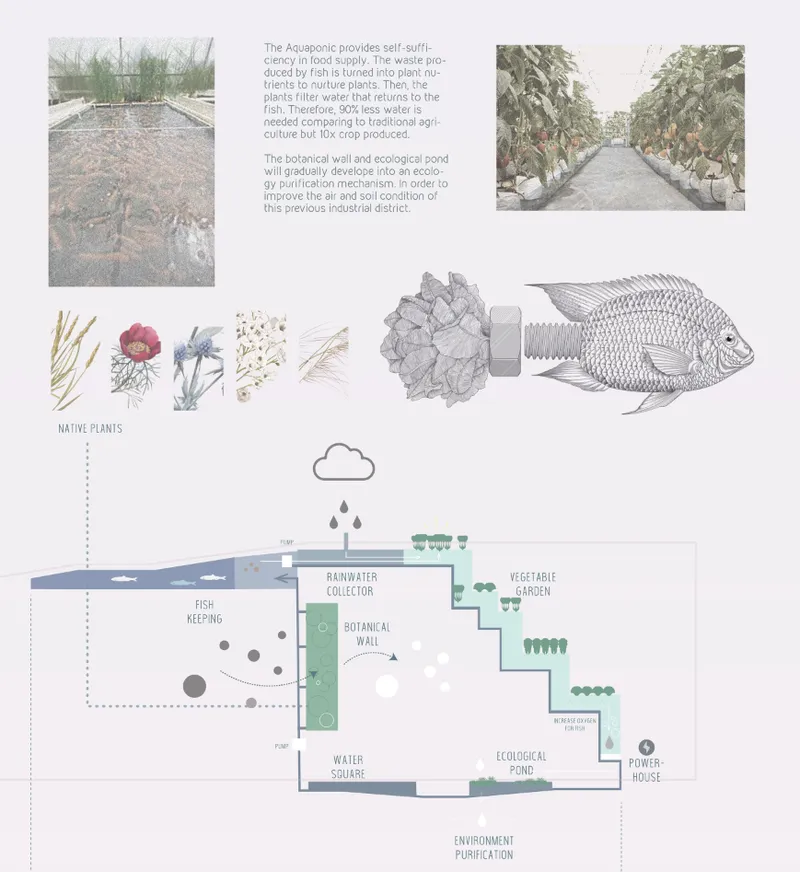
The aquaponic cycle diagram makes the ecological ambition legible. Rainwater is harvested, fed through botanical walls that filter and oxygenate it, then channeled into fish-keeping tanks and vegetable gardens before settling in ecological ponds that further purify the runoff. The system uses 90% less water than conventional agriculture, a critical metric for a project that also aims to rehabilitate the contaminated post-industrial soil of the ZIL District. These are not decorative green gestures. They form a closed-loop infrastructure that simultaneously produces food, cleans air, and reduces the energy load on the broader municipal grid.
Sectional Logic: Stacking Work, Life, and Play
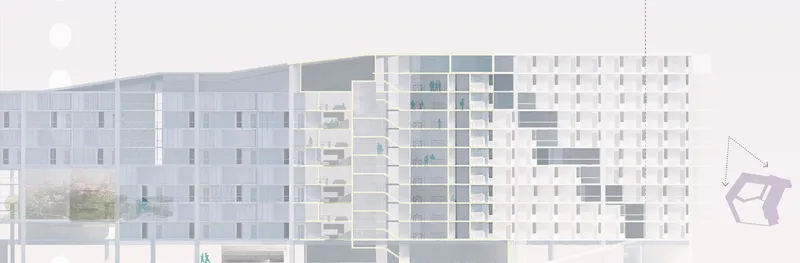
The building section reveals the vertical choreography that makes the 40-30-30 program split work in practice. Communal spaces are distributed across multiple levels rather than confined to a single amenity floor, so residents and workers encounter each other organically throughout the day. Transparent circulation zones, visible in the section as glazed stair volumes, double as social condensers: a grand staircase connecting workspace floors encourages casual encounters that would never happen in an elevator lobby. Cafes, copy rooms, and restrooms are woven into every office level, supporting formats that range from individual focus zones to shared startup studios.
Recreation occupies the connective tissue between residential and work zones. Dynamic programs like gyms, cycling tracks, and sports courts sit alongside quieter spaces for reading and greenhouse gardening. A publicly accessible bike park at grade ties into a broader network of non-motorized paths, while the site's adjacency to the TKK Ring Road preserves links to Moscow's larger transit system. The section drawing makes a persuasive argument that density, when organized with sectional intelligence, does not produce claustrophobia but variety.
Why This Project Matters
The fifteen-minute city has become a fashionable planning concept, but few competition entries commit to the idea with this level of programmatic specificity. By fixing a hard radius of one kilometer and then rigorously distributing live, work, and play functions within it, Brenda Liu avoids the vagueness that plagues many mixed-use proposals. The aquaponic infrastructure and passive solar strategies are not bolted onto a conventional plan; they reshape the building's section, orientation, and material boundaries. That integration is what separates a credible urban prototype from a diagram.
Siting the project on contaminated post-industrial land adds a layer of ecological responsibility that most student work sidesteps. The ZIL District needs remediation, and the closed-loop water systems proposed here address that need while simultaneously producing food and reducing municipal energy demand. As cities worldwide confront overlapping crises of climate change, housing affordability, and social isolation, Life Within 1 KM offers a compact, replicable template: not a utopian vision, but a spatially disciplined framework for living closer together without sacrificing the things that make daily life worth the effort.
View the Full Project
About the Designers
Designer: Brenda Liu
Enter a Design Competition on uni.xyz
uni.xyz runs architecture and design competitions year-round that reward proposals with spatial conviction and real site intelligence.
Project credits: Life Within 1 KM by Brenda Liu Hustle Hub 2019 (uni.xyz).


Popular Articles
Popular articles from the community


Extended Shell: Retrofitting Kolkata's Balconies as Living Urban Thresholds
A modular retrofit system recovers the social and environmental intelligence of Kolkata's historic verandas for contemporary Park Street residents.

Cloaked Colonization: A Mobile Underwater Habitat That Moves Like a Fish
Micah Abaya's shortlisted EHC Pacific entry reimagines ocean settlement as a dispersed network of self-sustaining architectural organisms.

Temporary Home for Dogs: A Reversed Zoo Rethinks Animal Shelter Architecture
In Bucharest, a sinuous corridor and freed landscape flip the logic of containment, designing a shelter that works to make itself unnecessary.

The Amber Palace Opera: A Geological Fiction Surfaces on Tallinn's Baltic Waterfront
Pierre Brillard reimagines a Baltic legend as a public landscape, opera house, and waterfront promenade rooted in Tallinn's coastal identity.

Similar Reads
You might also enjoy these articles

Day and Night Park: A Time-Based Urban Newsstand in Beijing
A temporary urban newsstand in Beijing blending travel, light, and reading through poetic colors, compact form, and community-focused design.

Modernist Patio Renovation in El Masnou, Barcelona by Oliver Segura Arquitectura + Cebrià Arquitectura
Modernist patio renovation blending tradition and innovation with a movable pool, leveled floors, and Catalan materials in El Masnou.

Alto Residencial Coop: Cooperative Housing Development in Santiago de Compostela by Carbajo Barrios Arquitectos
A linear cooperative housing complex blending white volumes and perforated metal façades, enhancing community living, natural light, privacy, and urban integration.

Vil Genis School by BPA ARCHITECTURE – Massy, France
Vil Genis School in Massy, France, features sustainable design, south-facing classrooms, community integration, accessible spaces, and modern educational architecture.


Comments (0)
Please login or sign up to add comments
No comments yet. Be the first to comment!