

Liljewall Plants a Hexagonal Timber Pavilion in Sweden's Largest Uninhabited Wilderness
A skeletal wooden structure in Tresticklan National Park blurs the line between ruin and landmark, shelter and forest clearing.


Sweden's Tresticklan National Park, near the Norwegian border in Dalsland, is the country's largest uninhabited area. No villages, no infrastructure, just dry marshlands, lakes, and dense pine forest marked by the faint traces of wartime escape routes and abandoned settlements. It is the kind of place where architecture has no obvious right to exist. So when Liljewall was asked to design a visitor pavilion here, the central question was not what to build but how little to build while still giving the park a meaningful point of arrival.
The answer, led by architect Lars Olausson, is a 40 square meter open-air structure made entirely of locally sourced Swedish timber, treated with pigmented linseed oil so that it greys over time like the old ruins scattered through the surrounding forest. The pavilion's hexagonal plan, a nod to Sweden's National Parks brand symbol, is split into two identical gabled halves. There are no solid walls, no enclosed rooms. Vertical timber slats act as transparent screens, and a glass roof set within the structure keeps rain out while preserving the sensation of standing in an open clearing. It is simultaneously a ruin and a new building, a shelter and a frame.
Arriving Through the Forest
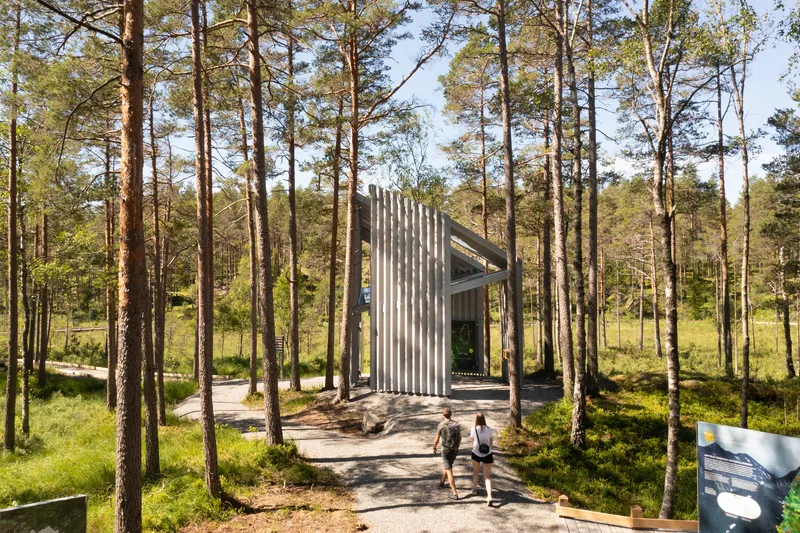
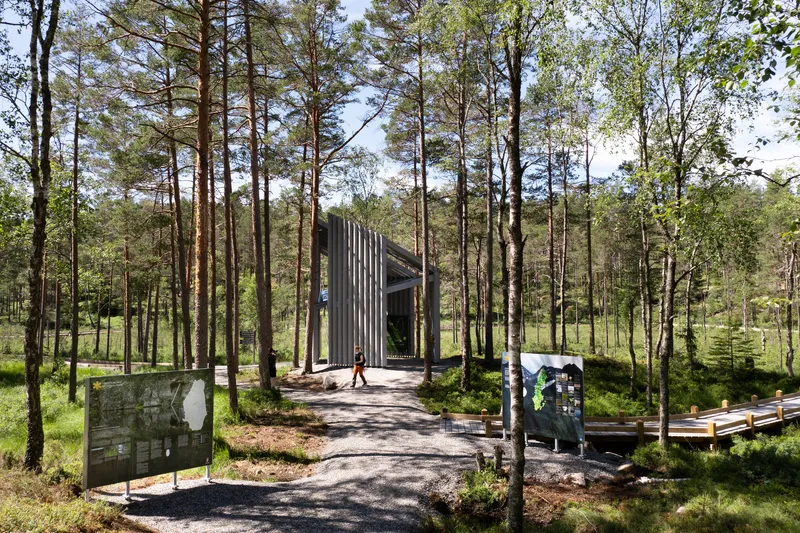
The pavilion sits a couple hundred meters into the forest from the car park, positioned on a natural elevation in a small clearing. The approach is choreographed simply: a gravel path winding between standing pines, the structure gradually revealing itself through the trunks. Its vertical slatted walls echo the rhythm of the surrounding trees, making the building feel less like an interruption and more like a condensation of the forest's own geometry.
This careful siting matters. Tresticklan is a depopulated landscape where people once lived but now only summer houses remain. The pavilion's placement on a clearing reads almost as a reoccupation of one of those ghost sites, giving the building historical resonance without resorting to literal mimicry.
Structure as Enclosure

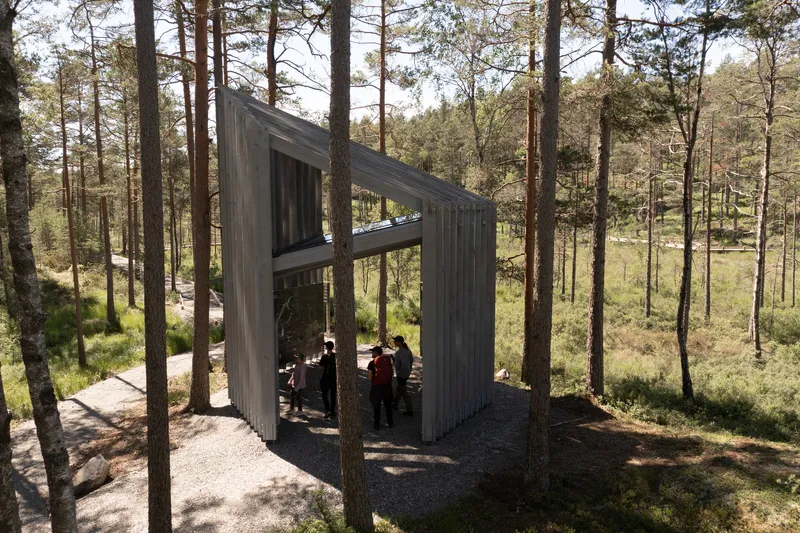
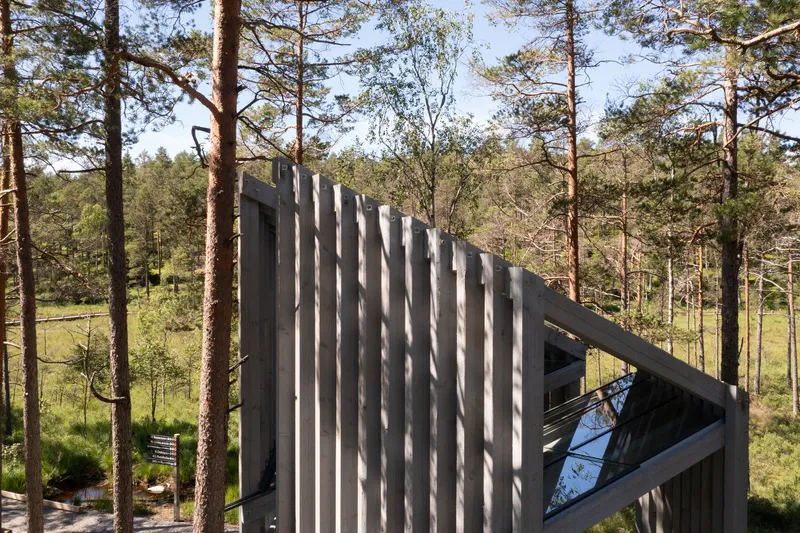
The most compelling move here is the refusal to separate structure from skin. The vertical timber columns that hold the building up are the walls. The roof truss is visible, distorting and merging as it stretches skyward. There is no cladding system concealing a frame; the frame is the architecture. Walk around the pavilion and the slatted walls shift from opaque to transparent depending on your angle, producing a moiré effect that makes the building seem to breathe.
The triangular glazed openings cut into the gable ends are the only moments of conventional enclosure, and even these read more as absences than surfaces. Light pours through them, and on clear days the glass nearly disappears. Inside, park information and maps are displayed, but the real function of the space is perceptual: it offers a threshold between the managed world of the car park and the wild territory beyond.
The Roof as Landscape
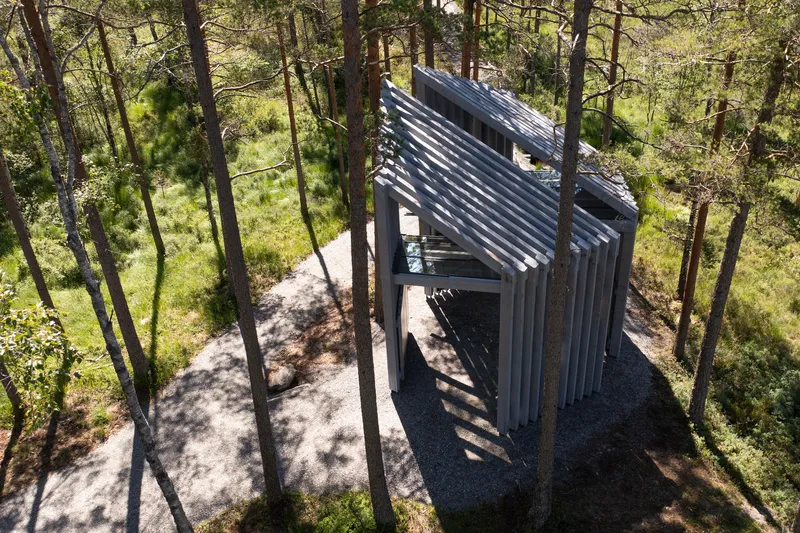

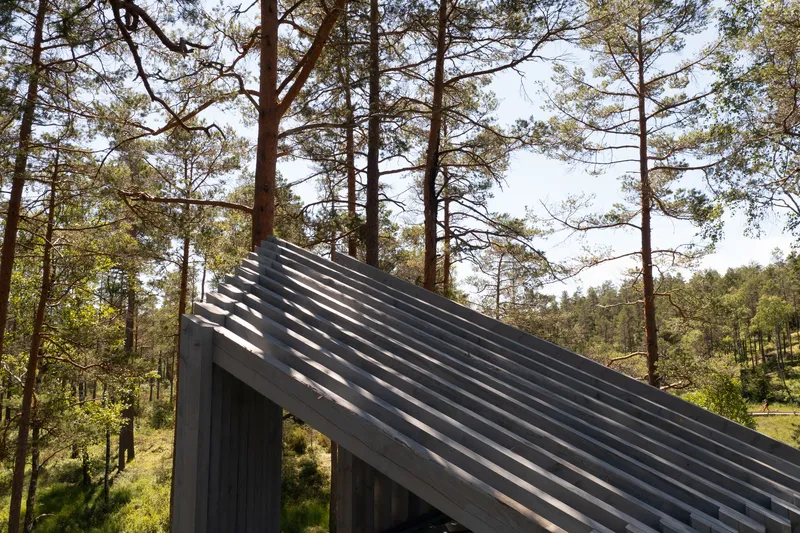
Seen from above, the pavilion's faceted roof planes look like origami dropped into the canopy. The hexagonal geometry creates angular folds that catch and redirect light throughout the day, producing shadow play that rotates around the building. The horizontal battens of the roof structure create their own visual rhythm against the vertical slatting of the walls, a deliberate counterpoint that gives the building compositional tension even at its modest scale.
The glass roof, sourced from a glazier in nearby Dals-Ed, sits inside the timber structure rather than on top of it. This inversion is subtle but important: it means the timber reads as the dominant element from every vantage point, while the glass performs its protective function almost invisibly. Rain slides off; the sense of openness remains.
Material Honesty and Slow Aging
Everything here is wood, and all of it is local. The timber was produced in the region and treated only with pigmented linseed oil, a finish that does not seal the wood but allows it to weather. Over time, the pavilion will grey to match the old structures and remains that dot the forest, the abandoned foundations and fence posts of Dalsland's depopulated settlements. Liljewall is designing for entropy, not against it.
This commitment to a single material family, combined with a finish designed to disappear, gives the building an ethical legibility that more complex material palettes often lack. There is no greenwashing involved in claiming sustainability when your entire structure is local timber treated with plant oil. The building's carbon story is written in its surfaces.
Plans and Drawings

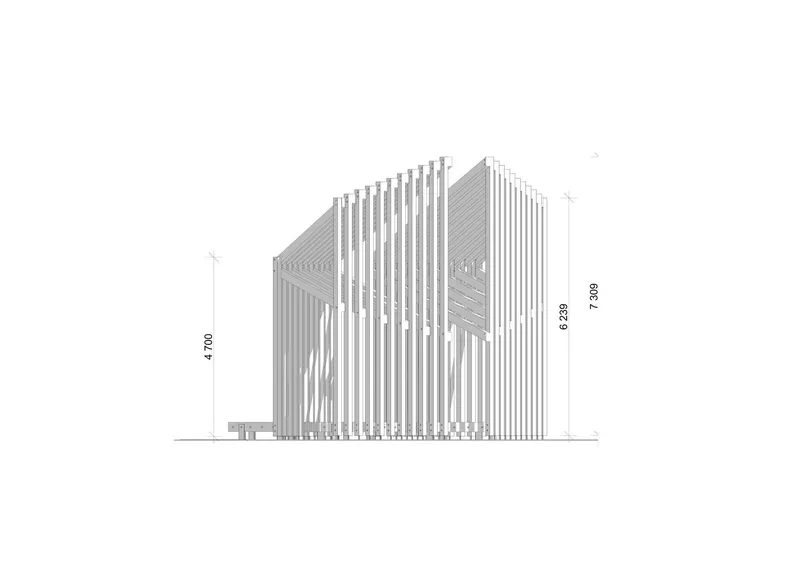
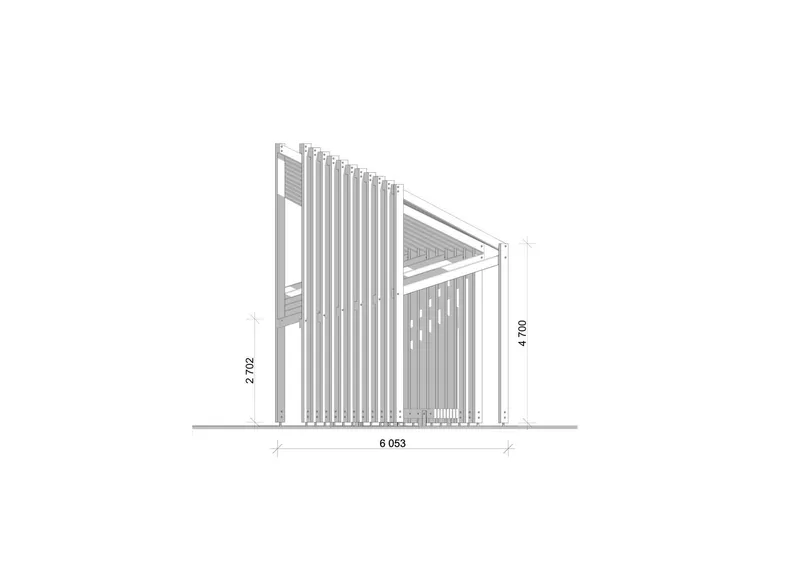
The axonometric drawing reveals the pavilion's logic most clearly: two identical gabled volumes, each with parallel slatted roof structures and interior cores, joined along a shared edge to form the hexagonal plan. The elevation drawings show how the triangular glazed cutout sits within the gable, framed by the exposed structural skeleton. What reads in photographs as intuitive and organic is, on paper, precisely calibrated. The symmetry between the two halves is exact, and the proportional relationship between column spacing, slat width, and overall height has been tuned to match the scale of the surrounding pines.
Why This Project Matters
National park architecture tends to fall into two camps: the overdesigned visitor center that competes with its landscape, or the utilitarian shelter that aspires to nothing. Liljewall's Tresticklan pavilion occupies a rare third position. It is architecturally ambitious, compositionally rigorous, and materially honest, yet it operates at a scale and with a transparency that allows the forest to remain the dominant experience. The building does not interpret nature for you; it gives you a place to stand while you interpret it yourself.
At 40 square meters, it is also a reminder that small commissions can carry outsized ideas. The decision to build a structure that looks forward to its own decay, that treats greying as a feature rather than a defect, represents a philosophy of time that most contemporary architecture refuses to engage with. In a landscape defined by absence, by the people and settlements that once existed here, this pavilion acknowledges that all buildings eventually become ruins. It simply starts closer to that condition than most.
Tresticklan National Park Pavilion by Liljewall, lead architect Lars Olausson. Located in Dalsland, Sweden. 40 m². Completed 2022. Photography by Joacim Winqvist and Anna Kristinsdóttir.
About the Studio
Share Your Own Work on uni.xyz
If projects like this are the kind of work you want to make, uni.xyz is a place to publish your own, find collaborators, and enter design competitions.


Popular Articles
Popular articles from the community


GROUP A Strips a 1969 Rotterdam Harbor Headquarters to Its Frame and Wraps It in Timber Louvers
In Rotterdam's M4H harbor district, Ferro Offices reuses a 1969 frame, adds one timber storey and reaches BREEAM-NL Outstanding.

Cube Design Draws an Ecological Corridor Between Two Shenzhen Hills with the Nankai Building
Beside Shenzhen's container docks, the Nankai Building pairs stacked balconies with a climbing green screen to connect two hillsides across its height.

Architekt Andreas Gruber Scatters 23 Dark Timber Chalets Across a South Tyrolean Forest Edge
In Molini di Tures, Amonti Chalets breaks a resort into a hamlet of gabled timber houses, with parking, storage and services pushed into the slope.

LT2A and OPEN Architectes Thread a Brick and Glass High School Through a Wooded Belgian Campus
In Braine-l'Alleud, a 3,000 m² wing for Collège Cardinal Mercier pairs pale brick with a glazed colonnade, deferring to a small chapel and a dense wood.

Similar Reads
You might also enjoy these articles


LAVA Architecten Gives Vocational Education a Sawtooth-Roofed Face on a Mechelen School Campus
In Mechelen, Belgium, a 2,053 m² STEM school on a 6×6 m grid turns workshops and classrooms into rooms that can be rearranged as teaching changes.

KEMA Studio Turns a Derelict Marvila Attic into a 60 m² Lighthouse Apartment Above Lisbon
In Lisbon's Marvila district, a rebuilt roof, four skylights and two plywood volumes turn an unlivable attic into a bright home facing the Tagus.

Pixel Gardens: One Repeated Module Stacked Into a Terraced Social Housing Tower for Famagusta
Salem Bader's shortlisted housing tower builds a vertical neighbourhood from one repeated module, offsetting units to carve terraces, light and air.

Bao Huynh Watercolor Atelier: A Serene Art Retreat in Hội An
Bao Huynh Watercolor Atelier in Hội An blends multifunctional art spaces, sustainable design, local materials, and family-friendly living in a serene environment.

Explore Power Station Competitions
Discover active competitions in this discipline

Challenge to design a portable theatre

Challenge to design a portable music platform

Challenge to design an open learning module for the elderly
Comments (0)
Please login or sign up to add comments
No comments yet. Be the first to comment!