

Little Granite House by BRD Studio: A Compact Sustainable Home Connected to Nature in Rural Australia
Compact off-grid house in rural Australia featuring biophilic design, passive solar strategies, local materials, and strong indoor-outdoor connections.


Located in the scenic rural landscape of Wooragee, Australia, the Little Granite House by BRD Studio is a remarkable example of compact sustainable architecture that harmoniously blends with its surrounding environment. Completed in 2022, the modest 96-square-meter home demonstrates how thoughtful design can create a comfortable and highly functional living space while maintaining a strong connection with nature.
Designed by lead architect Tim Smith, the project embraces principles of biophilic design, passive solar architecture, and off-grid sustainability. Instead of dominating the rural landscape, the home intentionally integrates with the surrounding agricultural infrastructure, allowing the building to feel like a natural extension of the site.
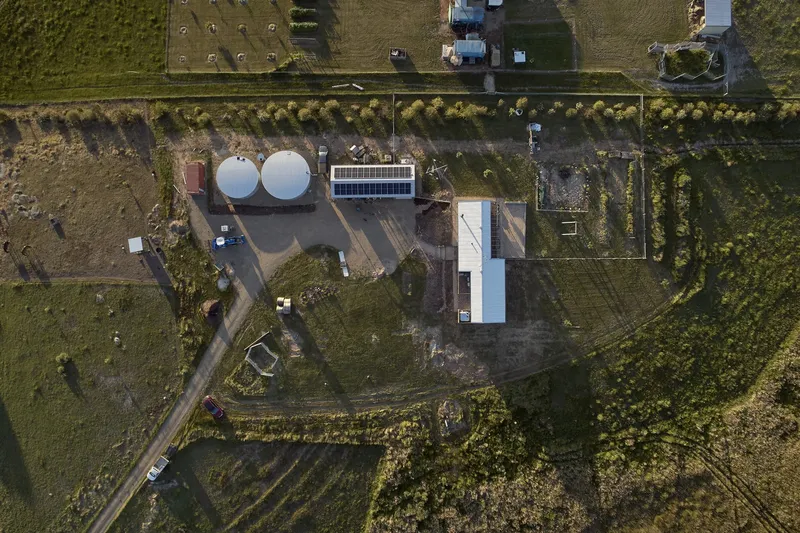

Architecture Inspired by Rural Context
The architectural concept of the Little Granite House revolves around simplicity, contextual sensitivity, and functional efficiency. The structure adopts a minimal gable form, referencing the typology of traditional agricultural buildings commonly found in the Australian countryside.
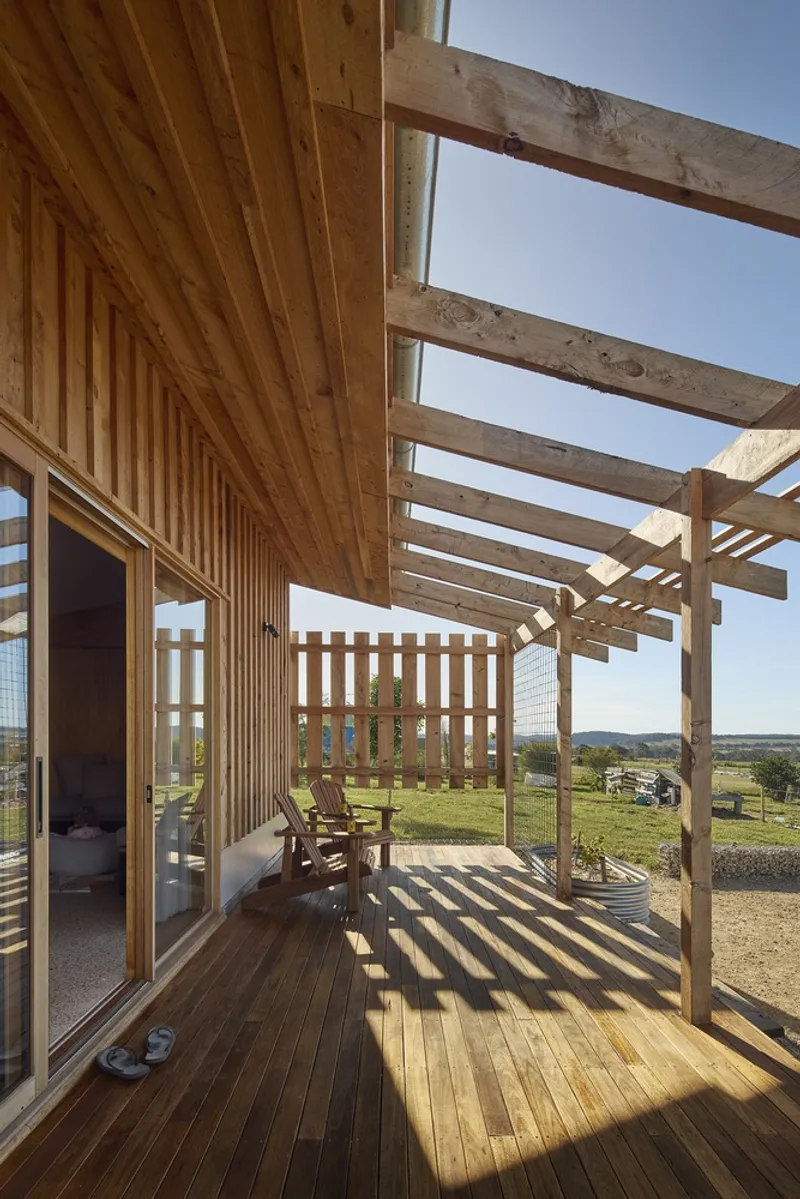
Rather than creating a bold architectural statement, the house subtly blends into the environment. Strategic extractions within the gable form create apertures and transitional spaces that enhance the connection between indoor and outdoor living. These openings also allow the residents to fully experience the surrounding landscape, changing weather patterns, and seasonal variations.
Material choices played a crucial role in shaping the architectural identity of the house. The design team carefully balanced several practical considerations, including local material availability, bushfire safety, durability, shading, and long-term maintenance. This approach ensured that the building would not only perform well but also age gracefully within its natural setting.
Smart Spatial Planning for Modern Family Living
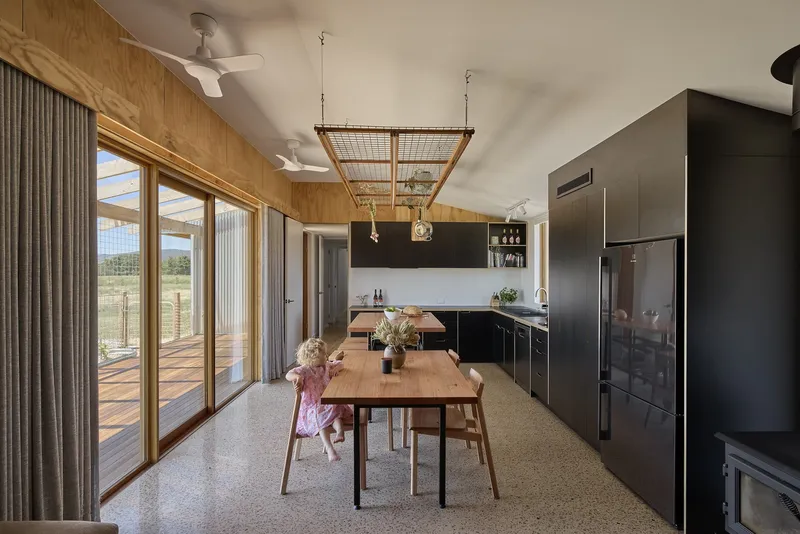
Despite its compact footprint, the house offers a surprisingly spacious and comfortable living experience. The interior is organized into two primary functional zones, allowing the family to enjoy shared spaces while maintaining privacy when needed.
The social zone centers around a generous kitchen area, which acts as the heart of the home. A multifunctional kitchen island that doubles as a dining table links the kitchen, dining space, and outdoor deck, creating a fluid environment for everyday family activities and social gatherings.
Large openings extend the kitchen area onto a wide shaded deck, providing an ideal space for outdoor dining, relaxation, and entertaining guests. This seamless indoor-outdoor connection reinforces the house’s relationship with the surrounding natural landscape.
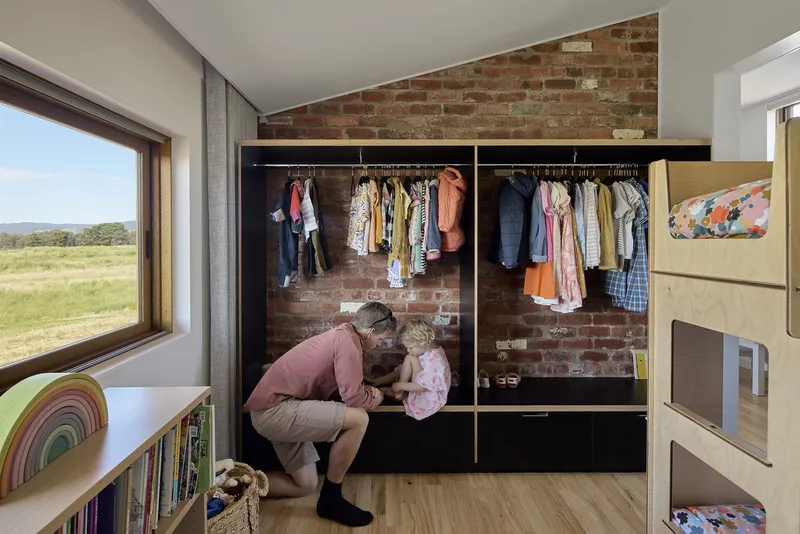
At the opposite end of the home lies the private zone, which includes the bedrooms. Each bedroom is designed with ample natural light, ventilation, and integrated storage, ensuring comfort and practicality. The bedrooms open onto an oversized hallway that serves multiple functions, including additional storage, circulation, and a play area for the family’s children.

Biophilic Design and Natural Material Expression
A central design philosophy behind the project was the integration of biophilic design principles, which aim to strengthen the relationship between people and nature. Natural light, cross-ventilation, and visual connections to the surrounding landscape were prioritized throughout the design.
The material palette reflects the rural environment of Wooragee. Locally sourced timber and granite stone are used extensively, celebrating regional craftsmanship and reducing transportation impacts. These materials are complemented by recycled concrete elements and galvanized metal cladding, which together form a durable exterior shell.
Over time, the materials are intended to develop a natural patina, allowing the building to evolve alongside the landscape. This aging process enhances the authenticity of the architecture while reinforcing its connection to the site.

A Fully Off-Grid Sustainable Home
Sustainability was a guiding principle throughout the design and construction of the Little Granite House. The home operates as a fully off-grid all-electric residence, sourcing and storing its own energy and water directly from the site.
Passive solar design strategies play a critical role in minimizing energy consumption. Careful building orientation, shading devices, and thermal mass help regulate indoor temperatures naturally, significantly reducing reliance on mechanical heating and cooling systems.
Water is harvested and stored on-site, while organic waste is processed locally and returned to nourish the surrounding environment. This closed-loop system demonstrates a holistic approach to sustainable living, reducing the home’s environmental footprint while promoting ecological balance.
Compact Living Without Compromise
One of the most striking aspects of the Little Granite House is how it challenges conventional ideas about residential size. Although the home is relatively small compared to contemporary housing trends, it offers a spacious and flexible living environment through thoughtful planning and multifunctional design elements.
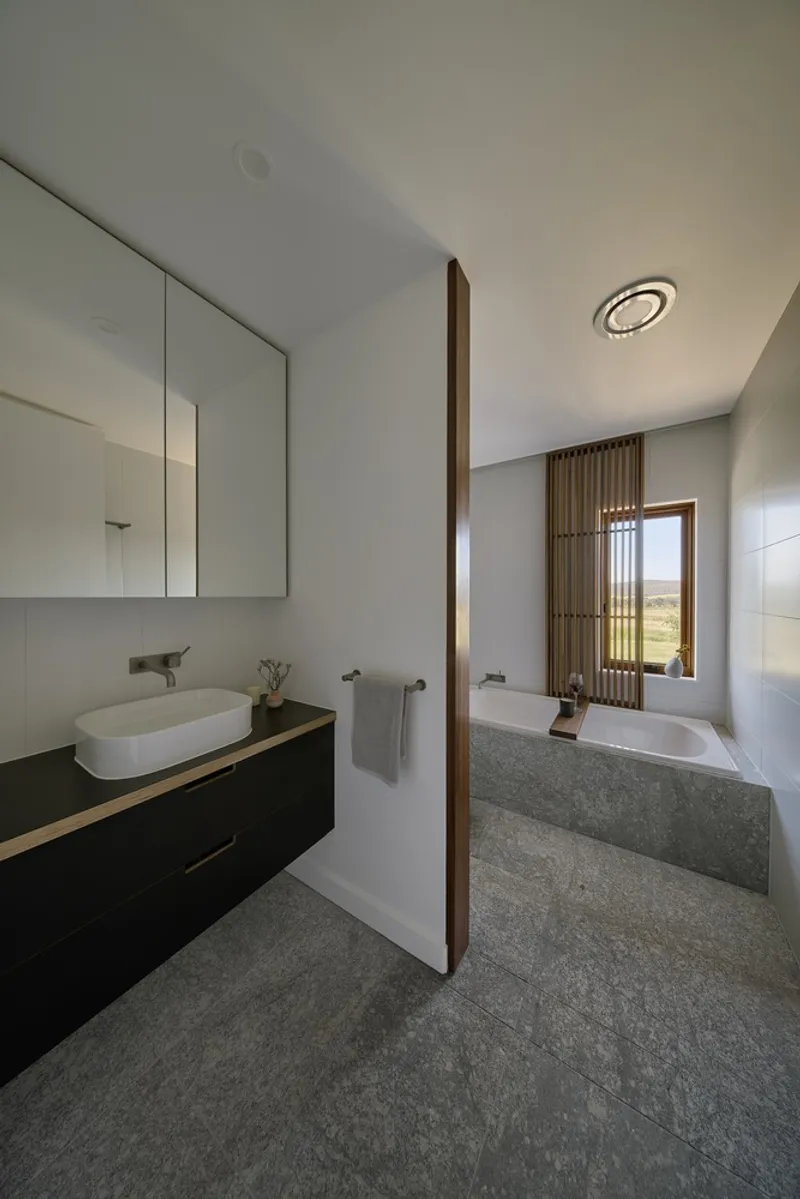
The architects prioritized quality of space over quantity, creating interiors that feel open, bright, and connected to nature. Large windows, natural materials, and integrated storage solutions ensure the home remains uncluttered and comfortable.
For the homeowners, the result exceeded expectations. The house proves that compact architecture can deliver exceptional livability, demonstrating that sustainable, efficient homes can be both beautiful and practical.

A Model for Sustainable Rural Architecture
The Little Granite House stands as an inspiring example of context-responsive architecture that respects both the landscape and the needs of its occupants. By combining biophilic design, passive solar strategies, and locally sourced materials, the project highlights how small-scale residential architecture can achieve meaningful sustainability.
Through its careful integration with the surrounding agricultural environment, the home demonstrates a forward-thinking approach to rural living: one that prioritizes environmental stewardship, simplicity, and connection to place.

All photographs are works of
Jeremy Weihrauch


Popular Articles
Popular articles from the community

Cloaked Colonization: A Mobile Underwater Habitat That Moves Like a Fish
Micah Abaya's shortlisted EHC Pacific entry reimagines ocean settlement as a dispersed network of self-sustaining architectural organisms.
Faces of the Soviet Avant-Garde: Turning Moscow's Street Names into an Open-Air Museum
A network of sculptural installations across a Moscow residential district transforms forgotten architect names into spatial encounters with cultural memor
Extended Shell: Retrofitting Kolkata's Balconies as Living Urban Thresholds
A modular retrofit system recovers the social and environmental intelligence of Kolkata's historic verandas for contemporary Park Street residents.

Opera on the Sea: Driftwood Logic Shapes a Timber Opera House on Estonia's Coast
Trevor Orgill's opera house translates the entangled drift of floating timber into a civic building where wood, water, and music converge.

Similar Reads
You might also enjoy these articles

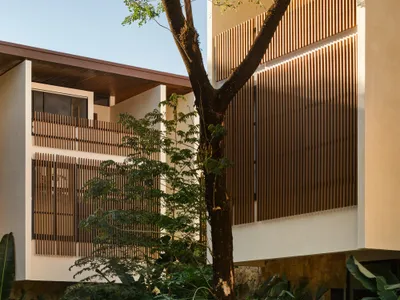
FAMM Arquitectura Organizes Ten Villas Around Courtyards and Jungle in Nosara, Costa Rica
El Molino pairs two elongated volumes with deep overhangs and timber louvers to build a compact coastal community five minutes from the beach.
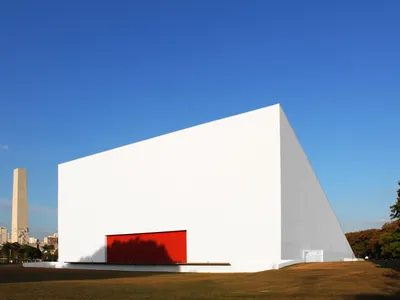
Oscar Niemeyer's Ibirapuera Park Pavilions Define São Paulo's Cultural Identity in Concrete and Curve
A constellation of modernist volumes set within São Paulo's most important urban park, conceived for the city's 400th anniversary in 1954.
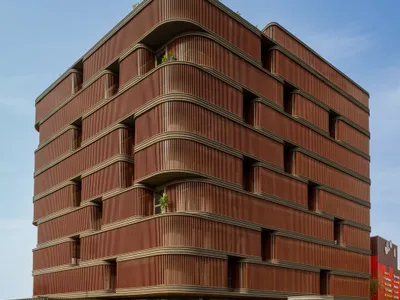
Sanjay Puri Architects Wraps a Jaipur Office Tower in Capsule-Shaped Green Buffers
A nine-level climate-responsive workplace near Jaipur Airport uses stacked planter terraces and aluminium screens to fight 40°C heat.
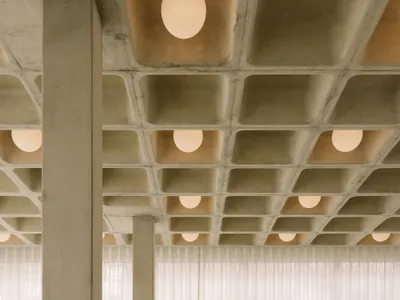
RHO Converts a Berlin Spree-Side Industrial Courtyard into Enkime's 1,000 m² Agency Headquarters
A social media agency's new home in Charlottenburg trades glossy branding for concrete waffle ceilings, glazed tile, and sheer curtains.

Explore Temporary Dwelling Competitions
Discover active competitions in this discipline

Challenge to reimagine the Iron Throne

Photograph architecture without architects

Illustrate the lost glory of Angkor Wat - Render Challenge

Design challenge to reuse E-waste
Comments (0)
Please login or sign up to add comments
No comments yet. Be the first to comment!