

Community Centre for Therapy: Healing Architecture on Edinburgh's Canaan Lane
A shortlisted proposal for a sensory-driven therapy centre that uses golden ratio geometry and biophilic design to address mental health through public spa


Nearly one in three people in Scotland experience mental health difficulties each year, yet the spaces we build for recovery still default to clinical enclosures. The Community Centre for Therapy in Edinburgh takes the opposite position: therapy should be communal, sensory, and architecturally generous. Situated on Canaan Lane in Morningside, South West Edinburgh, the project proposes a public building whose curving, golden-ratio-derived form is itself a therapeutic instrument, designed to relieve mental pressure through soft geometry, natural materials, and carefully calibrated sensory zones.
Designed by Sakypzhamal Khalyk, the project was shortlisted in the Live Laugh Love 2020 competition. The site's neighbours are telling: an old age home, a school for children with disabilities, and a blind school. That adjacency drove the centre's programme toward radical inclusivity, serving people of all ages and abilities through art therapy, dance therapy, water therapy, and social dialogue. The building reframes therapy not as a clinical transaction but as a community experience embedded in landscape.
A Pavilion Lifted Above the Ground Plane
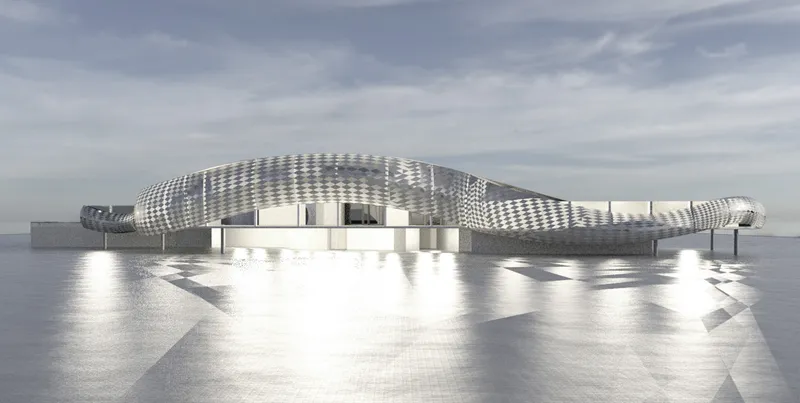
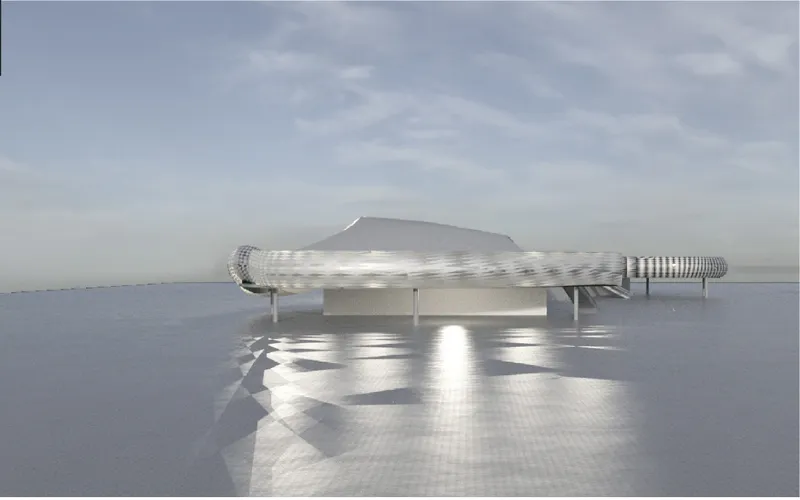
The centre's primary architectural gesture is its elevation on slender columns above a reflective wet plaza. A perforated metallic skin wraps the structure, filtering light and creating a dappled, diffused interior atmosphere. The cylindrical volume at one end introduces a distinct spatial event, breaking the horizontal datum and signalling a shift in programme. Raising the building off the ground does two things simultaneously: it opens the landscape beneath for public gathering, and it establishes a sense of arrival that is gradual rather than abrupt. Users approach the building across water and open ground, a sequence that slows movement and prepares the body for a therapeutic experience.
The Pier as Threshold: Transitioning from City to Refuge
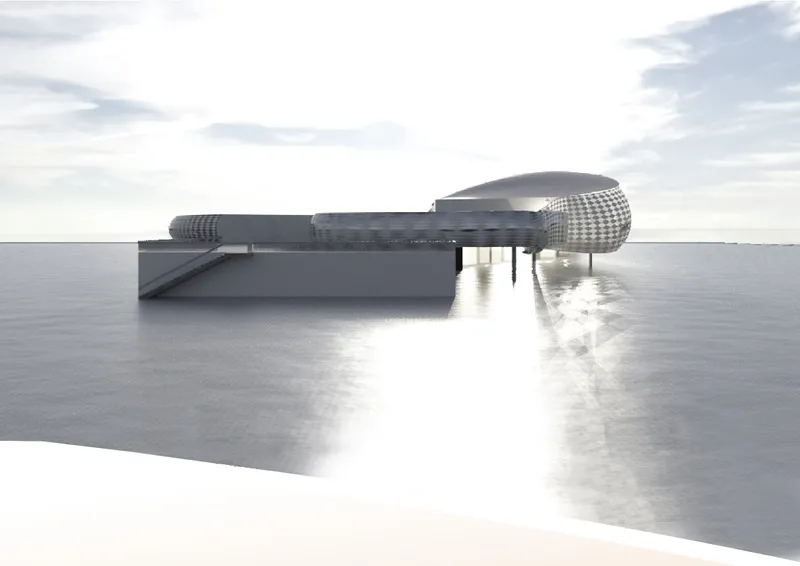
A long concrete pier extends toward the elevated pavilion, with a bulbous glazed volume anchoring the far end over calm water. The pier functions as more than circulation; it is a decompression chamber, a physical and psychological buffer between the noise of the city and the stillness of the therapy centre. Walking its length, users shed the pace of urban life. The glazed terminus acts as a beacon, drawing visitors forward while flooding the interior with natural light. It is a compelling spatial argument for the idea that architecture can regulate emotion through movement, view, and material transition.
Undulating Roof and Biophilic Coherence
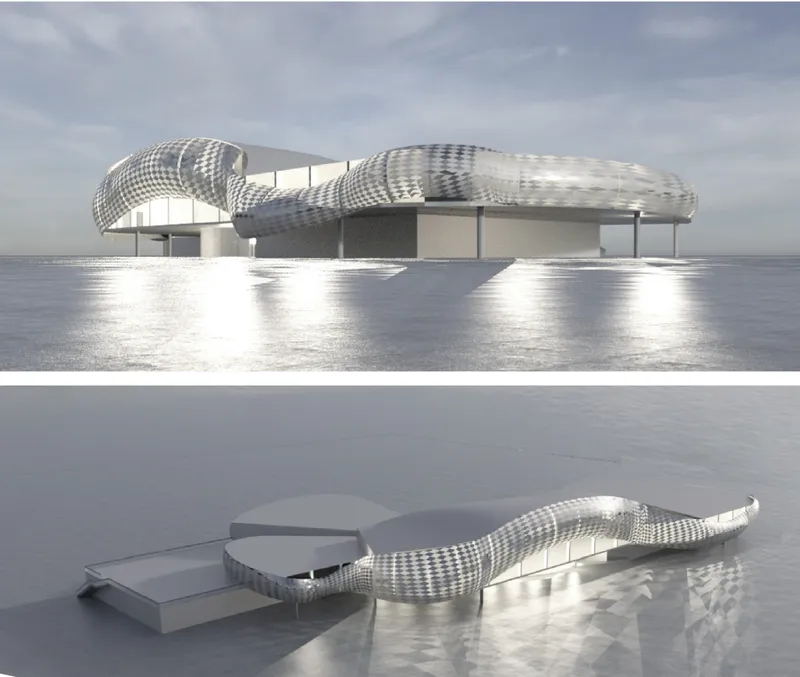
Two views reveal the undulating roof form, clad in chequered panels and supported on pilotis above water. The roof's curves are derived from the golden ratio, a proportional system Khalyk deploys to achieve visual harmony without relying on rigid, imposing geometries. The flowing form is intended to produce a calming psycho-emotional response, and its relationship to the water surface below amplifies that effect through reflection and ambient sound. Natural materials and biophilic detailing reinforce the connection between the building and its landscaped surroundings. Open spaces and generous natural light encourage emotional openness, while the zoned layout allows both social interaction and personal retreat.
Sensory Zones and Programmatic Logic
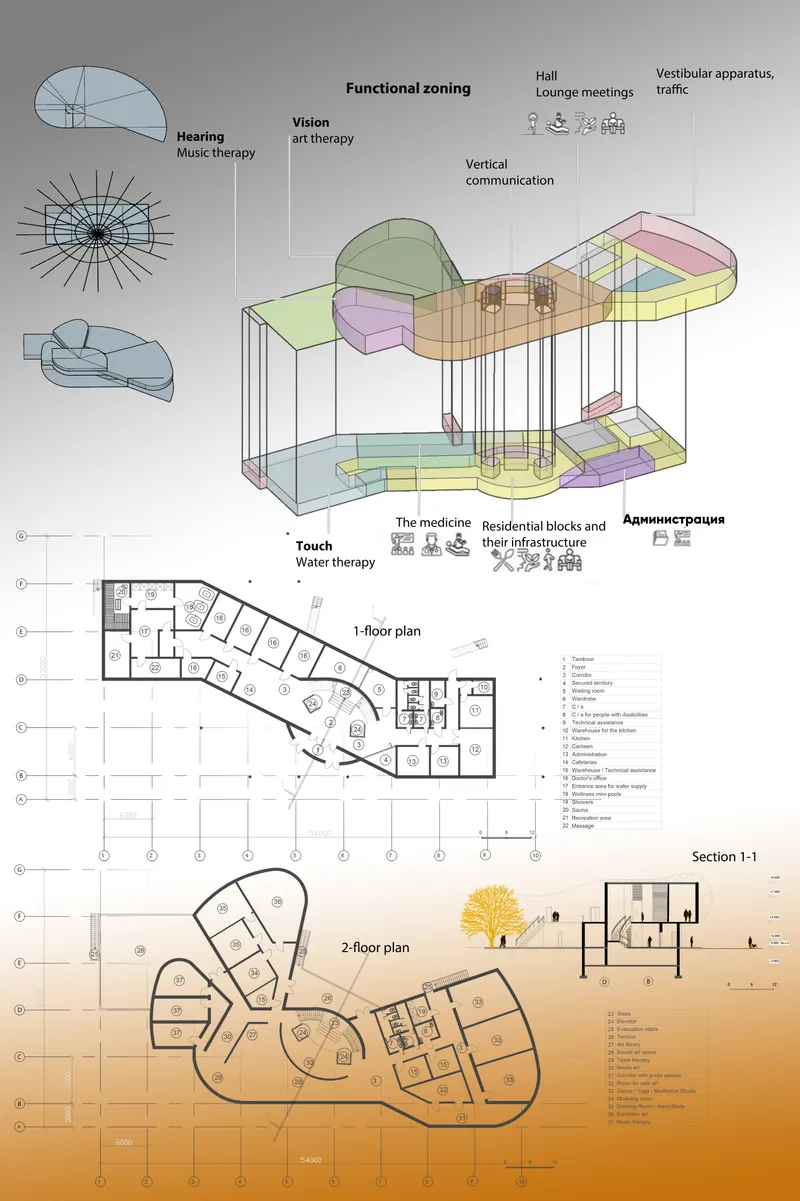
The presentation board lays out the building's organizational logic through an axonometric exploded view, floor plans, section, and colour-coded functional zoning diagrams. The programme is structured around four sensory categories: hearing, touch, vision, and movement. Music therapy and water therapy occupy zones calibrated for acoustic performance, while visual art therapy rooms are positioned to capture optimal natural light. Dance and movement spaces are given generous floor-to-ceiling heights. The colour-coded diagrams make the spatial relationships legible at a glance, showing how the design channels visitors through a sequence of sensory experiences rather than depositing them in a generic open plan.
Competition juror Eleena Jamil acknowledged the strength of the concept while noting that a less iconic approach might better serve vulnerable users, and that the project would benefit from deeper exploration of interior spatial experience and contextual relationships. These observations point toward productive next steps rather than fundamental flaws: the sensory framework and inclusive programme are robust, and the design invites the kind of refinement that could make it genuinely exceptional.
Why This Project Matters
The Community Centre for Therapy challenges a stubborn default in healthcare architecture: that spaces for mental health must look and feel institutional. By grounding its design in sensory research, golden ratio geometry, and the specific social context of its Morningside site, the project argues that public buildings can actively participate in healing rather than merely housing it. Khalyk's proposition that "the architecture of a building can affect entire generations of people living in its environment" is not rhetorical; it is embedded in every design decision, from the pier approach sequence to the sensory zoning strategy.
For a student project, the ambition here is significant. The work synthesizes urban context, inclusive programming, biophilic design, and formal invention into a single coherent proposal. Its shortlisting in the Live Laugh Love 2020 competition recognizes that ambition. What the project needs next is exactly what Jamil suggested: deeper immersion in the user's bodily experience of these spaces, and a willingness to let the programme shape the form rather than the other way around. That tension between conceptual boldness and experiential specificity is where the most important architectural work happens.
View the Full Project
About the Designers
Designer: Sakypzhamal Khalyk
Enter a Design Competition on uni.xyz
uni.xyz runs architecture and design competitions year-round that reward proposals with spatial conviction and real site intelligence.
Project credits: Community Centre for Therapy by Sakypzhamal Khalyk Live Laugh Love 2020 (uni.xyz).




Popular Articles
Popular articles from the community


The Earth Pod: 3D Printed Homes for Resilient Refugee Communities
The Earth Pod reimagines refugee housing through 3D printed homes made from clay, combining resilience, self-sufficiency, and rapid shelter.

Hill & Cross Opera: Sculptural Opera House Architecture Shaped by Tallinn’s Landscape and Identity
Hill & Cross Opera reimagines opera house architecture in Tallinn through its sculptural hill, civic plaza, glass wave and a luminous cross.

Co-life: Sustainable Architecture for Age-Friendly Community Living
Co-life reimagines sustainable architecture for seniors through courtyards, rammed earth, shared gardens, and spaces designed for belonging.
AL-JANNAH: Sustainable Architecture and Permaculture for Afghan Widows
AL-JANNAH uses sustainable architecture and permaculture to create resilient oasis of housing, learning, work and renewal for Afghan widows.


Similar Reads
You might also enjoy these articles

Day and Night Park: A Time-Based Urban Newsstand in Beijing
A temporary urban newsstand in Beijing blending travel, light, and reading through poetic colors, compact form, and community-focused design.

Modernist Patio Renovation in El Masnou, Barcelona by Oliver Segura Arquitectura + Cebrià Arquitectura
Modernist patio renovation blending tradition and innovation with a movable pool, leveled floors, and Catalan materials in El Masnou.
Alto Residencial Coop: Cooperative Housing Development in Santiago de Compostela by Carbajo Barrios Arquitectos
A linear cooperative housing complex blending white volumes and perforated metal façades, enhancing community living, natural light, privacy, and urban integration.
Vil Genis School by BPA ARCHITECTURE – Massy, France
Vil Genis School in Massy, France, features sustainable design, south-facing classrooms, community integration, accessible spaces, and modern educational architecture.


Comments (0)
Please login or sign up to add comments
No comments yet. Be the first to comment!