
Lopez Gonzalez Studio Stacks a Gravity-Defying Concrete House on a Steep Xalapa Street
Casa Tlaloc rises through four levels of increasing privacy, harvesting rain and framing views of Veracruz's misty highlands.

Xalapa occupies a peculiar seam in Mexico's geography: the point where Gulf Coast humidity collides with cool air descending from Cofre de Perote. Building here means negotiating steep terrain, persistent rain, and the kind of diffused light that flattens most facades into monotony. Casa Tlaloc, designed by the father-and-son practice of Jesús Arturo and José Pedro López González at Lopez Gonzalez Studio, treats every one of those conditions as a design driver rather than a constraint. The result is a 316-square-meter house that reads as a series of concrete trays cantilevered off a precise structural grid, each level stepping back or forward to create terraces, catch rainwater, and calibrate exactly how much of the city you see from each room.
What makes the project worth close attention is not the stacking itself, which is common enough on sloped sites, but the disciplined relationship between structure and program. A grid of four bidirectional axes with square columns provides the skeleton. Three pairs of double metallic supports clear specific spans where columns would have blocked views or movement. From that alphabet, the architects build a sentence: communal transparency at ground level, a cruciform bedroom floor in the middle, and a merged living area and studio at the summit that pulls away from the building's edges to create generous rooftop terraces. The vertical sequence mirrors the daily arc from sociability to solitude.
A Facade That Negotiates the Street
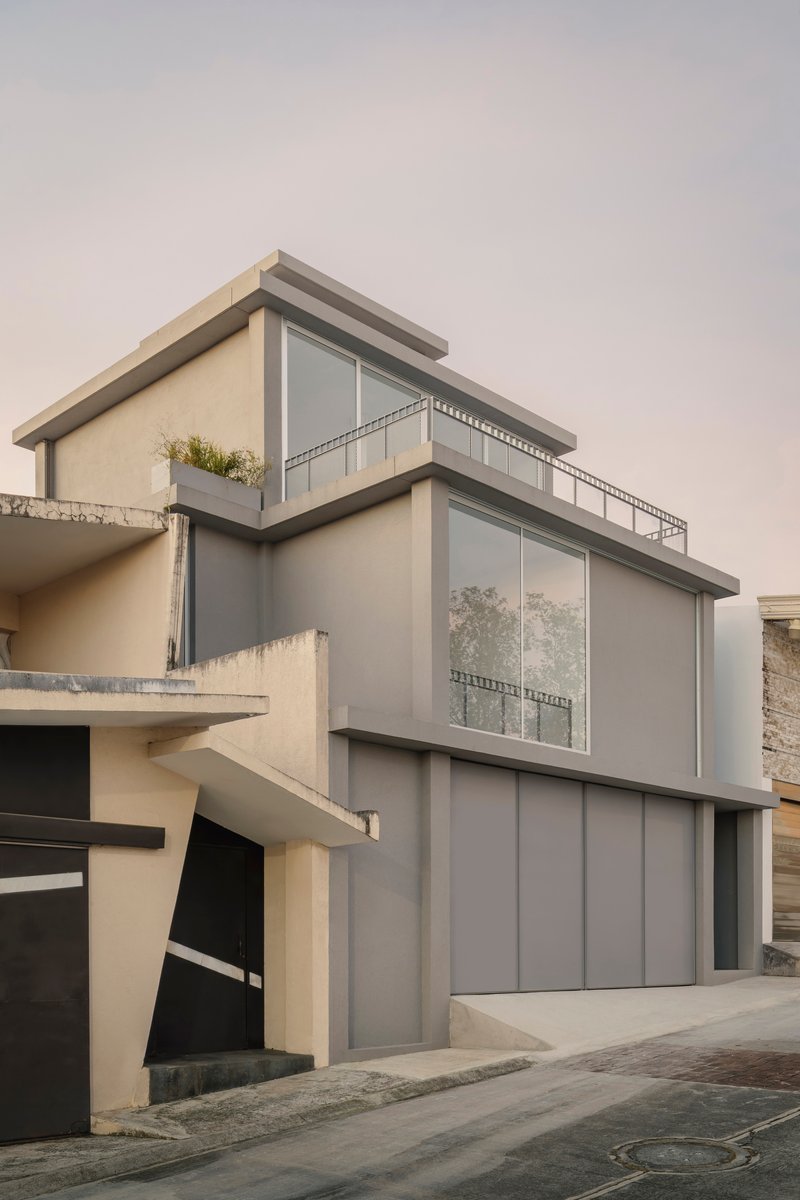
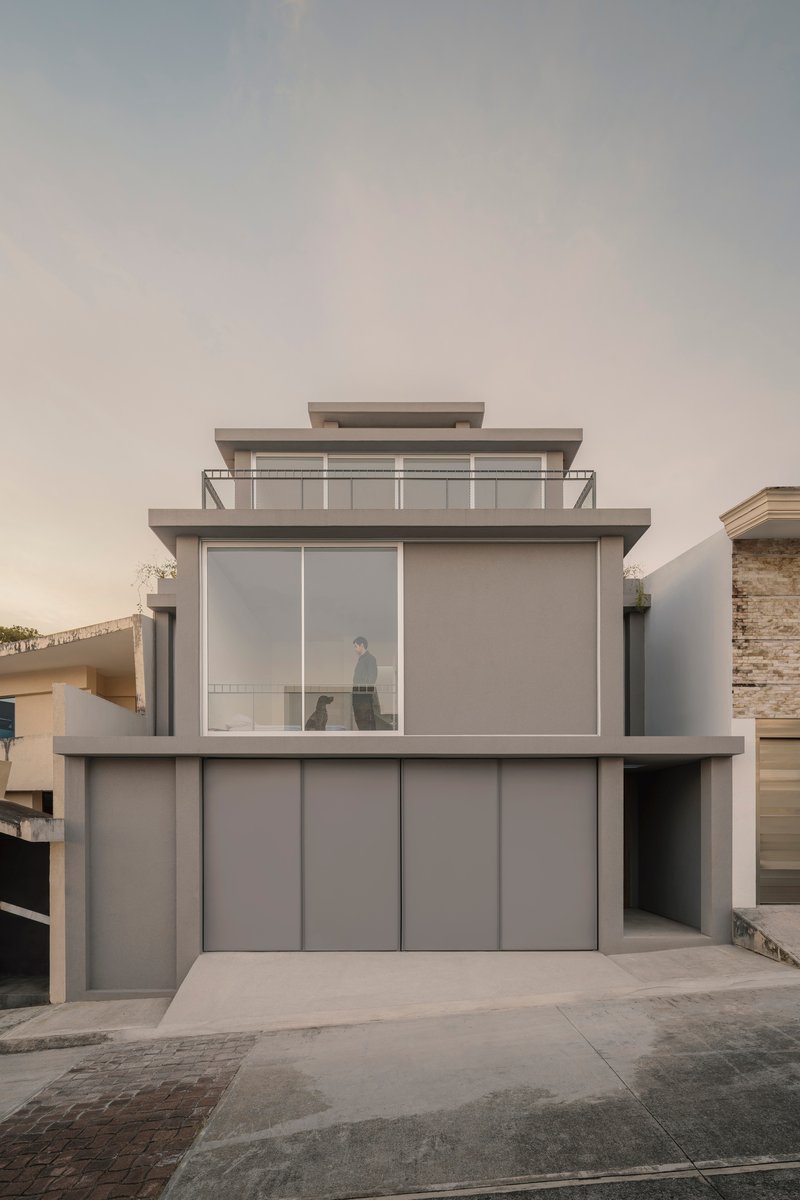
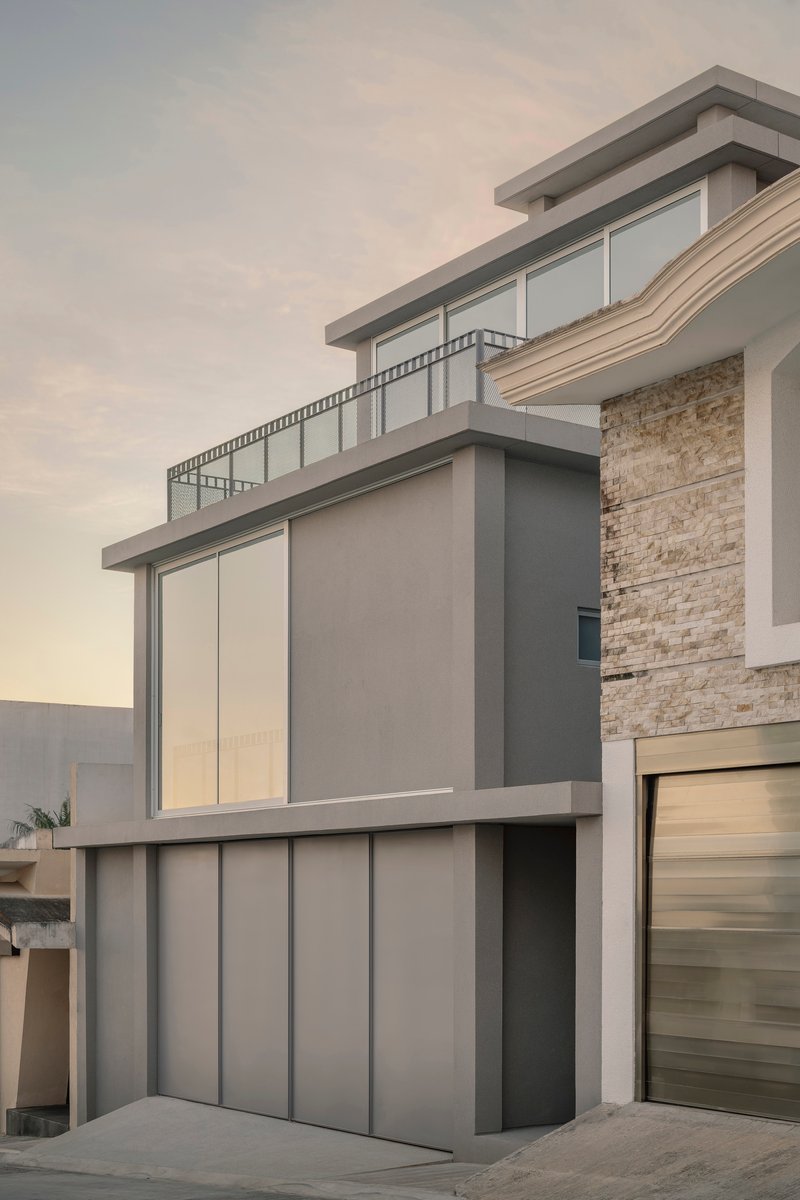
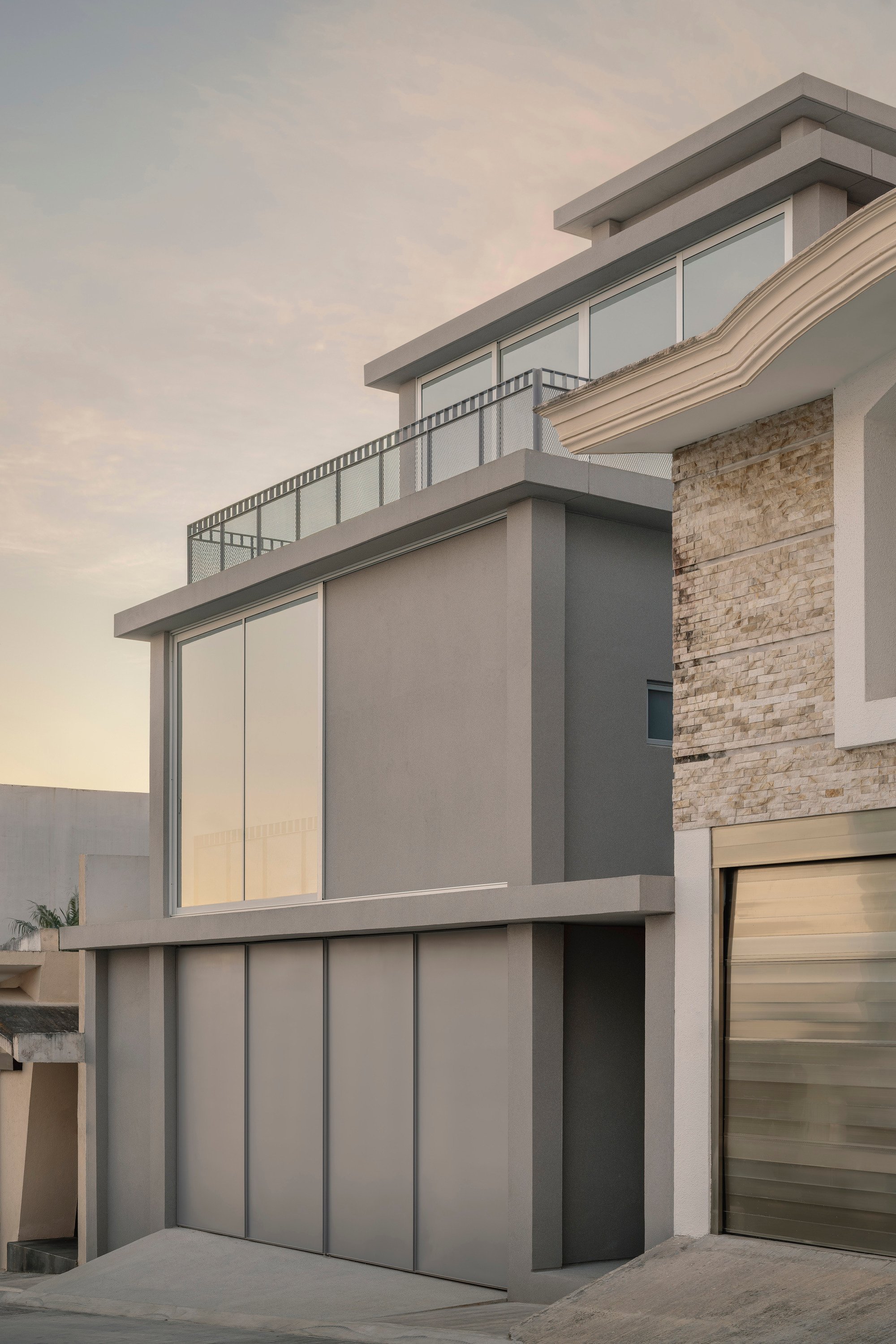
Facing a steep street, Casa Tlaloc presents its most guarded face to passersby. Grey panel cladding and stone veneer anchor the lower levels, while the upper volumes step back behind glass balustrades and metal railings. At dusk, the tiered balconies glow with interior light, but during the day the building is deliberately reticent. The choice to stack vertical balconies rather than wide horizontal openings on this side is a pragmatic one: privacy from the close street and controlled solar gain on the urban elevation.
The corner condition is handled with care. Where grey panels meet stone, the junction reads as a deliberate material shift rather than an awkward collision. The glass balustrades keep the upper volumes visually light, preventing the massing from becoming oppressive on a narrow residential block.
The Rear Elevation Opens Up
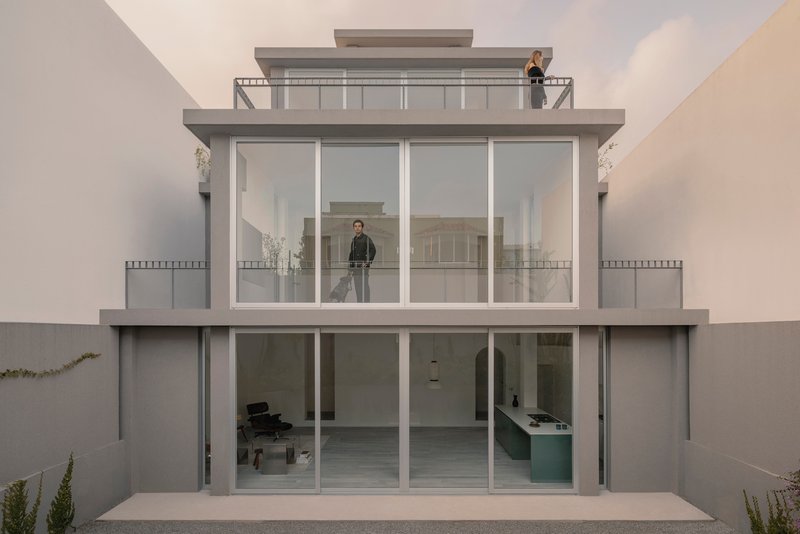
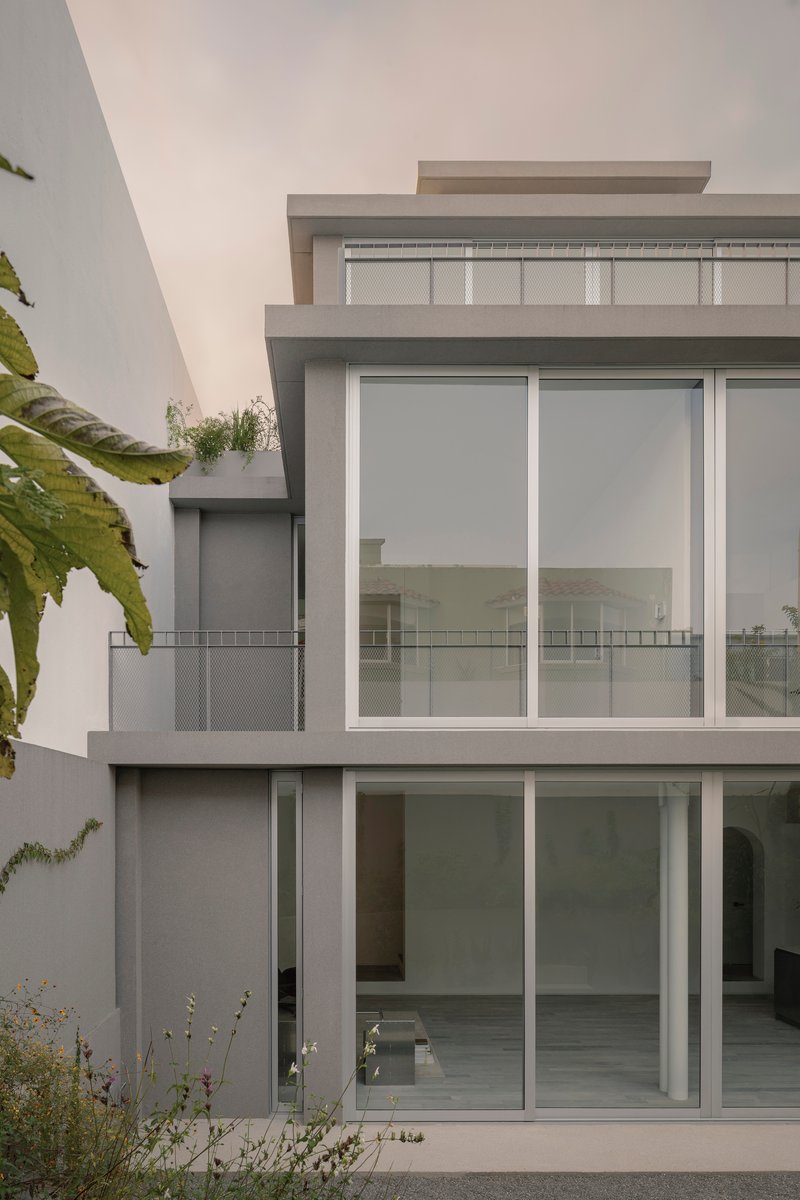
Turn the building around and the character flips. The rear facade dissolves into stacked glazed volumes, recessed balconies, and sliding glass doors that connect every level to the garden. Palms and ferns frame the planted roof terrace, and the overcast Xalapa sky wraps the whole composition in a soft, even light that makes the white interiors read as continuous with the exterior.
The cantilevered slabs that project beyond the glass line are doing double duty here: they shade the openings below from high-angle sun and channel rainwater toward collection points. In a city where annual rainfall hovers around 1,500 millimeters, harvesting that water is not a sustainability gesture but a material fact of living.
Ground Floor: Garden as Room
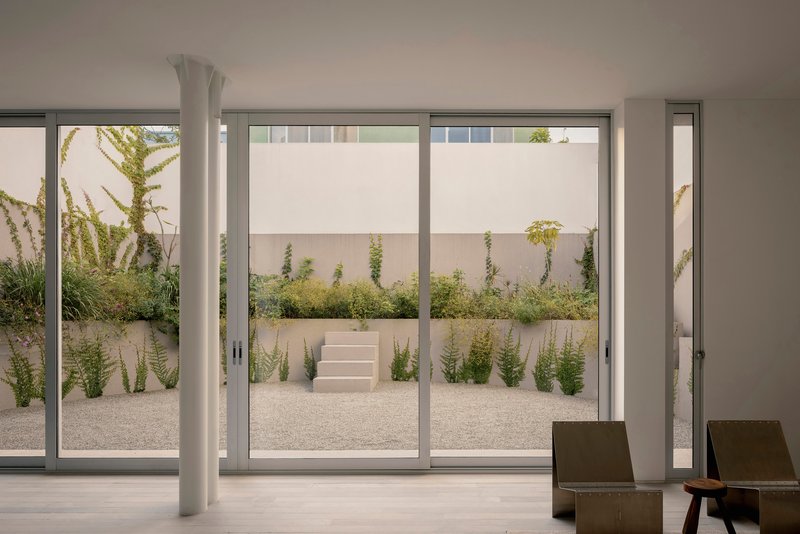
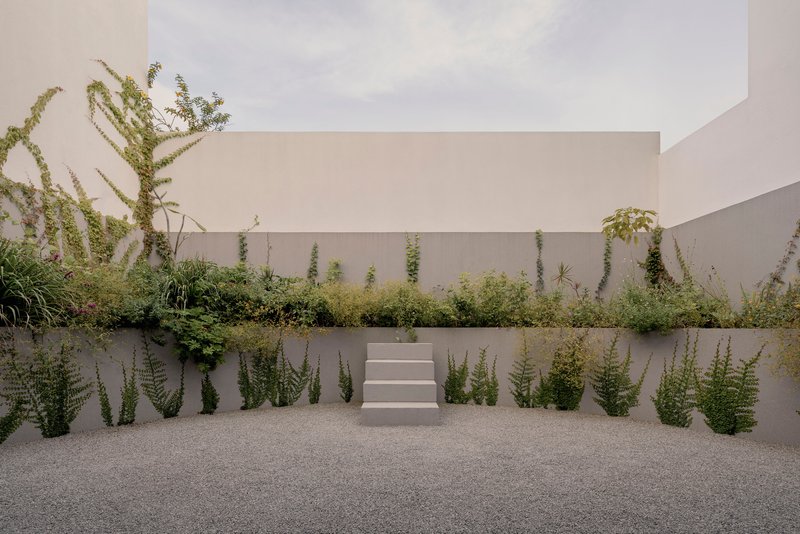
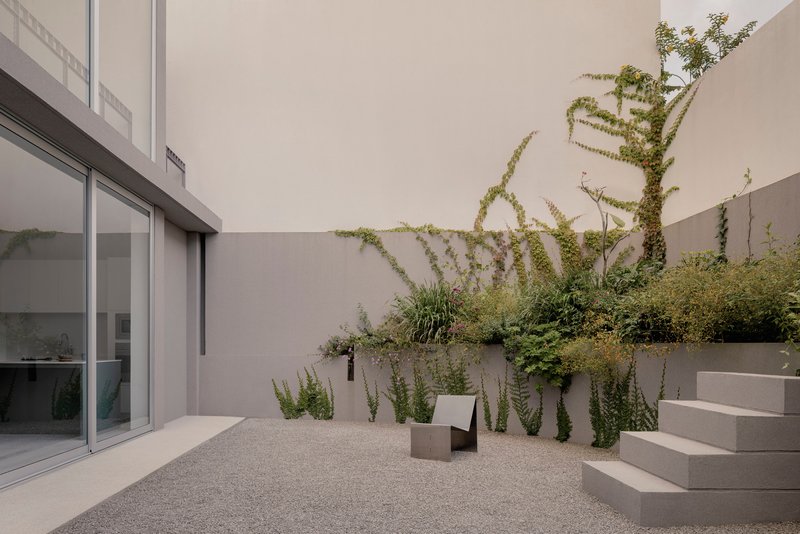
The ground floor social spaces open directly to a rear patio organized around a semicircle of mineral gravel that embraces a guayacán tree. It is a deliberately theatrical landscape move: the guayacán's flowering marks the seasons, so the garden functions as a living calendar visible from the main living and dining areas. Raised concrete planters filled with vertical succulents and ground cover grasses step up the grade change, turning what could have been a retaining wall problem into a terraced garden.
Climbing vines against the rendered courtyard walls will, in a few years, soften the edges further. The architects have planned for growth, leaving trellising surfaces and planter depths generous enough to accommodate mature root systems. Landscape here is not decoration applied after the architecture was resolved; it is integral to the section.
The Structural Spine and Staircase
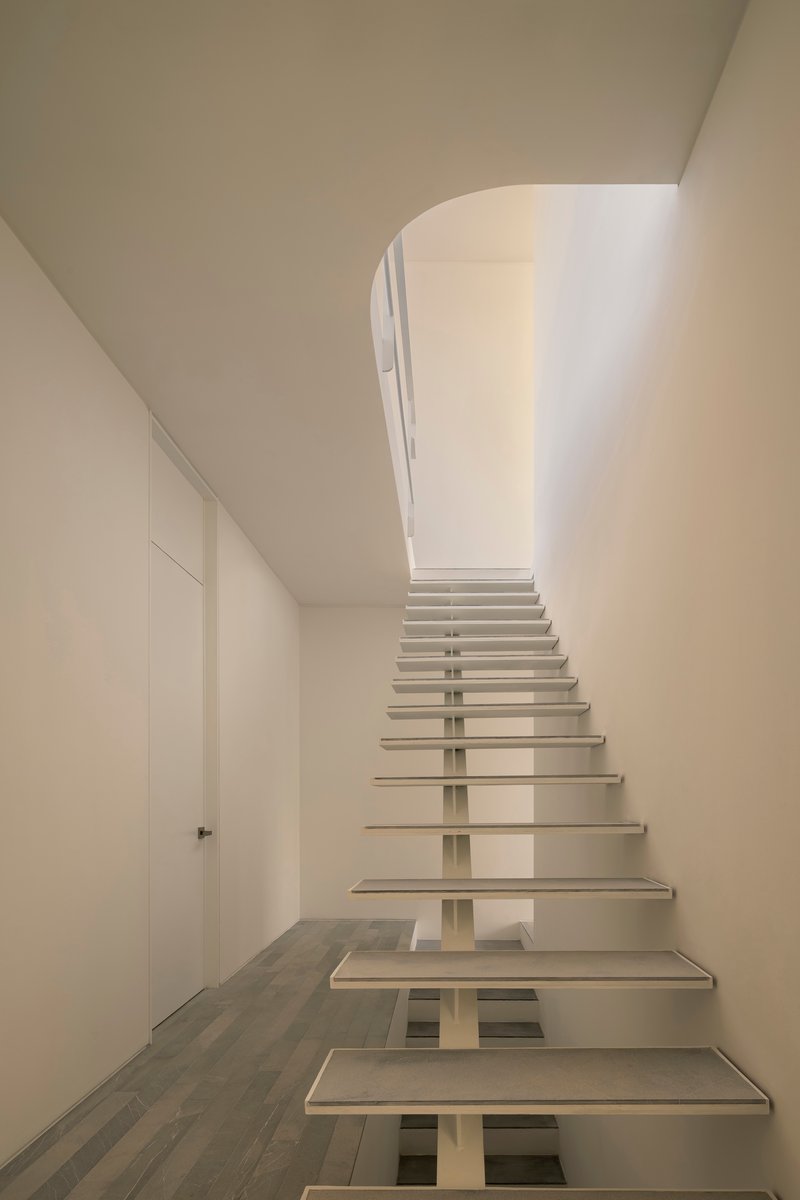
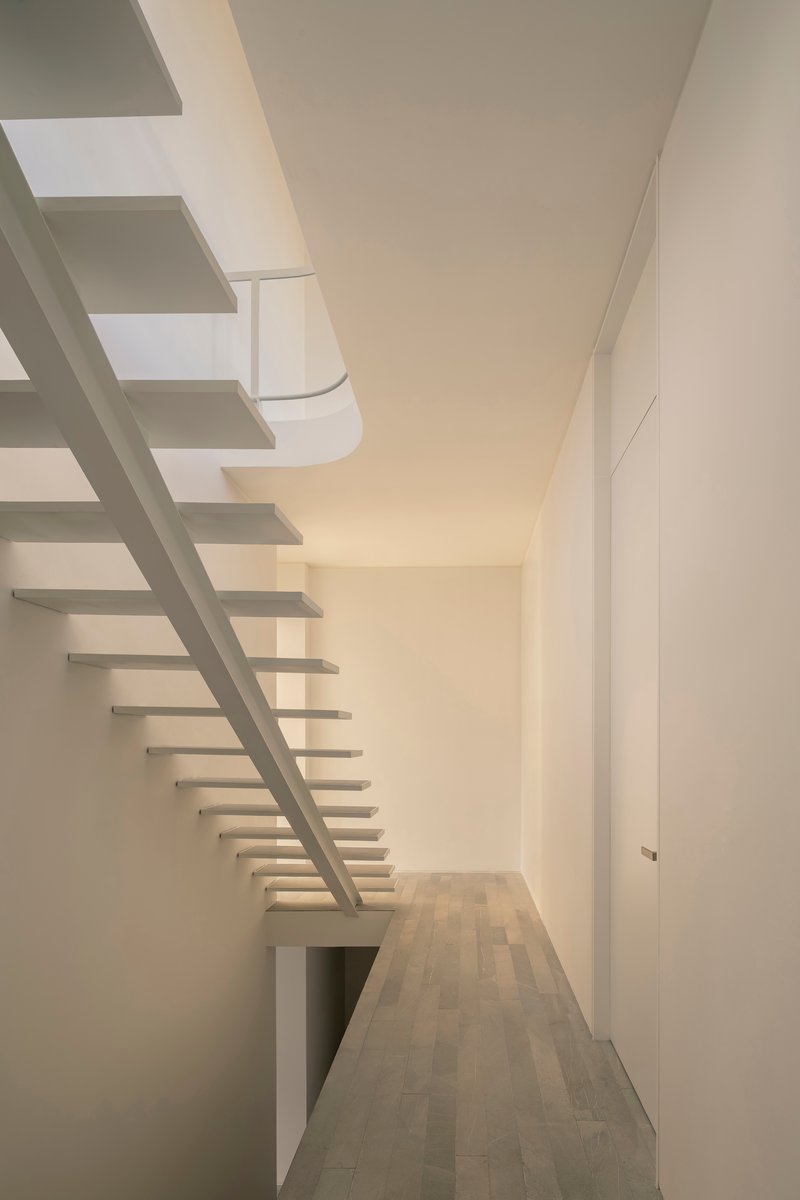
The central staircase is the spine that organizes every floor. White treads cantilever from a central stringer, rising through a skylit void that pulls daylight deep into the plan. The open risers keep the volume feeling continuous rather than chopped into discrete storeys, and the curved geometry of the stair introduces the only non-orthogonal element in an otherwise rigidly gridded structure.
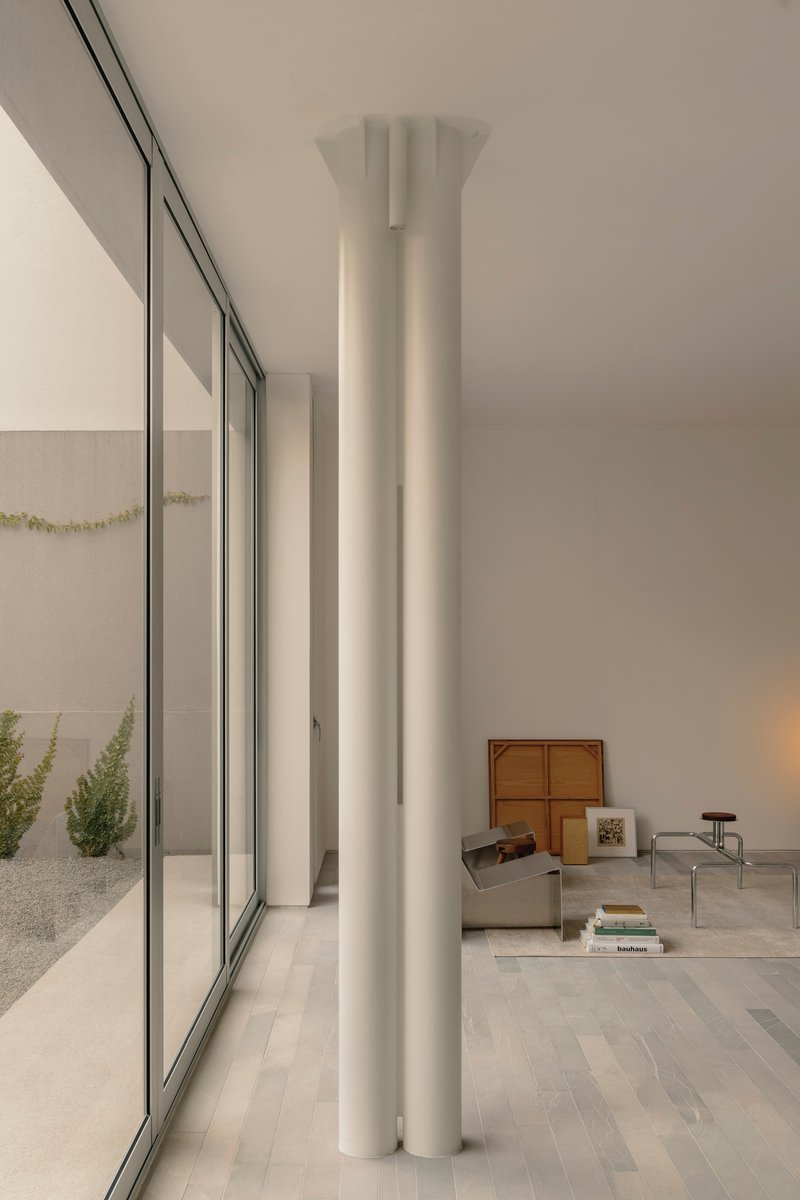
Cylindrical white columns with integrated lighting appear at key structural nodes, marking the points where the bidirectional grid intersects. They are unexpectedly graceful for load-bearing elements, and they signal the architects' insistence that structure is not something to be hidden inside walls but expressed as part of the interior language. The column beside the full-height glazing in image 12 is a good example: it frames the courtyard view rather than obstructing it.
Domestic Interiors and Ritual
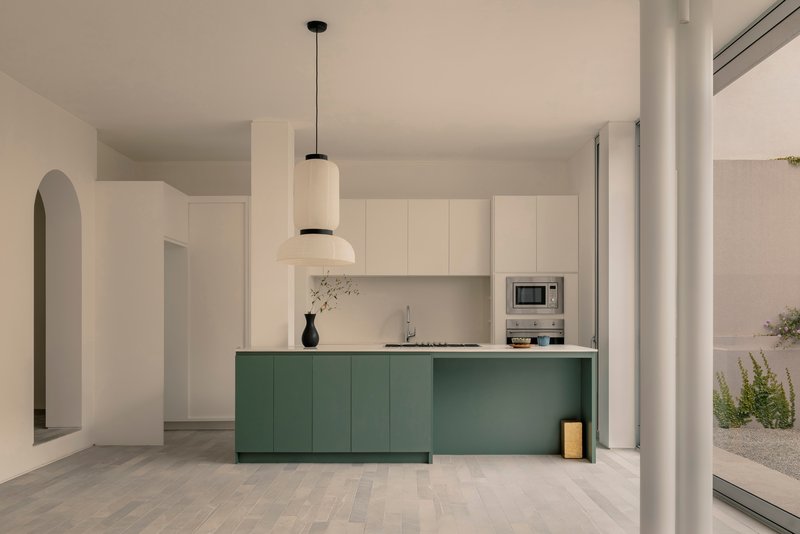
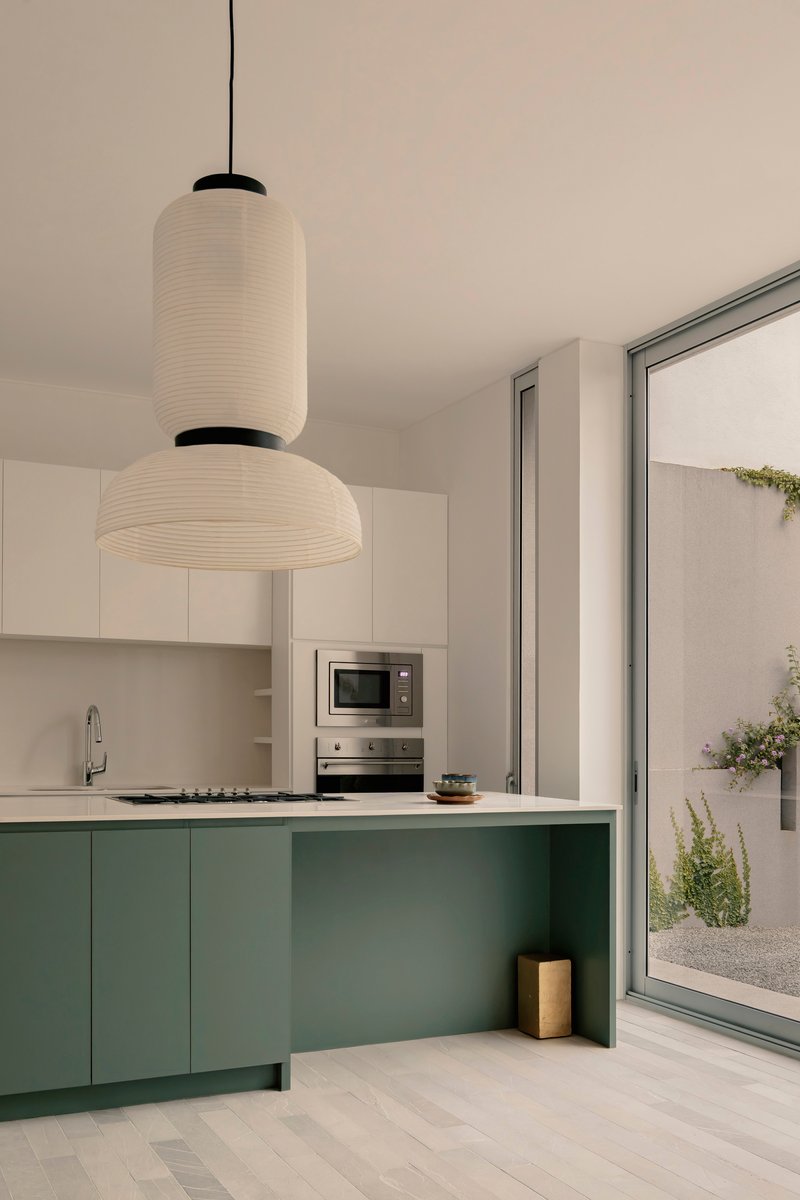
The kitchen anchors the social level with green island cabinetry set against white uppers, a color choice that ties the interior palette back to the garden. Two stacked paper lantern pendants provide ambient light without competing with the views. It is a restrained approach to a room that many architects over-design: functional, warm, and deliberately quiet.
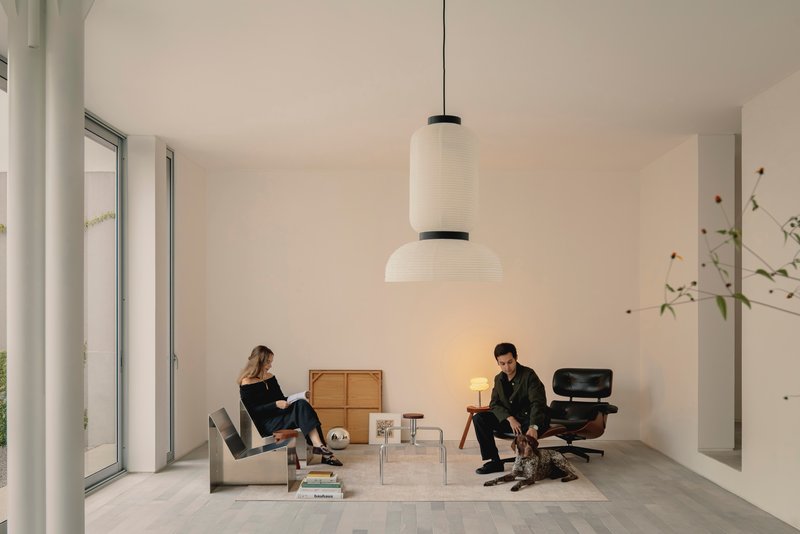
The living room above captures a different mood. A layered pendant light fixture presides over a sitting area that feels more contemplative than convivial. The vertical separation of social and living spaces is the project's most interesting programmatic decision: cooking and dining happen closest to the garden, while reading and conversation happen one level up, slightly removed from the ground, with broader views.
Private Chambers and the Summit
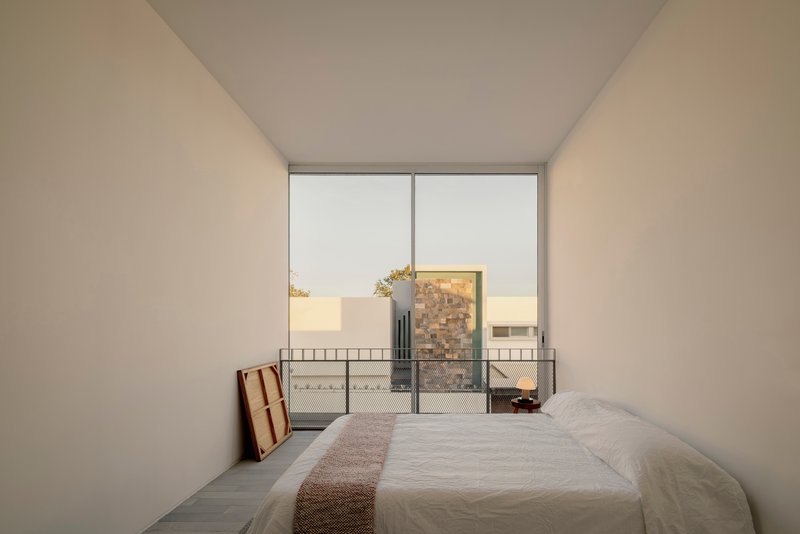
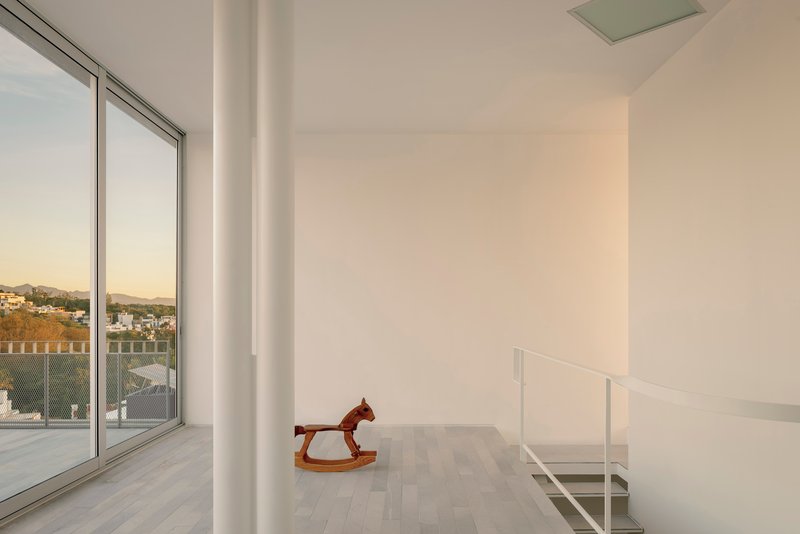
The cruciform bedroom floor places the master suite at the front of the house, projecting toward the urban landscape, while secondary rooms extend laterally toward the garden. The low platform bed in image 16 faces a glazed door that opens directly to a courtyard, making the most private room also the one with the most direct connection to landscape. A wooden rocking horse on the upper landing, silhouetted against a glazed opening at sunset, suggests a house that accommodates childhood as comfortably as it frames views.
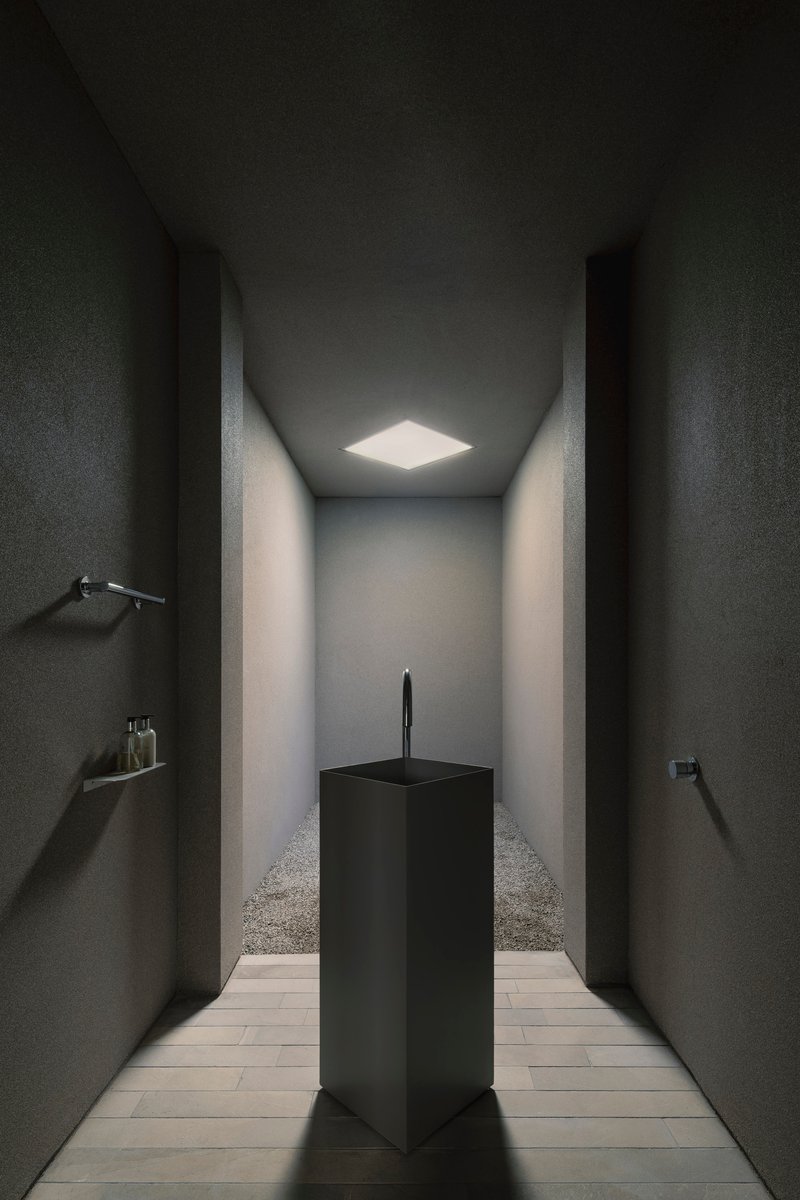
The most arresting interior moment is the narrow corridor with dark textured walls and a single skylight illuminating a freestanding black pedestal sink. It is a compression point: the entire house narrows here before releasing into the open studio above. The darkness is calculated, making the skylight's shaft of light feel almost solid.
Roof Terrace and City
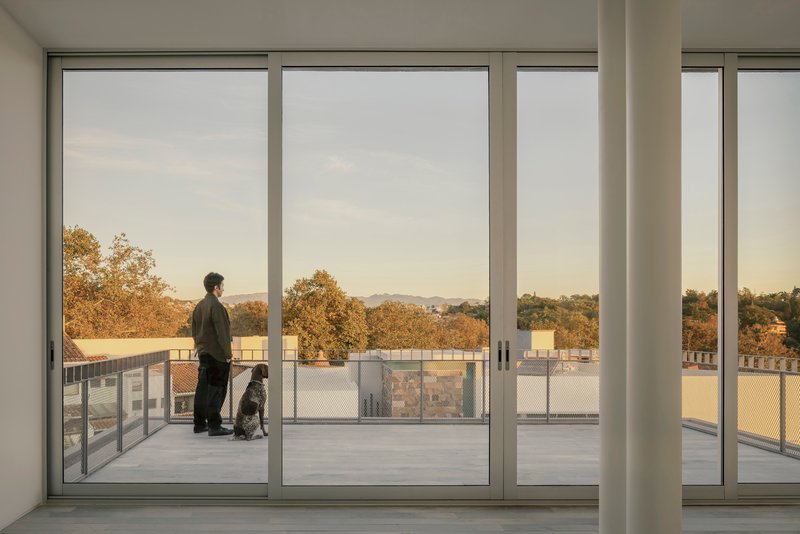
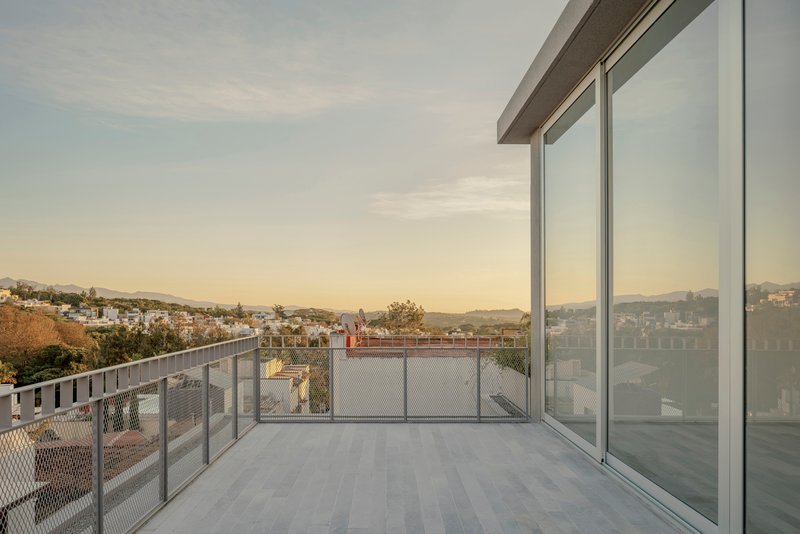
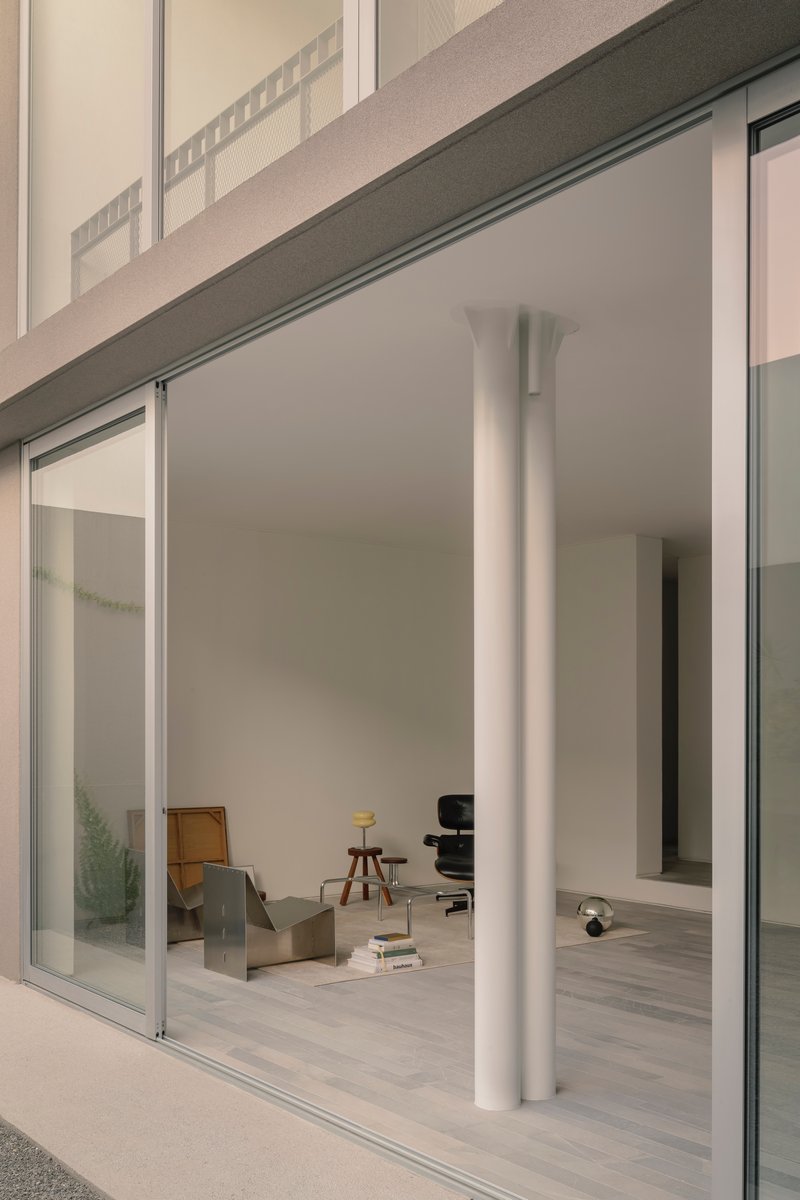
At the summit, the floor plate retracts from the building's edges to create generous terraces that float above the neighboring rooflines. The metal mesh railing provides security without blocking sightlines to the surrounding hills. A person and a dog stand on the terrace in image 18, and the scale is telling: this is not a token outdoor space but a genuine room without a ceiling, sized for daily use.
The view from the terrace sweeps across Xalapa's hilly residential fabric toward the horizon. The house earns this panorama through its disciplined stacking: each setback at the upper levels is not arbitrary but calibrated to clear the sightlines above adjacent structures. A technical volume at the very top houses the equipment for the home's operation, tucked out of sight.
Physical Models
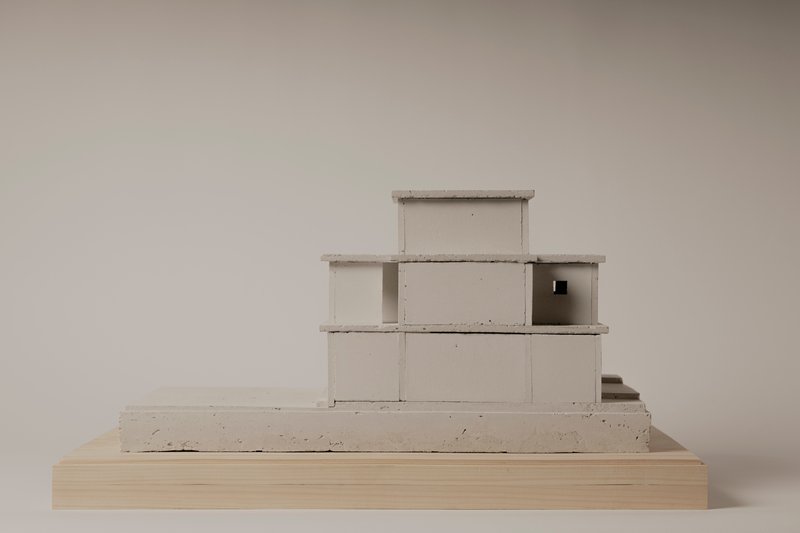
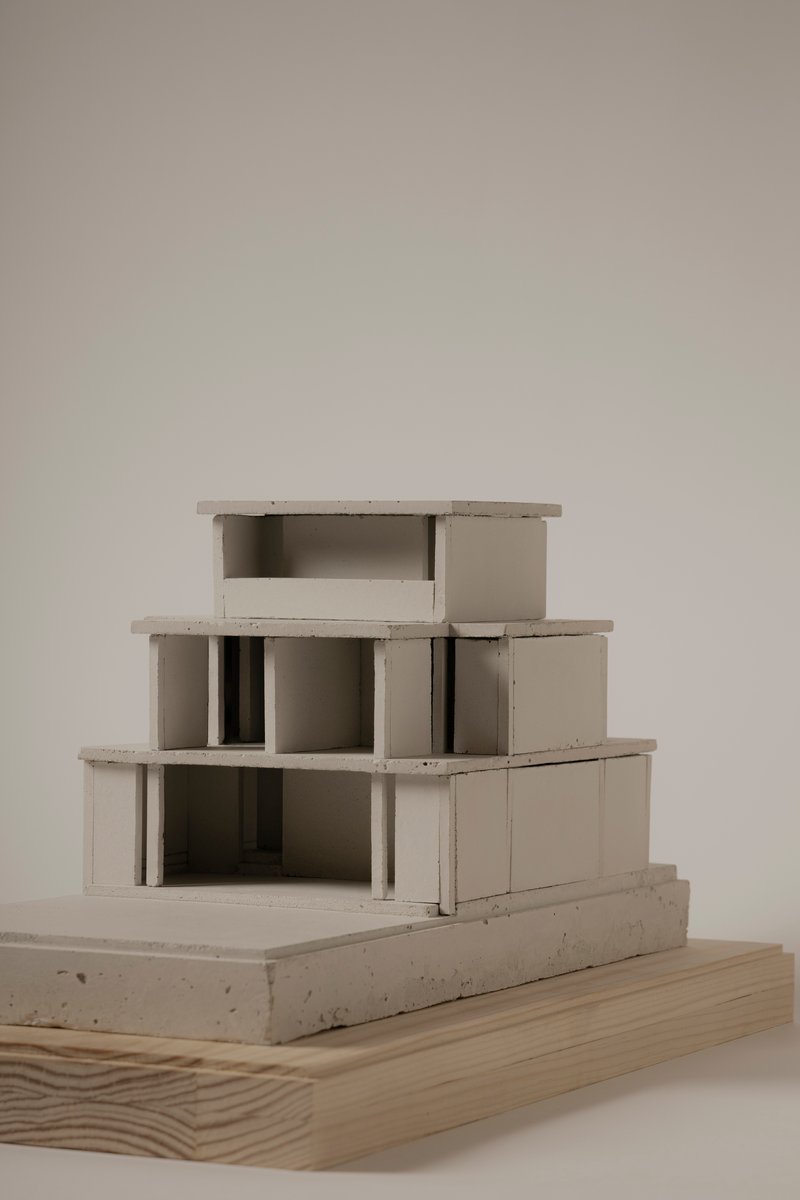
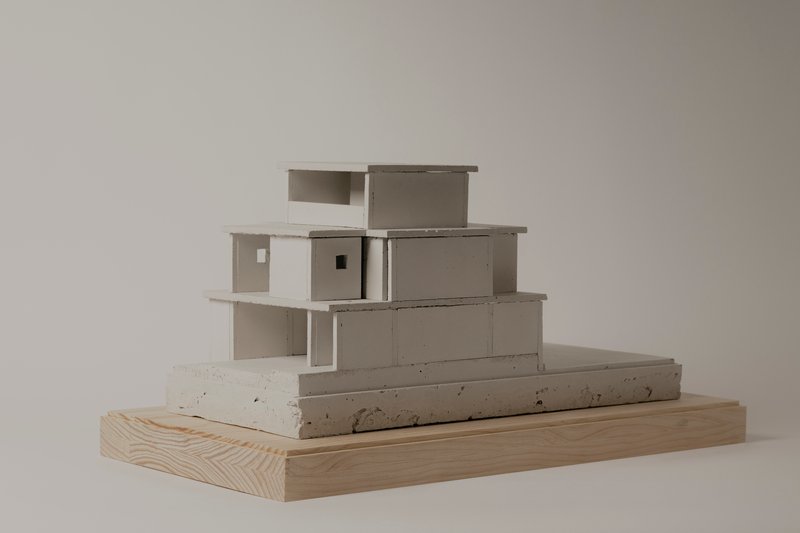
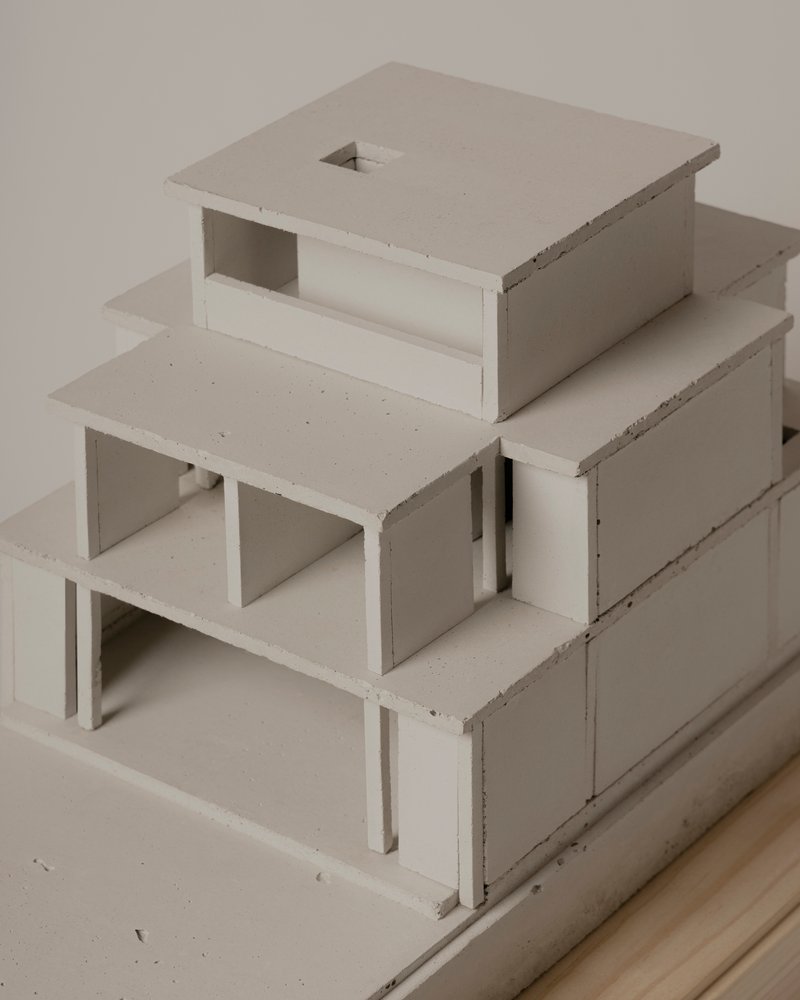
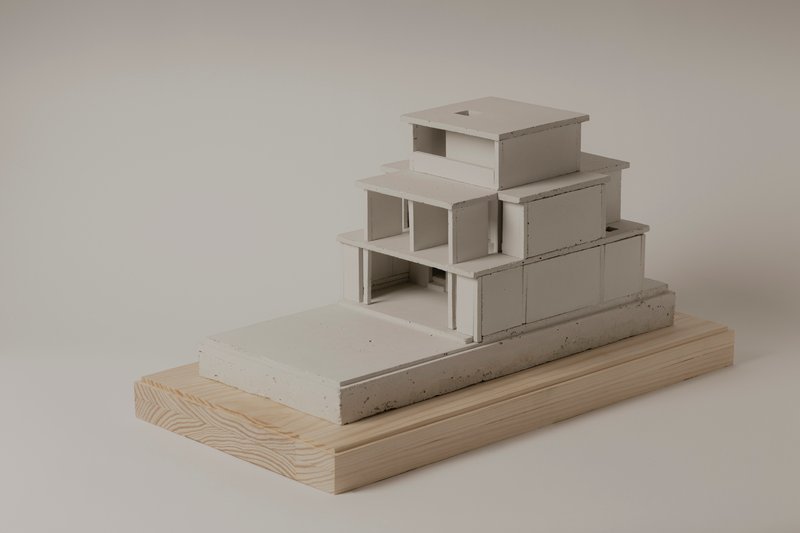
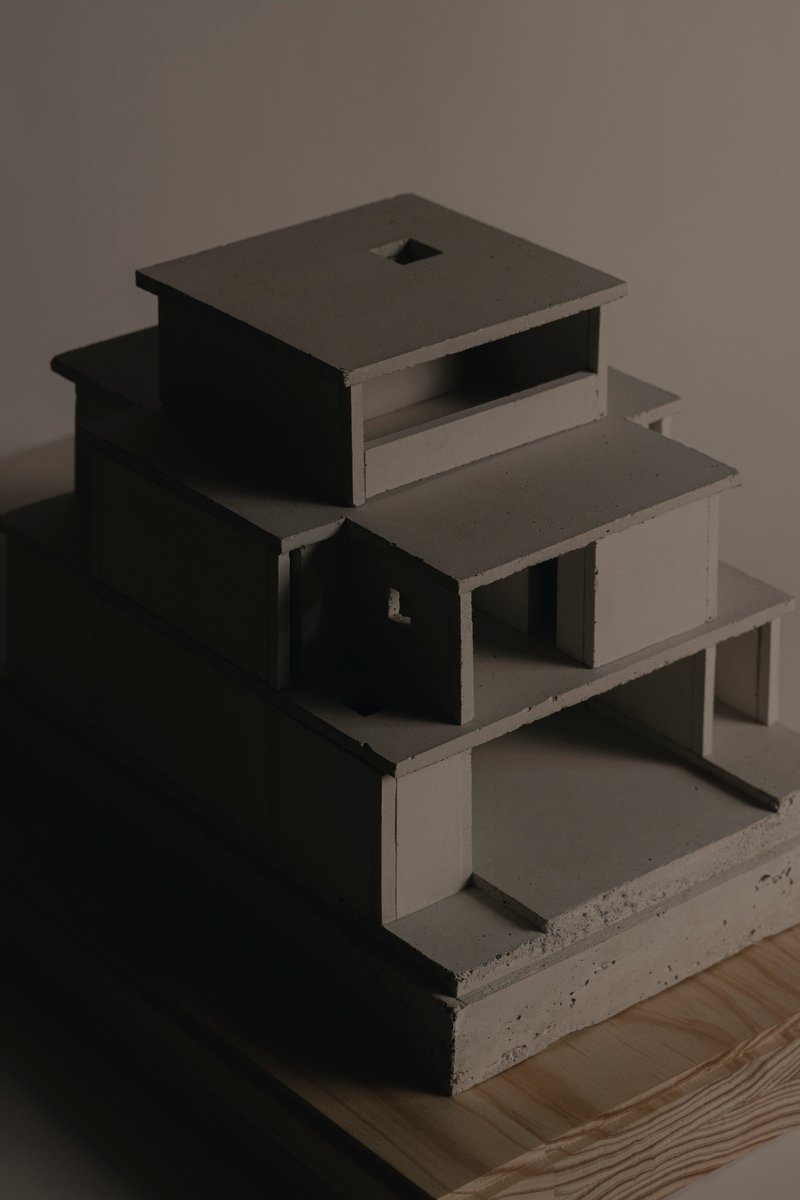
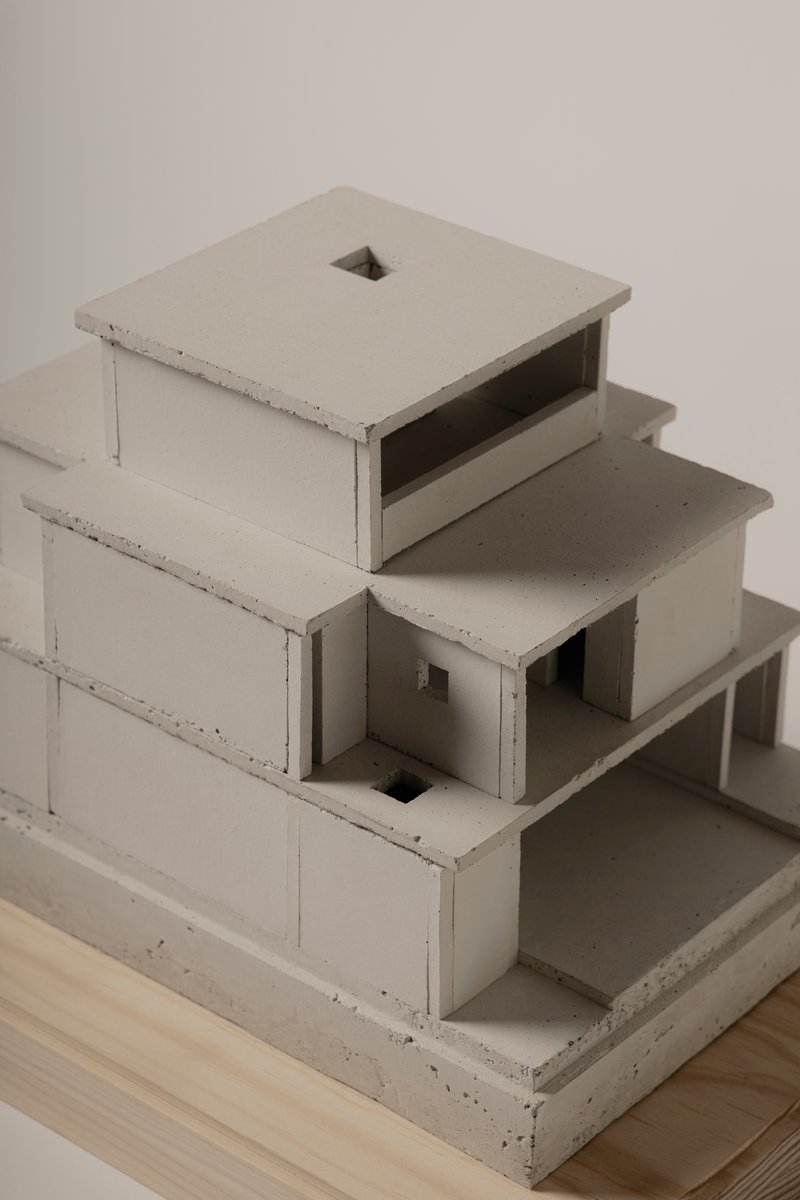
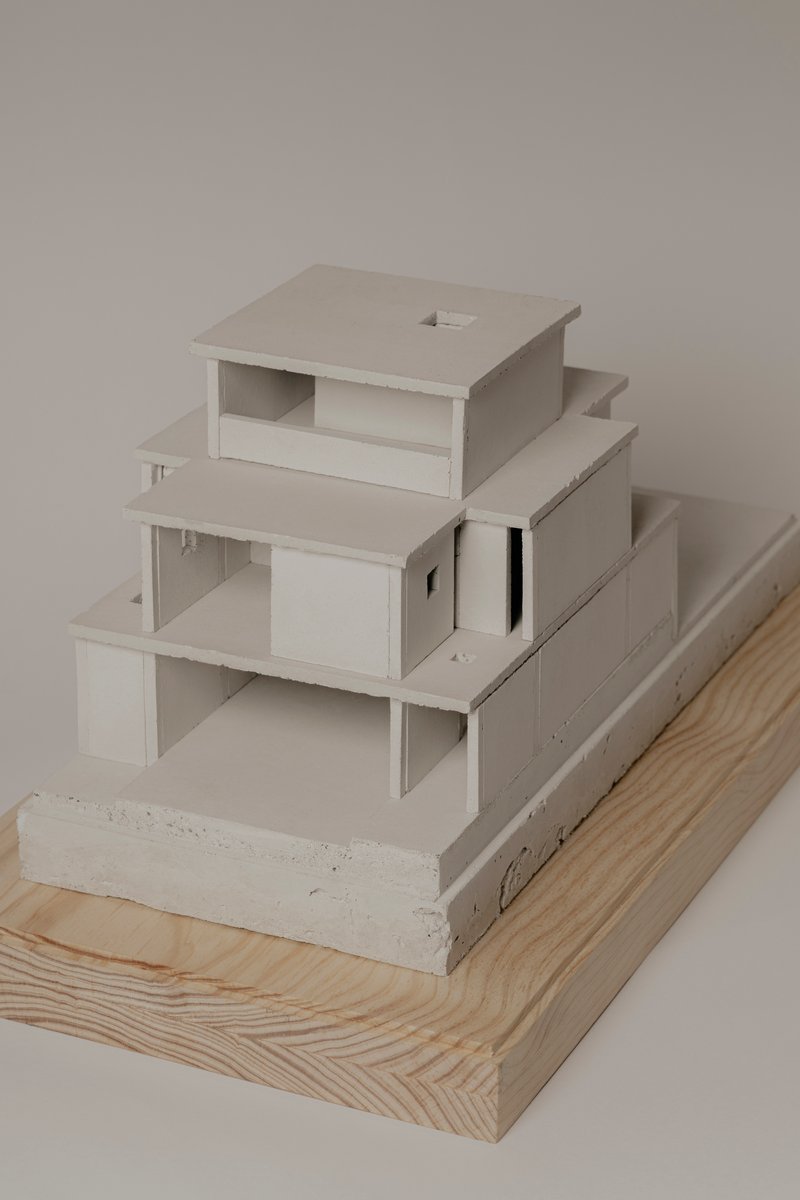
The concrete study models reveal how the architects worked through the massing. Sectional cuts expose the internal column grid and terraced levels, making visible the structural logic that the finished building absorbs into its surfaces. The shadow studies in particular demonstrate the cantilevered slabs' role as solar shading devices: at different angles of incidence, the overhangs protect different depths of the floor plate.
What the models also show is how much the project depends on the void. Open terraces, recessed balconies, and the central stair void are not leftover space; they are the primary compositional elements. The solid volumes are shaped by what has been removed from them.
Plans and Drawings
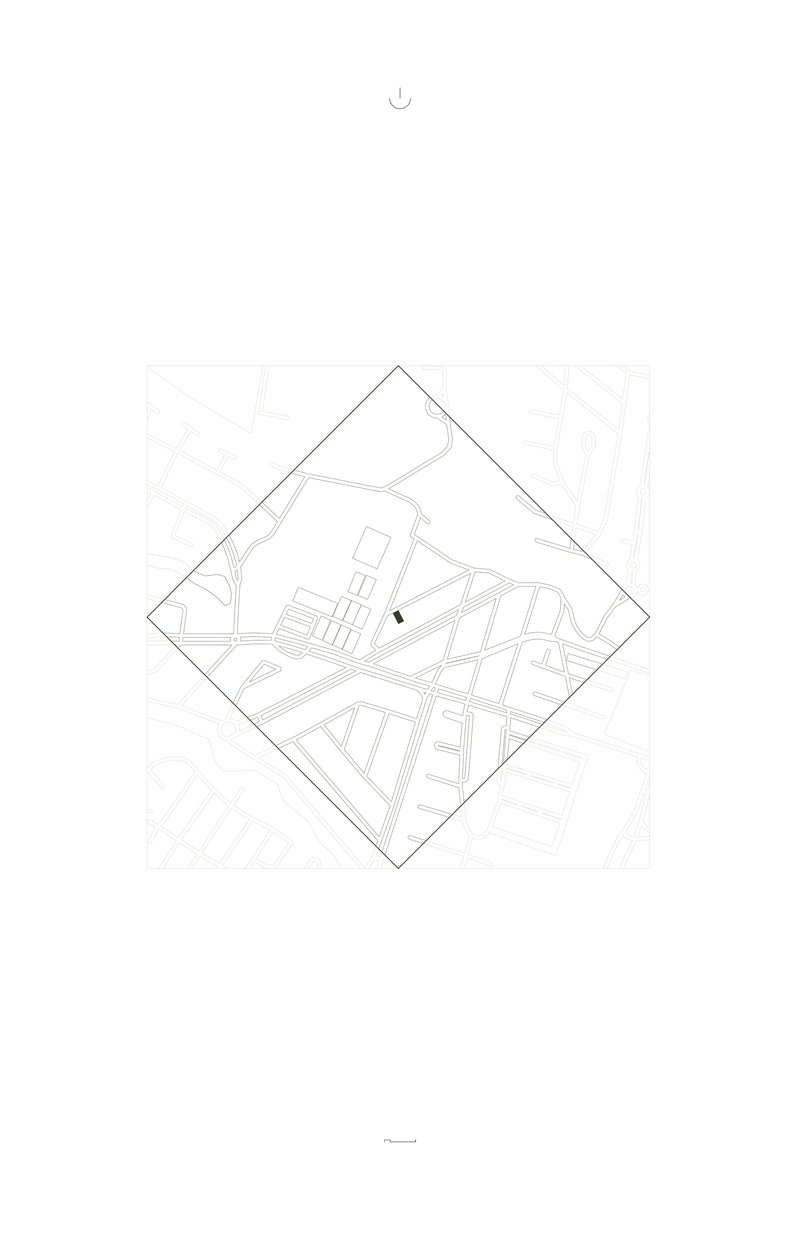
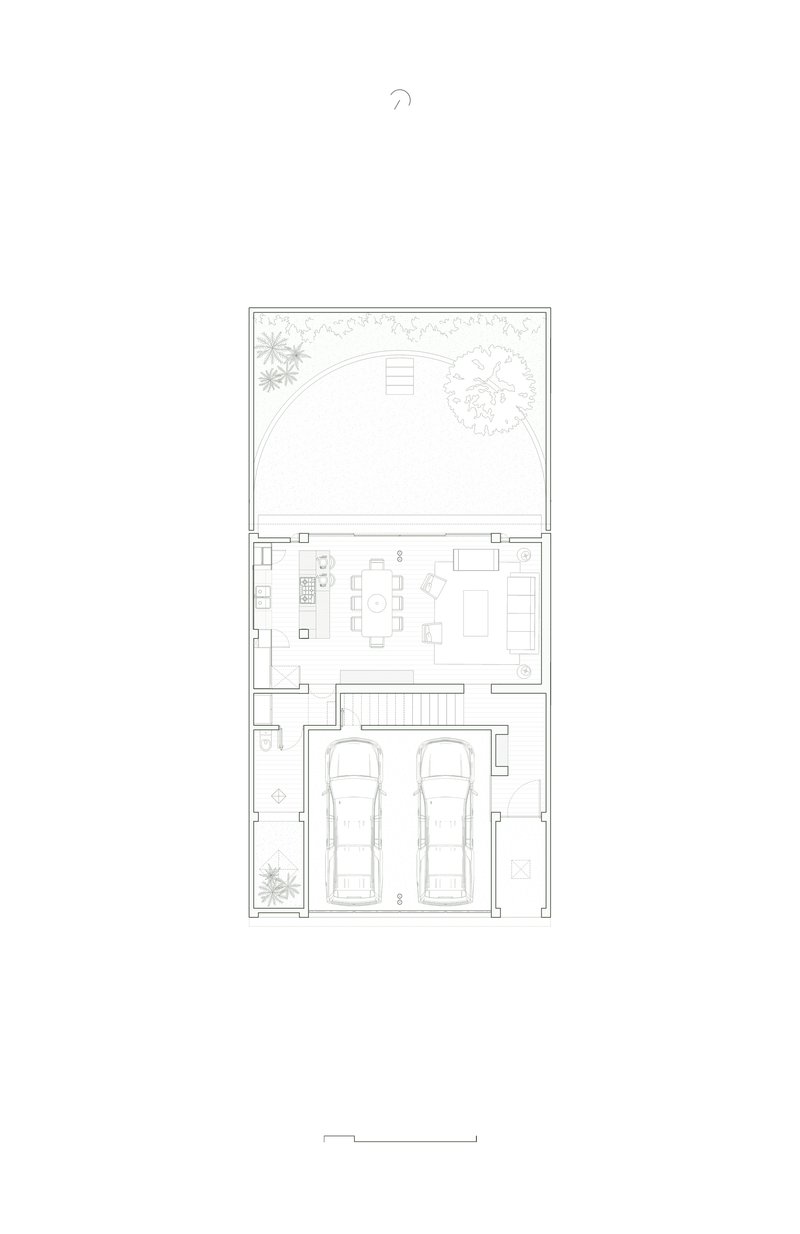
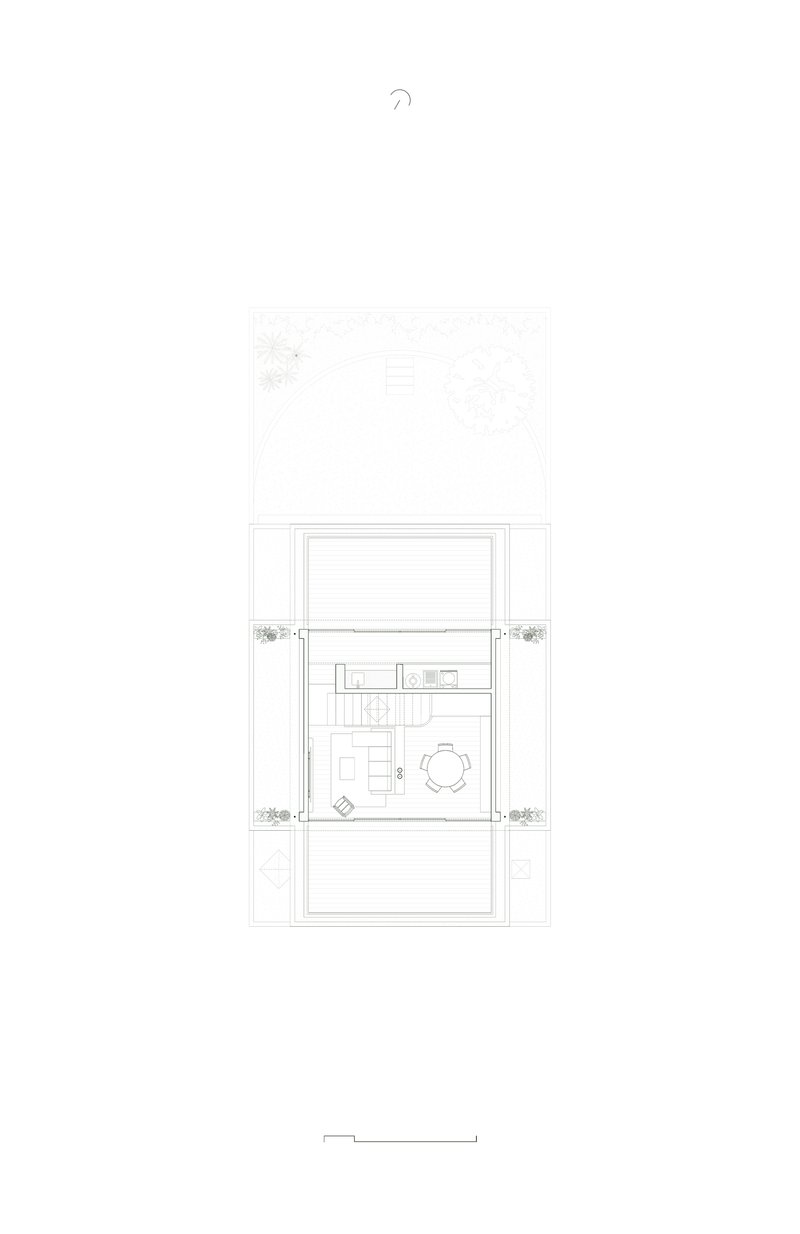
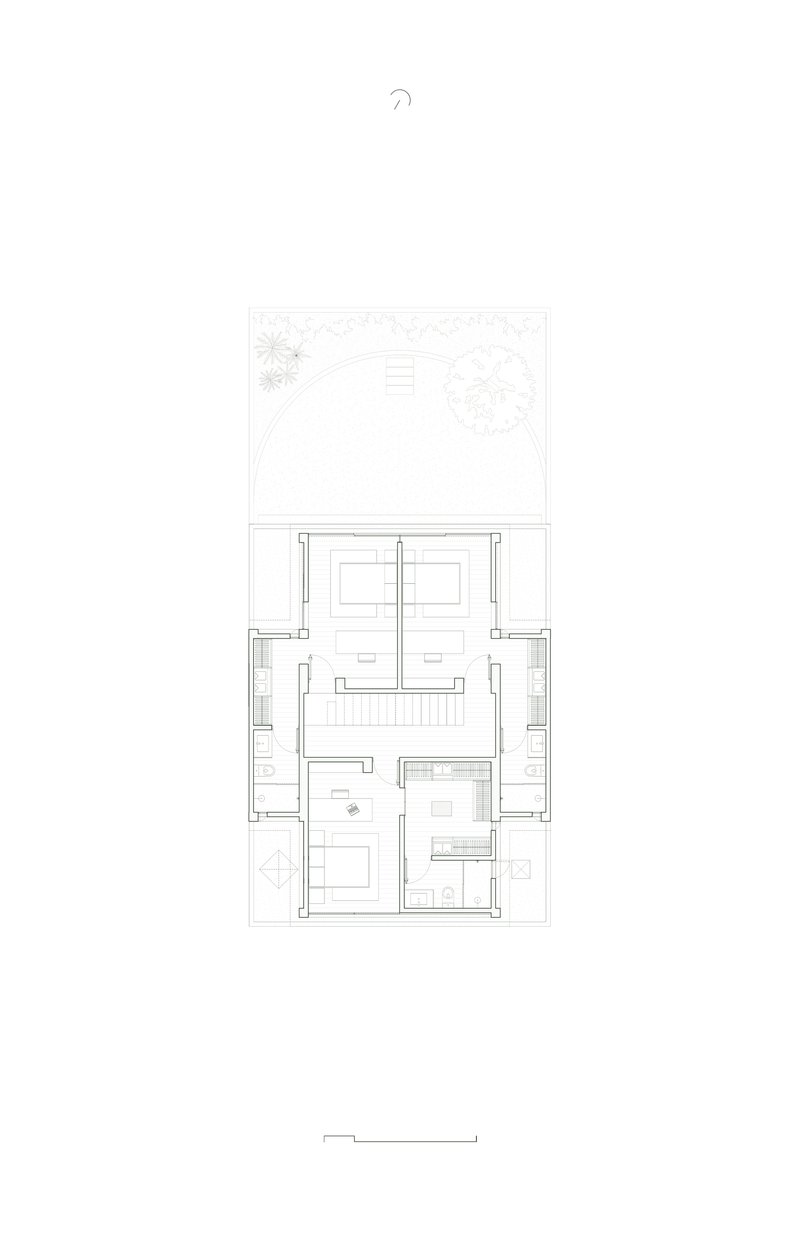
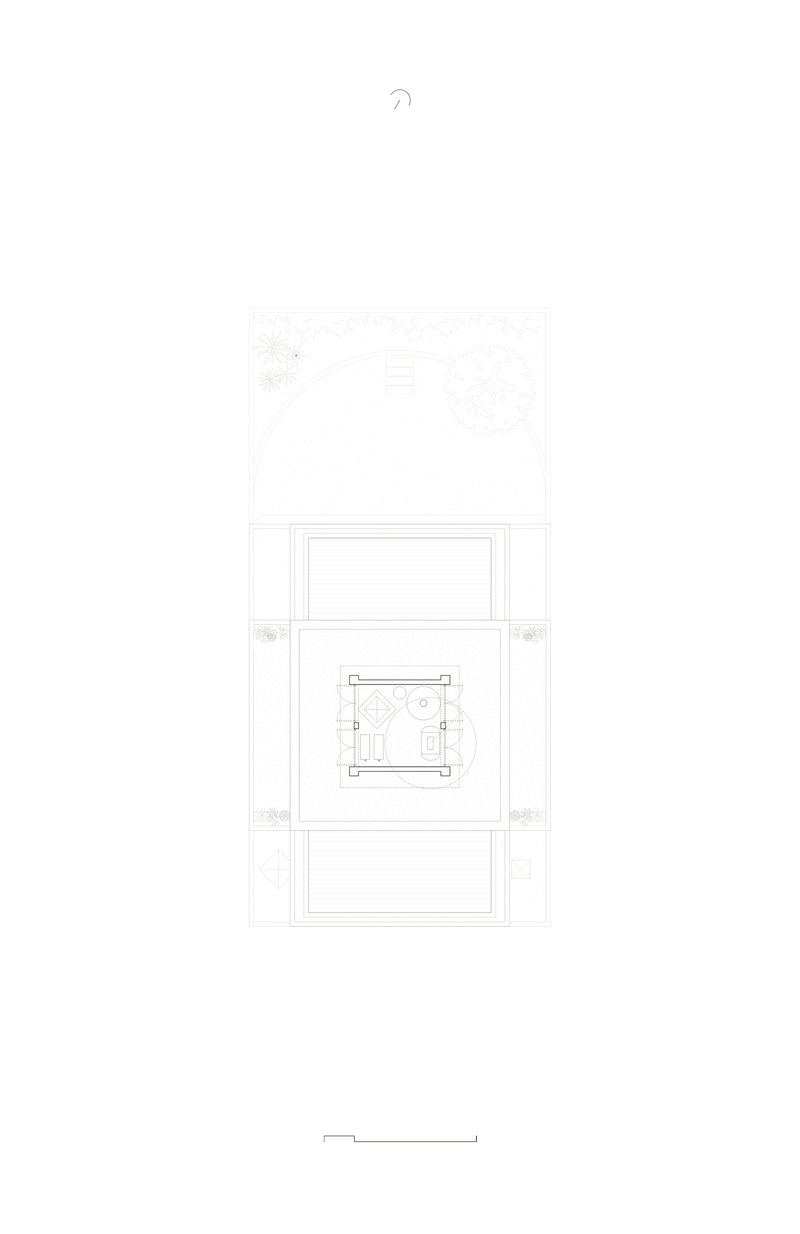
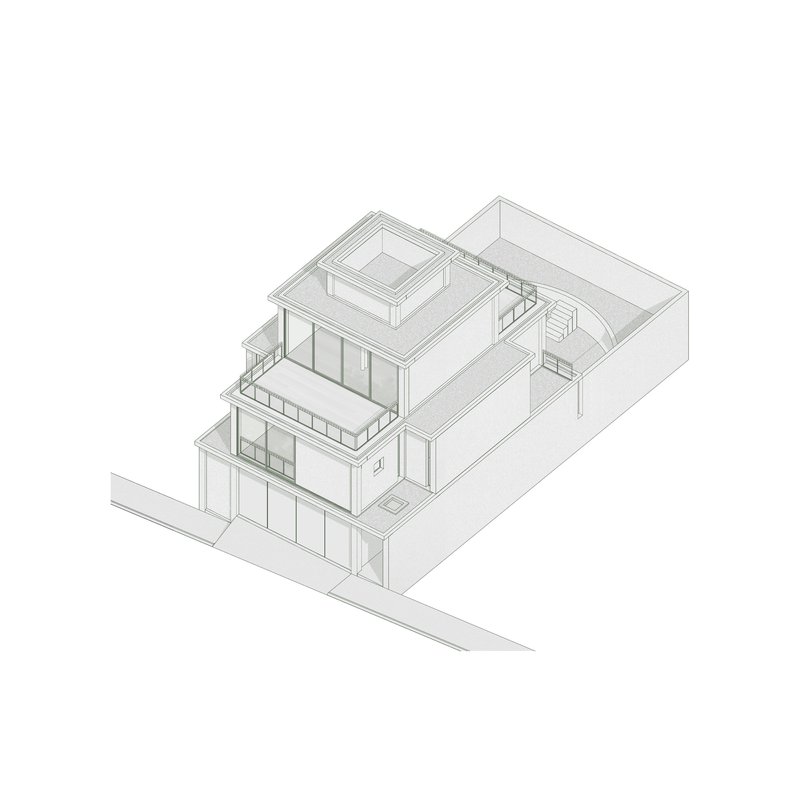
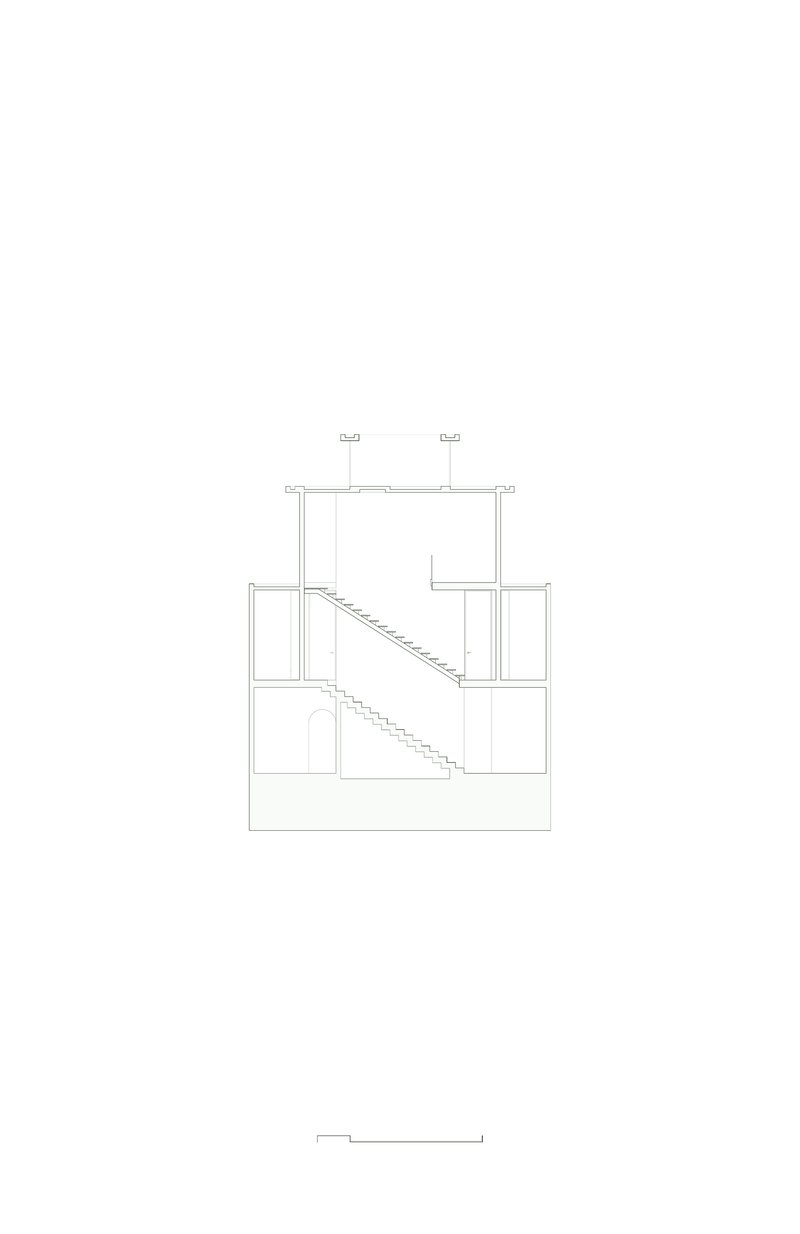
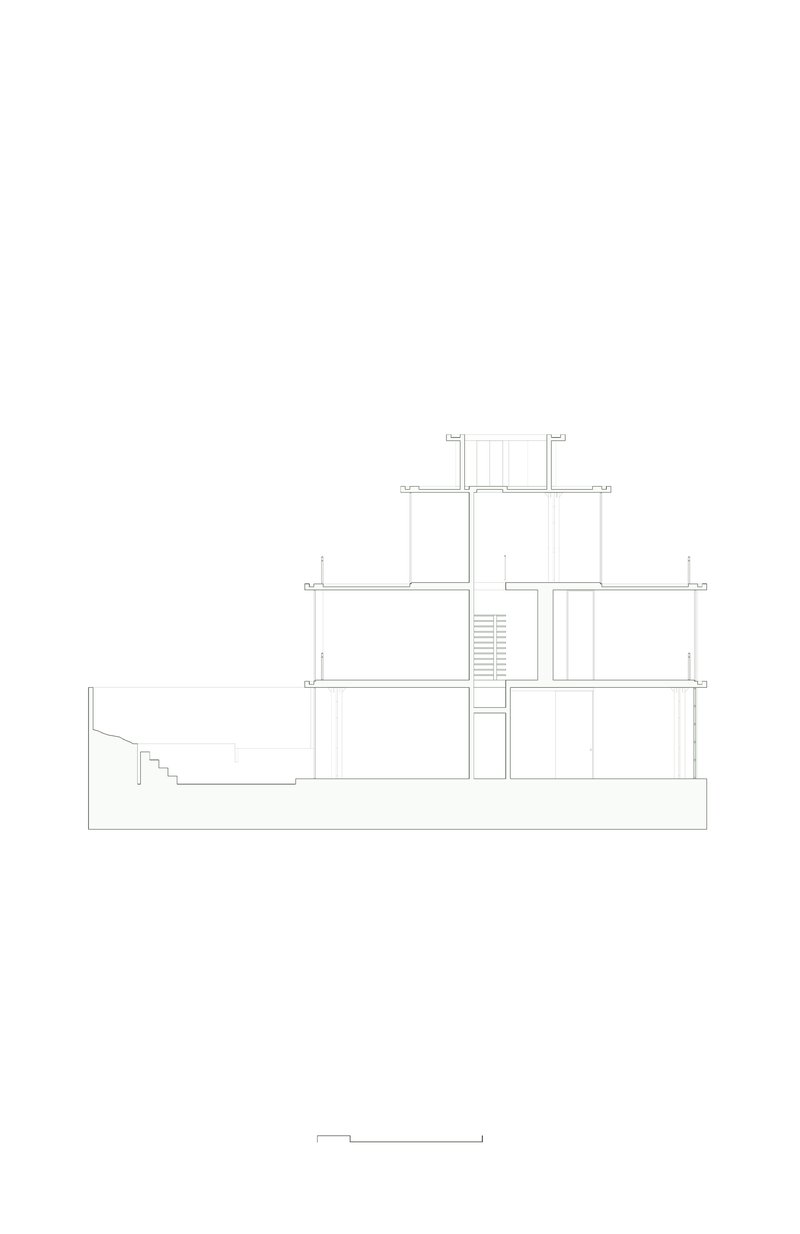
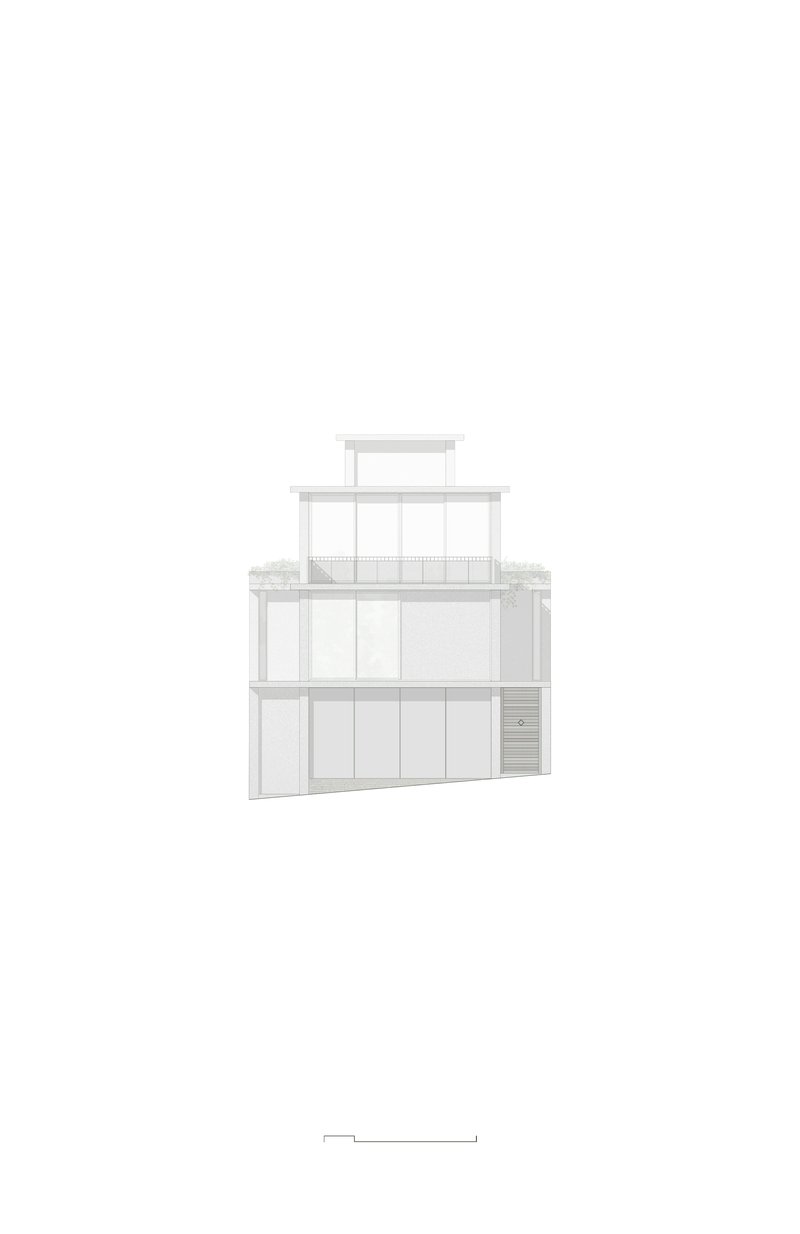
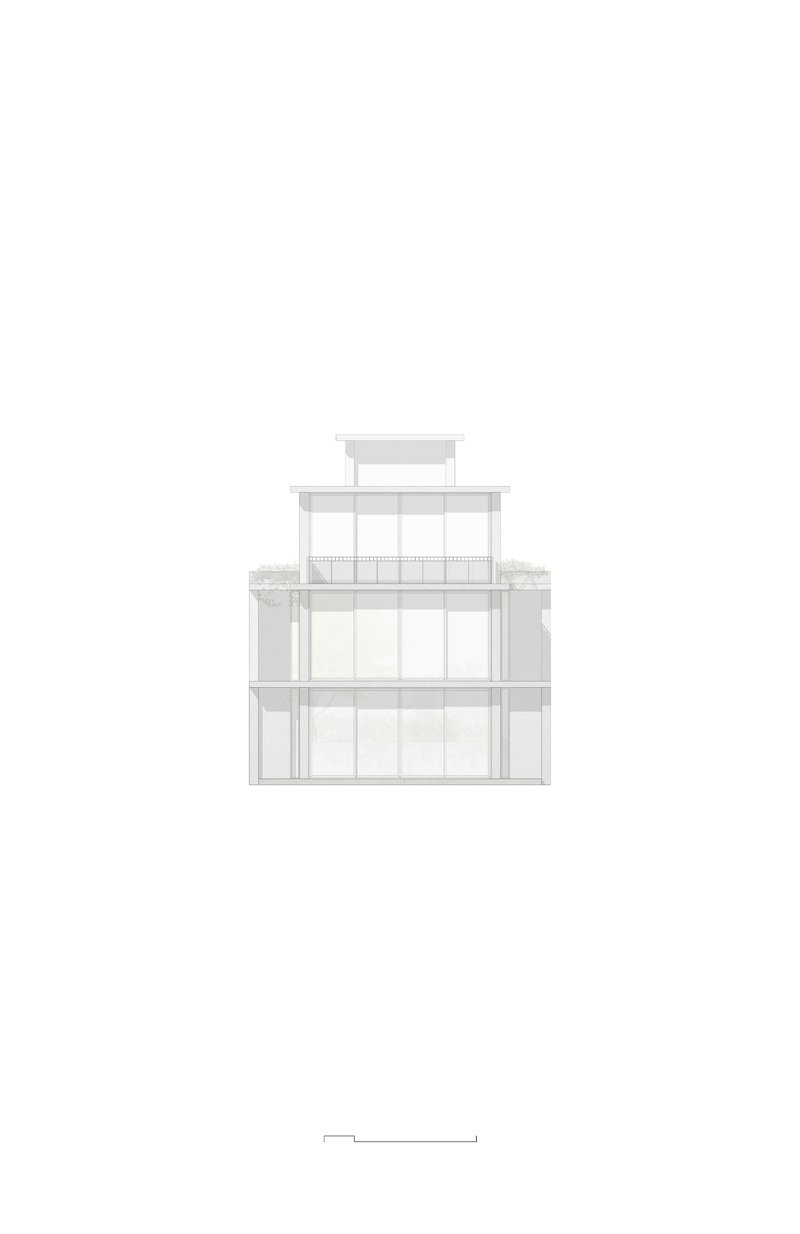
The site plan reveals the building's rotation within a diagonal street grid, explaining the angled approach that makes the corner elevation so prominent. The ground floor plan shows the two-car garage tucked beneath the living spaces, with the semicircular garden occupying the rear of the lot. Moving upward, the cruciform bedroom plan is clearly legible: the master suite pushes forward, secondary rooms extend to the sides, and the central stair void holds everything together.
The sections are the most instructive drawings. They trace the diagonal staircase connecting all four levels and expose the sloping ground condition that the house negotiates. The cantilevered slabs read as horizontal datum lines against the irregular topography, each one at a slightly different depth, creating the stepped profile visible from the street. The axonometric drawing pulls the whole composition apart to reveal how rooftop terraces and open corner balconies give the upper floors their expansive character.
Why This Project Matters
Casa Tlaloc is named for the Aztec rain god, and the house takes that reference seriously. Rainwater harvesting, solar shading through cantilevered slabs, and a guayacán tree that marks the passing seasons are not applied sustainability features but core architectural moves that shape the section, the facade, and the daily experience of living in the building. The structural grid of columns and metallic supports is legible throughout, giving the house an intellectual clarity that many residential projects sacrifice in pursuit of comfort.
What Lopez Gonzalez Studio has built is a convincing argument that a house on a steep, tight urban lot does not have to choose between density and openness. By stacking program vertically according to degrees of privacy and pulling the upper floors back to create terraces, the architects achieve both enclosure at the street and panoramic exposure at the top. It is a house that understands its city, its climate, and its inhabitants with equal precision.
Casa Tlaloc by Lopez Gonzalez Studio (Jesús Arturo and José Pedro López González). Xalapa, Mexico. 316 m². Completed 2026. Photography by Cesar Bejar Studio and Zaicks Moz.
About the Studio
Share Your Own Work on uni.xyz
If projects like this are the kind of work you want to make, uni.xyz is a place to publish your own, find collaborators, and enter design competitions.




Popular Articles
Popular articles from the community

Kawasaki Olympic Sports Center: Sports Complex Architecture Rooted in Community, Tradition, and Movement
Kawasaki Olympic Sports Center reimagines sports complex architecture as a civic park where tradition, training, and community meet locally.
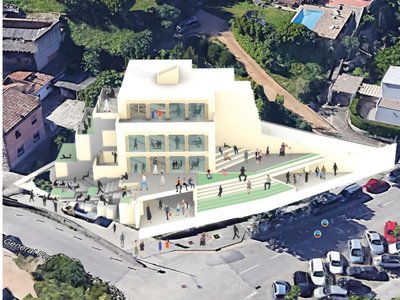
Community Library in Girona: A Replicable Model for Inclusive Library Architecture
A modular community library in Girona transforms learning, culture, and climate-responsive design into a shared civic network for all users.
Shinkō Komyuniti: Public Space Architecture Reimagining Sport, Culture and Community in Tokyo
Shinkō Komyuniti transforms sports spectatorship into public space architecture that reconnects play, culture, community and Tokyo life now.

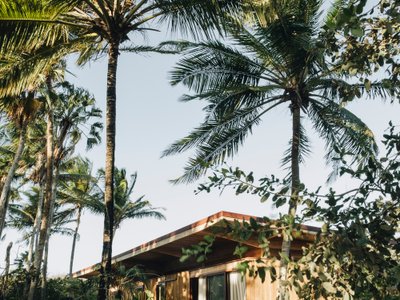
UNA Barbara e Valentim Plants Four CLT Bungalows in a Fragile Ceará Landscape
Prefabricated eucalyptus timber cabins touch down lightly on the sandy, biodiverse coast of Barroquinha, Brazil.


Similar Reads
You might also enjoy these articles
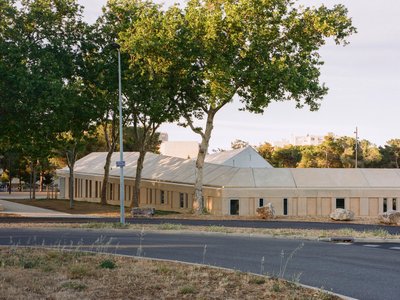
School Group Samuel Paty in Béziers: A Contemporary Educational Campus by Ateliers O-S Architectes and NAS Architecture
Samuel Paty School in Béziers features concrete massing, porous courtyards, metal structures, and landscaped playgrounds, creating a child-scaled, light-filled learning environment.
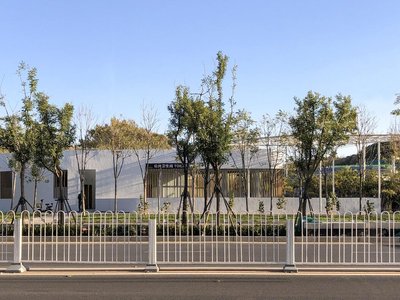
Four Public Pavilions in Beijing by Aurélien Chen and CSCEC
Four park pavilions in Beijing combine public services with floating roofs, acting as subtle urban signals integrated into landscape contextually.
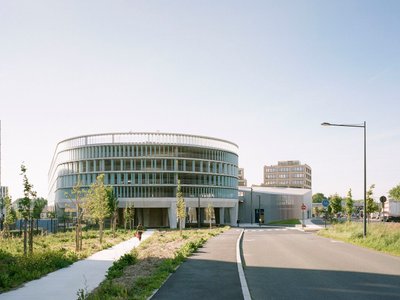
LÁ-SÁCH House by Atelier tho.A
Compact tropical tube house-library with polycarbonate louvers, flexible interiors, concrete core, crafted materials, and community-focused alley setback.
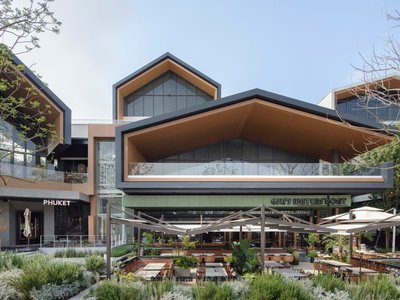
Luxelakes Tianfu Food Island Phase II: A Contemporary Lakeside Commercial Hub in Chengdu
Lakeside commercial complex in Chengdu featuring cascading terraces, sloped roofs, and public waterfront spaces, blending restaurants, retail, and community interaction.


Explore Architecture Competitions
Discover active competitions in this discipline




The International Standard for Design Portfolios


The Global Benchmark for Architecture Dissertation Awards


The Global Benchmark for Graduation Excellence


Challenge to reimagine the Iron Throne
Comments (0)
Please login or sign up to add comments
No comments yet. Be the first to comment!