
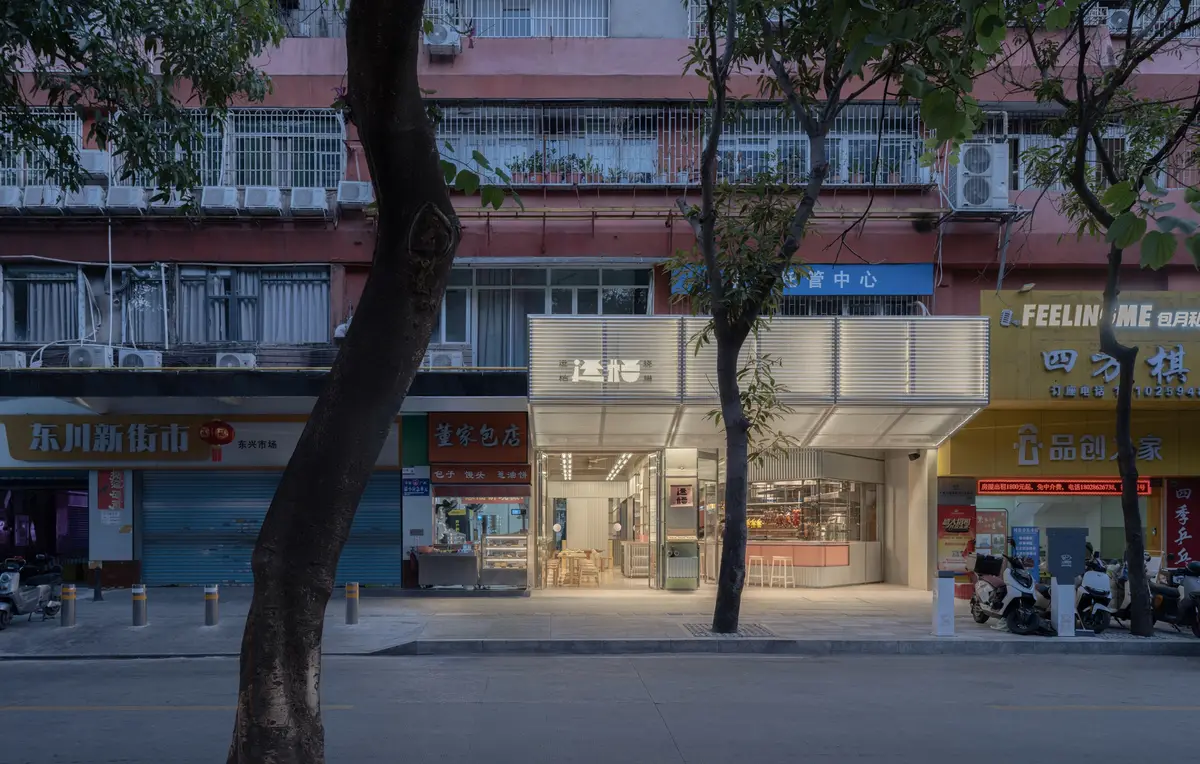
LUKSTUDIO Wraps a Guangzhou Roast Meat Restaurant in Corrugated Metal and Cantonese Memory
A 103-square-meter siu mei restaurant in Guangzhou pairs industrial cladding with warm interiors rooted in everyday Cantonese food culture.


Siu mei, the lacquered roast meats that hang in shop windows across southern China, are less a delicacy than a fact of life. They belong to the sidewalk, to the fluorescent glow of a corner takeout, to the steam and clatter of lunch hour. When LUKSTUDIO, led by Christina Luk, took on the Yunju Roast Meat Restaurant in Guangzhou, the studio had to reconcile that street-level familiarity with a dining experience that could hold its own as a sit-down destination. The result, completed in 2026, is a compact 103-square-meter space that refuses to pretend it is anything other than a neighborhood joint, but one that has been designed with a precision usually reserved for projects ten times its size.
What makes the project worth studying is how directly it addresses the tension between display and dining. A siu mei shop is defined by its window: the row of glistening ducks, the char siu sliced to order. LUKSTUDIO keeps that spectacle front and center while building a material world around it that feels cohesive without being slick. Corrugated metal, exposed brick, terrazzo, blonde plywood: these are ordinary ingredients, but their assembly here is anything but casual.
A Canopy That Claims the Sidewalk
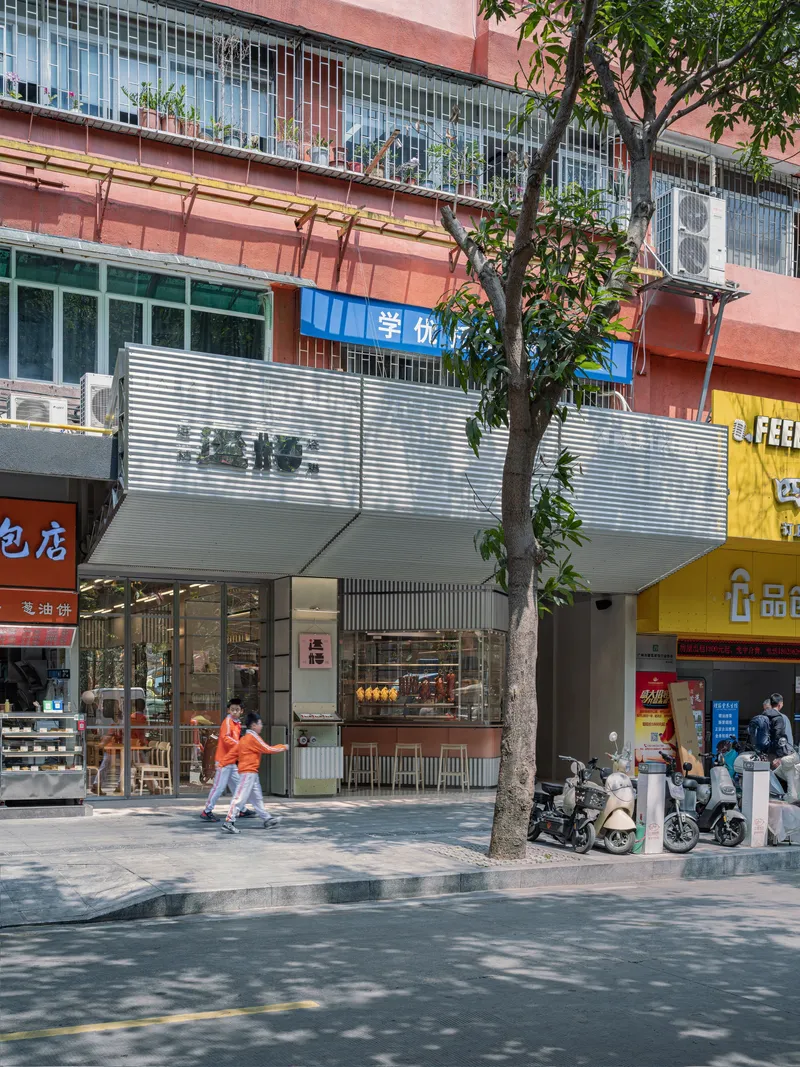

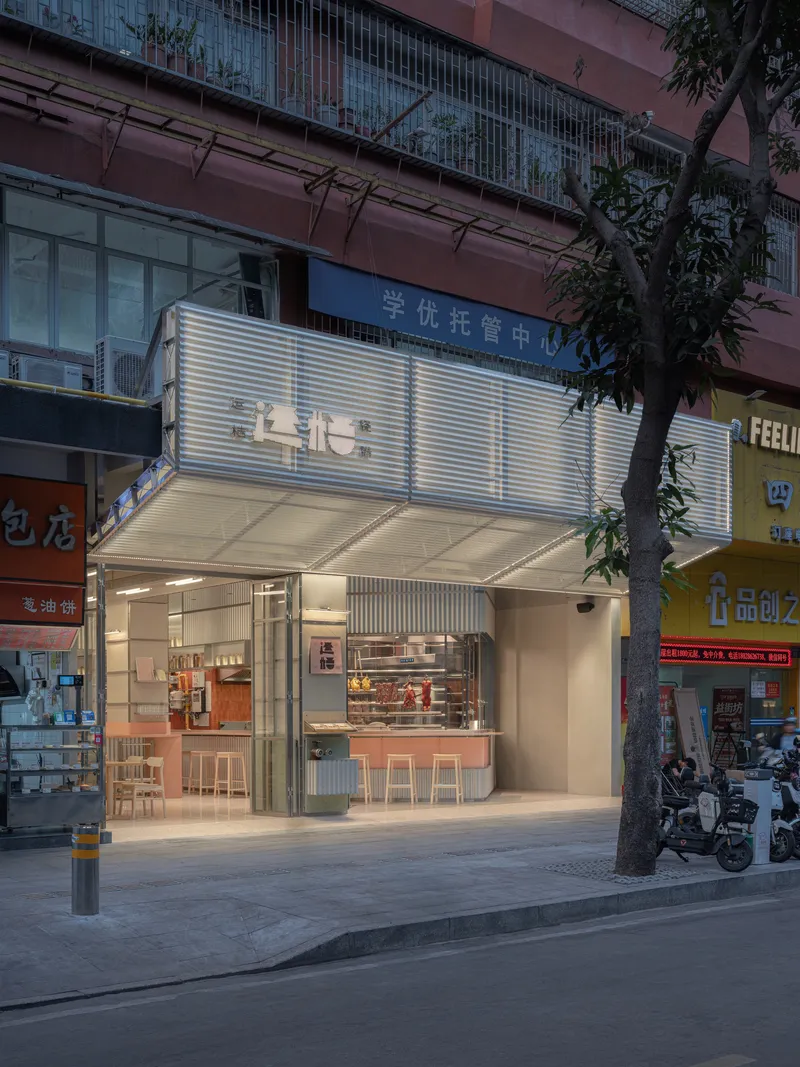
The restaurant's relationship with the street is established before you cross the threshold. A cantilevered corrugated metal canopy extends over the pavement, creating a sheltered zone where customers gather, queue, and eat. At dusk, the storefront glows behind mature trees, and the horizontal metal cladding catches the last light in a way that makes the whole facade read as a single lantern. It is a smart move: in a dense Guangzhou streetscape, the canopy turns dead sidewalk into activated frontage without requiring a single extra square meter of leasable floor area.
The canopy is not decorative. It signals utility, a shelter for the half-inside, half-outside rhythm that defines how Cantonese roast meat is actually consumed. Many customers want takeout, not a table. The design accommodates both modes without privileging one over the other.
Corrugated Metal as Character


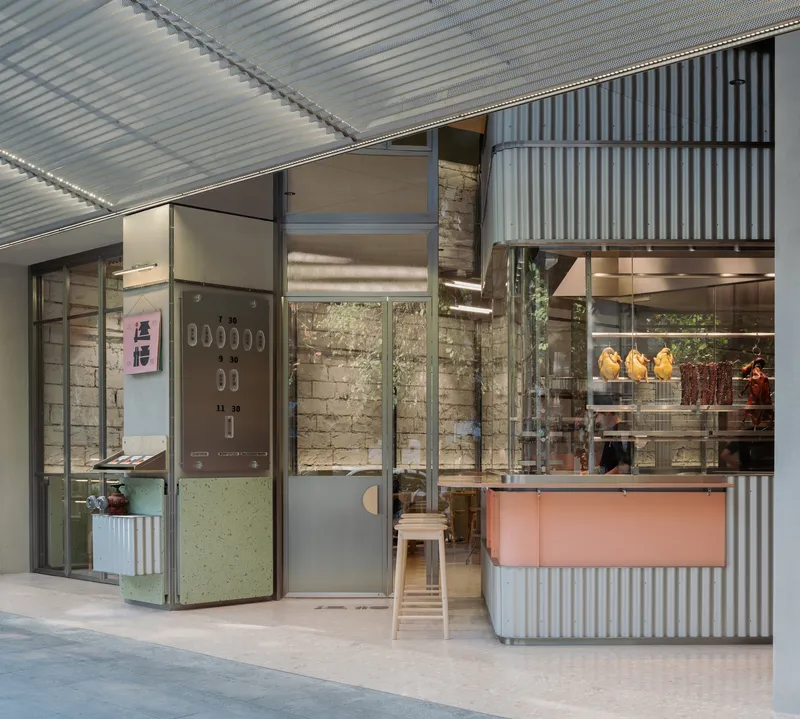
Corrugated metal does a lot of work here. On the ceiling, panels span between steel bracing in a composition that reads as raw but deliberate, the structural connections left visible so you understand how the system holds together. On the facade, perforated panels throw diagonal shadow patterns that shift through the afternoon, adding a temporal dimension to what could have been a flat surface. The material is cheap, ubiquitous in Guangzhou's industrial periphery, but LUKSTUDIO treats it with the same care a different firm might lavish on stone or timber.
The entrance detail is particularly well resolved. A pale green folding door sits against exposed brick with the corrugated cladding wrapping overhead, a collision of textures that works because each element has a clear tectonic role. Nothing is applied as veneer; everything is doing something.
The Display Window and Dining Room
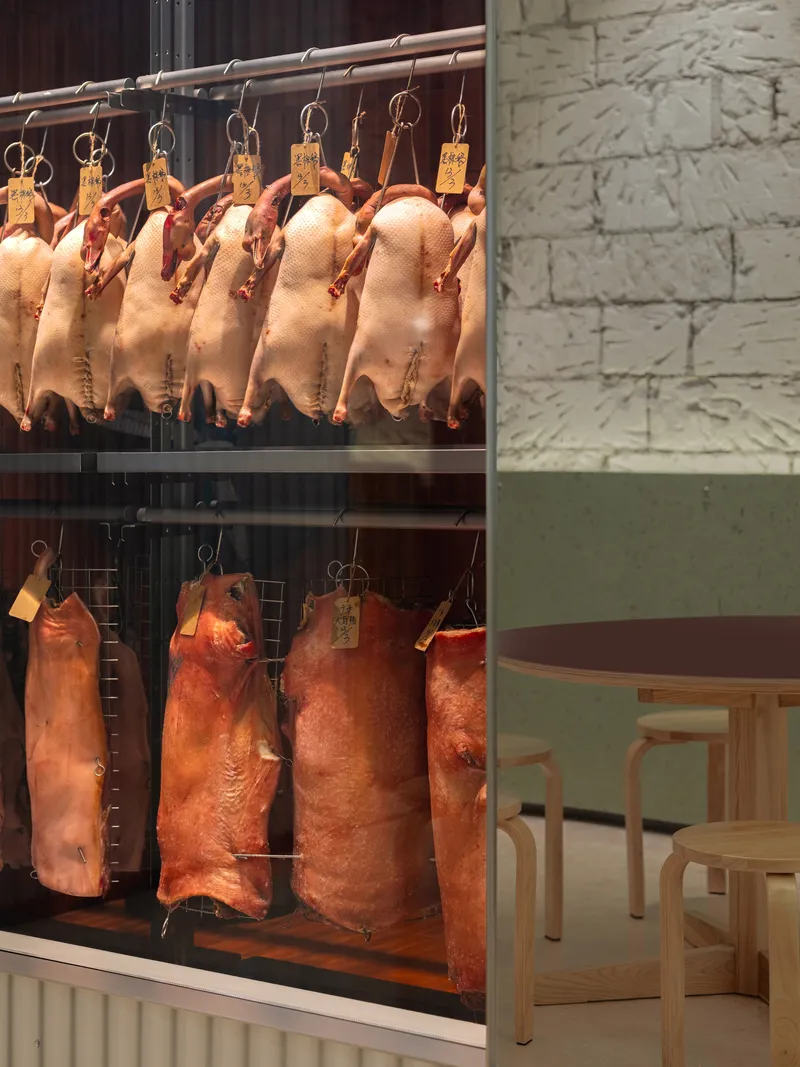
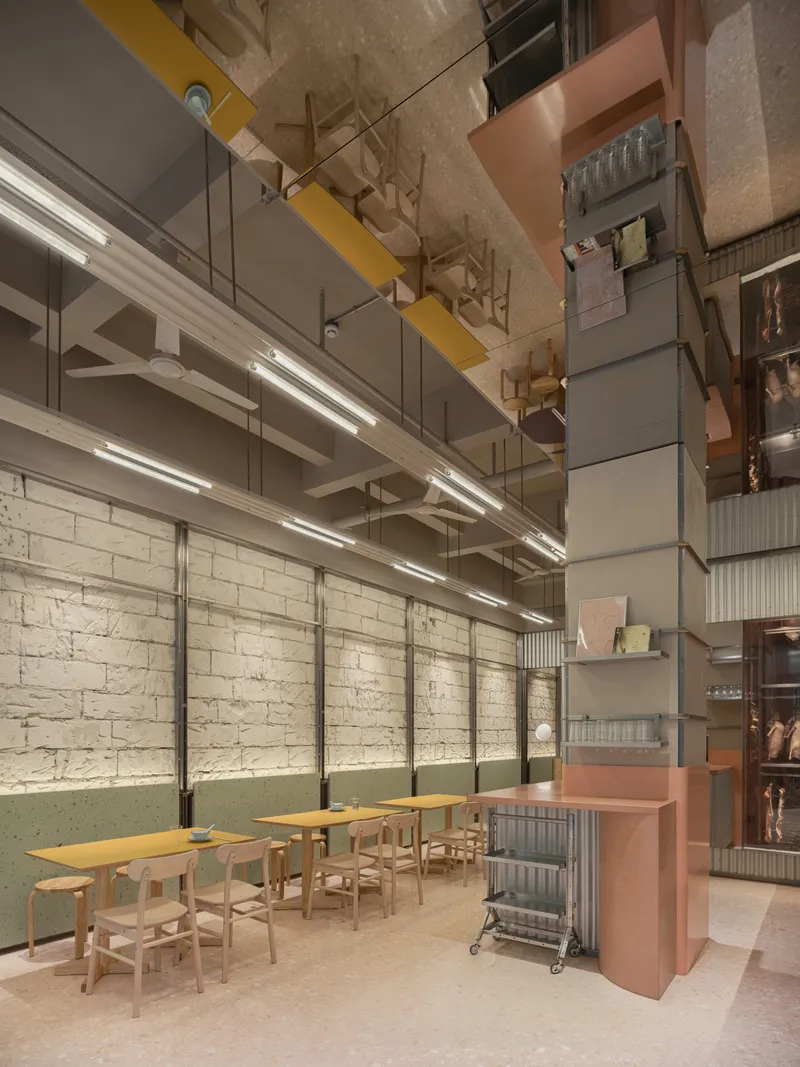

The display window with hanging roasted meats is the emotional core of the restaurant, and LUKSTUDIO wisely positions it adjacent to the primary seating area rather than isolating it behind glass. Diners sit next to the spectacle. Light wood furniture keeps the palette warm, and a painted brick wall behind provides a textured backdrop that stops the room from feeling like a showroom. Suspended linear lighting runs the length of the dining area, casting even illumination that avoids the harshness typical of fast-casual restaurants.
Through the steel-framed folding doors, the interior unfolds as a sequence of modest but well-proportioned spaces. The exposed timber ceiling adds warmth overhead, counterbalancing the industrial toughness of the metal and brick below. It is a room you could spend forty minutes in comfortably, which for a siu mei restaurant is not a given.
Material Joints and Honest Details

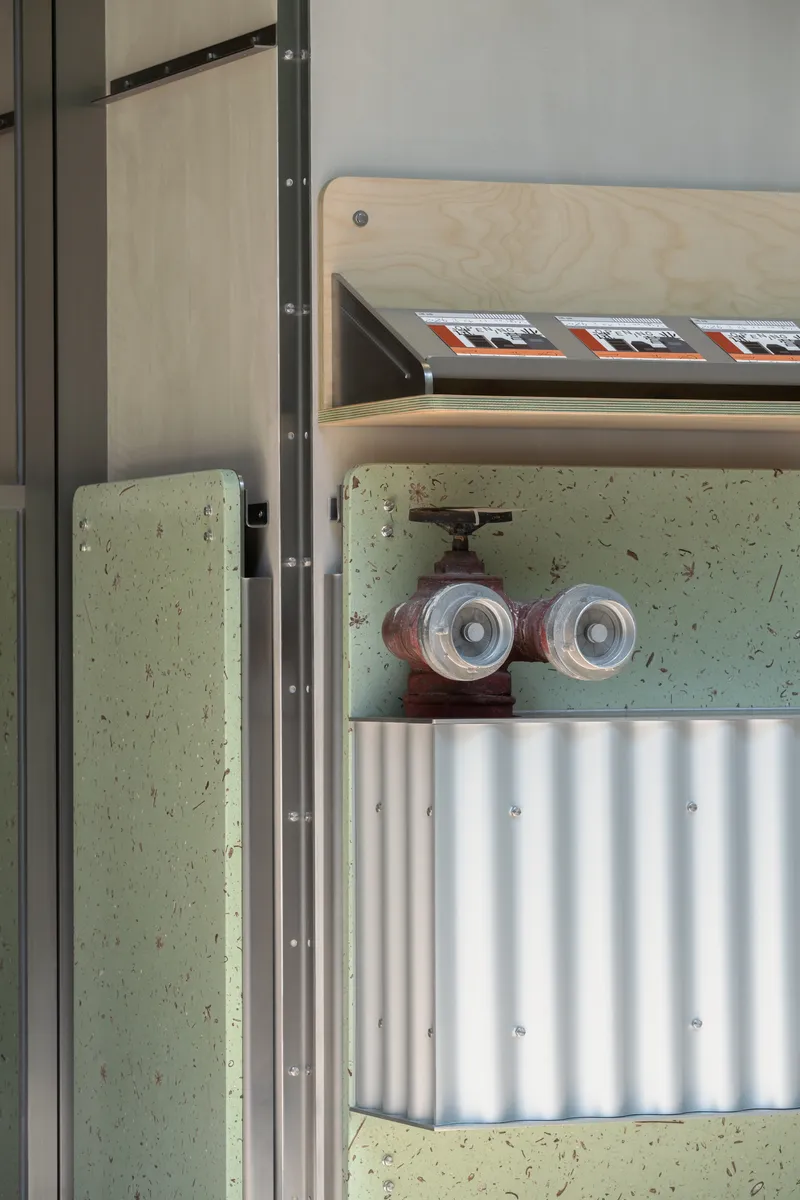

The close-up details tell you the most about how LUKSTUDIO thinks. A steel door frame meets terrazzo panels and concrete block with bolted connections that are visible, almost celebrated. Exposed water valves and pipes are mounted on a pale green terrazzo wall beneath a plywood shelf, not hidden but composed. These are not budget compromises dressed up as design decisions; they are genuine expressions of a construction logic that refuses to conceal its own assembly.
The plywood table surfaces, the white fluted wall panels, and the glass partitions form a secondary material family that softens the industrial palette without contradicting it. The terrazzo, tinted a gentle green that echoes the entrance doors, provides a chromatic thread that ties interior to exterior. It is restrained color work, the kind that registers subconsciously rather than announcing itself.
Storefront Graphics and Street Identity
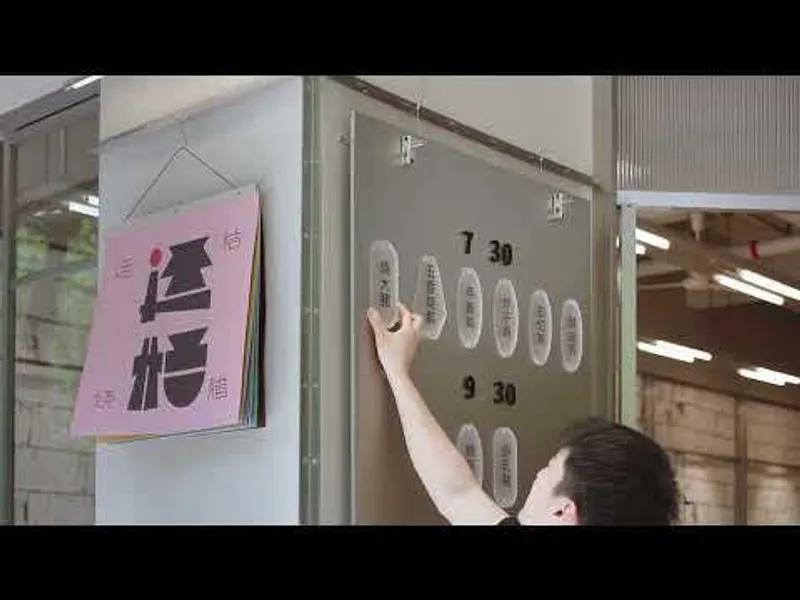

A hand adjusting circular signage elements on the glass storefront, beneath a pink poster, reveals a graphic identity that is playful and tactile. The signage system appears modular, something that can be rearranged or updated, which suits the informality of a roast meat shop that might rotate its specials daily. From the covered entrance, the corrugated canopy frames a view straight through to the tiled interior and service counter, giving passersby an unobstructed read of what the place is and what it offers. There is no mystique here, just clarity.
Plans and Drawings
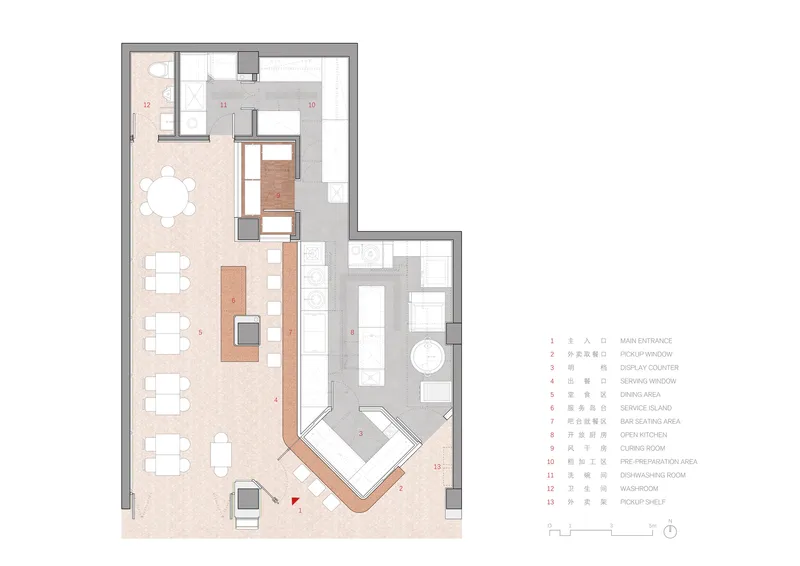
The floor plan reveals how much LUKSTUDIO extracted from 103 square meters. The dining area occupies the majority of the footprint, with the service core tucked efficiently to one side. An angled glazed corner opens the restaurant to its street intersection, maximizing visibility from two directions. The plan is compact but not cramped, with clear circulation routes that separate dine-in traffic from takeout customers. It is an economy of means that never feels stingy.
Why This Project Matters
Restaurant interiors are among the most disposable commissions in architecture. They are designed to trend, photographed to perform on social media, and gutted within five years. Yunju pushes back against that cycle by grounding its design in the material logic of its own construction and in the cultural logic of what it serves. Corrugated metal, exposed brick, and terrazzo are not trendy finishes here; they are the building itself, left legible. If the restaurant ages, it will age honestly.
More broadly, the project demonstrates that small-scale food architecture in China does not have to choose between the anonymous tile box of a traditional roast meat shop and the overproduced theatrics of a concept restaurant. LUKSTUDIO finds a third path: a space that respects the street life and culinary traditions of Cantonese siu mei while offering the kind of spatial generosity and material care that turns a meal into an experience worth remembering. At 103 square meters, that is no small feat.
Yunju Roast Meat Restaurant by LUKSTUDIO, lead architect Christina Luk. Guangzhou, China. 103 m². Completed 2026. Photography by ten visions studio.
About the Studio
Share Your Own Work on uni.xyz
If projects like this are the kind of work you want to make, uni.xyz is a place to publish your own, find collaborators, and enter design competitions.


Popular Articles
Popular articles from the community


Jaramillo Van Sluys Arquitectura and Urbanismo Turn a Demolished Registry Lot in Quito into an Orchard Plaza
In Quito's Centro Histórico, a 2,800 m² plaza exposes the San Agustín convent wall and redraws its lost Augustinian orchard in volcanic stone.

David Macias Steps a Doorless Stone and Plaster House Down a Tropical Colombian Hillside
In the humid hills of Colombia, Threshold House replaces the front door with an open void and terraces its 850 m² down the slope instead of fighting it.

David Ortega Stacks a Two-Story Mexico City Penthouse Around a Steel Stair and a Pergola-Shaded Roof Terrace
In Colonia Roma, a 300 m² penthouse uses oak joinery, a planted steel stair and a slatted roof pergola to make a new-build apartment feel like a house.

LT2A and OPEN Architectes Thread a Brick and Glass High School Through a Wooded Belgian Campus
In Braine-l'Alleud, a 3,000 m² wing for Collège Cardinal Mercier pairs pale brick with a glazed colonnade, deferring to a small chapel and a dense wood.

Similar Reads
You might also enjoy these articles


LAVA Architecten Gives Vocational Education a Sawtooth-Roofed Face on a Mechelen School Campus
In Mechelen, Belgium, a 2,053 m² STEM school on a 6×6 m grid turns workshops and classrooms into rooms that can be rearranged as teaching changes.

KEMA Studio Turns a Derelict Marvila Attic into a 60 m² Lighthouse Apartment Above Lisbon
In Lisbon's Marvila district, a rebuilt roof, four skylights and two plywood volumes turn an unlivable attic into a bright home facing the Tagus.

Pixel Gardens: One Repeated Module Stacked Into a Terraced Social Housing Tower for Famagusta
Salem Bader's shortlisted housing tower builds a vertical neighbourhood from one repeated module, offsetting units to carve terraces, light and air.

Bao Huynh Watercolor Atelier: A Serene Art Retreat in Hội An
Bao Huynh Watercolor Atelier in Hội An blends multifunctional art spaces, sustainable design, local materials, and family-friendly living in a serene environment.

Comments (0)
Please login or sign up to add comments
No comments yet. Be the first to comment!