
LUO Studio's Shell Book Pavilion Opens and Closes Like a Clam on a Beijing Plaza
A 43-square-meter kinetic aluminum shell in Shunyi District transforms from sealed pod to open-air library in seconds.


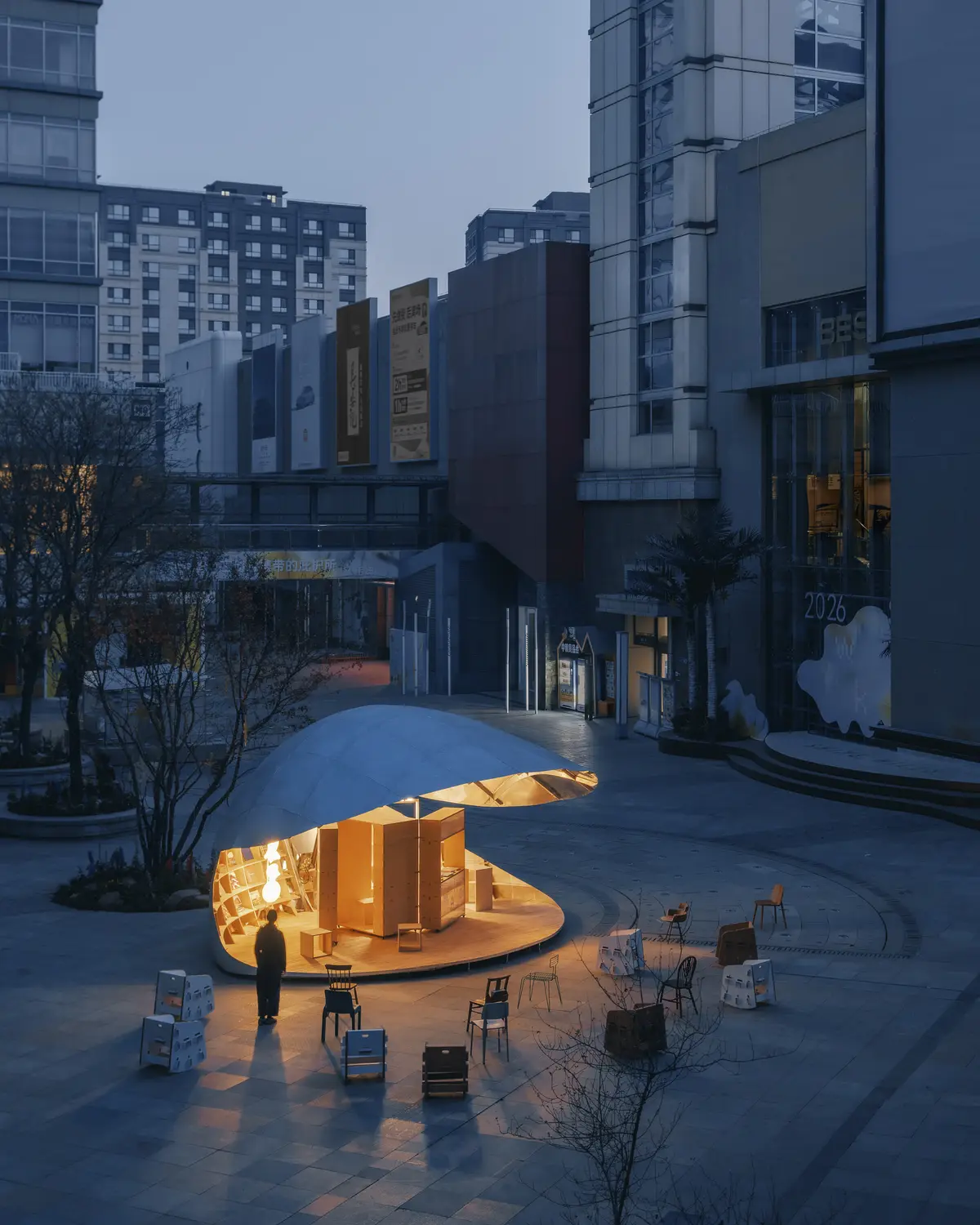
A building that breathes. That is the simplest way to describe what LUO studio has placed on the Fountain Plaza in Xiangyun Town, a commercial district in Beijing's Shunyi District. The Shell Book Pavilion is a 43-square-meter community library, reading room, and gathering space whose aerospace-grade aluminum shell can lift vertically to create a broad canopy or settle back down into a sealed, quiet volume. The mechanism is not a gimmick. It redefines the pavilion's relationship to its plaza every time it moves, shifting between states of enclosure and exposure that give a tiny building a disproportionately large civic presence.
What makes the project genuinely interesting is how it refuses to commit to a single architectural posture. Fully open, half open, partially closed, nearly closed, fully shut: each configuration produces a distinct spatial experience, from shaded outdoor room to intimate reading nook. The shell has no front or back, inviting approach from every direction. And because movable seating pieces scatter across the surrounding plaza, the pavilion's social footprint extends well beyond its structural boundary. During events, the mechanical transformation becomes performative. A speaker can begin enclosed and be revealed as the roof ascends, turning the act of opening a building into ceremony.
A Kinetic Shell in the Public Realm
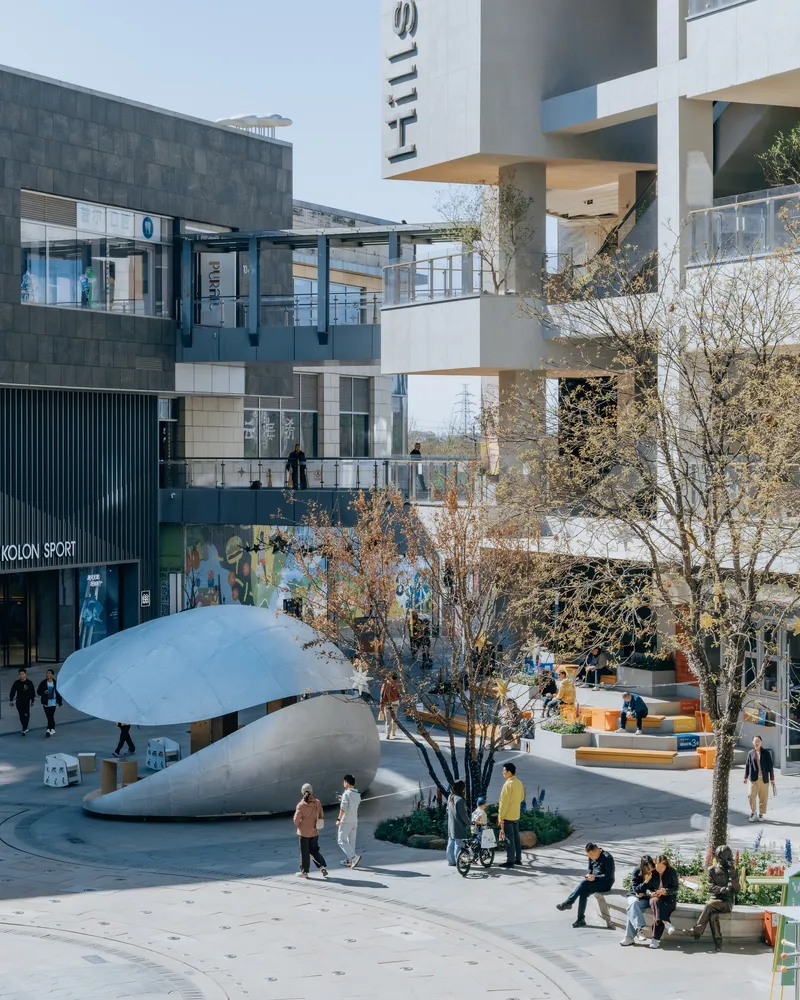
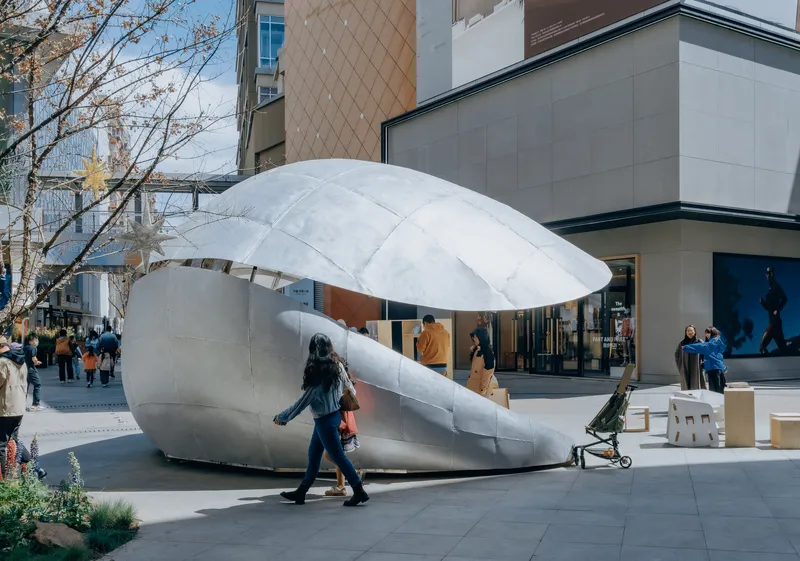
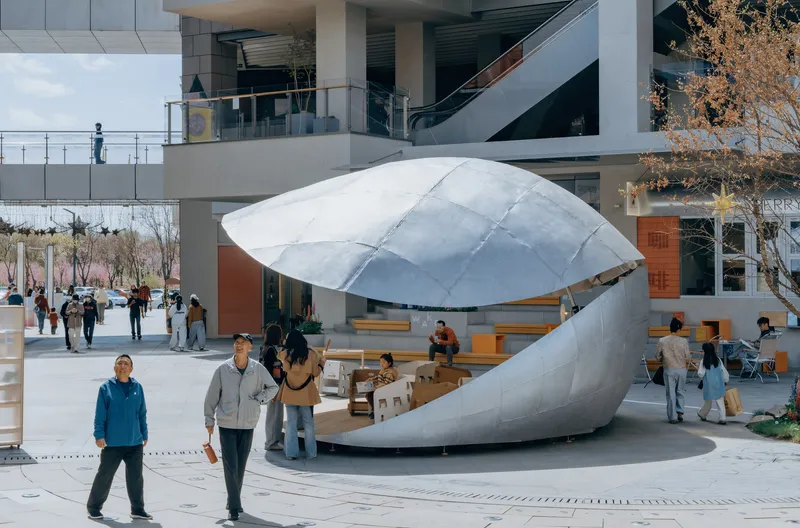
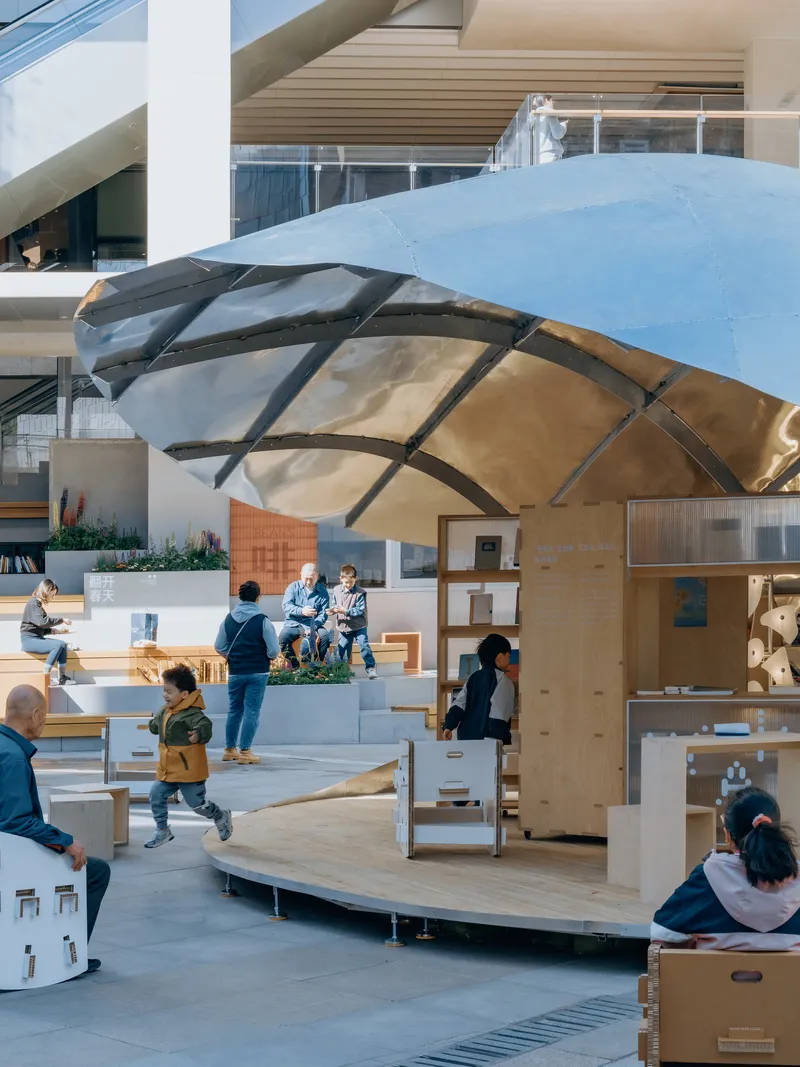
Placed among bare autumn trees, pedestrian flows, and the glass facades of surrounding commercial buildings, the pavilion reads as a strange organism that has landed on the paved plaza. Its white shell profile is immediately legible as a clam or bivalve, a form that communicates its operating logic before anyone explains it. The grey base anchors the structure while the curving canopy floats above, and the contrast between the two halves telegraphs movement even when the shell is at rest.
Context matters here. Xiangyun Town already had a culture of art installations and was open to children and community life. LUO studio did not have to argue for a playful building; they had to deliver one that could withstand daily use on a plaza whose surface had variations in level that needed correction before the moving structure could operate accurately. The pavilion is not a gallery piece. It is infrastructure for gathering.
Aluminum Engineering, Twenty-Day Build
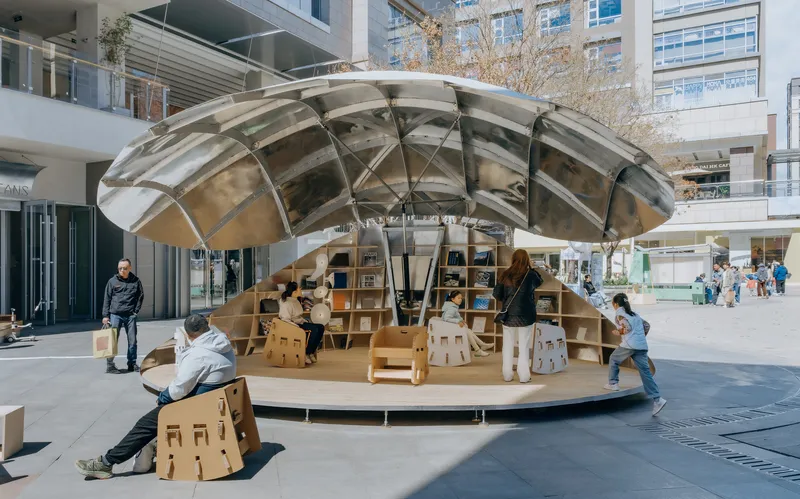

The choice of aerospace-grade aluminum alloy for the primary structural frame was driven by a practical constraint: the shell needs to lift. Weight matters when you are moving an entire roof on a bearing-supported mechanism. Aluminum gave LUO studio the strength-to-weight ratio necessary for efficient movement without sacrificing structural durability. CNC machining, forging, lathe work, and welding were all employed to fabricate the ribbed frame, and the entire construction was completed within a compressed timeline of roughly twenty days, with installation taking place during nighttime hours.
The exposed metal ribs beneath the canopy are both structural and aesthetic. They radiate outward from the shell's crown, giving the underside a skeletal clarity that makes the engineering legible. You can see how the building works, which is part of its appeal in a public setting where children are expected to be curious.
Timber Interior and Tiered Seating
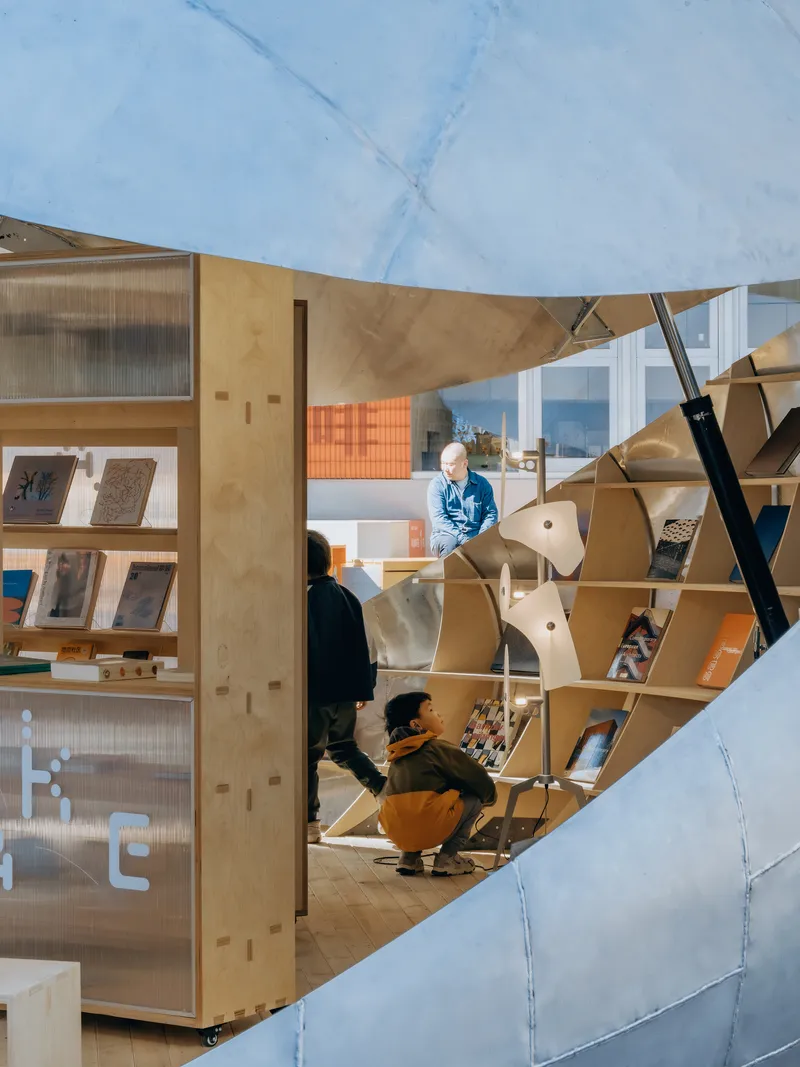

Inside, the aluminum gives way to timber. Plywood shelving lines the interior and stepped platforms create tiered seating that accommodates readers, browsers, and children who simply want to sit. The material shift from cold metal outside to warm wood inside is deliberate, creating a sensory threshold that marks the transition from plaza to library. Interior height ranges from 2.5 meters to 4.2 meters depending on position, so the space compresses and expands as you move through it.
The shelving is not token. It is deep, organized, and occupies enough surface area to function as an actual lending collection. Combined with the movable seating, the interior can reconfigure for reading groups, storytelling sessions, or informal lectures. When the canopy lowers, the compressed volume produces a quieter, more sheltered atmosphere; when it rises, the reading room becomes an open-air pavilion with a broad shading canopy spanning approximately 8 meters by 6 meters.
Cardboard Furniture and the Extended Footprint
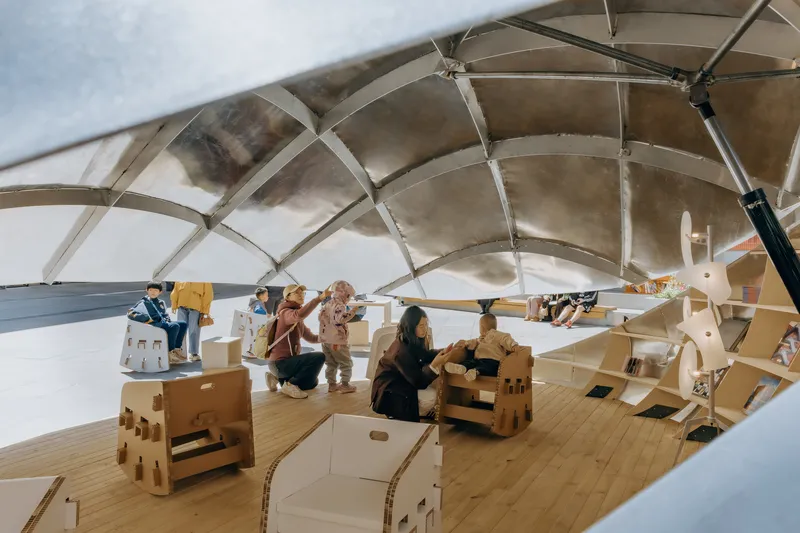
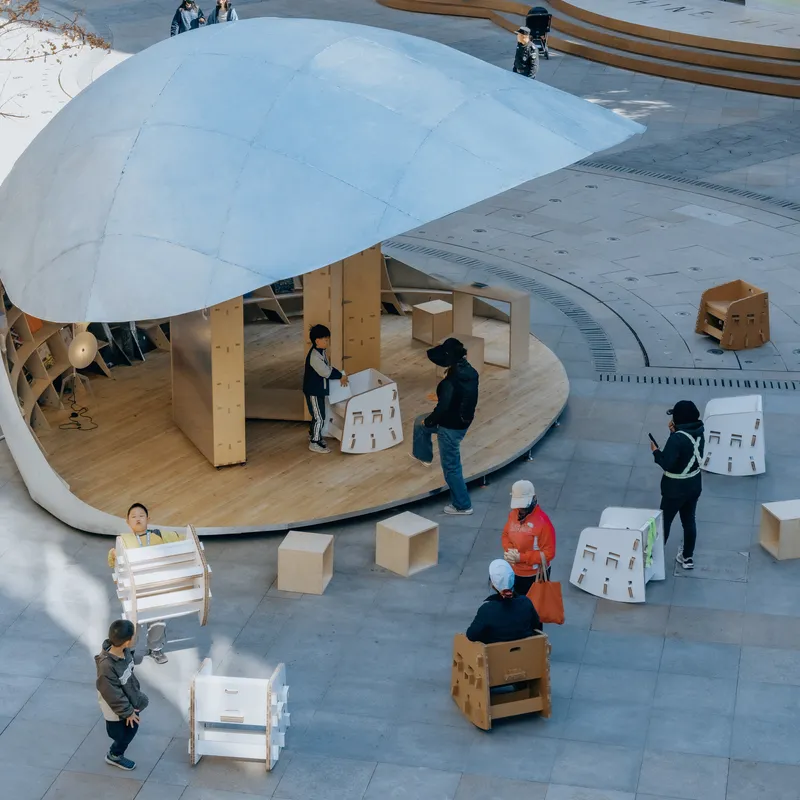

One of the project's smarter moves is the deployment of lightweight, modular cardboard furniture pieces that spill across the surrounding plaza. White cardboard stools and assembled structures extend the pavilion's influence far beyond the shell's physical edge, turning a 43-square-meter building into a much larger social territory. Children assemble and rearrange the pieces, treating the furniture itself as a kind of play system. The boundary between building and plaza dissolves.
The cardboard pieces also serve as a democratic gesture. They are cheap, replaceable, and kid-scaled, which signals that the pavilion belongs to everyone. There is no preciousness here, no velvet rope. The architecture invites rough handling, and the furniture program reinforces that invitation.
After Dark
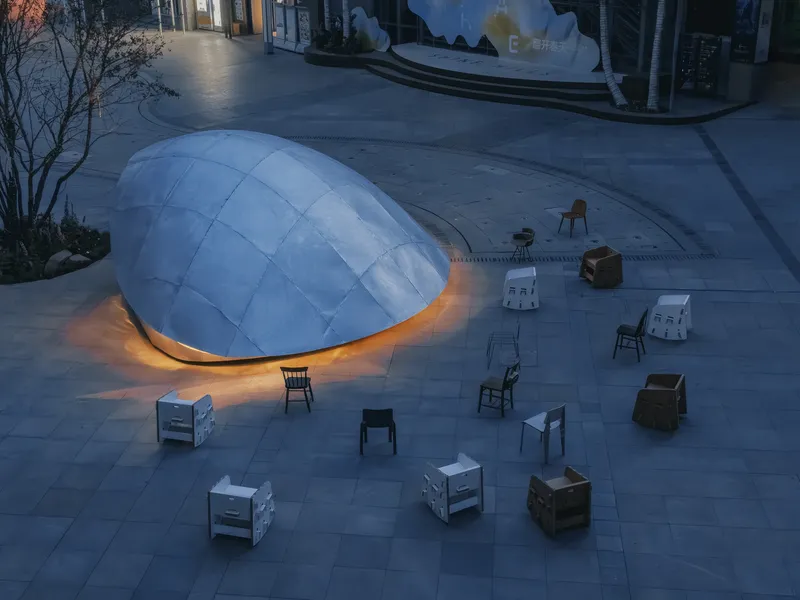
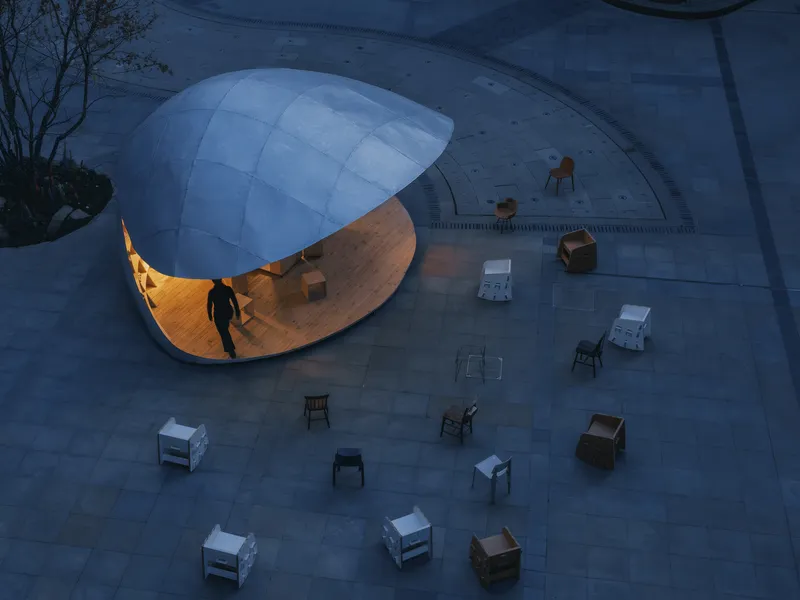
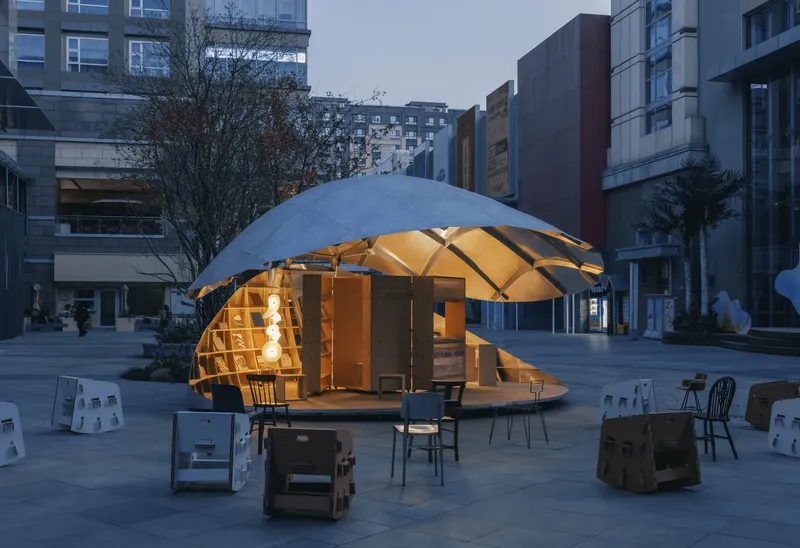
At dusk, the pavilion transforms again. Interior lighting turns the translucent shell into a glowing lantern on the plaza, and the scattered furniture takes on a theatrical quality under artificial light. The aerial views at night reveal the full extent of the social footprint: chairs, stools, and clusters of people radiating outward from the illuminated pod. Against the backdrop of residential towers, the pavilion becomes a civic hearth, a warm point of orientation in the commercial district.
The nighttime presence also reinforces the pavilion's role as an event space. The performative quality of the opening mechanism gains dramatic weight after dark, when the ascending shell catches light and shadow in ways that the daytime configuration cannot replicate.
Family Scale
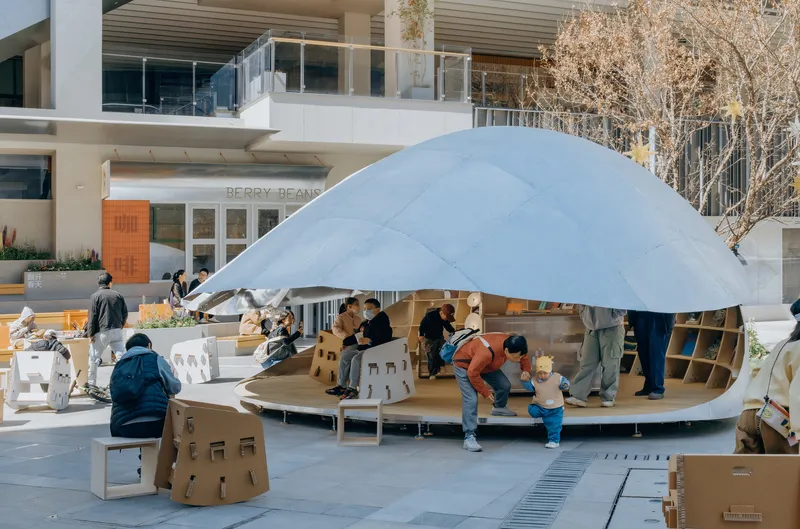

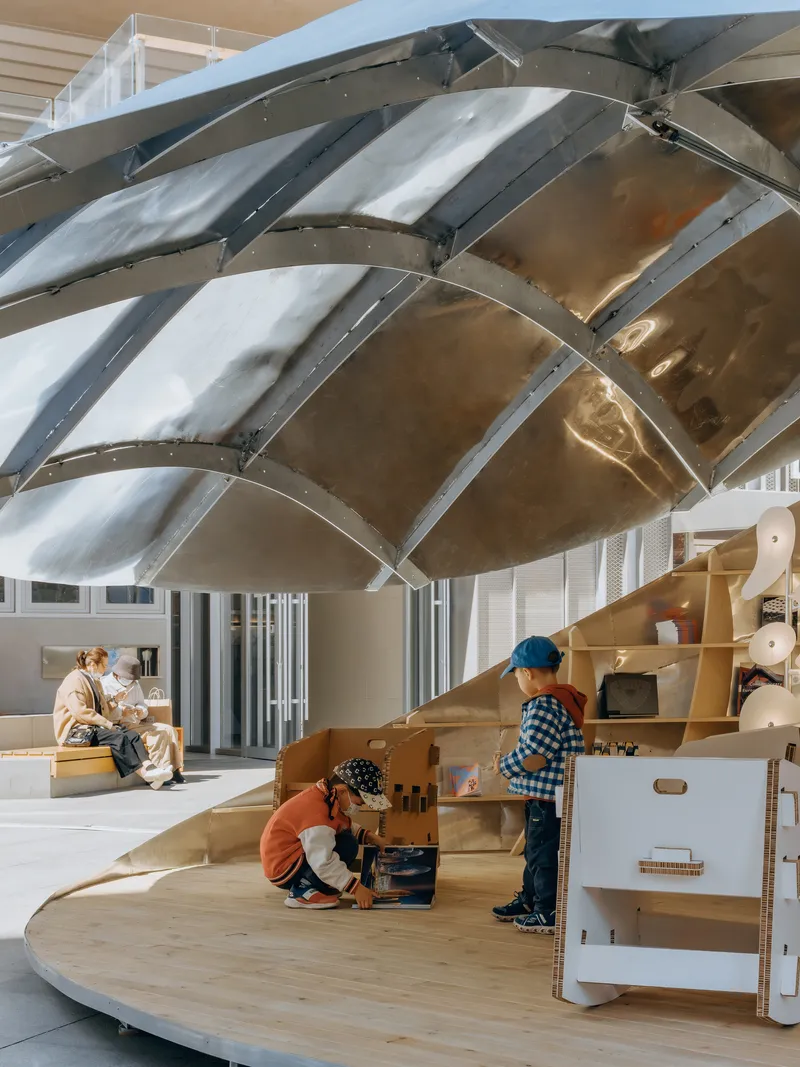
The photographs consistently show families with young children occupying the pavilion, and this is clearly the intended audience. The timber deck, the low shelving, the stepped seating, and the modular cardboard toys all calibrate toward a child's scale without being condescending. Adults fit comfortably, but the spatial proportions reward small bodies. LUO studio understood that a community library in a commercial district needs to serve the people who actually have time to linger during the day: parents with children.
Plans and Drawings
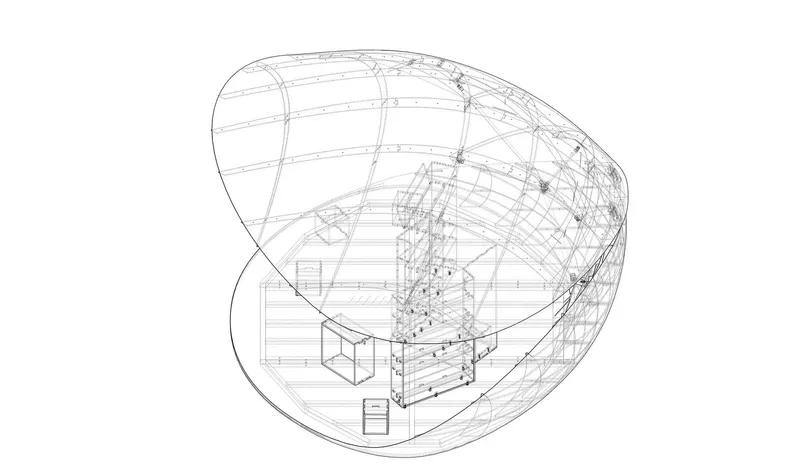
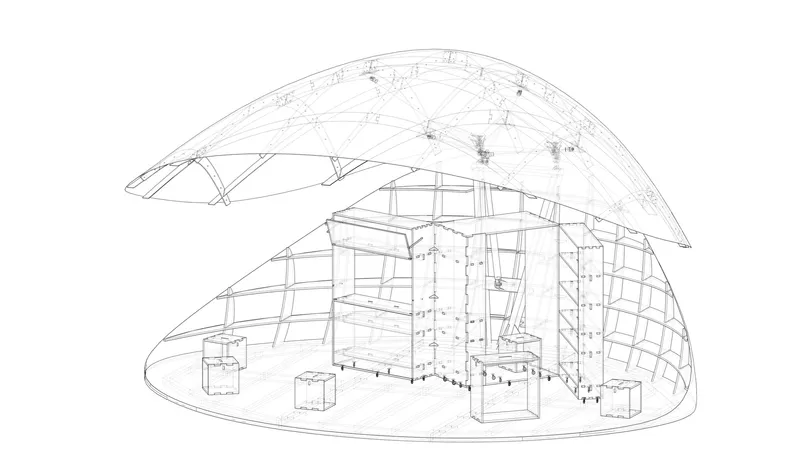
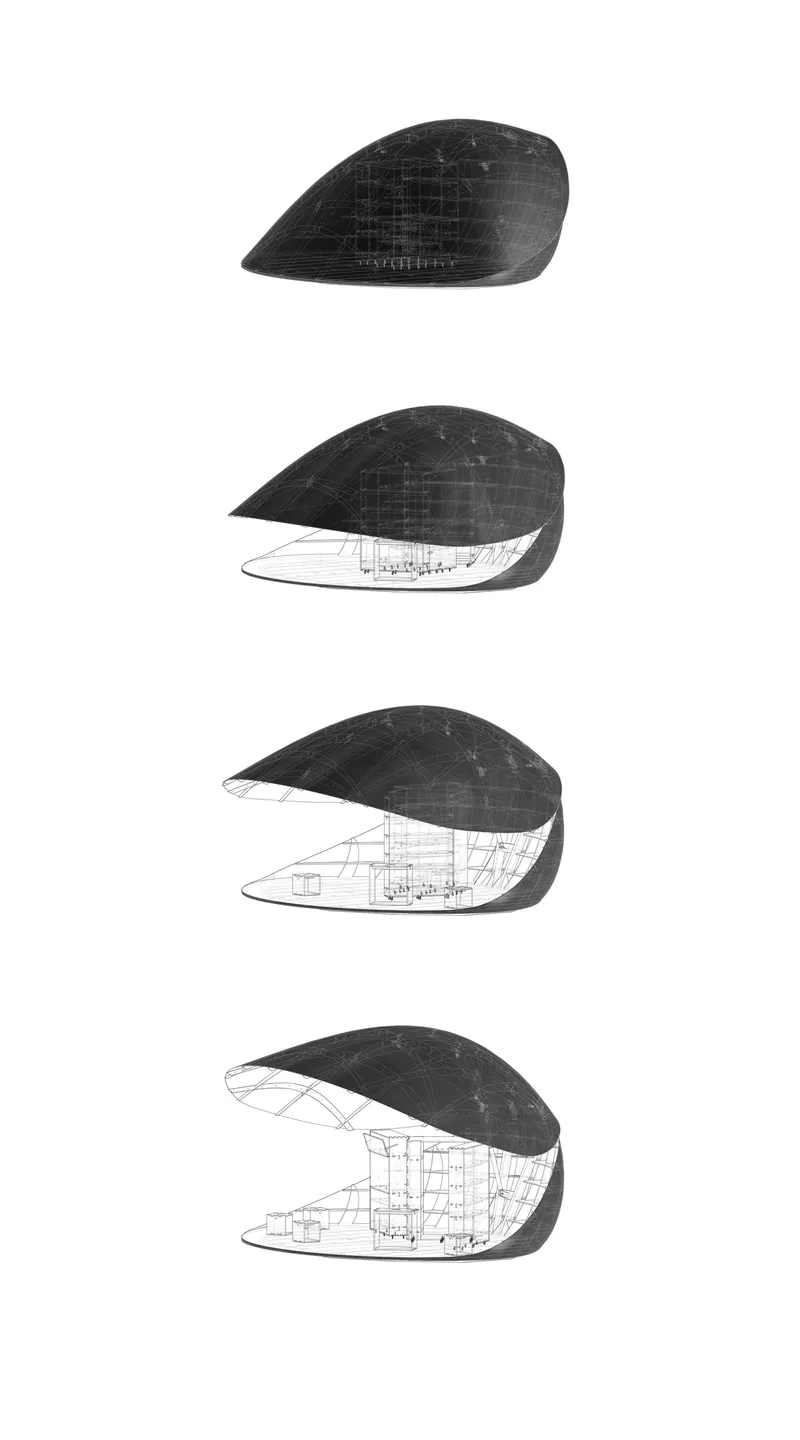
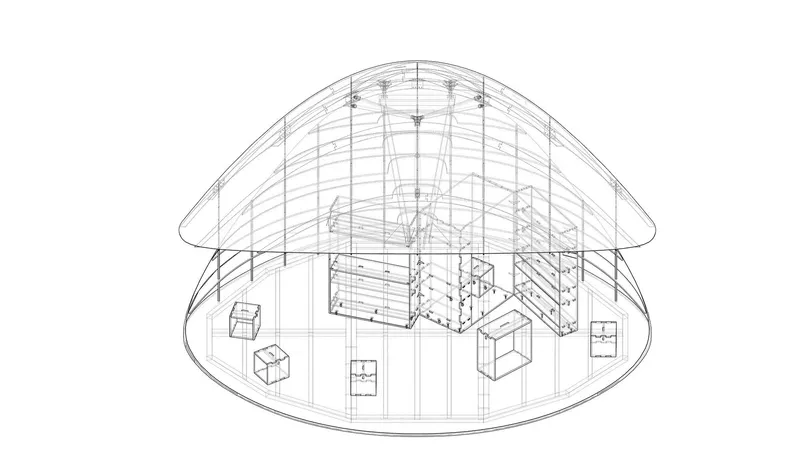

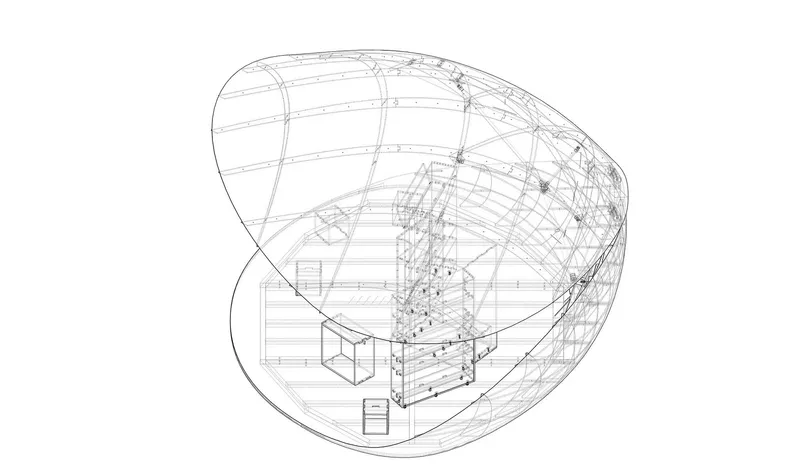
The axonometric and section drawings reveal the layered logic of the design. The exploded axonometric separates the domed roof structure from the interior volumes and furniture layout, making clear how few components produce how much spatial variety. The sequential sections show the progressive layering of the curved shell above the interior arrangement, illustrating how different degrees of opening alter the interior's character. A central stair tower anchors the geometry while perimeter furniture pieces occupy the shell's curved edges.
What the drawings communicate most effectively is the project's economy. This is not a complex plan. It is a simple geometric idea executed with precision fabrication, and the drawings show exactly where the budget went: into the shell mechanism and into the quality of the timber interior. Everything else is restrained.
Why This Project Matters
Kinetic architecture has a long history of promising more than it delivers. Moving parts break. Mechanisms seize. Maintenance budgets balloon. The Shell Book Pavilion is interesting precisely because it bets the entire project on a single kinetic gesture, the vertical lift of the shell, and makes that gesture legible, functional, and repeatable. The aluminum frame is engineered for durability, not spectacle. The timber interior does not depend on the mechanism to be useful. Even if the shell never moved again, you would still have a decent 43-square-meter library on a public plaza.
But when it does move, the building becomes something rarer: a piece of civic architecture that can perform. The act of opening and closing restructures the social space around it, inviting approach or signaling closure, creating shade or sealing shelter. In a discipline that often treats buildings as fixed propositions, LUO studio has produced a small structure with a genuinely variable relationship to its context. That the whole thing was built in twenty days and installed at night only adds to the sense that architecture, at its best, can be both rigorous and light on its feet.
Shell Book Pavilion by LUO studio. Located in Xiangyun Town, Shunyi District, Beijing, China. 43 m². Completed 2026. Photography by Yumeng Zhu.
About the Studio
Share Your Own Work on uni.xyz
If projects like this are the kind of work you want to make, uni.xyz is a place to publish your own, find collaborators, and enter design competitions.


Popular Articles
Popular articles from the community


Singing Woman: An Opera House That Performs Before the Curtain Rises
Ovidiu Cristian Pavel's conceptual opera house translates Estonia's choral identity into a sculpted waterfront landmark facing the Baltic Sea.

Extended Shell: Retrofitting Kolkata's Balconies as Living Urban Thresholds
A modular retrofit system recovers the social and environmental intelligence of Kolkata's historic verandas for contemporary Park Street residents.

Faces of the Soviet Avant-Garde: Turning Moscow's Street Names into an Open-Air Museum
A network of sculptural installations across a Moscow residential district transforms forgotten architect names into spatial encounters with cultural memor

Opera by the Sea Estonia: Three Shells Dissolving Architecture into Tallinn's Coastline
A winning opera house proposal replaces monumental form with interconnected shells that blur the boundary between building, park and Baltic Sea.

Similar Reads
You might also enjoy these articles

Pixel Gardens: One Repeated Module Stacked Into a Terraced Social Housing Tower for Famagusta
Salem Bader's shortlisted housing tower builds a vertical neighbourhood from one repeated module, offsetting units to carve terraces, light and air.

Bao Huynh Watercolor Atelier: A Serene Art Retreat in Hội An
Bao Huynh Watercolor Atelier in Hội An blends multifunctional art spaces, sustainable design, local materials, and family-friendly living in a serene environment.

Atelier Macri Concept Store Interior Design by CASE-REAL
Atelier Macri store features a "ko" counter, walnut wood details, cork displays, blending retail, gallery, and seamless customer experiences.

Manuel Vargas Izquierdo Stadium and High-Performance Sports Center: Architectural Excellence in Jalpa de Méndez
The Manuel Vargas Izquierdo Stadium blends sustainable design, inclusive sports facilities, and cultural-inspired architecture, revitalizing Jalpa de Méndez’s public spaces.

Explore Pavilion Competitions
Discover active competitions in this discipline

Challenge to design a portable theatre

Challenge to design a portable music platform

Challenge to design public laboratory

Challenge to design an open learning module for the elderly
Comments (0)
Please login or sign up to add comments
No comments yet. Be the first to comment!