
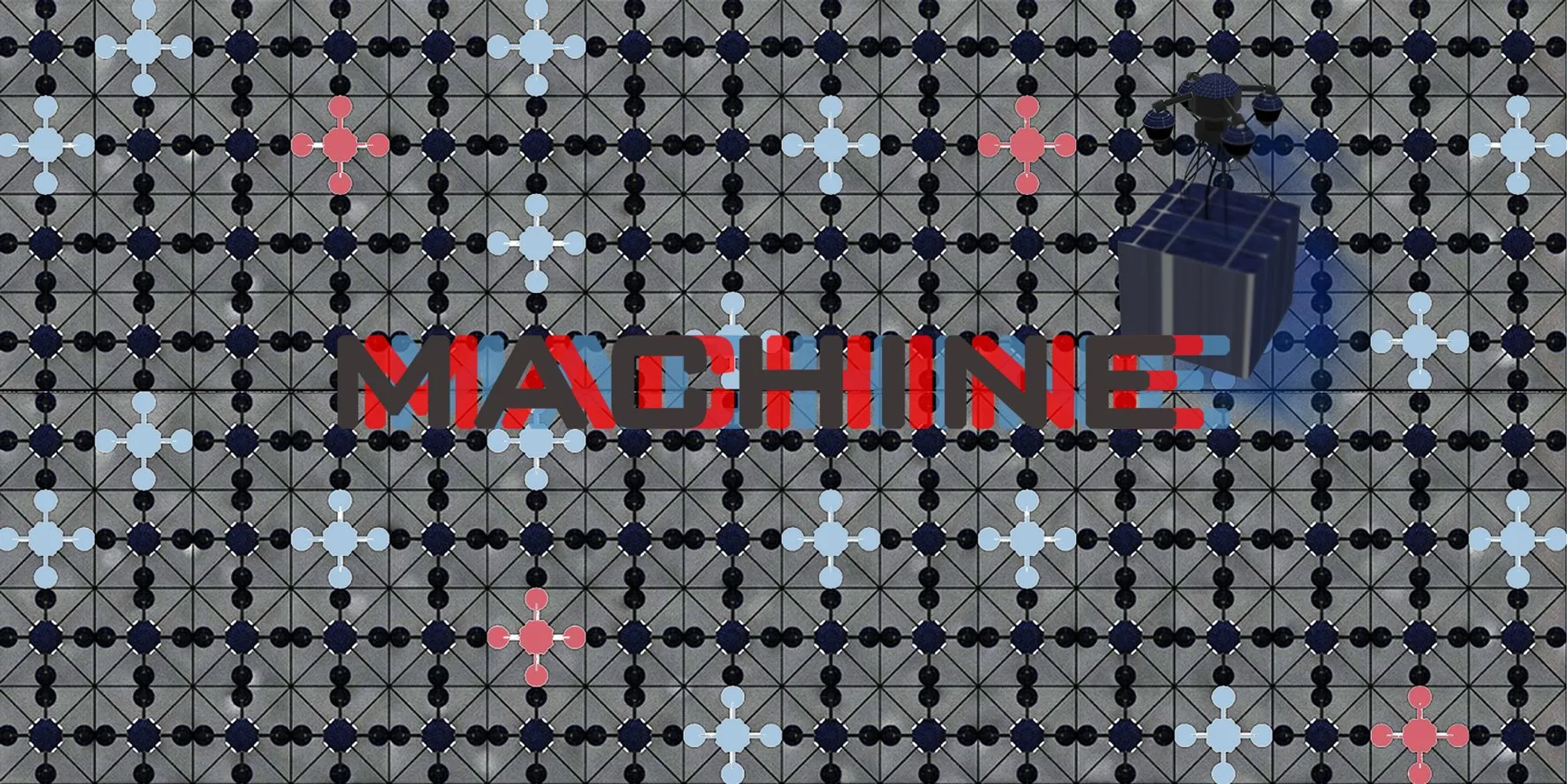
Machine: A 200-Floor Vertical Factory Where AI Becomes the Architecture
Andre Cifuentes imagines Seoul in 2050, where buildings operate as self-directing organisms serving AI systems, energy grids, and drone logistics.


What happens when the building no longer serves the people inside it, but serves the intelligence running it? Andre Cifuentes answers that question with a 200-floor vertical factory in Seoul that functions as a self-operating organism: assembling, storing, distributing, and repairing without waiting for human instruction. The structure's walls, floors, and platforms synchronize in real time with AI directives, making the entire tower a responsive machine rather than a static envelope. Drones launch from ports embedded in the facade. Energy is AI-optimized. The human role shrinks to orchestration and maintenance.
Titled Machine, the project is a shortlisted entry in the Breaking Work: Singularity competition on uni.xyz. Cifuentes sets his speculative scenario in 2050, when AI and robotics have entirely restructured the global workforce and coal remains the last fossil fuel, pushing artificial intelligence to accelerate photovoltaic deployment. The site is Seoul, South Korea, and the provocation is stark: buildings no longer serve people. They serve systems. People, in turn, serve the system by keeping it running.
Three Towers in Blue Twilight: The Facade as Logistics Interface
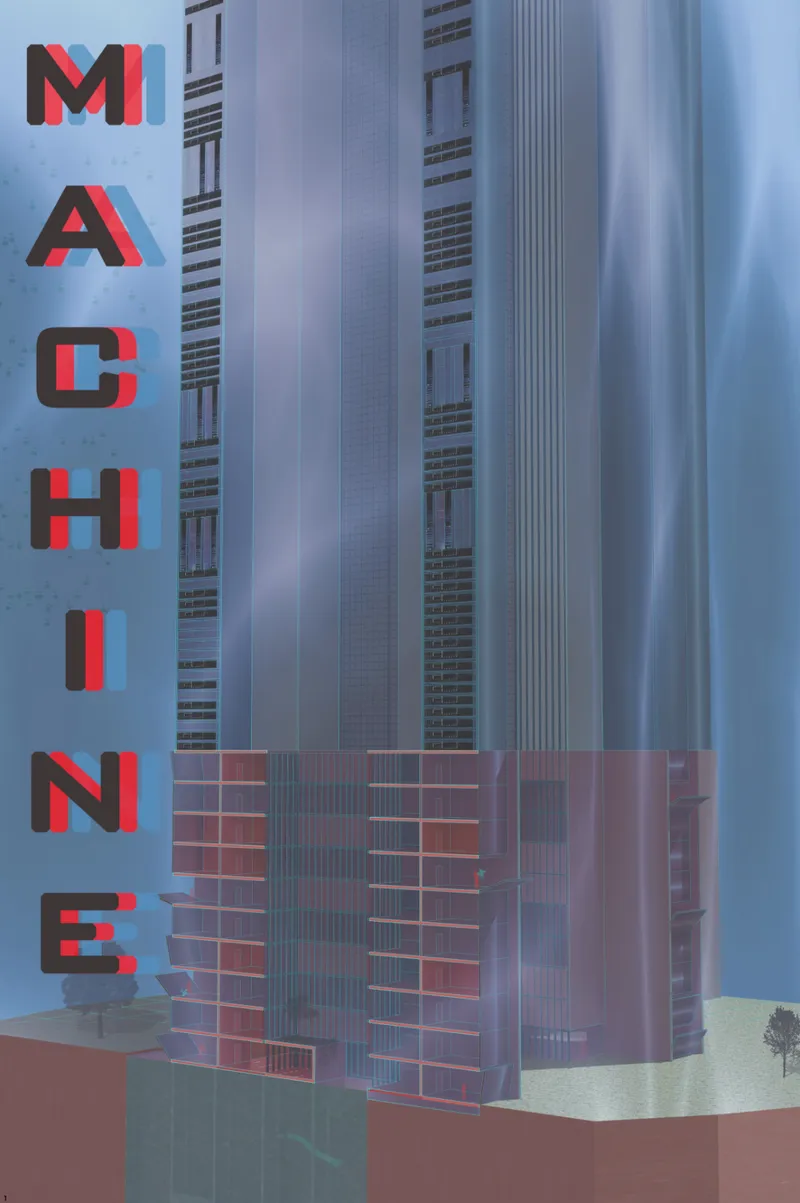
The opening rendering presents three slender towers rising into a blue twilight, their gridded facades hinting at the modular logic governing every surface. These are not decorative grids. Each cell in the facade doubles as a drone port, allowing units to detach, retrieve goods, and redock without disrupting the building's operations. The architectural skin ceases to be a boundary and becomes an intelligent interface capable of logistics, environmental response, and self-repair. In Cifuentes's vision, the envelope is the most active element of the structure.
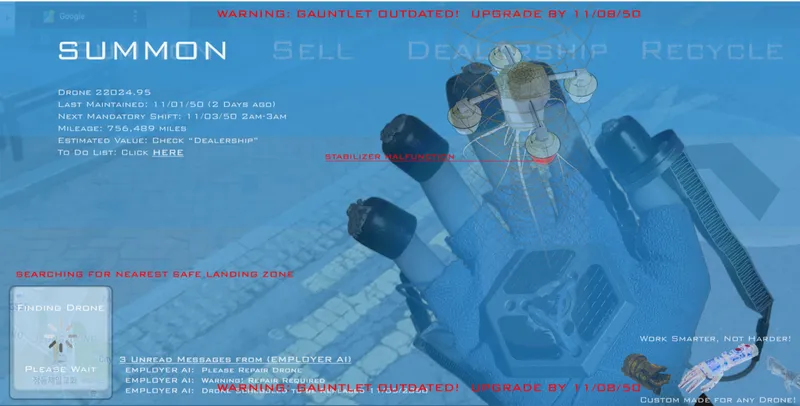
The human interface is equally radical. Workers interact with the building through personalized gauntlets that pair each user with their assigned machines. A digital illustration shows a figure immersed in a wireframe overlay: statuses, tasks, diagnostics, and drone summons all delivered in augmented reality by an AI employer. The relationship between body and building is mediated entirely through this device. Execution belongs to the machine; the person's job is to watch, interpret, and occasionally intervene.
Tapered Forms and Dispersing Pixels: Reading the Elevation
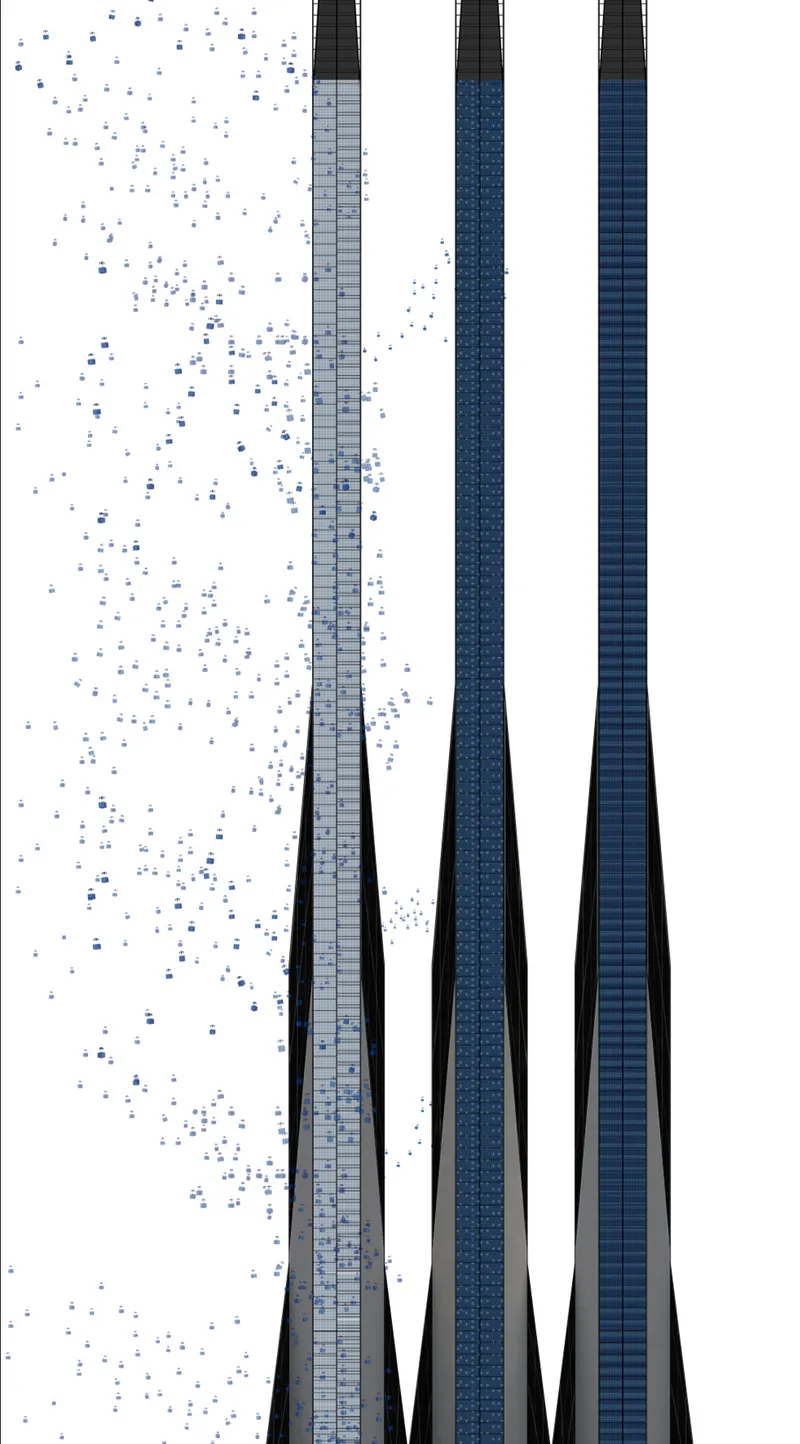
The elevation drawing strips the towers to their essential silhouette: three tapered volumes dissolving at their upper edges into dispersing pixel patterns. The graphic language is deliberate. Where a conventional tower terminates in a roofline or crown, Cifuentes's towers disintegrate into data, suggesting that the physical structure is inseparable from the information systems it hosts. The taper itself speaks to structural logic and energy distribution, narrowing as loads decrease and solar exposure increases toward the top. It is speculative, yes, but the drawing communicates a clear spatial argument: form follows algorithm.
Embedded Infrastructure: Delivery Nodes, Charging Towers, and Sensor Networks
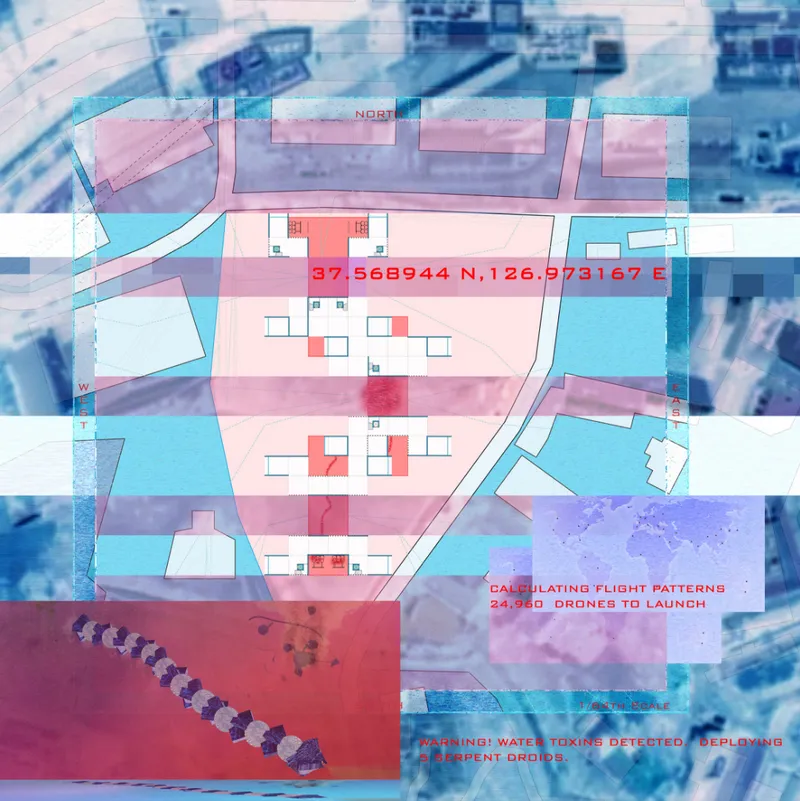
Zooming out to the urban scale, the site plan overlays building footprints and GPS coordinates onto an aerial photograph of Seoul. Logistics is not peripheral here; it is the urban plan. Delivery nodes, serpent-shaped charging towers for drones, and dedicated zones for production and maintenance are woven into the fabric surrounding the towers. Coded coordinates and sensor networks transform the precinct into a responsive urban machine. Cifuentes even accounts for environmental contingencies: threats like water pollution trigger the autonomous deployment of specific drone units, making the building a proactive agent rather than a passive structure.
Interior Conditions and the Multi-Phase Assembly Line
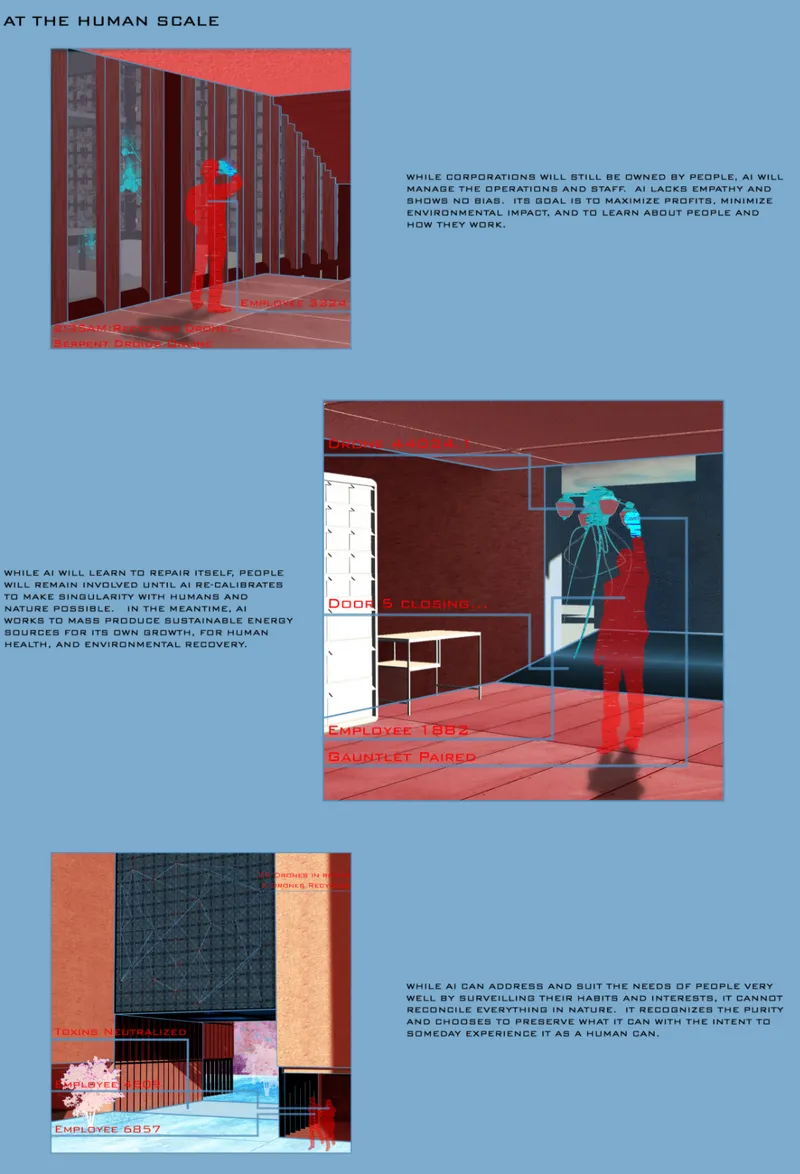
The final presentation board compiles interior and exterior renderings with text annotations, revealing how the 200 floors operate as a multi-phase assembly line. The building autonomously shifts between production, storage, and distribution modes, each floor reconfiguring according to real-time AI directives. The interior spaces shown are not rooms in any conventional sense; they are operational zones defined by task rather than occupancy. Platforms move, walls reposition, and the vertical factory hums through its cycles without pause. The annotations ground the speculation in systems thinking, mapping energy flows, material paths, and maintenance protocols across the section.
Why This Project Matters
Cifuentes does not soften the implications of his scenario. Machine posits a world where the boundary between architecture and artificial intelligence dissolves entirely, and the result is neither utopia nor dystopia but a new operational order. The project's strength lies in its refusal to treat AI integration as a feature bolted onto conventional design. Instead, AI is the spatial logic itself, dictating form, program, envelope, and urban strategy from the ground up. The timeline embedded in the project, tracing labor from pre-industrial manual work to AI-driven autonomy, gives the speculation historical grounding that many visionary projects lack.
For architects and designers grappling with automation's impact on the built environment, Machine offers a provocation worth sitting with. It asks whether the profession's anthropocentric assumptions hold up when the primary occupant is not a person but a system. The answer, in Cifuentes's telling, is that they do not, and the architecture that emerges from that admission is startling, coherent, and deeply uncomfortable in all the right ways.
View the Full Project
About the Designers
Designer: Andre Cifuentes
Enter a Design Competition on uni.xyz
uni.xyz runs architecture and design competitions year-round that reward proposals with spatial conviction and real site intelligence.
Project credits: Machine by Andre Cifuentes Breaking Work: Singularity (uni.xyz).



Popular Articles
Popular articles from the community


Play: Fragments of Their World
Familiar architecture becomes modular playground design, creating safe spaces where displaced children can learn, connect, imagine and play.

Conexión: Biophilic Design Reimagines High-Rise Living in Hong Kong
Conexión reimagines high-rise living in Hong Kong through biophilic design, green facades, shared spaces, daylight, water and nature within.

Co-life: Sustainable Architecture for Age-Friendly Community Living
Co-life reimagines sustainable architecture for seniors through courtyards, rammed earth, shared gardens, and spaces designed for belonging.

Hill & Cross Opera: Sculptural Opera House Architecture Shaped by Tallinn’s Landscape and Identity
Hill & Cross Opera reimagines opera house architecture in Tallinn through its sculptural hill, civic plaza, glass wave and a luminous cross.


Similar Reads
You might also enjoy these articles

Day and Night Park: A Time-Based Urban Newsstand in Beijing
A temporary urban newsstand in Beijing blending travel, light, and reading through poetic colors, compact form, and community-focused design.

Modernist Patio Renovation in El Masnou, Barcelona by Oliver Segura Arquitectura + Cebrià Arquitectura
Modernist patio renovation blending tradition and innovation with a movable pool, leveled floors, and Catalan materials in El Masnou.

Alto Residencial Coop: Cooperative Housing Development in Santiago de Compostela by Carbajo Barrios Arquitectos
A linear cooperative housing complex blending white volumes and perforated metal façades, enhancing community living, natural light, privacy, and urban integration.
Vil Genis School by BPA ARCHITECTURE – Massy, France
Vil Genis School in Massy, France, features sustainable design, south-facing classrooms, community integration, accessible spaces, and modern educational architecture.


Explore Human-Building Connect Competitions
Discover active competitions in this discipline



Challenge to design locus for the upliftment of human rights


Design challenge to reuse E-waste
Comments (0)
Please login or sign up to add comments
No comments yet. Be the first to comment!