

MAD Architects Spirals a Science Museum Around Three Cores on the Edge of a Hainan Wetland
A biomorphic tower of 843 FRP panels rises six stories above reflecting pools in Haikou's Free-Trade Port district, turning science education inside out.


Most science museums are introverted buildings. They seal off daylight, stack galleries in a grid, and treat the lobby as little more than a ticket counter. MAD Architects, led by Ma Yansong, has taken a fundamentally different position in Haikou. The Hainan Science Museum is a 46,528 square meter spiral that begins at the fifth floor and corkscrews visitors downward through space, ecology, mathematics, and play, with the structure itself on full display. Completed in 2026 at the edge of Wuyuan River National Wetland Park, the building reads as a single updraft of warm tropical air made solid: a biomorphic volume clad in 843 pieces of fiberglass reinforced plastic, hovering above reflecting pools that extend the surrounding wetland into the site.
What makes the project genuinely interesting is the integration of structure, circulation, and program into one inseparable system. Three concrete core tubes hold up the entire spiraling volume, freeing every exhibition floor from columns. The ramp that moves visitors between galleries is not applied decoration; it is the building. MAD has designed out the distinction between corridor and room, between structure and envelope, and between indoor museum and outdoor landscape. In a dense educational zone surrounded by more than 30 schools and kindergartens, this is a building that models the kind of thinking it hopes to provoke: open, interconnected, and resistant to neat categorization.
A Form That Performs
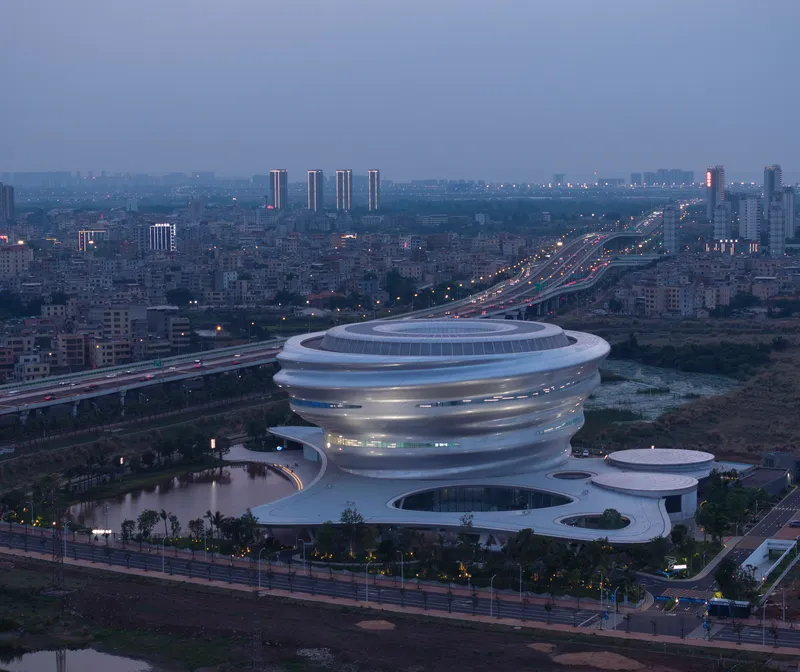
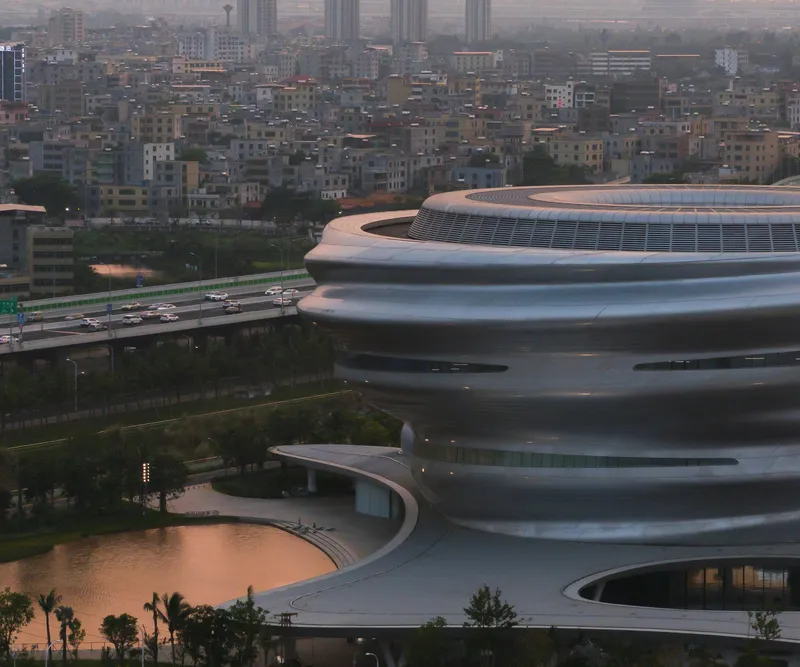
At dusk the building's stacked horizontal bands light up against the Haikou skyline, revealing the logic of the spiral. The FRP panels wrap the volume in continuous ribbons, their open seams and water-guiding grooves calibrated for Hainan's tropical downpours. From a distance the facade looks monolithic; up close it is porous, breathing. Curved water features at the base mirror the facade's geometry and double as thermal regulators, pulling humidity away from the ground level and tying the architecture visually to the wetland beyond.
The aerial view is the clearest reading of the concept. The spiral is not ornamental. It is the section made visible on the exterior, a direct expression of the descending ramp within. You can trace a visitor's journey just by looking at the skin.
Lifting the Building, Extending the Ground
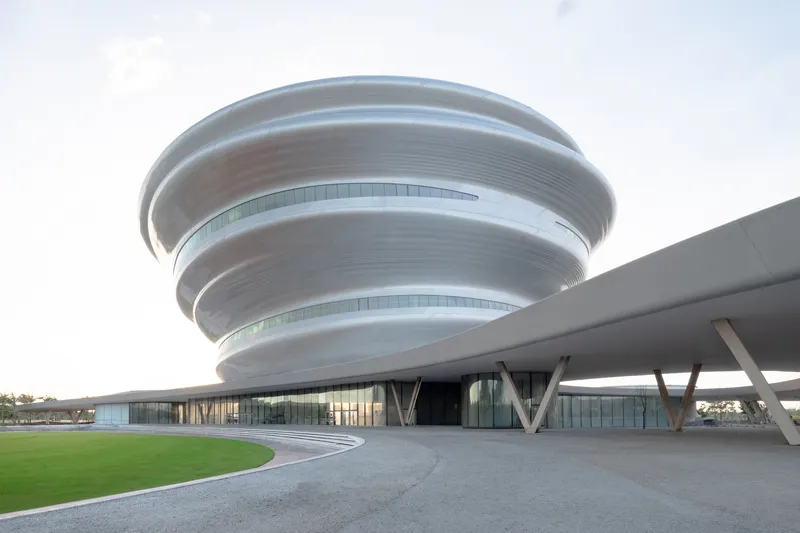
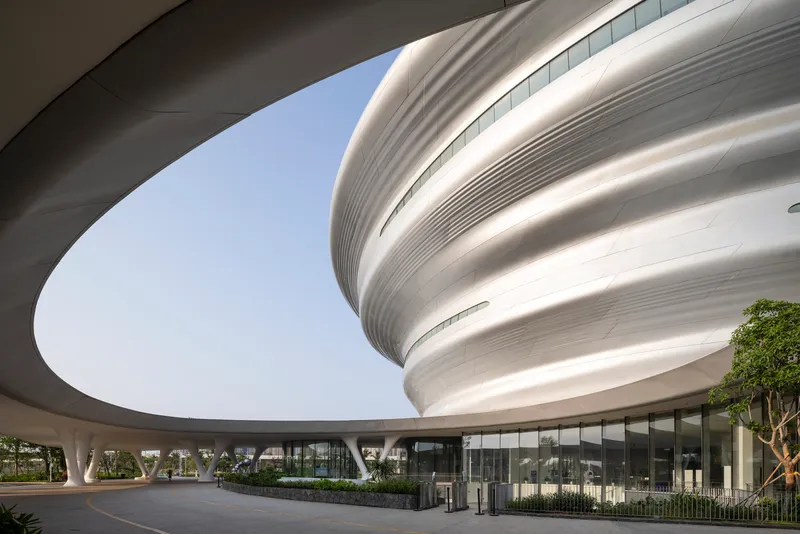
MAD's decision to raise the main volume above ground level creates a generous covered landscape beneath the museum. Angled V-shaped columns carry the mass while allowing planted beds, shaded walkways, and reflecting pools to flow freely underneath. The effect is a building that does not sit on its site so much as float above it. Haikou's west coast is hot, humid, and green; lifting the architecture lets the natural environment breathe through the structure rather than stopping at its walls.
The ground plane becomes a continuation of the wetland park, with sunken plazas and covered walkways connecting outdoor learning landscapes focused on tropical ecology and agriculture. For a science museum aimed largely at children, this is a smart move: the educational experience starts before you enter the building.
Structure as Architecture

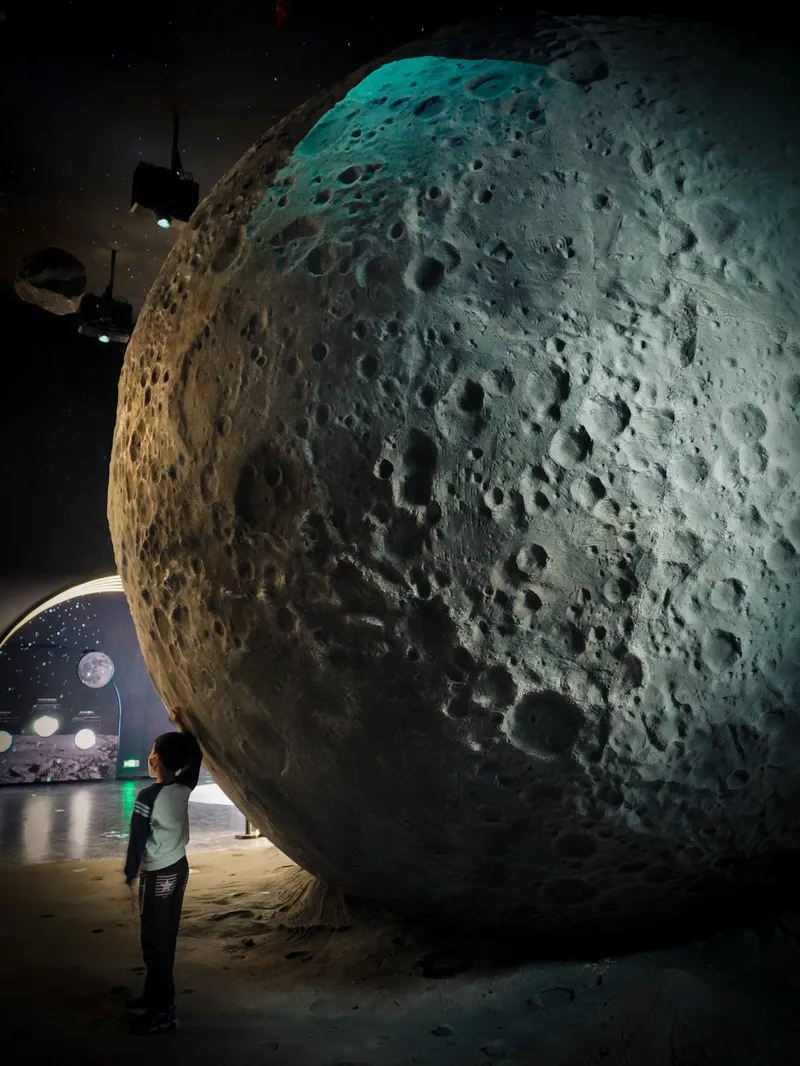
The three concrete cores are not hidden behind drywall. They are exposed, along with the curved trusses, the spiral ramps, and the roof structure. MAD has committed to a principle that is easy to state and hard to execute: every structural element is an architectural element. The cores support the spiraling exhibition floors, which remain completely column-free, giving curators the flexibility to stage large-scale installations like the illuminated lunar surface seen in the gallery view.
Visitors begin at the top, on a 360-degree viewing platform on the fifth floor, and descend through technology and space galleries, ocean and life science galleries, mathematics and science galleries, and finally multimedia interactive areas and a children's playground on the second floor. The journey is gravitational: you start with the cosmos and arrive at play. A planetarium, giant-screen cinema, and flying theater are embedded within the program, making the building a piece of infrastructure as much as a cultural object.
The Balcony as Threshold
One image captures two visitors leaning on a railing between curved balcony levels. It is a small moment that reveals a big idea. The spiral ramp opens repeatedly to the outside air, turning what would normally be a fire stair or a service corridor into a place to pause, look out, and reconnect with the wetland and the city. The museum does not ask you to forget the outside world while you learn about it.
Plans and Drawings
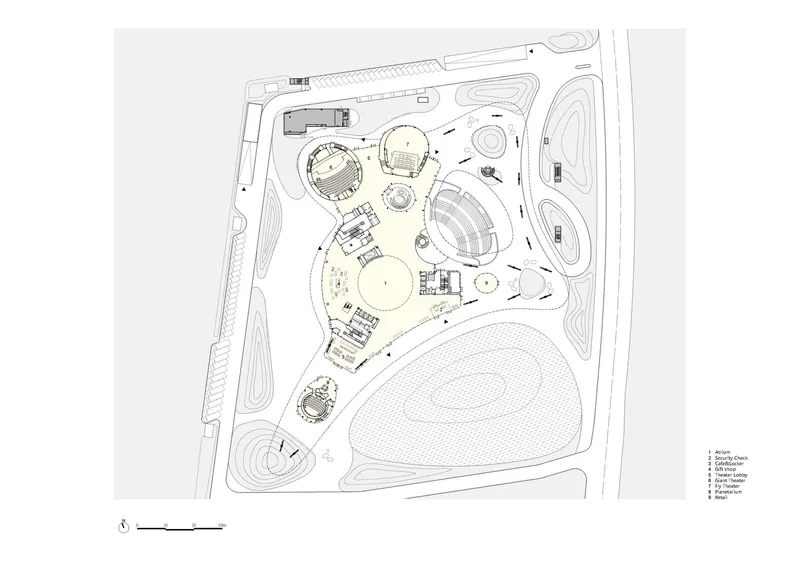
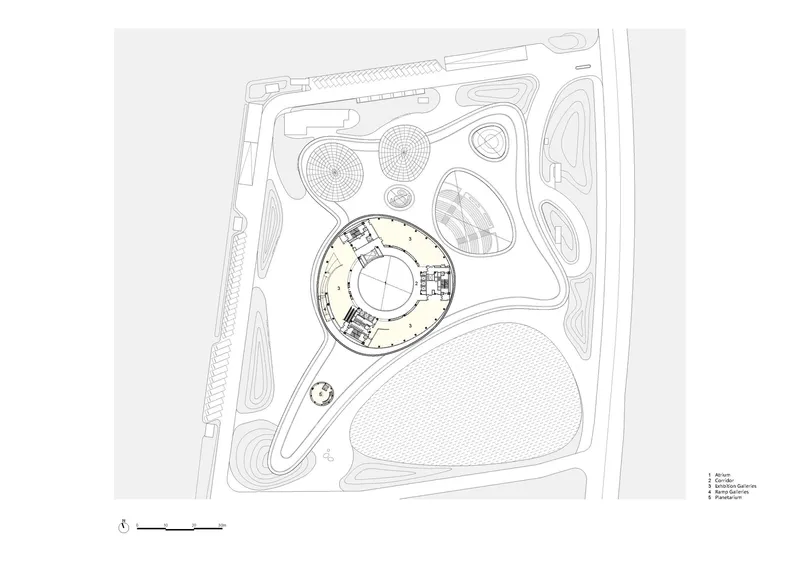
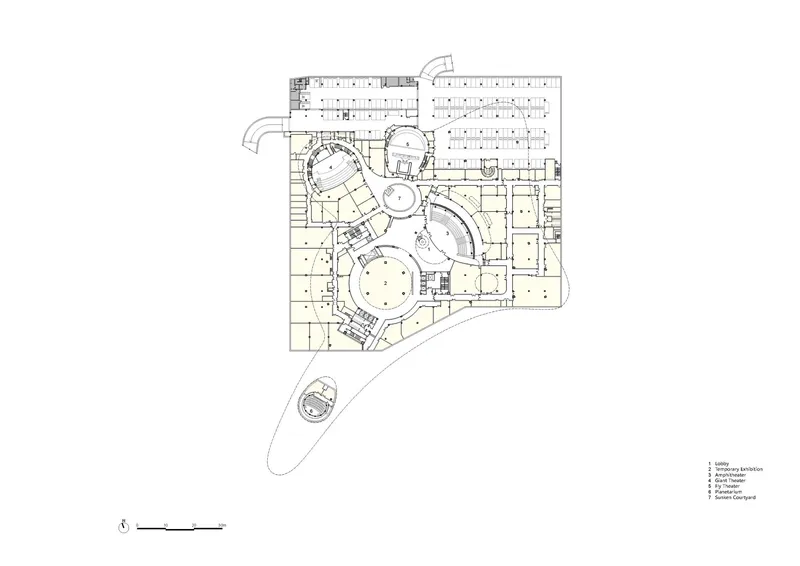
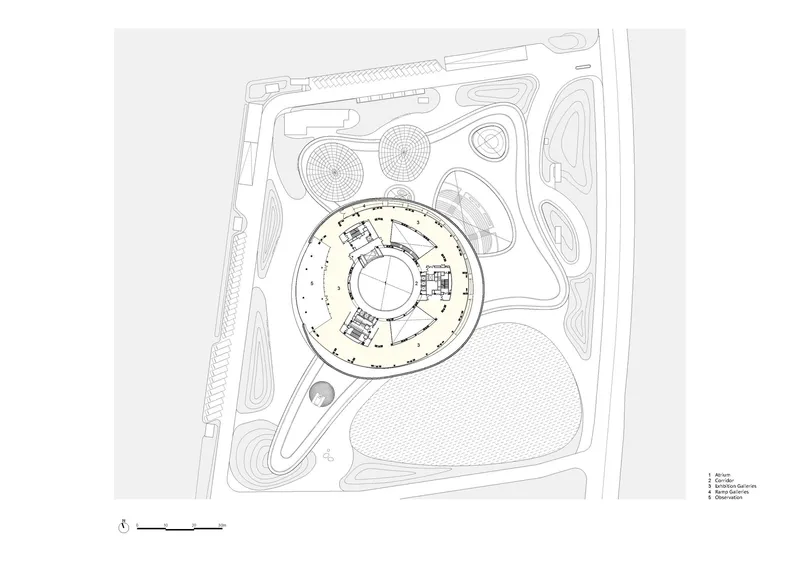
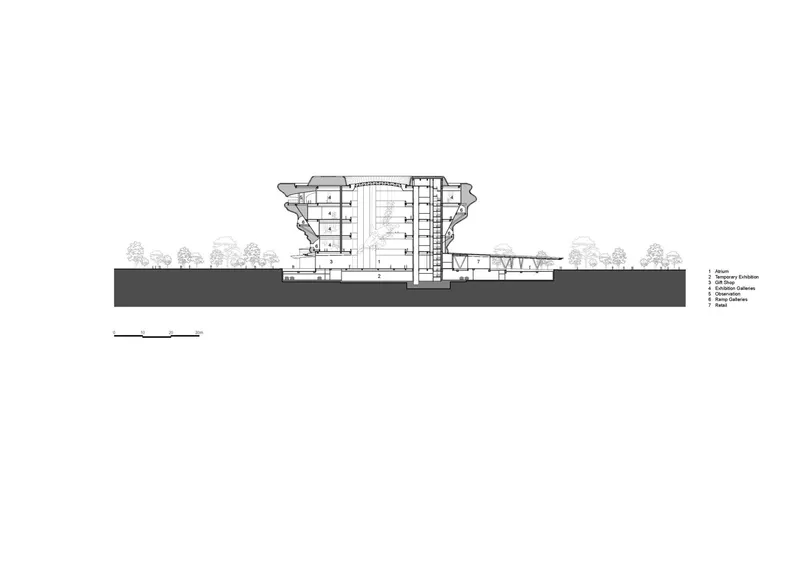
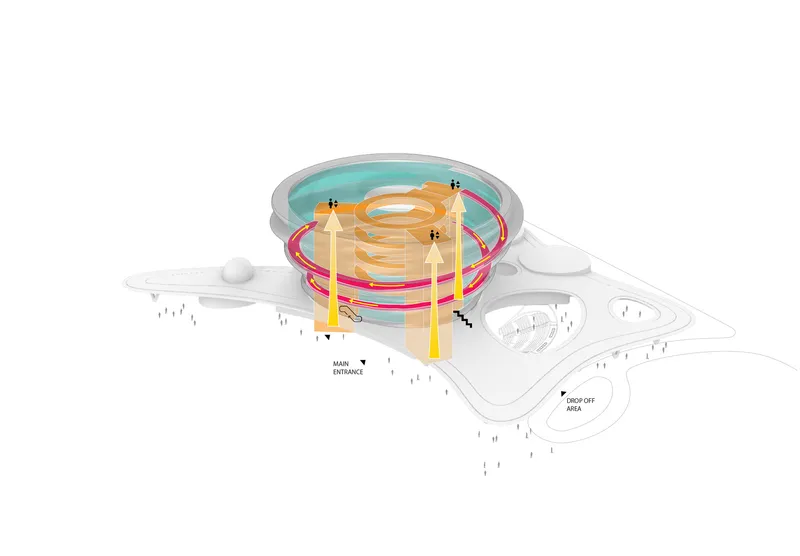
The site plans clarify the museum's relationship to its compound: a circular main volume flanked by secondary oval forms within a landscaped perimeter on the 40,000 square meter site. The floor plans show a ring-shaped gallery level with a central void, the glass dome skylight above the atrium acting as the building's luminous core. The section drawing reveals the cantilevered upper volume and the multi-level stacking that allows the column-free exhibition floors to function. Most revealing is the axonometric diagram, which maps colored circulation paths through the interior levels. It confirms that the ramp is not a single helix but a network of branching routes, offering multiple ways to move through the program rather than a single prescribed sequence.
The structural strategy is legible in every drawing: three cores, a spiraling floor plate, and a facade that is structurally integral rather than applied. MAD has designed out redundancy. The core, the floor plates, and the main structure connect directly with the curved facade, meaning the building uses less material by refusing to separate skin from skeleton.
Why This Project Matters
Science museums have a credibility problem. They are supposed to inspire curiosity, but they are often the most conventional buildings in a city's cultural portfolio: boxy, top-lit, and organized like textbooks. The Hainan Science Museum challenges that typology at a structural level. By making the building's circulation, structure, and program one and the same system, MAD has created a space where the act of moving through the museum is itself instructive. Children do not walk down a corridor to reach a gallery about physics; they descend a spiral ramp that embodies gravitational force, structural logic, and spatial flow simultaneously.
The project also represents a maturing of MAD's formal ambitions. The biomorphic language that once read as sculptural provocation is here disciplined by climate, program, and material economy. The FRP panels manage rainwater. The lifted volume ventilates the ground plane. The exposed structure eliminates superfluous finishes. None of this diminishes the building's visual power; it makes the power credible. In a Free-Trade Port district still defining its identity, Haikou now has a science museum that teaches not through signage but through architecture.
Hainan Science Museum, designed by MAD Architects. Haikou, China. 46,528 m². Completed 2026. Photography by Arch-Exist, Moden Wang, and SheinAtlas.
About the Studio
Share Your Own Work on uni.xyz
If projects like this are the kind of work you want to make, uni.xyz is a place to publish your own, find collaborators, and enter design competitions.


Popular Articles
Popular articles from the community


Jaramillo Van Sluys Arquitectura and Urbanismo Turn a Demolished Registry Lot in Quito into an Orchard Plaza
In Quito's Centro Histórico, a 2,800 m² plaza exposes the San Agustín convent wall and redraws its lost Augustinian orchard in volcanic stone.

Architekt Andreas Gruber Scatters 23 Dark Timber Chalets Across a South Tyrolean Forest Edge
In Molini di Tures, Amonti Chalets breaks a resort into a hamlet of gabled timber houses, with parking, storage and services pushed into the slope.

GROUP A Strips a 1969 Rotterdam Harbor Headquarters to Its Frame and Wraps It in Timber Louvers
In Rotterdam's M4H harbor district, Ferro Offices reuses a 1969 frame, adds one timber storey and reaches BREEAM-NL Outstanding.

Cube Design Draws an Ecological Corridor Between Two Shenzhen Hills with the Nankai Building
Beside Shenzhen's container docks, the Nankai Building pairs stacked balconies with a climbing green screen to connect two hillsides across its height.

Similar Reads
You might also enjoy these articles


LAVA Architecten Gives Vocational Education a Sawtooth-Roofed Face on a Mechelen School Campus
In Mechelen, Belgium, a 2,053 m² STEM school on a 6×6 m grid turns workshops and classrooms into rooms that can be rearranged as teaching changes.

KEMA Studio Turns a Derelict Marvila Attic into a 60 m² Lighthouse Apartment Above Lisbon
In Lisbon's Marvila district, a rebuilt roof, four skylights and two plywood volumes turn an unlivable attic into a bright home facing the Tagus.

Pixel Gardens: One Repeated Module Stacked Into a Terraced Social Housing Tower for Famagusta
Salem Bader's shortlisted housing tower builds a vertical neighbourhood from one repeated module, offsetting units to carve terraces, light and air.

Bao Huynh Watercolor Atelier: A Serene Art Retreat in Hội An
Bao Huynh Watercolor Atelier in Hội An blends multifunctional art spaces, sustainable design, local materials, and family-friendly living in a serene environment.

Explore Space Museum Competitions
Discover active competitions in this discipline

Challenge to reimagine the Iron Throne

Photograph architecture without architects

Illustrate the lost glory of Angkor Wat - Render Challenge

Bring back Drive In's
Comments (0)
Please login or sign up to add comments
No comments yet. Be the first to comment!