

Maden Group Builds a Brutalist Multimedia Complex from Kosovo's Own Unfinished Vernacular
A 17,100 m² production facility in Obiliq uses raw concrete and clay block to channel Kosovo's collective construction memory.


Across Kosovo, buildings stand with their facades unfinished: bare concrete frames, exposed clay block, the raw palette of a construction culture that has become, almost accidentally, a regional aesthetic. Maden Group, led by architects Ideal Vejsa and Rashit Zeneli, took this ubiquitous condition and turned it into a deliberate architectural language for AMC Multimedia, a 17,100 m² production and events facility in Obiliq. The result is not an imitation of roughness but a building that locates beauty in the materials most Kosovars already know by heart.
What makes the project genuinely compelling is the refusal to treat brutalism as a borrowed style. Rather than citing Le Corbusier or Tadao Ando, the architects root their concrete and clay block choices in the specific building traditions of their own territory. The untreated facades are not a provocation. They are a mirror, reflecting back the collective memory of how Kosovo has built for decades. That the building houses scenography studios, shooting spaces, and multicultural event halls only sharpens the irony: a place dedicated to media production is wrapped in the most analog, most local materials available.
A Modular Geometry Rooted in the Landscape
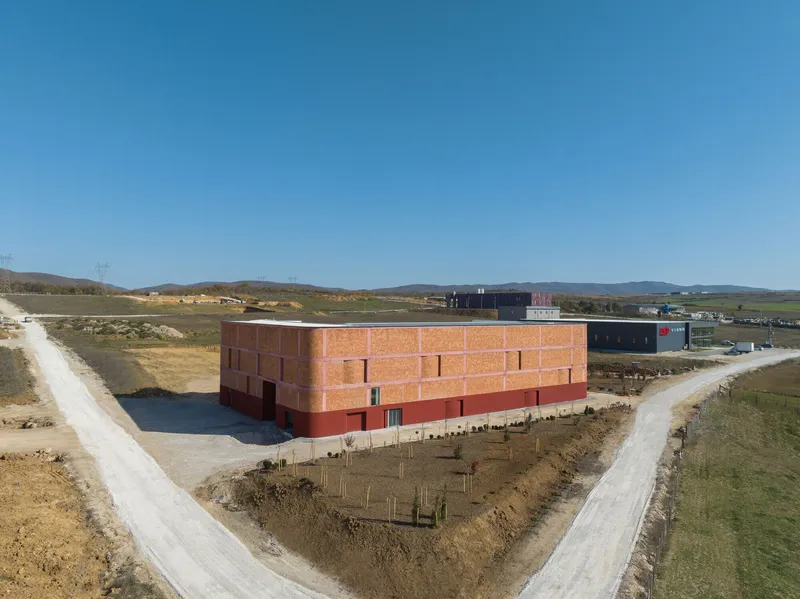
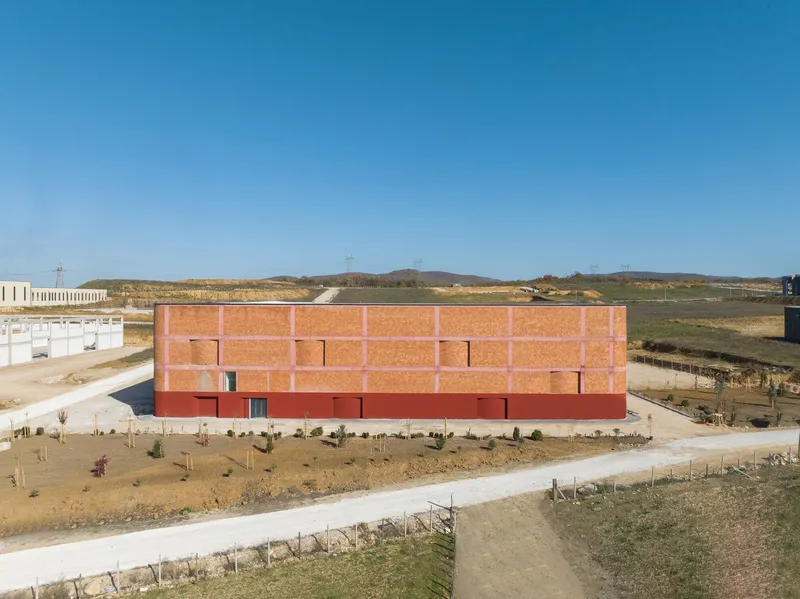
Seen from above, AMC Multimedia reads as a cluster of regular geometric volumes arranged in a modular grid across a flat, semi-rural site. The terracotta-toned clay block surfaces absorb the warm light of the Kosovo plain, grounding the building in its context rather than competing with it. Newly planted saplings along the access road hint at a future landscape that will soften the hard edges, but for now the architecture stands in frank dialogue with the open terrain.
The long facade along the road reveals the building's organizational logic: repeating bays of clay block sit atop a red-painted plinth, establishing a rhythm that is industrial in its consistency but artisanal in its texture. There is no curtain wall, no composite cladding. The wall is the structure, and the structure is the finish.
The Red Plinth and the Threshold
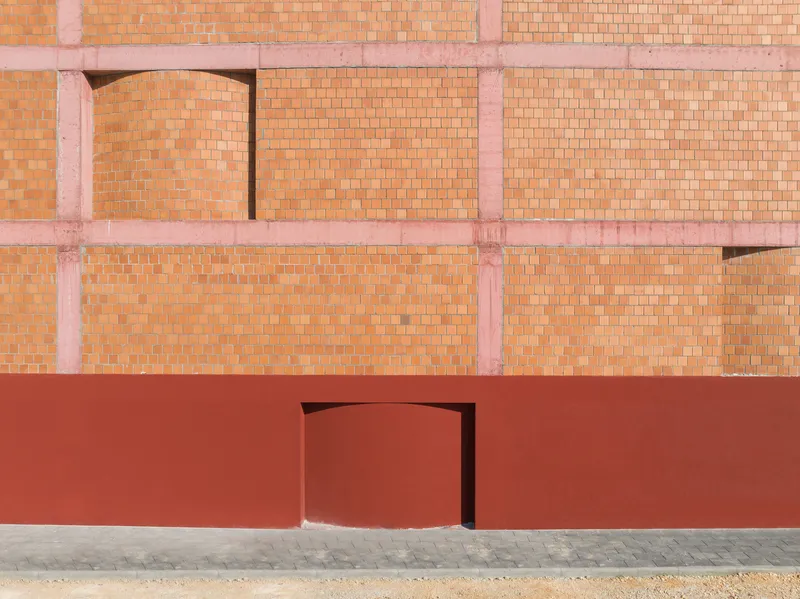
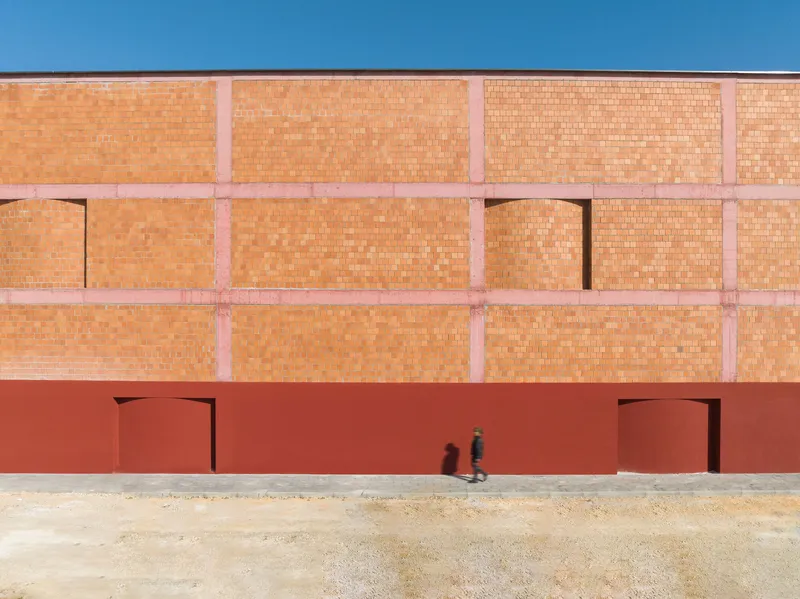
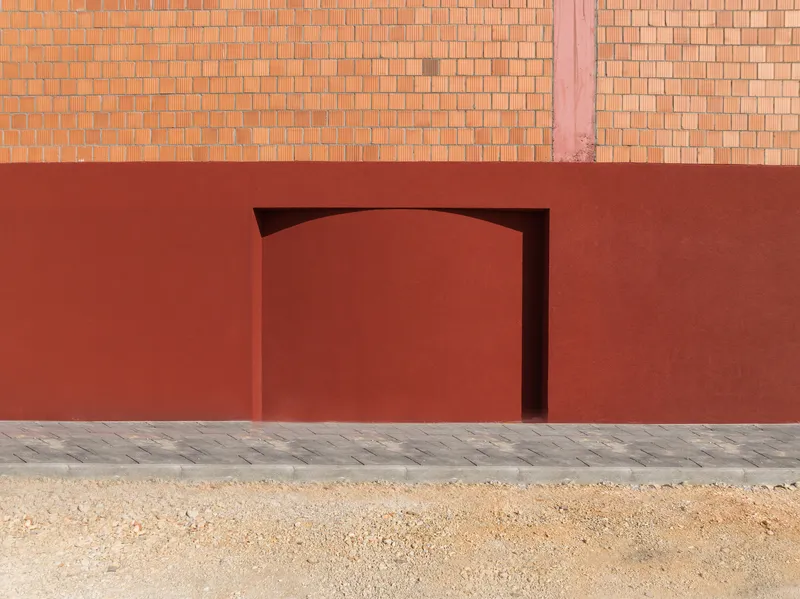
At ground level, a saturated red plaster band wraps the base of the building, creating a continuous datum that anchors the clay block mass above. Entrances are carved into this band as deliberate events: curved red doors sit within arched openings, and recessed doorways are framed by patterned stone paving strips that pull visitors forward. The threshold is not just a transition from outside to inside; it is a choreographed moment where the weight of the building becomes tangible.
The contrast between the rough upper wall and the smooth, deeply colored plinth gives the facade a legibility that might otherwise be lost in the monotony of a single material. It also introduces a surprising playfulness to what could easily have been a dour composition. The red is assertive, almost festive, and it lends the building an identity visible from the road well before any signage comes into view.
Arched Openings and the Play of Light
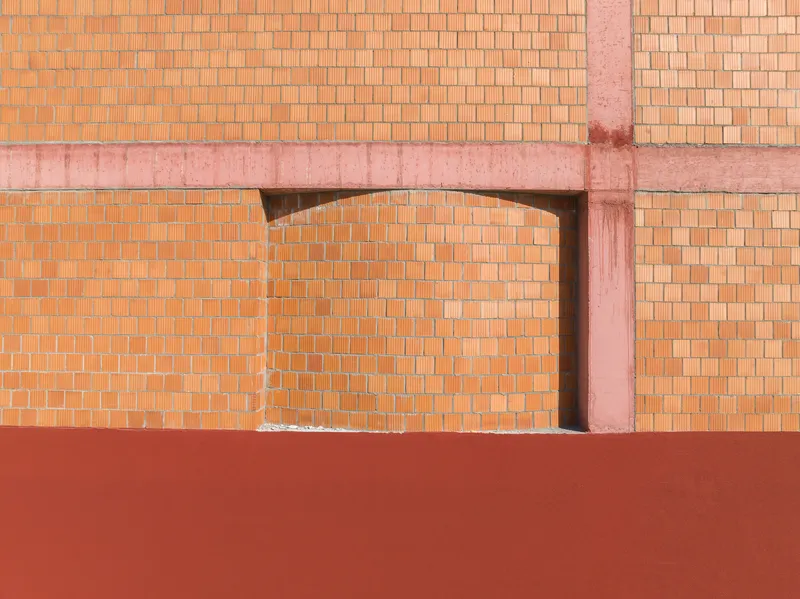
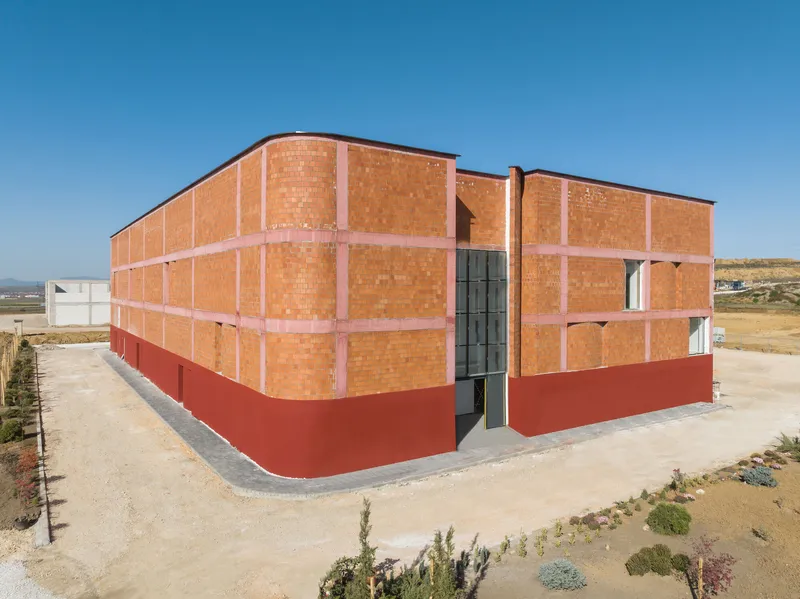
The arched openings punched through the clay block walls are the building's most expressive detail. Framed in a pink-tinted concrete that reads as almost geological, they recall traditional masonry construction while operating at a scale that belongs to industrial architecture. Each arch creates a deep reveal that modulates light throughout the day, casting shadow patterns across the facade and into the interior spaces beyond.
At the corner, a tall glazed slot breaks the clay block grid to expose the structural frame and admit daylight into the building's core. The exposed pink concrete columns and beams become visible here, confirming what the facade only implies: that the entire building is organized around a modular structural grid. The glass is treated as an absence in the wall rather than a competing material, keeping the hierarchy of concrete and block intact.
The Central Stair Tower as Public Face
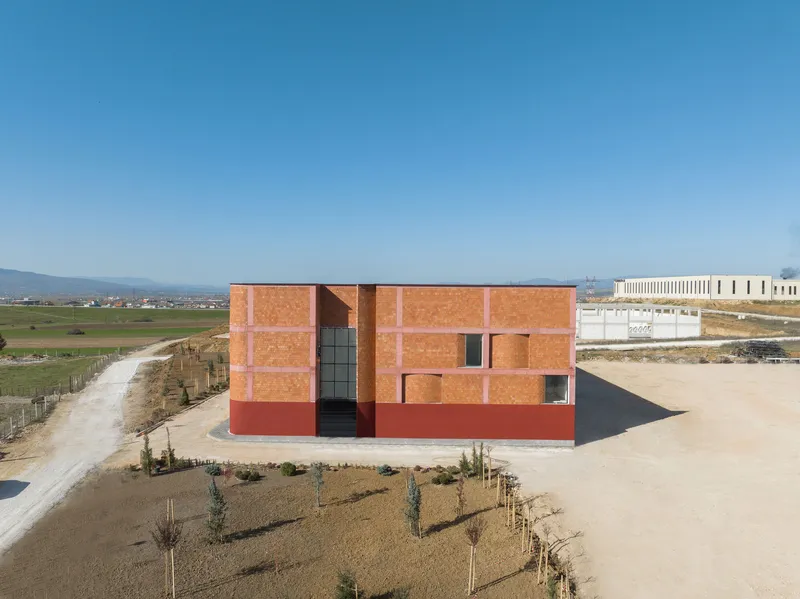
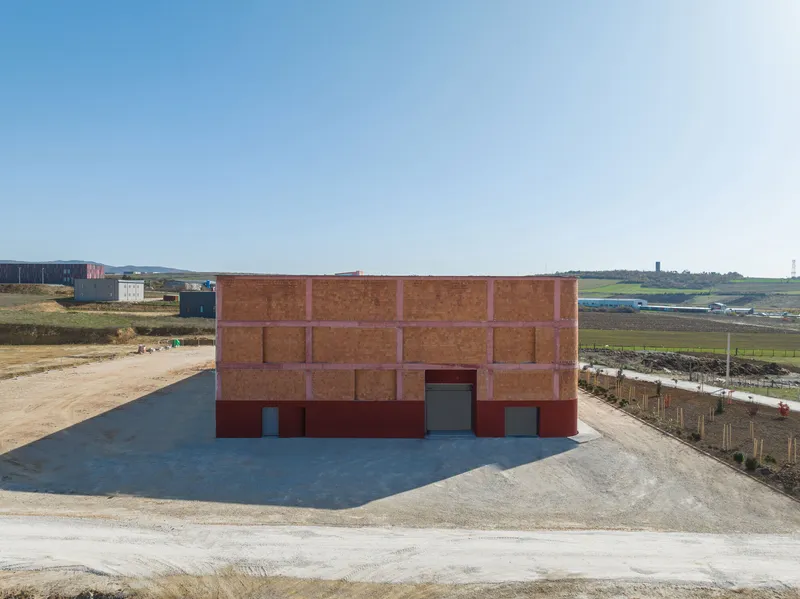
The front elevation is organized around a central glazed stair tower that rises through the full height of the building, flanked by symmetrical bays of terracotta brick. It is a straightforward compositional move, but effective: the transparency of the stair volume provides a visual anchor and signals the public entrance in a building whose repetitive facade might otherwise obscure it.
The rear elevation strips away the formal gestures of the front, presenting an unapologetic working face of clay block and red plaster over a gravel yard. There is no pretense here, and the contrast between front and back reveals a building that understands the difference between address and service. The consistency of material on all sides, however, prevents the rear from feeling neglected. It is simply less theatrical.
Plans and Drawings
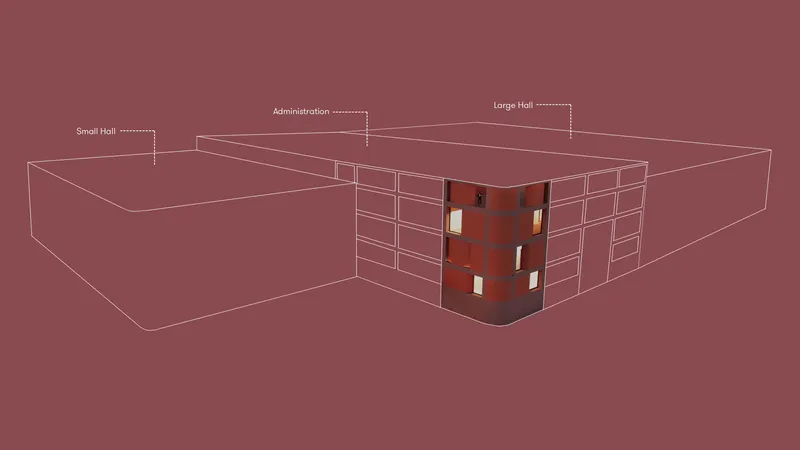
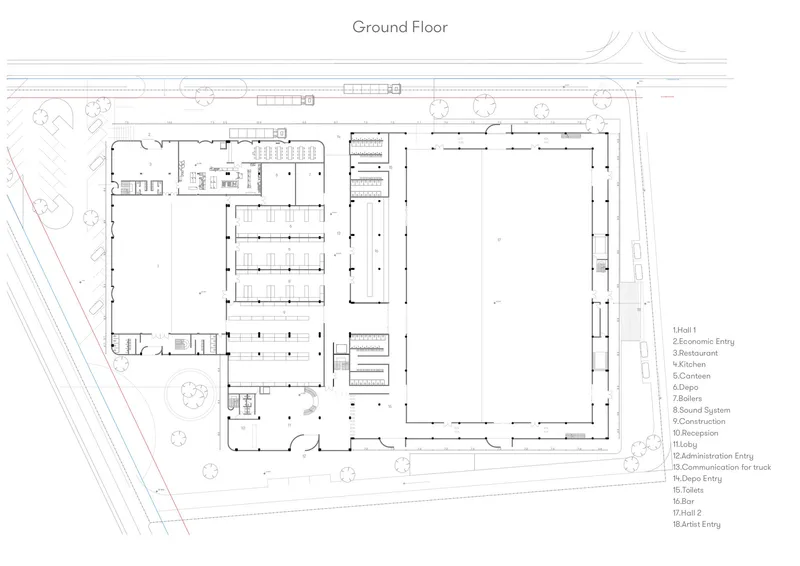
The axonometric drawing clarifies what the photographs can only suggest: AMC Multimedia is composed of three linked hall volumes, joined at their intersection by illuminated corner glazing that floods the junctions with daylight. This organizational strategy is economical and legible, producing large, column-free spans suitable for scenography, shooting, and events while concentrating circulation and administration at the seams.
The ground floor plan confirms a bilateral symmetry, with two large halls flanking a central spine of administrative offices and service zones. The plan is rational to the point of diagram, but that clarity is the project's strength. Every square meter of the 17,100 m² program is accounted for without spatial gymnastics. The modular structural grid visible in the elevations directly generates the plan, producing a building in which structure, enclosure, and spatial organization are a single, integrated system.
Why This Project Matters
AMC Multimedia matters because it demonstrates that architectural identity does not require imported materials or borrowed typologies. By taking the raw, often stigmatized palette of everyday Kosovar construction and deploying it with precision, Maden Group transforms a liability into a proposition. The building argues that unfinished is not the same as incomplete, and that collective memory can be a legitimate design resource.
In a region where the pressure to adopt a globalized aesthetic is strong, this project stands as a reminder that specificity wins. The clay block and concrete will age, the saplings will grow, and the building will settle into its landscape with the same quiet inevitability as the vernacular structures it references. That is not nostalgia. That is architecture working within its means, and working well.
AMC Multimedia by Maden Group (lead architects Ideal Vejsa and Rashit Zeneli), Obiliq, Kosovo. 17,100 m², completed 2022. Photography by Leonit Ibrahimi.
About the Studio
Share Your Own Work on uni.xyz
If projects like this are the kind of work you want to make, uni.xyz is a place to publish your own, find collaborators, and enter design competitions.


Popular Articles
Popular articles from the community


Singing Woman: An Opera House That Performs Before the Curtain Rises
Ovidiu Cristian Pavel's conceptual opera house translates Estonia's choral identity into a sculpted waterfront landmark facing the Baltic Sea.

Temporary Home for Dogs: A Reversed Zoo Rethinks Animal Shelter Architecture
In Bucharest, a sinuous corridor and freed landscape flip the logic of containment, designing a shelter that works to make itself unnecessary.

Cloaked Colonization: A Mobile Underwater Habitat That Moves Like a Fish
Micah Abaya's shortlisted EHC Pacific entry reimagines ocean settlement as a dispersed network of self-sustaining architectural organisms.

Manzana Morphosis: Stretching Barcelona's Grid into a Living Landscape for 2050
A radical reworking of the Eixample manzana turns density into a tool for generous public space, vertical ecology, and environmental performance.

Similar Reads
You might also enjoy these articles

Pixel Gardens: One Repeated Module Stacked Into a Terraced Social Housing Tower for Famagusta
Salem Bader's shortlisted housing tower builds a vertical neighbourhood from one repeated module, offsetting units to carve terraces, light and air.

Bao Huynh Watercolor Atelier: A Serene Art Retreat in Hội An
Bao Huynh Watercolor Atelier in Hội An blends multifunctional art spaces, sustainable design, local materials, and family-friendly living in a serene environment.

Atelier Macri Concept Store Interior Design by CASE-REAL
Atelier Macri store features a "ko" counter, walnut wood details, cork displays, blending retail, gallery, and seamless customer experiences.

Manuel Vargas Izquierdo Stadium and High-Performance Sports Center: Architectural Excellence in Jalpa de Méndez
The Manuel Vargas Izquierdo Stadium blends sustainable design, inclusive sports facilities, and cultural-inspired architecture, revitalizing Jalpa de Méndez’s public spaces.

Explore Multimedia Arts Competitions
Discover active competitions in this discipline

Challenge to reimagine the Iron Throne

Photograph architecture without architects

Illustrate the lost glory of Angkor Wat - Render Challenge

Design challenge to reuse E-waste
Comments (0)
Please login or sign up to add comments
No comments yet. Be the first to comment!