

Marine student container city
The main aim of the project is to create a comfortable dwelling for maritime students and to provide the possibility of using this space for another function.

Nowadays the use of shipping containers in construction is widespread. Because of cheapness of the material and ease of its transportation the use of containers for housing has become very popular. The advantages of building from containers are: reliability, high speed of construction, possibility of creation multilevel structures, operation in regions with different climatic conditions, unlimited service life of containers.
We used several approaches to the formation of objects: statics, functional connections and chaos.
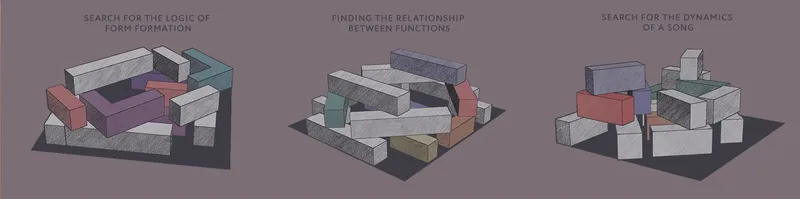
The final version uses a multi-level space: MODULE
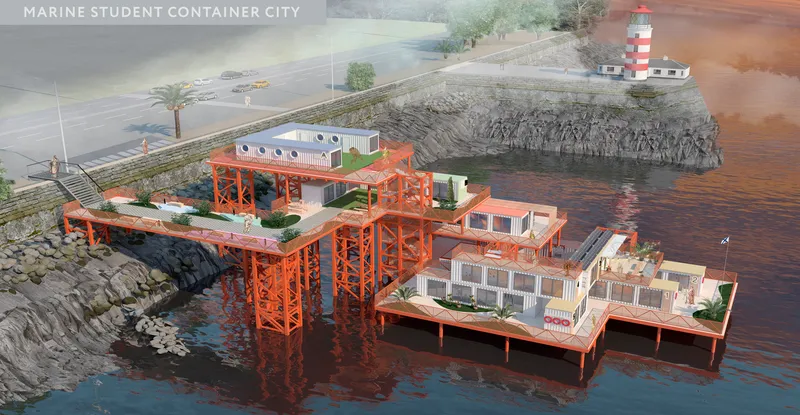
The main aim of the project is to create a comfortable dwelling for maritime students. We created a multilevel system which consists of metal trusses, platforms, 15 containers 40 and 20 feet wide. All elements are fixed on a collapsible construction, which composed of trusses and beam ceiling. This method of space formation has the following advantages:
- Small built-up area
- High rate of construction
- Multifunctionality (living space can be transformed into exhibition space for navy)
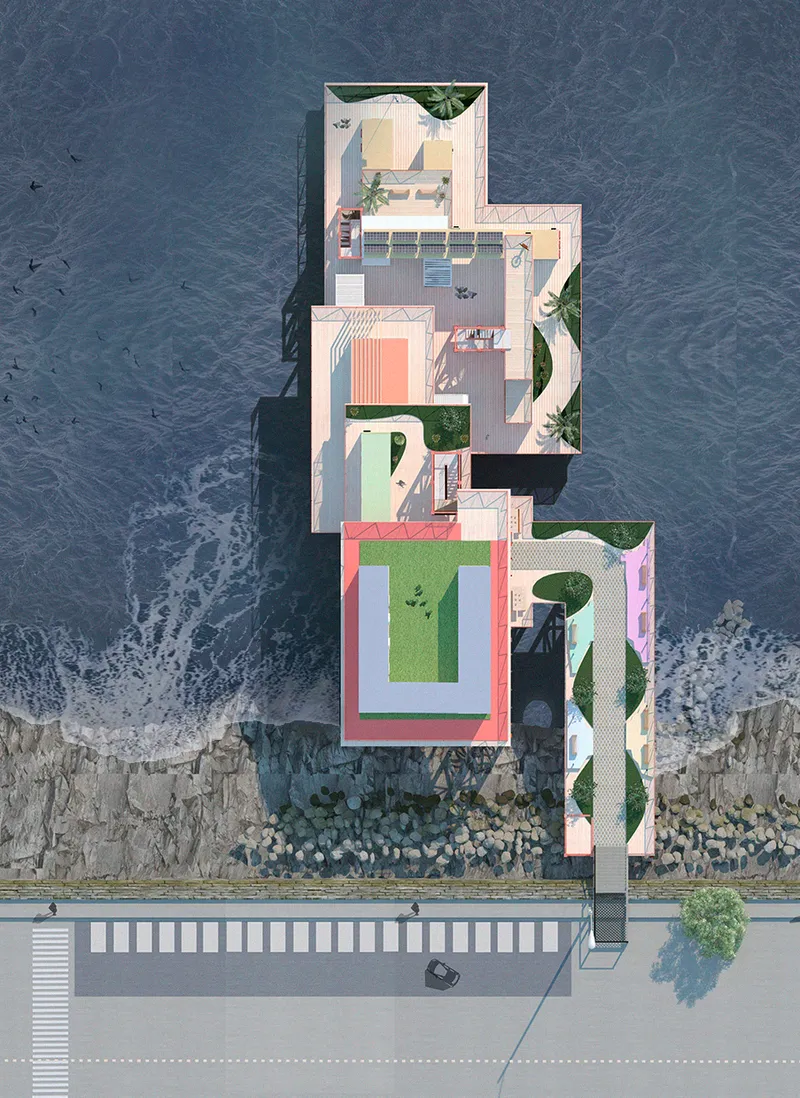
Principles for the organization of public and residential space:
During the development of the concept, were proposed several ideas for the organization of public and residential space, such as:
The entrance to the entire module is located on the embankment, where parking is organized, where you can park your personal car. The main embankment leads to the second level of the platform where the containers are located (container B). On this level, there is a dining area with a terrace. The level above is the sports area (container A) in which there are small gyms and yoga areas. From the dining room level, you can go down to the next level and get to the reading and library areas
(container C). At this level, students can do their homework, as well as arrange various lectures.
On the lowest zone, there is an area of bedrooms and bathrooms (container numbers 1-5). This platform is farthest from the rest in order to ensure the privacy and comfort of the students living there. This functional zoning was designed to address several important issues: the intersection of streams, the ability to place a variety of functions in one location, and the most comfortable opportunity to change the space for exhibitions.
This module can accommodate 27 people. There are 5 people per 40-foot container. 2 people per 20-foot container.

The location of this module was chosen as a rocky area near the water reservoir. The estimated place is Montenegro. The main criteria were the warm climate, the possibility of accommodation outside in an urban environment, as well as land prices and the cost of construction.
In conclusion, as a result of the developed concept, a MODULE is proposed, which can be considered one of the urban planning solutions of various locations. The module provides all the requirements for students ' accommodation. This is a variant of the most generalized urban space, but at the same time with the greatest divider of the resident traffic. No less important is the possibility of using this space for another function.

Popular Articles
Popular articles from the community


Opera on the Sea: Driftwood Logic Shapes a Timber Opera House on Estonia's Coast
Trevor Orgill's opera house translates the entangled drift of floating timber into a civic building where wood, water, and music converge.

Temporary Home for Dogs: A Reversed Zoo Rethinks Animal Shelter Architecture
In Bucharest, a sinuous corridor and freed landscape flip the logic of containment, designing a shelter that works to make itself unnecessary.

Cloaked Colonization: A Mobile Underwater Habitat That Moves Like a Fish
Micah Abaya's shortlisted EHC Pacific entry reimagines ocean settlement as a dispersed network of self-sustaining architectural organisms.
Extended Shell: Retrofitting Kolkata's Balconies as Living Urban Thresholds
A modular retrofit system recovers the social and environmental intelligence of Kolkata's historic verandas for contemporary Park Street residents.

Similar Reads
You might also enjoy these articles

The Rhythm of Seasons
A Farmers' Market Connecting Nature and the City

More Than a Building-Designing a Living System
More Than a Building-Designing a Living System
Base Beyond
DESERT COMPOUND ARID: TOURISM OF ABSENCE AND ABUNDANCE

Explore Architecture Project Competitions
Discover active competitions in this discipline


Deconstructivism - Illustration Design Challenge

Challenge to illustrate a Contemporary Castle

Illustrate the lost glory of Angkor Wat - Render Challenge

Bring back Drive In's
Comments (0)
Please login or sign up to add comments
No comments yet. Be the first to comment!