
MEAN* Threads a Seven-Room Wellness Sequence Through a Former Barcelona Storefront
Handcrafted Cumella ceramics, soft curves, and a monochromatic palette transform a layered Eixample commercial unit into a holistic fitness club.

The Eixample grid is Barcelona's great equalizer: every block gets roughly the same chamfered corners, the same generous ceiling heights, the same stone pilasters at grade. What happens behind those facades, though, is anyone's guess. When MEAN* (Middle East Architecture Network) took on a ground-floor commercial unit at Carrer d'Ausiàs Marc 41, the interior was a palimpsest of prior tenants. Uneven walls, residual structures, and a deep, irregular floor plate had been hacked and patched so many times that the space had no coherent spatial logic left. Local planning regulations required the exterior envelope to remain untouched. Every architectural move had to happen inside.
What makes Repeat Wellness Club genuinely interesting is not merely that it converts retail space into fitness studios. It is the ambition of the spatial sequence: seven distinct program zones, each with its own material temperature and chromatic register, threaded through a continuous promenade that unfolds as a single, legible experience. Two years in development and completed in 2026, the project collaborates with ceramicist Cumella, the studio behind tiles for the Sagrada Familia, alongside lighting design by Leika Light and custom joinery by Benoît Duchesne. The result is a project where adaptive reuse becomes less about preservation and more about layering new rituals onto inherited bones.
A Storefront That Keeps Its Composure
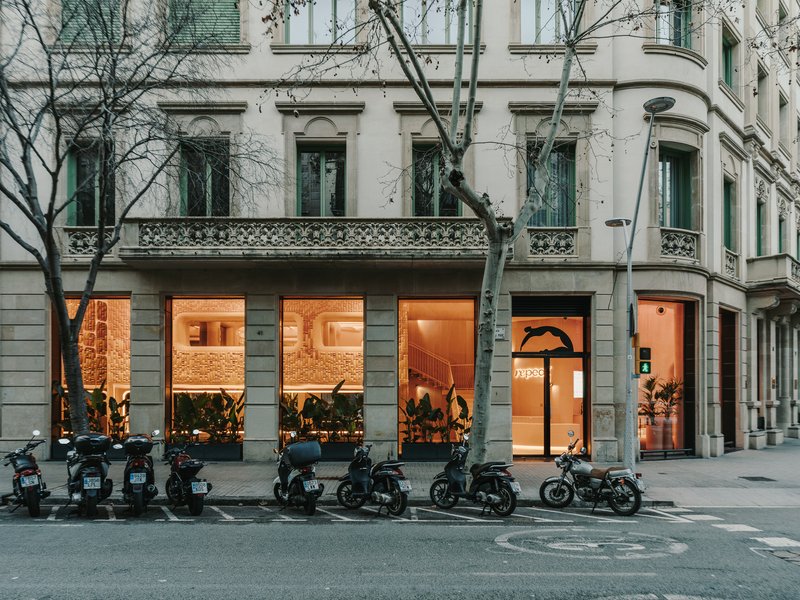
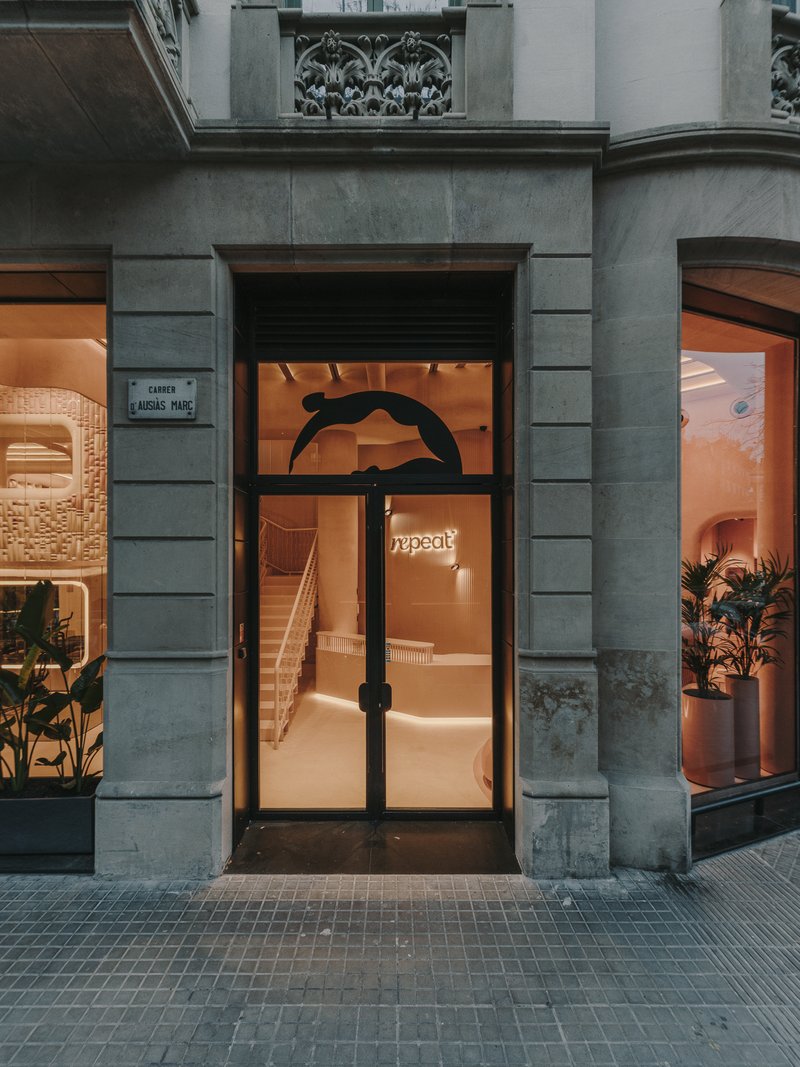
From the street, Repeat is almost quiet. The corner storefront at dusk glows warm through full-height glass, its grey stone pilasters and original facade rhythm left completely intact. That restraint is not a stylistic choice; it is a planning mandate. The entire exterior had to stay as found. But the effect is deliberate and powerful: the building reads as a respectful member of the Dreta de l'Eixample streetscape while hinting, through illuminated interiors and the suggestion of movement within, that something unexpected is happening behind the glass.
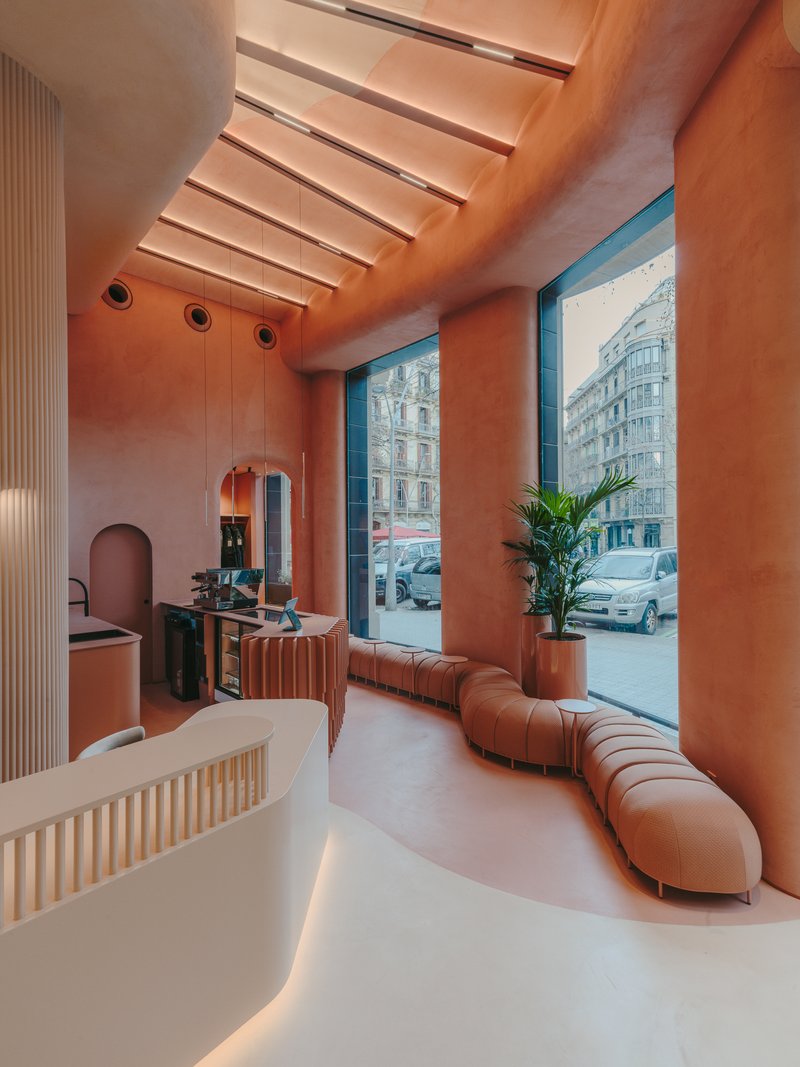
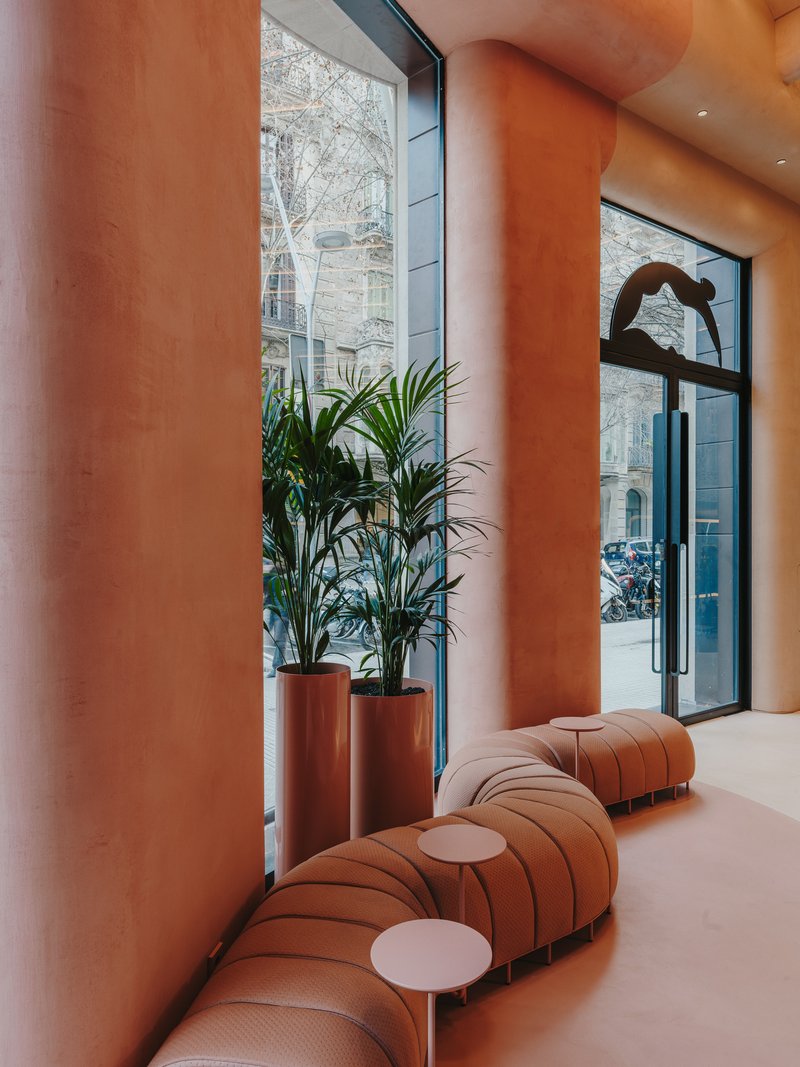
Inside the entrance zone, terracotta tones and ribbed upholstered seating along the tall windows create a kind of decompression chamber between the city and the workout floor. Potted palms and segmented lounge seating soften the threshold. The cafe and retail area occupy this warmer, deeper tonal register, a deliberate chromatic decision by MEAN* to separate social and commercial program from the lighter, more focused training spaces beyond.
The Staircase as Spatial Engine
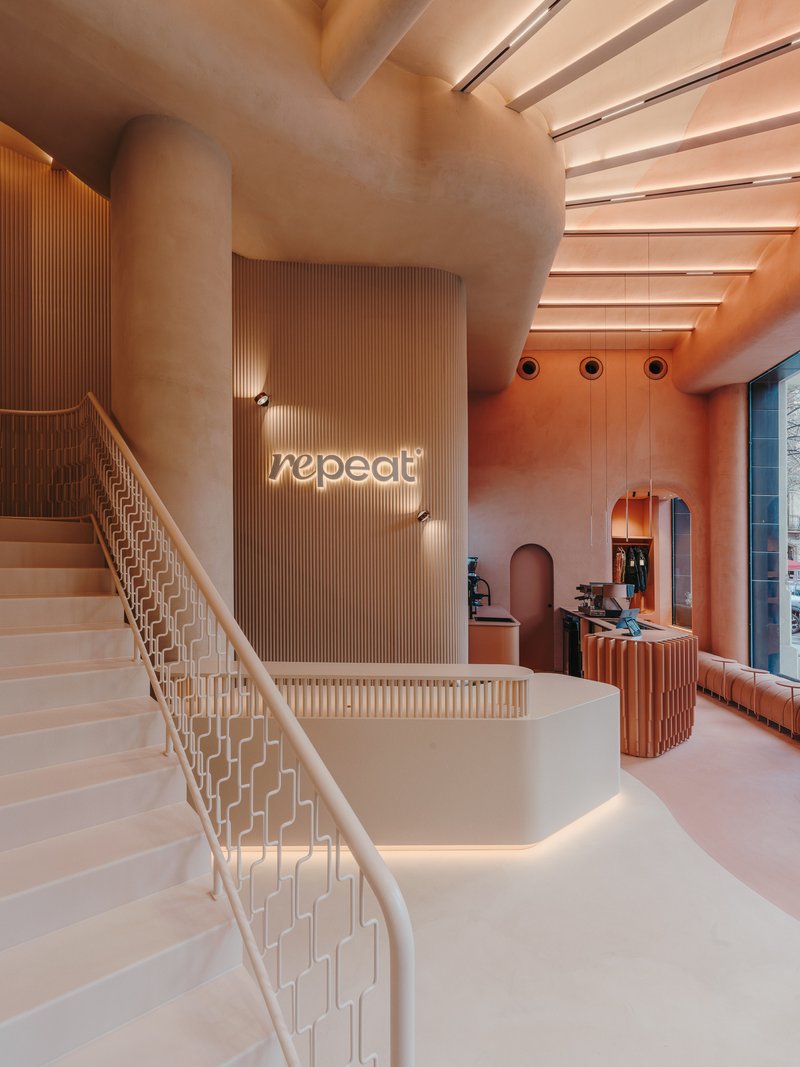
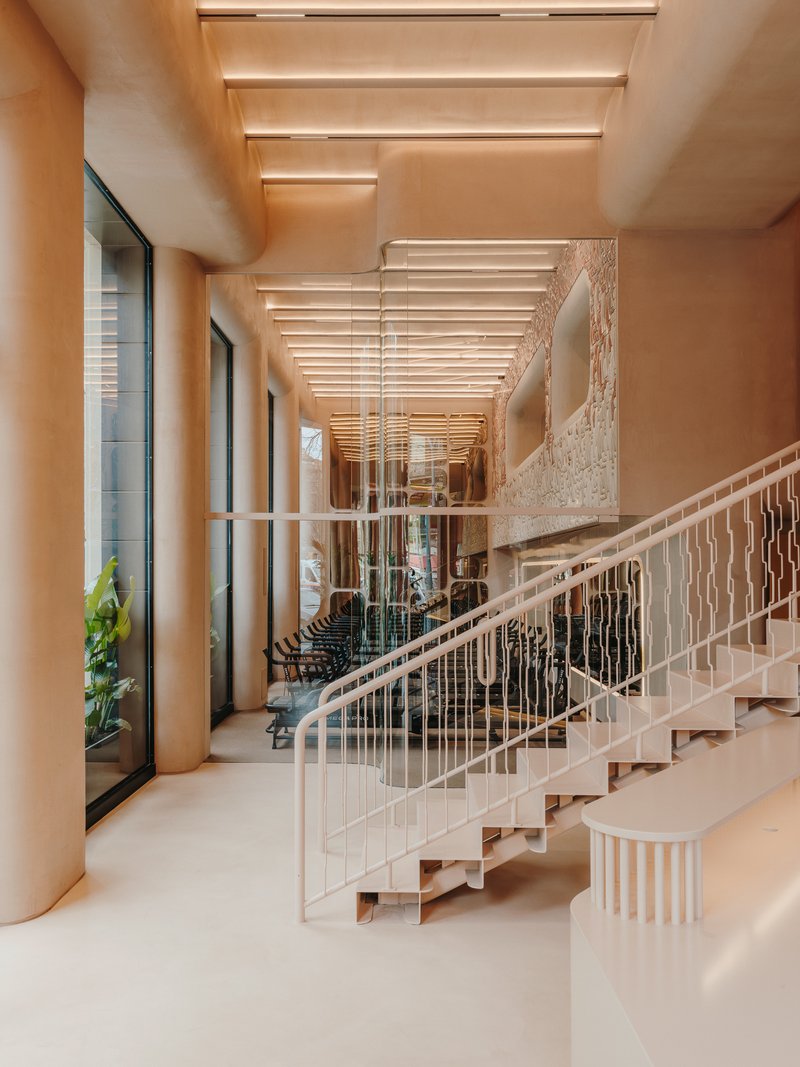
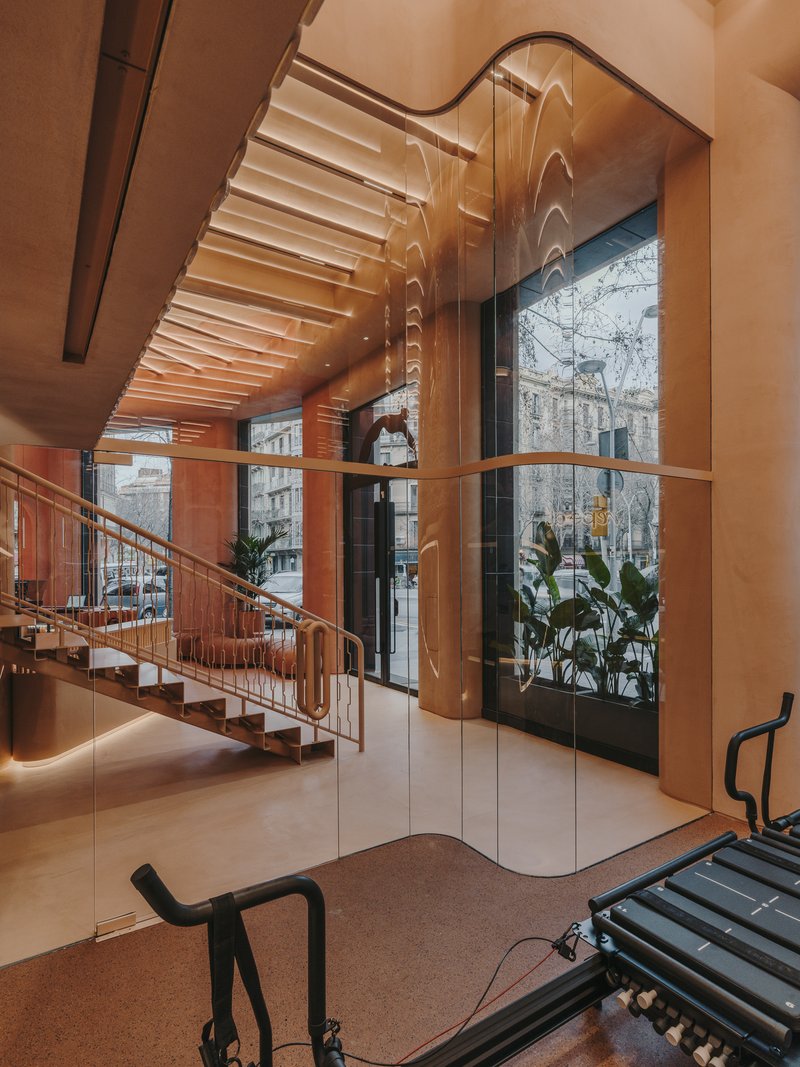
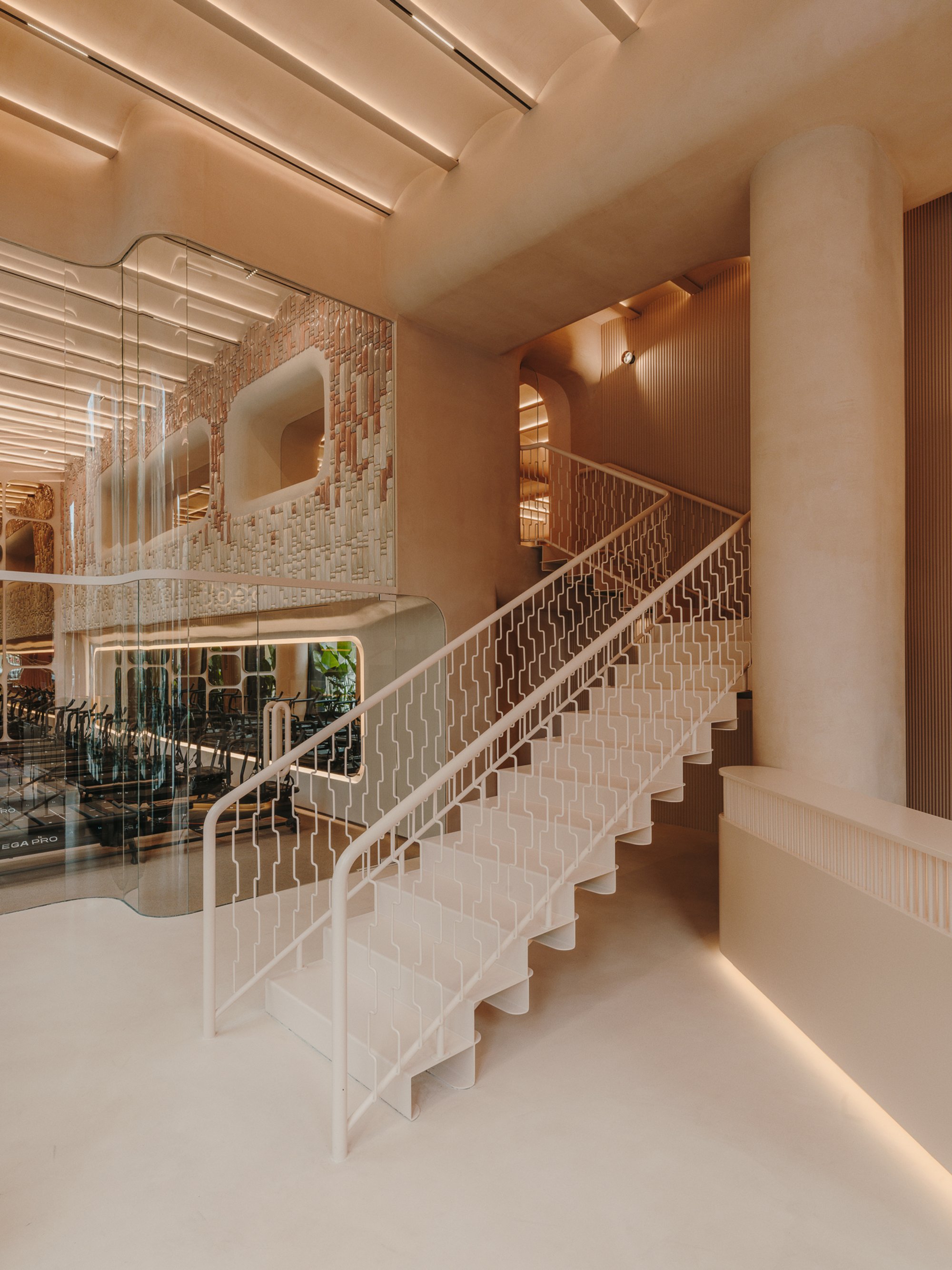
A floating curved staircase dominates the double-height lobby and does more work than any single element in the project. Its white plaster curves and geometric balustrade create a vertical axis around which the entire plan pivots. On one side, slatted timber walls and illuminated signage mark the reception desk. On the other, the stair pulls daylight down from a glass-enclosed stairwell that fronts the street, connecting upper and lower levels while offering views back into the exercise floor below.
The stair is not just circulation; it is legibility. In a deep, irregular floor plate where spatial orientation could easily collapse, the double-height void and its sculptural staircase act as a compass point. You always know where you are relative to it. Linear ceiling baffles radiate outward from this core, reinforcing directionality and guiding movement toward the training zones.
Reform and Rebuild: The Pilates and Lagree Studios
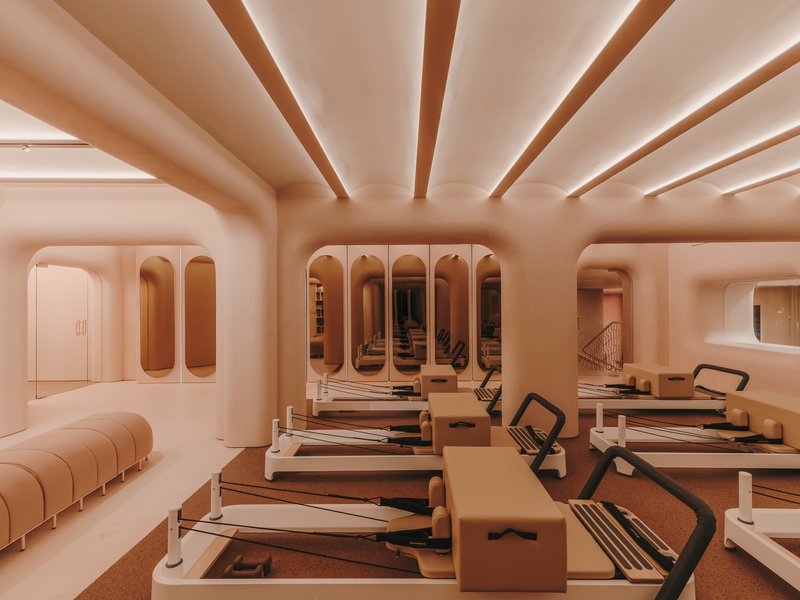
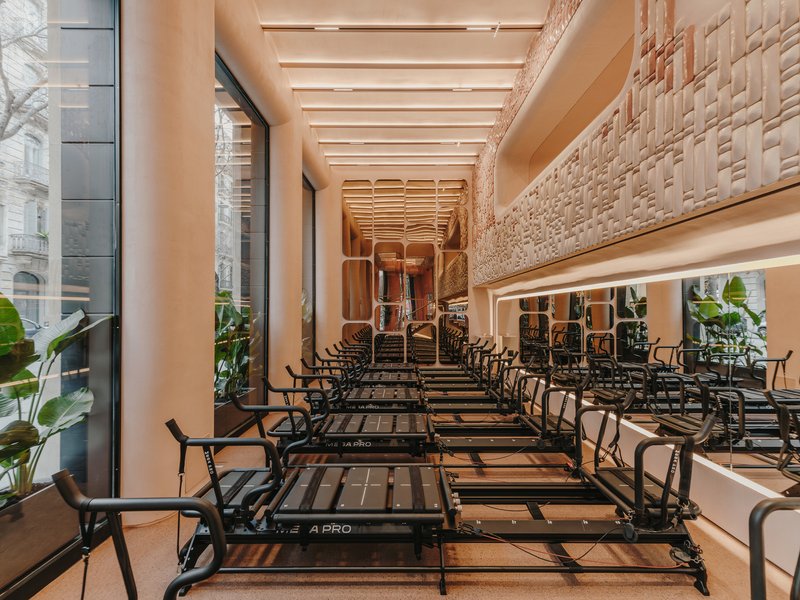
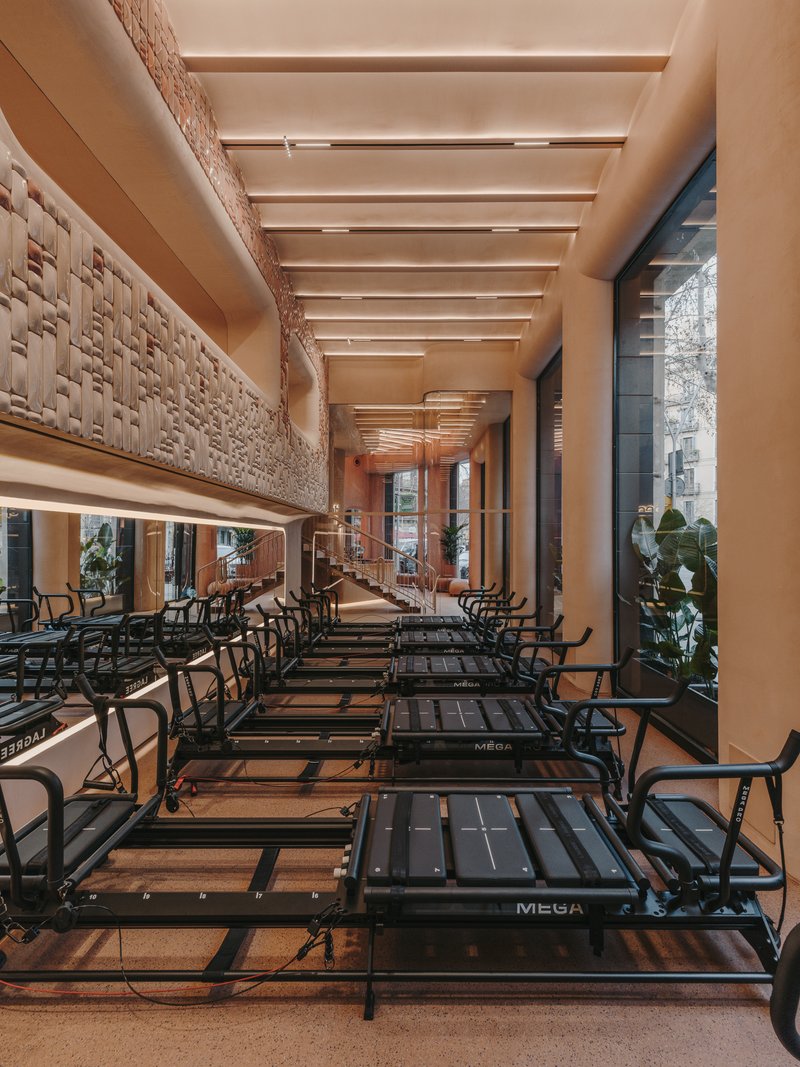
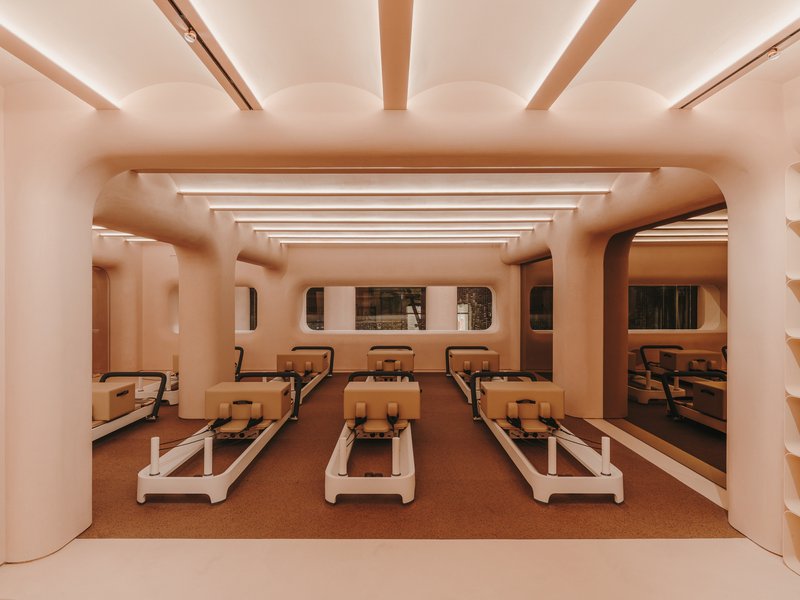
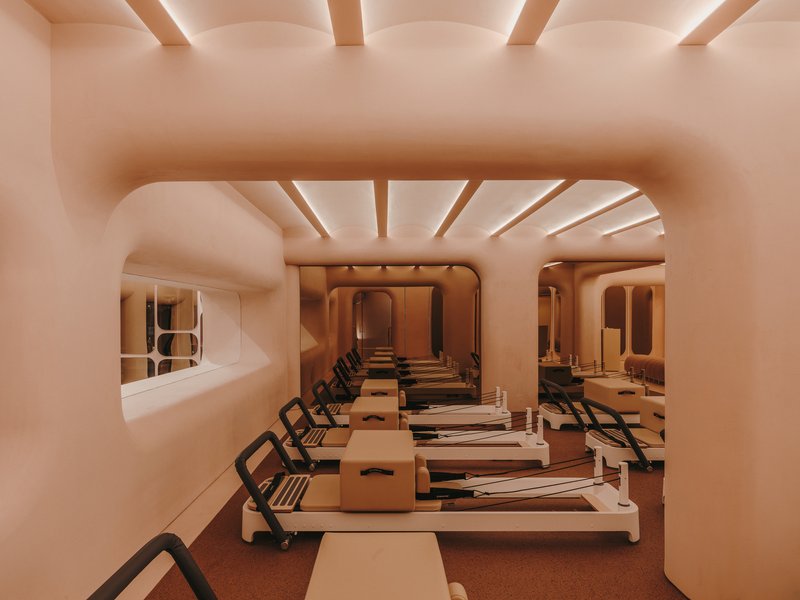
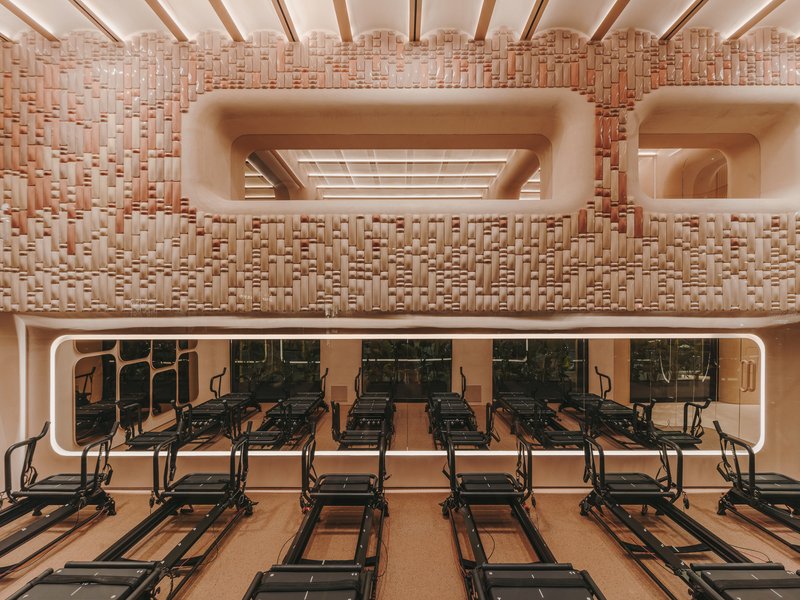
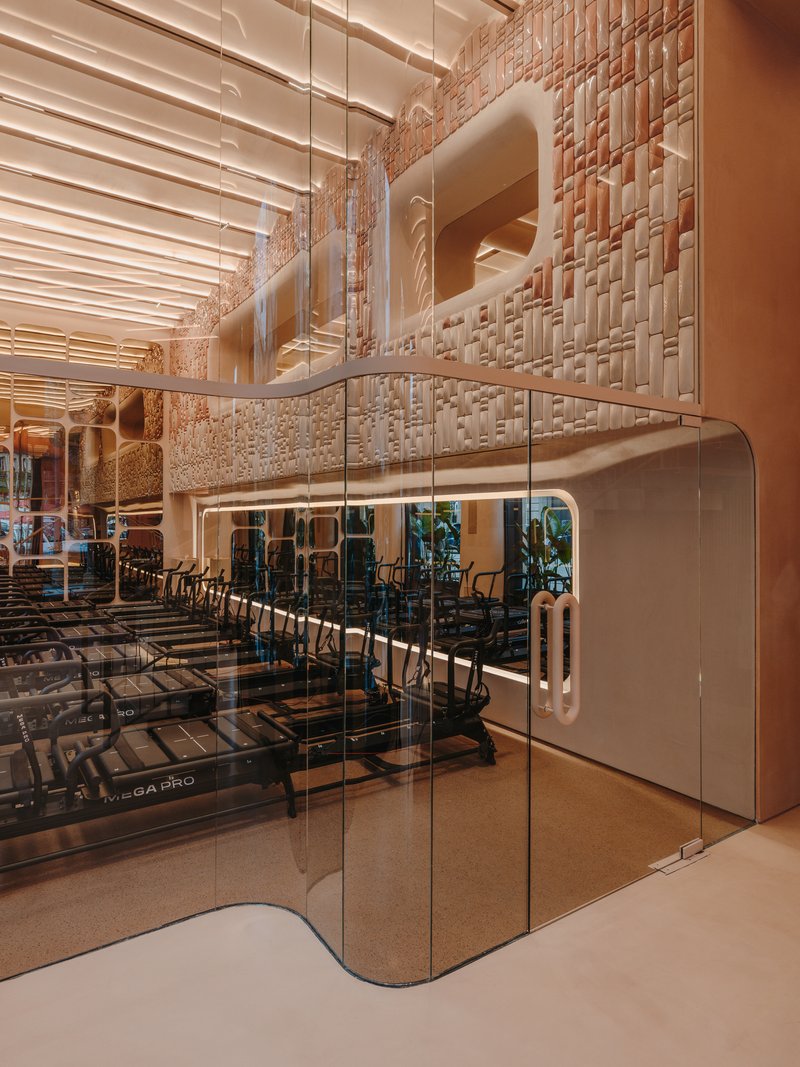
MEAN* names each program zone with a verb: Reform for Pilates Reformer, Rebuild for Lagree training, Recharge for EMS. It is a branding conceit, but the architecture follows through. The Reform studio is the project's showpiece: rows of reformer machines sit beneath arched openings and ribbed ceiling beams, washed in cove lighting that transforms the timber structure into something almost ecclesiastical. The basketweave wall panels, handcrafted by Cumella, line the double-height rear wall and give the room a texture that photographs cannot fully convey. These are not applied surfaces; they are load-bearing expressions of craft.
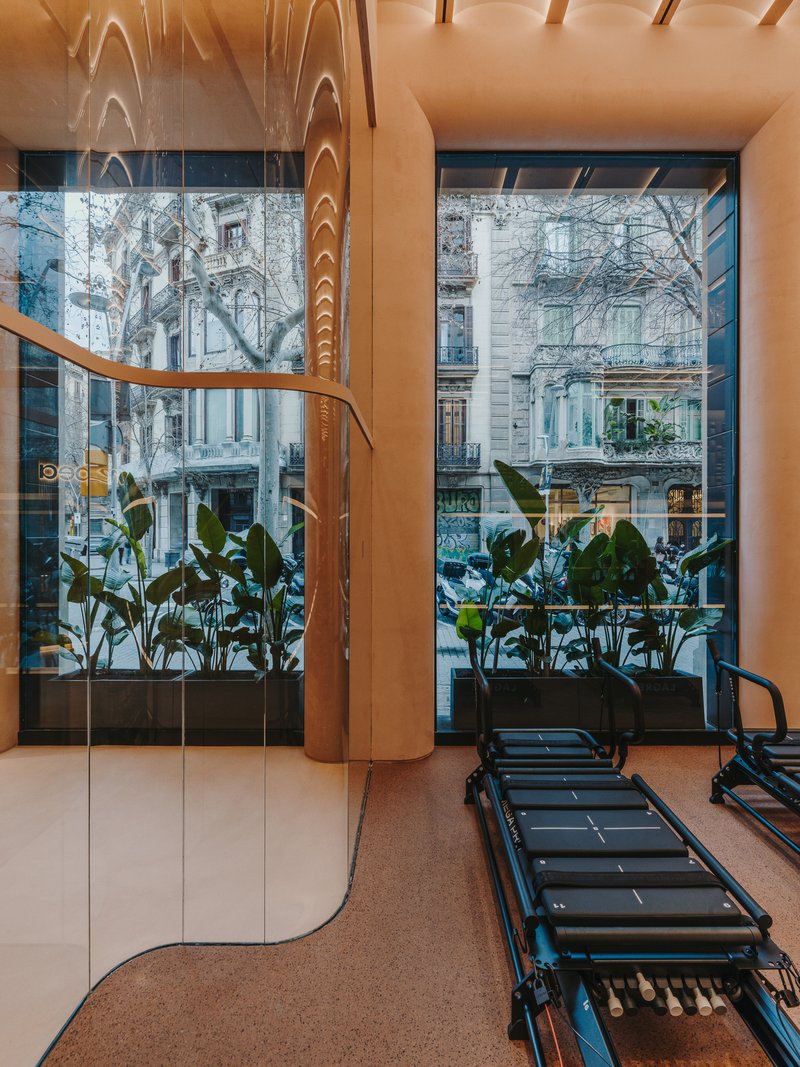
The palette here shifts to cream and soft pink, distinct from the terracotta entry. Planters punctuate the reformer rows, and natural light from full-height windows on one side keeps the space from feeling hermetic. Seen from above, through the diagonal timber bracing and mirrored balcony, the studio reads as a disciplined field of repetition, equipment and architecture reinforcing each other's rhythm. The Lagree space operates on similar principles but with a tighter ceiling and more intimate scale.
Cumella Ceramics and the Detail Register
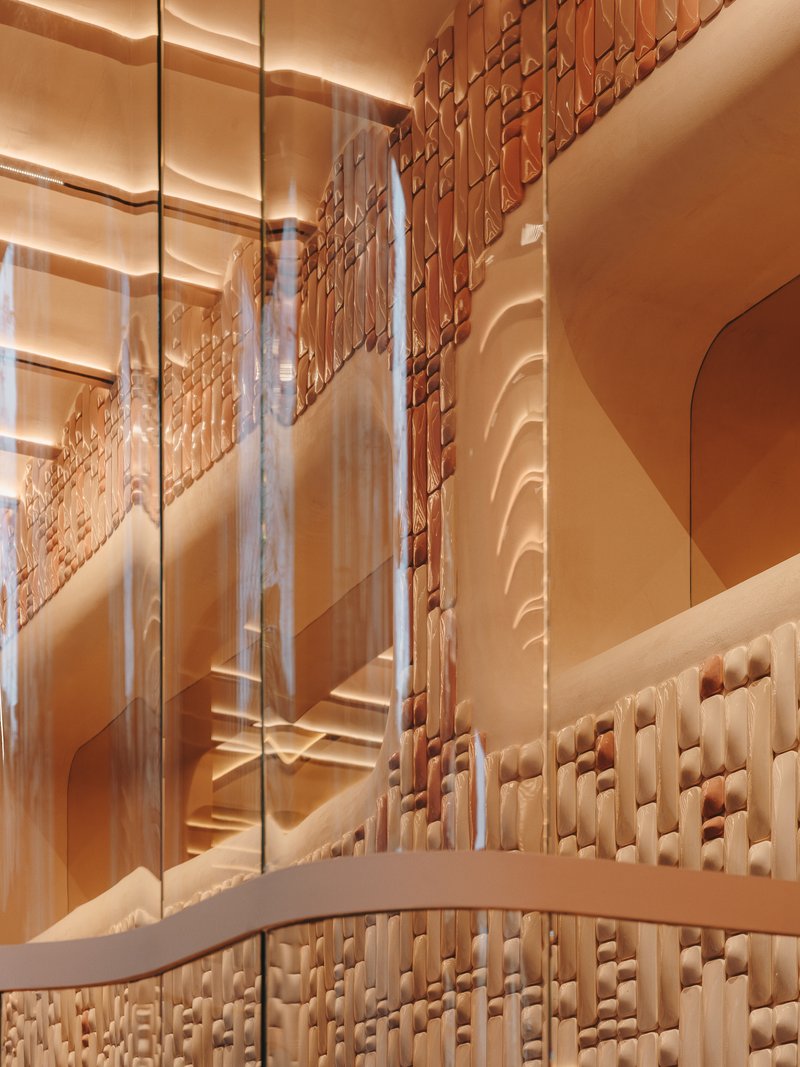
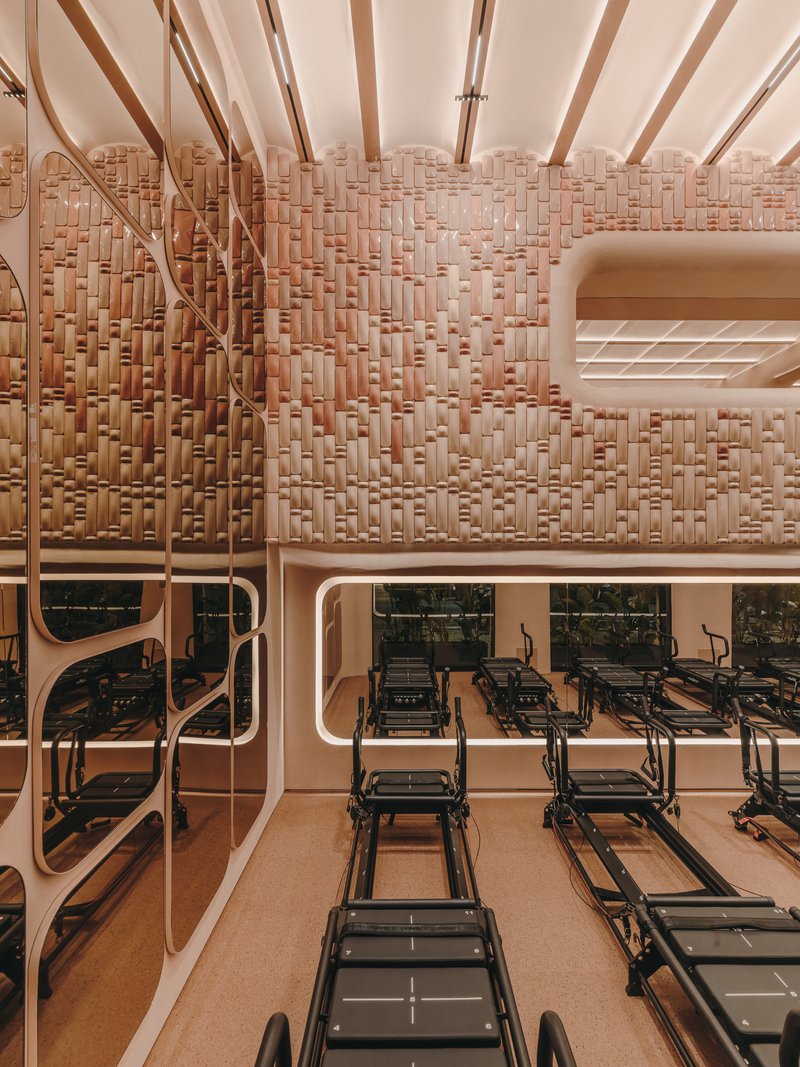
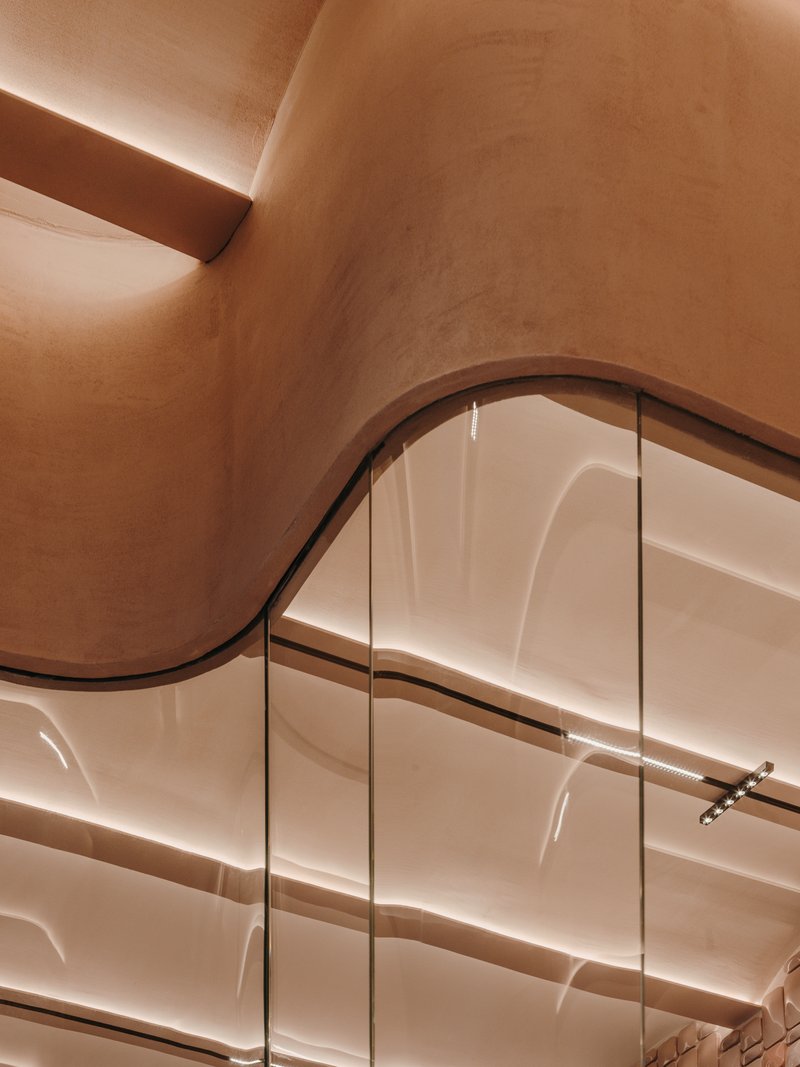
The collaboration with Cumella is not decorative. The ceramics studio, whose work adorns Gaudí's unfinished basilica, produced the woven terracotta surfaces that define the double-height wall in the main studio. Seen through glass partitions or from oblique angles, the basketweave pattern creates a moiré effect that shifts with your position, making the wall feel alive rather than static. It is a material choice that anchors the project in Barcelona's ceramic tradition without resorting to pastiche.
Elsewhere, the detail register holds. Curved plaster walls meet sculptural ribbed glass panels with precision. Benoît Duchesne's custom joinery appears at the reception desk, the cafe counter, and the locker room benches, each piece subtly different in profile but unified in finish. Leika Light's contribution is equally specific: cove lighting in the studio ceilings, vertical pendants at the espresso bar, recessed linear strips in the locker alcoves. No fixture appears twice in the same configuration.
Café and Retail as Threshold
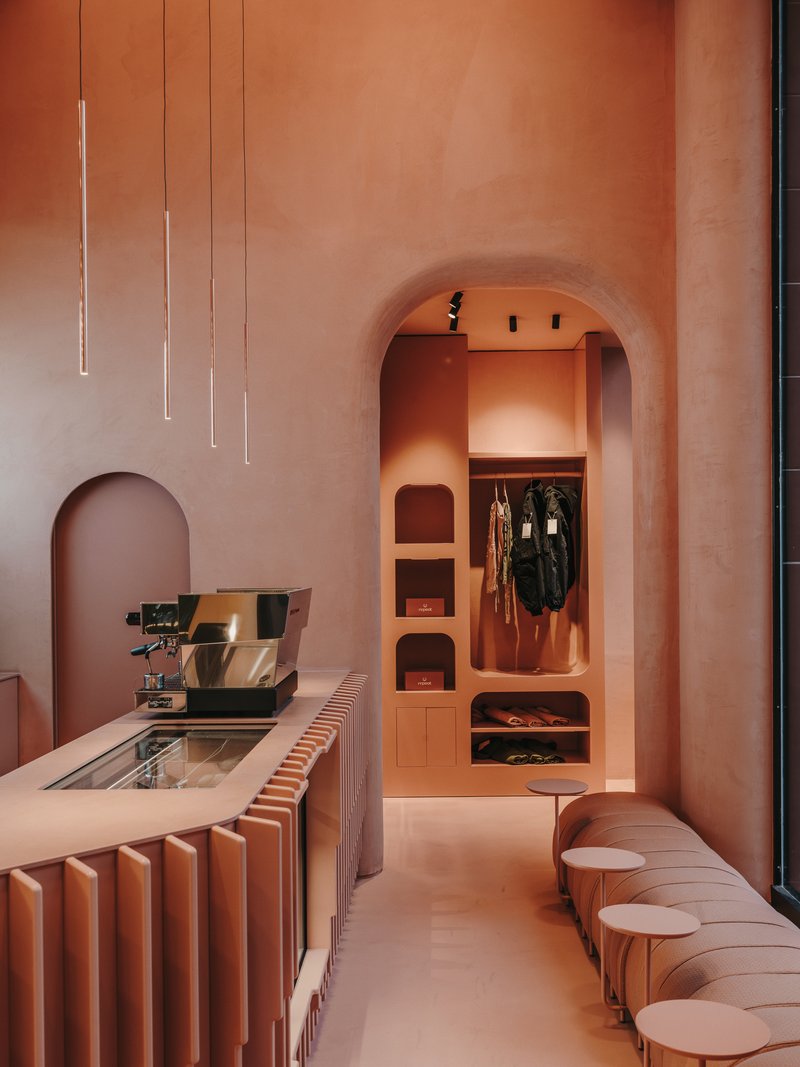
The espresso bar and retail area occupy the front of house, deliberately positioned as a social buffer between street and studio. Vertical pendant lights hang above a curved counter backed by an arched alcove displaying retail merchandise. The deeper tones here, warm terracotta and amber, are the project's most saturated. MEAN* treats the cafe not as an afterthought but as the first chapter in a chromatic narrative that lightens and cools as you move deeper into the building.
Corner window seating with potted palms and segmented lounges invites lingering. Glass partitions allow sightlines into the double-height studio beyond, maintaining visual continuity without acoustic bleed. It is a smart social design: members arriving for class pass through the cafe, encounter friends, and are already oriented before they reach the training floor.
Reset: Sauna, Ice Plunge, and the Green Rooms
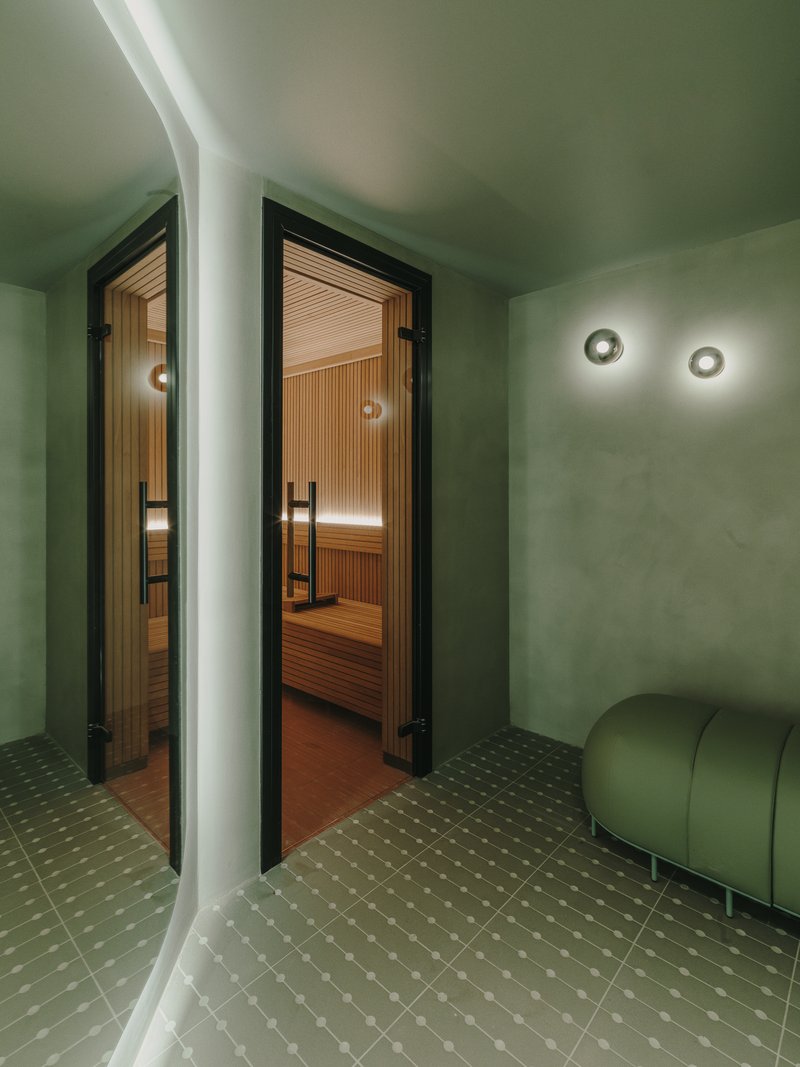
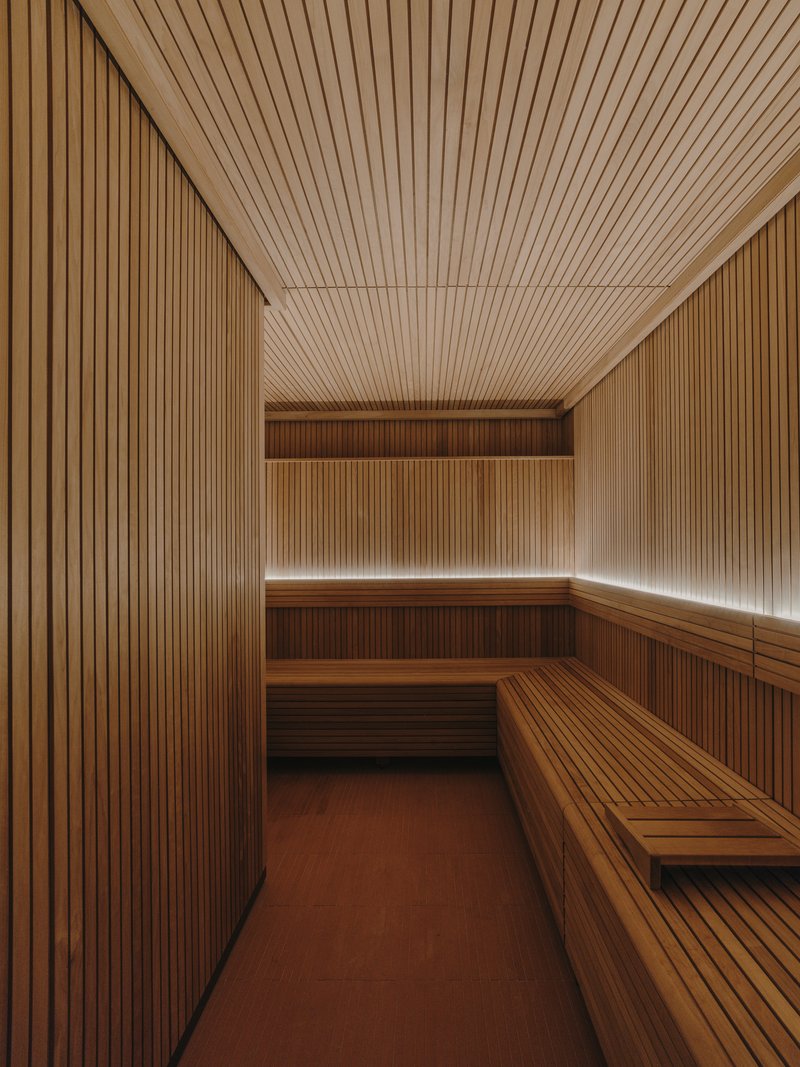
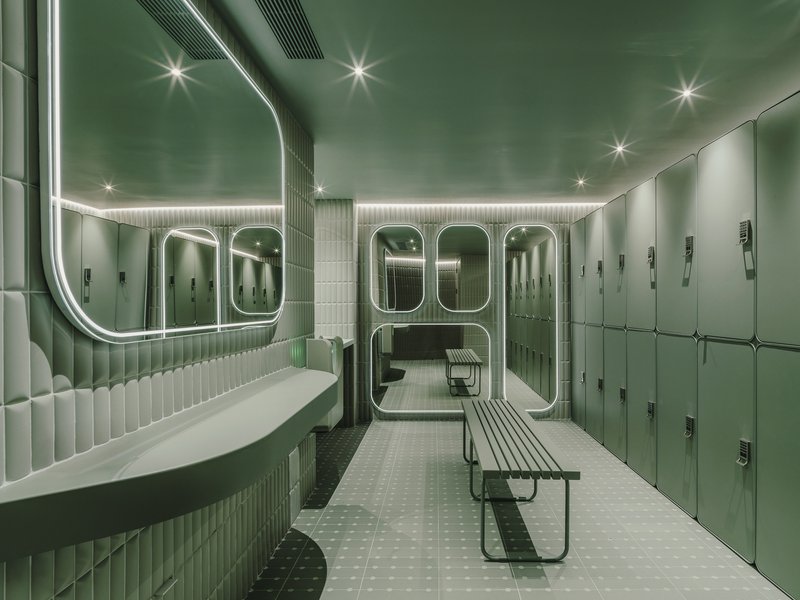
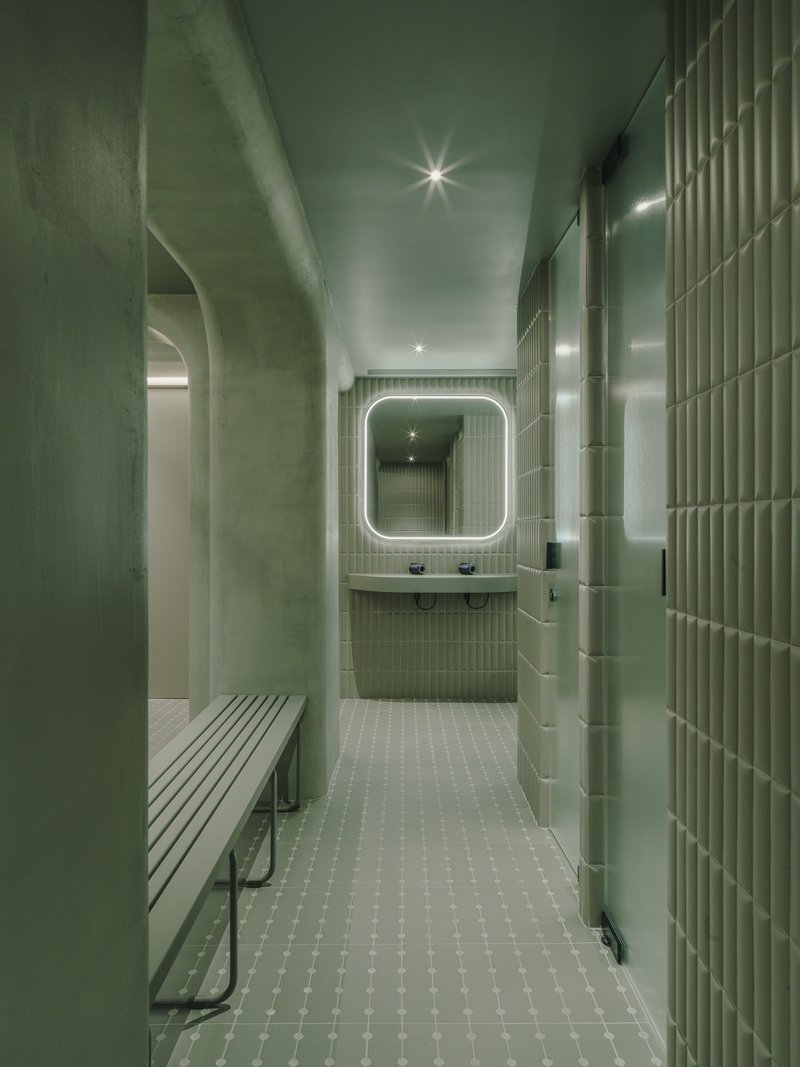
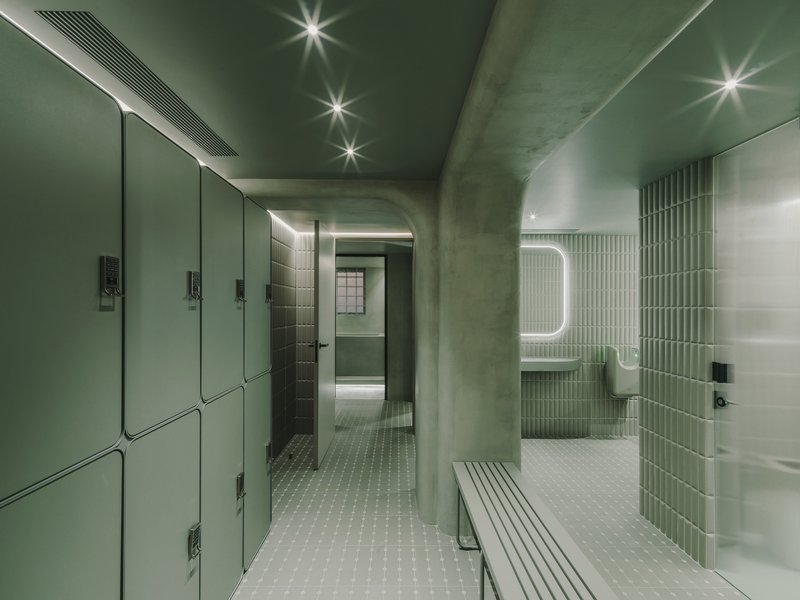
The wellness zones at the rear of the plan are where the chromatic strategy pays off most clearly. Light greens take over: fluted green tile lines the locker rooms and changing areas, the ceiling shifts to a painted green, and the mosaic floor introduces a pale, almost aquatic tonality. The sauna, visible through a glass door beyond a curved white column, is lined entirely in vertical wood slats with tiered benches and continuous perimeter lighting. It is elemental and precise.
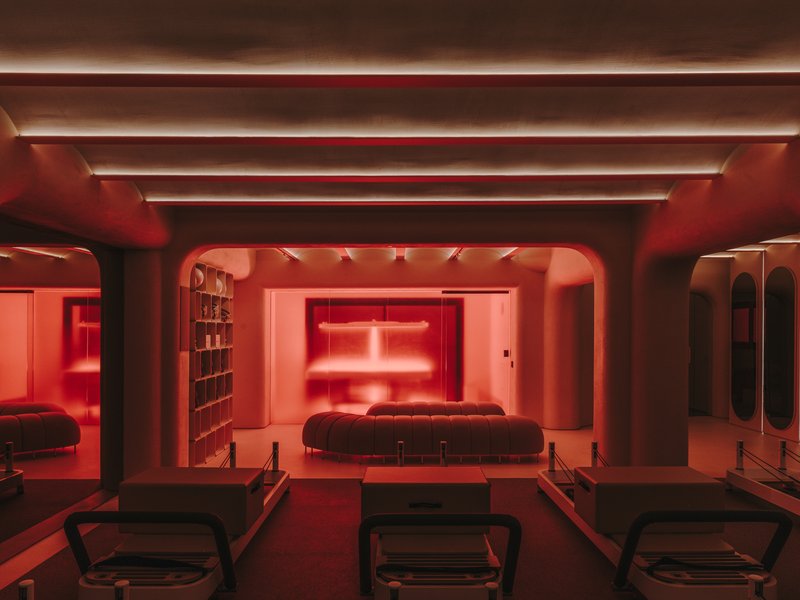
A red-lit wellness space offers a dramatic counterpoint: reformer stations face arched openings under linear ceiling coves in deep crimson. It reads almost theatrical, a deliberate tonal shift that signals a different mode of engagement. The curved passage connecting locker area to shower rooms uses the mosaic floor and painted green ceiling to create a sense of continuous flow, making the transition from exertion to recovery feel spatial rather than merely functional.
Wet Rooms and the Precision of Service Spaces
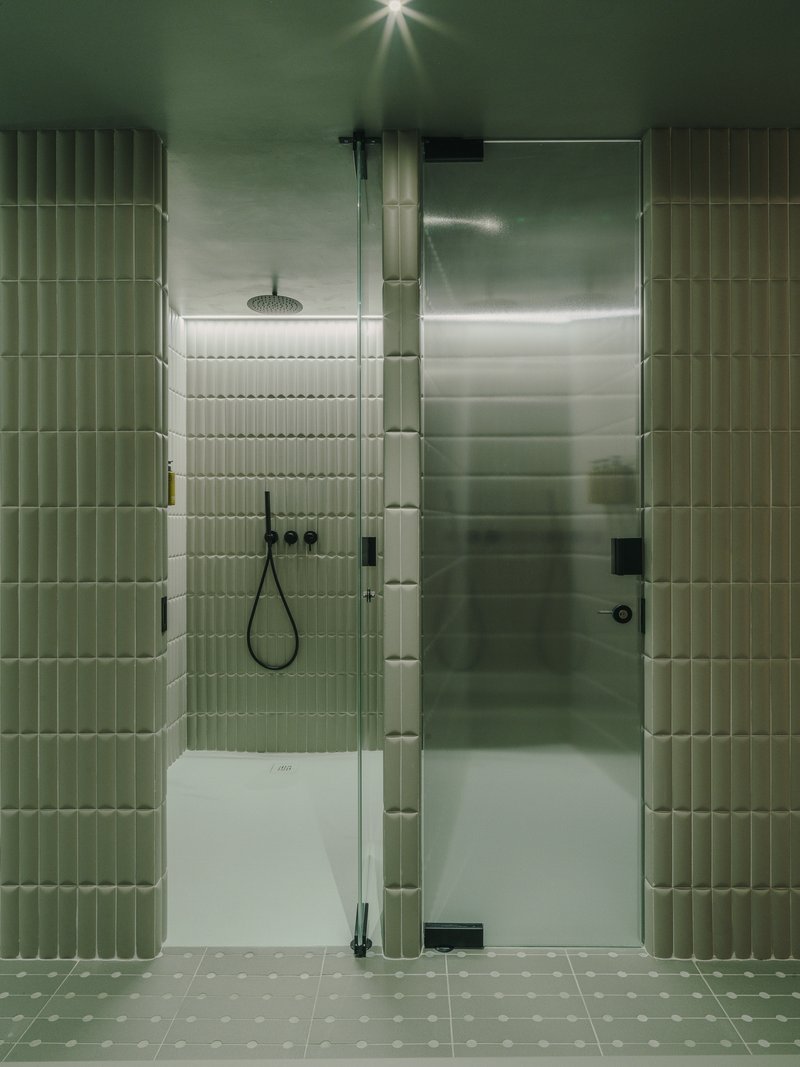
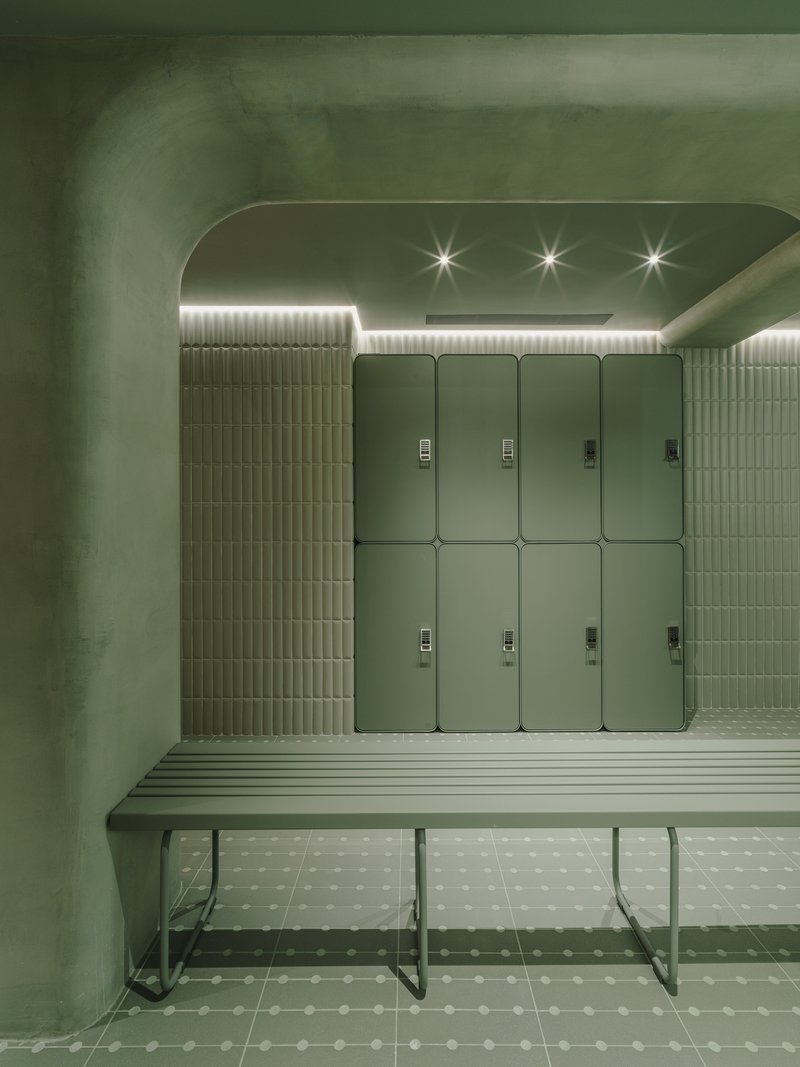
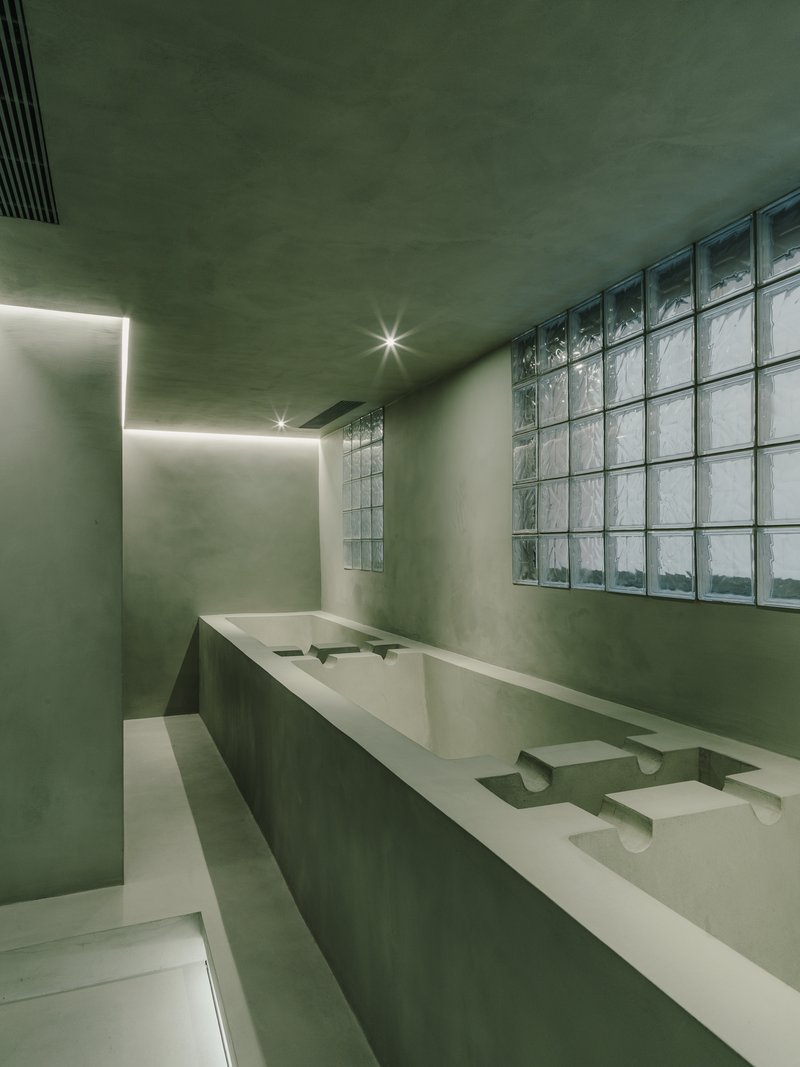
Service spaces in wellness projects are often the places where design ambition dies. Not here. The glass-enclosed shower stalls with vertical ribbed green tile and overhead rainfall showerheads maintain the same material exactness as the front-of-house areas. Locker alcoves feature slatted benches with recessed linear lighting above, and the washroom integrates basin counters against a glass block window wall that admits diffused light without sacrificing privacy.
These rooms are small and utilitarian, but the material continuity is total. The ribbed tile profile matches across showers, lockers, and corridors. The concealed ceiling lighting maintains consistent color temperature. MEAN* and their collaborators clearly understood that a wellness experience collapses the moment the back-of-house feels like an afterthought.
Plans and Drawings
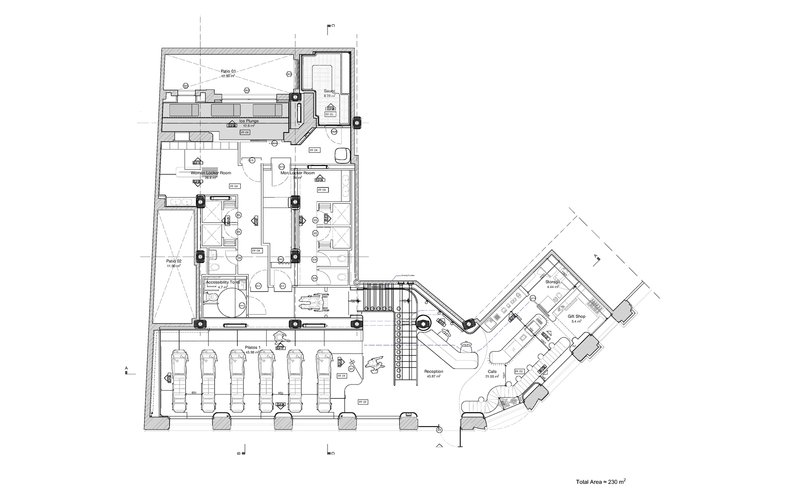
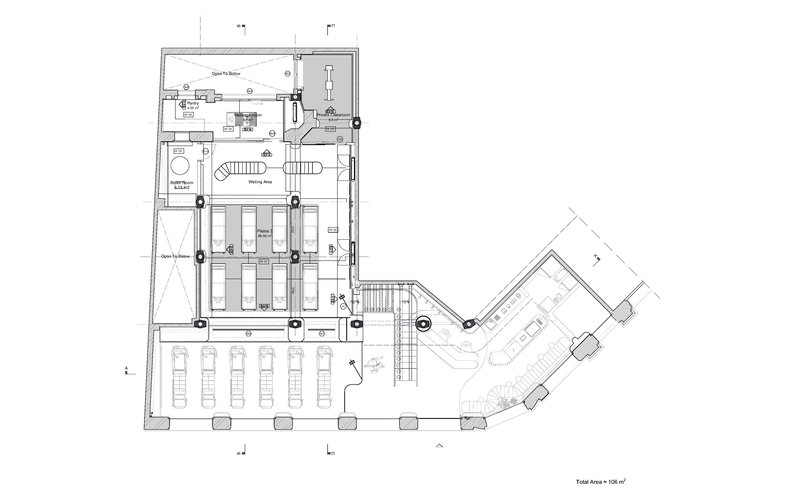
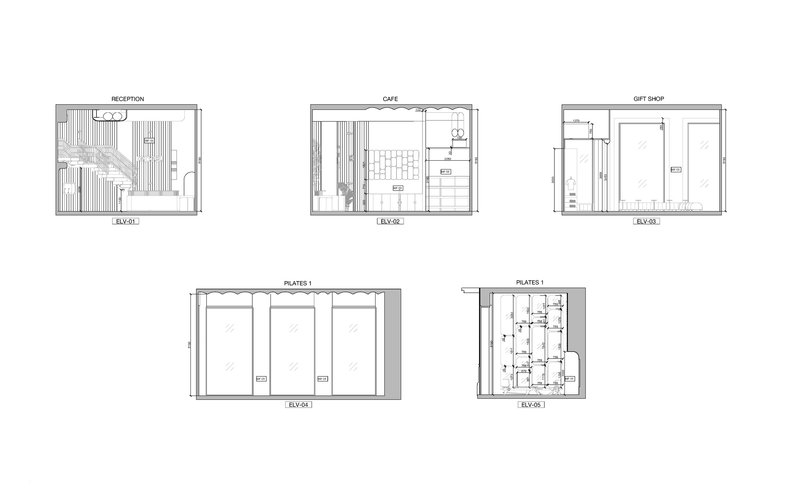
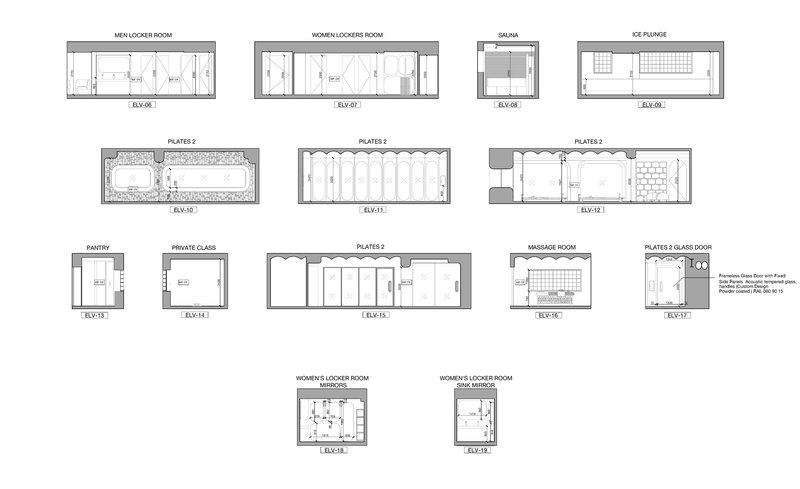
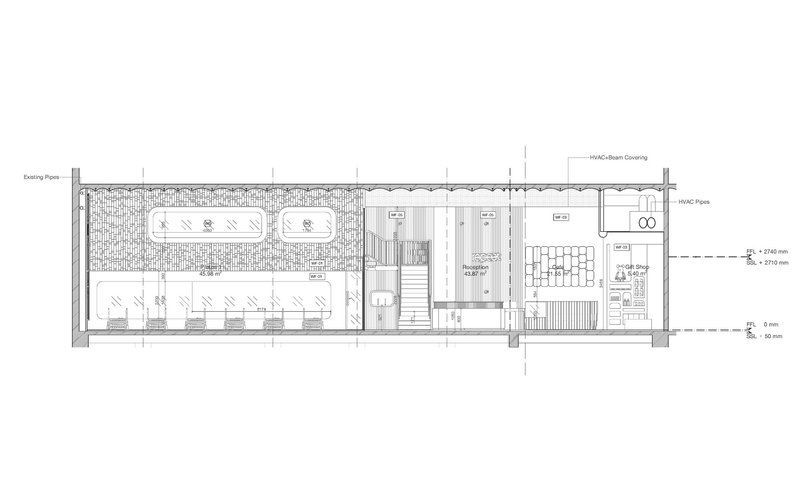
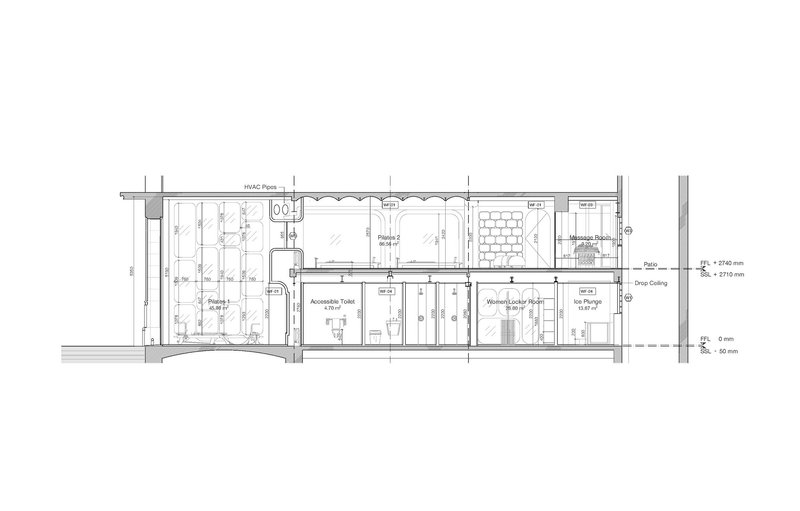
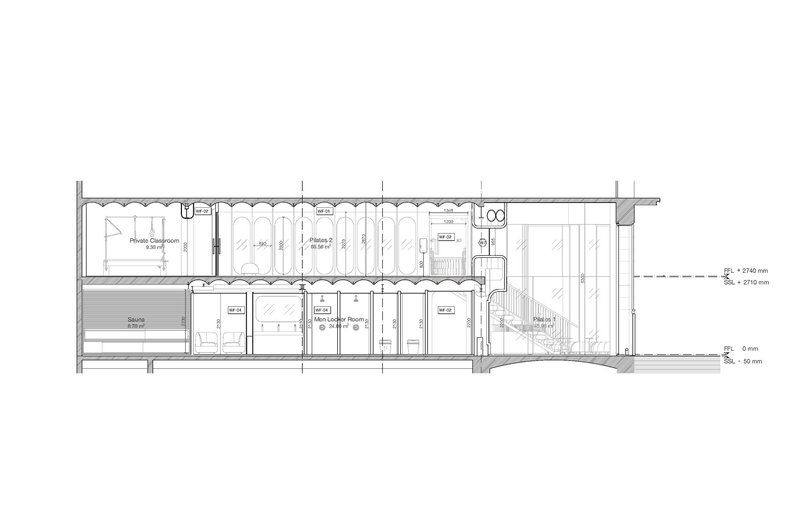
The floor plans reveal the angled geometry that MEAN* inherited and had to resolve. The site is not a simple rectangle; it pitches at an angle that forces the stair core and exercise areas into a diagonal relationship. The sections are particularly telling: they show how the double-height studio volume is carved out of the deep floor plate, how level changes accommodate the sauna and ice plunge at the rear, and how the ceiling profiles, from ribbed timber beams to flat coves, modulate the sense of compression and release as you move through the sequence.
Interior elevations document the material specificity in each room: hatching for the basketweave ceramic, the fluted green tile, the timber slat sauna lining, the glass block washroom wall. Every surface is drawn and specified. For a project built inside an inherited shell with no exterior expression, these drawings carry the entire architectural argument.
Why This Project Matters
Wellness interiors are booming, and most of them are terrible. They default to a vague Scandinavian aesthetic, plywood and white oak and diffused light, because it signals calm without requiring real design thought. Repeat Wellness Club is a corrective. It takes a specific site with specific constraints, an irregular Barcelona commercial unit that cannot be touched on the outside, and builds an intensely resolved interior sequence that changes color, material, and spatial proportion as program demands shift. The collaboration with Cumella alone sets it apart: using the same ceramicists who work on the Sagrada Familia to line a Pilates studio is not prestige borrowing, it is a genuine engagement with local craft tradition applied to a contemporary program.
More broadly, the project makes a case for adaptive reuse as a creative constraint rather than a compromise. The irregular floor plate, the deep plan, the untouchable facade: these are not problems to be overcome but conditions that generate the architecture. The staircase exists because the section demanded vertical connection in a specific location. The chromatic gradient exists because seven programs needed to feel distinct within a continuous envelope. MEAN* has produced a project where every decision traces back to a site condition or a programmatic need, and that legibility is what separates architecture from interior decoration.
Repeat Wellness Club, designed by MEAN* (Middle East Architecture Network) with AK Studio as Architect of Record. Located at Carrer d'Ausiàs Marc 41, Dreta de l'Eixample, Barcelona, Spain. Completed in 2026. Ceramics by Cumella, custom joinery by Benoît Duchesne, lighting design by Leika Light, MEP engineering by Metrico, main contractor Arqfai, brand identity and signage by A4 Design House. Photography by Salva Lopez.
About the Studio
Share Your Own Work on uni.xyz
If projects like this are the kind of work you want to make, uni.xyz is a place to publish your own, find collaborators, and enter design competitions.



Popular Articles
Popular articles from the community

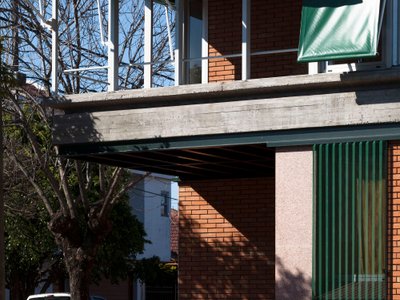
Francisco Cadau Converts a 1970s Corner House in Campana into Four Compact Dwellings
A light steel-and-timber upper volume lands on a brick base, turning a single Argentine home into a tectonic study in railroad vernacular.
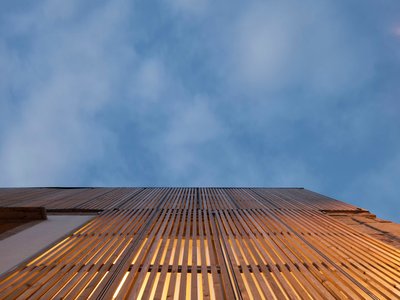
LIQE arquitectura Wraps a Vigo Old Town Housing Reform in Folding Pine Screens
Perched between castle walls and the historic center, a timber-clad renovation filters estuary light through autoclave-treated slats.
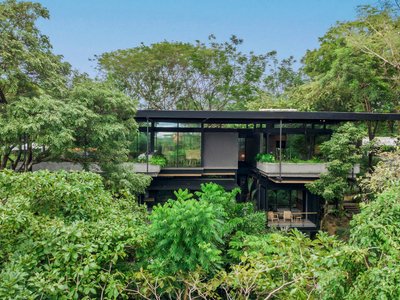
Studio Saxe Cantilevers a Seismic-Proof Jungle House Over the Costa Rican Canopy
Raintree House in Nosara perches on a forested hilltop, merging prefabricated steel structure with local craft and bioclimatic logic.
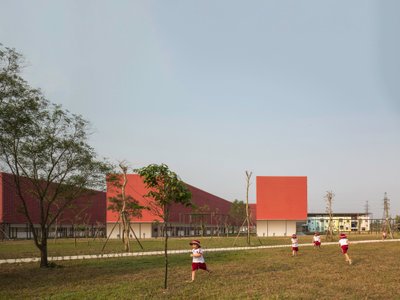
BHA Studio Wraps a 2,000-Student Campus in Terracotta Screens and Double-Layered Roofs in Central Vietnam
iSchool Quang Tri in Đông Hà uses perforated brick lattices and rainwater harvesting to keep 17,000 square meters cool and green.

Similar Reads
You might also enjoy these articles

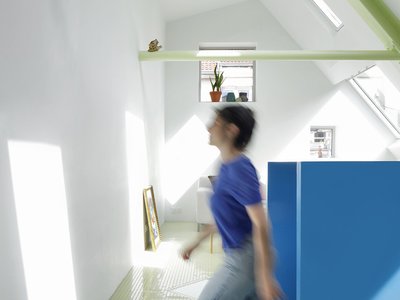
127af Flips a Tiny Bagnolet Rowhouse Upside Down with a Handcrafted Roof Extension
A 55-square-meter terraced house on the edge of Paris gains a luminous upper living floor through lightweight timber and steel.
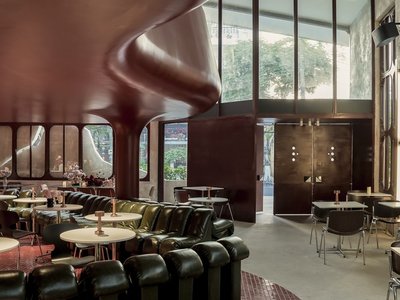
1.61 Design Workshop Wraps a 600-Square-Meter Café in Vietnam in Sculptural Burgundy Drama
Reden Café & Bistro pairs a helical staircase, mosaic floors, and deep red interiors to rethink Vietnamese hospitality space.

The Unbound Brain: A School Shaped by Cognitive Architecture
Cylindrical learning pods radiate like neurons from a central cortex, turning the floor plan into a spatial model of human thought.
Revival Vernacular Architecture: Rammed Earth Settlements for the Sahara
A modular desert community in Mauritania that fuses passive cooling techniques with earthen construction and local craftsmanship.




Comments (0)
Please login or sign up to add comments
No comments yet. Be the first to comment!