
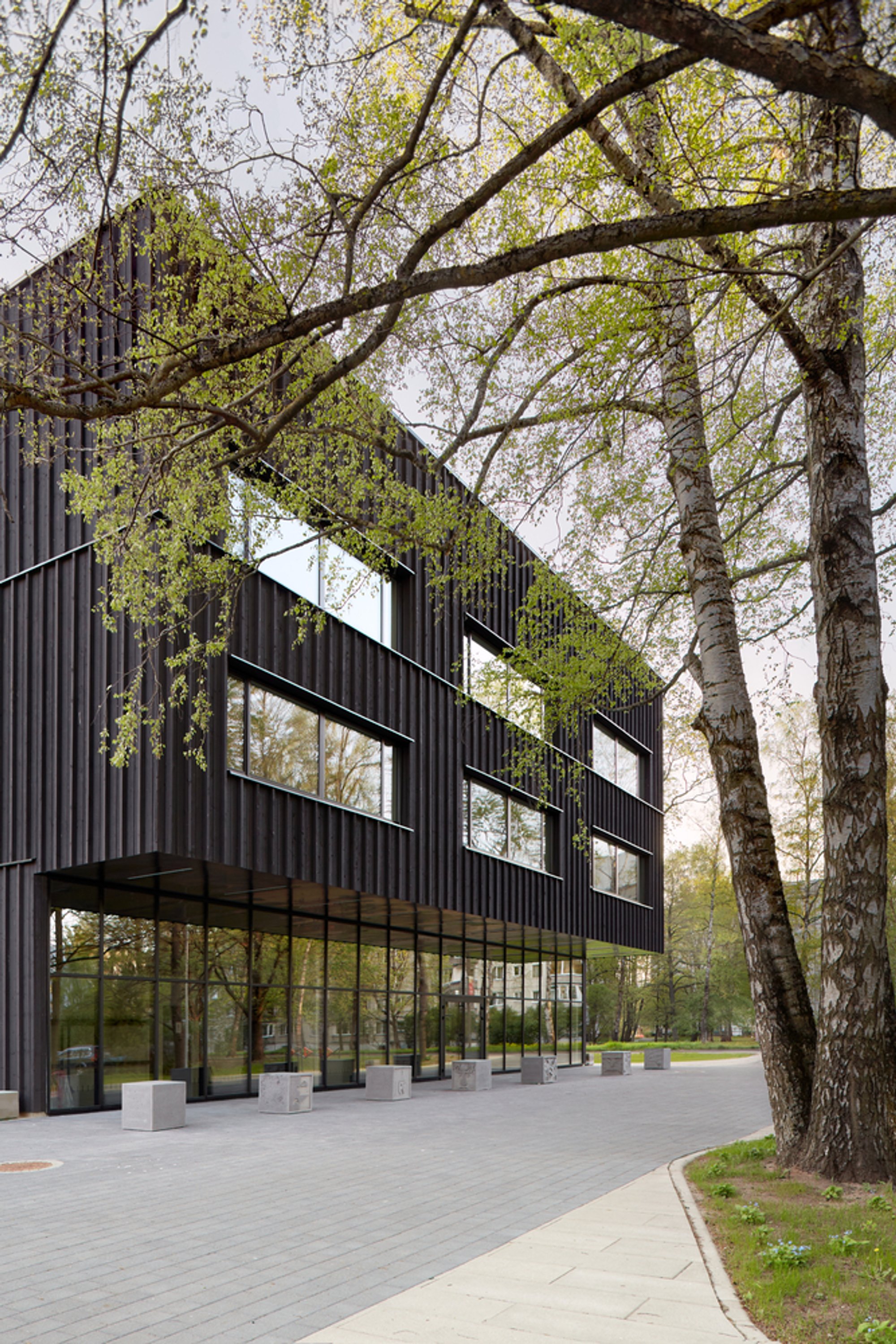
MADE Arhitekti Wraps a Film Studio in Black Timber for Riga's Art and Media School
A monolithic concrete blackbox clad in charred-looking wooden boards anchors a media campus on the western edge of Riga.

There is a long tradition of arts schools that look nothing like the work produced inside them. MADE arhitekti took the opposite approach with the Media Building for Riga Art and Media School (RMMT). The building's monochrome envelope, clad in black-painted wooden boards and lats, reads like a clapperboard propped against the birch trees along Jūrmalas Gatve. It is blunt about its purpose: this is a place where film gets made, and the architecture does not pretend otherwise.
What makes the project genuinely interesting, beyond the striking palette, is the way a 1,574-square-meter footprint absorbs two fundamentally different programmes. A 400-square-meter filming studio, 9 meters tall and modeled on black box theatre principles, sits beside conventional classrooms and administrative offices stacked across three floors. The building has to be quiet enough for sound recording and flexible enough for daily teaching. Monolithic reinforced concrete does both jobs at once, providing mass for acoustic isolation and thermal stability with minimal mechanical cooling.
A Facade That Signals Intent
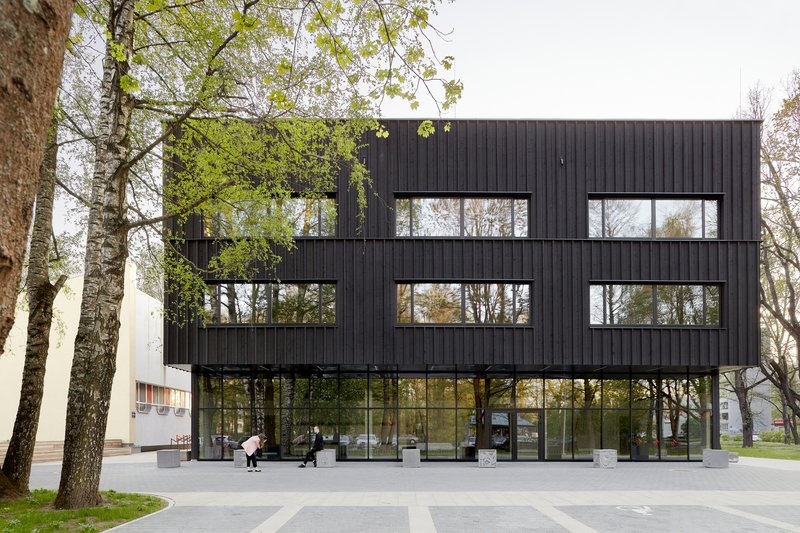
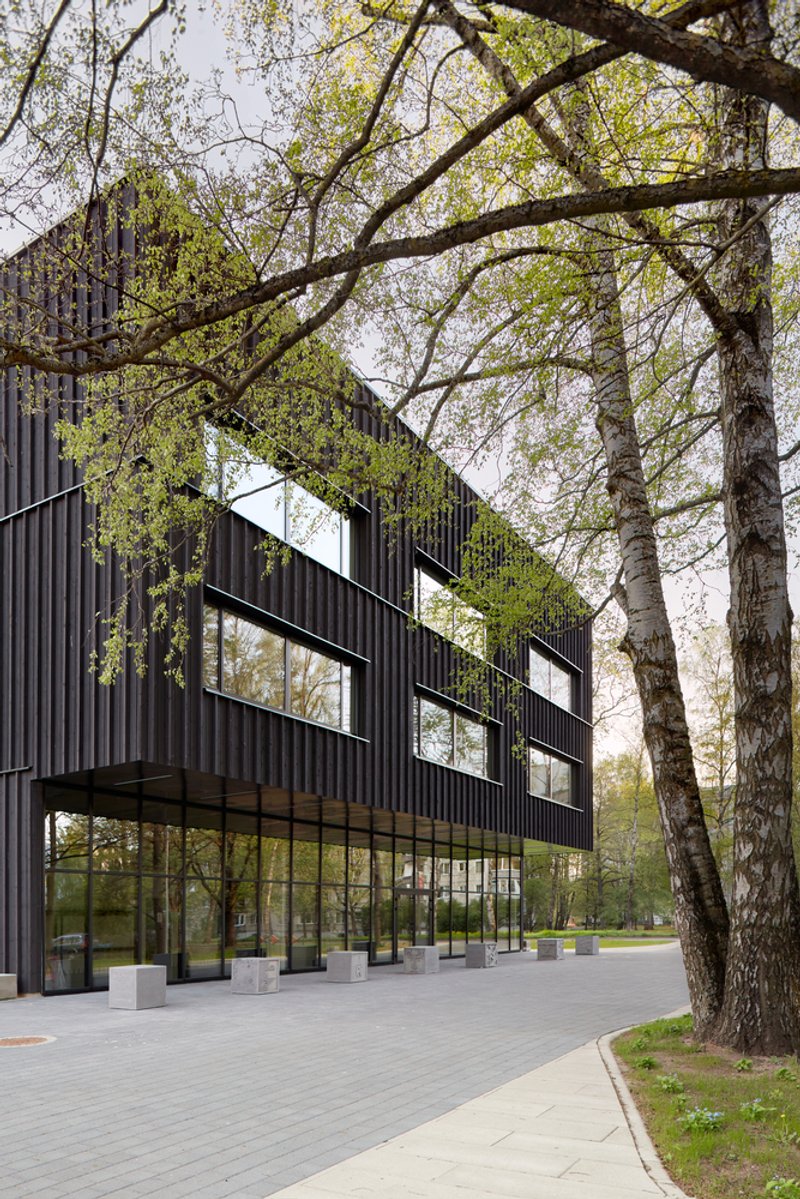
The ventilated facade spans 1,383 square meters of black-painted timber, divided into three horizontal lanes. Each lane steps out slightly from the one below it, producing a subtle, staggered profile that catches light differently across the day. The effect is less about ornament and more about breaking down what would otherwise be a sizable concrete mass. Against the pale trunks of the surrounding birch trees, the dark cladding creates an almost theatrical contrast, as if the building is permanently set-dressed.
Windows are punched into the wooden skin at irregular intervals, their placement governed by the interior programme rather than a strict compositional grid. On the eastern elevation, larger glazed openings take advantage of natural shading from existing trees, reducing summer solar gain. The result is a facade that looks consistent from a distance but reveals its logic up close.
Concrete and Light in the Circulation Core
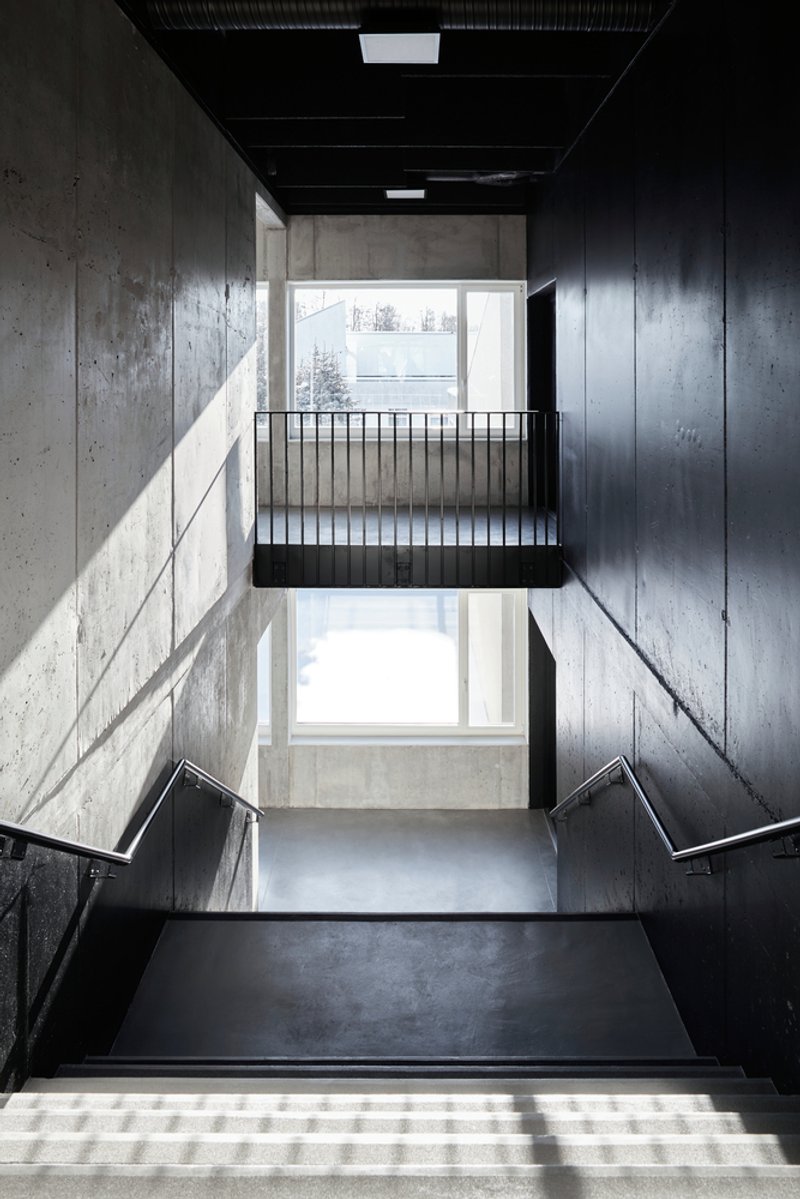
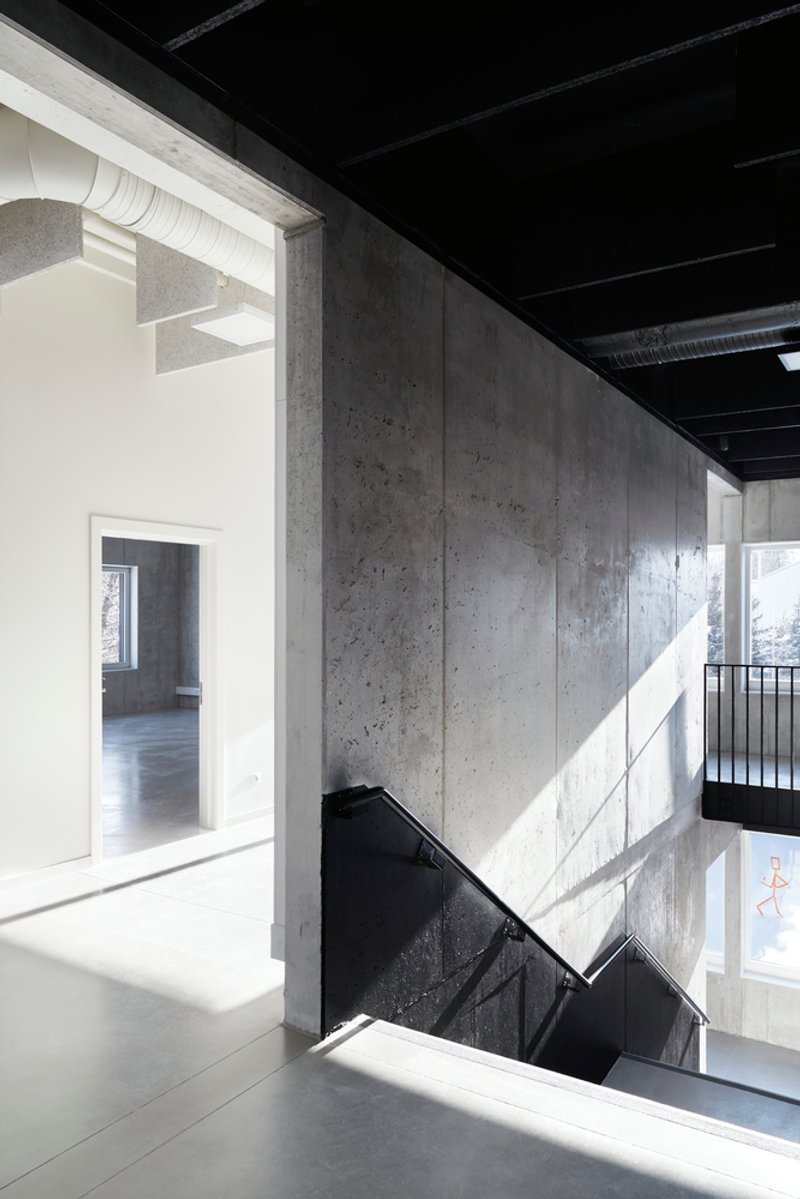
Two staircases, one open and one enclosed, knit the three floors together. The open stair is the more expressive of the two: board-formed concrete walls catch afternoon sunlight through tall windows, casting warm bands of light across the raw surfaces. Black metal railings and balustrades introduce the same tonal discipline found on the exterior, keeping the interior language tight.
Board-formed concrete is notoriously difficult to execute well. Here the formwork imprint is deliberate, adding grain and texture to surfaces that might otherwise feel institutional. It also serves as a visual bridge between the rough, industrial character of the filming studio and the cleaner finishes in the classrooms above.
Interior Spaces: White Rooms, Black Box
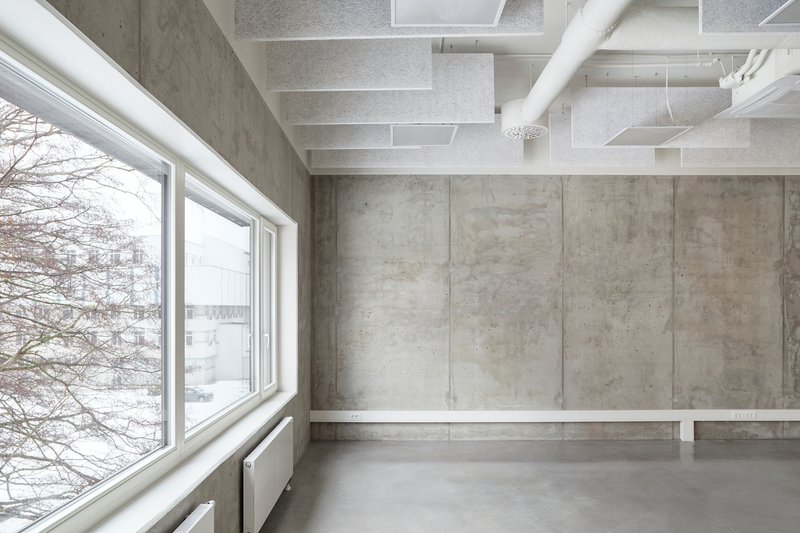
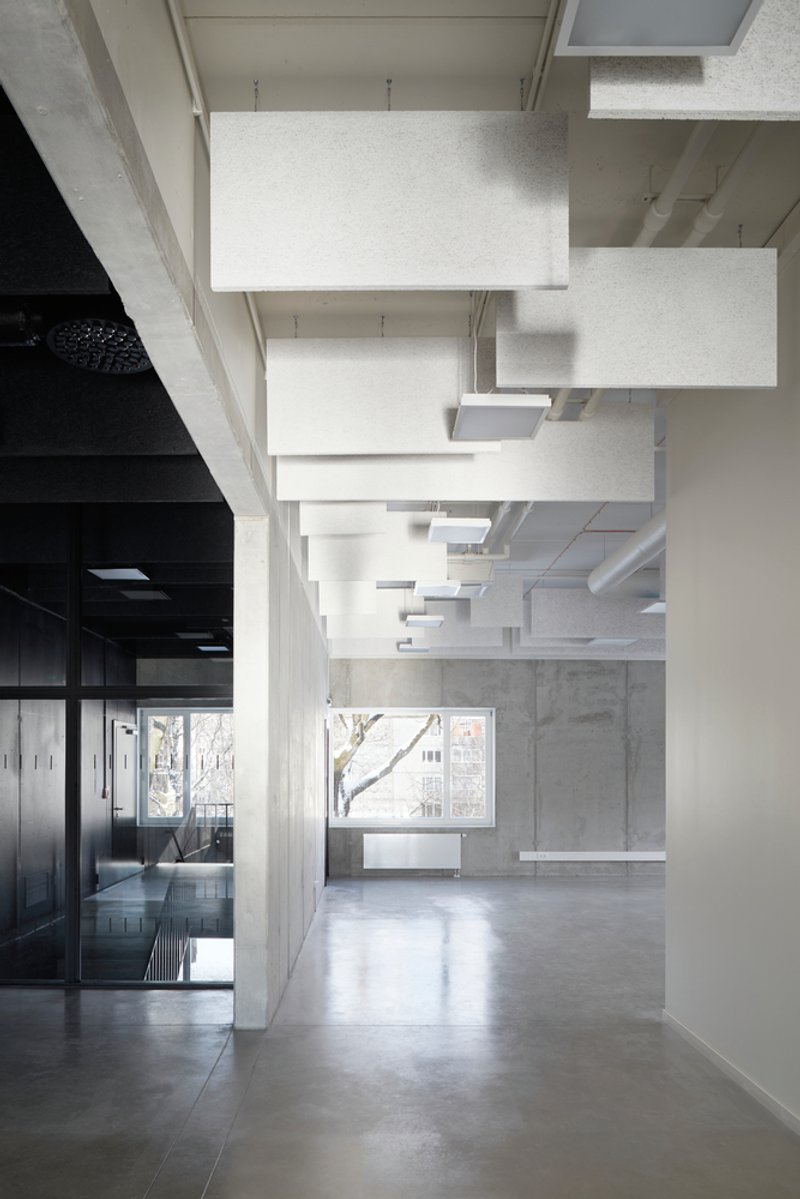
The classroom and administrative zones occupy the second and third floors. Rooms are painted white and paired with exposed concrete, producing a neutral backdrop suited to focused study. Floating acoustic ceiling panels manage reverberation without dropping the ceiling height, and glazed partitions between the corridor and teaching spaces allow borrowed light to penetrate deep into the floor plate.
The contrast with the filming studio below is stark. The blackbox, measuring 20 by 21 meters with a clear height of 9 meters, follows black box theatre conventions: a dark, neutral volume designed for maximum transformability. Acoustics and sound insulation were engineered to accommodate simultaneous episodic filming and everyday instruction. The building effectively contains two atmospheres, one clinical and bright, the other industrial and absorptive, separated by a single concrete slab.
Acoustic Detailing and the Studio Threshold
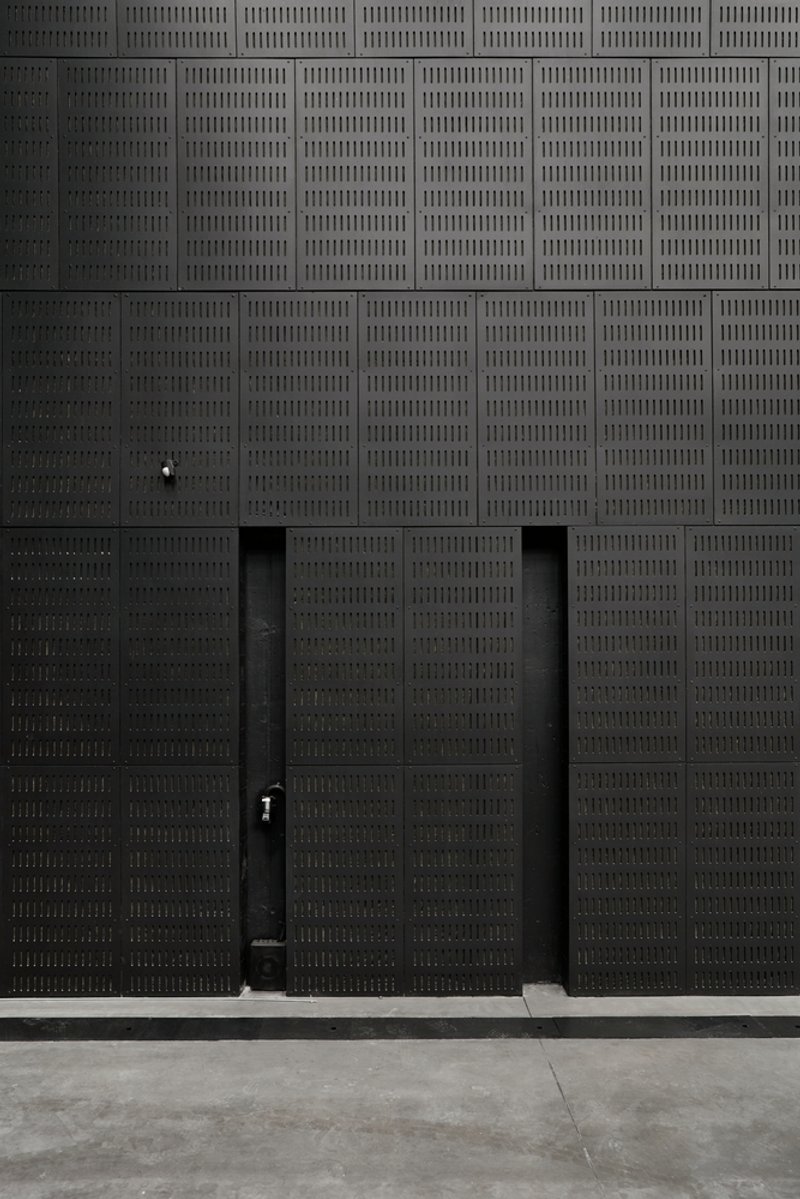
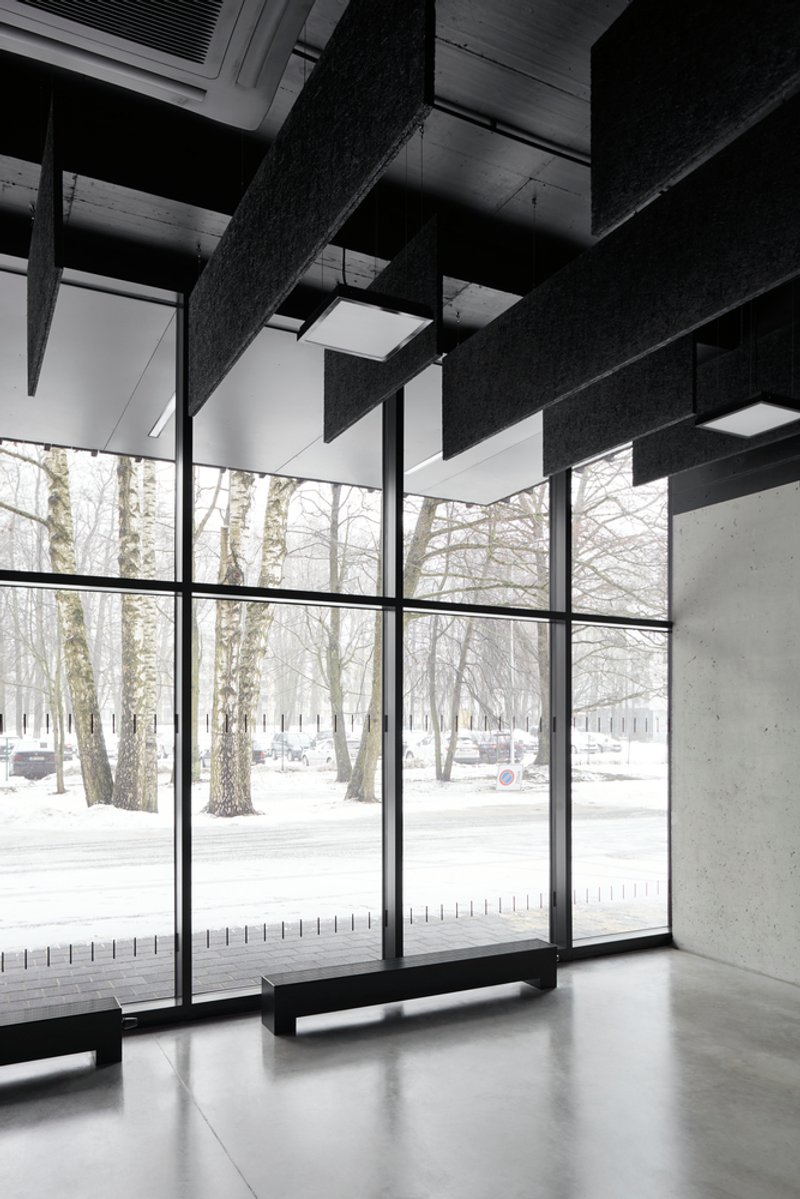
A pair of perforated black metal doors marks the entrance to the main studio, set within a grid of acoustic panels. It is a small detail, but it signals a material shift: beyond these doors, every surface is tuned for sound control. The precision required to make a working film studio inside an educational building is often underestimated. Walls, floors, and ceilings must isolate sound from adjacent classrooms, and the studio must accommodate changing rooms, make-up spaces, and a photo studio on its flanks without acoustic bleed.
MADE arhitekti's decision to use solid monolithic reinforced concrete for the enclosing structure was driven as much by acoustic performance as by energy strategy. Mass dampens vibration and blocks airborne sound, solving two problems with one material choice. The ventilated timber facade adds another decoupled layer, further reducing transmission from outside.
Campus Strategy and Urban Connection
The Media Building defines the entrance to the RMMT complex. A new pedestrian street connects Jūrmalas Gatve to the main school building, with a landscaped amphitheater stitching the new volume to its older neighbours. The ground floor lobby opens generously onto this route, functioning as a convertible event space that extends the public life of the street into the building.
Existing school buildings at RMMT are free-standing rectangular blocks with characteristic overhangs. The Media Building adopts the same typological posture, elevated on pilotis and reading as a discrete object in the landscape. But its dark skin and stepped facade set it apart as the campus's public face, the first thing visitors encounter and the building most legible from the street.
Why This Project Matters
Educational buildings for creative disciplines tend to fall into two traps. They either suppress the programme behind a generic institutional envelope, or they over-perform architecturally and compromise the functional neutrality that studios and workshops demand. The RMMT Media Building avoids both. Its monochrome timber cladding communicates the building's cinematic identity without resorting to spectacle, and its monolithic concrete structure delivers the acoustic and thermal performance that a working film studio requires. The nomination for the 2022 Mies van der Rohe Award was well deserved.
For a school transitioning from its origins as a crafts institution into a media-focused curriculum, the building is also a statement of ambition. It tells students, prospective applicants, and the city that RMMT takes its new direction seriously enough to build infrastructure at a professional standard. That kind of institutional confidence, backed by architecture that actually works, is rarer than it should be.
Media Building of Riga Art and Media School by MADE arhitekti. Located in Riga, Latvia, at Jūrmalas gatve 96. 1,574 square meters. Completed 2021. Photography by Madara Kuplā.
About the Studio
Share Your Own Work on uni.xyz
If projects like this are the kind of work you want to make, uni.xyz is a place to publish your own, find collaborators, and enter design competitions.



Popular Articles
Popular articles from the community

20 Most Popular Office Building Projects of 2025
From biophilic workspaces in India to net-positive energy offices in New Delhi, 20 office building projects that defined architecture in 2025.

YOAP Architects Round a Corner in Yeongcheon with a Cylindrical Community Hub
A 197-square-meter brick and ribbed-clad tower turns a forgotten alley corner in South Korea into a public garden with a low threshold.
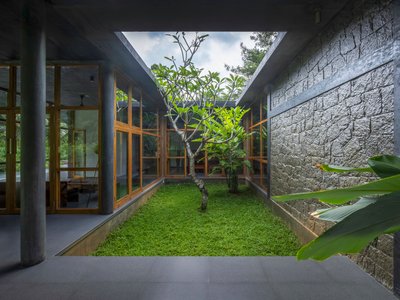
3dor Concepts Wraps a Kerala Home in Mirrored Concrete Arcs Around a Courtyard Tree
In the Western Ghats foothills of Thamarassery, a 270 m² single-story house uses two curved volumes to frame nature as its center.
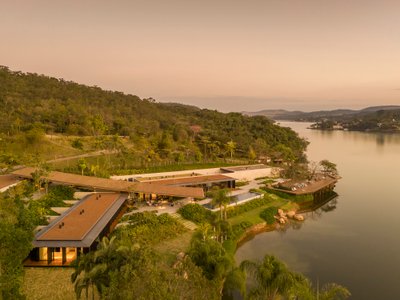
Bernardes Arquitetura Stretches a Timber Roof Along a Reservoir's Edge in Minas Gerais
Dam House in Itaúna lets a sweeping wooden canopy dissolve the boundary between hillside terrain and open water.

Similar Reads
You might also enjoy these articles
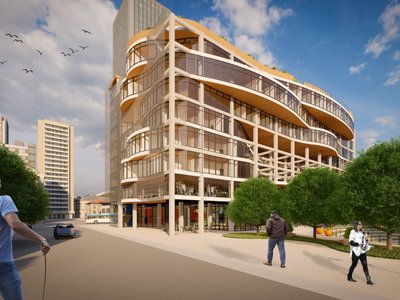
Olio Towers: A Mid-Rise for Performers That Fuses Housing, Rehearsal, and Stage
Located blocks from Houston's Theater District, this modular tower stacks living units around a central performance atrium.
Oasis: Modular Green Housing Carved into Dhaka's Urban Fabric
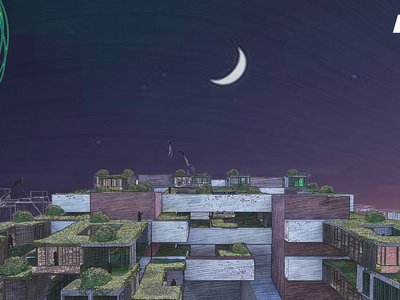
A shortlisted Plugin Housing entry reclaims unauthorized settlements in Dhaka with stepped concrete volumes, green roofs, and ventilation-driven design.

Black Hole: A Floating Megastructure for the Post-Physical Era
Emiliano Mazzarotto envisions a spherical, self-scaling arena where e-sports, digital hotels, and holographic stadiums replace traditional public space.
Compact & Sustainable Living in Piraeus: A Four-Level Family Home Built Around Light and Air
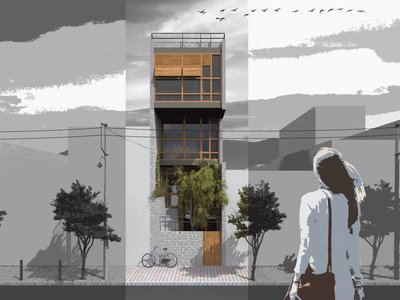
A narrow townhouse in one of Greece's densest port cities uses a central atrium and passive strategies to house three generations under one roof.

Explore Architecture Competitions
Discover active competitions in this discipline




The International Standard for Design Portfolios


The Global Benchmark for Architecture Dissertation Awards


The Global Benchmark for Graduation Excellence


Challenge to design public laboratory
Comments (0)
Please login or sign up to add comments
No comments yet. Be the first to comment!