
MIA Design Studio Builds a Family Home in Vietnam from Materials Found Within One Kilometer
A steel-framed, curtain-divided house in Phan Thiet proves that radical economy and spatial generosity can coexist on 86 square metres.


During Vietnam's COVID-19 lockdowns in 2021, MIA Design Studio faced a challenge that would have stalled most residential commissions: a family of four needed a home in Phan Thiet, Binh Thuan province, but the architects could not visit the site. Construction had to be managed remotely, with a local team and whatever materials were available nearby. The result is Binh Thuan House, an 86 square metre dwelling assembled from a prefabricated steel frame and corrugated iron, all sourced within a one-kilometer radius of the plot.
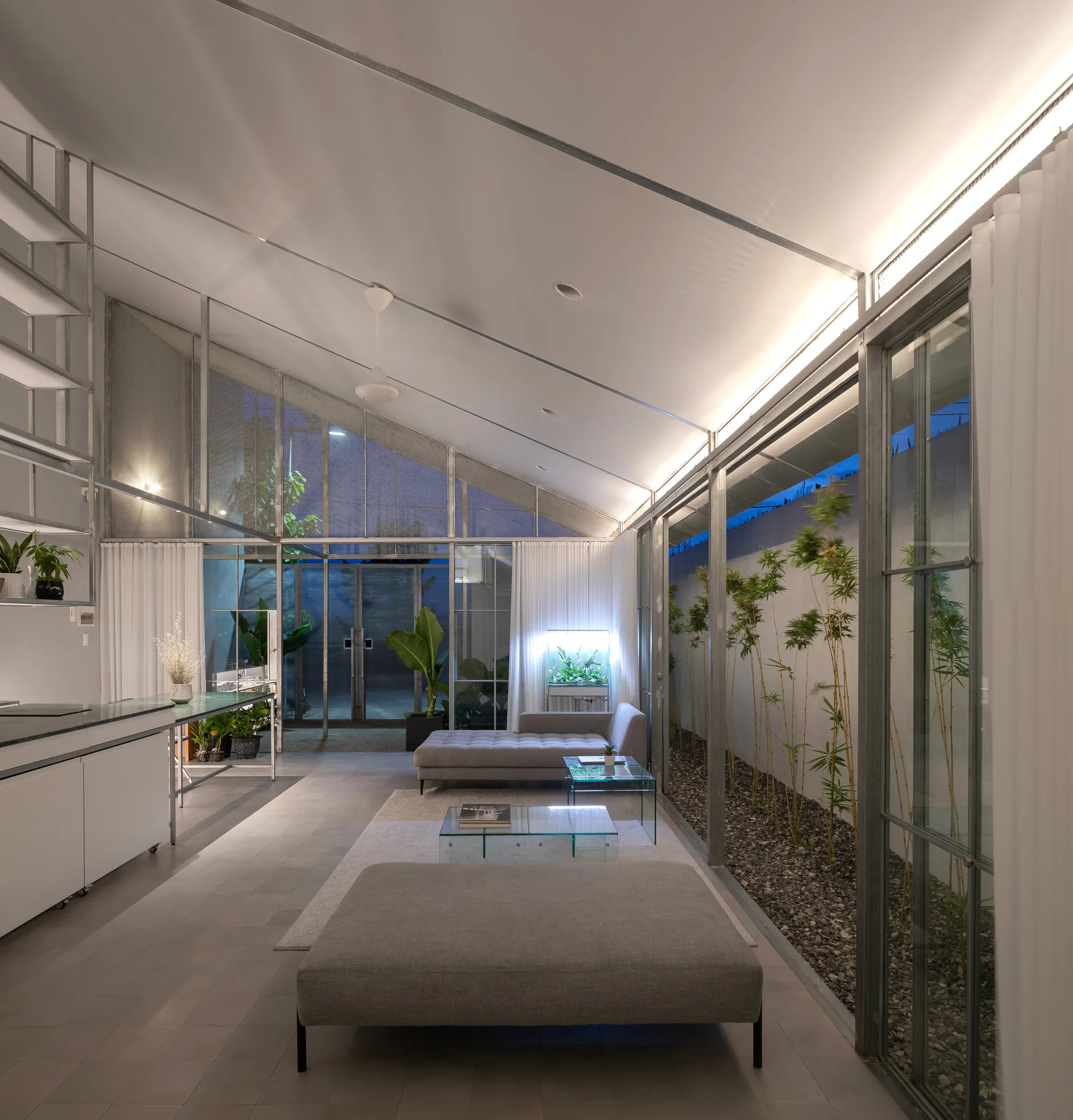
What makes this project worth paying attention to is not the constraint story alone. Plenty of pandemic-era projects leaned on logistical hardship as a crutch. What is actually interesting here is the design proposition that emerged from those limits: a single open volume where the steel frame does the work of walls, furniture, shelving, curtain tracks, and clothes hangers simultaneously. There are no fixed partitions. White curtains are the only thing separating sleeping from cooking from bathing. The house is less a finished product than a framework for inhabitation, one the family can reconfigure, subdivide, or expand as their lives change.
A Countryside Vernacular, Sharpened
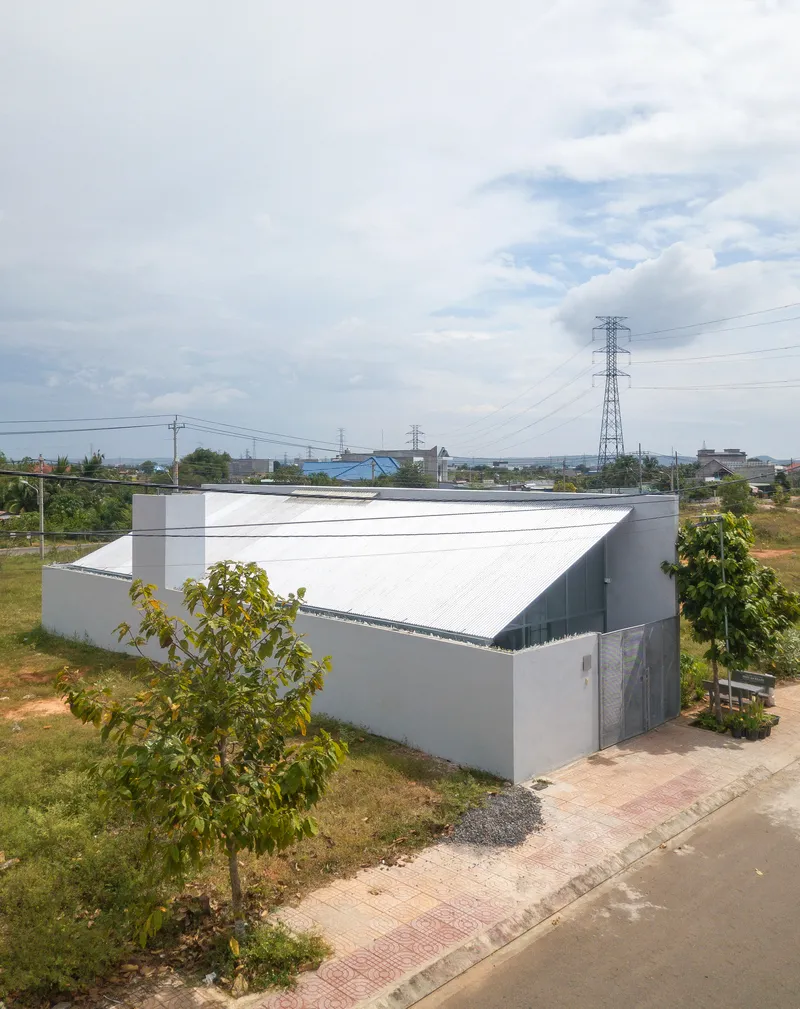
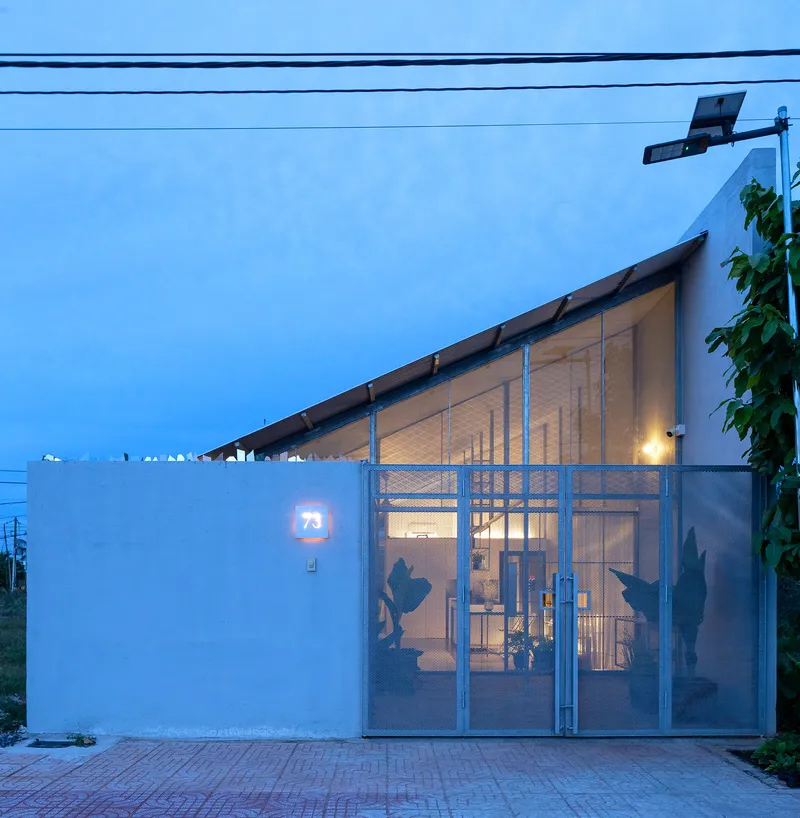
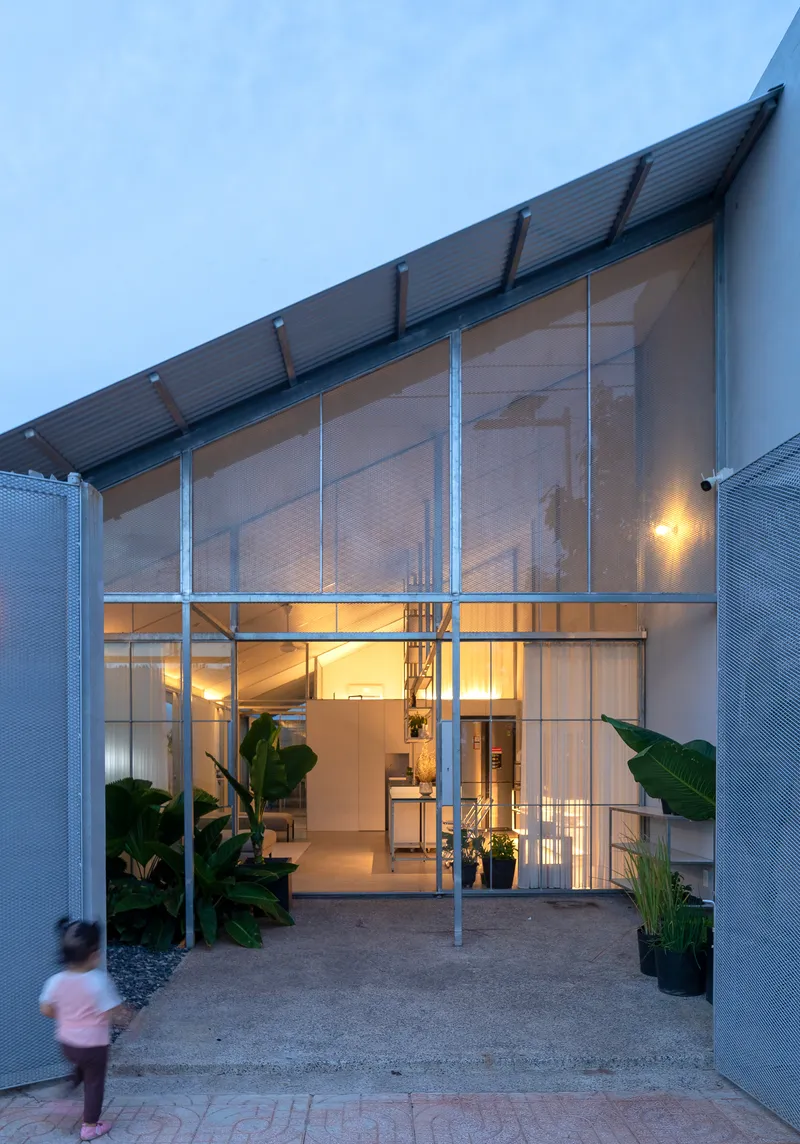
From the street, Binh Thuan House reads as a gabled corrugated iron volume sitting behind a sliding metal gate. Power lines cross overhead. The pitched roof is unpretentious to the point of anonymity, deliberately echoing the simple metal-clad structures found across the Vietnamese countryside. MIA Design Studio describes the project as "truly ordinary," and at a glance it delivers on that claim. The mono-pitched roof rises above grey masonry walls, and the entrance is framed by a steel portal flanked by banana plants.
But ordinariness here is a design decision, not a default. The proportions are precise, the steel framing at the entrance is legible as a deliberate architectural gesture, and translucent screens above the door hint at the spatial complexity inside. The house sits on a 150 square metre triangular lot, and its footprint of 126.2 square metres of construction area uses nearly every available inch, making the choices about where to leave space open all the more pointed.
Steel Frame as Total System

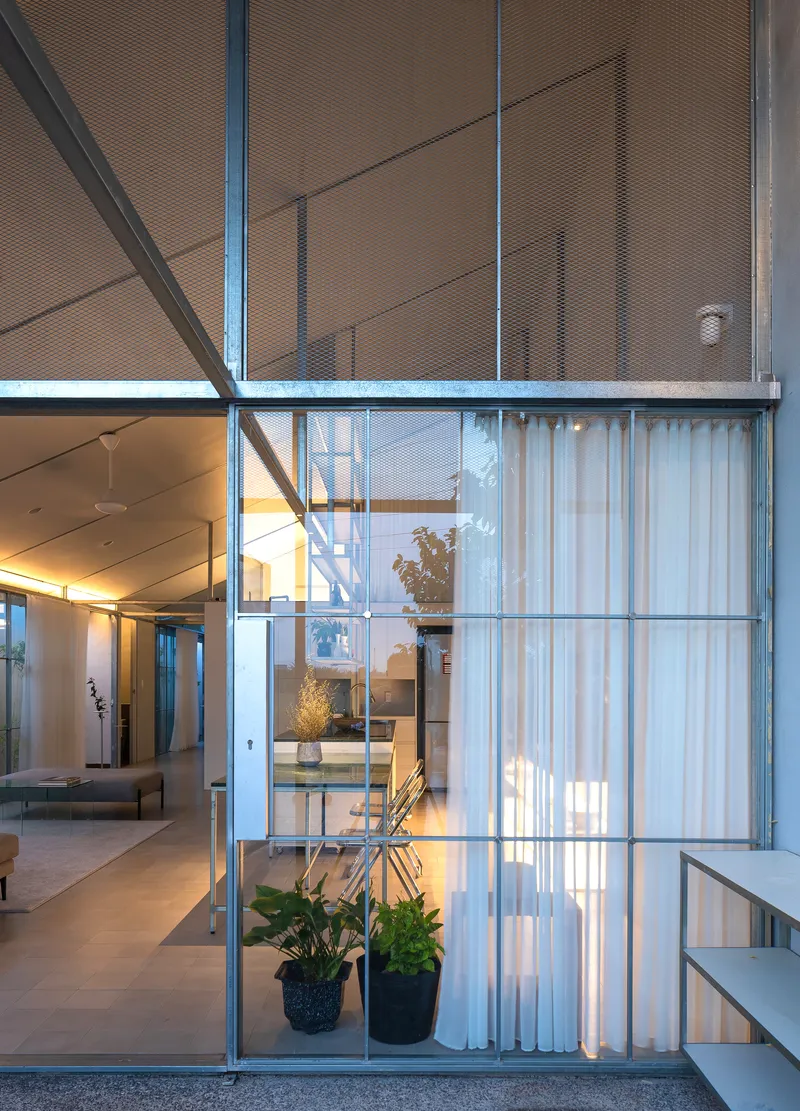
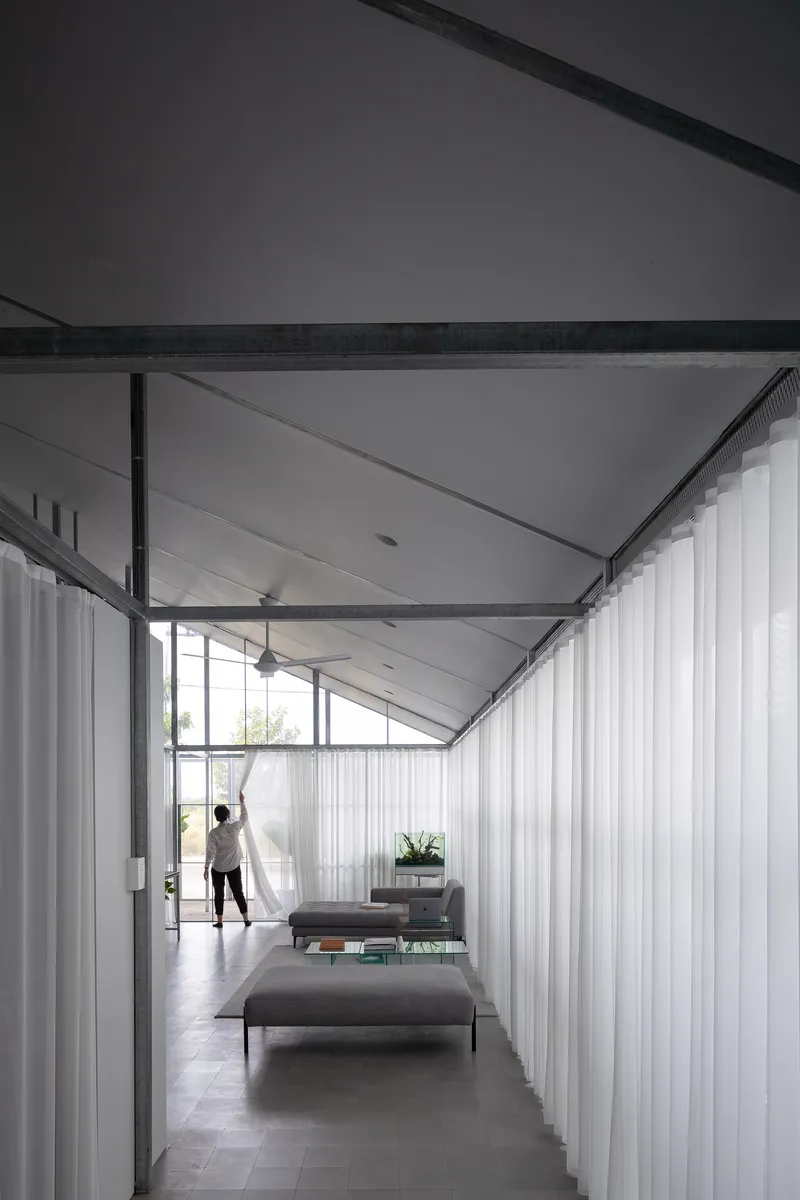
The exposed prefabricated steel frame is the project's central architectural idea and its most radical economy. Rather than treating structure as one system and furniture as another, MIA collapses them into one. The same steel members that carry roof loads also serve as sliding door tracks, curtain rails, shelving supports, and hanging frames for clothes. A freestanding white cabinet box hangs from the ceiling structure, its edges defined by steel sections rather than conventional cabinetry.
This multi-role approach keeps costs low, but it also produces a specific aesthetic: the interior feels like a workshop for living, with every connection visible and every joint legible. The three-dimensional modular frames create hollow volumes that the owners can fill or leave open. It is an architecture that trusts its inhabitants to participate in the final composition, a bet that not every family would take but one that suits a household willing to live lightly.
Curtains Instead of Walls


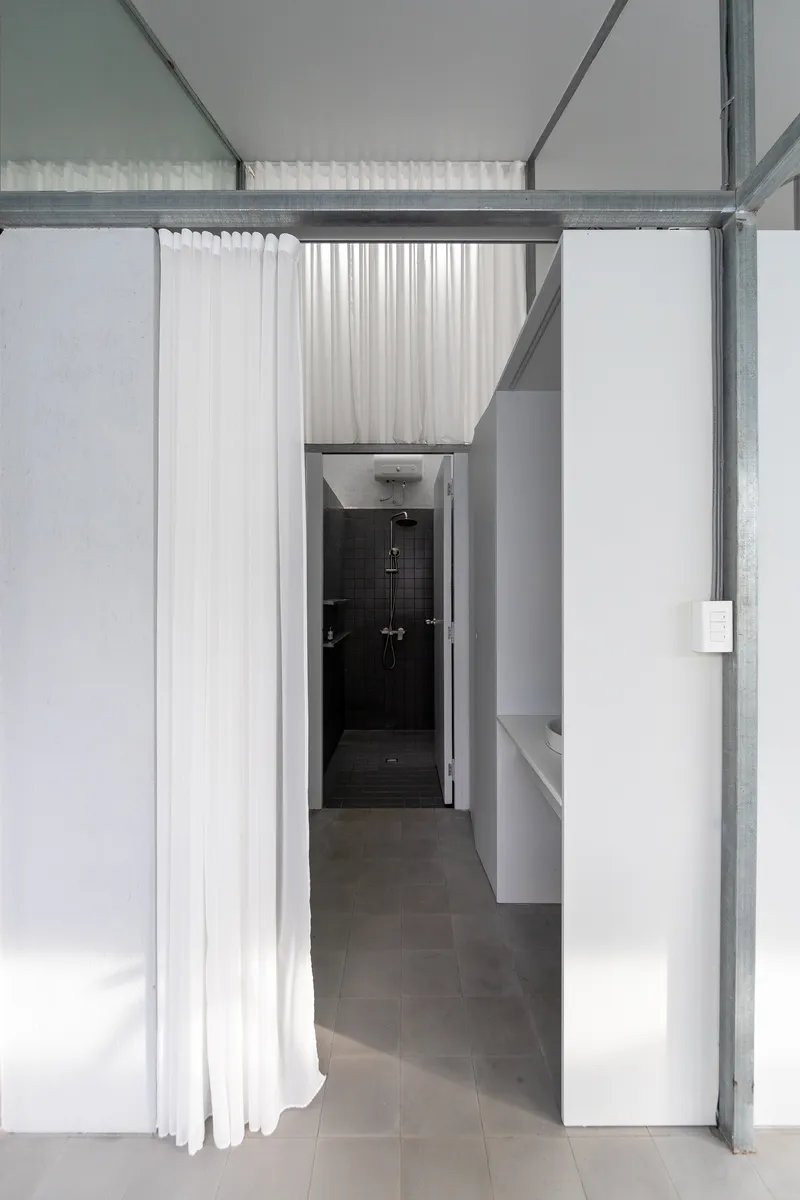
Privacy in Binh Thuan House is a matter of fabric, not masonry. White curtains hung from the steel frame separate sleeping areas from circulation, and a drawn curtain reveals a dark-tiled shower enclosure beneath a skylight. The effect is soft, luminous, and surprisingly dignified. Diffused daylight filters through the curtain surfaces, creating a milky interior atmosphere that shifts through the day.
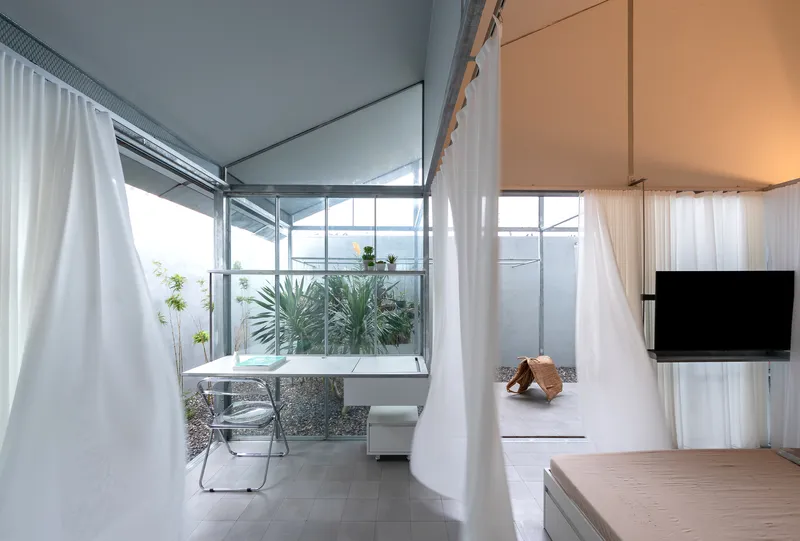
The double-height bedroom demonstrates how this strategy works at scale. Concrete walls provide acoustic and thermal mass where it matters most, but the boundary between the bedroom and a glazed courtyard is mediated by curtain, not door. The occupant adjusts the degree of openness in real time. It is a low-tech version of the sliding partition systems found in far more expensive Japanese houses, achieved here with steel tubing and white polyester.
Green Rooms and Interior Courtyards


For a house this compact, Binh Thuan gives a surprising amount of its footprint to planting. Interior courtyards filled with gravel, bamboo, and large-leafed tropicals punctuate the linear plan, pulling natural light and ventilation deep into the volume. A covered terrace under the corrugated metal roof extends the living space into a planted outdoor room framed by banana leaves.
These green pockets are not decorative. In the hot, humid climate of coastal Binh Thuan province, natural cross-ventilation is the primary cooling strategy. The courtyards create temperature differentials that draw air through the open plan, and the planted surfaces reduce radiant heat from adjacent walls. The narrow desk niche alongside a planted gravel bed offers a workspace that feels closer to a garden pavilion than a home office.


Kitchen as Social Core


The open-plan kitchen anchors the household. A teal-tiled island acts as the primary social surface, with an exposed steel ladder stair rising to a mezzanine above. Open steel shelving replaces upper cabinets, keeping cookware visible and accessible. The double-height volume above the white cabinetry lets hot air rise and escape, turning the kitchen into a chimney that ventilates itself.
A green glass dining table sits under afternoon sunlight, and the steel-frame partition between the kitchen and living area is permeable enough to maintain visual connection while giving each zone a distinct identity. The kitchen is simultaneously utilitarian and the most spatially generous room in the house, a choice that reflects how Vietnamese domestic life often centers on food preparation and shared meals.
Light, Threshold, Detail


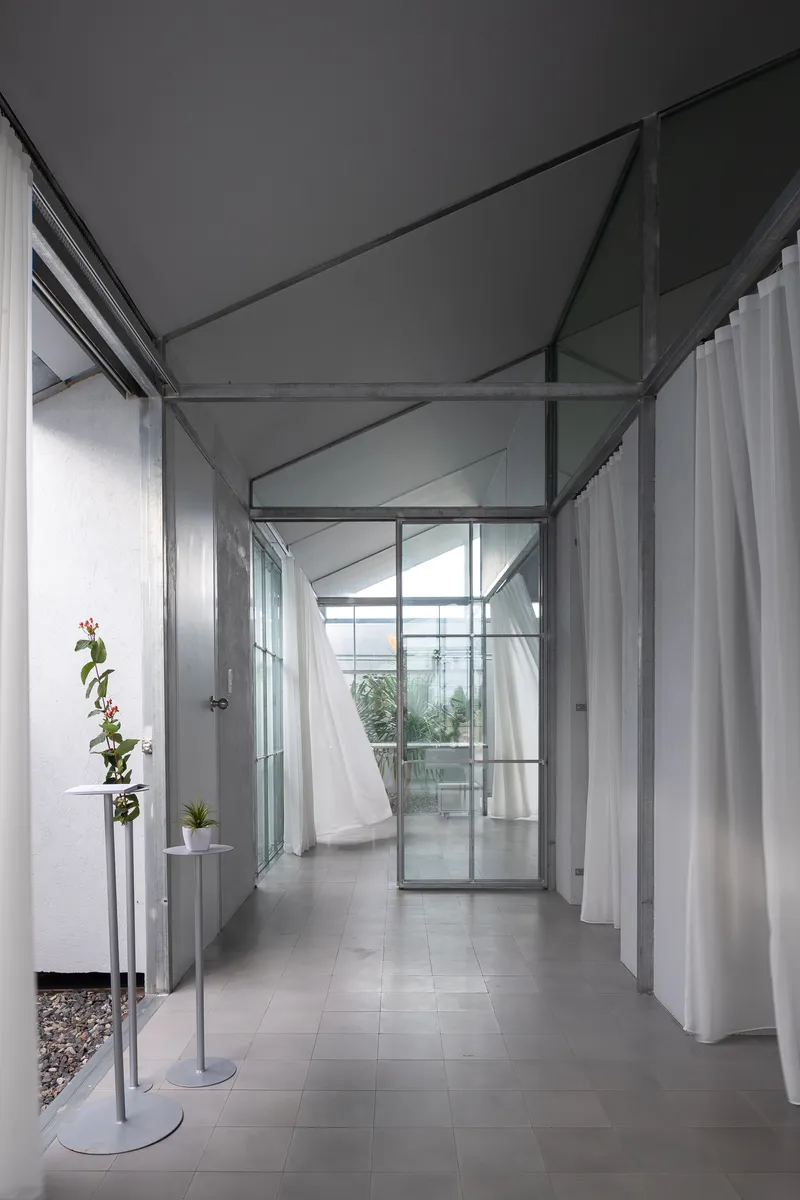
The quality of light inside Binh Thuan House is its quietest achievement. Perforated metal screens above the glazed entry doors scatter light into shifting patterns. A narrow corridor lined with built-in benches channels a central skylight toward a black-tiled bathroom beyond. Even the detail of a curtain hem meeting a gravel courtyard floor carries a considered relationship between soft and hard, interior and exterior.
These moments of resolution matter because the palette is so limited. With corrugated iron, steel, white curtains, and concrete as the entire material vocabulary, every joint and every transition is exposed. The house cannot hide behind rich finishes. It survives on proportion, light, and the discipline of a few ideas executed with consistency.
Living at Dusk
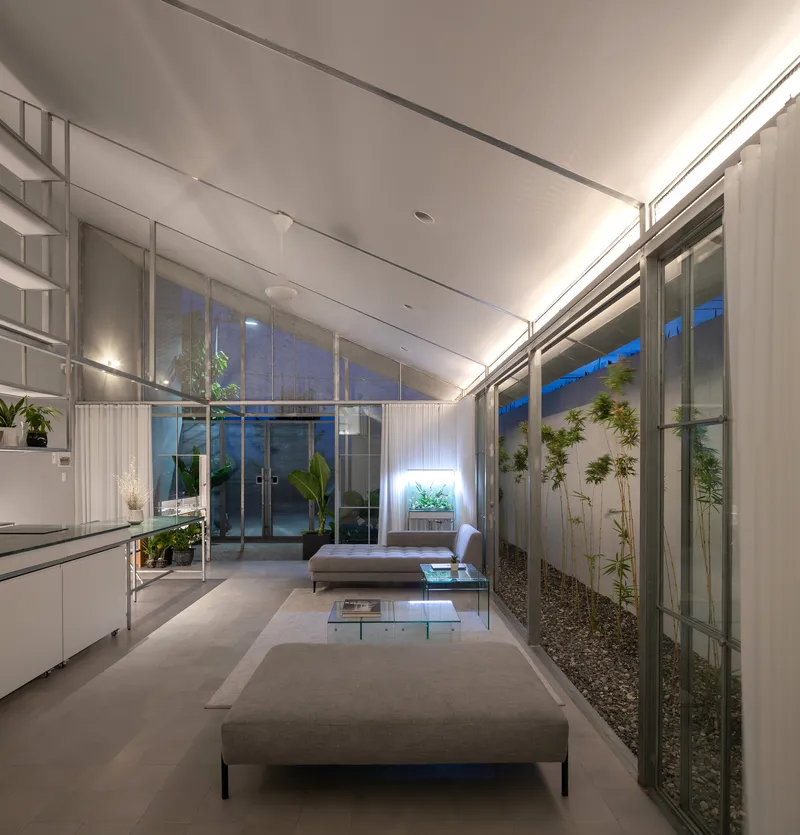
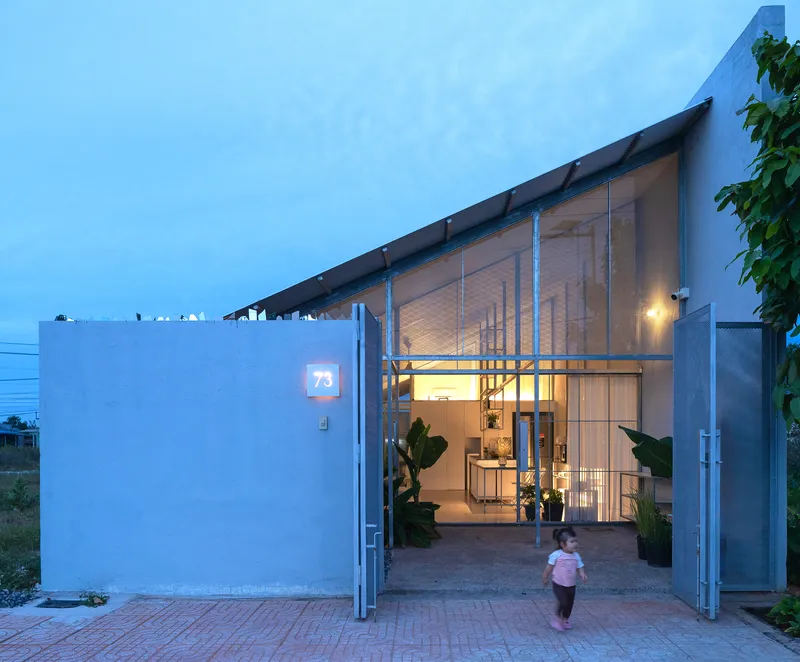

At twilight, the house reveals its internal logic most clearly. The glazed walls flanking the interior gravel courtyards glow, and the sloped ceiling reads as a single continuous surface connecting the planted voids. A child walks through the entrance courtyard, and the open gate frames a domestic scene that feels both protected and porous. The living area, with its glass coffee tables and view to the planted courtyard, settles into a warm stillness.
Plans and Drawings
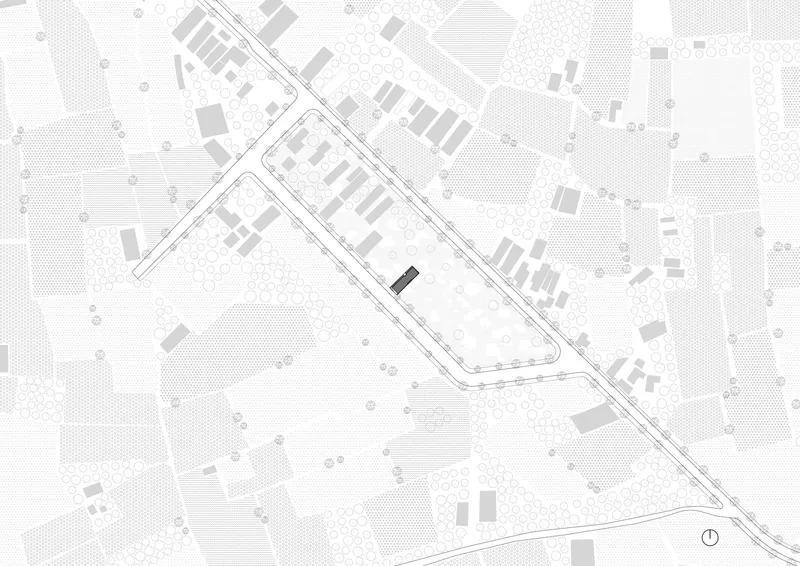


The site plan confirms the tight triangular lot, with the house occupying nearly its full extent. The ground floor plan reveals a strictly linear layout: living area, kitchen, bedrooms, and service spaces arranged in sequence along a single axis, with courtyards interrupting the procession at calculated intervals. The exploded axonometric is the most informative drawing, showing how the roof structure, steel frame, and interior layout relate across three levels.
The isometric cutaway drawings comparing two interior configurations within the same volume are the clearest illustration of the project's core ambition. The frame stays constant; the inhabitation changes. Sections show the mono-pitched roof creating double-height volumes where they matter, over the kitchen and the bedroom, while compressing service spaces to single height. The detail section at the sloped roof connection reveals the planted buffer zone between interior and boundary wall, a narrow green gap that does serious climatic work.
Why This Project Matters
Binh Thuan House is a quiet argument against the idea that good residential architecture requires generous budgets, exotic materials, or physical proximity between architect and site. MIA Design Studio built this house remotely during a pandemic with locally sourced corrugated iron and prefabricated steel, and the result is more spatially inventive than most houses that cost ten times as much. The decision to make the structural frame do the work of furniture, partitions, and services is not just clever engineering; it produces a fundamentally different relationship between building and inhabitant, one where the architecture invites ongoing negotiation rather than imposing a fixed layout.
At a moment when the profession is awash in sustainability rhetoric and parametric complexity, a house like this is a useful corrective. Its environmental strategy is passive ventilation and planted courtyards, not mechanical systems. Its flexibility comes from curtains, not motorized partitions. Its material honesty is born of necessity, not aesthetic ideology. For 86 square metres in a Vietnamese countryside town, Binh Thuan House offers a template for how to build well with very little, a template worth studying far beyond its local context.
Binh Thuan House by MIA Design Studio, Phan Thiet, Binh Thuan Province, Vietnam. 86 m². Completed 2021. Photography by Trieu Chien.
About the Studio
Share Your Own Work on uni.xyz
If projects like this are the kind of work you want to make, uni.xyz is a place to publish your own, find collaborators, and enter design competitions.




Popular Articles
Popular articles from the community


Co-life: Sustainable Architecture for Age-Friendly Community Living
Co-life reimagines sustainable architecture for seniors through courtyards, rammed earth, shared gardens, and spaces designed for belonging.

Hill & Cross Opera: Sculptural Opera House Architecture Shaped by Tallinn’s Landscape and Identity
Hill & Cross Opera reimagines opera house architecture in Tallinn through its sculptural hill, civic plaza, glass wave and a luminous cross.
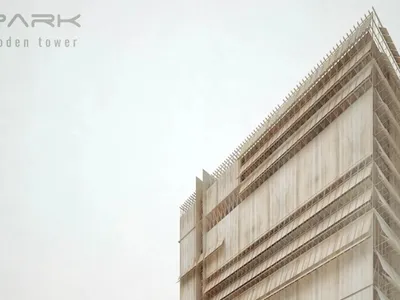
EW PARK: Sustainable Architecture Reimagines the Future of Urban Parking
EW PARK reimagines city parking as a modular wooden tower combining automation, solar energy, electric mobility, and adaptable urban design.

Riyadh For All: Intergenerational Urban Design for Active Aging in Rabat
Riyadh For All reimagines urban design in Rabat with intergenerational co-living, adaptive courtyards, and Moroccan cultural exchange today.


Similar Reads
You might also enjoy these articles

Bao Huynh Watercolor Atelier: A Serene Art Retreat in Hội An
Bao Huynh Watercolor Atelier in Hội An blends multifunctional art spaces, sustainable design, local materials, and family-friendly living in a serene environment.

Atelier Macri Concept Store Interior Design by CASE-REAL
Atelier Macri store features a "ko" counter, walnut wood details, cork displays, blending retail, gallery, and seamless customer experiences.

Manuel Vargas Izquierdo Stadium and High-Performance Sports Center: Architectural Excellence in Jalpa de Méndez
The Manuel Vargas Izquierdo Stadium blends sustainable design, inclusive sports facilities, and cultural-inspired architecture, revitalizing Jalpa de Méndez’s public spaces.

KAKR Buluh Awar Hall: Revitalizing Community and Ecology Through Bamboo Architecture
Community built bamboo hall revitalizes Buluh Awar village, empowering youth, restoring ecology, celebrating vernacular craftsmanship through sustainable architecture and culture.




Comments (0)
Please login or sign up to add comments
No comments yet. Be the first to comment!