

Ming Architects Folds Shophouse Logic into a Sculptural Singapore Terrace Home
Node House channels the courtyard and air well traditions of tropical shophouses through a language of curves, concrete, and perforated steel.


The inter-terrace plot is one of Singapore's most constrained residential typologies: a narrow, deep lot sandwiched between party walls, where light and air are luxuries that have to be engineered rather than assumed. Ming Architects, led by Tan Cher Ming, takes that constraint as a starting point for Node House, a 4,000 m² residence that borrows the courtyard-and-air-well section of the traditional shophouse and rebuilds it in fair-face concrete, brushed oak, and perforated steel. The result is a house where every vertical void and curved surface is doing thermodynamic work, pulling cool air down and pushing hot air up through a vented skylight, while simultaneously creating the kind of spatial drama that most terrace houses never achieve.
What makes Node House genuinely interesting is the commitment to curves as structure rather than decoration. From the rounded beam corners visible on the street facade to the single sweeping wall that organizes the entire ground floor, the curvilinear language is load-bearing, space-defining, and consistent. It softens a house built between raw concrete party walls without ever feeling whimsical. The project earned a Bronze Award at the 2025 Houzee Awards for Architecture Single Family Housing, and it is easy to see why: this is disciplined tropical design with a sculptural edge.
A Tiered Facade Between Tiled Roofs
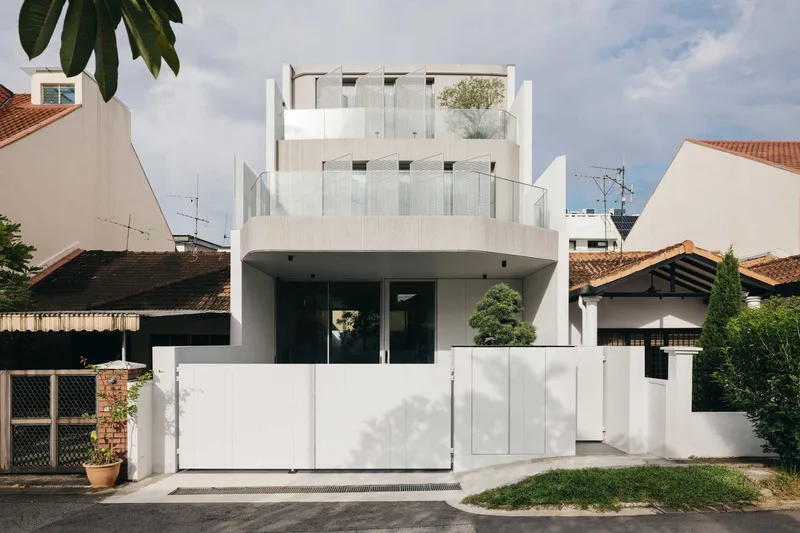

Seen from the street, Node House announces itself through stacked balconies with rounded edges and glass balustrades, a crisp white volume rising among its pitched-roof neighbors. The facade is restrained, almost reticent, but the subtle rounding of every horizontal element hints at what happens inside. At dusk, the perforated metal screening on the upper levels glows faintly, turning the house into a lantern that reveals its layered interior life without sacrificing privacy.
The raised planter along the driveway, with its chamfered edges, sets the tonal register before you even reach the front door: nothing here has a hard corner it does not need.
The Courtyard as Engine


The courtyard is the project's organizing principle. A ficus longifolia, requested by the homeowner, rises through a double-height void from the ground floor, its canopy reaching toward a curved skylight that vents heat and admits filtered daylight. This is a direct adaptation of the shophouse air well: a vertical shaft that draws natural light deep into a narrow plan and creates a stack effect for passive cooling. The vented skylight above the courtyard is critical in Singapore's equatorial climate, allowing rising hot air to escape while pulling cooler air through the ground-floor living spaces.
From the dining area, floor-to-ceiling glazing frames the tree and its planter as a composed landscape, merging interior and courtyard into a single room. Upper-floor bedrooms look down into the void, borrowing its greenery and its light. The courtyard is not a feature; it is the house's lungs.
Curved Walls, Linear Plan


On the ground floor, a single curved wall guides circulation from the entrance through living, dining, and dry kitchen spaces. In a plan this narrow, a straight wall would have created a corridor; the curve eliminates the feeling of compression and makes the sequence of rooms feel continuous rather than serial. White marble floors amplify light across the ground level, while a speckled stone surface in the dry kitchen and living area introduces texture without competing with the wall's geometry.
The rounded column beside a backlit credenza is a small detail that rewards attention. It is not decorative trim applied to a square column; the curve is the structure. That consistency, from party wall to furniture niche, is what gives Node House its coherence.
Steel, Concrete, and Filtered Light

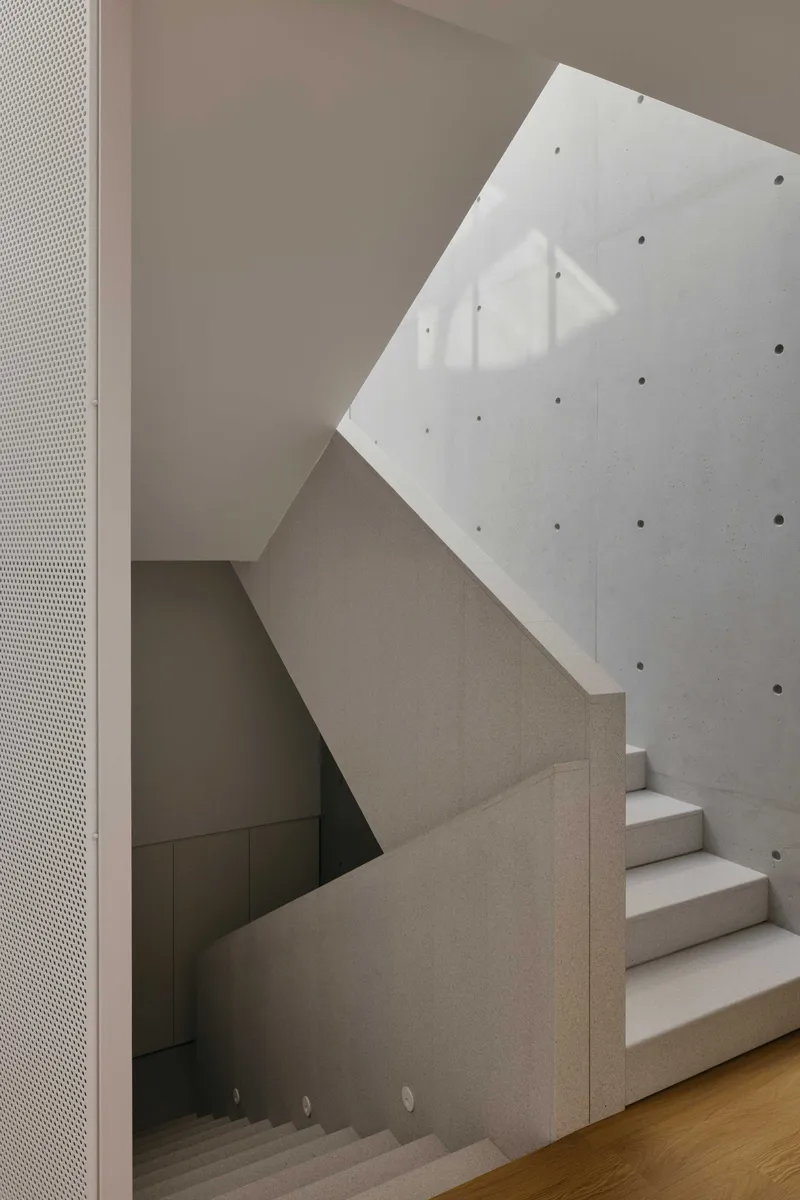

The staircase is fabricated from steel plates and perforated metal panels, a decision that turns a circulation element into both a light filter and a privacy screen. Where the stair passes the courtyard, the perforations allow dappled light to wash across the concrete walls, producing shifting shadow patterns through the day. The cantilevered concrete treads in the secondary stair are more brutalist in character, their raw surfaces accented by circular formwork ties left exposed.
Fair-face off-form concrete on the party walls is left unfinished throughout, providing a tactile counterpoint to the brushed oak timber ceilings overhead. The material palette is deliberately tight: concrete, timber, steel, glass. Each material does something different with the light that enters through the courtyard and skylights, so the house feels richer than its material count would suggest.
The Stairwell Void as Vertical Garden


Looking up through the stairwell void reveals the full ambition of the section: perforated panels, potted plants, angular skylights, and glass balustrades all layered into a single vertical composition. The translucent metal panels glow with ambient light, turning what could be a purely functional shaft into the most spatially complex moment in the house. Vertical green curtains on the upper balcony add a soft biological layer to the steel-and-concrete framework.
Glass panels along the open spaces pull light from the skylight into private living areas on the upper floors, a strategy that ensures the deepest rooms in the plan are never dark. The void, the courtyard, and the stairwell work together as a single environmental system, distributing light, air, and views across all levels.
Intimate Rooms, Warm Materials
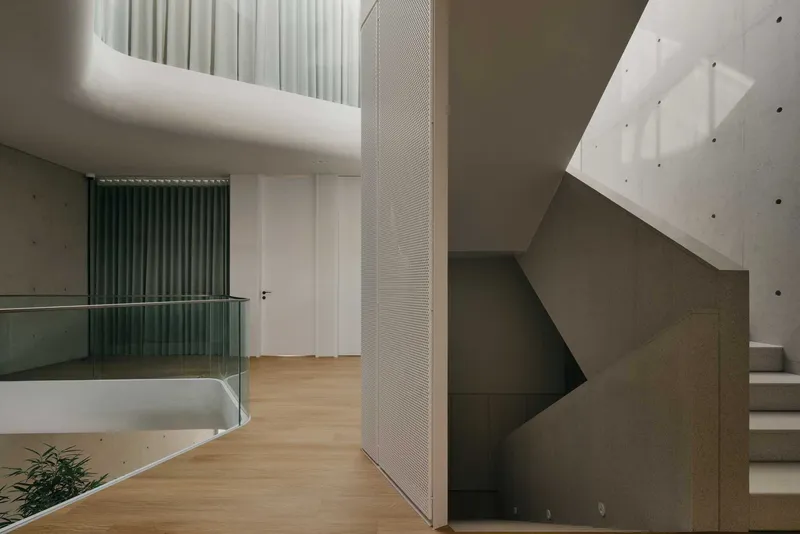
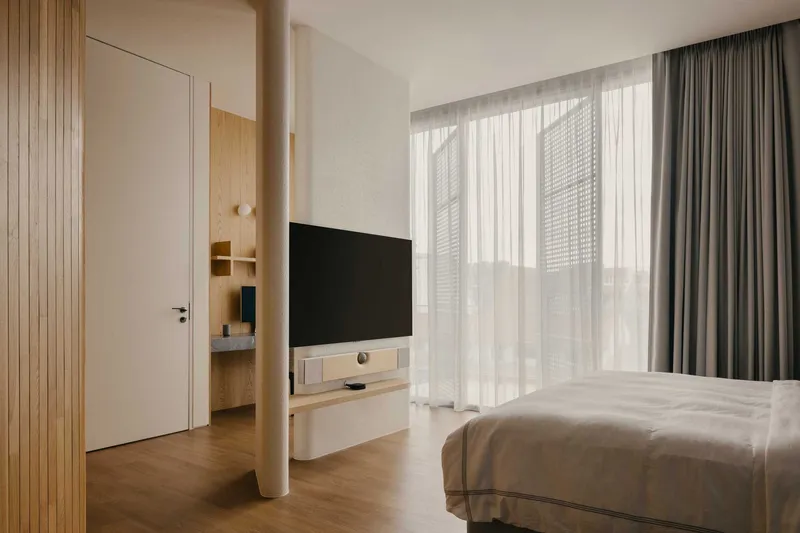

Upper-floor corridors lined with perforated metal panels and clerestory skylights maintain the language of filtered light established on the ground floor. Bedrooms are calmer: light timber paneling, sheer curtains, and restrained furniture let the architecture recede. The perforated panel wall in the hallway casts diagonal handrail shadows against the timber ceiling insert, a moment of graphic precision in an otherwise warm, tactile environment.

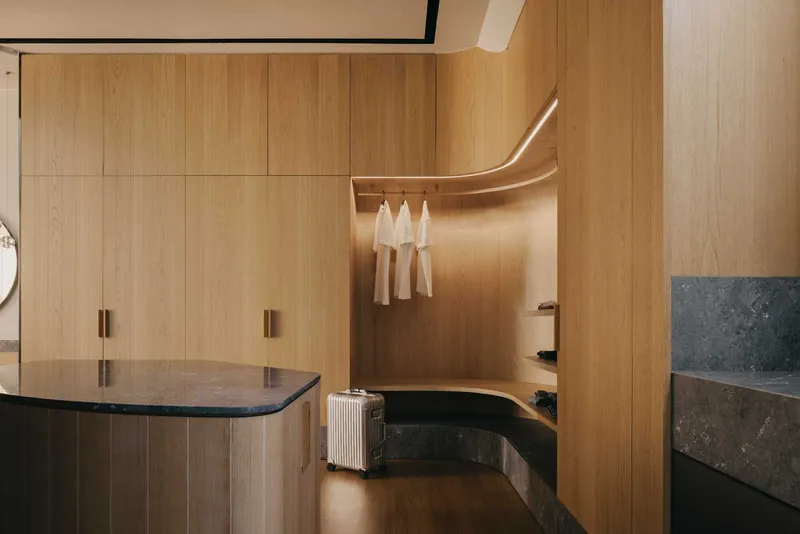

Storage and dressing spaces reveal a level of craft that matches the public rooms. The curved timber hanging rail in the wardrobe is a miniature echo of the ground-floor wall; the stone bench seating beside it could be a detail from a boutique hotel. Even the built-in desk nook with floating shelves and wall hooks, a small gesture, is carefully proportioned within the soft daylight that reaches it through the courtyard system. These rooms prove that the project's curvilinear discipline extends to furniture scale.
Plans and Drawings
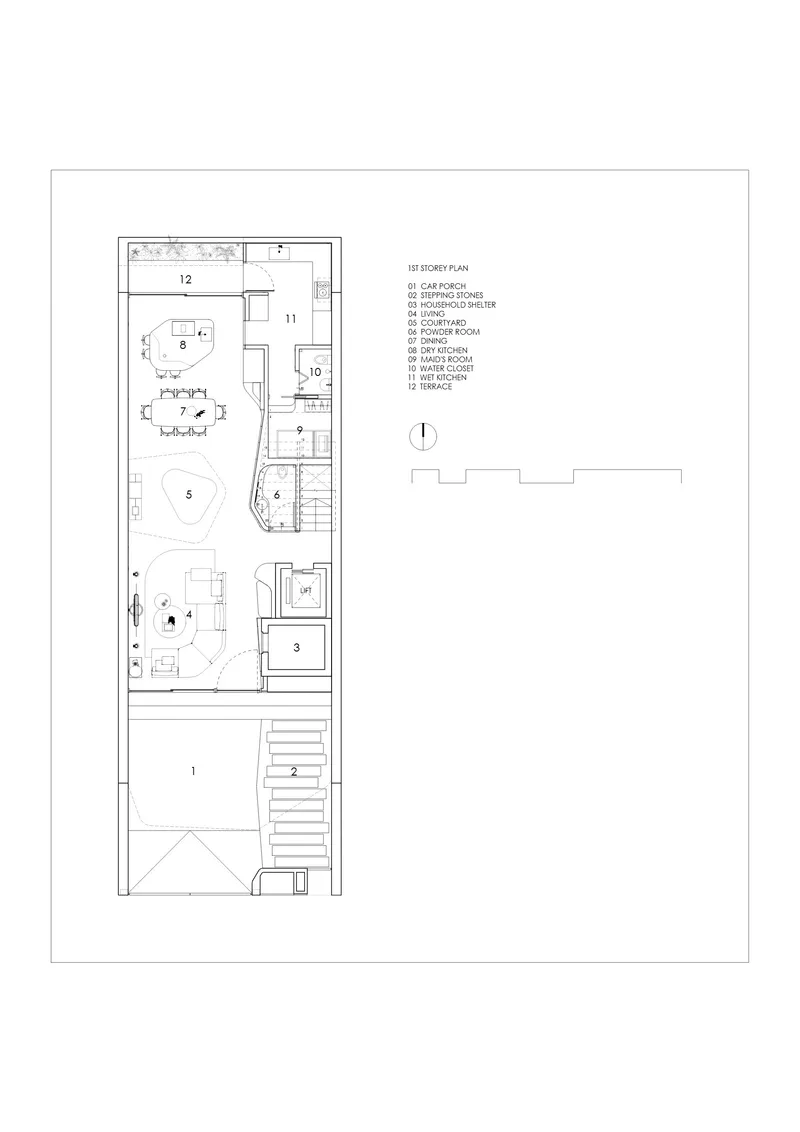

The floor plan confirms what the photographs suggest: this is an extremely narrow, linear layout where every square meter is accounted for. The stair core sits roughly at the midpoint, dividing the plan into front and rear zones connected by the courtyard void. The small rear garden at the back provides a second source of natural light and ventilation, ensuring cross-ventilation through the full depth of the plot. Reading the plan, it is clear how much the courtyard and air well owe to the traditional shophouse section, updated here with contemporary structure and environmental performance.
Why This Project Matters
Singapore's inter-terrace houses are often treated as real-estate problems: maximize floor area, stack the bedrooms, finish in white render, move on. Node House pushes back against that formula by treating the constraints of the narrow plot as design opportunities. The courtyard and air well are not nostalgic references to shophouse culture; they are working passive-cooling devices calibrated to an equatorial climate. The curves are not stylistic flourishes; they solve the compression problem inherent in a deep, narrow plan. Every formal decision has an environmental or spatial justification, which is what separates architecture from interior styling.
The project also makes a quiet argument for material honesty in a city where residential finishes tend toward the decorative. Fair-face concrete, perforated steel, and brushed oak are left to do their work without concealment. The result is a house that will age well, that performs thermally without relying entirely on mechanical systems, and that proves the terrace typology still has room for invention. Ming Architects has delivered a house that is as disciplined in section as it is generous in experience.
Node House by Ming Architects (lead architect: Tan Cher Ming), Singapore. 4,000 m², completed 2025. Photography by Studio Periphery.
About the Studio
Share Your Own Work on uni.xyz
If projects like this are the kind of work you want to make, uni.xyz is a place to publish your own, find collaborators, and enter design competitions.


Popular Articles
Popular articles from the community


Opera by the Sea Estonia: Three Shells Dissolving Architecture into Tallinn's Coastline
A winning opera house proposal replaces monumental form with interconnected shells that blur the boundary between building, park and Baltic Sea.

Opera on the Sea: Driftwood Logic Shapes a Timber Opera House on Estonia's Coast
Trevor Orgill's opera house translates the entangled drift of floating timber into a civic building where wood, water, and music converge.

The Amber Palace Opera: A Geological Fiction Surfaces on Tallinn's Baltic Waterfront
Pierre Brillard reimagines a Baltic legend as a public landscape, opera house, and waterfront promenade rooted in Tallinn's coastal identity.

Singing Woman: An Opera House That Performs Before the Curtain Rises
Ovidiu Cristian Pavel's conceptual opera house translates Estonia's choral identity into a sculpted waterfront landmark facing the Baltic Sea.

Similar Reads
You might also enjoy these articles

Pixel Gardens: One Repeated Module Stacked Into a Terraced Social Housing Tower for Famagusta
Salem Bader's shortlisted housing tower builds a vertical neighbourhood from one repeated module, offsetting units to carve terraces, light and air.

Bao Huynh Watercolor Atelier: A Serene Art Retreat in Hội An
Bao Huynh Watercolor Atelier in Hội An blends multifunctional art spaces, sustainable design, local materials, and family-friendly living in a serene environment.

Atelier Macri Concept Store Interior Design by CASE-REAL
Atelier Macri store features a "ko" counter, walnut wood details, cork displays, blending retail, gallery, and seamless customer experiences.

Manuel Vargas Izquierdo Stadium and High-Performance Sports Center: Architectural Excellence in Jalpa de Méndez
The Manuel Vargas Izquierdo Stadium blends sustainable design, inclusive sports facilities, and cultural-inspired architecture, revitalizing Jalpa de Méndez’s public spaces.


Comments (0)
Please login or sign up to add comments
No comments yet. Be the first to comment!