

Mission V.E.N.T: Reimagining Delhi as a Breathable, Biodiverse Urban District
A speculative infrastructure of netted canopies, airquariums, and modular towers turns polluted neighborhoods into pure air districts.


What if an entire neighborhood could function like a lung? Mission V.E.N.T. proposes exactly that: a layered urban infrastructure of netted canopies, planted domes, and modular towers designed to convert polluted zones of Delhi into districts that actively generate clean air. The project reads less like a conventional building and more like a territorial organism, radiating circular zones of influence across an existing urban grid, pulling biodiversity and breathable atmosphere back into the heart of the city.
Designed by Karan Daisaria, Mission V.E.N.T. is a People's Choice Award entry in the Neo Delhi competition. The brief challenged participants to reimagine the Indian capital for a more resilient future, and Daisaria's response is both ambitious and specific: a system of interconnected structures that prioritize clean air production, food cultivation, wildlife habitation, and public gathering. It is speculative urbanism grounded in spatial generosity.
A Netted Canopy That Doubles as an Aviary
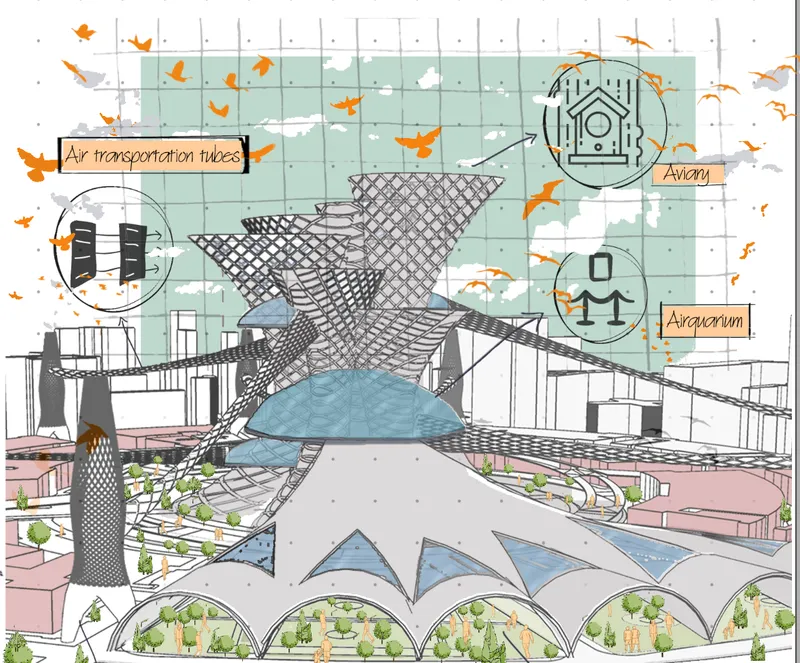
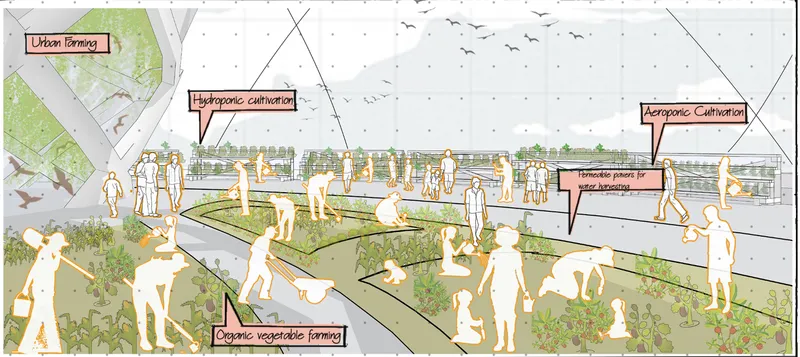
The perspective section drawing reveals the project's most striking spatial move: a vast netted canopy that stretches above planted domes, sheltering air transportation tubes and a functioning aviary overhead. Below this mesh, the ground level is lush with cultivated foliage, while birds circulate freely in the intermediate zone. The canopy is not decorative; it is an ecological threshold, separating polluted ambient air from a controlled micro-atmosphere underneath.
Ascending to the rooftop terraces, the project introduces hydroponic and aeroponic cultivation systems that line the upper surfaces. Visitors move through these productive landscapes alongside flying birds, collapsing the distinction between park, farm, and habitat. The vertical stacking of programs, from public ground to agricultural roof to aviary canopy, shows how density can serve ecological rather than purely economic ends.
Ground-Level Gathering Beneath Glass and Lattice
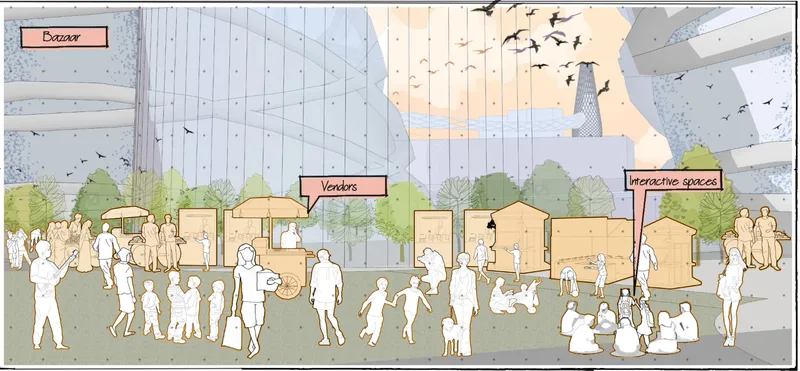
At street level, the project is unmistakably social. A dusk-lit public plaza populated with vendor kiosks and pedestrians sits beneath a glass enclosure, creating a sheltered commons that feels more like a greenhouse market than a conventional square. The warmth of the lighting and the transparency of the enclosure suggest a space designed for extended occupation, not just passage.
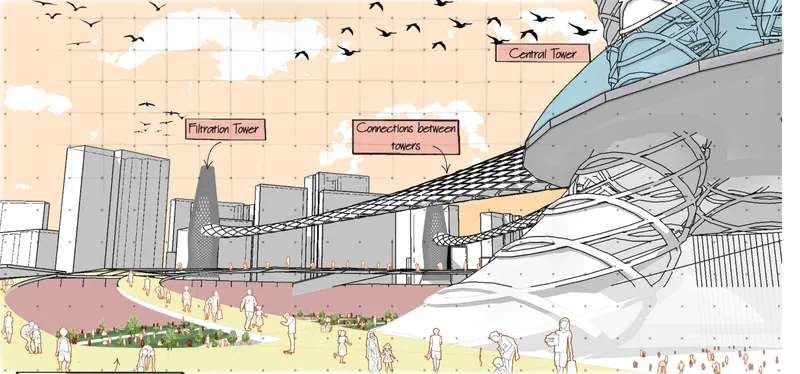
Latticed bridges then extend between vertical towers above a planted plaza, where crowds gather below. These elevated connections stitch the towers into a continuous network, ensuring that movement through the district happens at multiple altitudes. The lattice itself is structurally expressive, filtering light downward into the gathering spaces and reinforcing the sense that the entire district is covered by a living, breathing armature.
Sloped Lawns and Arched Pavilions as Breathing Rooms
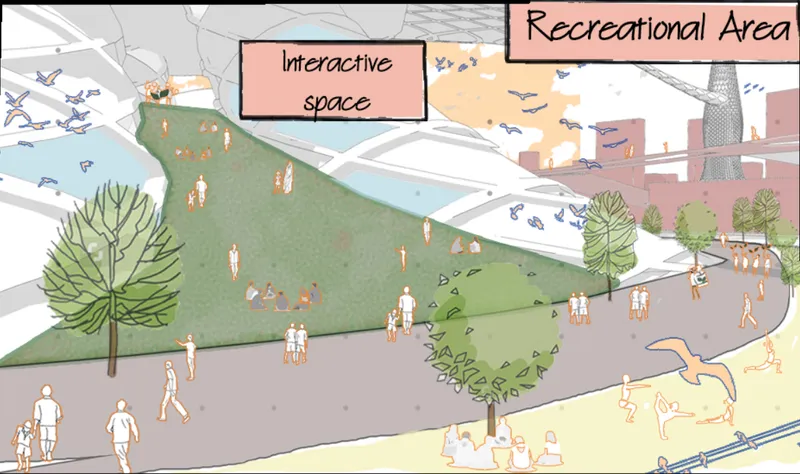
Not every moment in Mission V.E.N.T. is structurally dramatic. A gently sloped lawn recreational area, scattered with trees and pedestrians under afternoon light, provides the kind of simple, open ground that dense cities desperately need. It functions as a relief valve within the larger system, offering unstructured space for rest and play without the overhead complexity of canopies and towers.
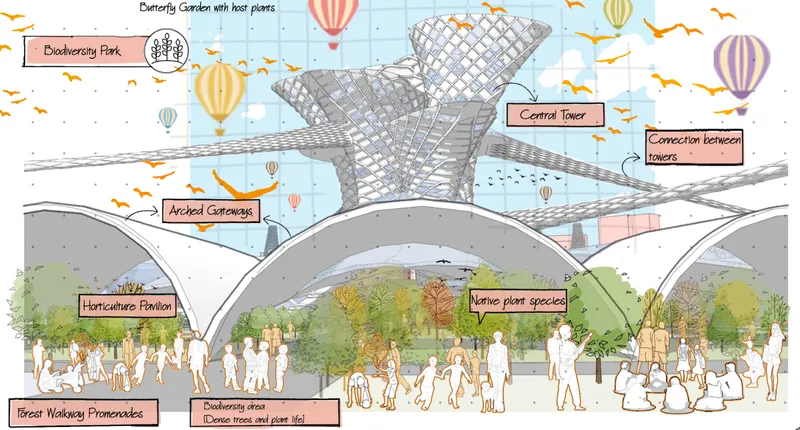
Nearby, arched pavilions sit beneath a lattice tower, their curved profiles creating sheltered pockets at ground level. Hot air balloons and butterflies drift overhead in the sectional perspective, a detail that signals the project's aspiration toward a radically different atmospheric quality. These pavilions are intimate in scale compared to the district-wide infrastructure, and they anchor the scheme in a human, tactile register.
The Airquarium: Circular Chambers of Purified Air
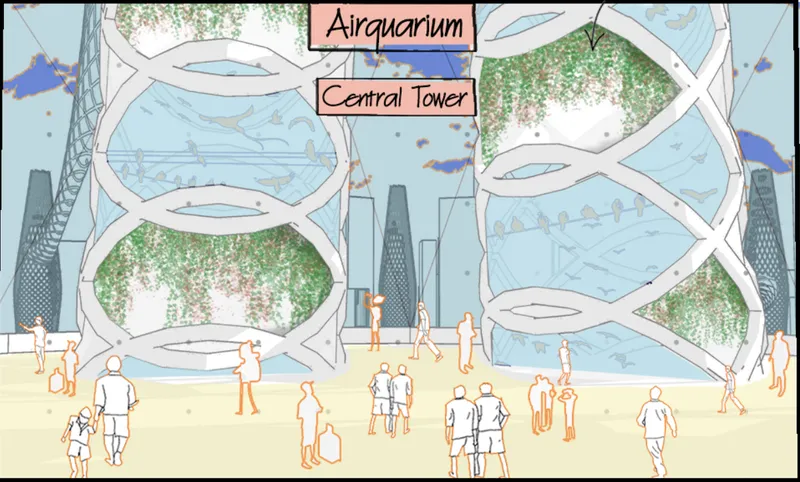
Perhaps the most inventive element of the proposal is the "airquarium," a structure composed of circular chambers containing dense planted foliage. The section drawing shows visitors circulating beneath and around these chambers, experiencing purified air as a spatial condition rather than an abstract metric. The circular geometry suggests modularity and self-containment, each chamber a discrete pocket of cleaned atmosphere.
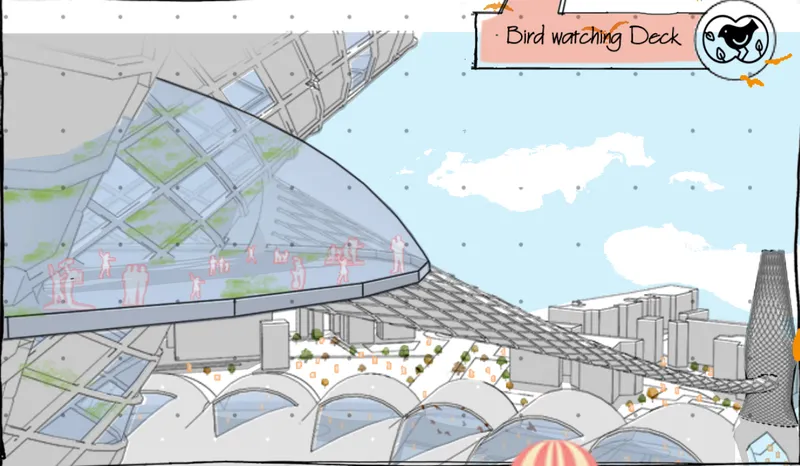
An elevated bird-watching deck extends outward from the airquarium, offering views across curved glass enclosures and the existing Delhi skyline. The juxtaposition is pointed: the hazy urban horizon set against the transparent, life-filled enclosures of the new district. It is a moment of designed contrast that makes the project's environmental argument visible and visceral.
Modular Towers Radiating Across the Urban Grid
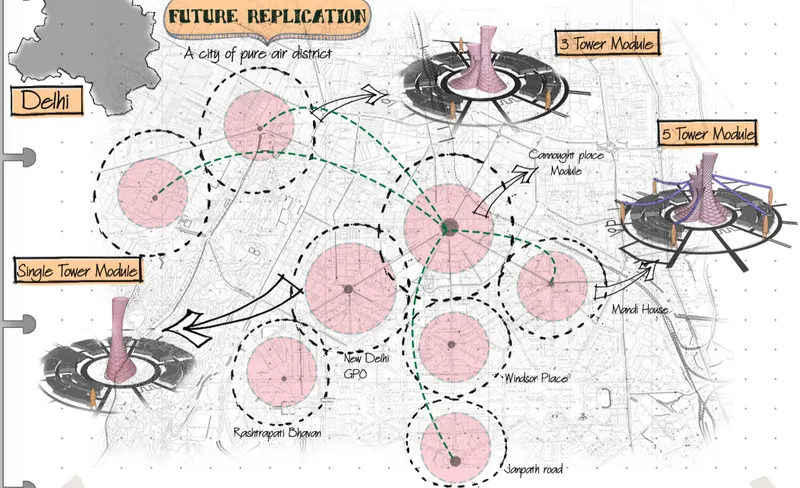
A diagram illustrating the modular tower system clarifies the project's urban logic. Each tower generates circular zones of influence that radiate outward across the existing grid, overlapping to create a continuous field of effect. The system is scalable: add more towers, expand the breathable territory. It is a strategy that treats clean air not as a luxury amenity but as an infrastructural network, comparable to water or electricity distribution.
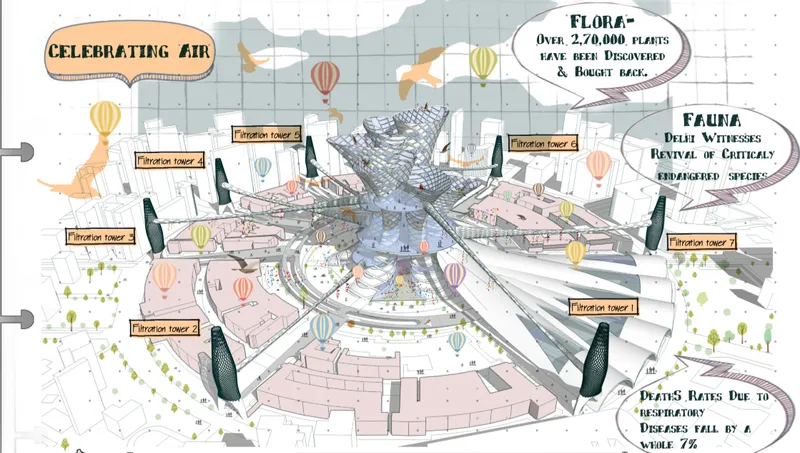
The axonometric rendering of the central tower brings this logic into three dimensions. Migration corridors extend from the tower's base, guiding both human and animal movement through the district, while hot air balloons drift above as markers of the purified atmosphere. The image captures the full ambition of Mission V.E.N.T.: a single system that simultaneously addresses air quality, biodiversity, food production, public space, and urban connectivity.
Why This Project Matters
Delhi's air pollution crisis is well documented, and most responses to it are either technological (filtration towers, masks) or regulatory (vehicle bans, factory shutdowns). Mission V.E.N.T. takes a different approach entirely, proposing that architecture itself can be the remediation. By embedding purification, cultivation, and habitat into a layered spatial system, Daisaria argues that the solution to bad air is not a device but a district.
The project's strength lies in its willingness to think at multiple scales simultaneously. It operates at the level of the individual pavilion, the rooftop terrace, the airquarium chamber, and the city-wide network of modular towers. Each scale reinforces the others, creating a proposal that is both visionary in its scope and specific in its spatial commitments. For a competition entry that asks how Delhi might reinvent itself, Mission V.E.N.T. offers a genuinely original answer: build the atmosphere.
View the Full Project
About the Designers
Designer: Karan Daisaria
Enter a Design Competition on uni.xyz
uni.xyz runs architecture and design competitions year-round that reward proposals with spatial conviction and real site intelligence.
Project credits: Mission V.E.N.T. by Karan Daisaria Neo Delhi (uni.xyz).


Popular Articles
Popular articles from the community


The Amber Palace Opera: A Geological Fiction Surfaces on Tallinn's Baltic Waterfront
Pierre Brillard reimagines a Baltic legend as a public landscape, opera house, and waterfront promenade rooted in Tallinn's coastal identity.

Cloaked Colonization: A Mobile Underwater Habitat That Moves Like a Fish
Micah Abaya's shortlisted EHC Pacific entry reimagines ocean settlement as a dispersed network of self-sustaining architectural organisms.
Opera by the Sea Estonia: Three Shells Dissolving Architecture into Tallinn's Coastline
A winning opera house proposal replaces monumental form with interconnected shells that blur the boundary between building, park and Baltic Sea.

Extended Shell: Retrofitting Kolkata's Balconies as Living Urban Thresholds
A modular retrofit system recovers the social and environmental intelligence of Kolkata's historic verandas for contemporary Park Street residents.

Similar Reads
You might also enjoy these articles

Shakur's House: Exposed Brick as an Interior Organiser in a 168 m² Mashhad Residence
Brick moves indoors in this Mashhad residence, where masonry walls, glass partitions and teal planes sequence a compact home without closing it off.

Day and Night Park: A Time-Based Urban Newsstand in Beijing
A temporary urban newsstand in Beijing blending travel, light, and reading through poetic colors, compact form, and community-focused design.

Modernist Patio Renovation in El Masnou, Barcelona by Oliver Segura Arquitectura + Cebrià Arquitectura
Modernist patio renovation blending tradition and innovation with a movable pool, leveled floors, and Catalan materials in El Masnou.

Alto Residencial Coop: Cooperative Housing Development in Santiago de Compostela by Carbajo Barrios Arquitectos
A linear cooperative housing complex blending white volumes and perforated metal façades, enhancing community living, natural light, privacy, and urban integration.

Comments (0)
Please login or sign up to add comments
No comments yet. Be the first to comment!