

Moment Stadium: A Relocatable Arena Built to Travel the World
A modular, fabric-wrapped stadium for 30,000 spectators that can be disassembled, shipped, and rebuilt across borders and climates.


What if a 30,000-seat stadium could be packed into shipping containers, sent across an ocean, and reassembled in a new country? The Relocatable Stadium "Moment" takes that question seriously, proposing a full-scale arena built from modular steel components between 3 and 12 meters long, wrapped in a tensioned architectural fabric, and designed for repeated disassembly and reuse. It is stadium architecture reframed as logistics problem, and the solution is unexpectedly elegant.
Designed by Konstantin Dolgikh, the project was shortlisted in the Staydium 2020 competition, which challenged designers to rethink how stadiums are conceived, built, and sustained. Dolgikh's entry pushes past incremental improvements to permanent venues and instead questions whether permanence is the right goal at all. For cities that need a major event venue for months rather than decades, Moment offers a genuinely different model.
A Steel Skeleton Designed for Disassembly
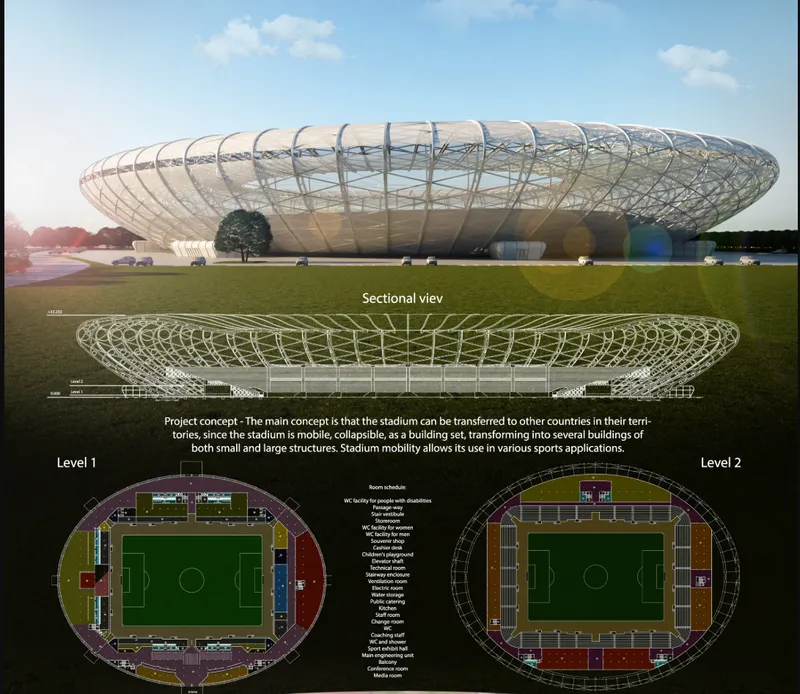
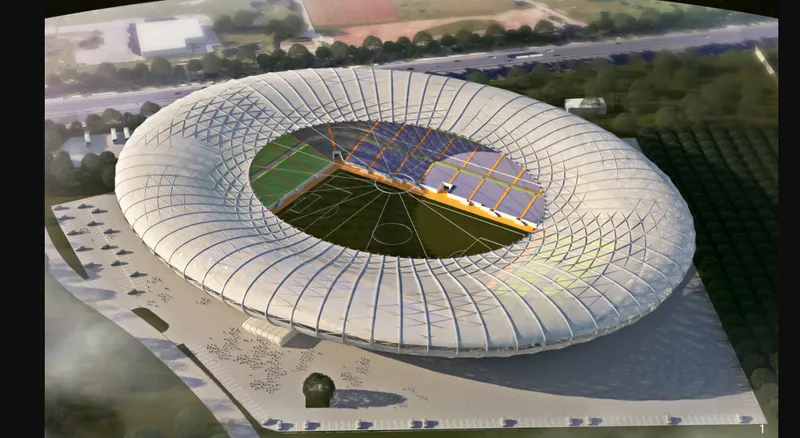
The structural logic of Moment is visible from the outside: a series of radiating steel ribs define the stadium's elliptical form, creating a rhythmic, almost skeletal silhouette. These ribs are composed of modular metal elements, each sized to fit standard freight dimensions. The rendering and sectional drawing reveal how this framework operates as both structure and expression. There is no applied ornament here; the architecture is the assembly system made visible.
The aerial view clarifies the stadium's relationship to its site. Parking and circulation areas surround the oval footprint, and crucially, the entire ground plane is composed of removable square or triangular tiles. Even the natural turf pitch is designed as a liftable layer. When the event is over and the stadium ships out, the site returns to its prior condition. This is circular design applied at the scale of landscape, not just building.
Fabric Envelope: Lightweight, Breathable, Wind-Ready
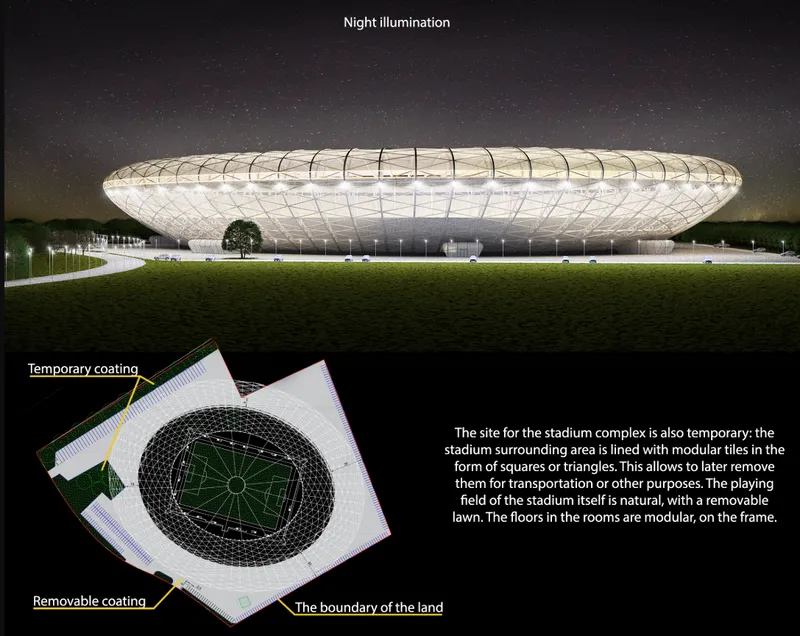
At night, Moment reveals its second material identity. The translucent fabric envelope glows from within, transforming the stadium into a lantern on the landscape. The membrane is tensioned using sling wire ropes and is engineered with strategic cut-throughs that reduce wind loads while allowing natural ventilation. It is weather-resistant but breathable, a combination that lets the stadium function across different climates without relying on energy-intensive mechanical systems.
The choice of textile-based architecture is not merely aesthetic. Fabric is dramatically lighter than glass or metal cladding, reducing transportation weight and simplifying the erection process. Paired with dry construction techniques for the interior fit-out and autonomous utility systems for water, sewage, and heating, the design is optimized for deployment in locations with limited existing infrastructure. The stadium brings its own services with it.
Two Levels: Operations Below, 30,000 Seats Above
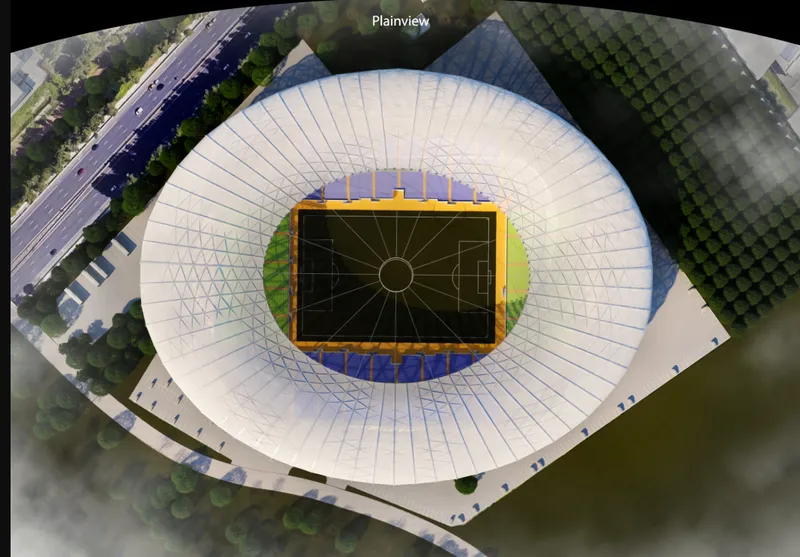
The plan view exposes the internal organization: a clear oval pitch at the center, surrounded by radiating structural ribs that support the seating bowl and roof. The stadium is arranged across two levels. The ground floor houses all operational functions, including locker rooms, media centers, first-aid facilities, and dedicated spaces for staff and VIPs. The upper level contains the spectator seating for up to 30,000 people, configured to maintain optimal sightlines and efficient crowd circulation.
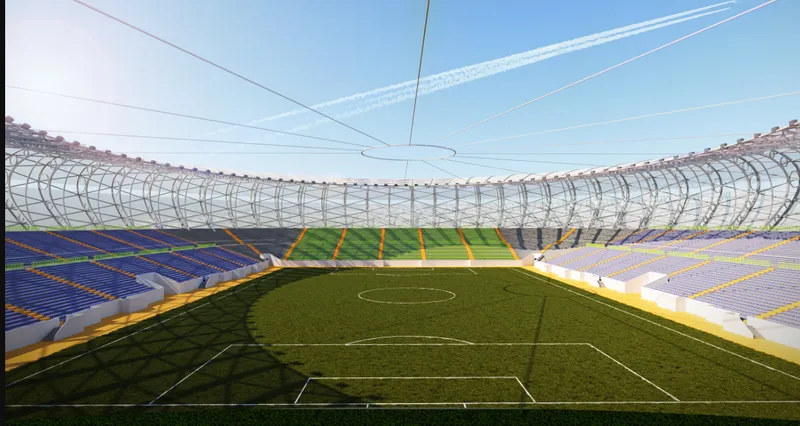
The interior view from pitch level is the most revealing image in the set. Tiered seating rises steeply on all sides, and the arched, cable-supported roof frames the sky overhead. The openness is striking. Rather than the enclosed, artificially lit bowl of a typical permanent stadium, Moment offers an experience closer to an open-air amphitheater, with the fabric canopy providing shelter without sealing the space. The structural cables read as taut, precise lines against the sky, reinforcing the temporary but rigorous character of the whole assembly.
Beyond Sport: A Multifunctional Nomadic Venue
Dolgikh positions Moment not as a single-purpose sports facility but as a platform for concerts, exhibitions, and large public gatherings. The modularity that enables relocation also enables reconfiguration: seating counts can be adjusted, interior layouts rearranged, and the venue adapted to different cultural contexts and event types. In a global landscape littered with underutilized permanent stadiums built for one-off tournaments, a venue that can serve multiple cities and multiple purposes over its lifespan represents a fundamentally different economic and environmental equation.
Why This Project Matters
The white elephant problem in stadium architecture is well documented. Cities spend billions on venues that see intensive use for weeks, then decay into maintenance burdens. Moment Stadium confronts this pattern directly by proposing that a major venue does not need to be permanent to be serious. The 3-to-12-meter modular steel system, the tensioned fabric skin, the removable site tiles, and the autonomous utility networks form a coherent, integrated argument for mobility at a scale that architecture rarely attempts.
What makes Dolgikh's proposal compelling is its refusal to treat portability as a compromise. The interior views show a stadium that reads as generous and spatially ambitious, not as a temporary structure apologizing for its impermanence. If anything, the exposed steel ribs and taut cable networks give Moment a formal clarity that many permanent stadiums, buried under cladding and corporate branding, never achieve. It is a provocation worth taking seriously: architecture that earns its relevance by moving on.
View the Full Project
About the Designers
Designer: Konstantin Dolgikh
Enter a Design Competition on uni.xyz
uni.xyz runs architecture and design competitions year-round that reward proposals with spatial conviction and real site intelligence.
Project credits: Relocatable stadium "Moment by Konstantin Dolgikh Staydium 2020 (uni.xyz).


Popular Articles
Popular articles from the community


Singing Woman: An Opera House That Performs Before the Curtain Rises
Ovidiu Cristian Pavel's conceptual opera house translates Estonia's choral identity into a sculpted waterfront landmark facing the Baltic Sea.

Opera by the Sea Estonia: Three Shells Dissolving Architecture into Tallinn's Coastline
A winning opera house proposal replaces monumental form with interconnected shells that blur the boundary between building, park and Baltic Sea.

Manzana Morphosis: Stretching Barcelona's Grid into a Living Landscape for 2050
A radical reworking of the Eixample manzana turns density into a tool for generous public space, vertical ecology, and environmental performance.

Tsunami Convergenics: Turning Catastrophic Ocean Forces into Underwater Housing Infrastructure
A speculative underwater settlement off the coast of Onagawa, Japan, treats tsunamis and typhoons as energy sources rather than threats.

Similar Reads
You might also enjoy these articles

Shakur's House: Exposed Brick as an Interior Organiser in a 168 m² Mashhad Residence
Brick moves indoors in this Mashhad residence, where masonry walls, glass partitions and teal planes sequence a compact home without closing it off.

Day and Night Park: A Time-Based Urban Newsstand in Beijing
A temporary urban newsstand in Beijing blending travel, light, and reading through poetic colors, compact form, and community-focused design.

Modernist Patio Renovation in El Masnou, Barcelona by Oliver Segura Arquitectura + Cebrià Arquitectura
Modernist patio renovation blending tradition and innovation with a movable pool, leveled floors, and Catalan materials in El Masnou.

Alto Residencial Coop: Cooperative Housing Development in Santiago de Compostela by Carbajo Barrios Arquitectos
A linear cooperative housing complex blending white volumes and perforated metal façades, enhancing community living, natural light, privacy, and urban integration.

Explore Stadium Competitions
Discover active competitions in this discipline

Challenge to design a barrier free sports center

Challenge to design an outdoor ice-rink and park
Comments (0)
Please login or sign up to add comments
No comments yet. Be the first to comment!