

Moon Hoon Carves a Diagonal Staircase Through a 1980s Seoul Building to Unlock City Views
A tiny commercial renovation in Haebangchon turns a forgotten brick residence into a wormhole of pinkish concrete and timber arches.


Haebangchon, the hillside neighborhood wedged between Itaewon and Yongsan, has spent the last decade reinventing itself. A district once defined by modest brick housing for foreign nationals and military personnel now hums with hip bars and destination restaurants, its steep alleys drawing a young international crowd. The buildings, however, have not always kept pace. Most date from the 1980s: squat concrete frames wrapped in brick, their interiors carved into cramped residences that ignored the panoramic city views sitting just above their rooflines.
Moon Hoon saw exactly that gap in the Diagon Commercial Building, a 93 square meter footprint on a 168 square meter site. Rather than demolish and rebuild, the studio preserved the original concrete skeleton and removed nearly every interior wall, then drove a diagonal staircase clean through the first, second, and third floors. The move is part Louis Kahn public gesture and part science fiction: a wormhole-like passage that halves each floor plate, starts at the sidewalk, and deposits visitors onto a rooftop terrace where the full hillside panorama finally reveals itself. At just 350 square meters of gross floor area spread across a basement and three stories, it is tiny. But Moon Hoon has packed it with enough spatial invention to fill a building five times its size.
A Street Offering in Timber and Glass


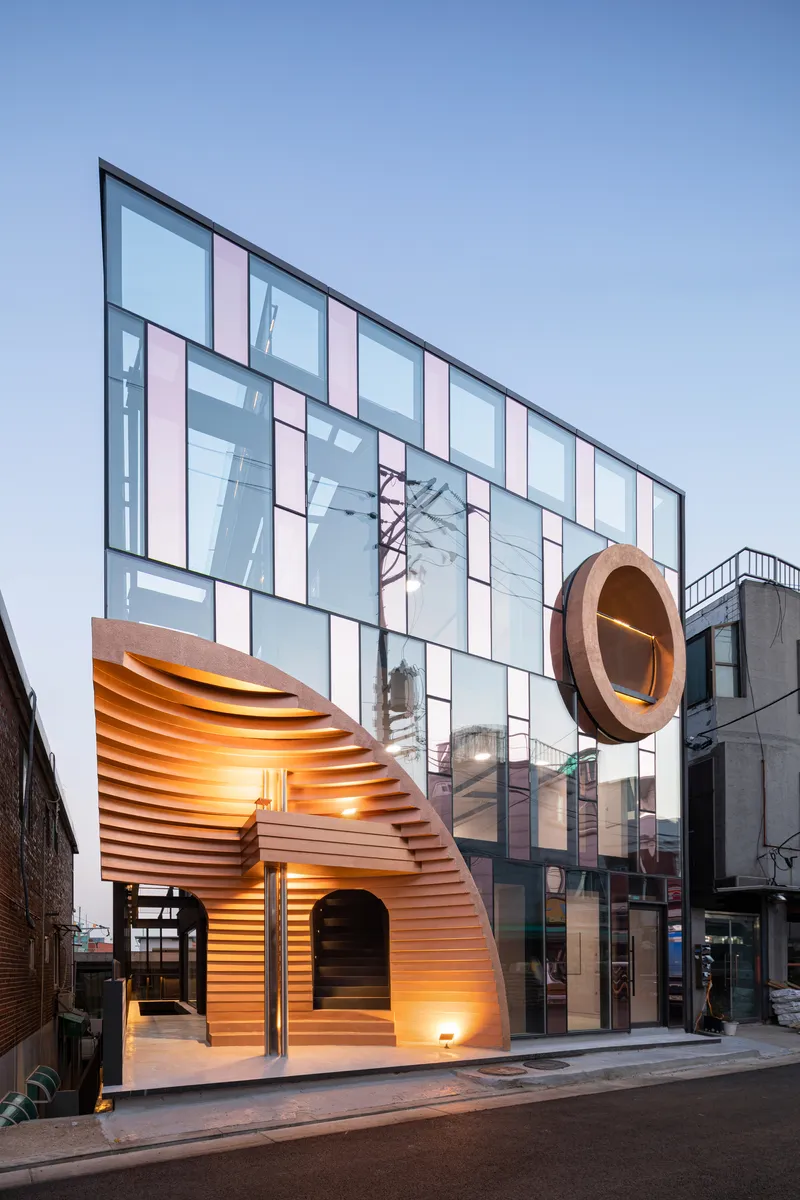
The street facade is where the building announces its ambitions. Pale blue and pink glazed panels form a curtain wall that reads as a single luminous plane, but Moon Hoon punches two laminated timber arches through its base, creating portals that pull pedestrians off the sidewalk. The arches are not decoration; they are the threshold of that diagonal staircase, wrapped in horizontal timber slats that give the entrance the feel of a ribbed tunnel rather than a commercial doorway.
A stepped concave seat at the entrance doubles as a public bench, a deliberate offering to passersby that Moon Hoon compares to the shaded arches at the Kimbell Art Museum. Whether or not you accept that comparison, the gesture is real: in a neighborhood of blank walls and rolled shutters, the building opens its ground floor to the street like an outstretched hand.
The Wormhole Staircase


The diagonal stair is the project's defining spatial move. It pierces through each floor plate at an angle, carving away half of every level and creating a continuous vertical passage lined in timber slats and warm strip lighting. Ascending through it feels less like climbing a stair and more like moving through an organism. Moon Hoon describes the form as a giant animal rising through the building, and the interior views confirm the metaphor: the slats ripple like ribs, the arched openings glow blue, and the proportions shift from claustrophobic to expansive at each landing.
The structural logic is straightforward. The original concrete frame does the heavy lifting, and the new stair simply occupies the void left by demolished partition walls. But the experiential result is anything but simple. Circulation wraps each level except the third floor, meaning you can always find your way around the stair even as it consumes the center of the plan. The building becomes a loop threaded by a diagonal cut.
Pinkish Concrete Meets Black Steel


Moon Hoon works the material palette hard for a building this small. The new sculptural additions are cast in pinkish concrete, their curves and gaps standing in deliberate contrast to the black painted steel sheet that wraps much of the exterior. Between the two facades, narrow courtyard passages open up, crossed by steel bridges and topped with glazed skylights. These interstitial zones feel like gaps between tectonic plates: tight, vertiginous, and full of unexpected light.
The perforated metal mesh that appears on balustrades and facade panels adds a third register of texture. At twilight, when interior lighting bleeds through the perforations, the building shifts from solid to lattice, its mass dissolving into a constellation of warm pinpoints.
Cantilevered Creatures


Two circular timber volumes project from the facade like oversized portholes, their curved slats giving them the appearance of barrels or cocoons. One cantilevers from the second floor as a balcony, large enough for a single person to stand inside and survey the street below. At night, lit from within, these volumes become lanterns that mark the building from blocks away. They are characteristic Moon Hoon moves: whimsical in silhouette, serious in the way they redirect sightlines and create inhabitable thresholds between interior and city.
Rooftop as Destination
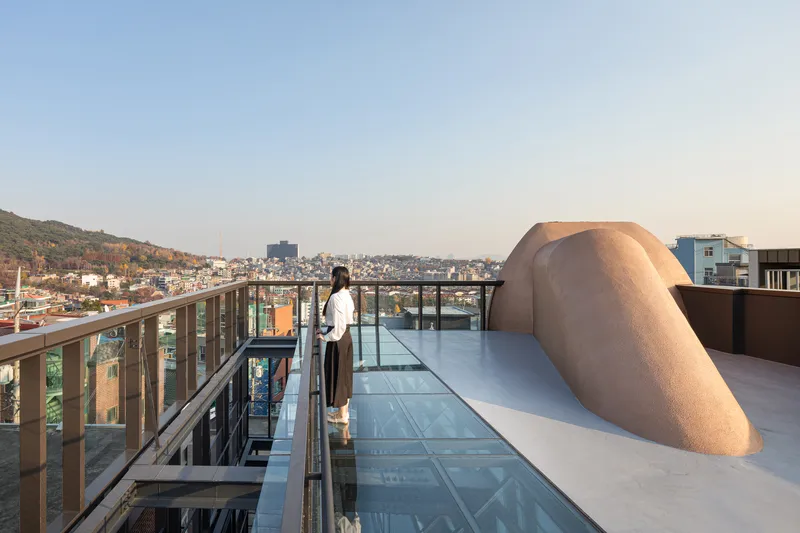


The whole point of the diagonal stair is its terminus: a rooftop terrace with glass floor panels and steel railings that opens onto the hillside neighborhood spreading toward Yongsan. The original building, like most of its 1980s neighbors, treated the roof as dead space. Moon Hoon treats it as the climax. The copper-toned sculptural element visible from the street rises through the rear elevation to become a guardrail and windbreak, its angled face catching afternoon light.
A third-floor balcony wrapped in fake glass walls sits just below, designed not as enclosure but as trellis. Moon Hoon envisions vertical-climbing plants colonizing these glass surfaces over time, a reference to Geoffrey Bawa's Kandalama hotel in Sri Lanka. Whether the planting materializes or not, the intent is clear: this is a building designed to age, its surfaces softening as vegetation fills the armature.
Interior Arches and Corridors


Inside, arched doorways frame views through white curved walls and wood panel ceilings, compressing and releasing space in quick succession. The arch is a recurring motif that Moon Hoon uses to signal passage rather than decoration: each one marks a shift in program, light condition, or orientation. Narrow corridors between perforated concrete walls and layered timber canopies create a layered depth that belies the building's modest footprint.
The effect is cinematic. You move through the building as though through a sequence of frames, each transition tightly choreographed. For a renovation of a nondescript 1980s box, the spatial complexity is remarkable.
The Building After Dark

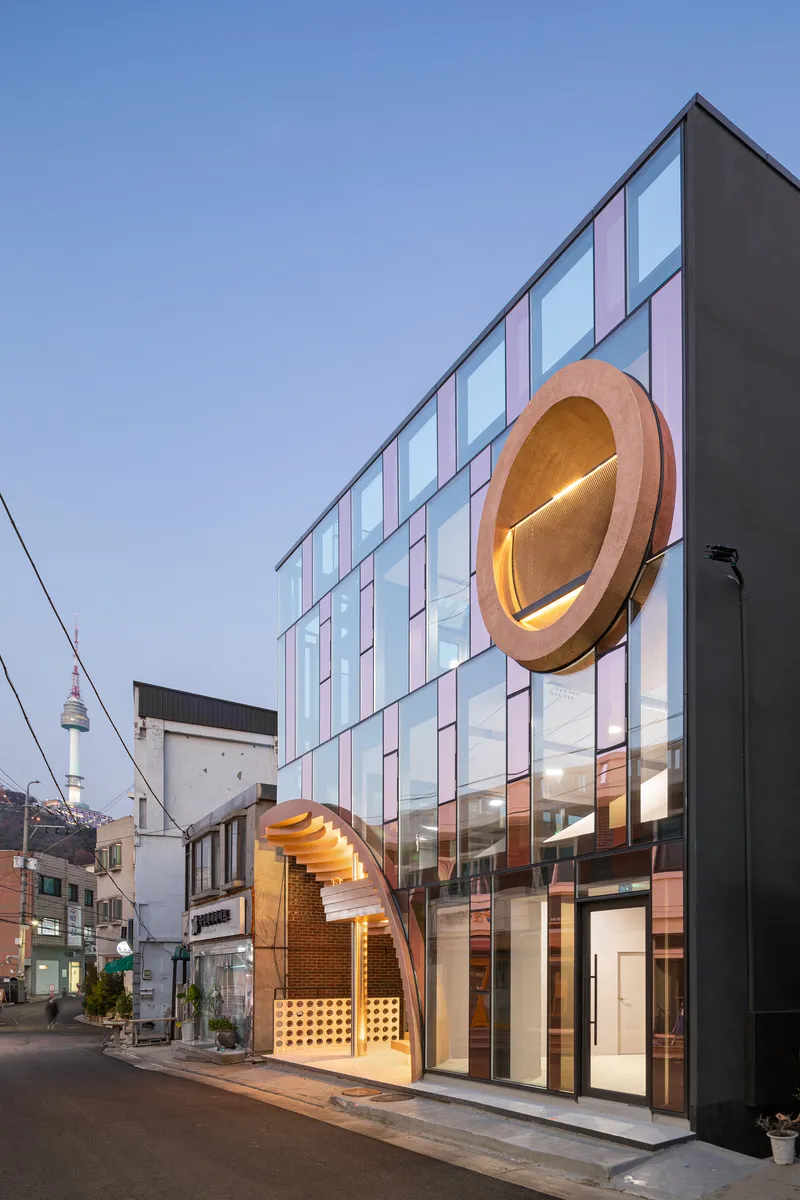

Diagon is a building that performs differently at night. The vertical glass panels on the street facade become a translucent screen, the timber arches glow amber, and the cantilevered porthole element reads as a floating eye above the sidewalk. In a neighborhood where evening foot traffic is the economic engine, this nocturnal presence matters. The building advertises its commercial tenants without a single sign, relying instead on spatial drama and warm light to draw people in.
Exterior Details and Walkways


Perforated metal balustrades, black steel overhead beams, and stepped exterior walkways complete the picture. Each element serves double duty: the balustrades provide safety and shade, the beams support future planting, and the walkways connect the building's levels to the sloping street without the need for an elevator. In a zero-parking project on a tight hillside lot, this kind of economy is not optional. It is the only way the building works.
Why This Project Matters
Seoul is full of 1980s concrete boxes waiting to be either demolished or ignored. Moon Hoon's Diagon Commercial Building makes the case for a third option: keep the bones, gut the assumptions, and rewrite the spatial logic from the inside out. The diagonal staircase is not just a clever section move. It is an argument that even a 93 square meter footprint can generate public space, vertical circulation, and city views if you are willing to sacrifice the conventional floor plate.
The project also demonstrates that playfulness and rigor are not opposites. The timber arches, pinkish concrete curves, and cantilevered portholes could easily tip into cartoon territory, but Moon Hoon grounds each gesture in a programmatic or environmental purpose. The result is a building that earns its strangeness, one that makes Haebangchon's transformation visible not through signage or branding but through architecture that invites you to climb.
Diagon Commercial Building by Moon Hoon (Creative Consultant: MOONBALSSO), with KJY Architects as Architect of Record. Yongsan-gu, Seoul, South Korea. 93 m² building area, 350 m² gross floor area. Completed 2022. Photography by Kim Chang Mook.
About the Studio
Share Your Own Work on uni.xyz
If projects like this are the kind of work you want to make, uni.xyz is a place to publish your own, find collaborators, and enter design competitions.


Popular Articles
Popular articles from the community

Temporary Home for Dogs: A Reversed Zoo Rethinks Animal Shelter Architecture
In Bucharest, a sinuous corridor and freed landscape flip the logic of containment, designing a shelter that works to make itself unnecessary.

Faces of the Soviet Avant-Garde: Turning Moscow's Street Names into an Open-Air Museum
A network of sculptural installations across a Moscow residential district transforms forgotten architect names into spatial encounters with cultural memor

Cloaked Colonization: A Mobile Underwater Habitat That Moves Like a Fish
Micah Abaya's shortlisted EHC Pacific entry reimagines ocean settlement as a dispersed network of self-sustaining architectural organisms.

Singing Woman: An Opera House That Performs Before the Curtain Rises
Ovidiu Cristian Pavel's conceptual opera house translates Estonia's choral identity into a sculpted waterfront landmark facing the Baltic Sea.

Similar Reads
You might also enjoy these articles

Pixel Gardens: One Repeated Module Stacked Into a Terraced Social Housing Tower for Famagusta
Salem Bader's shortlisted housing tower builds a vertical neighbourhood from one repeated module, offsetting units to carve terraces, light and air.

Bao Huynh Watercolor Atelier: A Serene Art Retreat in Hội An
Bao Huynh Watercolor Atelier in Hội An blends multifunctional art spaces, sustainable design, local materials, and family-friendly living in a serene environment.

Atelier Macri Concept Store Interior Design by CASE-REAL
Atelier Macri store features a "ko" counter, walnut wood details, cork displays, blending retail, gallery, and seamless customer experiences.

Manuel Vargas Izquierdo Stadium and High-Performance Sports Center: Architectural Excellence in Jalpa de Méndez
The Manuel Vargas Izquierdo Stadium blends sustainable design, inclusive sports facilities, and cultural-inspired architecture, revitalizing Jalpa de Méndez’s public spaces.

Explore Tall Building Competitions
Discover active competitions in this discipline

Challenge to reimagine the Iron Throne

Photograph architecture without architects

Illustrate the lost glory of Angkor Wat - Render Challenge

Design challenge to reuse E-waste
Comments (0)
Please login or sign up to add comments
No comments yet. Be the first to comment!