

Mycelium Path: A Wetland Research Center Built from Fungal Logic
Near the River Tame floodplains, a bio-architecture proposal uses mycelium as both material and metaphor for ecological restoration.


What if the most advanced building material on Earth has been growing underfoot for 700 million years? Mycelium Path takes that question seriously, proposing a wetland research center whose structure, spatial logic, and material palette all derive from the vegetative body of fungi. The building doesn't simply reference nature; it operates according to fungal principles, using mycelium's capacity to purify water, break down toxins, and self-heal as the foundation for an architecture that is lightweight, biodegradable, and symbiotically integrated into its floodplain site.
Designed by Ivona Mangovic, this shortlisted entry for the WIC Competition is sited near the River Tame in the Tame Valley Wetlands, a landscape spanning Warwickshire, Birmingham, and Staffordshire that encompasses over 1,000 hectares of vital wetland ecosystems. Once environmentally degraded, the area now presents a charged opportunity: a place where sustainable materials and ecological design can demonstrate restoration rather than simply talk about it.
Fungal Networks as Architectural Blueprint
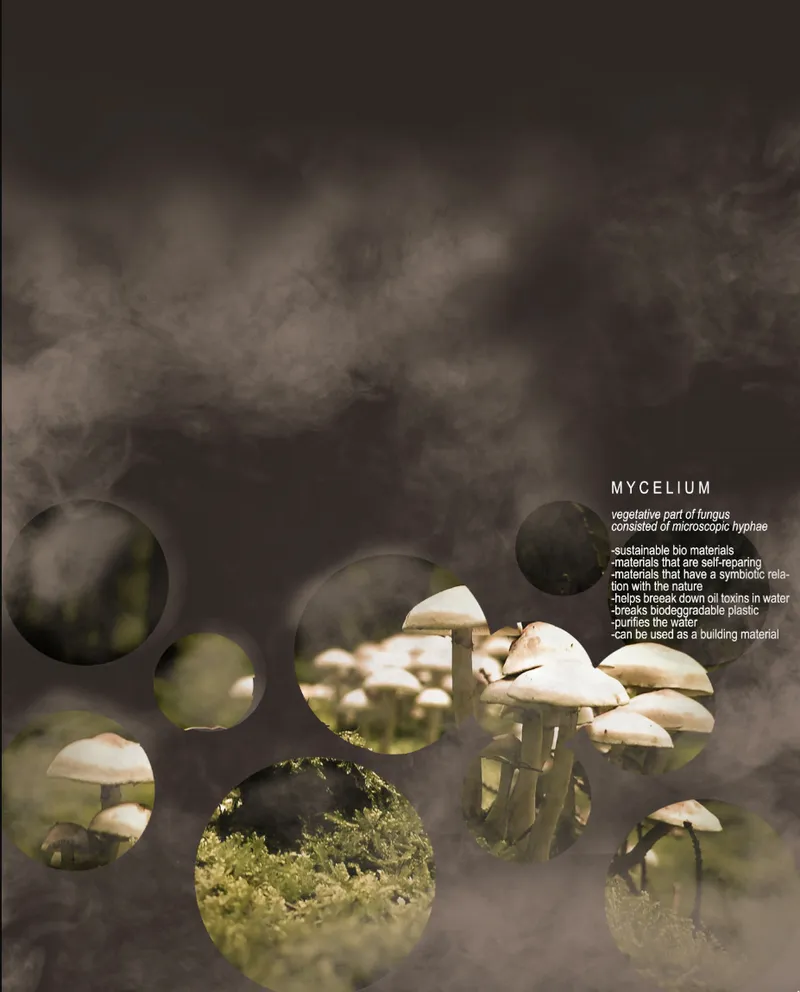
The conceptual diagram reads like a microscope slide scaled to landscape proportions: circular portals frame mycelium forms and mushroom bodies emerging through a misty haze, establishing the visual and intellectual framework for the entire project. Mangovic treats mycelium's microscopic hyphae, those threadlike filaments that weave through soil connecting organisms, as more than a metaphor. They become a literal form-finding tool. The building's plan and circulation derive from the entangled, branching geometry of fungal root networks, producing a biomimetic organization where corridors split, merge, and reconnect like hyphae seeking nutrients.
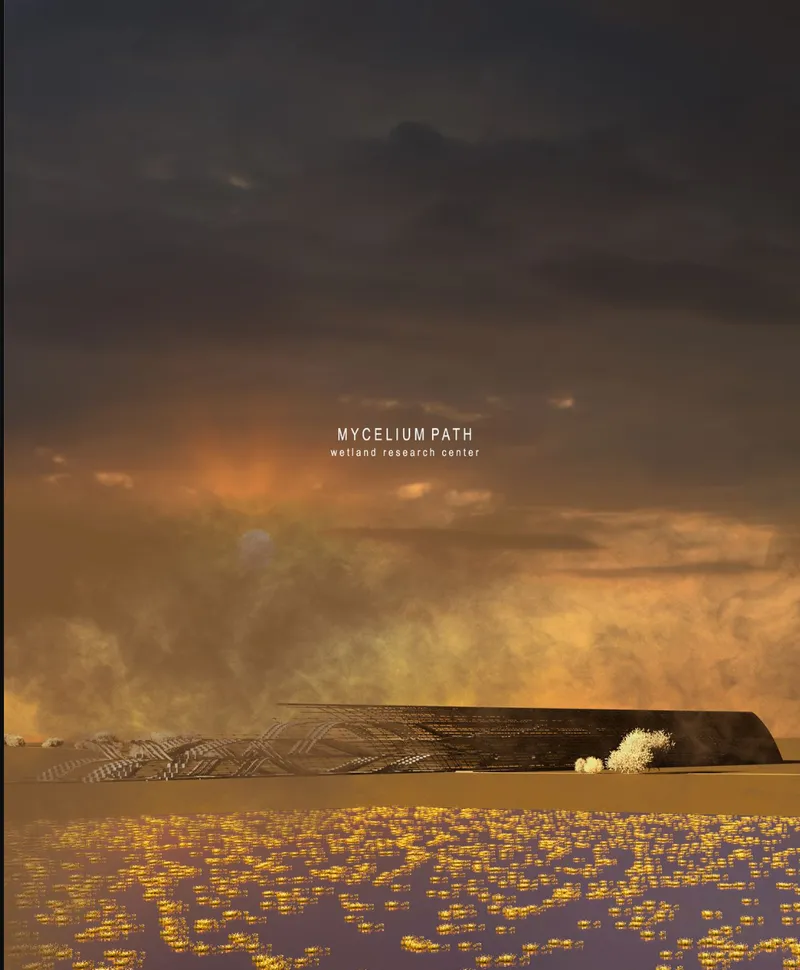
The dusk rendering reveals the result at landscape scale: a low, timber-clad structure that barely lifts above the wetland field. The building's horizontal profile refuses to dominate; it reads as a deliberate continuation of the terrain, its materiality and proportions calibrated to dissolve the line between constructed floor and natural ground plane.
Sections That Layer Timber, Greenery, and Light
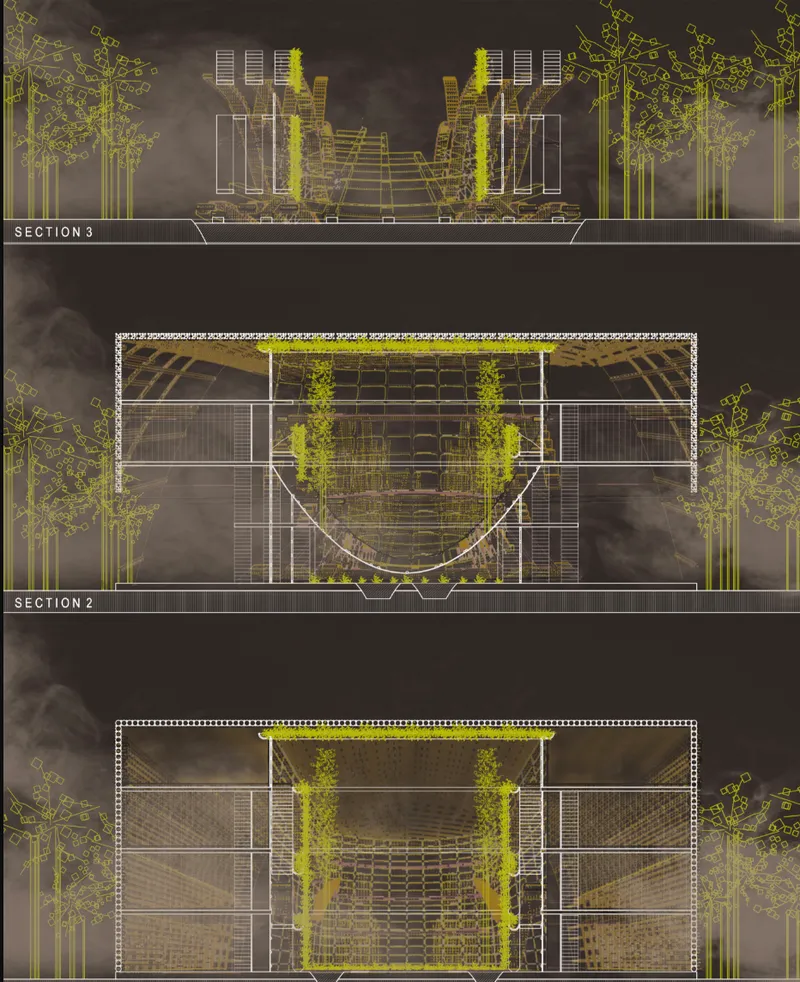
Three section drawings reveal the building's real spatial ambition. Vertical gardens climb through interstitial zones between floor plates, while layered timber louvers control light admission and ventilation. The sections show a structure operating in gradient: solid, enclosed laboratory and education spaces on one side give way to increasingly open, planted zones on the other. This is not a conventional environmental center with a green roof slapped on top; the planting is woven through the section, occupying the same spatial register as the occupied rooms.
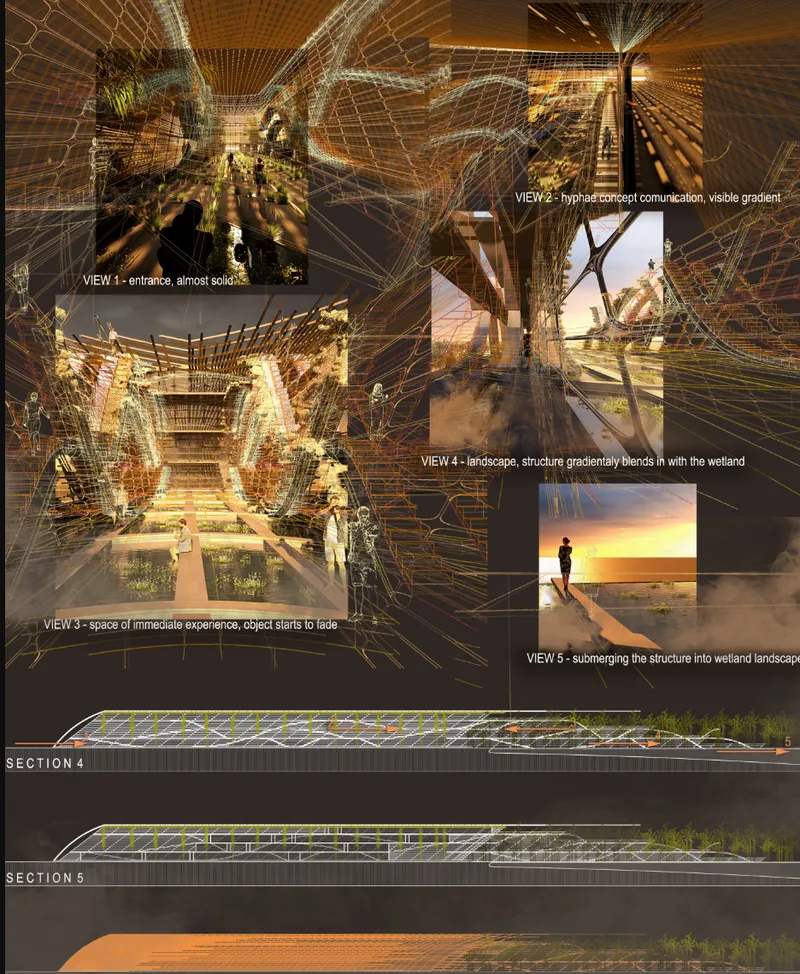
The composite presentation board reinforces this reading with wireframe renderings and sectional views that expose the interior's planted volumes. Two programmatic zones organize the facility. Zone 1 combines an educational sector, designed to inform the public about wetlands and fungi, with a laboratory sector where visitors can observe mycelium applications firsthand. Zone 2 prioritizes direct immersion, offering sensory engagement with the surrounding wetland ecosystems. The wireframe aesthetic is deliberate: it suggests a building still in the process of becoming, much like the living material it celebrates.
Interior Spaces Where Architecture and Wetland Converge
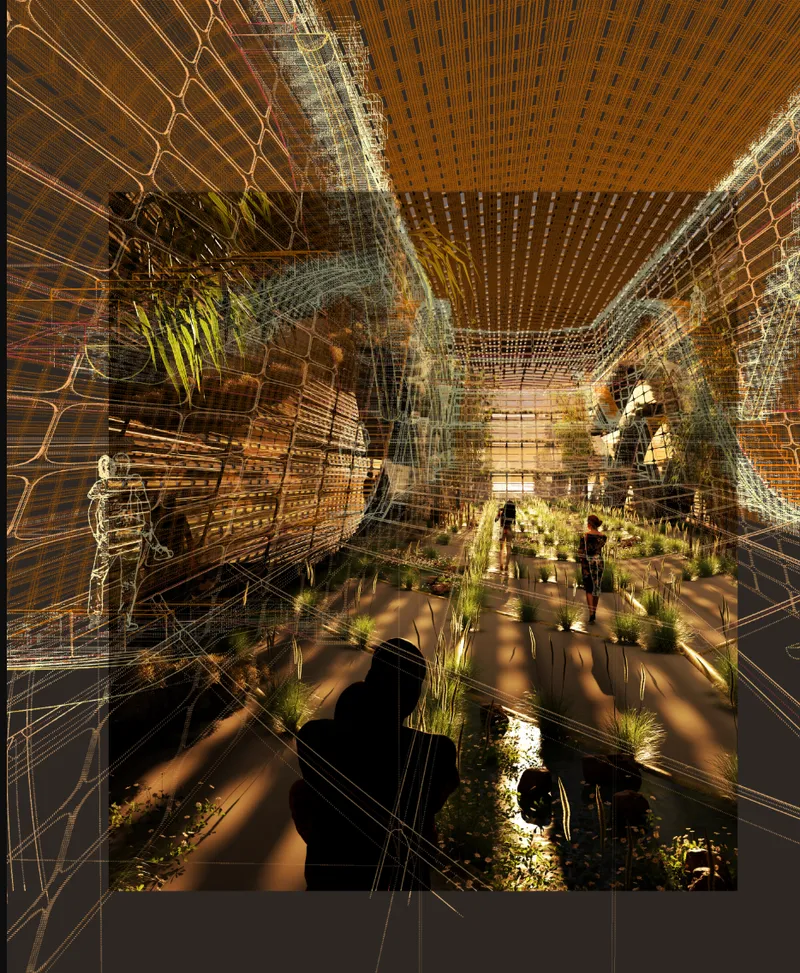
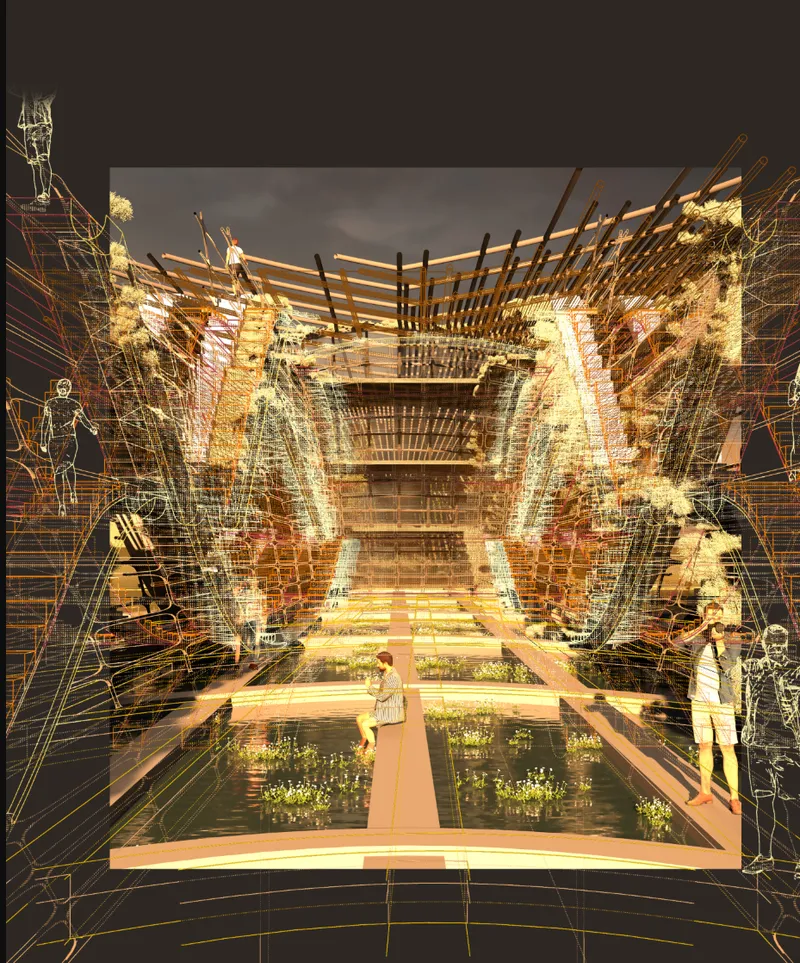
The interior renderings are where the project's spatial proposition becomes most vivid. In one view, a timber ceiling grid floats above wetland plantings that occupy the floor below, collapsing the distinction between research greenhouse and habitable room. The wireframe overlay suggests transparency and porosity, reinforcing the concept of hyphae-inspired membranes that allow the structure to fade into its context. Visitors move through what Mangovic describes as gradients of spatial intensity: from solid interiors to transparent, dissolving boundaries where the building essentially ceases to exist as a distinct object.
Looking upward through an interior courtyard, angled timber slats filter light down to planted water channels at ground level. The composition is both structural and atmospheric, producing conditions that shift with weather and season. Water, plants, timber, and light share the frame equally; no single element dominates. The building becomes what the project's brief promises: a structure that breathes, decays, renews, and disappears into the environment it protects.
Why This Project Matters
Mycelium Path succeeds because it refuses to treat biomaterials as a surface-level gesture. The fungal logic permeates every scale of the design, from the branching plan organization to the material palette to the way boundaries between interior and landscape progressively dissolve. In a competition landscape crowded with projects that invoke nature without rigorously engaging it, Mangovic's proposal demonstrates what happens when a single biological system is studied closely enough to generate form, program, and tectonic strategy simultaneously.
The choice of the Tame Valley Wetlands as a site grounds the proposal in real ecological stakes. Over 1,000 hectares of once-degraded floodplain now serve as the testing ground for an architecture that doesn't just minimize harm but actively participates in restoration. By using mycelium's proven abilities to purify water and remediate toxins, the building positions itself as infrastructure rather than monument. That shift, from architecture as object to architecture as ecological process, is exactly the kind of reframing that competitions like the WIC exist to provoke.
View the Full Project
About the Designers
Designer: Ivona Mangovic
Enter a Design Competition on uni.xyz
uni.xyz runs architecture and design competitions year-round that reward proposals with spatial conviction and real site intelligence.
Project credits: MYCELIUM PATH wetland research center by Ivona Mangovic WIC (uni.xyz).


Popular Articles
Popular articles from the community


longwave studio Reorganizes a 112 m² Tainan Apartment Around the Daily Routines of a Family and Two Cats
In Tainan, Taiwan, birch plywood, rust-red furniture and a freestanding plaster wall link arrival, storage, work and family life in one apartment.

Cube Design Draws an Ecological Corridor Between Two Shenzhen Hills with the Nankai Building
Beside Shenzhen's container docks, the Nankai Building pairs stacked balconies with a climbing green screen to connect two hillsides across its height.

LT2A and OPEN Architectes Thread a Brick and Glass High School Through a Wooded Belgian Campus
In Braine-l'Alleud, a 3,000 m² wing for Collège Cardinal Mercier pairs pale brick with a glazed colonnade, deferring to a small chapel and a dense wood.

David Macias Steps a Doorless Stone and Plaster House Down a Tropical Colombian Hillside
In the humid hills of Colombia, Threshold House replaces the front door with an open void and terraces its 850 m² down the slope instead of fighting it.

Similar Reads
You might also enjoy these articles


Vereda Arquitetos Renovates a 40-Square-Meter Apartment Inside Niemeyer's Copan Building
A compact unit in São Paulo's most iconic residential tower gets a material overhaul that pairs exposed concrete with bold blue Formica.

Shakur's House: Exposed Brick as an Interior Organiser in a 168 m² Mashhad Residence
Brick moves indoors in this Mashhad residence, where masonry walls, glass partitions and teal planes sequence a compact home without closing it off.

Day and Night Park: A Time-Based Urban Newsstand in Beijing
A temporary urban newsstand in Beijing blending travel, light, and reading through poetic colors, compact form, and community-focused design.

Modernist Patio Renovation in El Masnou, Barcelona by Oliver Segura Arquitectura + Cebrià Arquitectura
Modernist patio renovation blending tradition and innovation with a movable pool, leveled floors, and Catalan materials in El Masnou.


Comments (0)
Please login or sign up to add comments
No comments yet. Be the first to comment!