

Nano Nest: Compact Refugee Housing Rooted in Rome's Architectural Language
A vertical residence on a 4x12x12 meter plot uses fly ash concrete, classical arches, and split-level planning to house multi-generational refugee families


Fitting a multi-generational family home onto a 4x12x12 meter plot in Rome's historic core is a hard enough spatial puzzle. Doing it in a way that helps refugee families integrate into their new neighborhood, respects the city's architectural heritage, and remains affordable at scale is something else entirely. Nano Nest takes on all three problems simultaneously, stacking social life above sleeping quarters and wrapping the whole thing in a facade of arched openings that could pass for a fragment of Roman streetscape.
Designed by James Ingram, this Honorable Mention entry in the Nano Nest 2020 competition proposes a replicable prototype for compact refugee housing across Italian cities. The site is a narrow urban plot typical of Rome's dense historic fabric, where limited frontage and strict spatial constraints often sever the relationship between domestic life and the public realm. Ingram's response is a vertical residence that flips the conventional apartment section: grandparents live at ground level for easy street access, children occupy a playful split-level mezzanine, and the upper floors open into a flowing sequence of kitchen, lounge, and roof terrace designed to pull neighbors and residents into shared social space.
A Section That Reads Like a Social Diagram
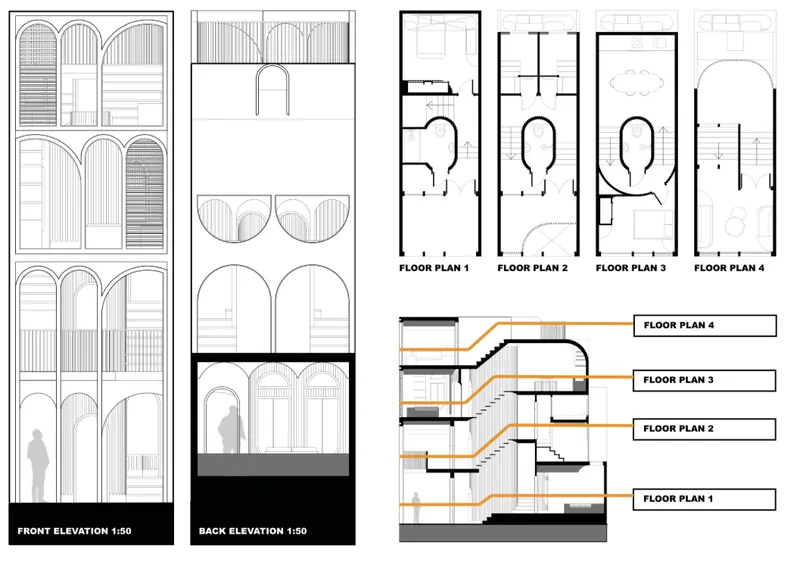
The drawings lay bare the project's organizing logic. Four floor plans, front and back elevations, and a sectional diagram reveal how the staggered levels create visual and acoustic connections between generations without sacrificing privacy. The grandparents' bedroom sits at street grade, giving elderly residents direct access to the sidewalk and, by extension, to daily neighborhood life. Above, the children's split-level room maintains a sightline down to the grandparents' area, a detail that acknowledges the practical realities of multi-generational caregiving. The section shows a central staircase that doubles as a ventilation shaft, channeling airflow upward through the building to combat Rome's hot summers.
What's striking about the plan is how little space is given over to corridors and circulation. Almost every square meter serves a dual purpose, whether as passage and ventilation, or as sleeping area and visual link. The 4x12 meter footprint forces tight discipline, and the result is a home where spatial efficiency doesn't come at the expense of lived experience.
Split Levels and Arched Openings as Spatial Connectors
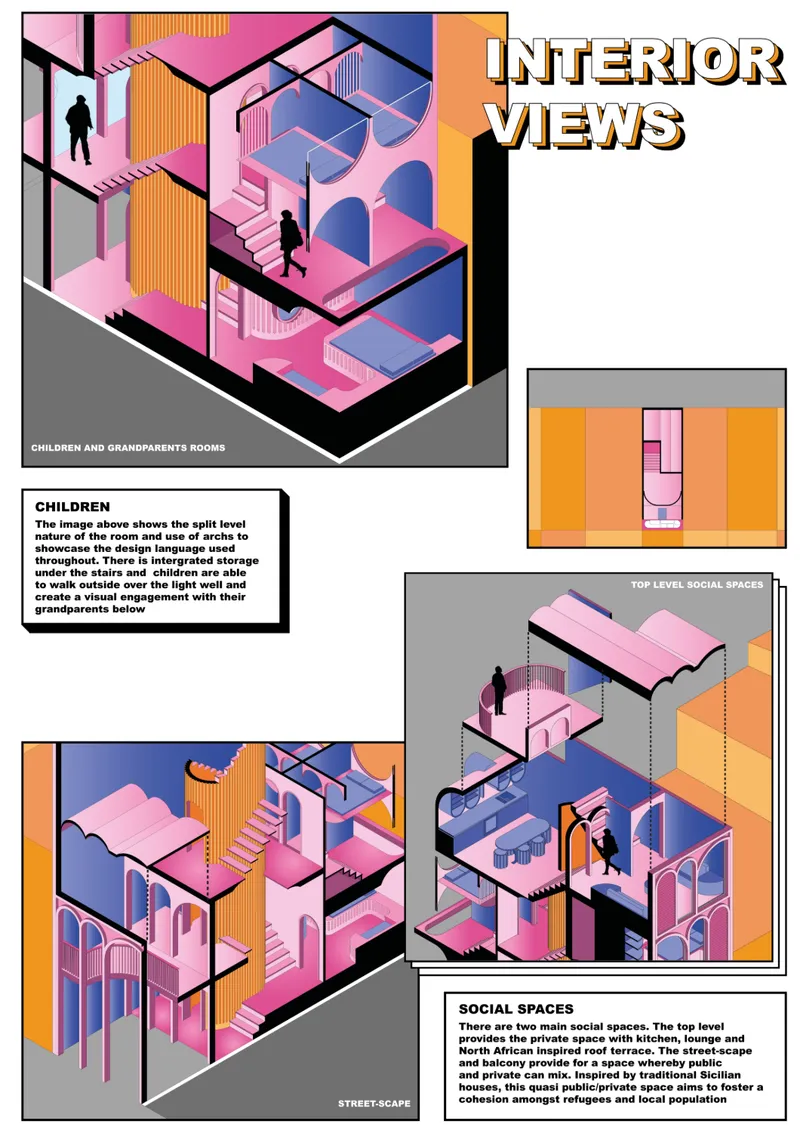
The axonometric diagrams, rendered in pink and orange, pull apart the interior to show how arched openings and half-level shifts create a continuous spatial flow. These arches are not decorative nostalgia. They derive from Rome's classical architectural typology and serve a structural role, framing large openings that flood interiors with daylight while supporting the loads of the floors above. The split-level arrangement lets the kitchen, lounge, and dining areas bleed into one another without hard walls, a strategy inspired by North African and Sicilian domestic traditions where cooking, eating, and socializing happen in a single unbroken zone.
By uniting these functions into interconnected spaces, the design strengthens family bonds while allowing individual members to pursue different activities at different elevations. A grandparent can rest near the street while children play on the mezzanine and adults prepare food on the upper level, all within earshot and sightline of one another.
A Facade That Belongs on the Street
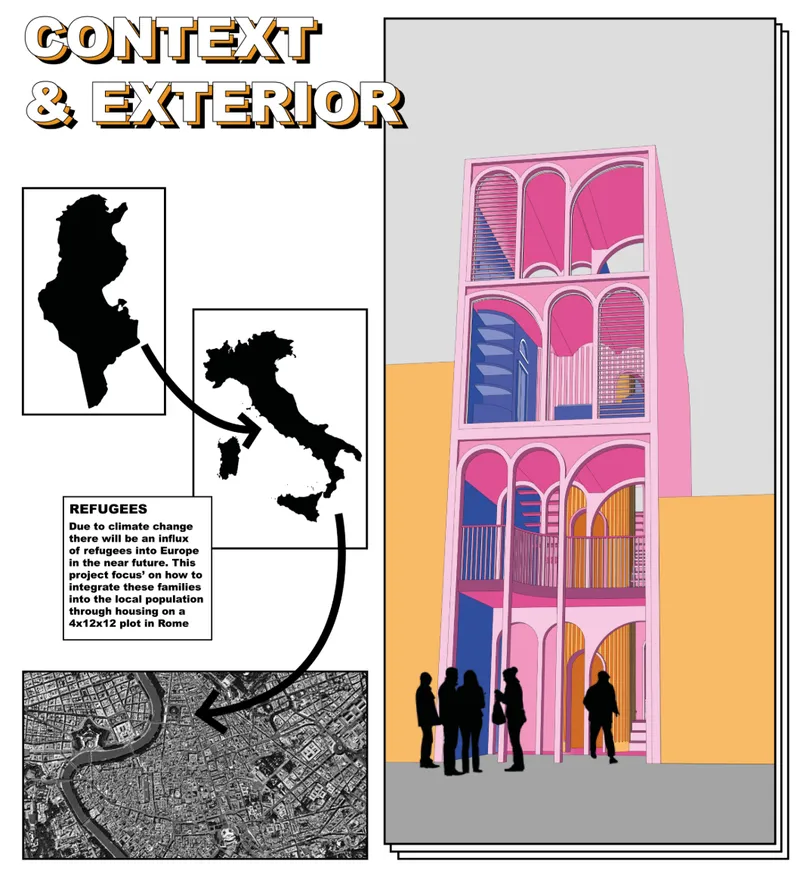
The elevation rendering shows a four-story pink facade punctuated by rounded arched openings of varying scale. Silhouetted figures at street level give a sense of the building's proportions and, more importantly, illustrate the project's core ambition: a ground floor that operates as a transitional zone between private domestic life and the public sidewalk. The street-facing social space draws on the tradition of Sicilian semi-public terraces and balconies, where the boundary between home and neighborhood is deliberately porous. Recessed balconies and shaded terraces on the upper floors extend this idea vertically, offering comfortable outdoor space while controlling solar gain.
The material choice reinforces the contextual sensitivity. Fly ash concrete, a by-product of the coal industry, delivers a lighter, ceramic-like surface finish that feels contemporary without clashing with Rome's masonry surroundings. Because it is both cheaper and less carbon-intensive than conventional concrete, and because the structural elements are designed for prefabrication, the entire system is engineered for large-scale adoption. Cost and environmental impact drop in tandem, a combination that makes the prototype viable beyond a single demonstration plot.
Designing for Climate, Cost, and Community at Once
Too often, refugee housing proposals treat sustainability, affordability, and social integration as competing priorities. Nano Nest treats them as inseparable. The central staircase ventilation shaft, the large facade openings, and the shaded terraces are passive cooling strategies that eliminate the need for mechanical systems, cutting both energy costs and carbon emissions. Prefabricated fly ash concrete panels reduce construction time and expense. And the lifestyle-based spatial strategy, which prioritizes communal areas over private sleeping quarters, is not just a space-saving trick but a deliberate framework for cultural continuity and neighborhood engagement.
Why This Project Matters
Climate change projections suggest that refugee migration into European cities will accelerate in the coming decades. The question is not whether historic urban cores will need to absorb new residents, but how. Ingram's proposal offers a concrete answer: identify underused narrow plots, deploy a replicable vertical housing typology that respects local architectural language, and engineer the section so that social integration is built into the spatial logic of the home itself.
What elevates Nano Nest beyond a competition exercise is its refusal to treat context as decoration. The arches work structurally. The split levels work socially. The fly ash concrete works economically and environmentally. Each design decision serves multiple purposes, and the result is a prototype that could genuinely transform how cities think about compact, inclusive housing on their tightest, most historically sensitive sites.
View the Full Project
About the Designers
Designer: James Ingram
Enter a Design Competition on uni.xyz
uni.xyz runs architecture and design competitions year-round that reward proposals with spatial conviction and real site intelligence.
Project credits: Nano Nest by James Ingram Nano Nest 2020 (uni.xyz).


Popular Articles
Popular articles from the community


Opera on the Sea: Driftwood Logic Shapes a Timber Opera House on Estonia's Coast
Trevor Orgill's opera house translates the entangled drift of floating timber into a civic building where wood, water, and music converge.

Aquadapt: An Underwater Habitat That Rewrites Its Rooms by the Hour
Curved modules ring the seabed while one shell shifts from breakfast room to cinema, farm and football pitch as residents' needs change.


Cube Design Draws an Ecological Corridor Between Two Shenzhen Hills with the Nankai Building
Beside Shenzhen's container docks, the Nankai Building pairs stacked balconies with a climbing green screen to connect two hillsides across its height.

graciastudio Turns a Viewless Tijuana Lot Inward Around a Courtyard of Concrete, Timber and Trees
In Tijuana, Jorge Gracia's GA2 House stacks a timber-clad private floor over exposed concrete and replaces a missing view with a planted interior patio.

Similar Reads
You might also enjoy these articles

Vereda Arquitetos Renovates a 40-Square-Meter Apartment Inside Niemeyer's Copan Building
A compact unit in São Paulo's most iconic residential tower gets a material overhaul that pairs exposed concrete with bold blue Formica.

Shakur's House: Exposed Brick as an Interior Organiser in a 168 m² Mashhad Residence
Brick moves indoors in this Mashhad residence, where masonry walls, glass partitions and teal planes sequence a compact home without closing it off.

Day and Night Park: A Time-Based Urban Newsstand in Beijing
A temporary urban newsstand in Beijing blending travel, light, and reading through poetic colors, compact form, and community-focused design.

Modernist Patio Renovation in El Masnou, Barcelona by Oliver Segura Arquitectura + Cebrià Arquitectura
Modernist patio renovation blending tradition and innovation with a movable pool, leveled floors, and Catalan materials in El Masnou.

Explore Nano Nest Competitions
Discover active competitions in this discipline

Challenge to design luxury tourism on rails

VR headsets Storefront design competition

Designing a staircase for a client
Comments (0)
Please login or sign up to add comments
No comments yet. Be the first to comment!