

Natura Futura Rewires a Deteriorating Ecuadorian Apartment with Movable Walls and Coastal Craft
In Babahoyo, a 90 m² renovation uses plant fibers, pivoting furniture, and pulley systems to make small space radically flexible.


Babahoyo sits on the banks of a river in coastal Ecuador, a city of roughly 150,000 people that has watched its stock of government-supported collective housing erode over four decades. The multi-family blocks that once gave the center its density now stand underoccupied and poorly maintained. Into one of these buildings, Natura Futura inserted a 90 m² apartment renovation for a young couple determined to stay in the urban core rather than flee to the periphery. The project, titled Operations Within Apartments, treats interior architecture not as decoration but as a set of mechanical propositions: fold it, slide it, pivot it, hoist it.
What makes the project worth studying is its refusal to accept the apartment's existing walls as given. Instead of demolishing and rebuilding, Natura Futura designed a series of operable devices, each constructed on-site through trial and error using plant fibers, wood, textiles, and pottery sourced from Ecuador's coast. The result is a home that can shift from a studio for one to a layout that accommodates a larger family, all without a single contractor return visit. Every mechanism is hand-operated, visible, and honestly expressed. The apartment becomes a kit of parts its occupants learn to play.
The Facade as Signal

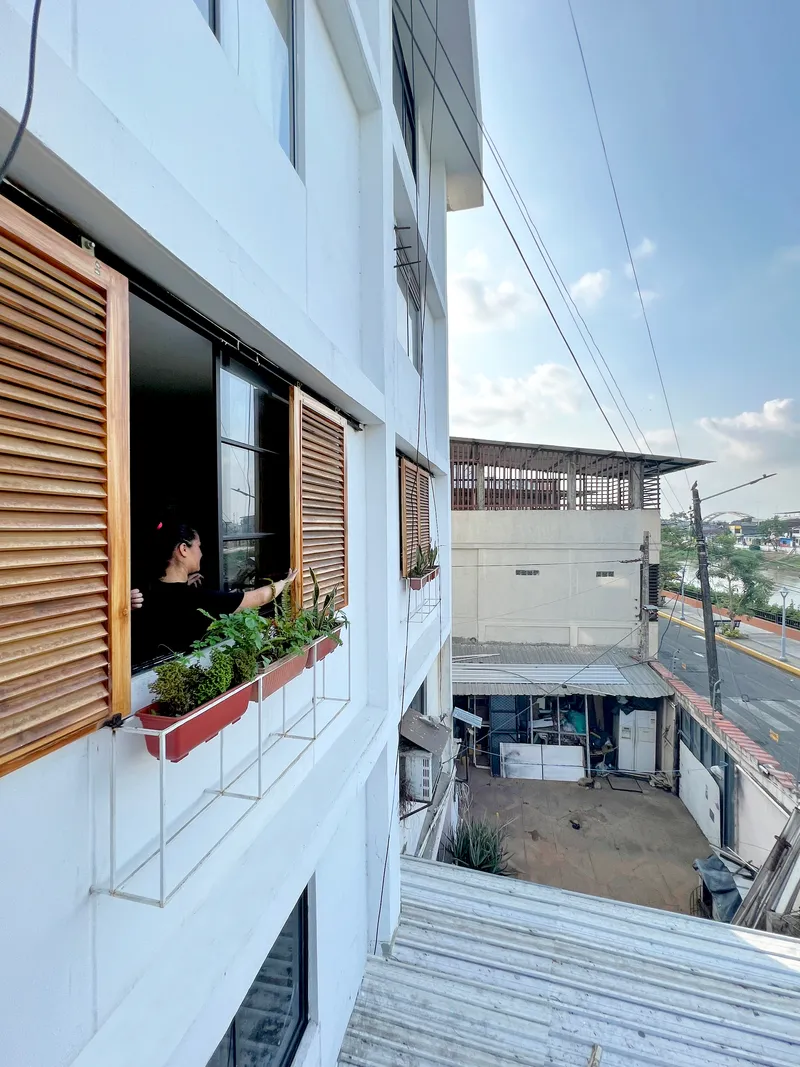
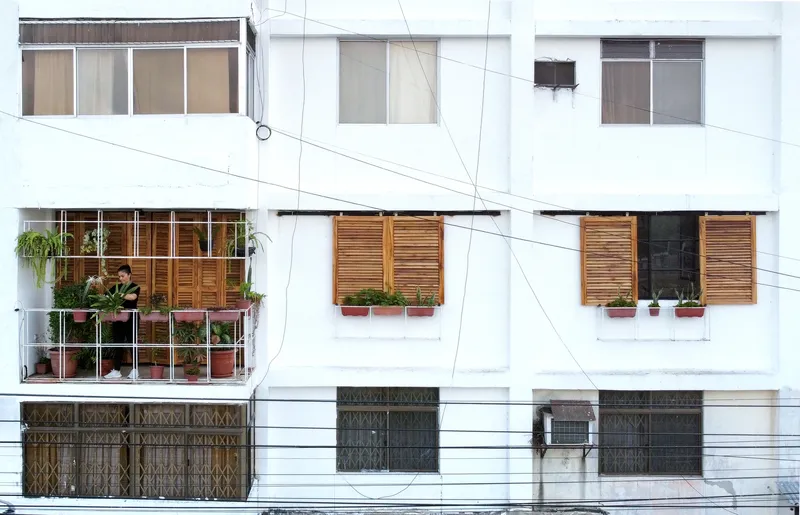
From the street, the white apartment block reads as unremarkable, the kind of mid-rise that dots Latin American city centers. But the timber louvered shutters punched into its facade tell a different story. Residents tend window-box planters behind these screens, and the interplay of open and closed louvers gives the elevation a rhythm that changes through the day. It is a modest gesture, but in the context of Babahoyo's declining housing blocks, it signals inhabitation and care where neither was expected.
The shutters also do real work. They control solar gain on the building's exposed face, filter the glare off the river, and provide a layer of security without resorting to the heavy metal grilles visible on neighboring units. The fact that a resident is visible at the balcony in nearly every exterior shot is not incidental: the design positions the occupant as part of the streetscape, reinforcing the civic argument that dense urban living still has a future here.
Woven Screens and Sliding Partitions


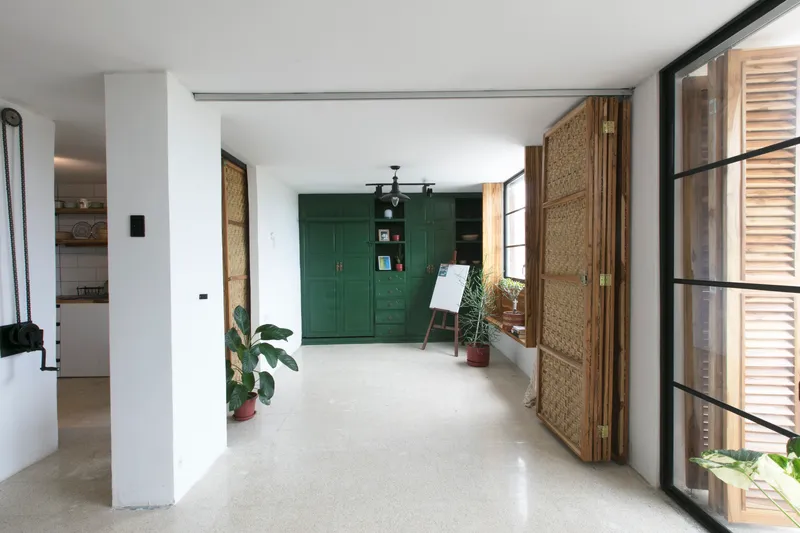
The apartment's primary spatial trick is its system of woven rattan and bamboo panels that slide along tracks to open or close rooms on demand. These are not decorative screens borrowed from a resort hotel. They are load-bearing dividers whose weave pattern allows air to pass through while still providing visual separation. The material comes from Ecuador's coastal region, and the panels were fabricated by local artisans, grounding the project in a craft tradition rather than an industrial supply chain.
Dark green cabinetry runs alongside these panels, absorbing storage into the wall plane and freeing the polished concrete floor for movement. The color choice is deliberate: the deep green reads as a continuation of the potted plants that populate every window sill and corner, collapsing the boundary between furniture and landscape.
Fold-Down Furniture and Chain Mechanisms

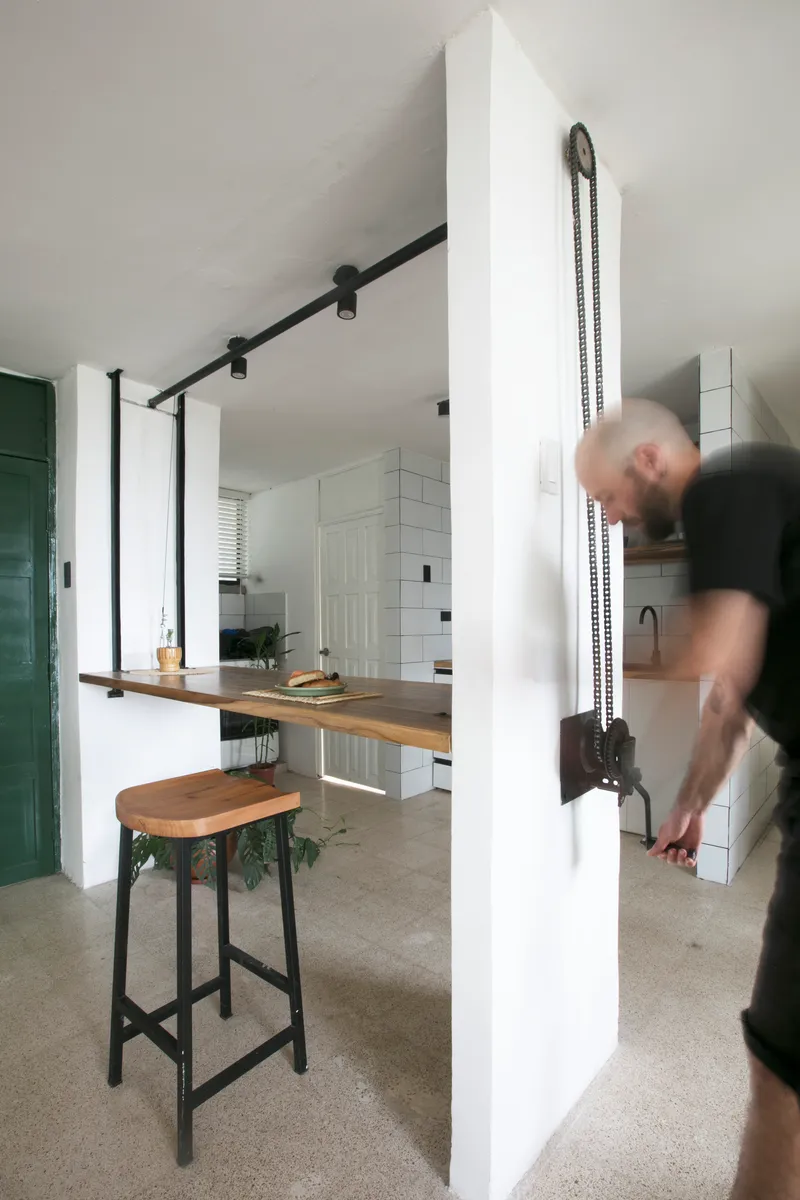

Several of the apartment's most striking elements hinge, literally, on a single black steel pipe column. A timber table folds down from it on chains, converting a corridor into a dining space in seconds. Nearby, a fold-down bench emerges from built-in cabinetry, creating a workspace or reading nook beside an easel. In the kitchen, a passthrough counter drops on a chain mechanism, its user captured mid-motion as they adjust the height. These are not off-the-shelf Murphy bed tricks; each device was prototyped in place, its proportions tuned to the specific ceiling heights and sight lines of this apartment.
The honesty of the hardware matters. Chains, bolts, and brackets are left exposed rather than concealed behind trim. Reclaimed timber beams hang from black steel brackets with visible fasteners. The aesthetic is closer to a workshop than a showroom, which suits the project's ethos: the apartment is a tool, and tools should be legible.
The Kitchen Alcove and Black Steel Frames
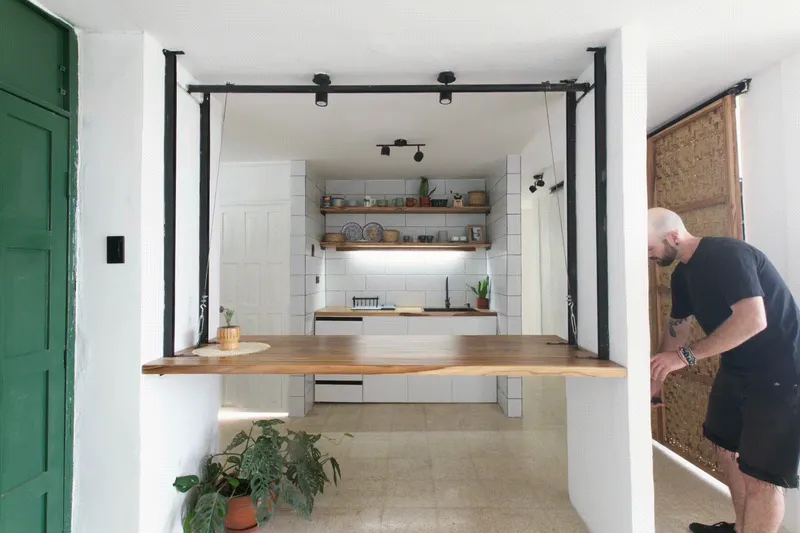

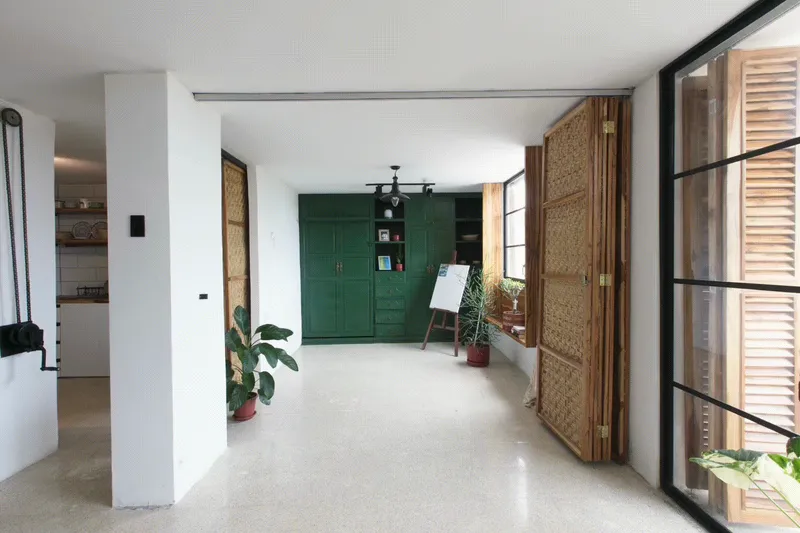
The kitchen occupies a compact alcove framed by black steel portals that read as thresholds rather than walls. White tile backsplash keeps the cooking zone hygienic and bright, while a timber shelf overhead stores essentials within arm's reach. The steel columns that define the opening are structural leftovers from the original building, repurposed here as frames that dignify what could have been a cramped galley.
Viewed from the living area, the kitchen alcove, the rattan doors, and the polished concrete floor compose into a single continuous interior that feels far larger than 90 square meters. The trick is disciplined materiality: only four or five materials appear in the entire apartment, and each one occupies its own register of color and texture so the eye reads depth rather than clutter.
Loft, Louvers, and Living Green
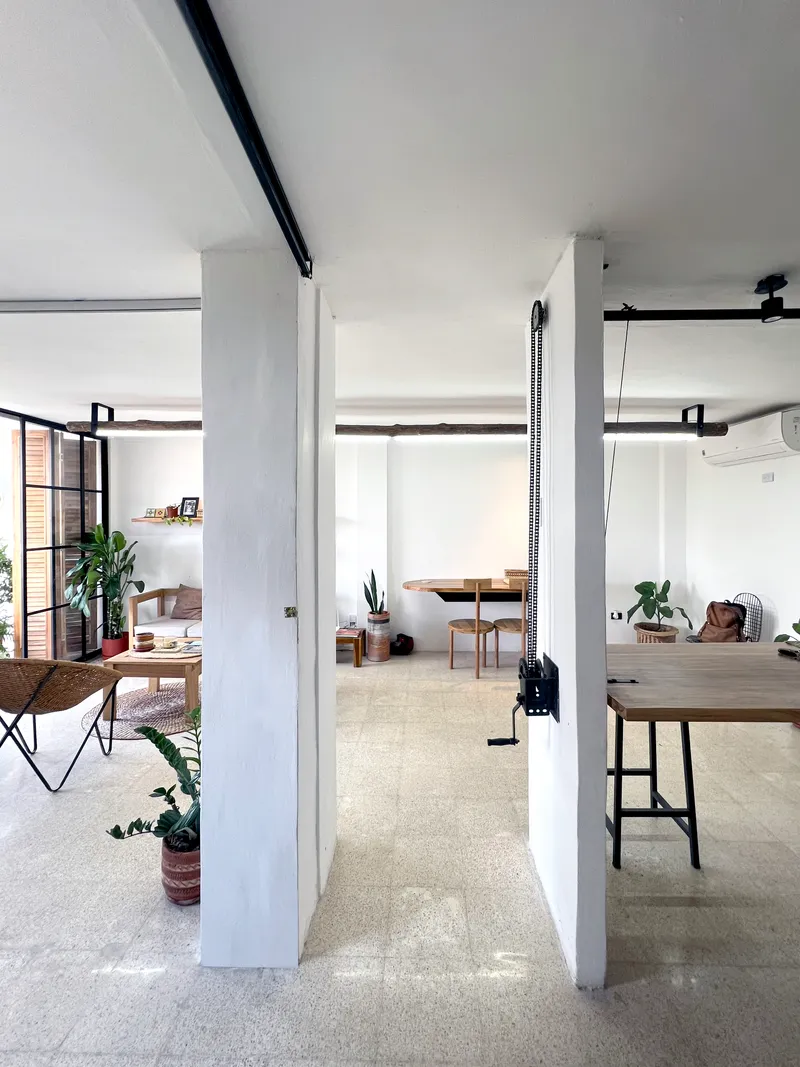


An open loft level with white columns, exposed black beams, and steel-framed glazing reveals the bones of the original structure. This space, stripped to its essentials, acts as both a reserve of square footage and a demonstration of what lies beneath the renovation's crafted surfaces. Below, timber louvered shutters open beside hanging ferns and potted plants under a glazed skylight, turning a rooftop condition into an interior garden.
The hammock strung across a room with green built-in shelving and a large black-framed window is perhaps the most telling detail. It is cheap, portable, and deeply Ecuadorian. In a project full of clever mechanisms, the hammock reminds you that adaptability does not always require engineering. Sometimes it just requires a pair of hooks and a willingness to let a room be more than one thing.
Structure and Detail
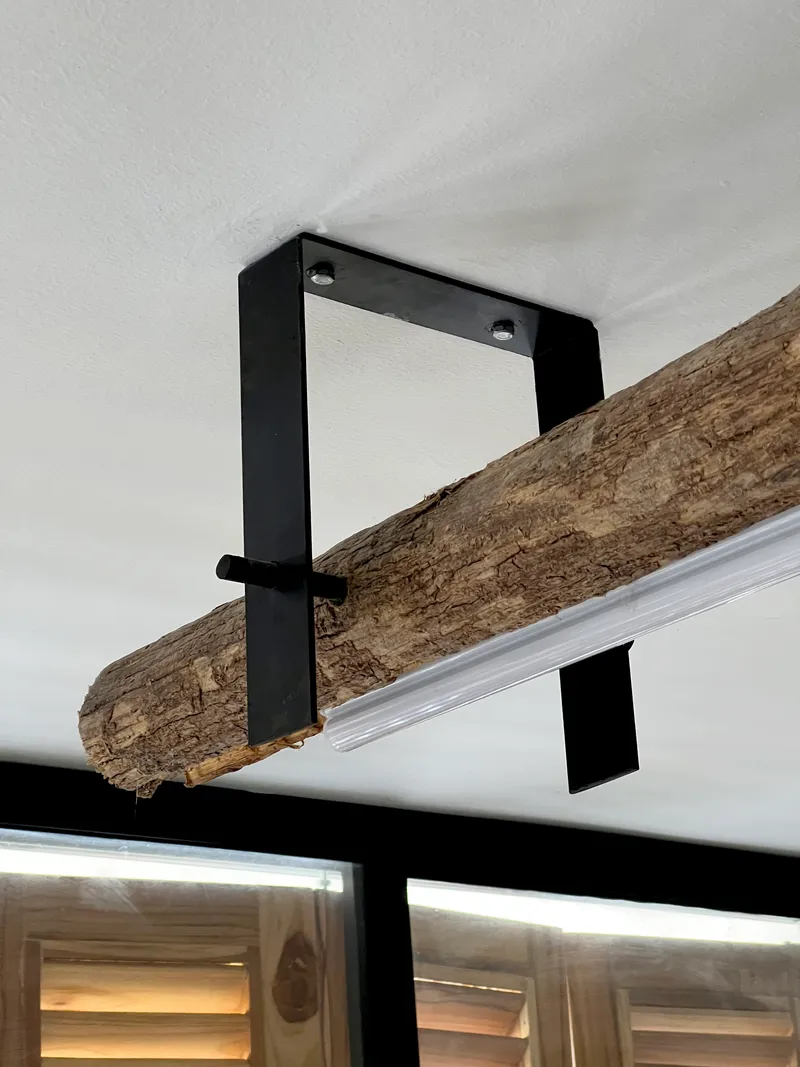

A reclaimed timber beam suspended from the white ceiling by black steel brackets captures the renovation's material logic in a single detail. The bolts are visible. The grain of the wood is unfinished. The steel is painted, not powder-coated. Nothing pretends to be something it is not. In the living room, timber louvre screens filter daylight across the polished concrete floor, casting striped shadows that shift through the afternoon. The floor itself, ground and sealed to a reflective finish, acts as a light amplifier, bouncing illumination deep into the plan.
Plans and Drawings

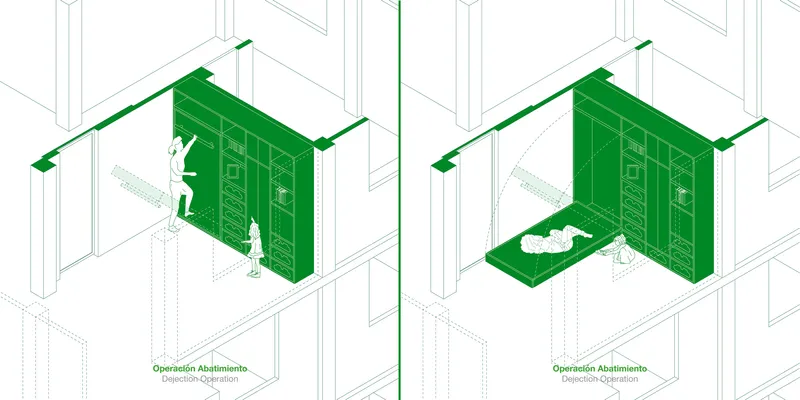


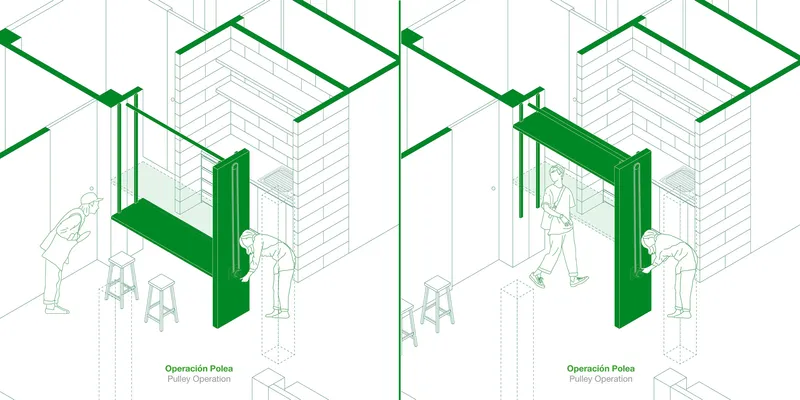
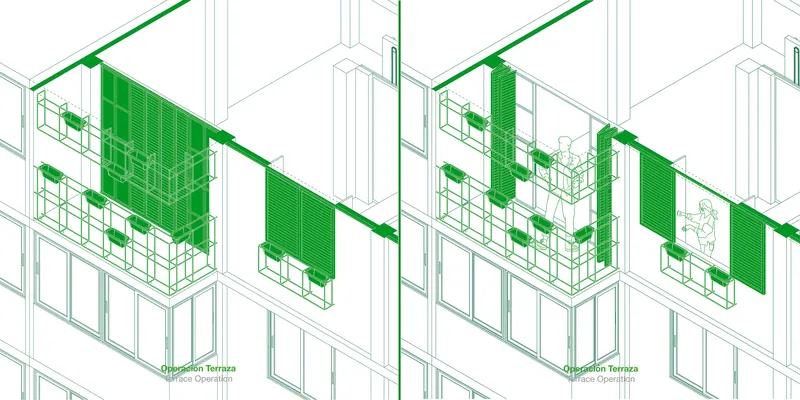


The drawing set is unusually revealing. A floor plan shows the spatial transformation from a conventional apartment layout to the proposed convertible arrangement, with furnishings indicated in their multiple positions. A series of axonometric diagrams isolate each operable device: pivoting storage units, rotating table elements, accordion-style sliding panels, and pulley-operated doors that fold upward into the ceiling structure. These drawings treat each mechanism as its own architectural project, complete with human figures demonstrating the sequence of movements. It is rare to see renovation drawings that communicate kinetics this clearly.
The longitudinal sections are equally instructive. They show a single inhabited floor sandwiched between vacant levels, with potted and hanging greenery populating what would otherwise be dead space. The implication is provocative: if every unit in this deteriorating block received the same treatment, the building could regain its density without any structural intervention at all.
Why This Project Matters
Operations Within Apartments is not a manifesto project dressed up as a home. It is a pragmatic response to a real urban problem: how do you keep people living in city centers when the housing stock is failing and replacement is unaffordable? Natura Futura's answer is to treat the apartment as an inventory of small, actionable operations rather than a fixed floor plan. By sourcing materials from the coast and building mechanisms through artisanal trial and error, the studio keeps the budget local and the labor skilled. That matters in a city like Babahoyo, where construction spending that leaves the region is spending that does not come back.
The project also makes a quiet argument about what renovation can mean in the Global South. It does not gut the apartment and start over. It does not import European minimalism. It takes what exists, the concrete slab, the steel columns, the river light, and adds layers of operable craft that the occupants control. The result is a home that is genuinely flexible, not in the marketing sense of open plan, but in the lived sense of a space that can be reconfigured by a single person in under a minute. That kind of agency is rare in architecture at any price point. At 90 square meters in a declining Ecuadorian city, it is extraordinary.
Operations Within Apartments by Natura Futura, Babahoyo, Ecuador. 90 m², completed 2022. Photography by Gianni Di Giuseppe.
About the Studio
Share Your Own Work on uni.xyz
If projects like this are the kind of work you want to make, uni.xyz is a place to publish your own, find collaborators, and enter design competitions.


Popular Articles
Popular articles from the community


Cube Design Draws an Ecological Corridor Between Two Shenzhen Hills with the Nankai Building
Beside Shenzhen's container docks, the Nankai Building pairs stacked balconies with a climbing green screen to connect two hillsides across its height.


Manzana Morphosis: Stretching Barcelona's Grid into a Living Landscape for 2050
A radical reworking of the Eixample manzana turns density into a tool for generous public space, vertical ecology, and environmental performance.

Singing Woman: An Opera House That Performs Before the Curtain Rises
Ovidiu Cristian Pavel's conceptual opera house translates Estonia's choral identity into a sculpted waterfront landmark facing the Baltic Sea.

FCC Arquitectura Expands a Portuguese Granite House with a Board-Marked Concrete Wing
In Portugal, JV House pairs a cleaned-up whitewashed and granite dwelling with a timber-shuttered concrete extension, courtyards and a garden pool.

Similar Reads
You might also enjoy these articles

LAVA Architecten Gives Vocational Education a Sawtooth-Roofed Face on a Mechelen School Campus
In Mechelen, Belgium, a 2,053 m² STEM school on a 6×6 m grid turns workshops and classrooms into rooms that can be rearranged as teaching changes.

KEMA Studio Turns a Derelict Marvila Attic into a 60 m² Lighthouse Apartment Above Lisbon
In Lisbon's Marvila district, a rebuilt roof, four skylights and two plywood volumes turn an unlivable attic into a bright home facing the Tagus.

Pixel Gardens: One Repeated Module Stacked Into a Terraced Social Housing Tower for Famagusta
Salem Bader's shortlisted housing tower builds a vertical neighbourhood from one repeated module, offsetting units to carve terraces, light and air.

Bao Huynh Watercolor Atelier: A Serene Art Retreat in Hội An
Bao Huynh Watercolor Atelier in Hội An blends multifunctional art spaces, sustainable design, local materials, and family-friendly living in a serene environment.

Explore Apartments Competitions
Discover active competitions in this discipline

Challenge to reimagine the Iron Throne

Photograph architecture without architects

Illustrate the lost glory of Angkor Wat - Render Challenge

Design challenge to reuse E-waste
Comments (0)
Please login or sign up to add comments
No comments yet. Be the first to comment!