

NeoSyria: Rebuilding Aleppo Through Memory, Play, and Collective Healing
A five-chapter urban vision for post-war Aleppo that turns ruins into nurseries, debris into civic stages, and voids into spaces of remembrance.


What happens when a city's ruins are not cleared away but reactivated as instruments of healing? NeoSyria proposes exactly that for Aleppo, treating the physical wreckage of years of conflict not as something to demolish but as raw material for a new civic identity. Across five conceptual chapters, the project weaves memory, faith, play, and democratic space into an urban fabric that refuses to forget its past while insisting on a future shaped by its people.
Designed by Sourav Banerjea, Siddharth Verma, and Madhur Agarwal, NeoSyria is a speculative architectural and socio-cultural vision that reimagines post-war urbanism in one of the world's most devastated cities. Each chapter addresses a different dimension of Syrian identity: Enlightened Syria, Peoples' Syria, Bleeding Syria, Free Syria, and Uncertain Syria. Together, they form a narrative-based masterplan where architecture serves as both provocation and repair.
Ruins Wrapped in Green: A Nursery Inside the Grand Serai
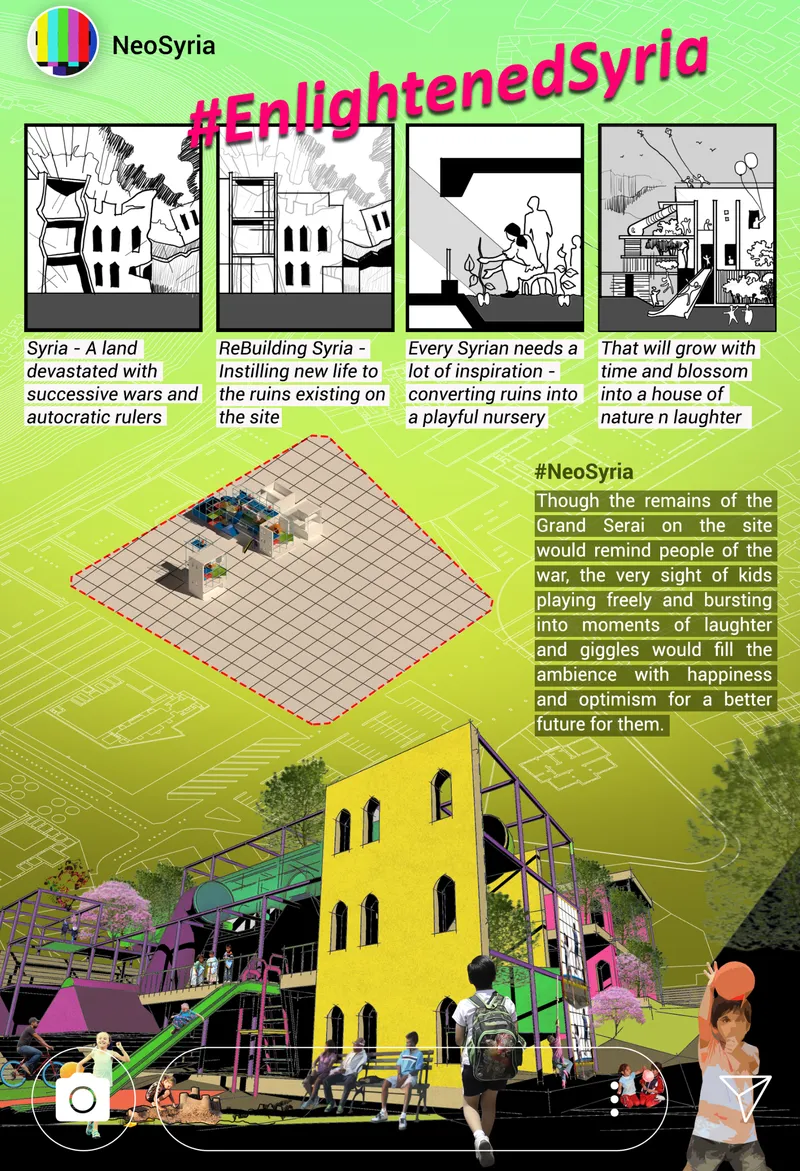
The project's first chapter, Enlightened Syria, is perhaps its most disarming. Rather than leveling the fractured walls of the Grand Serai site, the designers encase them in green scaffolding and play structures, transforming what was once a reminder of destruction into a nursery where children run freely. Yellow ruin fragments poke through lattices of new growth, and bright colors flood the terraces. It is architecture as social healing: joy deployed deliberately as a tool for rebuilding collective optimism.
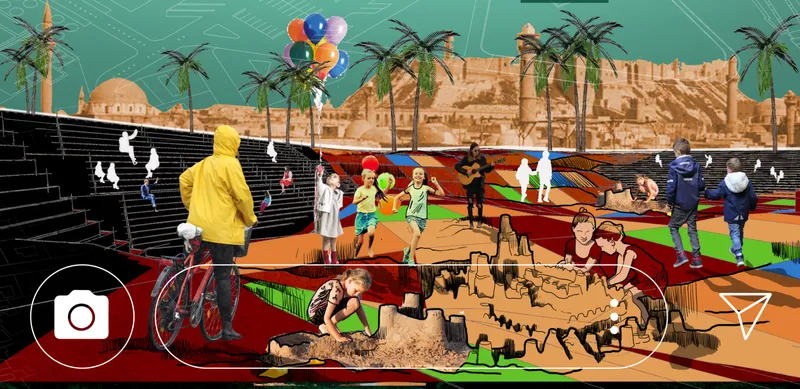
The rendered plaza view captures this spirit vividly. Children scatter across colorful terraces beneath palm trees and floating balloons, a hillside rising behind them. The terrain is playful and uneven, acknowledging the city's scars while converting them into sites of laughter. There is nothing naive about the gesture; it is a calculated bet that rebuilding a society starts with giving its youngest citizens a reason to stay.
A Waterfall Courtyard for Collective Mourning
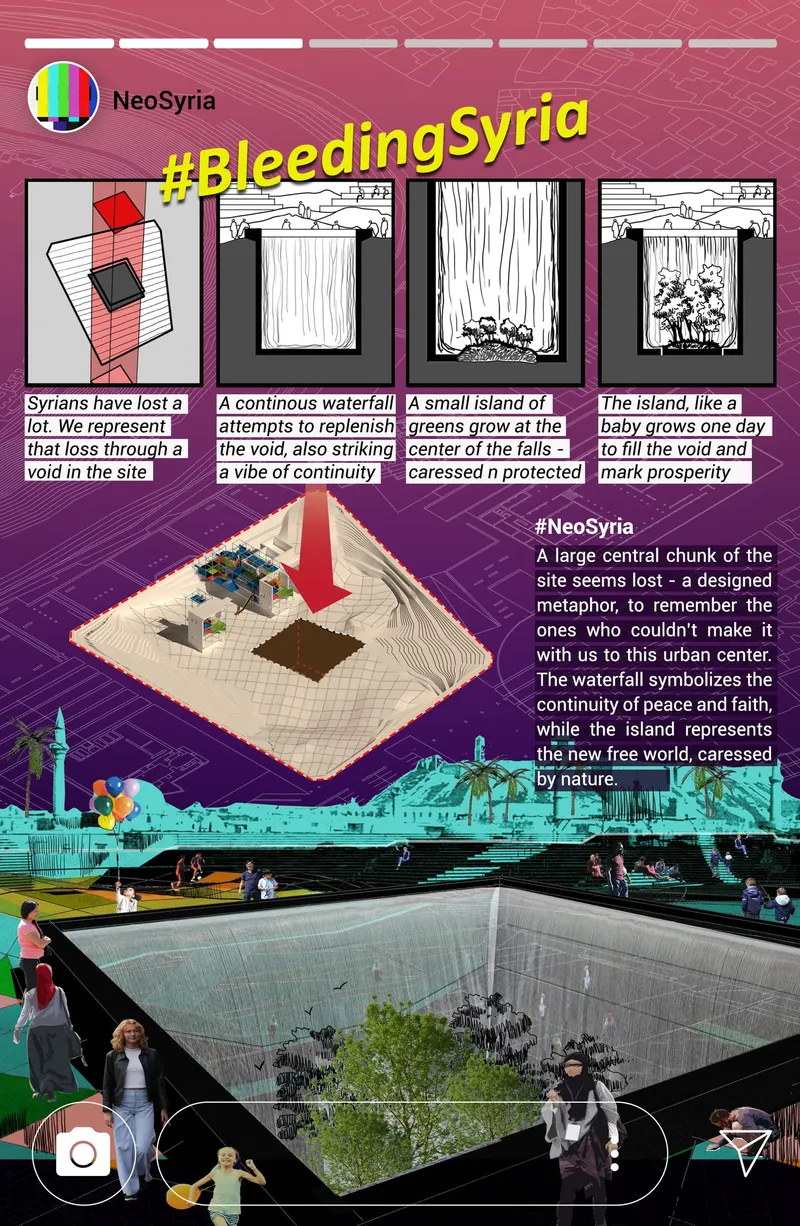
Bleeding Syria, the project's third chapter, confronts what many post-war visions avoid: the emotional void left by those who did not survive. The designers carve a large central void into the urban fabric and fill it with a waterfall courtyard. A sunken rectangular pool holds a planted island at its center, slowly expanding outward as a symbol of rebirth. Water falls continuously around it, forming a translucent veil that represents peace, faith, and the passage of time.
People walk along the surrounding platform, looking inward rather than outward. The architecture becomes a ritual of remembrance, blending memorial space with landscape regeneration. It is a poetic reading of loss that avoids sentimentality by grounding itself in material reality: water, stone, vegetation, and the simple act of gathering at an edge to reflect together.
A 70-Meter Minaret as Civic Monument
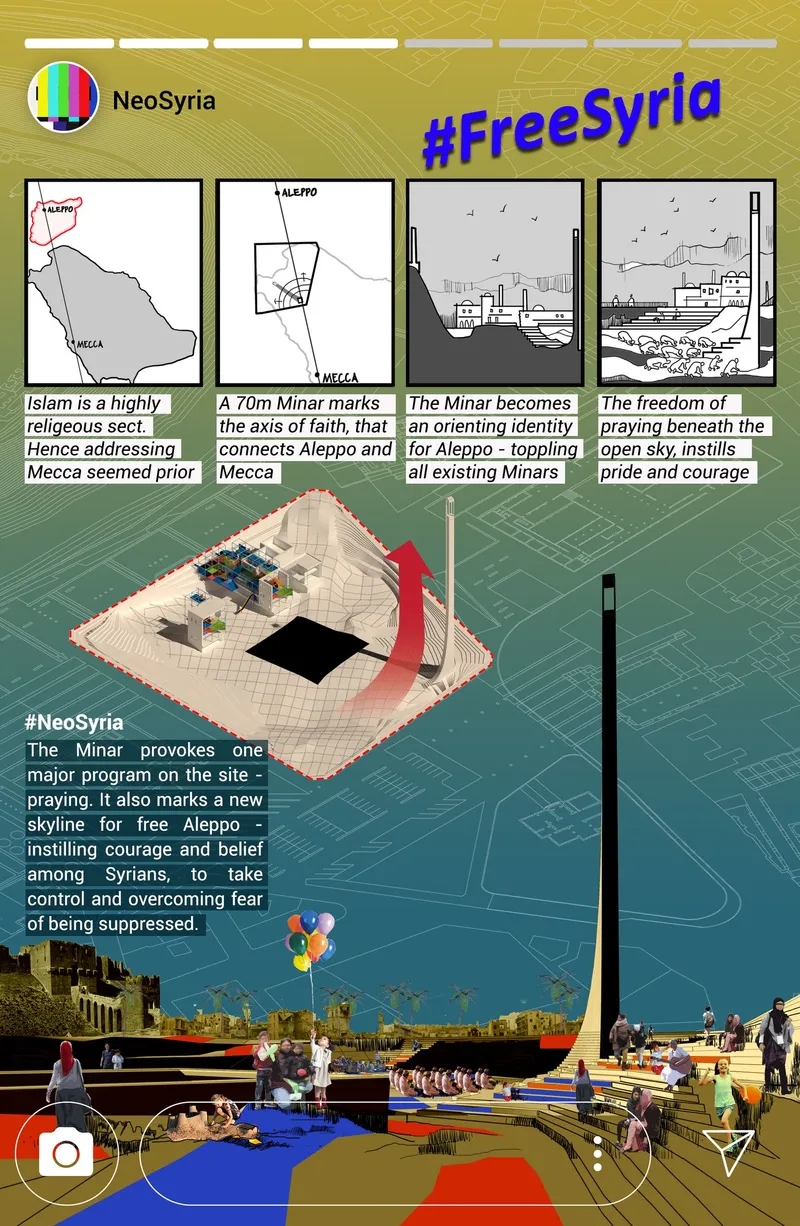
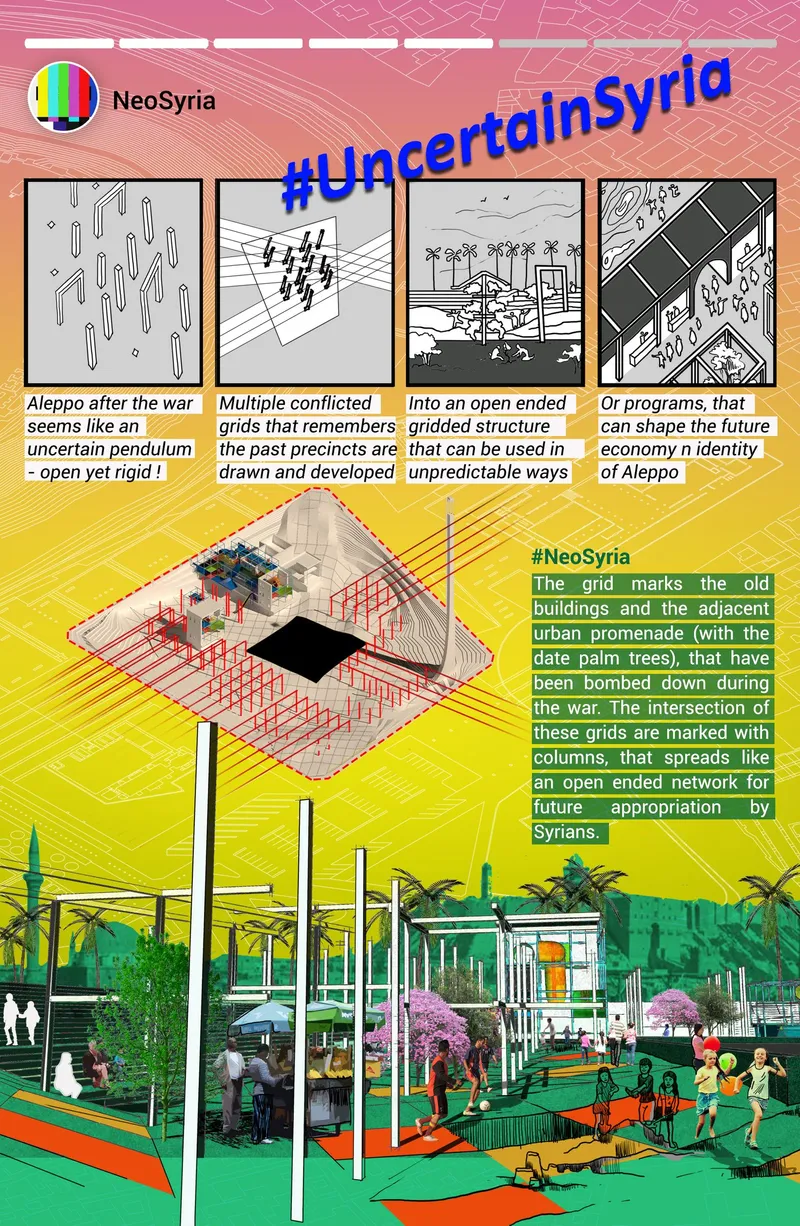
In a city where countless minarets once punctuated the skyline, NeoSyria introduces a single striking replacement: a 70-meter red minaret that connects Aleppo to Mecca through a symbolic axis of faith. Free Syria, the project's fourth chapter, positions this tower not as a religious directive but as a civic monument. An open-sky prayer ground surrounds it, encouraging spiritual expression without confinement. Low platforms and water features draw people to its base, creating a public gathering space that anchors identity and declares liberation.
The adjacent promenade extends this civic generosity. White columns and palm trees line a green platform where people walk, sit, and inhabit the space casually. The design language here shifts from memorial to everyday urbanism, suggesting that post-war identity is not only forged in grand gestures but also in the quiet dignity of a shaded walkway where neighbors can meet.
Underground Play: Color and Light Below the Surface
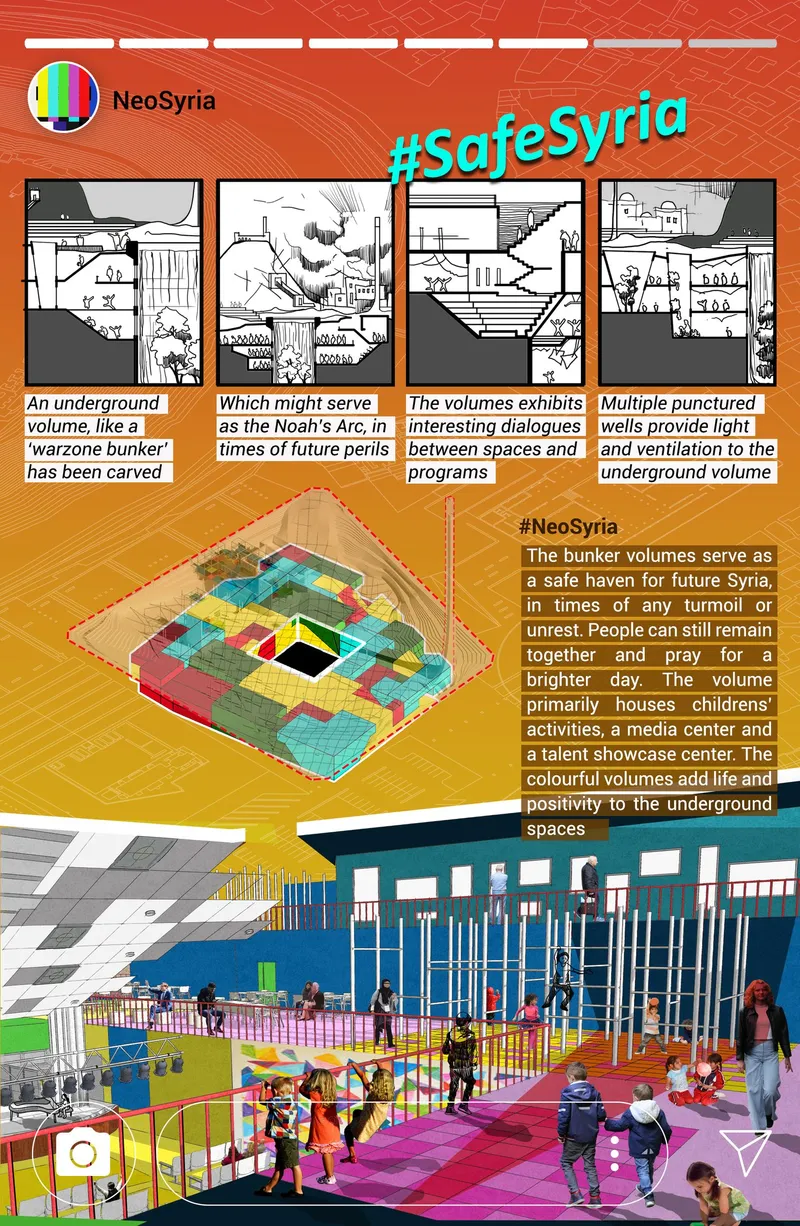
Below ground, NeoSyria reveals another layer of its ambition. An underground space filled with colorful vertical tubes, multilevel platforms, and filtered light creates a subterranean playground where children move between levels in an environment that feels almost biological. The tubes act as both structural elements and light wells, pulling color down into the earth and turning infrastructure into spectacle. It is a space designed for discovery, where the city's youngest inhabitants encounter architecture as something alive and responsive.
The decision to build downward, rather than only upward, speaks to the project's layered understanding of urban identity. Just as Aleppo's history exists in strata, its future should occupy multiple registers: visible and hidden, monumental and intimate, solemn and exuberant.
Why This Project Matters
NeoSyria resists the two dominant modes of post-conflict urbanism: erasure, which bulldozes the past to build anew, and preservation, which freezes ruins as untouchable artifacts. Instead, Banerjea, Verma, and Agarwal propose a third path where ruins become active participants in the city's next chapter. Fractured walls host nurseries. Demolition debris forms stepped galleries. Voids become courtyards for mourning. The architecture does not pretend the war did not happen; it metabolizes its aftermath into spaces that serve the living.
What makes the project compelling is its insistence that urban reconstruction is not a technical problem but an emotional and civic one. Every design move carries a question: Who bears responsibility for what was lost? What kind of collective identity do Syrians want to build? Can architecture make space for grief and joy simultaneously? NeoSyria does not answer these questions definitively, but it builds the rooms where they can be asked.
View the Full Project
About the Designers
Designers: Sourav Banerjea, Siddharth Verma, Madhur Agarwal
Enter a Design Competition on uni.xyz
uni.xyz runs architecture and design competitions year-round that reward proposals with spatial conviction and real site intelligence.
Project credits: NeoSyria by Sourav Banerjea, Siddharth Verma, Madhur Agarwal.


Popular Articles
Popular articles from the community


Singing Woman: Contemporary Architecture Inspired by Estonia’s Voice and the Sea
Singing Woman turns Estonia’s song culture into flowing opera house architecture, blending public life, landscape, sea, and national memory.
Faces of the Soviet Avant-Garde: Turning Moscow's Street Names into an Open-Air Museum
A network of sculptural installations across a Moscow residential district transforms forgotten architect names into spatial encounters with cultural memor

Cloaked Colonization: A Mobile Underwater Habitat That Moves Like a Fish
Micah Abaya's shortlisted EHC Pacific entry reimagines ocean settlement as a dispersed network of self-sustaining architectural organisms.
Extended Shell: Retrofitting Kolkata's Balconies as Living Urban Thresholds
A modular retrofit system recovers the social and environmental intelligence of Kolkata's historic verandas for contemporary Park Street residents.

Similar Reads
You might also enjoy these articles

The Amber Palace Opera: A Geological Fiction Surfaces on Tallinn's Baltic Waterfront
Pierre Brillard reimagines a Baltic legend as a public landscape, opera house, and waterfront promenade rooted in Tallinn's coastal identity.
Dynamic Modules Shelter: A Telescopic Ring for Mountain Pilgrimage
A circular modular framework of steel, bamboo, and fabric grows vertically with demand, wrapping communal ground in adaptable shelter.
Singing Woman: Contemporary Architecture Inspired by Estonia’s Voice and the Sea
Singing Woman turns Estonia’s song culture into flowing opera house architecture, blending public life, landscape, sea, and national memory.
HYPERBLOCK: Flexible Urban Design for Barcelona’s Future City
HYPERBLOCK reimagines Barcelona as flexible urban design, layering density, daylight, public space and adaptable housing above Cerdà’s grid.

Explore Neo-Urbanism Competitions
Discover active competitions in this discipline

Challenge to reimagine the Iron Throne

Photograph architecture without architects

Illustrate the lost glory of Angkor Wat - Render Challenge

Design challenge to reuse E-waste
Comments (0)
Please login or sign up to add comments
No comments yet. Be the first to comment!