

New Life Stadium: Rethinking Sports Architecture as Year-Round Urban Infrastructure
A shortlisted Staydium 2020 entry that dissolves the boundary between stadium, marketplace, and civic green space through dual-arch canopies and mixed-use


Stadiums are among the most underused building types in any city. They fill for a few hours on game day, then sit empty, radiating dead space into the surrounding streets. The New Life Stadium refuses that bargain entirely. Instead of a sealed container for spectacle, the proposal delivers a continuous landscape of markets, conference facilities, hospitality, and green infrastructure held together by a pair of sweeping timber lattice canopies. The stadium still hosts sport, but sport is no longer the only reason to show up.
Designed by Jesus Marchena, the project was shortlisted in Staydium 2020, a competition that challenged participants to imagine the stadiums of the future. Marchena's response traces the typology back through ancient Greek theatres and Roman amphitheatres, through the closed-off arenas of the Middle Ages, and forward into a future where large-scale public buildings earn their footprint every day of the week.
Dual-Loop Arches Over a Green Plaza
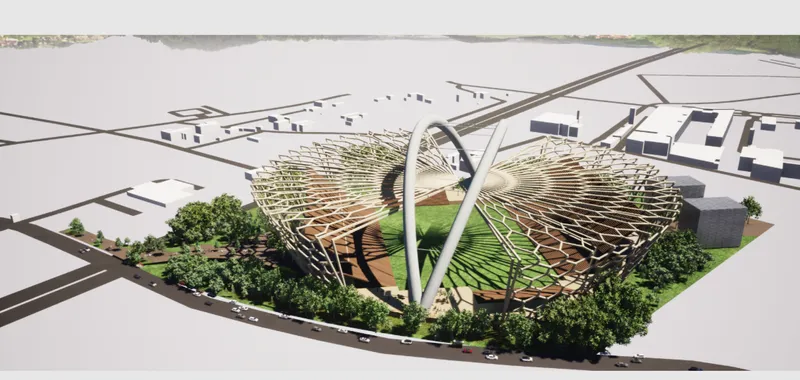
The aerial rendering reveals the project's most striking gesture: a pair of interwoven structural arches that carry hexagonal timber lattice canopies above a planted plaza. These dual-loop central arches are not decorative. They function as the primary structural anchors for the roof system while creating a dramatic focal point visible from surrounding streets. The canopy geometry optimizes shade and airflow beneath it, reducing mechanical cooling loads. Marchena also notes their potential to support photovoltaic panels or retractable roof membranes, turning the structure into an energy-generating surface.
Below the canopies, the ground plane reads as parkland rather than parking lot. Mature trees, open-air circulation paths, and soft landscaping occupy the space between programmatic zones, making the approach to the stadium feel more like walking through a neighbourhood park than navigating a concrete apron. The zoning plan distributes a commercial hub with a farmers market, a conference centre, and hospitality units around the main sporting facility, ensuring that activity is spread across the site rather than concentrated in one sealed volume.
A Lattice Canopy That Frames the Skyline
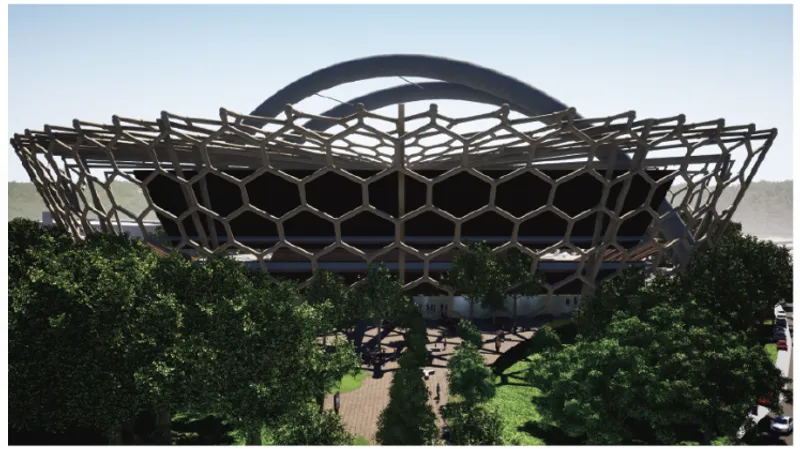
From an elevated vantage point, the hexagonal lattice structure becomes legible as both engineering and ornament. The canopy rises well above the tree line, establishing the stadium's presence in the skyline without resorting to the opaque, monolithic massing typical of conventional arenas. Light passes through the lattice openings, dappling the brick plaza below and blurring the threshold between interior shelter and exterior landscape. The choice of a brick ground plane, visible here among the mature trees, grounds the scheme in a material vocabulary that feels civic and durable rather than corporate.
Curb Configurations and Urban Interface
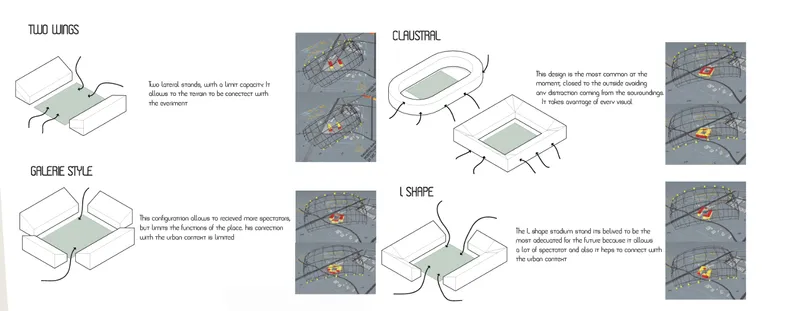
A detail often ignored in stadium design is the curb: the exact point where the building meets the street and the car meets the pedestrian. Marchena's diagram presents four curb configuration options, each illustrated with isometric line drawings alongside rendered plan views showing vehicle positioning. The variations address different street widths, traffic speeds, and pedestrian flow scenarios, demonstrating that the project thinks carefully about its urban edge. Getting this interface right determines whether the stadium invites passersby in or walls them out, and the range of options here suggests a design methodology adaptable to multiple site conditions.
Activation Beyond Game Day
The most compelling argument Marchena makes is economic as much as architectural. Traditional stadiums create urban voids: vast, single-purpose facilities that drain public budgets during the 300-plus days a year when no event is scheduled. By integrating a farmers market, hotel accommodation, and conferencing into the stadium precinct, the New Life Stadium generates foot traffic and revenue continuously. Locals shop, tourists stay, professionals meet, and athletes compete, all within the same interconnected zone. The design trades the spectacle-and-silence cycle for something steadier and more resilient.
Why This Project Matters
Stadiums consume enormous amounts of land, money, and political capital. When they serve only one purpose, cities pay an outsized price for a handful of events per year. Marchena's proposal challenges that model at every scale, from the macro decision to distribute multiple programmes across the site to the micro detail of curb geometry. The timber lattice canopy is visually memorable, but the real innovation is organizational: a stadium that behaves like a mixed-use district.
For cities grappling with post-pandemic budgets and climate targets, the New Life Stadium offers a template worth studying. Its green infrastructure, passive ventilation strategy, and year-round programme mix address the sustainability question not through token gestures but through fundamental rethinking of what a stadium is for. That shift in premise, more than any single formal move, is what makes the project valuable.
View the Full Project
About the Designers
Designer: Jesus Marchena
Enter a Design Competition on uni.xyz
uni.xyz runs architecture and design competitions year-round that reward proposals with spatial conviction and real site intelligence.
Project credits: New Life Stadium by Jesus Marchena Staydium 2020 (uni.xyz).


Popular Articles
Popular articles from the community


GROUP A Strips a 1969 Rotterdam Harbor Headquarters to Its Frame and Wraps It in Timber Louvers
In Rotterdam's M4H harbor district, Ferro Offices reuses a 1969 frame, adds one timber storey and reaches BREEAM-NL Outstanding.

Jaramillo Van Sluys Arquitectura and Urbanismo Turn a Demolished Registry Lot in Quito into an Orchard Plaza
In Quito's Centro Histórico, a 2,800 m² plaza exposes the San Agustín convent wall and redraws its lost Augustinian orchard in volcanic stone.

LT2A and OPEN Architectes Thread a Brick and Glass High School Through a Wooded Belgian Campus
In Braine-l'Alleud, a 3,000 m² wing for Collège Cardinal Mercier pairs pale brick with a glazed colonnade, deferring to a small chapel and a dense wood.

U.GA Architects Wraps an Oval Rooftop Pool in Curved Board-Formed Concrete on Busan's Jeollidan-gil
In Busan's Jeonpo-dong, a 454 m² mixed-use block stacks a neighborhood facility, guest rooms and an oval rooftop pool inside spiraling concrete walls.

Similar Reads
You might also enjoy these articles


Vereda Arquitetos Renovates a 40-Square-Meter Apartment Inside Niemeyer's Copan Building
A compact unit in São Paulo's most iconic residential tower gets a material overhaul that pairs exposed concrete with bold blue Formica.

Shakur's House: Exposed Brick as an Interior Organiser in a 168 m² Mashhad Residence
Brick moves indoors in this Mashhad residence, where masonry walls, glass partitions and teal planes sequence a compact home without closing it off.

Day and Night Park: A Time-Based Urban Newsstand in Beijing
A temporary urban newsstand in Beijing blending travel, light, and reading through poetic colors, compact form, and community-focused design.

Modernist Patio Renovation in El Masnou, Barcelona by Oliver Segura Arquitectura + Cebrià Arquitectura
Modernist patio renovation blending tradition and innovation with a movable pool, leveled floors, and Catalan materials in El Masnou.

Explore Stadium Competitions
Discover active competitions in this discipline

Challenge to design a barrier free sports center

Challenge to design an outdoor ice-rink and park
Comments (0)
Please login or sign up to add comments
No comments yet. Be the first to comment!