

Nieto Sobejano Arquitectos Wraps a Hamburg Exhibition Center in 330 Panels of Sculpted Black Concrete
Montblanc Haus stretches 100 meters along the brand's factory grounds, its textured facade evoking mountains and the gesture of writing.


A hundred meters of black concrete unfurl along the edge of Montblanc's manufacturing campus in Hamburg-Altona, and the building barely looks like a building at all. Montblanc Haus, designed by Nieto Sobejano Arquitectos and completed in 2022, is a cultural venue dedicated to the art of writing, housing permanent and temporary exhibitions, a boutique, a writing studio, a café, and a company archive. It won an international competition in 2016 against firms including Snøhetta, John Pawson, wHY, and Noé Duchaufour, and the reason is legible from the street: the architects treated the entire envelope as a single continuous relief sculpture rather than a conventional facade.
What makes the project genuinely interesting is its disciplined obsession with one idea: that the building's skin should carry the full cultural weight of the institution it houses. The undulating relief across 2,800 square meters of facade references both the Mont Blanc massif that gives the brand its name and the kinetic trace of a hand in the act of writing. Each of the 330 precast panels is 2.70 meters wide, with heights reaching nine meters, and many are geometrically unique. The result is a monolith that reads differently at every hour and from every angle, its shadows perpetually in motion.
A Hundred-Meter Case for Writing
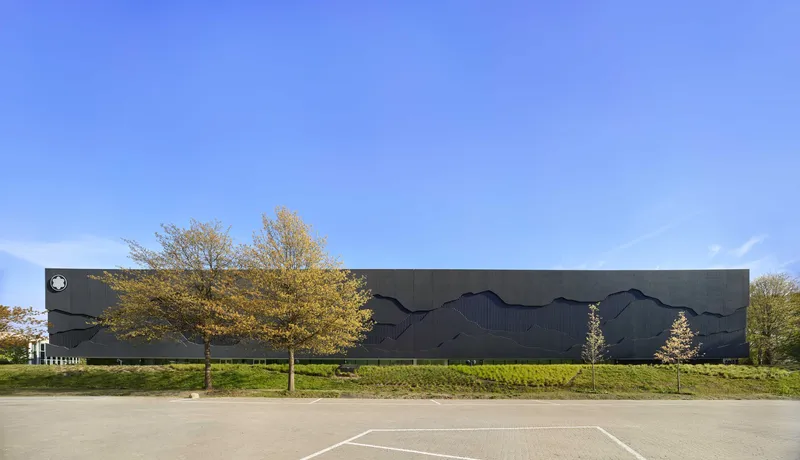
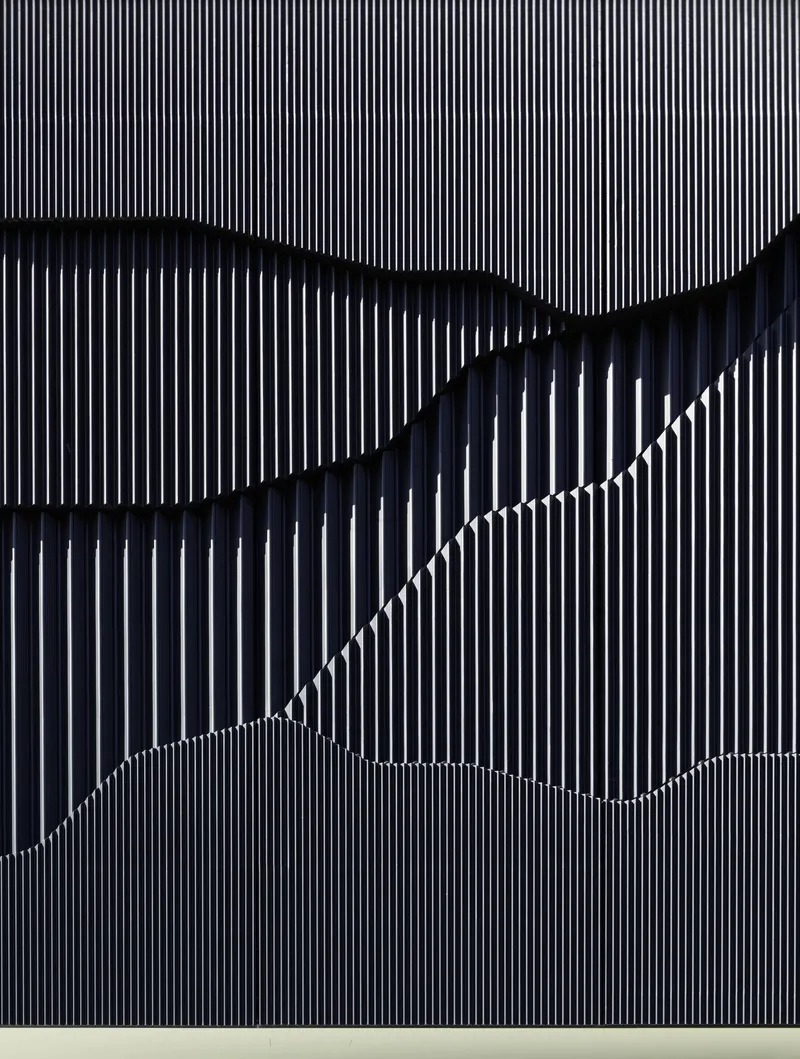
The conceptual move is disarmingly literal: the building takes the shape, color, and surface character of a classic Montblanc pen case. Black pigmented concrete, made with Danucem Rohoznik White cement mixed with basalt aggregates, forms the shell. The relief rises up to 13.5 centimeters from the panel surface, generating deep vertical shadows that oscillate between geological strata and the rhythmic marks of a nib on paper. From a distance the volume reads as a single dark mass hedged by greenery; up close the texture fractures into a restless topography.
Nieto Sobejano have long been interested in ornament as structural logic rather than appliqué, and this project pushes that interest to an industrial extreme. The panels use textile reinforcement, specifically Solidian Grid made of epoxy-resin-impregnated glass fibers, combined with traditional steel reinforcement. The technology, developed in partnership with C3 Carbon-Cement-Composite GmbH, allowed the reliefs to be cast at only three centimeters thick on a redistribution plate, keeping weight manageable despite the enormous panel sizes. Werner Sobek handled both the structural and facade engineering, a collaboration that kept the sculptural ambition structurally honest.
Entry Sequence and the Inverted Interior
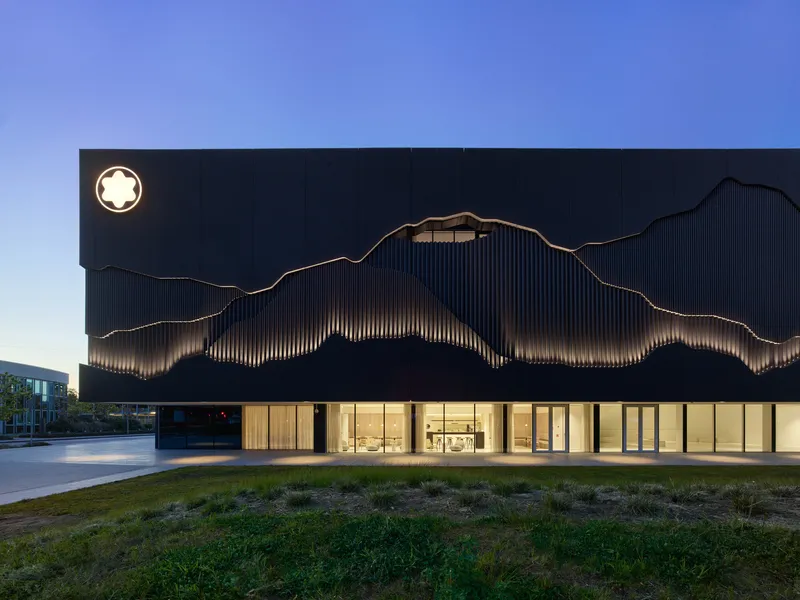
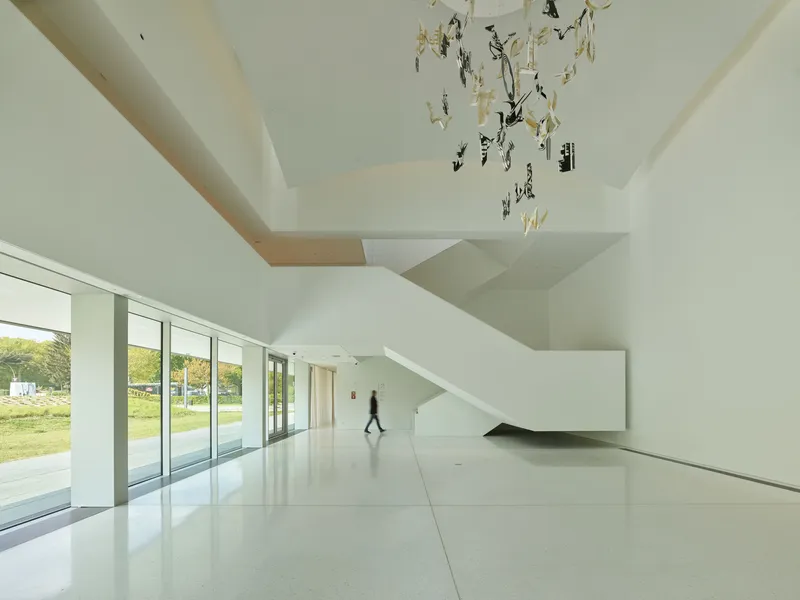
The front projection cantilevers up to eight meters over the building's full length, creating a deep porch that compresses arrival before the glass-walled entrance releases visitors into a luminous central foyer. If the exterior is unrelentingly dark, the interior flips the palette entirely: white terrazzo, pale surfaces, and zenithal light pouring in from above. The contrast is stark and intentional. You move from a shadowed cave mouth into a space flooded with daylight, a transition that resets the visitor's attention before the exhibition begins.
The foyer itself is a vertical event. A cantilevered stair rises through the space, and the company archive hangs overhead, suspended above the atrium like a vitrine you can look up into. The three levels of program, permanent exhibition below, temporary galleries and meeting rooms above, are organized around this single lit core. At roughly twelve meters deep, the building is narrow enough that every interior space maintains a relationship to either the foyer or the landscape beyond.
Linear Logic and Site Strategy
Stretching the full width of the plot, the building operates as a wall between the Montblanc factory grounds and the public realm. A green hill buffers the structure from vehicular traffic, a simple landscape gesture that gives the dark facade a quiet foreground. The linearity is uncompromising: 100 meters long, 12 meters deep, with no volumetric breaks or setbacks. Where most exhibition buildings celebrate formal complexity, Montblanc Haus insists on a single bar, trusting the envelope's material intensity to carry the architecture.
The solid construction method serves a pragmatic purpose beyond aesthetics. Compared to lightweight building systems, the thermal mass of the concrete envelope reduces energy demand peaks, smoothing interior climate swings passively before mechanical systems intervene. It is not a net-zero showcase, but the decision to let the massive wall do environmental work as well as cultural work is a thoughtful integration of priorities.
Surface as Identity
The three different relief types deployed across the 315 precast panels (with 15 additional panels of other configurations bringing the total to 330) give the facade a controlled heterogeneity. No two panels along certain stretches are identical, yet the consistent module width and coloring unify them into a single reading. The technique recalls Nieto Sobejano's earlier work on patterned envelopes, notably the San Telmo Museum extension in San Sebastián, but here the scale and material specificity leap forward.
For a brand whose identity rests on craft and the trace of the hand, the facade is an apt ambassador. The reliefs were not digitally arbitrary; they encode two specific narratives, mountain peaks and the cursive motion of handwriting, into a single graphic field. Whether you read either story or simply register an uncanny texture is beside the point. The building communicates precision and physicality simultaneously, which is, after all, what a good pen does.
Plans and Drawings
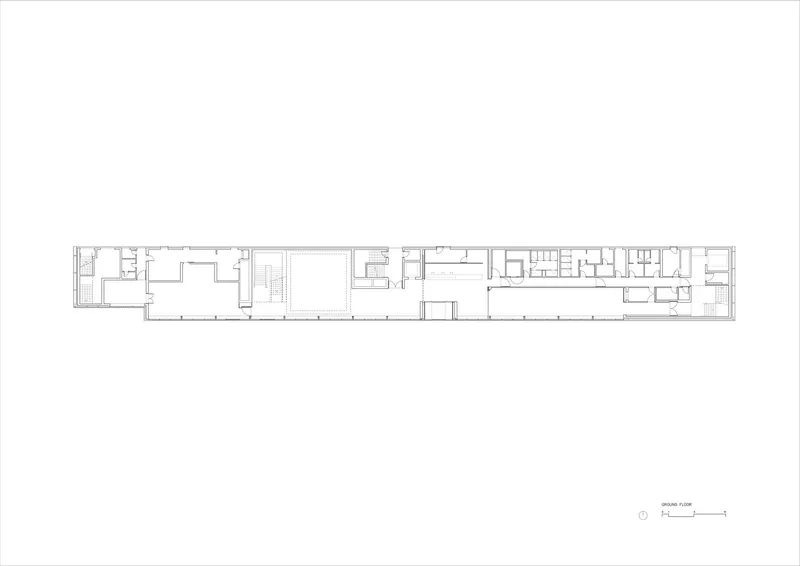
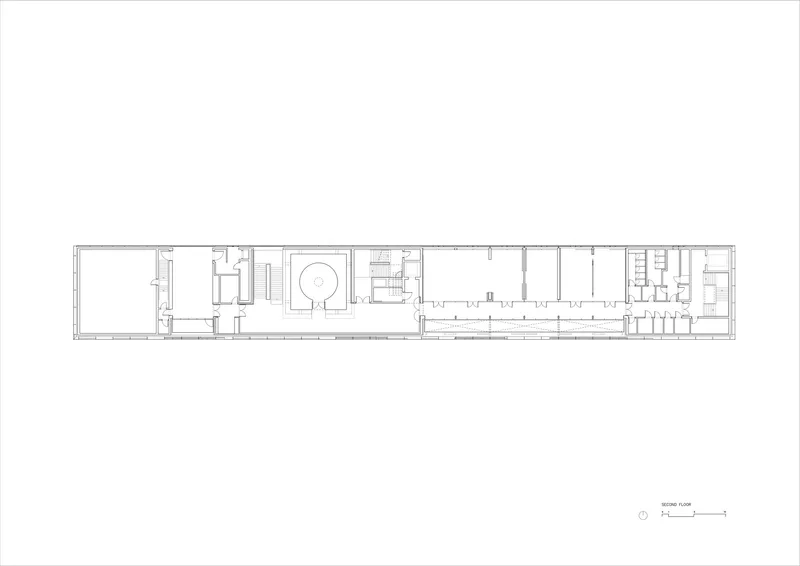
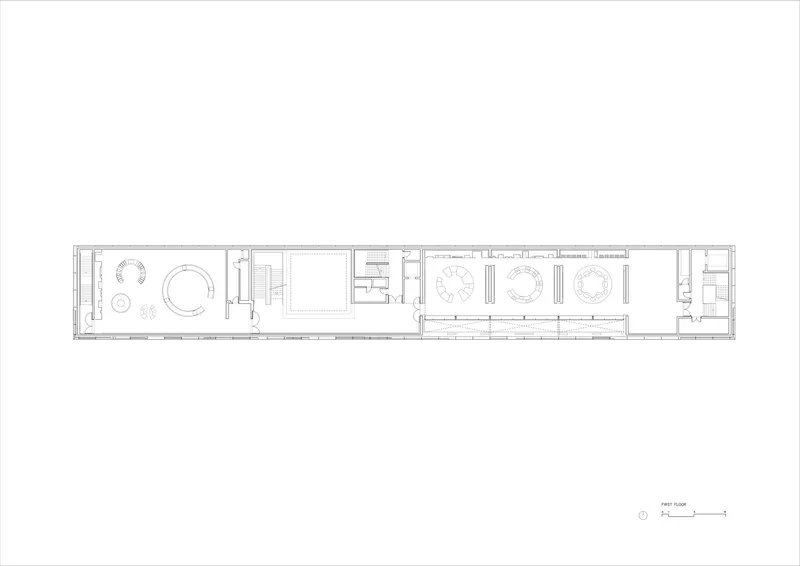
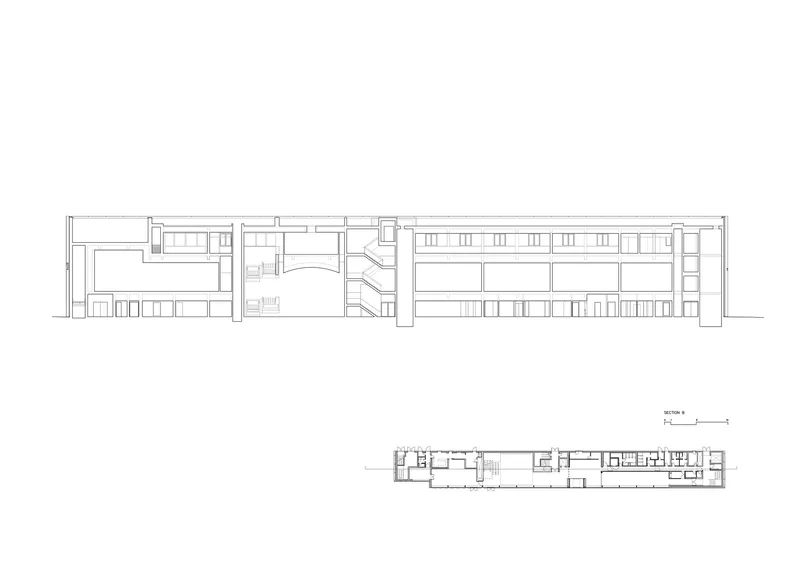
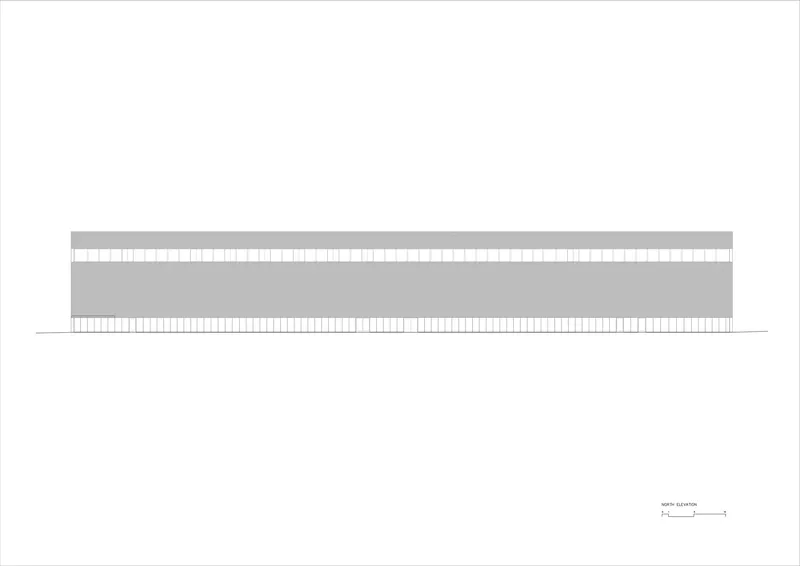
The plans confirm the extreme linearity of the scheme. The ground floor distributes public program along a central circulation spine, with the foyer acting as the hinge between entry sequence and exhibition route. Upper levels maintain the narrow cross-section, inserting circular meeting rooms as volumetric punctuation within the otherwise relentless bar. The section drawing reveals how the split levels and curved central stair knit the three stories into a continuous spatial experience despite the building's shallow depth.
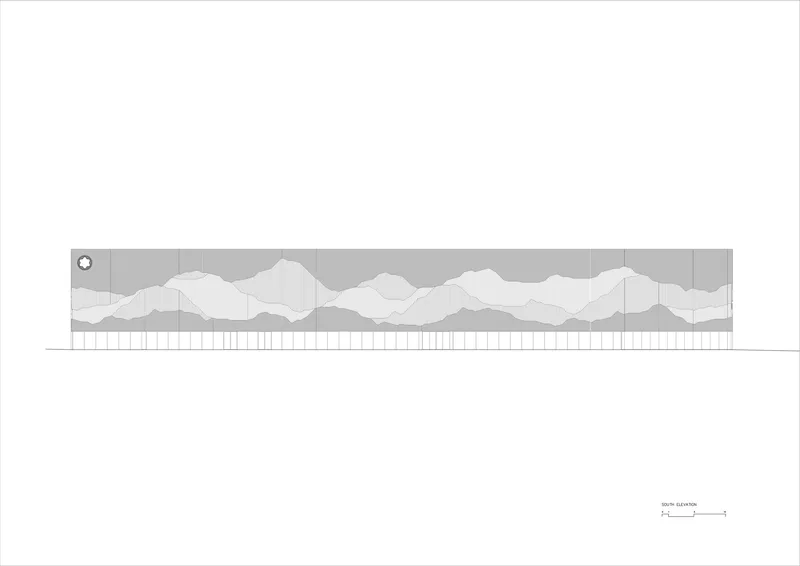
The elevation drawings are especially revealing. From one side, the facade presents its undulating profile as a dramatic silhouette against the sky; from the other, the building flattens into a long horizontal band interrupted only by a continuous clerestory strip at the roofline. The contrast between these two readings, one theatrical, one understated, underscores the architects' strategy of concentrating all formal energy onto the public face while keeping the factory-facing elevation disciplined and quiet.
Why This Project Matters
Corporate exhibition buildings often oscillate between two bad options: generic white boxes that defer entirely to curatorial content, or overwrought signature forms that overwhelm it. Montblanc Haus finds a third path by investing all of its architectural ambition into the building's material surface rather than its silhouette. The form is deliberately plain, a bar, a box. The richness lives in the 330 panels of sculpted concrete, in the shift from black exterior to white interior, in the section that threads three levels through a single narrow volume. It is architecture that trusts specificity over spectacle.
Nieto Sobejano Arquitectos have also demonstrated that advanced prefabrication and craft sensibility are not opposed categories. The textile-reinforced concrete panels are products of industrial engineering, but their effect is handmade, geological, almost calligraphic. In a moment when many firms reach for parametric complexity as an end in itself, this project uses computational control in service of a single legible idea. The building tells you exactly what it is about, and then it lets the shadows do the rest.
Montblanc Haus Exhibition Center by Nieto Sobejano Arquitectos, Hamburg, Germany. 4,390 m². Completed 2022. Photography by Roland Halbe.
About the Studio
Share Your Own Work on uni.xyz
If projects like this are the kind of work you want to make, uni.xyz is a place to publish your own, find collaborators, and enter design competitions.


Popular Articles
Popular articles from the community


Cloaked Colonization: A Mobile Underwater Habitat That Moves Like a Fish
Micah Abaya's shortlisted EHC Pacific entry reimagines ocean settlement as a dispersed network of self-sustaining architectural organisms.

Extended Shell: Retrofitting Kolkata's Balconies as Living Urban Thresholds
A modular retrofit system recovers the social and environmental intelligence of Kolkata's historic verandas for contemporary Park Street residents.

Opera on the Sea: Driftwood Logic Shapes a Timber Opera House on Estonia's Coast
Trevor Orgill's opera house translates the entangled drift of floating timber into a civic building where wood, water, and music converge.
Opera by the Sea Estonia: Three Shells Dissolving Architecture into Tallinn's Coastline
A winning opera house proposal replaces monumental form with interconnected shells that blur the boundary between building, park and Baltic Sea.

Similar Reads
You might also enjoy these articles

Bao Huynh Watercolor Atelier: A Serene Art Retreat in Hội An
Bao Huynh Watercolor Atelier in Hội An blends multifunctional art spaces, sustainable design, local materials, and family-friendly living in a serene environment.

Atelier Macri Concept Store Interior Design by CASE-REAL
Atelier Macri store features a "ko" counter, walnut wood details, cork displays, blending retail, gallery, and seamless customer experiences.

Manuel Vargas Izquierdo Stadium and High-Performance Sports Center: Architectural Excellence in Jalpa de Méndez
The Manuel Vargas Izquierdo Stadium blends sustainable design, inclusive sports facilities, and cultural-inspired architecture, revitalizing Jalpa de Méndez’s public spaces.

KAKR Buluh Awar Hall: Revitalizing Community and Ecology Through Bamboo Architecture
Community built bamboo hall revitalizes Buluh Awar village, empowering youth, restoring ecology, celebrating vernacular craftsmanship through sustainable architecture and culture.

Explore Exhibition Hall Competitions
Discover active competitions in this discipline

Challenge to reimagine the Iron Throne

Photograph architecture without architects

Illustrate the lost glory of Angkor Wat - Render Challenge

Bring back Drive In's
Comments (0)
Please login or sign up to add comments
No comments yet. Be the first to comment!