

No10-Architects Folds Concrete Around Living Trees to Build a Sensory Coffee Lab in Yunnan
In Baoshan, a 260-square-meter cafe wraps board-formed concrete planes around preserved courtyards, trees, and water to stage the full ritual of coffee.


Yunnan's Baoshan region has quietly become one of China's most consequential coffee origins, with a local industry that stretches from hillside cultivation through processing, roasting, and education. Voiceless Coffee occupies the full span of that chain, and its new Sensory Lab by No10-Architects is designed to make every link legible. Across 260 square meters of stacked, folded, and interpenetrating concrete volumes, the cafe stages an architectural argument: that understanding coffee means moving through space the way flavor moves across a palate, in discrete episodes that accumulate into something coherent.
What makes the project worth studying is not any single gesture but the relentlessness of its sectional strategy. The building is a sequence of courtyards, half-levels, and rooftop terraces threaded around existing trees, each space calibrated for a different sensory register. Daylight enters through circular oculi and slot windows. Water sits still in reflecting pools. Timber, concrete, and brick rotate through the material palette from room to room. It is a small building with big ambitions, and it mostly delivers.
A Street Presence That Earns Its Restraint
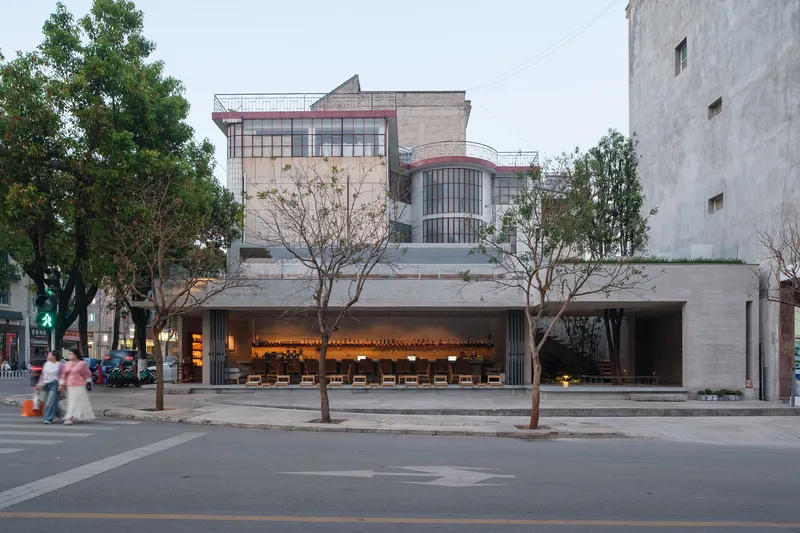
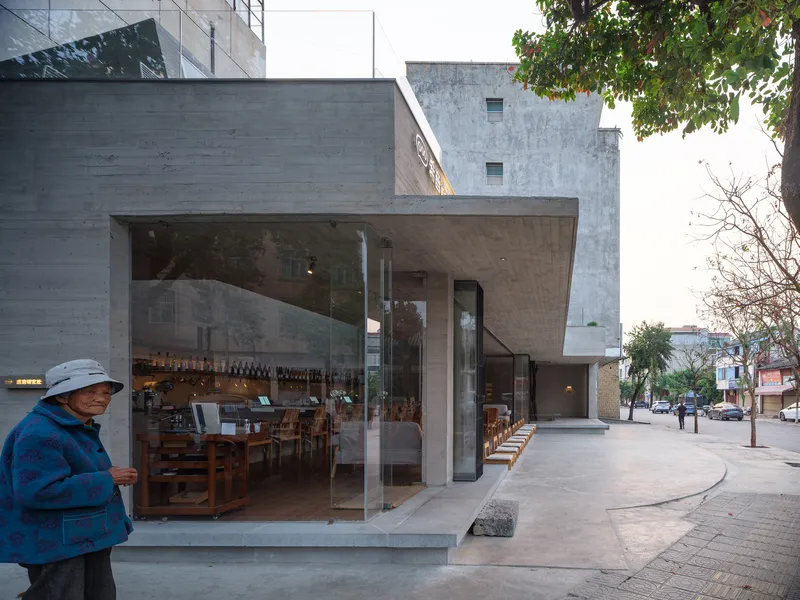
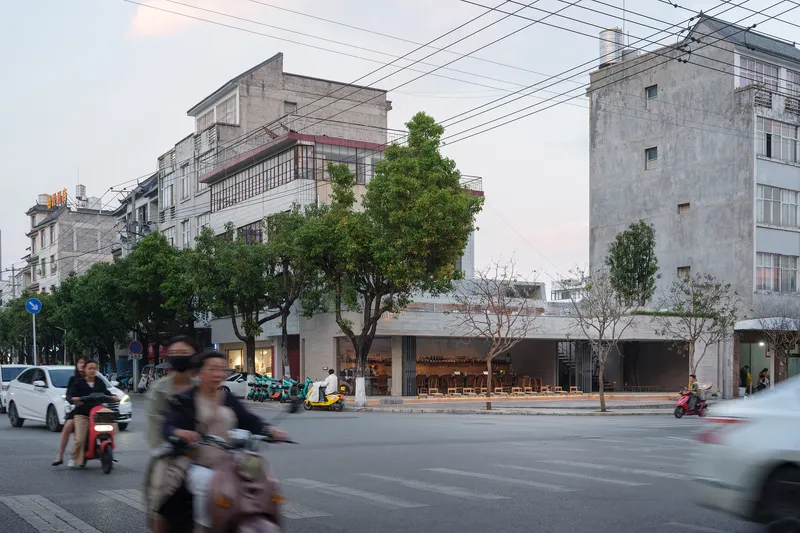
From the street, Voiceless Coffee reads as a series of recessed concrete planes set behind mature trees. At dusk, the glazed volumes glow, but during the day the building almost withdraws, letting its board-formed surfaces and deep overhangs absorb attention without competing for it. The street corner condition is handled with a chamfered setback that gives pedestrians and motorbike riders room to pass while framing the entry as an event rather than a doorway.
No10-Architects, led by Shihao Zhou, resist the temptation to make the facade a billboard. The timber folding doors and steel screens suggest openness without surrendering the building's interiority. You know there is something to discover inside, and the threshold is calibrated to slow you down before you cross it.
Thresholds and Terrace Seating
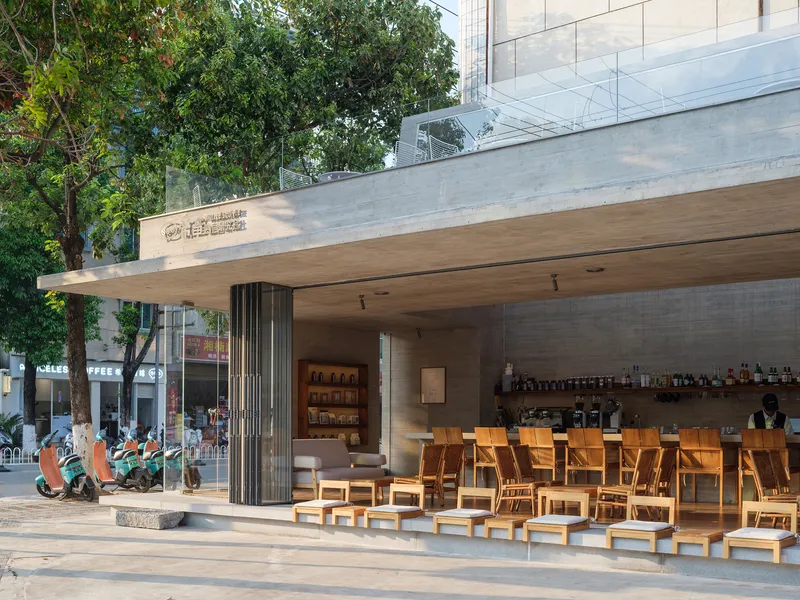
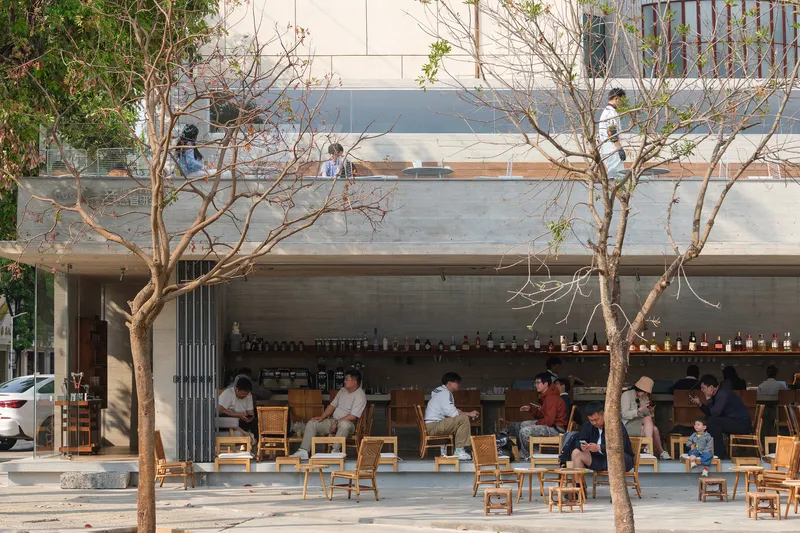
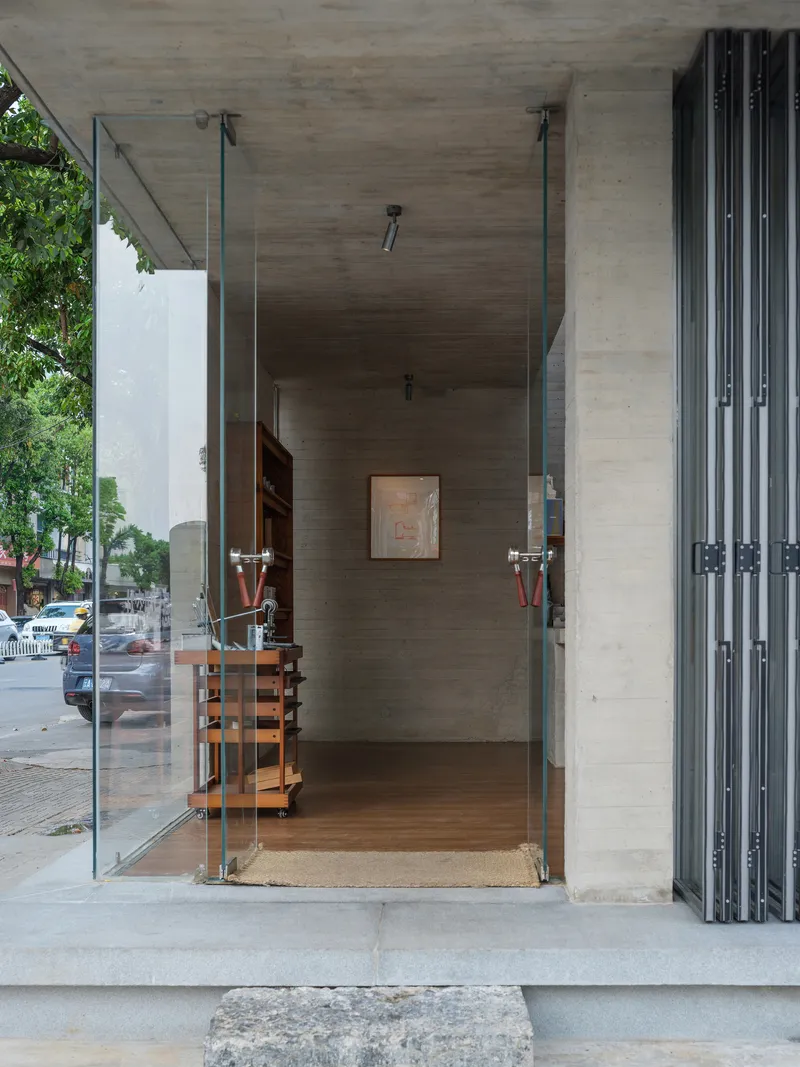
The covered outdoor terrace is the building's most public room. A concrete canopy with a warm timber soffit extends over simple wooden furniture, creating a zone that belongs equally to the street and the cafe. The bare branched trees overhead filter light and reinforce the sense that you are sitting under a constructed canopy within a natural one. It is a straightforward move, but the proportions are right: the soffit is low enough to feel sheltering, the opening wide enough to keep the space from becoming a cave.
The pivot door entrance marks a deliberate shift in register. Passing through the board-formed concrete frame, you move from the ambient noise of the street into a controlled interior where materials, light, and acoustics have all been calibrated. The transition is quick but unmistakable.
Concrete Geometry and the Timber Ceiling
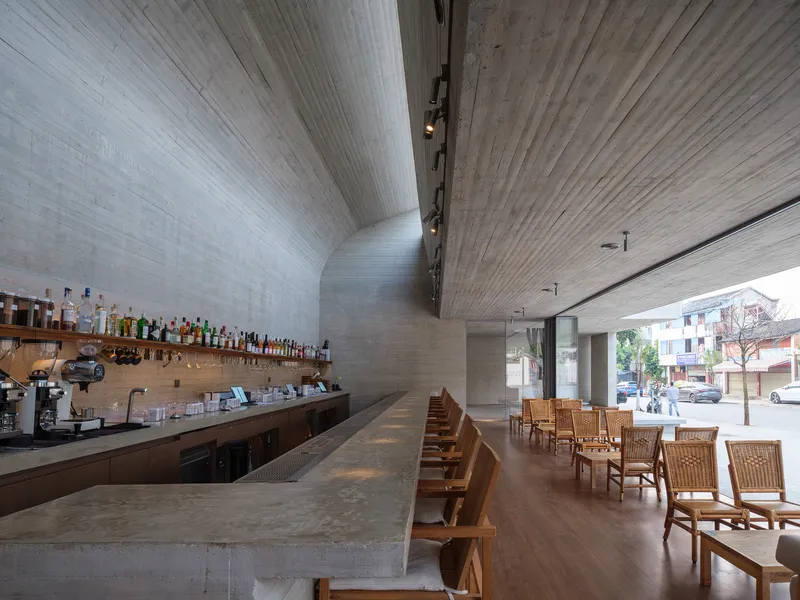
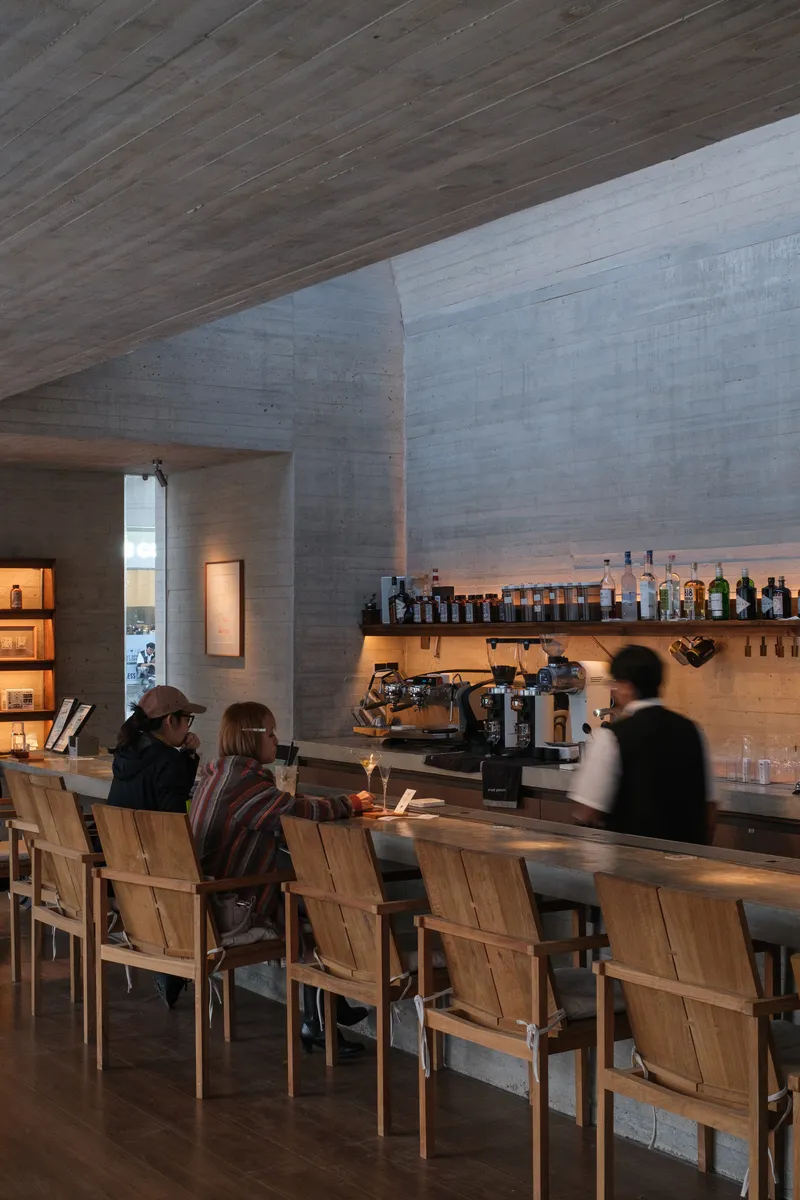
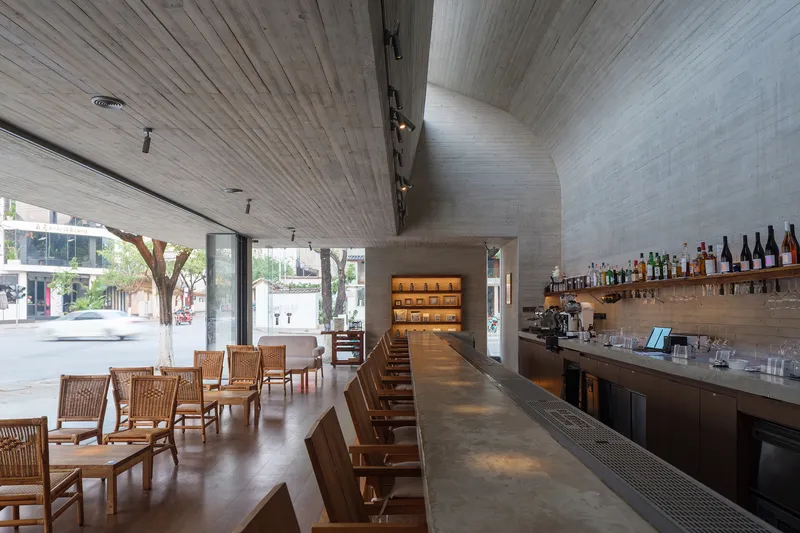
Inside, the primary bar spaces are defined by angled geometric ceiling planes in board-formed concrete. The formwork imprint gives the surfaces a directional grain that echoes the exposed timber structure visible elsewhere in the building. Sitting at the counter under these folded planes at dusk, with the street glowing through floor-to-ceiling glazing, the effect is genuinely atmospheric without relying on mood lighting or decorative flourishes.
The ribbed timber ceiling over the main cafe counter deserves particular attention. A curved clerestory window washes daylight across the bar in a controlled band, illuminating the service zone while leaving the seating in softer, more ambient light. It is a classic section trick, well executed.
Courtyards That Breathe
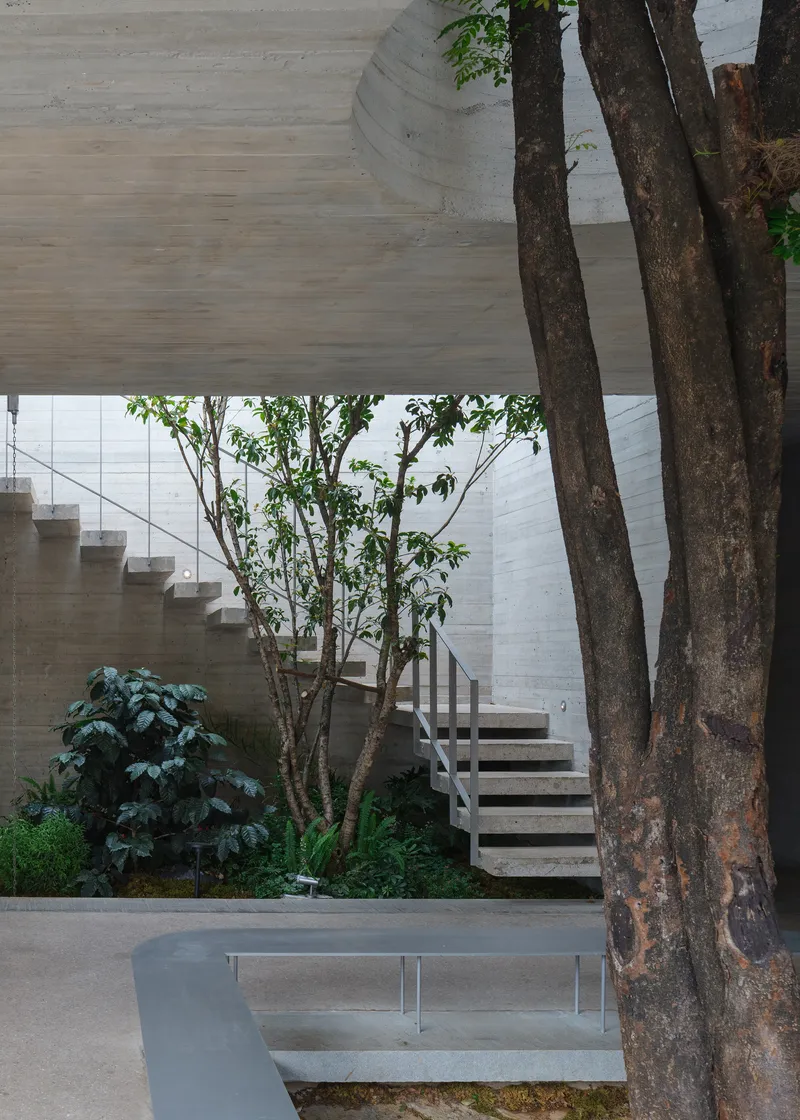
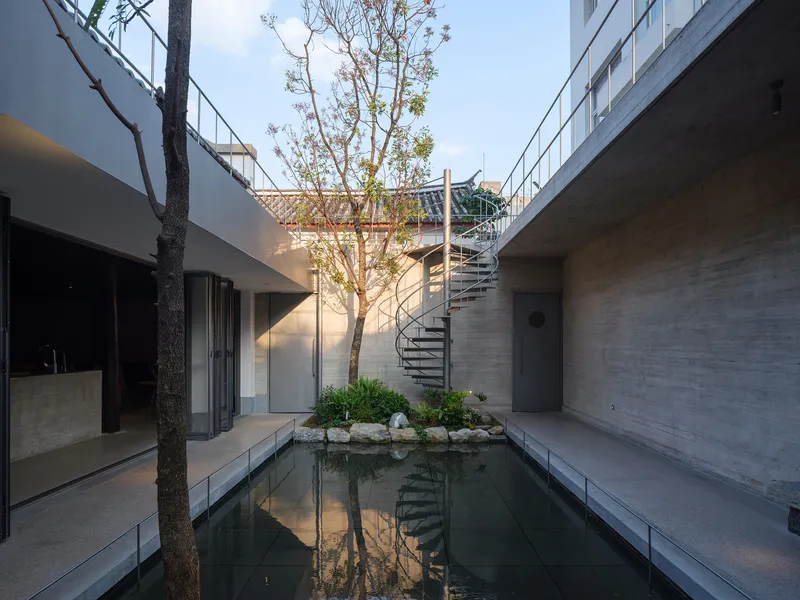
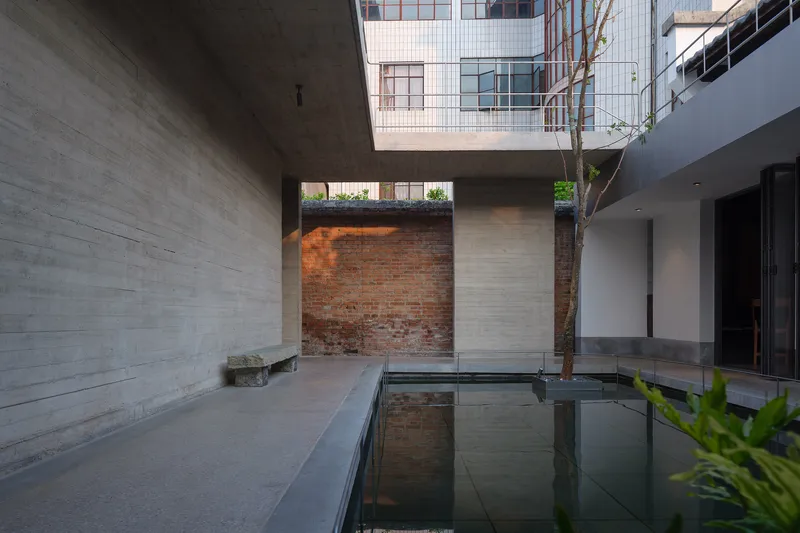
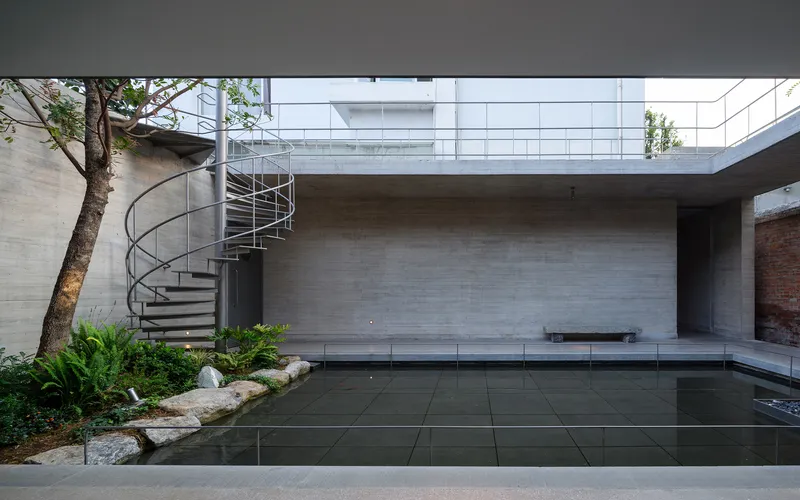
The courtyards are where the project becomes genuinely surprising. Rather than treating outdoor space as leftover area between volumes, No10-Architects gives each courtyard a specific material identity and purpose. One is structured around a preserved tree trunk and a concrete staircase, with ferns and ground cover softening the base. Another centers on a reflecting pool and a spiral staircase, its still water doubling the concrete walls overhead. A third features exposed brick alongside a preserved trunk, creating a rougher, more archaeological texture.
The decision to preserve existing trees and build around them, rather than clearing the site and replanting, gives these courtyards a temporal depth that new construction usually lacks. The trees are not props; they are structural elements of the spatial experience, their canopies filtering light, their trunks anchoring sightlines.
Looking Up: The Oculus and the Stair
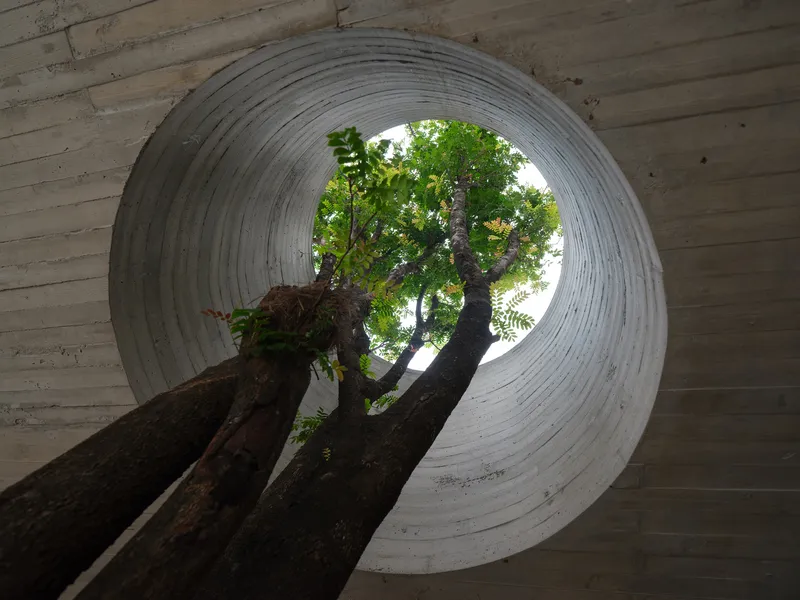
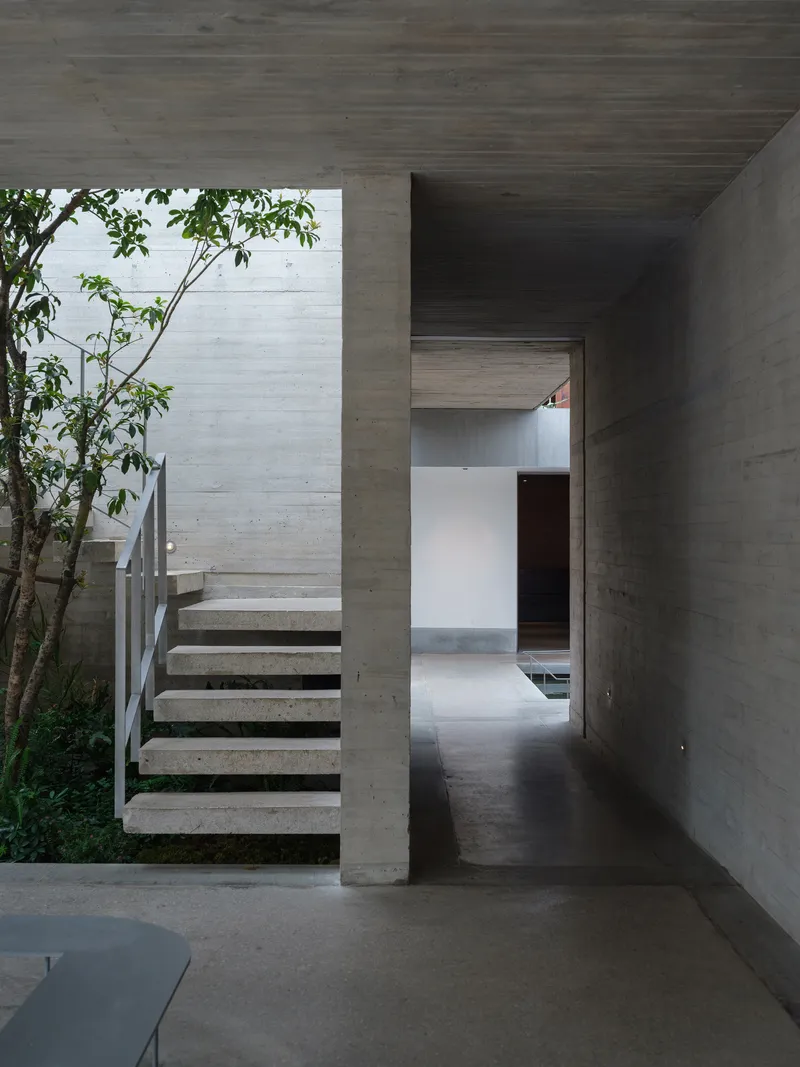
A circular oculus cut through a board-formed concrete slab frames a view straight up through tree branches to open sky. It is one of those architectural moments that photographs beautifully and functions even better in person, because it reorients your entire sense of the building's relationship to the outdoors. You are indoors, below grade or within a dense concrete volume, and suddenly the sky appears in a perfect circle, framed by bark and branches.
The concrete staircase and spiral stair serve as vertical connectors but also as objects in their own right. The cantilevered stair in the corridor alongside the courtyard is handled with a crispness that suggests the architects understood it would be seen as sculpture as much as circulation. The steel spiral stair beside the reflecting pool has a lighter, almost provisional quality, a deliberate contrast with the mass of the concrete walls it stands against.
Service and Craft Behind the Counter
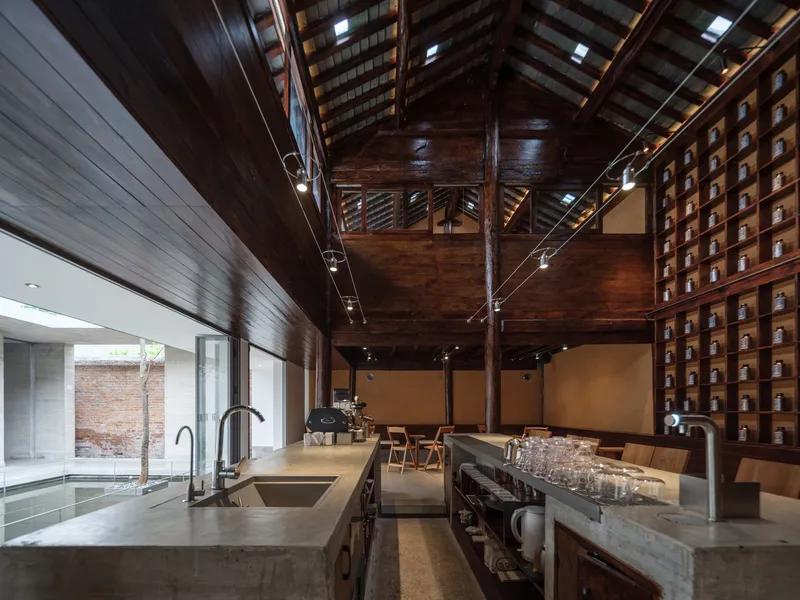
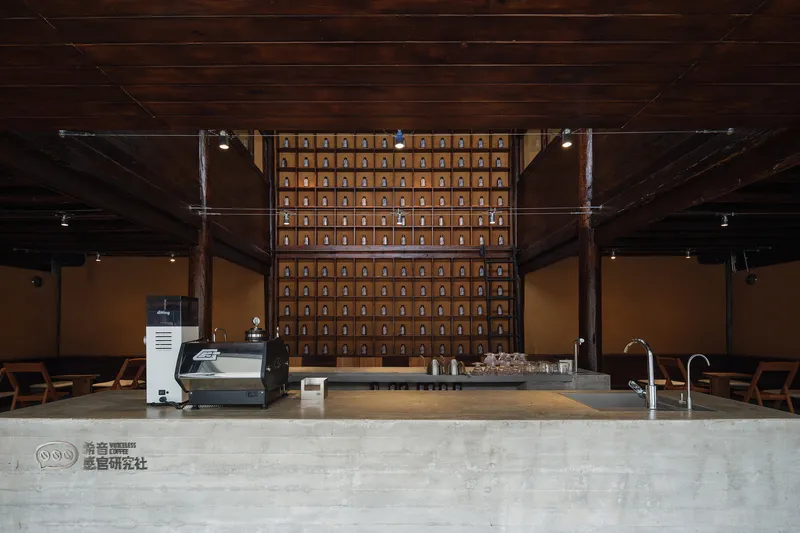
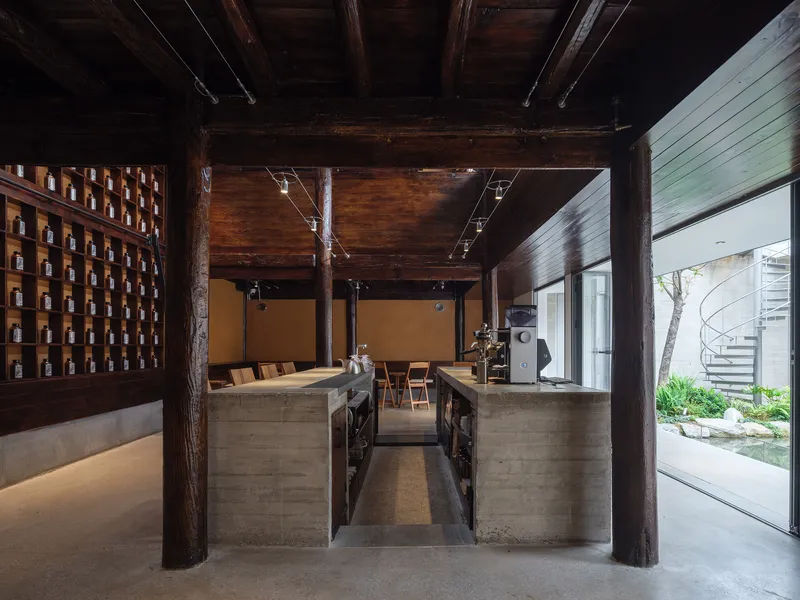
The back-of-house and service zones reveal how seriously the project takes coffee as a professional discipline. The stainless steel counter facing the planted courtyard signals laboratory precision, while the grid of wooden storage drawers on the rear wall of another counter zone recalls traditional apothecary cabinetry. These are not decorative references; they reflect the building's program as a sensory lab where tasting, training, and product development happen alongside retail service.
The open kitchen with its concrete counters, timber columns, and exposed ceiling beams is the most utilitarian space in the building, and it benefits from that directness. Track lighting replaces the elaborate daylighting strategies found elsewhere, acknowledging that this is a working room where functionality comes first. The double-height interior with its mezzanine overlooking the long service counter connects the public and professional halves of the program in a single sightline.
The Rooftop and the Aerial Condition
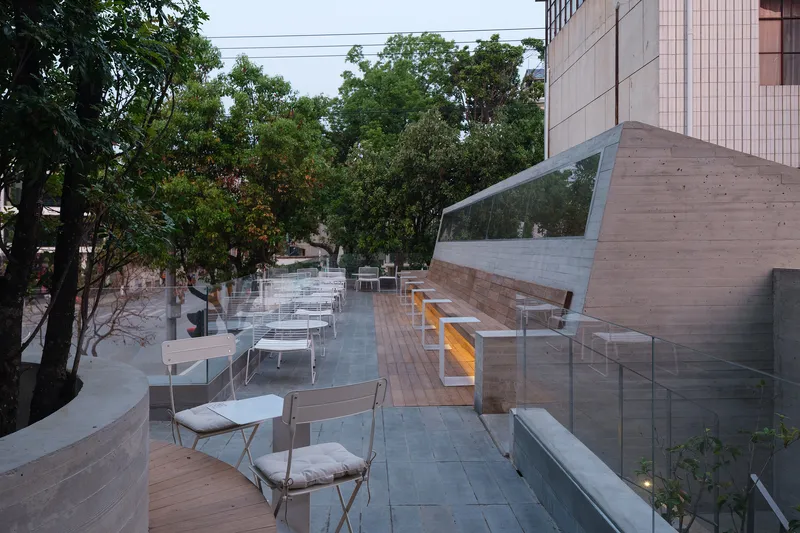
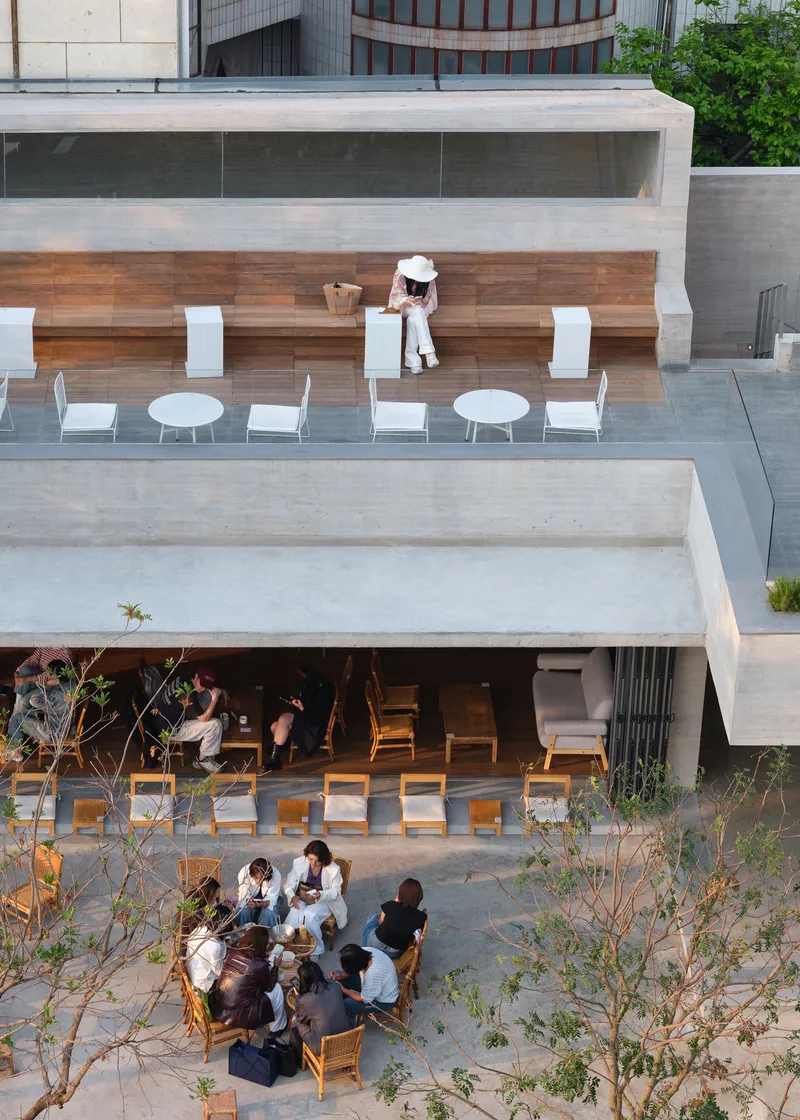
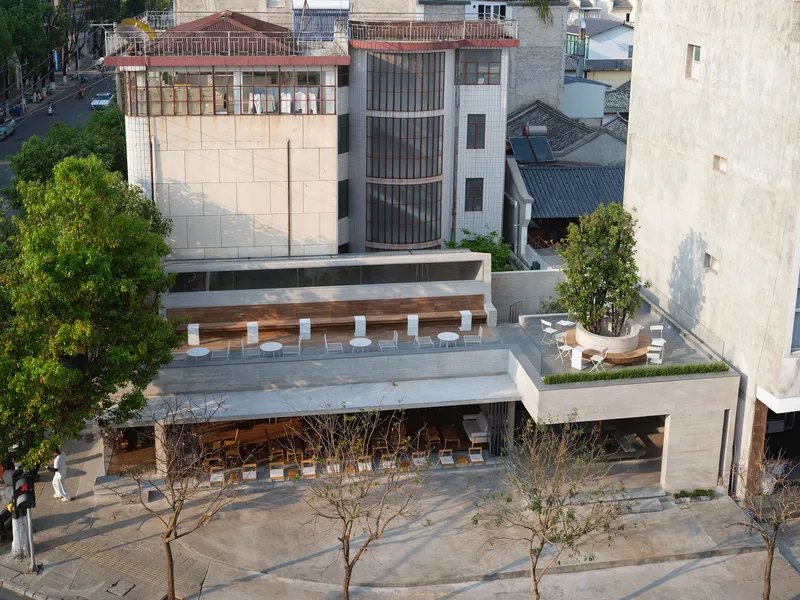
The rooftop terrace, with its timber decking and glass balustrade, offers a view over the treetops that reframes the entire neighborhood. From above, the building reveals itself as a stack of tiered concrete terraces stepping between adjacent structures, with planted trees and timber seating creating a series of inhabitable ledges. The aerial view confirms what the section suggests: this is a building designed to be read vertically as much as horizontally, with each level offering a different vantage point and a different relationship to vegetation and sky.
Plans and Drawings
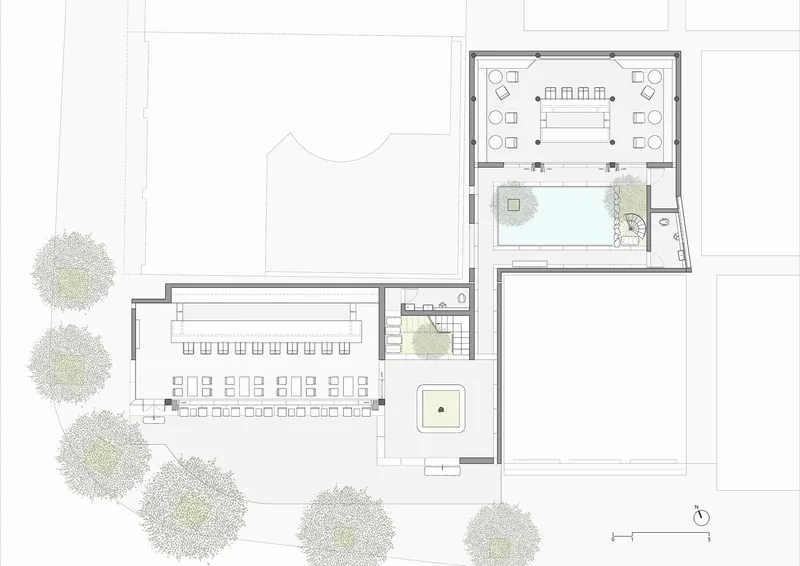
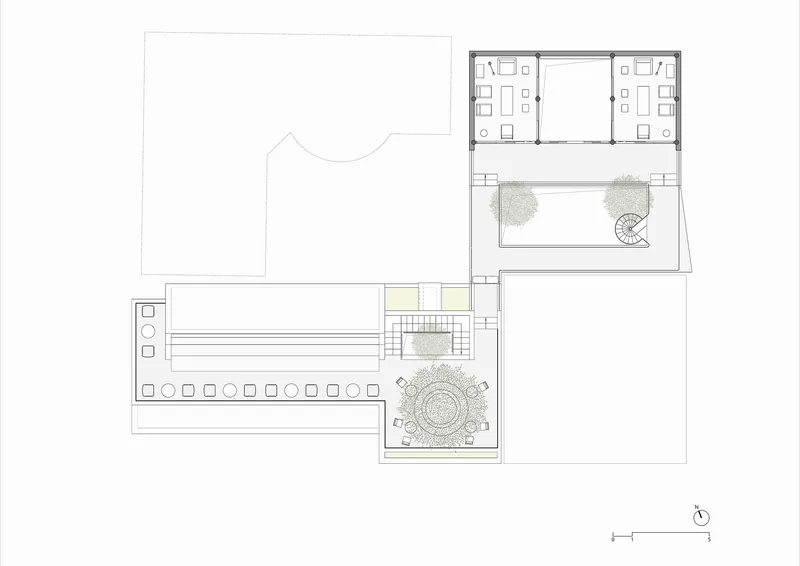
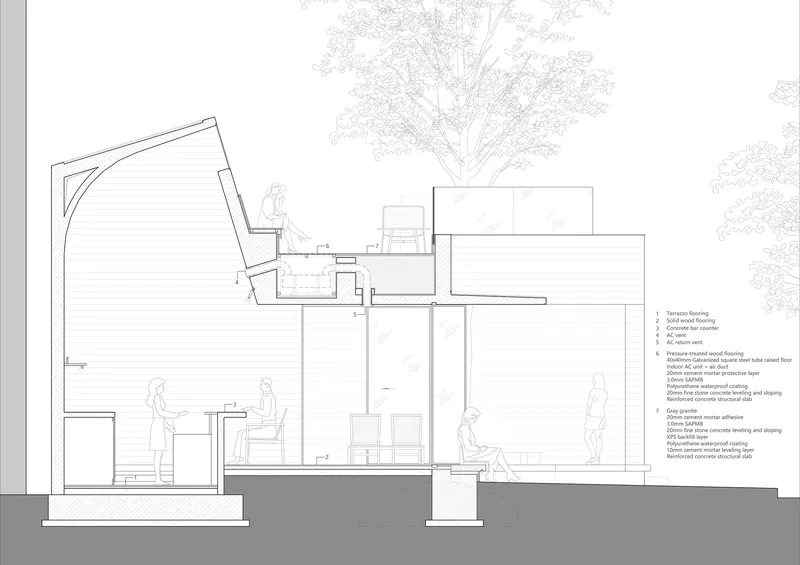
The floor plans reveal the project's organizational logic. Interconnected rectangular volumes wrap around multiple courtyards, with surrounding trees annotated as part of the design rather than incidental context. The upper level plan shows a central stairwell connecting the public mezzanine to the rooftop, with courtyard plantings threading through the section. The building section is the most revealing drawing: it shows how the half-level shifts, double-height voids, and courtyard cuts create a sectional richness that far exceeds what a 260-square-meter footprint would normally allow.
Why This Project Matters
Voiceless Coffee's Sensory Lab matters because it takes a building type that is routinely reduced to Instagram backdrops and treats it as a serious spatial problem. The cafe is not dressed up to look like a coffee laboratory; it is organized like one, with distinct zones for different stages of engagement, from the casual terrace to the professional training counter. The architecture does not illustrate the program so much as it enacts it, guiding visitors through a sequence of material and atmospheric shifts that parallel the progressive disclosure of flavor in a well-constructed tasting flight.
For a studio working in a region where coffee culture and architectural ambition are both accelerating, No10-Architects have set a benchmark. The project proves that a small, dense building on an unremarkable urban site can achieve real spatial complexity if the section is worked hard enough and the existing landscape is treated as a collaborator rather than an obstacle. In Baoshan's growing constellation of coffee destinations, this one argues that the room you drink in shapes what you taste.
Voiceless Coffee · Sensory Lab, designed by No10-Architects (lead architect: Shihao Zhou), Baoshan, China. 260 m², completed 2026. Photography by Ce Wang.
About the Studio
Share Your Own Work on uni.xyz
If projects like this are the kind of work you want to make, uni.xyz is a place to publish your own, find collaborators, and enter design competitions.


Popular Articles
Popular articles from the community


ETEH Reworks the Shared Spaces of São Domingos School in Brazil Around Timber, Color and Hanging Plants
At São Domingos School in Brazil, 436 m² of hall, refectory and library are recast with timber joinery, a yellow and blue code and trailing greenery.


The Amber Palace Opera: A Geological Fiction Surfaces on Tallinn's Baltic Waterfront
Pierre Brillard reimagines a Baltic legend as a public landscape, opera house, and waterfront promenade rooted in Tallinn's coastal identity.

Singing Woman: An Opera House That Performs Before the Curtain Rises
Ovidiu Cristian Pavel's conceptual opera house translates Estonia's choral identity into a sculpted waterfront landmark facing the Baltic Sea.

FCC Arquitectura Expands a Portuguese Granite House with a Board-Marked Concrete Wing
In Portugal, JV House pairs a cleaned-up whitewashed and granite dwelling with a timber-shuttered concrete extension, courtyards and a garden pool.

Similar Reads
You might also enjoy these articles

LAVA Architecten Gives Vocational Education a Sawtooth-Roofed Face on a Mechelen School Campus
In Mechelen, Belgium, a 2,053 m² STEM school on a 6×6 m grid turns workshops and classrooms into rooms that can be rearranged as teaching changes.

KEMA Studio Turns a Derelict Marvila Attic into a 60 m² Lighthouse Apartment Above Lisbon
In Lisbon's Marvila district, a rebuilt roof, four skylights and two plywood volumes turn an unlivable attic into a bright home facing the Tagus.

Pixel Gardens: One Repeated Module Stacked Into a Terraced Social Housing Tower for Famagusta
Salem Bader's shortlisted housing tower builds a vertical neighbourhood from one repeated module, offsetting units to carve terraces, light and air.

Bao Huynh Watercolor Atelier: A Serene Art Retreat in Hội An
Bao Huynh Watercolor Atelier in Hội An blends multifunctional art spaces, sustainable design, local materials, and family-friendly living in a serene environment.

Comments (0)
Please login or sign up to add comments
No comments yet. Be the first to comment!