
Noforma Design Studio Reveals the Forgotten Bones of a Japanese Hillside Home in Atami
A 240-square-meter renovation on Shizuoka's coast strips back decades of false ceilings to expose the timber soul of a traditional retreat.

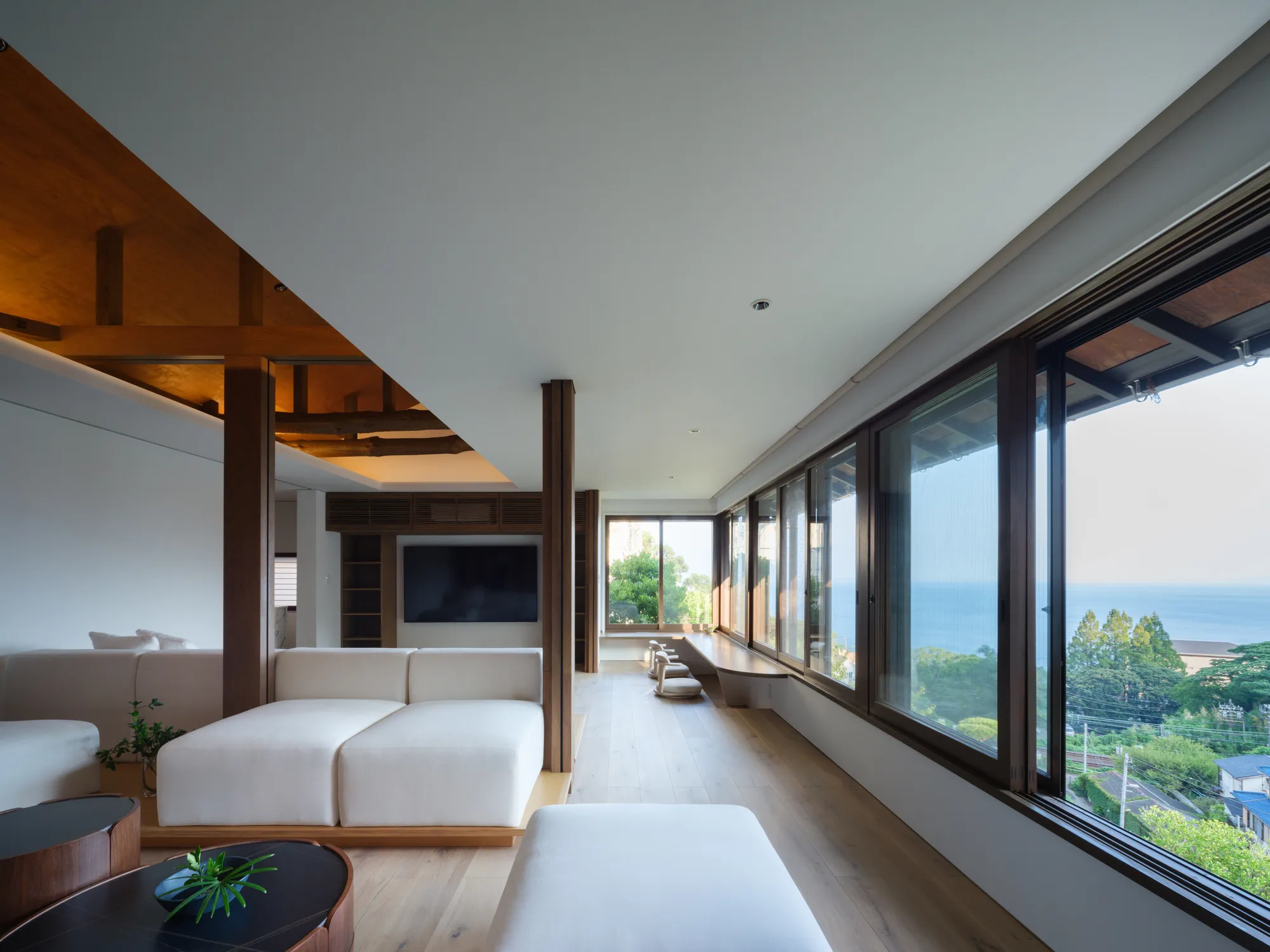
Atami sits along the historical Tokaido, the ancient route connecting Edo and Kyoto, and its name translates to "hot ocean," a nod to the thermal springs that rise from the seabed. The town is forty minutes from Tokyo by bullet train, close enough for weekend escape yet rooted in a slower coastal rhythm. On a hillside overlooking the Pacific, Noforma Design Studio, led by architect Luca Marulli, has completed a 240-square-meter renovation that peels back the accumulated layers of a traditional Japanese home to recover something the building itself had hidden: a structural timber frame concealed above a false ceiling.
What makes Atami House genuinely interesting is not the renovation's restraint, though it is remarkably restrained. It is the premise that drove the project. During a structural assessment, Marulli's team discovered aged natural timber beams above the dropped ceiling, beams that amounted to the building's forgotten core. Rather than treat them as charming relics, Noforma recognized them as a bridge between the house's historical identity and its new life as a contemporary retreat. The entire design strategy follows from that single discovery: expose what was buried, then build every spatial decision around it.
Timber Rediscovered
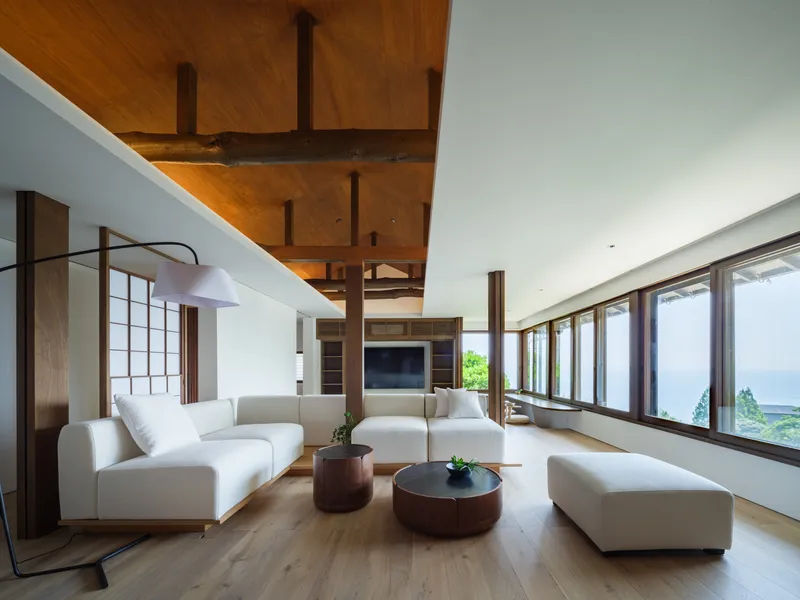
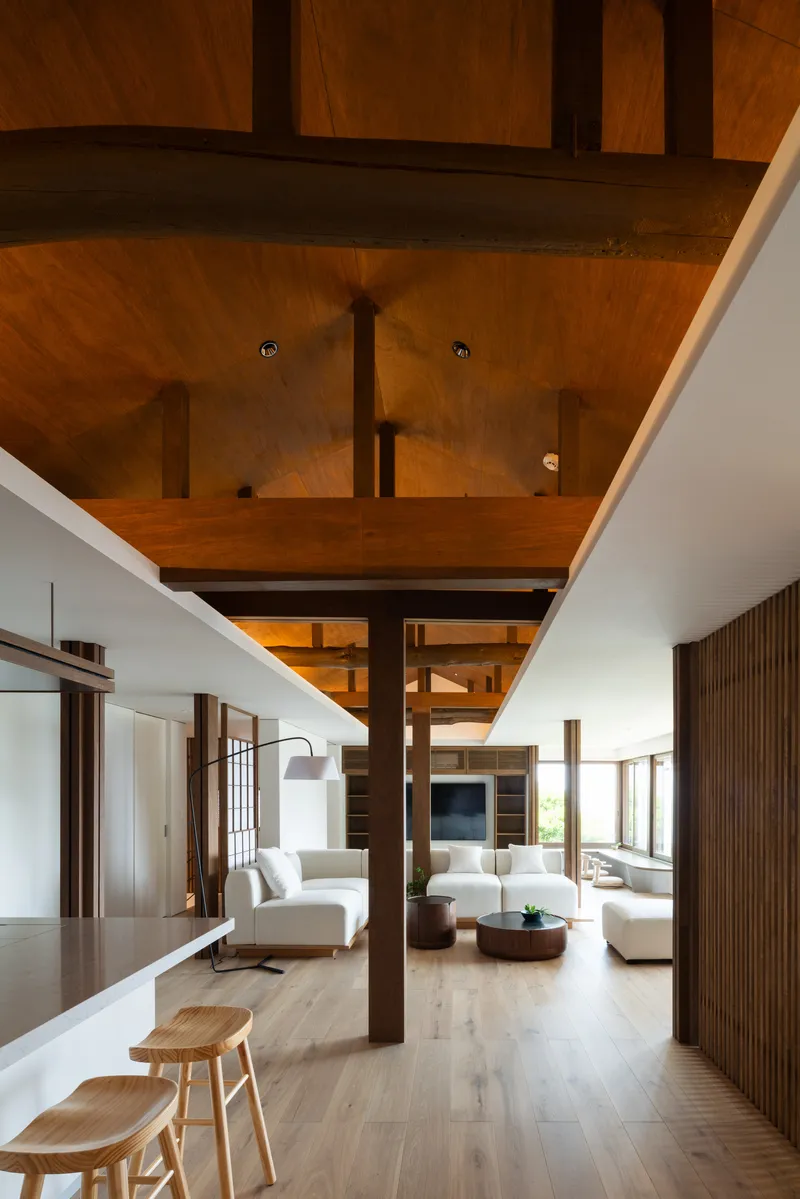
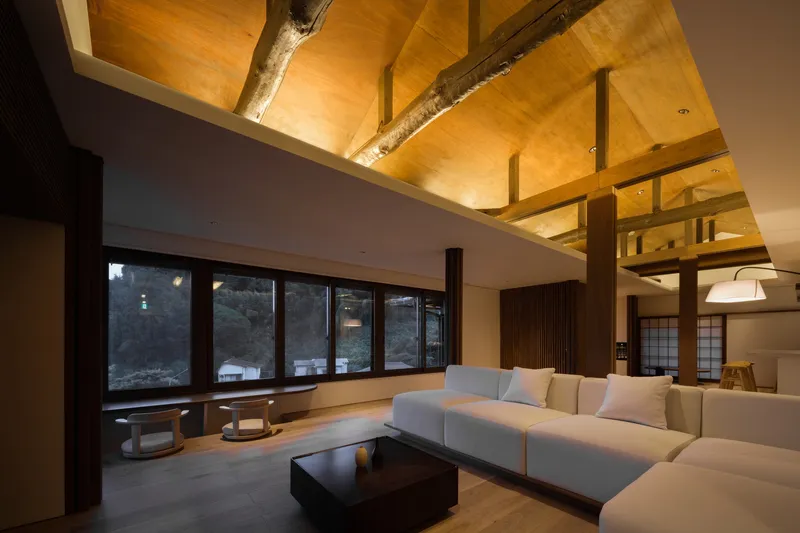
The ceiling is the project. Once the false panels came down, the timber post-and-beam structure took command of the interior. Freestanding columns rise to meet angular rafters and vaulted coffers, and the geometry overhead shifts from room to room, giving each zone a distinct spatial character even within a largely open plan. Recessed lighting traces the edges of these timber planes without competing with them.
There is a confidence in the decision to let aged wood do the heavy lifting. No paint, no cladding, no attempt to sand the material into something new. The beams carry their patina, and the contrast against pale floors and white walls makes the structure legible in a way it never was when the house was built. You read the load path with your eyes, and the room feels taller and more honest for it.
The Engawa Condition
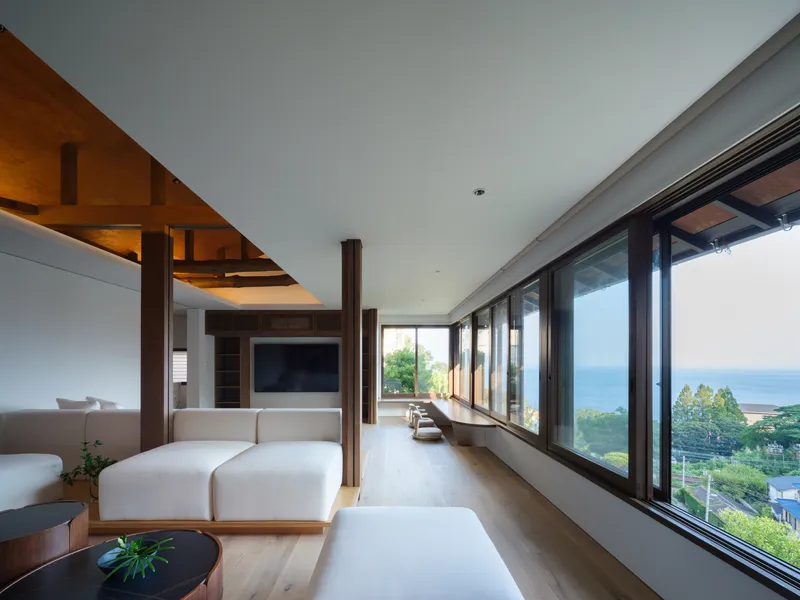
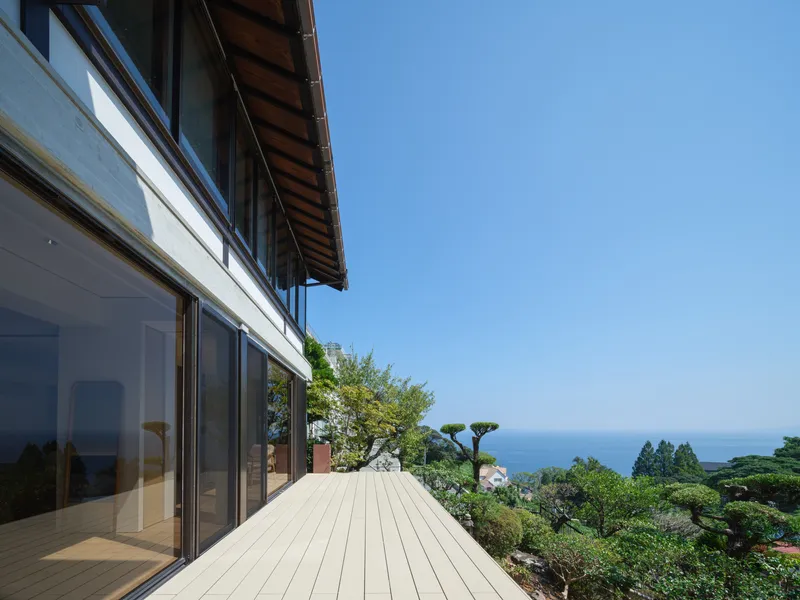
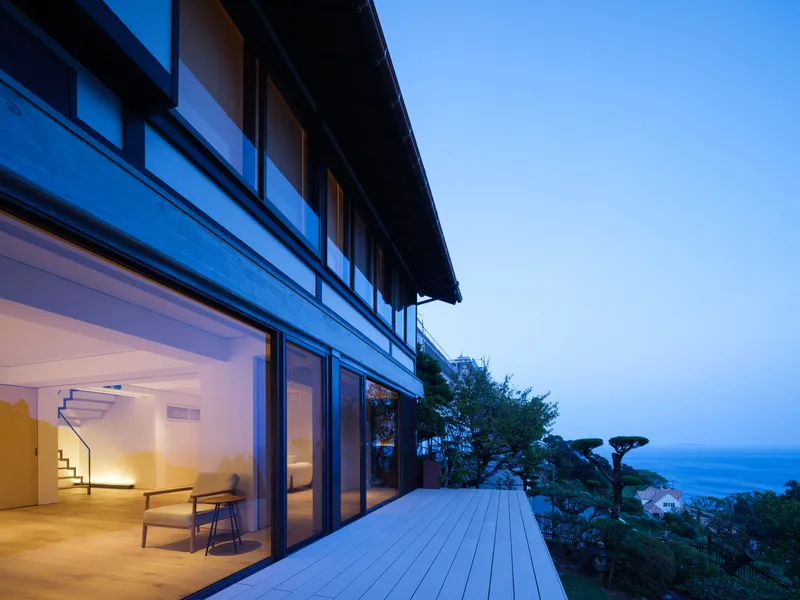
The long glazed wall on the ground floor operates as an engawa, the traditional Japanese threshold that belongs to neither inside nor outside while functioning as both. Continuous glass panels slide open to a timber deck terrace, and a deep overhanging eave provides shade without blocking the Pacific horizon. The result is a room that becomes a porch, or a porch that becomes a room, depending on the weather and your disposition.
At dusk, the threshold dissolves entirely. Interior lighting washes the timber ceiling warm while the sky beyond shifts through violet and blue, and the boundary between domestic space and coastal landscape becomes a matter of temperature rather than enclosure. Noforma understood that the engawa is not a detail but a spatial principle, and they scaled it up to define the entire ground floor experience.
Screens and Filtered Light
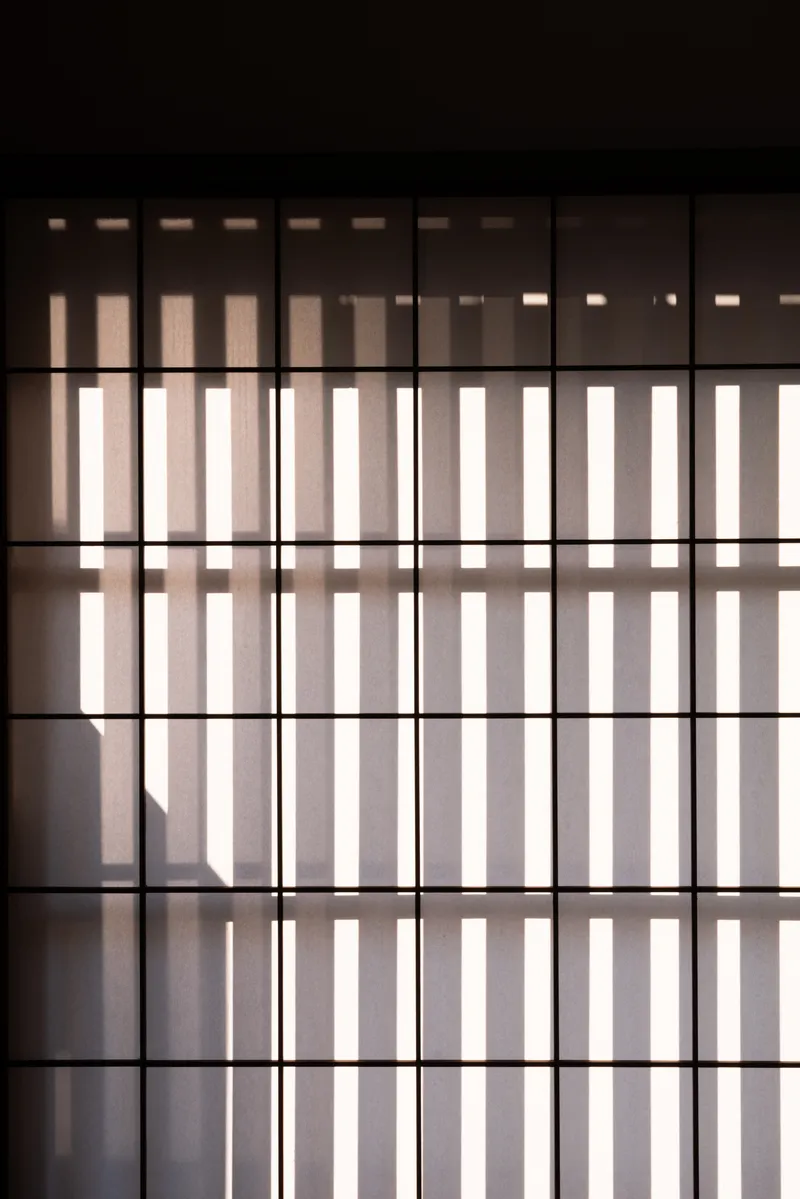
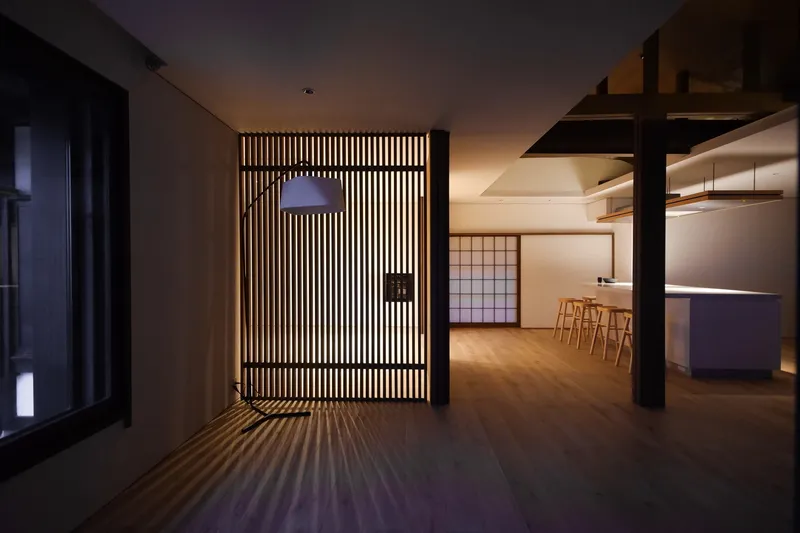
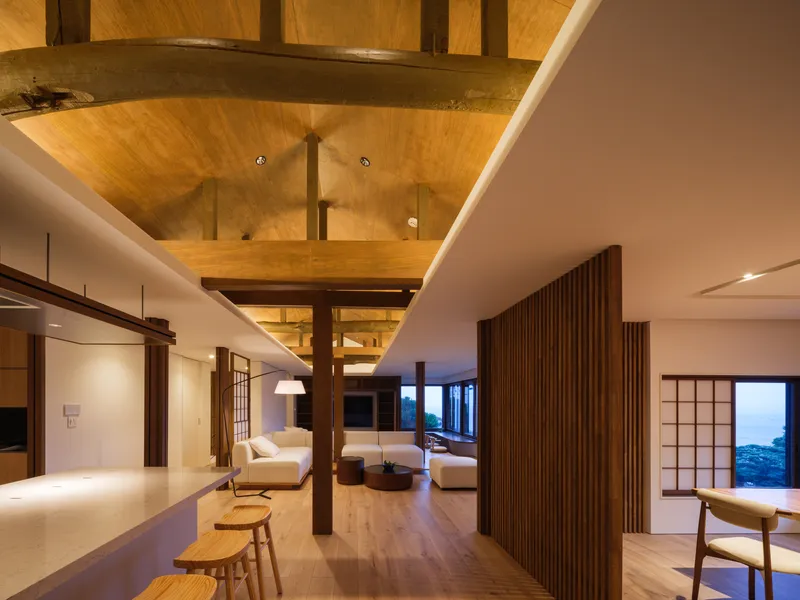
Vertical timber slat screens appear throughout the house, sometimes as room dividers, sometimes as backlit panels that cast rhythmic shadow patterns across floors and walls. They recall the translucent shoji doors of the original structure but operate differently. Where shoji diffuse light into soft evenness, these screens stripe it, creating depth and directionality. The effect at dusk, when interior lighting backlights the slats, is a controlled glow that pulses through the house.
The screens also solve a practical problem. With the false ceiling gone and the plan opened up, the house needed a way to define zones without rebuilding walls. The slat screens provide visual separation while allowing air and light to move freely, preserving the sense of volume that the exposed beams established.
Living Under the Frame
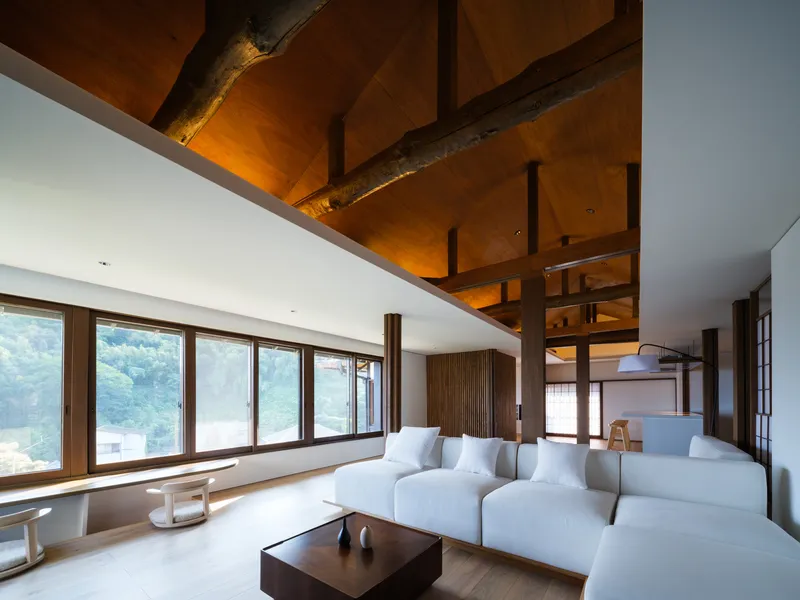
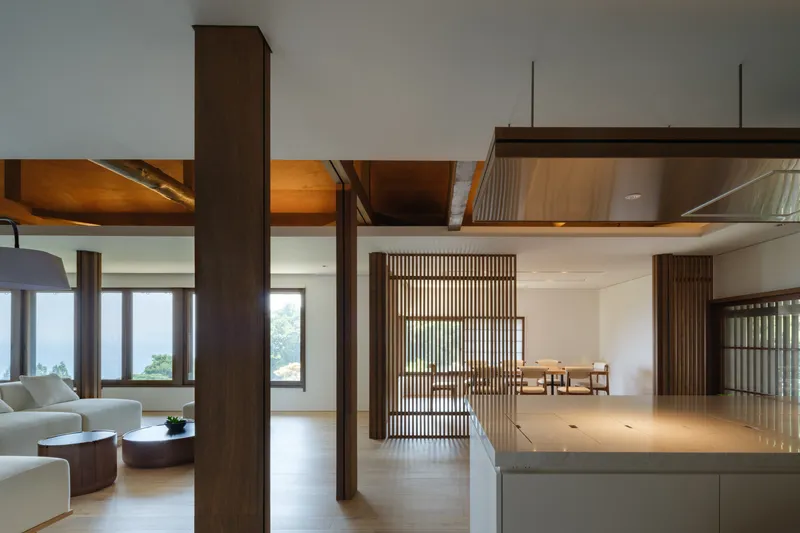
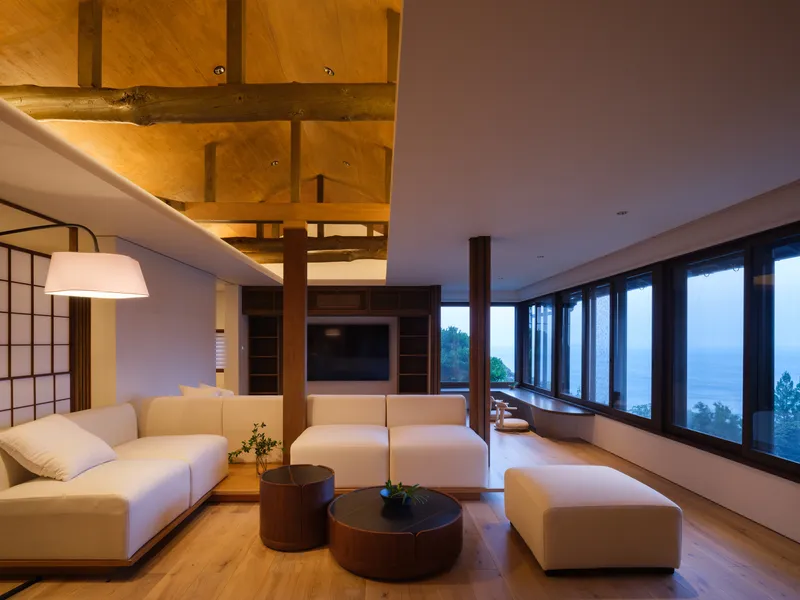
The open-plan living and kitchen area sits beneath the most dramatic section of the recovered timber structure. Dark columns punctuate the space at irregular intervals, and the ceiling cove above the kitchen island reads like a coffered tray that was always there, waiting. White seating and pale wood flooring keep the lower register neutral, letting the structural frame dominate the upper register without making the room feel heavy.
Translucent sliding screens in the background of the kitchen zone suggest that the old spatial logic of subdivision has not been erased so much as reinterpreted. Where the original house used shoji to compartmentalize tatami rooms, Noforma uses similar sliding elements to create optional privacy within the open plan, a gesture that respects the building's history without repeating it.
The Kitchen as Anchor
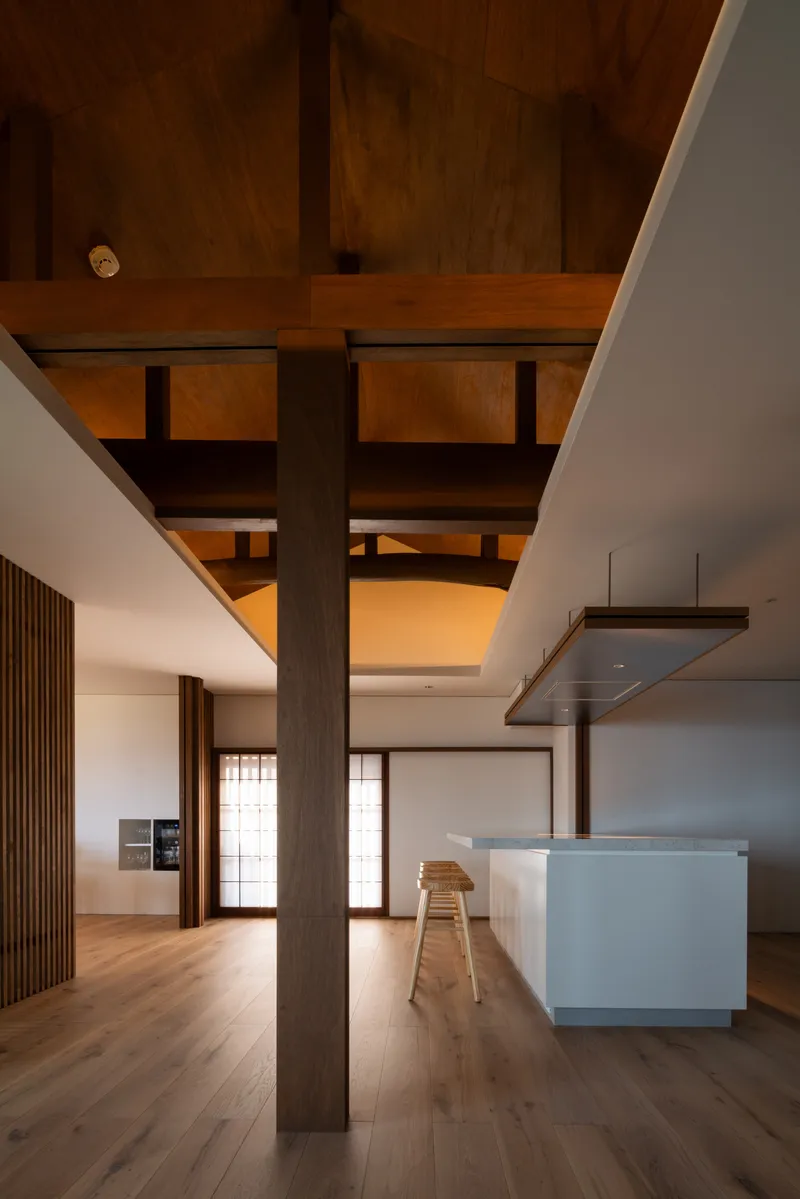
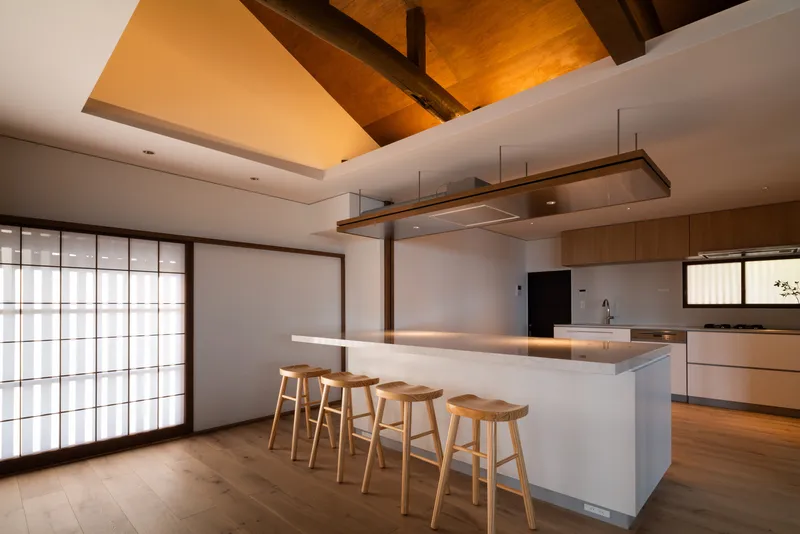
The kitchen island, flanked by three timber stools, sits directly beneath a recessed ceiling panel that frames it like a stage. It is the social center of the plan, positioned between the living area and the screened zones beyond. The material palette is deliberately simple: stone countertop, timber seating, and the beam structure overhead. Nothing competes for attention.
Marulli's placement is strategic. The island occupies the crossing point of several sight lines, including the lateral view through slat screens and the longitudinal view toward the ocean. Anyone standing at the counter becomes both participant and audience, connected visually to every major space on the floor.
Bathing and Private Retreat
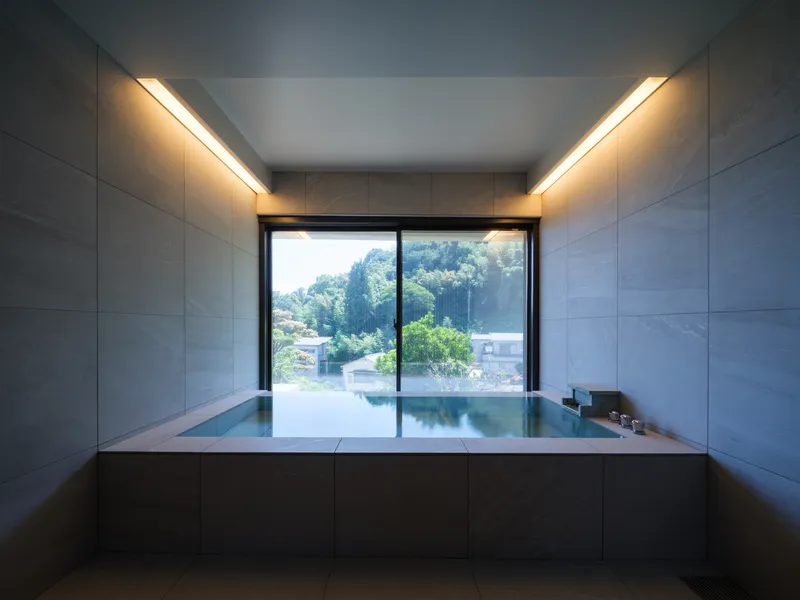
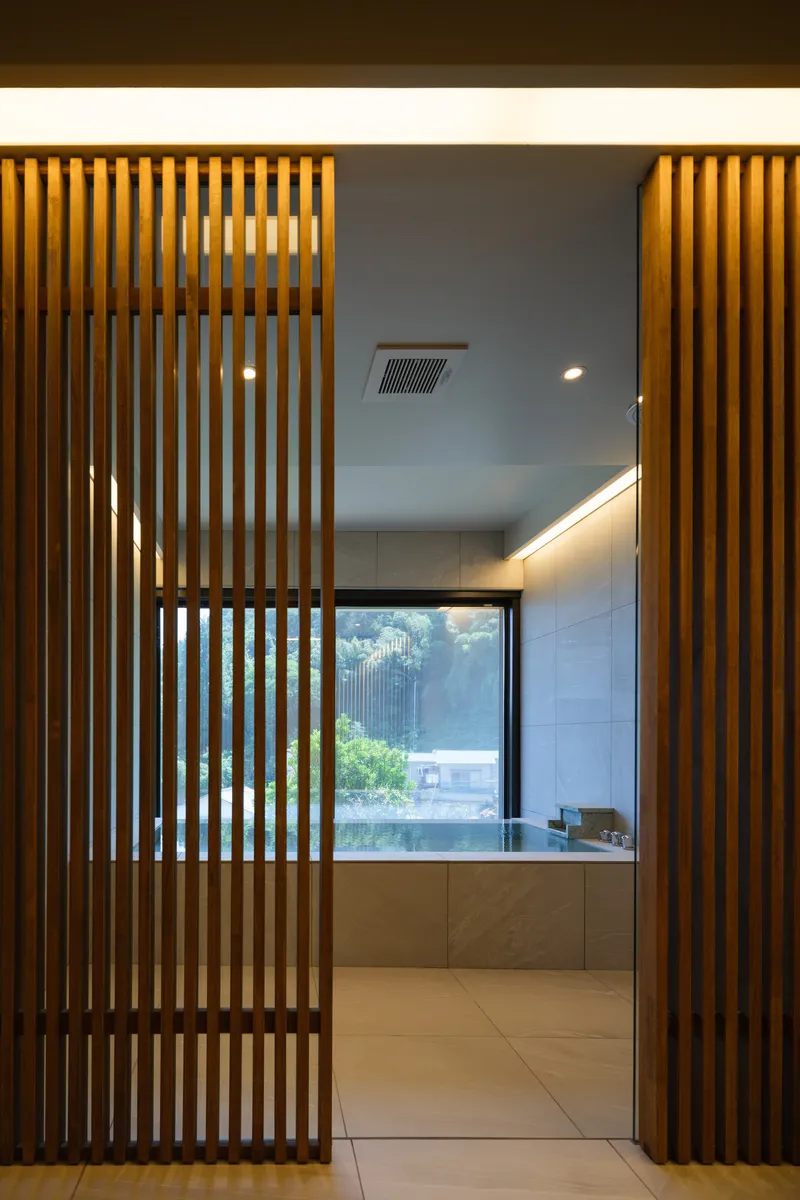
Atami's identity is inseparable from water. The house preserves its existing connection to onsen hot spring water, and the bathing space is treated not as a utilitarian bathroom but as a defining element of the program. A deep soaking tub with a stone tile surround faces the hillside landscape, framed by a picture window that makes bathing a meditative act rather than a private one. Backlit timber slat screens flank the entrance, signaling the transition from domestic space to something more ritualistic.
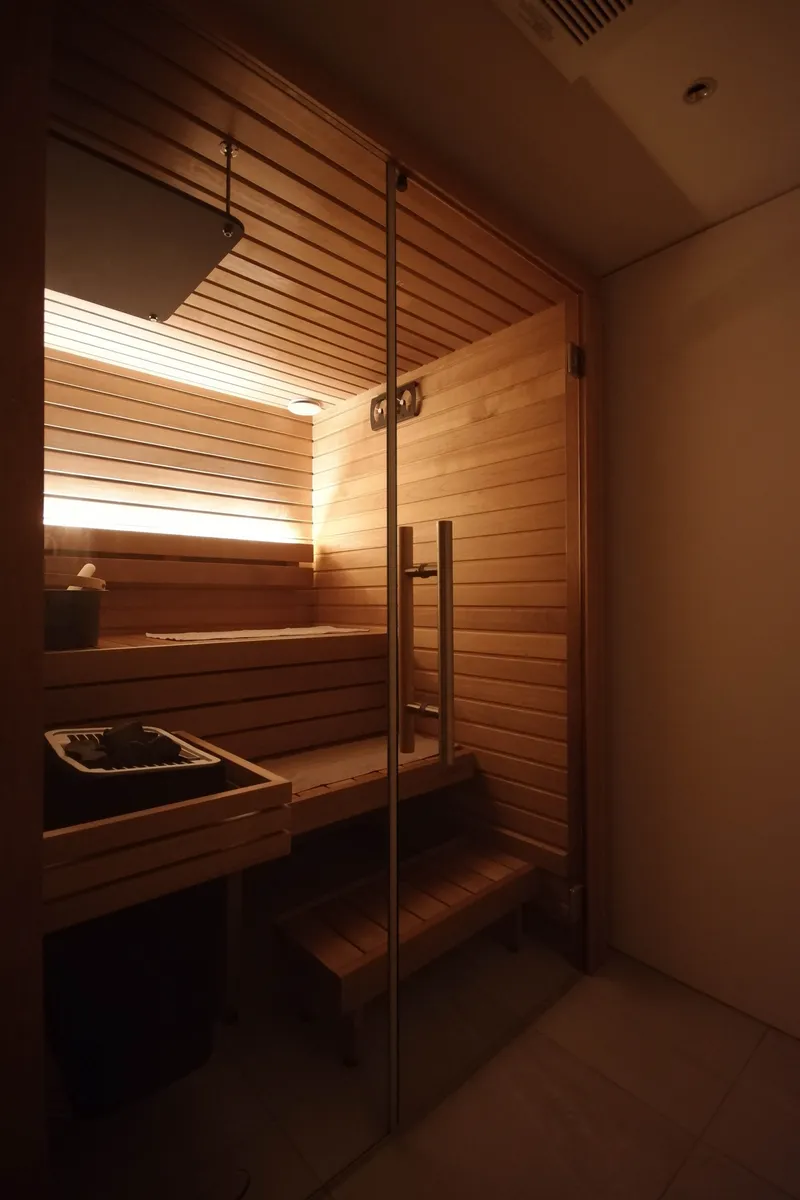
A wood-lined sauna with horizontal slat benches completes the bathing sequence. The material shift from the house's vertical slat language to horizontal orientation in the sauna is subtle but deliberate, marking the space as distinct from the rest of the interior while remaining within the same timber vocabulary.
Bedrooms and the Garden Threshold
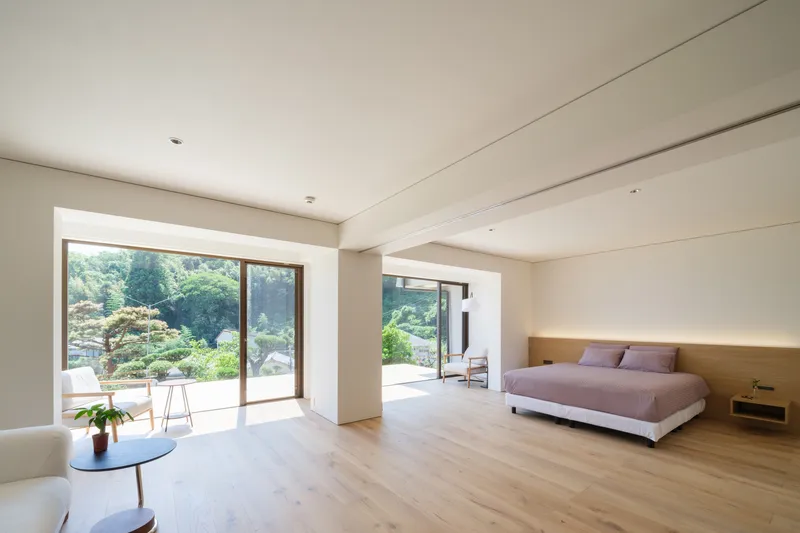
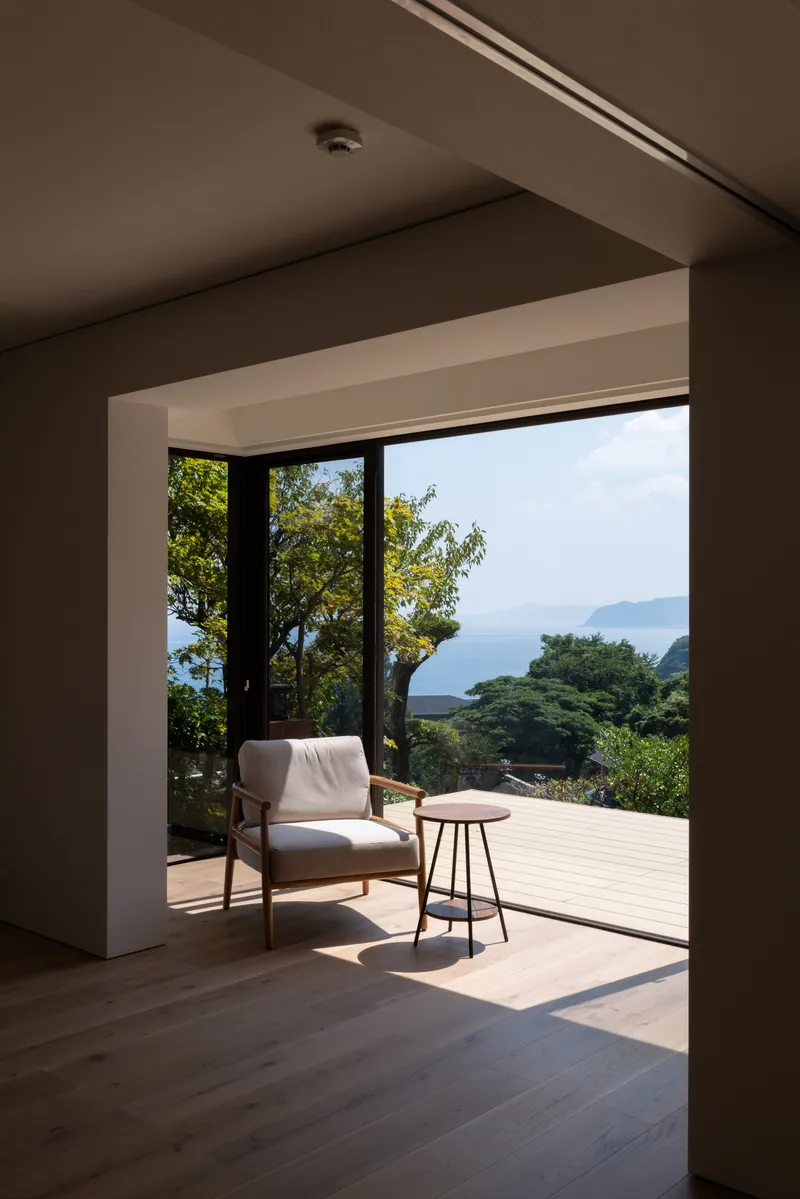
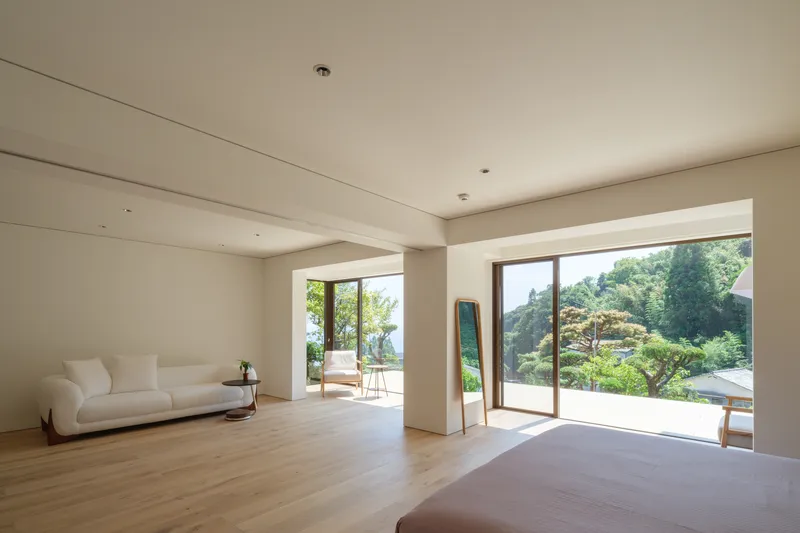
The ground floor master bedroom can be subdivided into two en-suite rooms or opened into a single flexible space for exercise, film screenings, or quiet work. Both configurations open directly onto a garden deck through full-height glass doors. A timber headboard wall anchors the sleeping zone while framing views of a sculptural garden and the terrace beyond.
The framed opening from the bedroom to the terrace deck is one of the project's most carefully composed moments. You look through a deep timber portal to the garden, then past it to the hillside, and finally to the ocean. Three layers of landscape, each at a different depth, stacked within a single aperture. It is the kind of view that rewards stillness.
Circulation and Detail
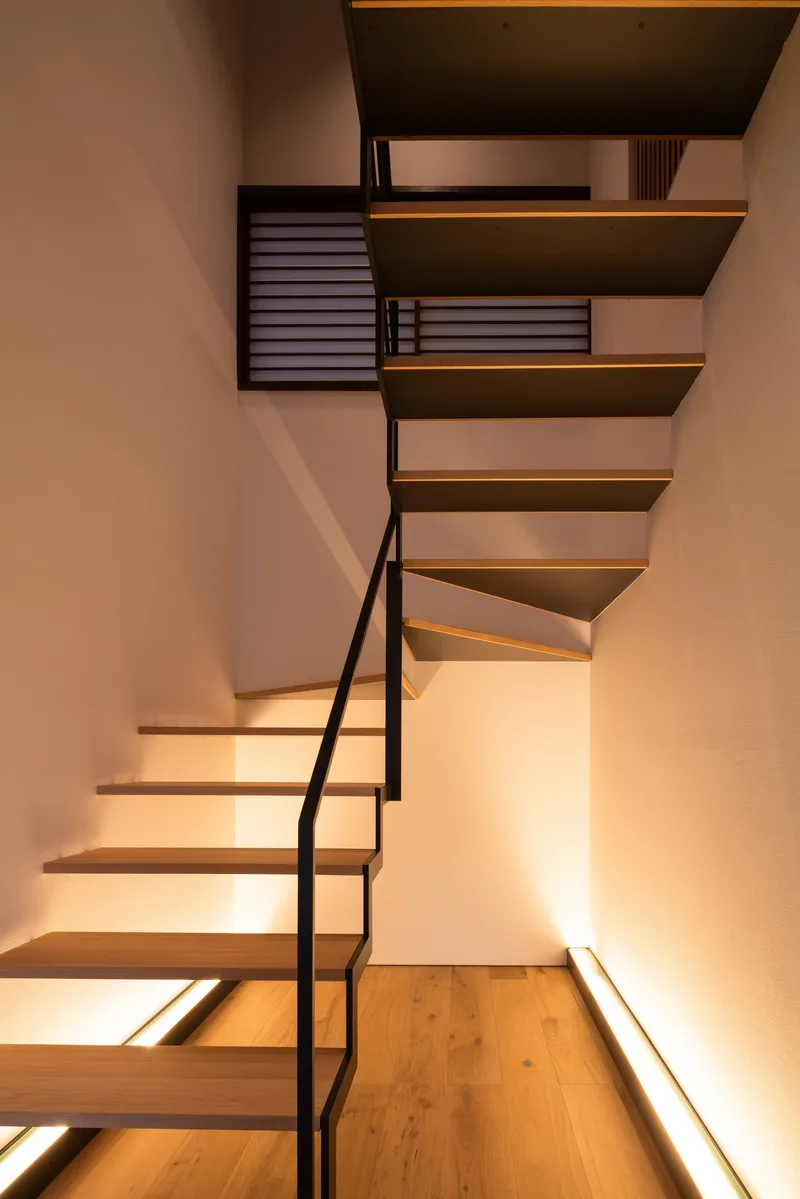
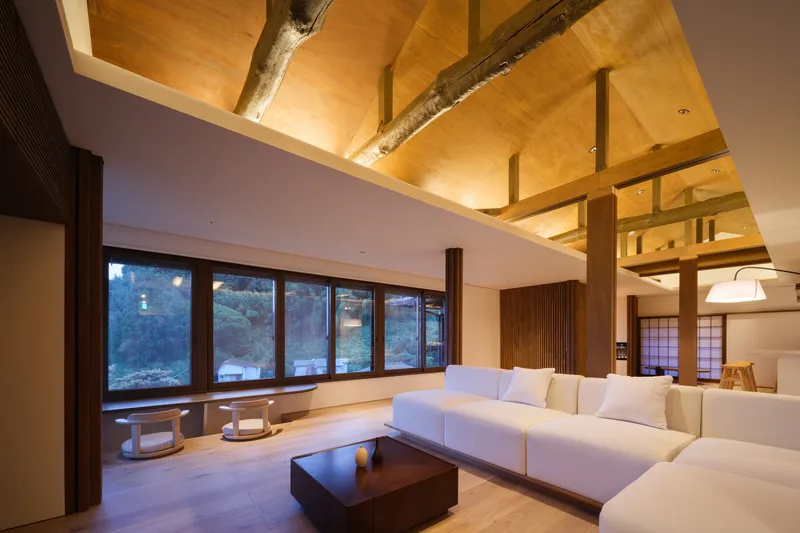
A floating timber staircase with a black steel railing and integrated LED strip lighting connects the floors. The staircase is the most overtly contemporary element in the house, clean and precise in a way that reads as intentionally different from the rough timber above. It functions as a temporal marker: new construction inserted into old fabric, visible and unapologetic about the gap in age.
From the upper seating area, ribbon windows frame the evening hillside, and the exposed timber frame wraps overhead. The exterior was left largely untouched, with only a few carefully placed window openings cut to direct new sight lines toward the ocean while maintaining the building's respectful relationship with its hillside neighbors. Restraint on the outside, revelation on the inside.
Plans and Drawings
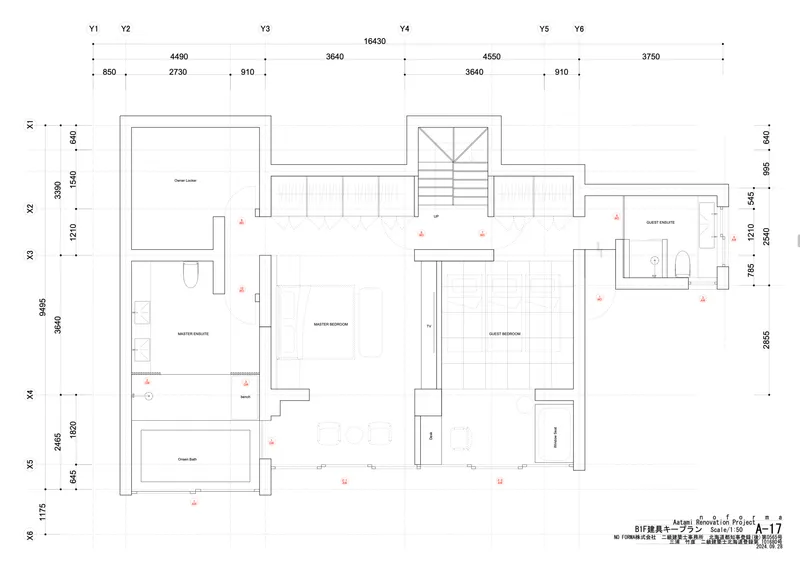
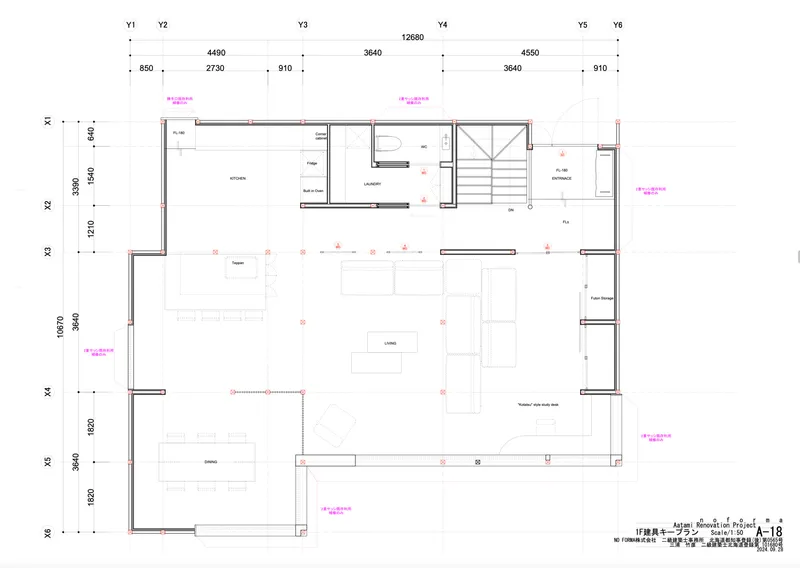
The two floor plans confirm the project's spatial logic. The upper level shows the bedroom suite layout organized around a central staircase, with tatami grid notation acknowledging the original module. The ground level shows the open-plan living and kitchen spaces in full, with dimension annotations that reveal how generously the plan flows once the shoji partitions are removed. What reads as effortless openness in the photographs is, on paper, a carefully measured negotiation between new openings and existing structure.
Why This Project Matters
Renovation projects in Japan face a particular challenge. The tradition of scrap-and-build, tearing down and starting fresh every thirty years or so, means that preserving an existing structure is already a statement. Noforma's decision to not only keep the building but to excavate its hidden timber frame positions Atami House as an argument for looking harder at what already exists before reaching for new material. The false ceiling was not just obscuring beams; it was obscuring a spatial possibility that no new construction could replicate.
The project also demonstrates that cultural continuity does not require cultural imitation. The engawa, the onsen connection, the shoji-like screens: all are present, but none are reproductions. Each element has been rethought for contemporary use without losing its original meaning. That balance is difficult to achieve and easy to get wrong. Noforma got it right, and the result is a house that feels both old and entirely of its moment, a coastal retreat that honors the Tokaido tradition of passage, rest, and renewal.
Atami House by Noforma Design Studio (Lead Architect: Luca Marulli). Shizuoka, Japan. 240 m². Completed 2025.
About the Studio
Share Your Own Work on uni.xyz
If projects like this are the kind of work you want to make, uni.xyz is a place to publish your own, find collaborators, and enter design competitions.




Popular Articles
Popular articles from the community


How Henri Picq's 1889 Paris Pavilion Traveled 11,000 Kilometers to Become Santiago's Artequín Museum
A prefabricated iron and glass pavilion built for the Paris Universal Exposition found a second life as a children's art museum in Chile.

Hierarchy Towers: Sustainable Architecture for Vertical Co-Living in Singapore
Hierarchy Towers reimagines sustainable architecture through co-living, shared workplaces, green terraces, and new public life in Singapore.
RHO Converts a Berlin Spree-Side Industrial Courtyard into Enkime's 1,000 m² Agency Headquarters
A social media agency's new home in Charlottenburg trades glossy branding for concrete waffle ceilings, glazed tile, and sheer curtains.
Simplex Architecture Steps a Seoul Mid-Rise Tower to Negotiate Between Low-Rise Commerce and High-Rise Housing
In Seocho-dong, a gridded stone tower of terraces and sunken courtyards mediates between two radically different urban scales.


Similar Reads
You might also enjoy these articles

Bao Huynh Watercolor Atelier: A Serene Art Retreat in Hội An
Bao Huynh Watercolor Atelier in Hội An blends multifunctional art spaces, sustainable design, local materials, and family-friendly living in a serene environment.

Atelier Macri Concept Store Interior Design by CASE-REAL
Atelier Macri store features a "ko" counter, walnut wood details, cork displays, blending retail, gallery, and seamless customer experiences.

Manuel Vargas Izquierdo Stadium and High-Performance Sports Center: Architectural Excellence in Jalpa de Méndez
The Manuel Vargas Izquierdo Stadium blends sustainable design, inclusive sports facilities, and cultural-inspired architecture, revitalizing Jalpa de Méndez’s public spaces.

KAKR Buluh Awar Hall: Revitalizing Community and Ecology Through Bamboo Architecture
Community built bamboo hall revitalizes Buluh Awar village, empowering youth, restoring ecology, celebrating vernacular craftsmanship through sustainable architecture and culture.


Explore Interior Design Competitions
Discover active competitions in this discipline




The Global Benchmark for Architecture Dissertation Awards


Challenge to design mud housing for contemporary communities


Challenge to design luxury tourism on rails


VR headsets Storefront design competition
Comments (0)
Please login or sign up to add comments
No comments yet. Be the first to comment!