
oftn studio Strips the Counter from a Seoul Hair Salon to Make It Feel Like a Private Studio
A 100 square meter salon across two compact floors in Yeonnam-dong trades commercial convention for domestic intimacy and sculptural steel.


The hair salon has a design problem no one talks about. The reception counter, the product shelf, the rows of mirrors: they all signal commercial transaction before any creative work begins. oftn studio's TAN Salon in Yeonnam-dong, Seoul, removes nearly all of those cues. There is no counter. There is no locker room. There is, instead, a large wardrobe, a sofa near the stairs, and pairs of chairs facing floor-to-ceiling glass. The result is a space that feels less like a retail storefront and more like a friend's loft where someone happens to cut hair very, very well.
Spread across just 100 square meters on two floors, TAN operates on a specific constraint: two stylists, one per floor, each with their own dispensing room and shampoo room. The architecture responds to this by treating each level as a near-duplicate, sharing the same spatial DNA but shifting materials and arrangement just enough to give each floor its own character. Connecting them is a folded steel staircase that is less circulation device and more sculptural object, a piece of furniture scaled up to the building.
The Staircase as Object
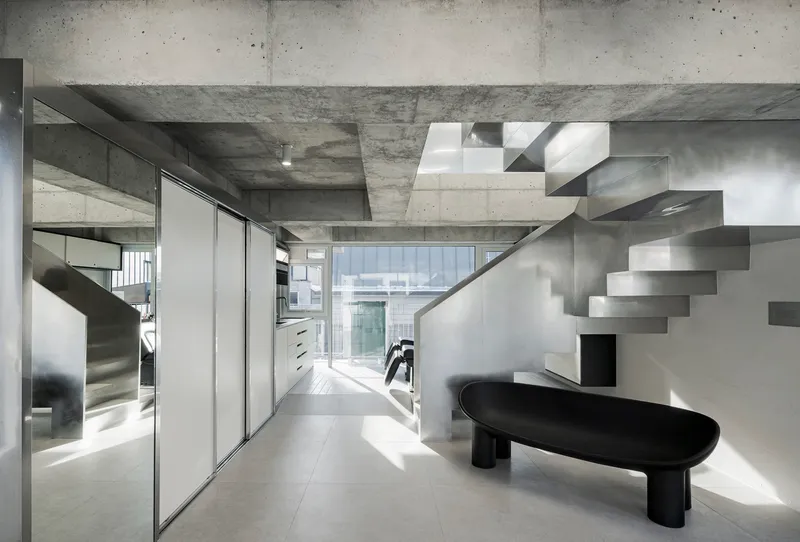
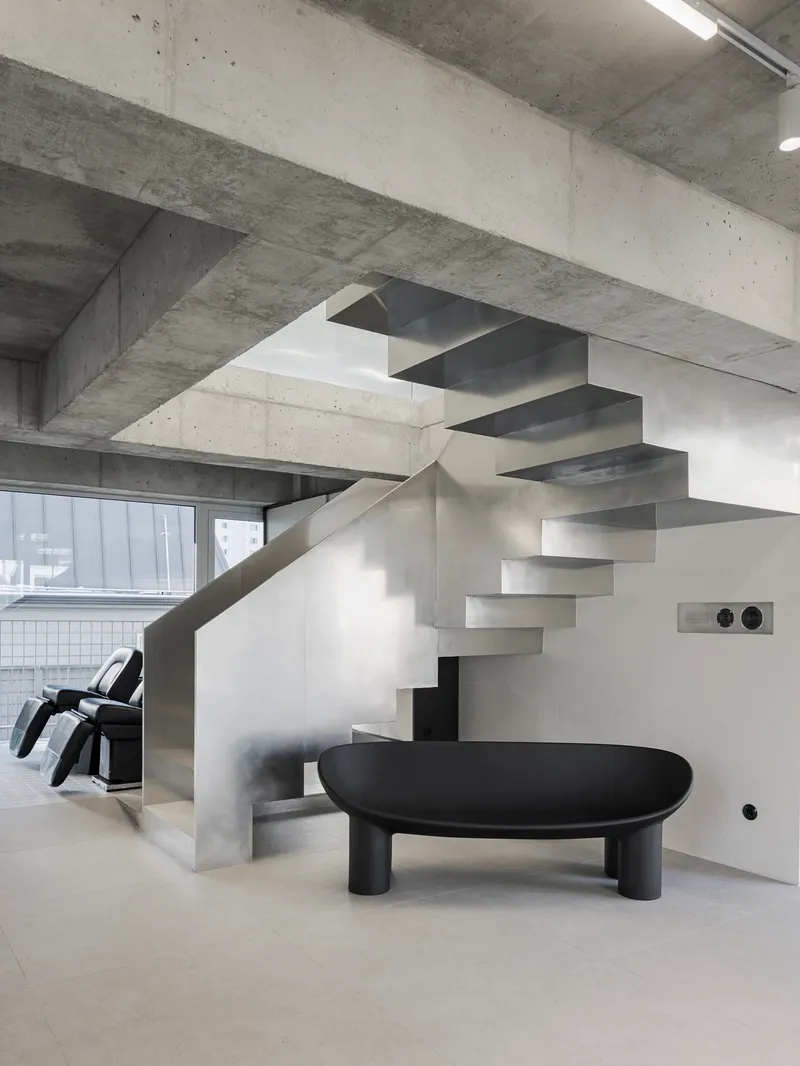
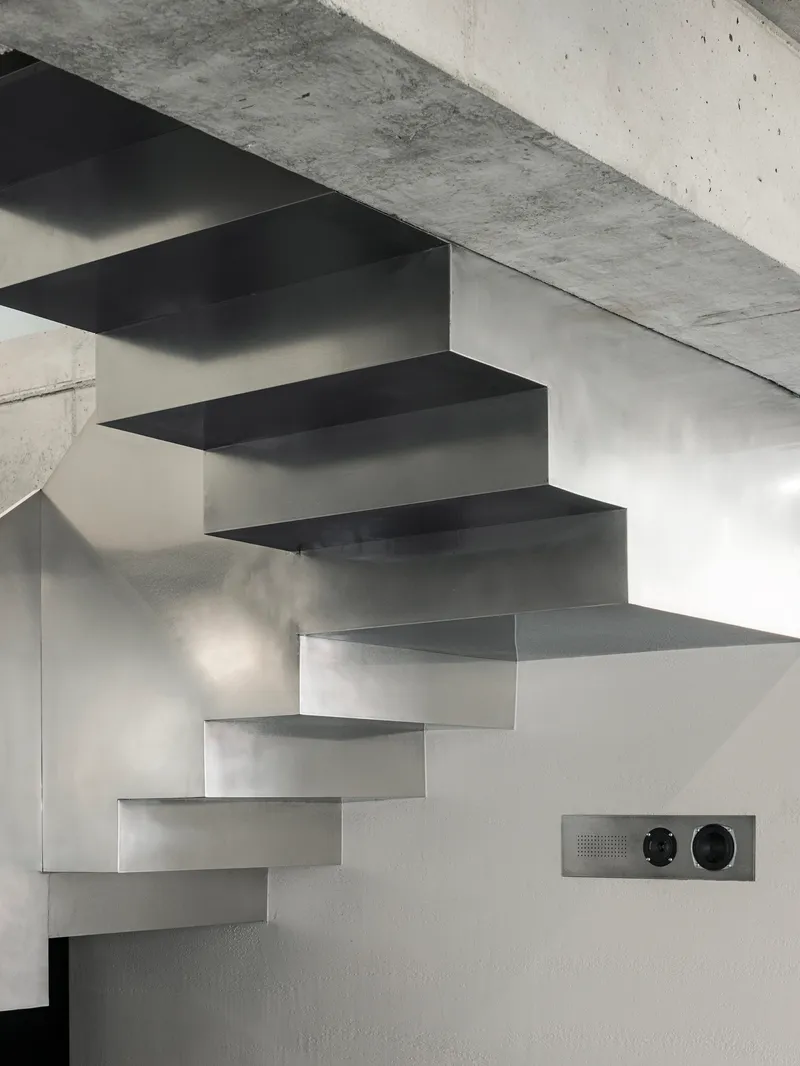
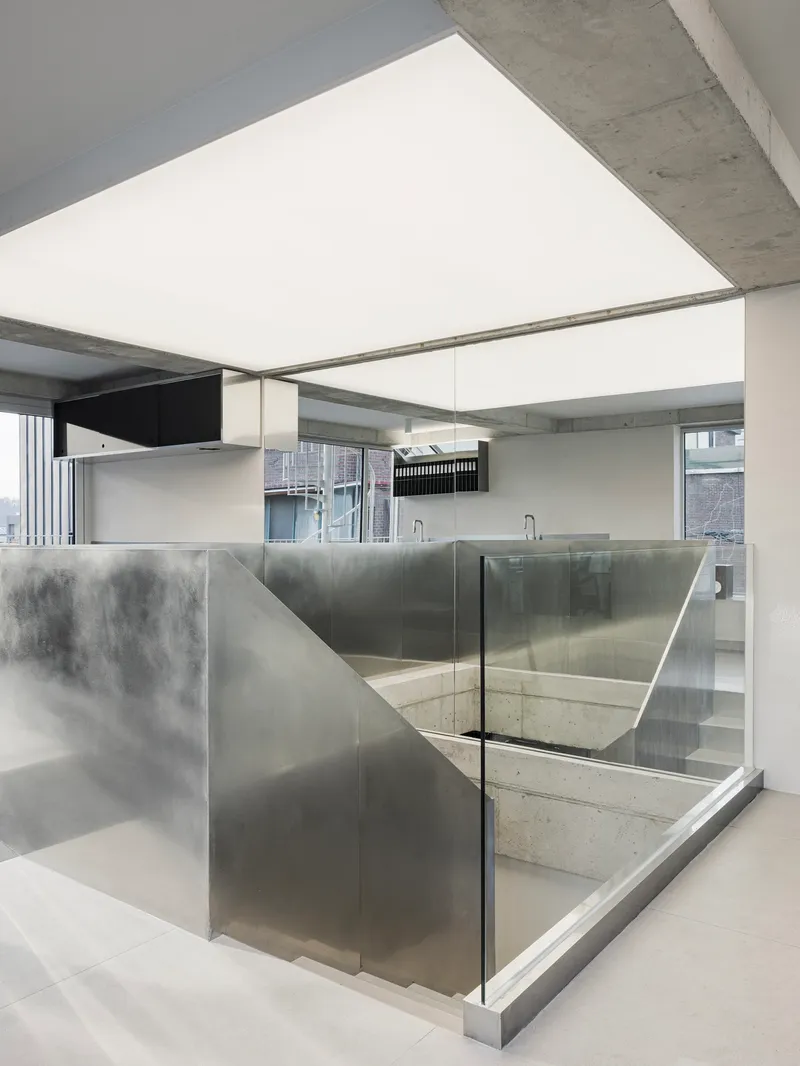
If there is a single move that defines TAN Salon, it is the staircase. oftn studio designed it with folded steel treads that cantilever from the wall, their angular geometry set against smooth white surfaces and raw concrete overhead. At its base, the stairs take on a terraced shape, almost stepping down into the room like a small amphitheater or a display plinth. The intent is clear: make the stair behave like a piece of furniture rather than a functional connector.
The metal reads as deliberate contrast. While the rest of the palette stays achromatic, soft, and muted, the staircase asserts itself as a hard, reflective line cutting vertically through the plan. It is the first thing you see on entering, and it sets the tone: this is a space where objects matter, where the things you touch and sit on carry the same design weight as the walls and ceiling.
Vertical Circulation as Spatial Drama
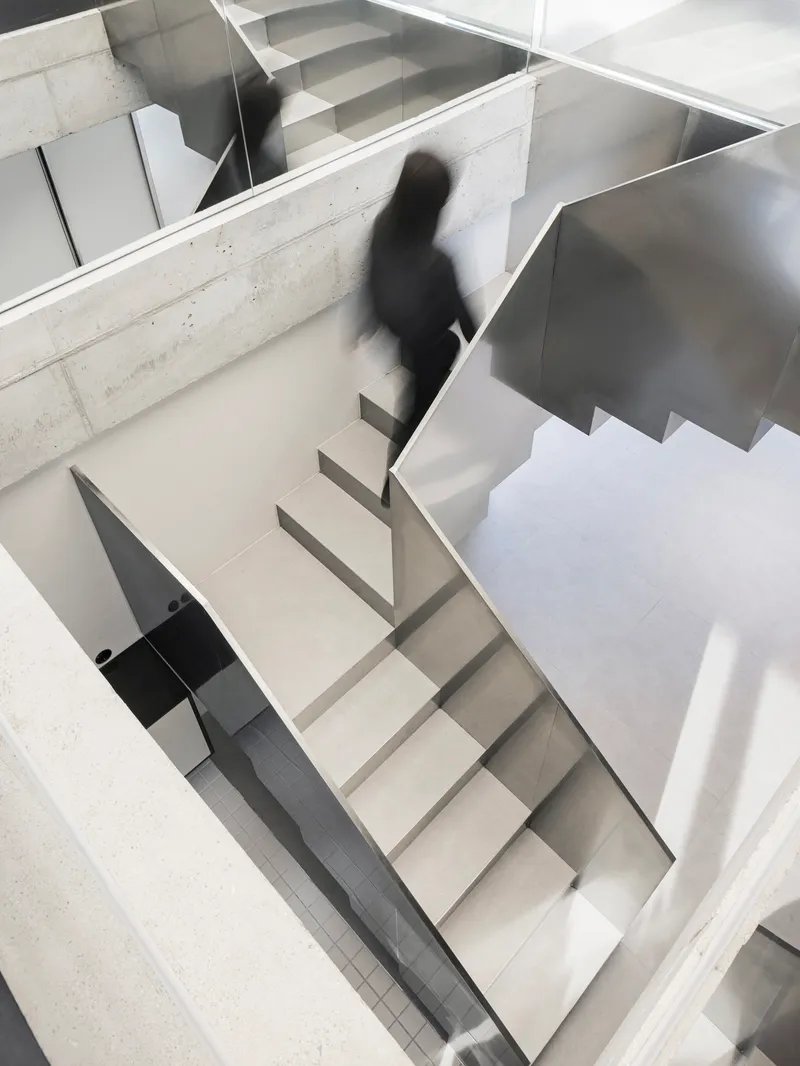
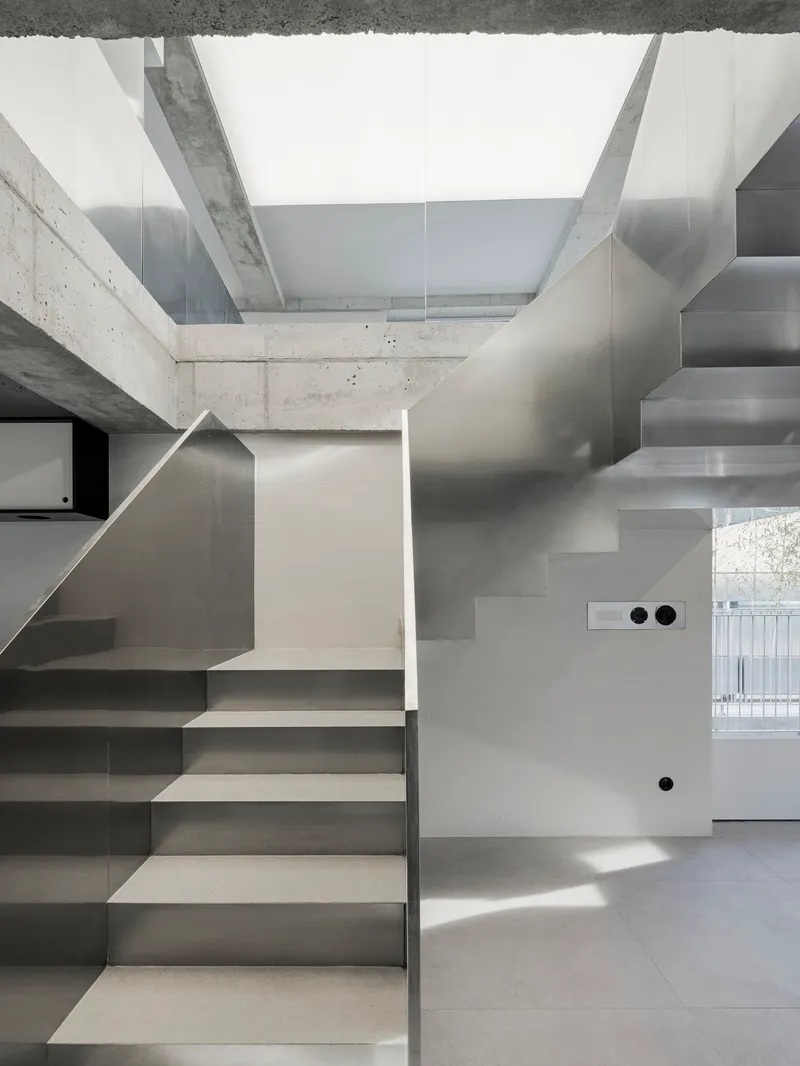
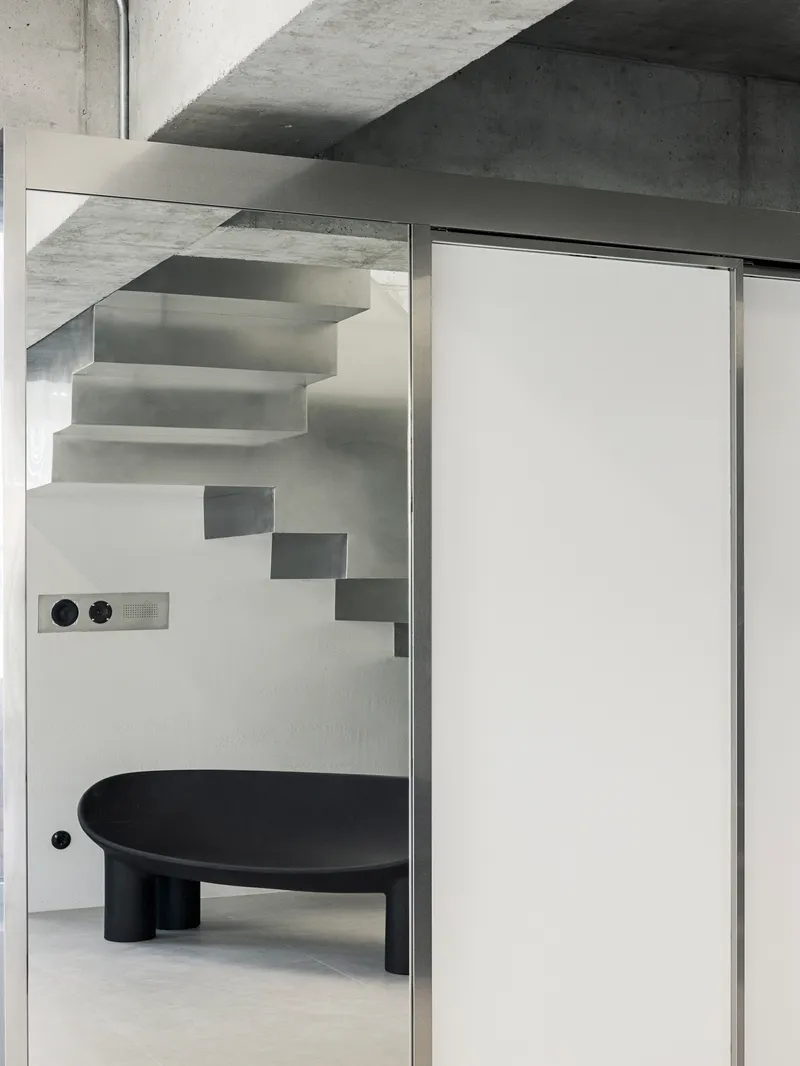
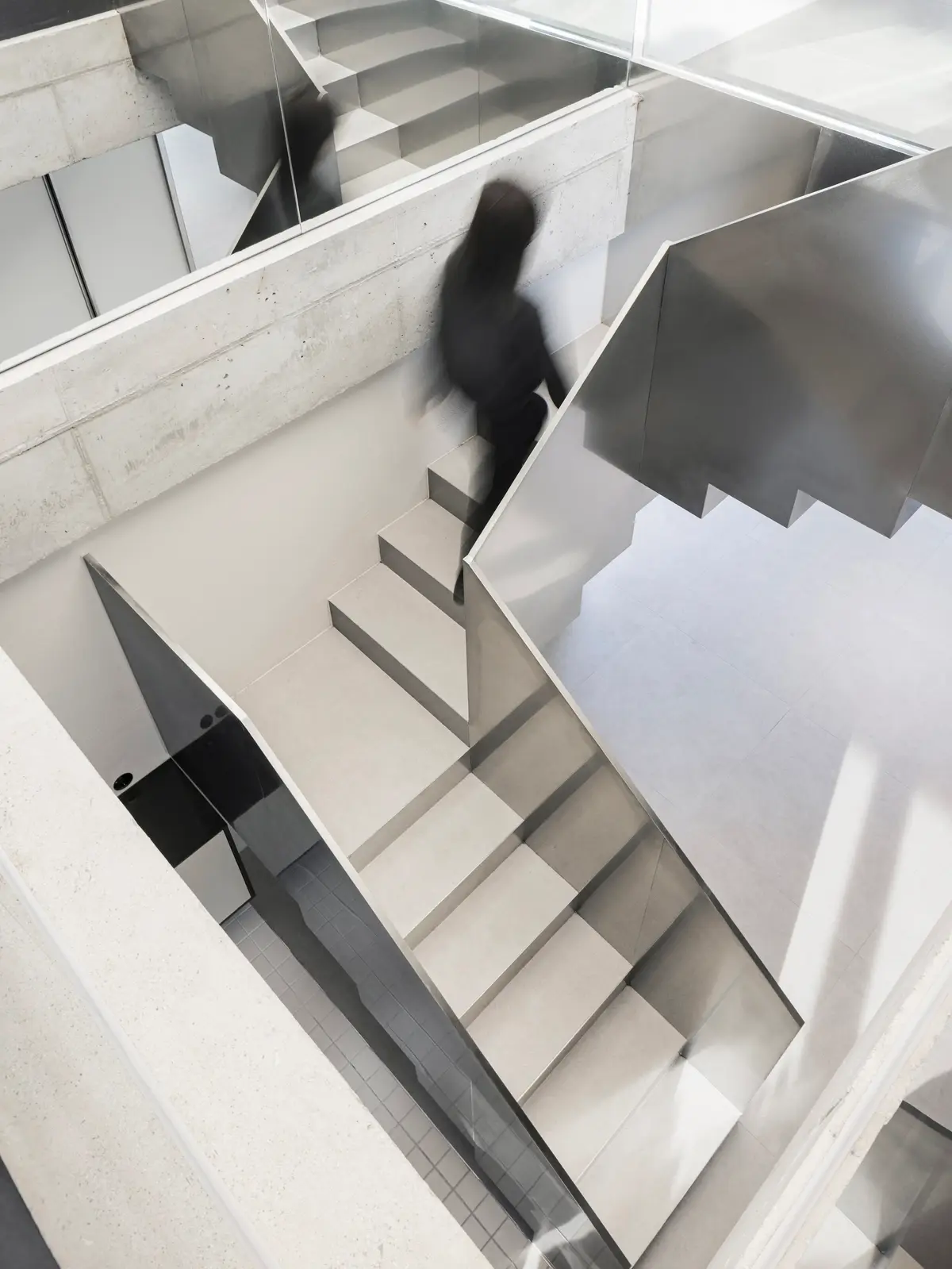
Seen from above, the staircase reveals its full geometry: a tight zigzag threading between floor plates, catching daylight at each turn. The sharp shadows it casts across the concrete beams become part of the interior's visual texture, shifting throughout the day. A figure ascending the stairs appears almost cinematic, framed between steel planes and translucent partitions.
This is a deliberate compression of experience. In 100 square meters, you do not have the luxury of generous double-height lobbies or sweeping ramps. oftn studio makes the vertical move feel expansive by treating it as a visual event, something you look at and through, not just something you walk up.
No Counter, No Problem
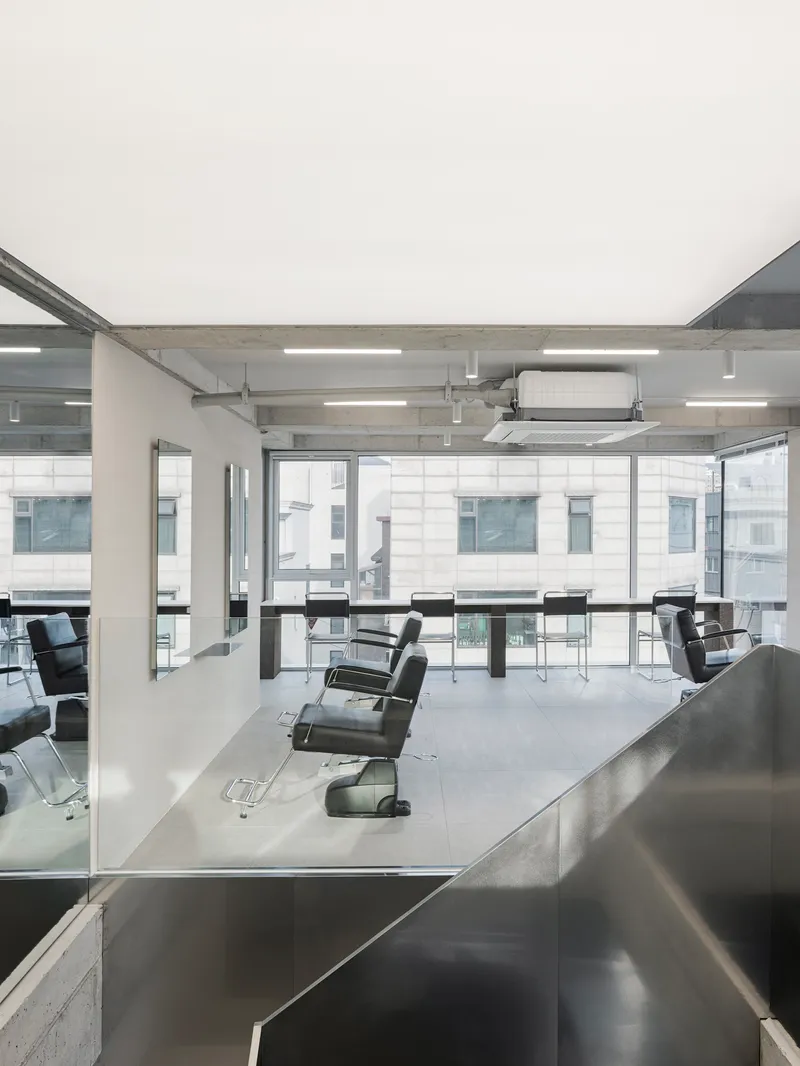
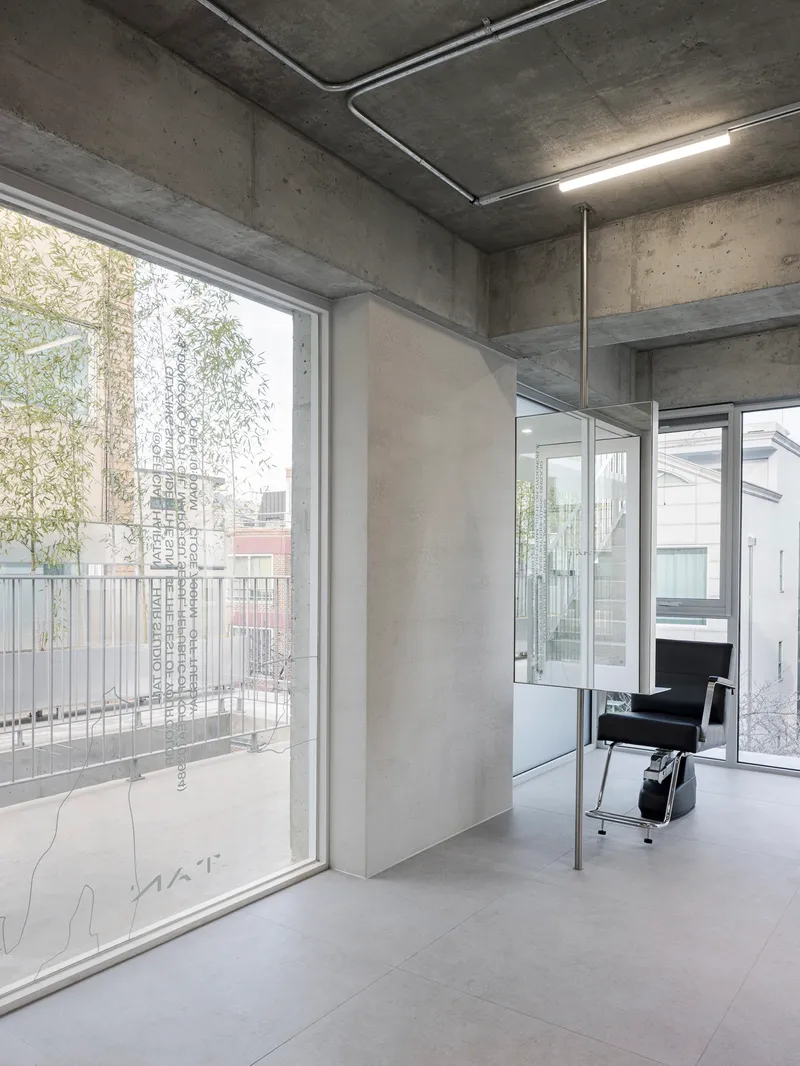
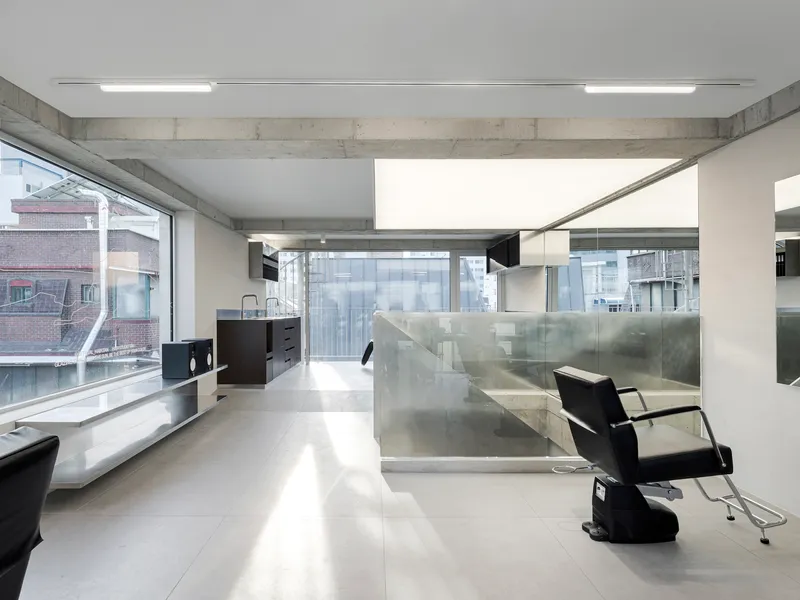
The open plan on each floor is organized around pairs of salon chairs facing large windows. Steel poles suspend mirrors at precise heights, and the chairs themselves are designed with the care of standalone objects, metal frames with contrasting upholstery that feel more like gallery seating than the typical hydraulic barber throne. Without a reception counter to anchor the room, the space reads as a loose, domestic interior. You are greeted by furniture, not by a transaction point.
Full-height glazing on both floors brings Yeonnam-dong's rooftops and bamboo plantings into the frame, making the compact rooms feel considerably larger than their measured area. The exposed concrete ceiling adds a layer of rawness that keeps the space from tipping into sterility. It is refined, but it has grain.
Support Spaces Hidden in Plain Sight
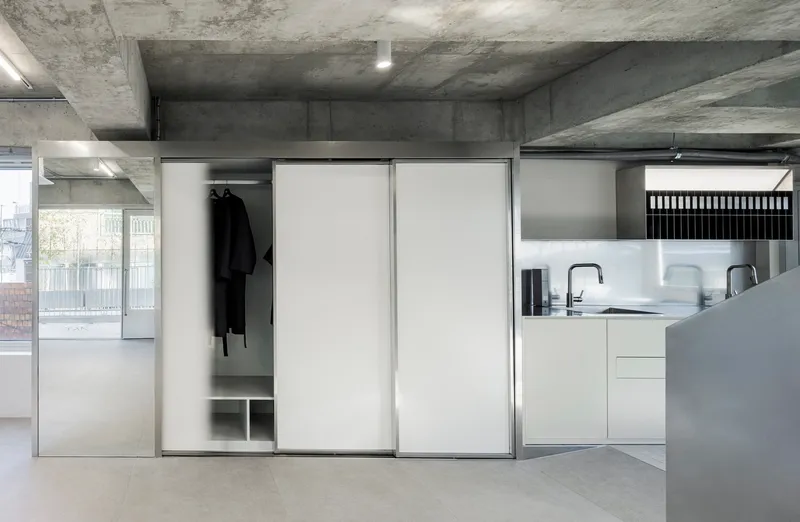
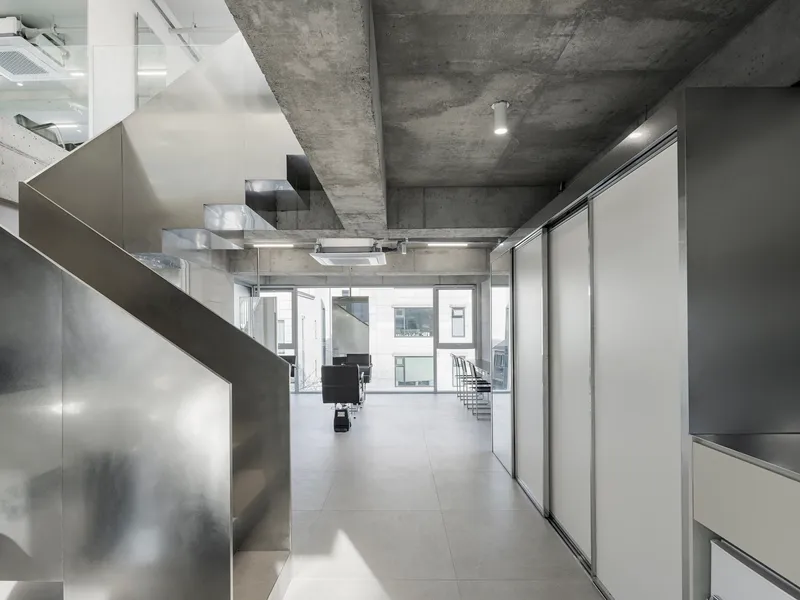
The large sliding wardrobe replaces the locker room entirely. White panels glide open to reveal hanging garments, and when closed, they become a flush wall. Nearby, a compact kitchen counter and stainless steel surfaces handle the practical needs of salon operation: product storage, mixing, preparation. These elements are not tucked into back-of-house corridors. They sit within the open plan, visible but not dominant.
Stainless steel partitions along the corridors serve double duty as spatial dividers and reflective surfaces, bouncing light deeper into the floor plate. The material choice keeps the palette tight: concrete above, white plaster and sliding panels at the walls, steel wherever the architecture touches the body.
Entering from the Street
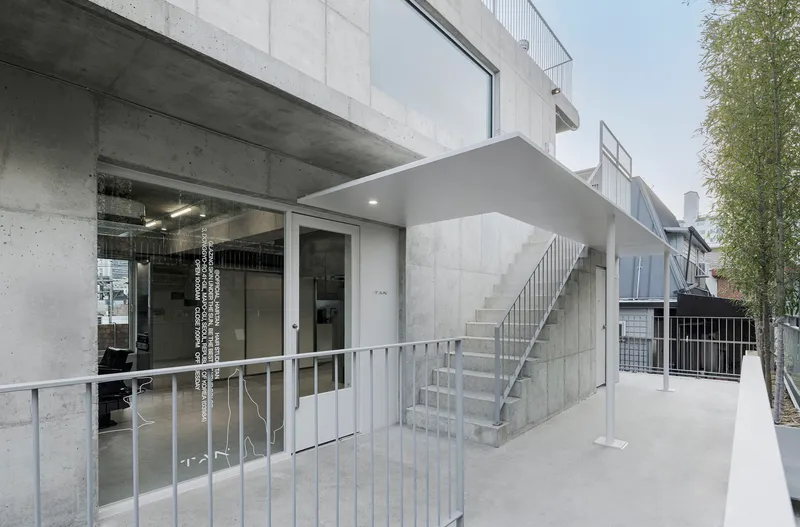
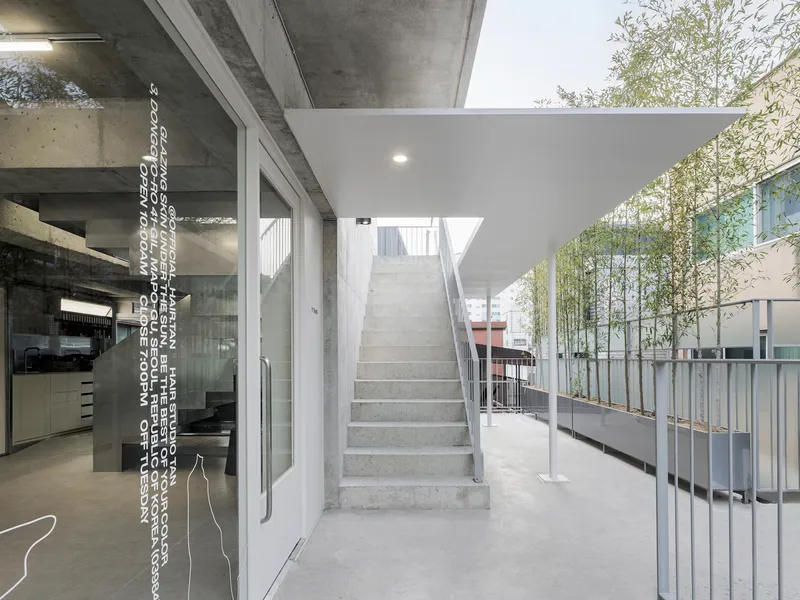
The exterior approach is deliberately understated. An outdoor terrace with concrete steps, metal railings, and bamboo plantings leads to the glass-walled entrance. There is no signage screaming for attention, no branded awning. The building sits within Yeonnam-dong's increasingly dense mix of cafes and boutiques, a neighborhood absorbing creative overflow from nearby Hongdae, and TAN reads as part of that quieter, second-wave gentrification: confident enough to let the interior do the talking.
The transition from exterior stair to interior stairwell is handled with translucent glass panels and brushed steel, creating a threshold zone that is neither fully outside nor fully inside. It is an effective decompression chamber, shifting your mindset from street to salon before you sit in a chair.
Material Pairs and Controlled Contrast
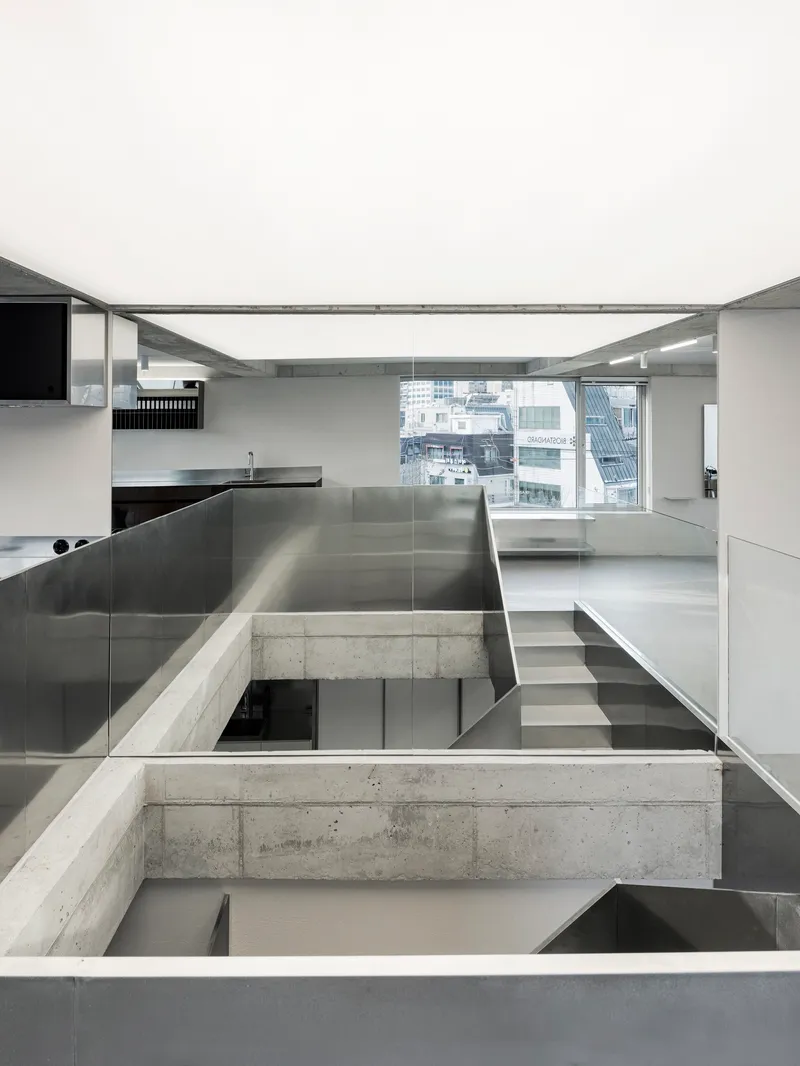
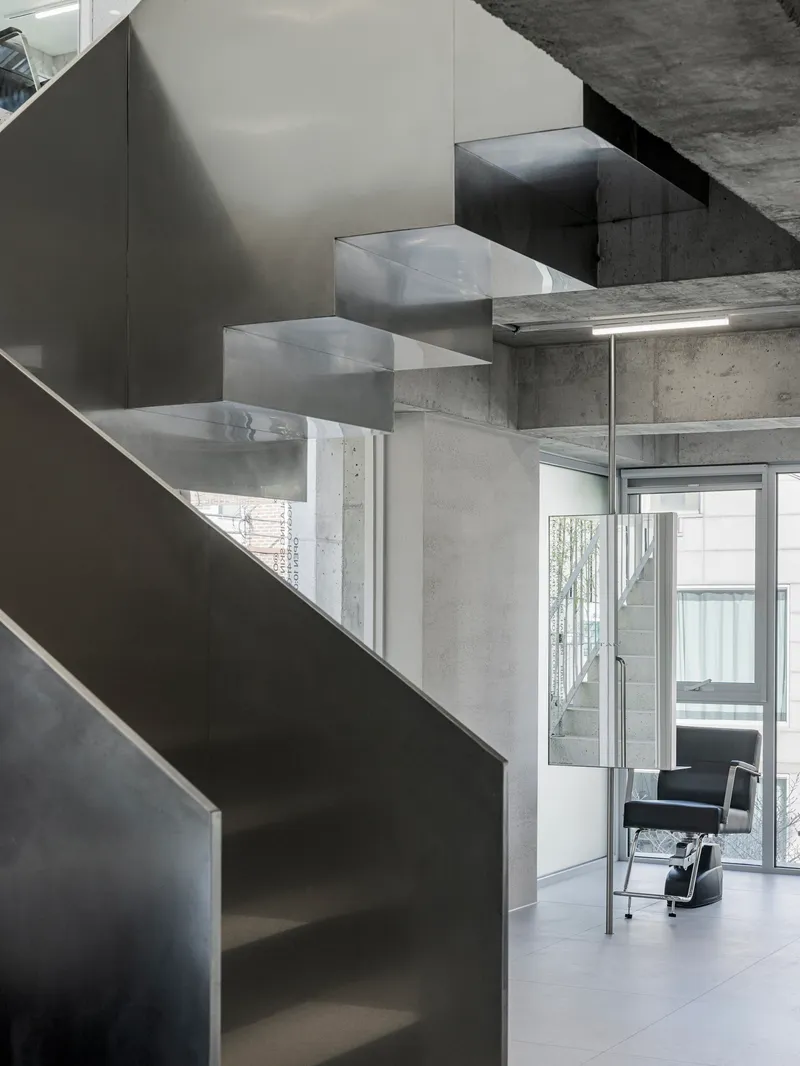
oftn studio works with a limited number of material pairings throughout. Exposed concrete beams cross over stainless steel islands. White sliding panels sit beside brushed metal walls. The chairs' soft upholstery meets rigid steel frames. Each pairing follows the same logic: one warm or soft element against one cool or hard element. This discipline is what keeps 100 square meters from feeling cluttered.
The second floor mirrors the first in program but not in exact finish, allowing returning clients to experience a subtle variation. It is a small move, but it reinforces the studio-like character oftn was after. No two rooms in a home are identical. Neither are the two floors of TAN.
Why This Project Matters
Most salon interiors fall into one of two traps: either they mimic a luxury retail environment with glossy surfaces and logo walls, or they lean so far into minimalism that they feel clinical. TAN Salon sidesteps both by borrowing from the logic of a working studio. The absence of a reception counter is not just an aesthetic gesture; it changes the social contract between stylist and client. You walk in and sit down. The space treats you as a guest, not a customer.
For oftn studio, the project is a lesson in how much can be achieved within severe spatial constraints when every element is treated as an opportunity for design. The folded staircase, the suspended mirrors, the wardrobe-as-wall: each solves a functional problem while carrying enough formal ambition to stand on its own. In a neighborhood rapidly filling with interchangeable storefronts, TAN earns its identity not through branding but through architecture.
TAN Salon by oftn studio, Yeonnam-dong, Seodaemun-gu, Seoul, South Korea. 100 sqm. Completed 2022. Photography by Yongjoon Choi.
About the Studio
Share Your Own Work on uni.xyz
If projects like this are the kind of work you want to make, uni.xyz is a place to publish your own, find collaborators, and enter design competitions.


Popular Articles
Popular articles from the community


Cube Design Draws an Ecological Corridor Between Two Shenzhen Hills with the Nankai Building
Beside Shenzhen's container docks, the Nankai Building pairs stacked balconies with a climbing green screen to connect two hillsides across its height.


Opera on the Sea: Driftwood Logic Shapes a Timber Opera House on Estonia's Coast
Trevor Orgill's opera house translates the entangled drift of floating timber into a civic building where wood, water, and music converge.

Singing Woman: An Opera House That Performs Before the Curtain Rises
Ovidiu Cristian Pavel's conceptual opera house translates Estonia's choral identity into a sculpted waterfront landmark facing the Baltic Sea.

ETEH Reworks the Shared Spaces of São Domingos School in Brazil Around Timber, Color and Hanging Plants
At São Domingos School in Brazil, 436 m² of hall, refectory and library are recast with timber joinery, a yellow and blue code and trailing greenery.

Similar Reads
You might also enjoy these articles

LAVA Architecten Gives Vocational Education a Sawtooth-Roofed Face on a Mechelen School Campus
In Mechelen, Belgium, a 2,053 m² STEM school on a 6×6 m grid turns workshops and classrooms into rooms that can be rearranged as teaching changes.

KEMA Studio Turns a Derelict Marvila Attic into a 60 m² Lighthouse Apartment Above Lisbon
In Lisbon's Marvila district, a rebuilt roof, four skylights and two plywood volumes turn an unlivable attic into a bright home facing the Tagus.

Pixel Gardens: One Repeated Module Stacked Into a Terraced Social Housing Tower for Famagusta
Salem Bader's shortlisted housing tower builds a vertical neighbourhood from one repeated module, offsetting units to carve terraces, light and air.

Bao Huynh Watercolor Atelier: A Serene Art Retreat in Hội An
Bao Huynh Watercolor Atelier in Hội An blends multifunctional art spaces, sustainable design, local materials, and family-friendly living in a serene environment.

Explore Solar Fabric Competitions
Discover active competitions in this discipline

Challenge to reimagine the Iron Throne

Photograph architecture without architects

Illustrate the lost glory of Angkor Wat - Render Challenge

Design challenge to reuse E-waste
Comments (0)
Please login or sign up to add comments
No comments yet. Be the first to comment!