
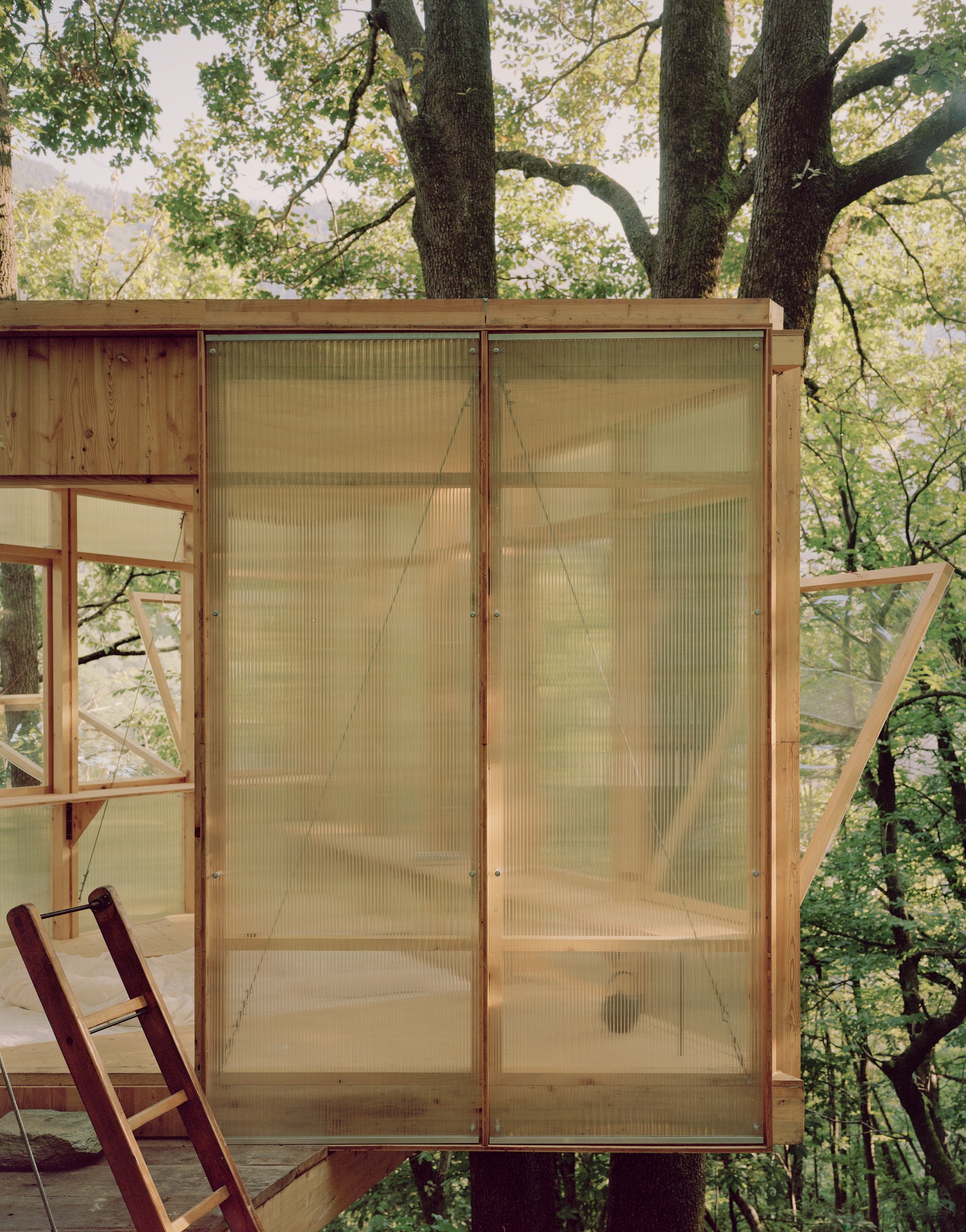
Olin Petzold Suspends a 12 m² Writing Cabin Between Three Oak Trees in the Swiss Alps
A triangular polycarbonate retreat in Valle Onsernone hovers above the forest floor, built entirely by hand from spruce, larch, and light.

Zoning in Valle Onsernone, a remote valley in the Swiss canton of Ticino, prohibits new foundations and additions to the existing building stock. For most architects, that regulation would end the conversation. For Berlin and Zurich-based Olin Petzold, it became the project's generative constraint. Asked by a Swiss artist and climate activist to design a secluded writing retreat on a steep, forested plot near the village of Loco, Petzold responded with a 12 m² cabin that touches no ground at all. Instead, it hangs between three mature oak trees on a trio of larch beams, forming an irregular triangular frame roughly 100 to 150 meters uphill from the client's house.
The reference point is Thoreau's Walden: a place stripped to essentials where solitude and concentration become possible. But where Thoreau's cabin sat on cleared land beside a pond, this one floats inside a canopy. Every component was carried to the site by hand along a narrow woodland path, designed to be light enough that the client could self-build the structure without machinery. The result is not a polished object but a working instrument, a room calibrated to the rhythms of the forest and the discipline of writing.
Hanging Without a Foundation
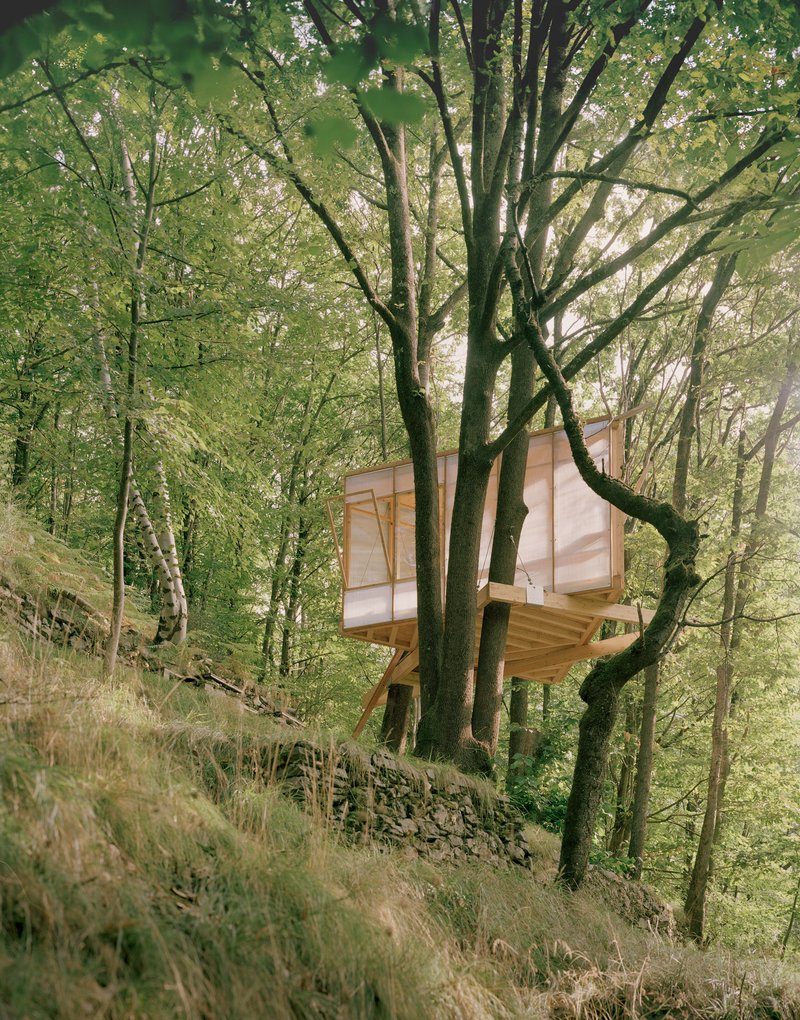
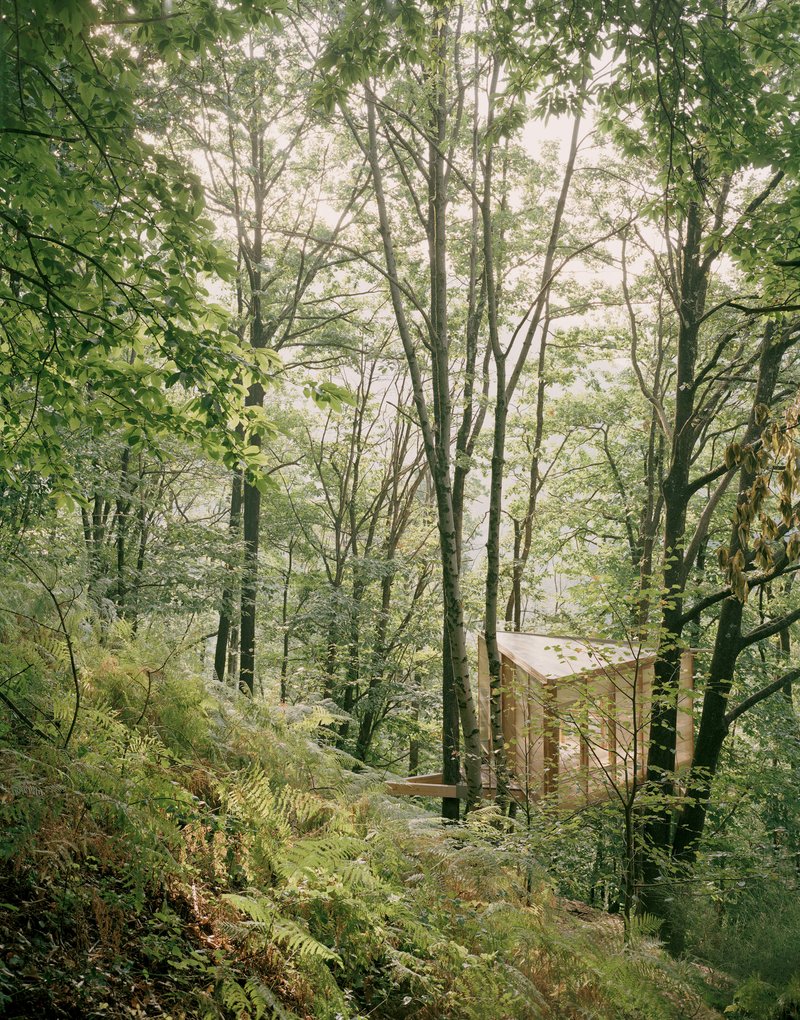
The cabin's structural premise is deceptively simple. Three larch beams span between three oak trunks, creating a suspended triangular base. The equilateral triangle floor plan is then rotated so that its corners project into the gaps between trunks rather than colliding with them. The whole assembly hovers above the steeply sloping woodland floor, eliminating any need for excavation, concrete, or permanent ground contact. It is simultaneously a legal workaround and an ecological gesture: the forest floor beneath remains undisturbed, and the trees continue to grow.
From a distance, the cabin reads as a pale geometric anomaly among ferns and trunks. The raised position keeps it above moisture and leaf litter while giving its occupant a vantage point within the mid-canopy, eye level with branches rather than roots.
Polycarbonate Skin, Seasonal Logic
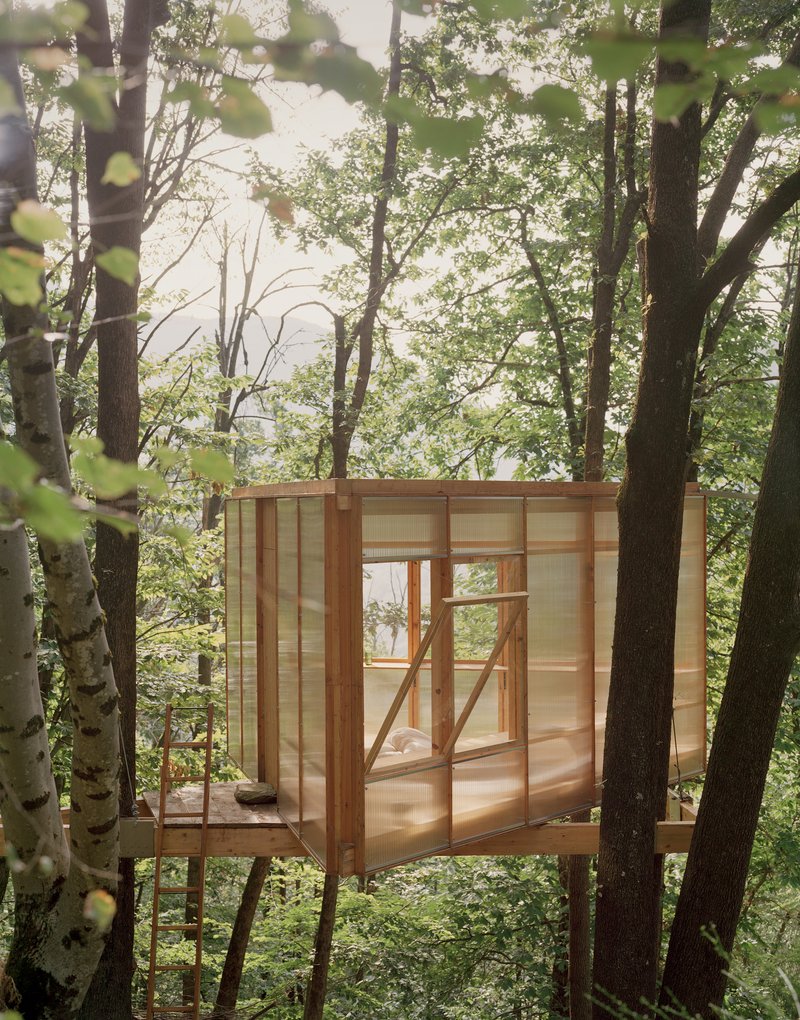
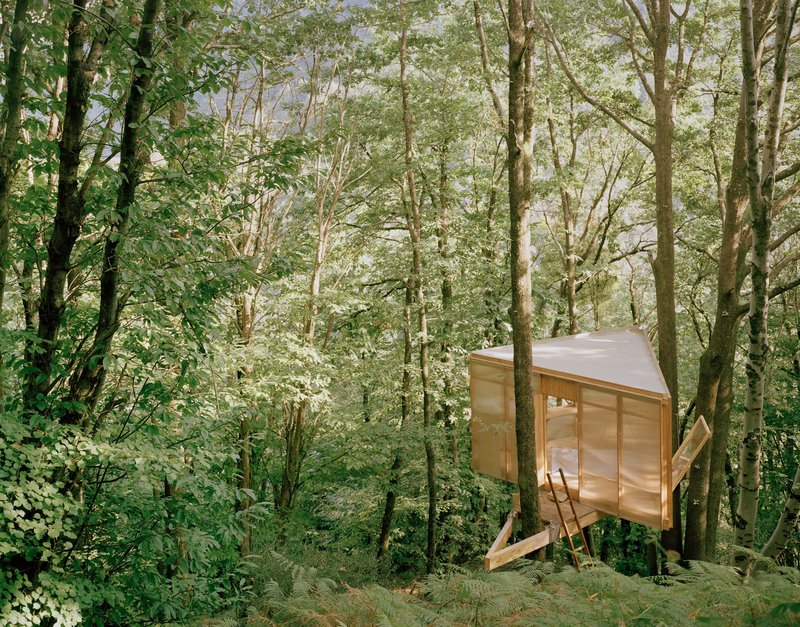
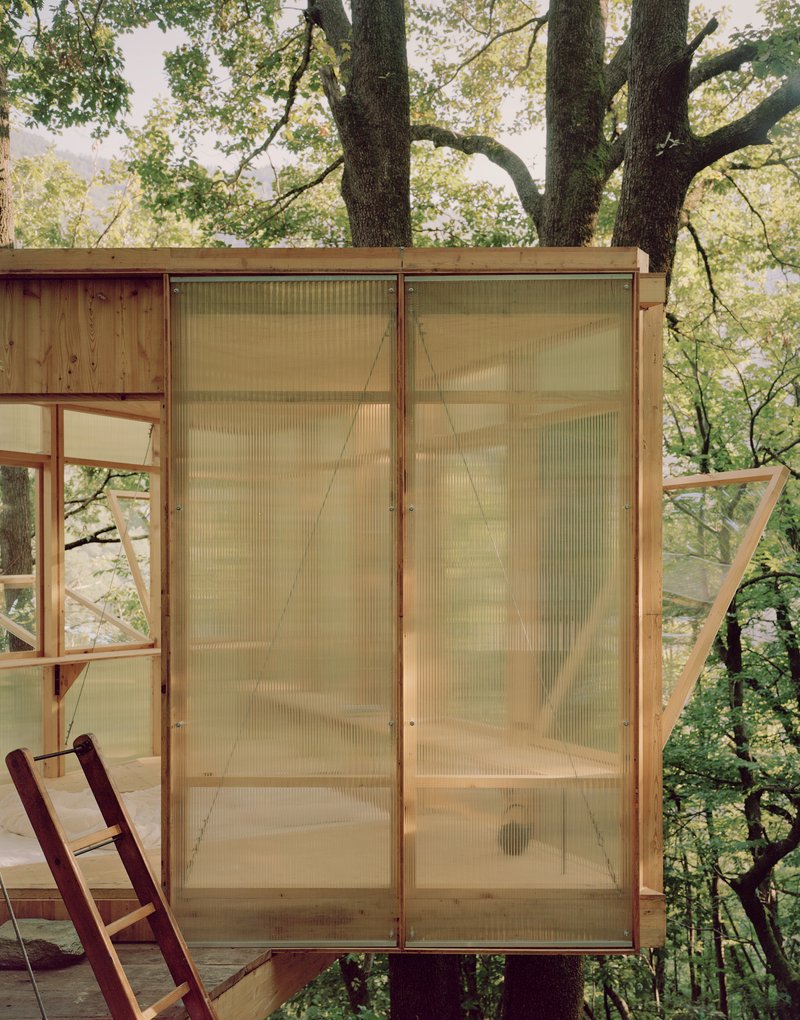
The building's skin is translucent polycarbonate, corrugated and lightweight, stretched over a spruce and larch frame. It glows in filtered forest light without exposing the interior to direct view. The material choice is pragmatic: polycarbonate is light enough to be hand-carried up the slope and durable enough to handle alpine weather without heavy framing. But it also drives a passive climate strategy that shifts with the seasons.
In summer, the surrounding deciduous canopy shades the cabin, moderating heat gain. All three facades can be opened, turning the interior into a screened porch that borrows the forest's own ventilation. In winter, when the oaks drop their leaves, low-angle sunlight passes through the polycarbonate panels and warms the enclosed air. The cabin does not fight its climate; it synchronizes with it.
Orientation and the Valley
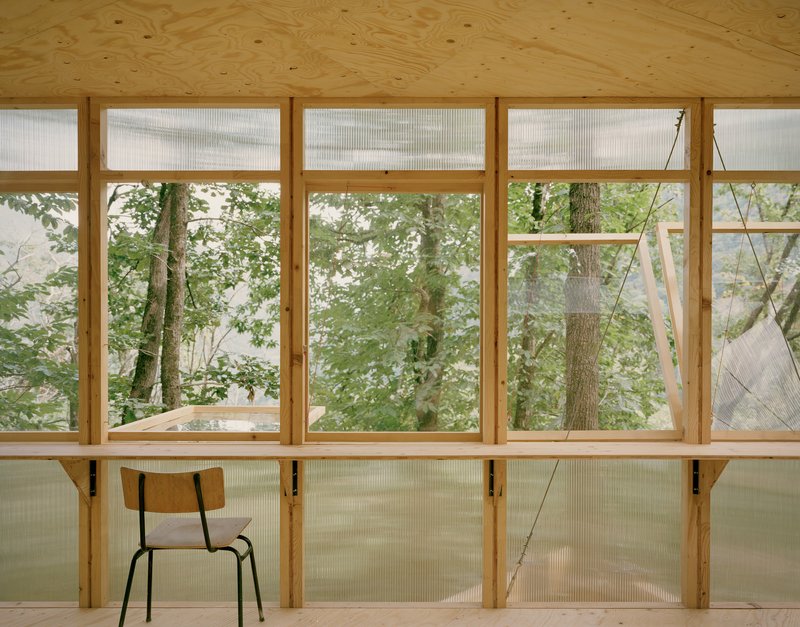
Petzold was careful about which direction each face of the triangle addresses. One side turns toward the slope, providing a sense of enclosure and privacy from the main house below. The other two open up and down the valley, aligning views along the terrain's natural axis. The effect is that you are looking with the landscape rather than at it, following the valley's depth instead of scanning a panoramic postcard. For a writing retreat, this directionality matters: the view pulls the eye outward without overwhelming the room.
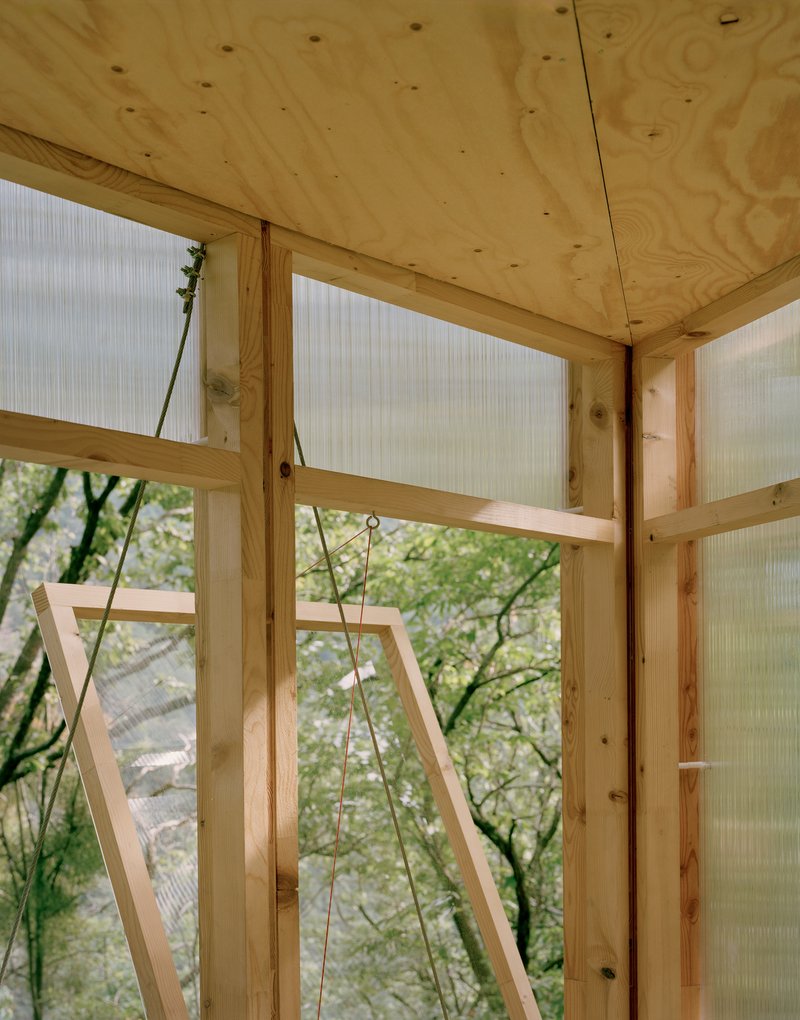
Upper casement windows frame the green canopy above, while lower translucent panels diffuse light from the forest floor. The layering gives the interior two distinct registers of illumination, one crisp and leafy, the other soft and ambient.
Twelve Square Meters, Three Programs
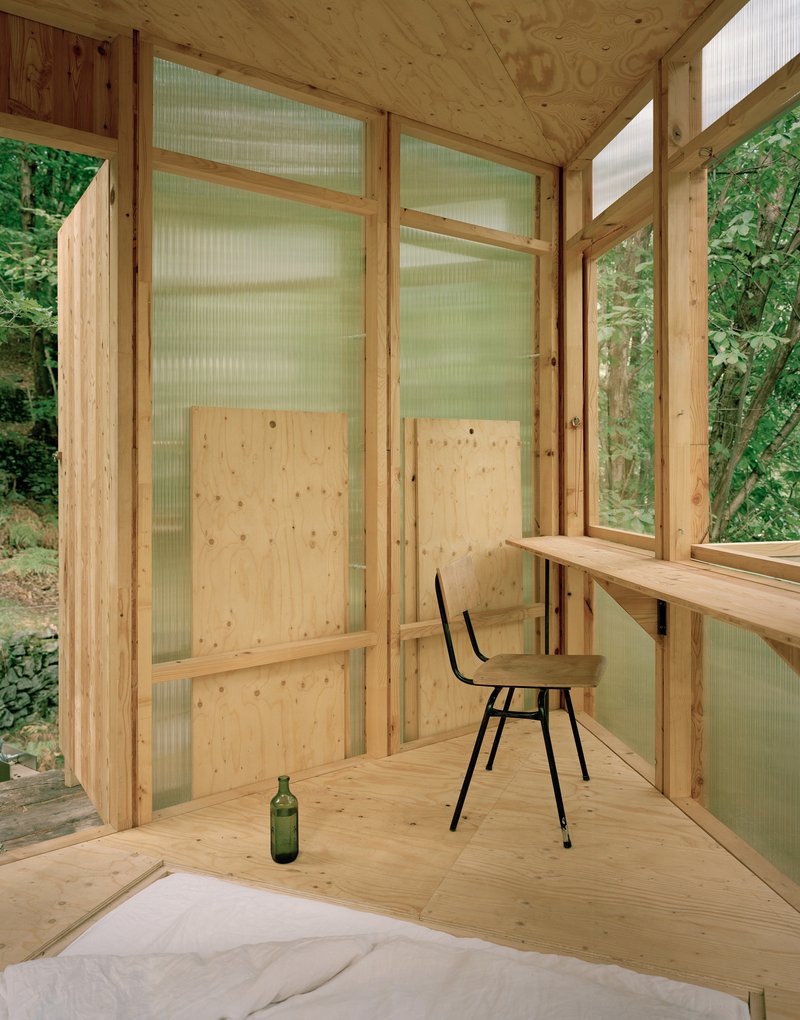
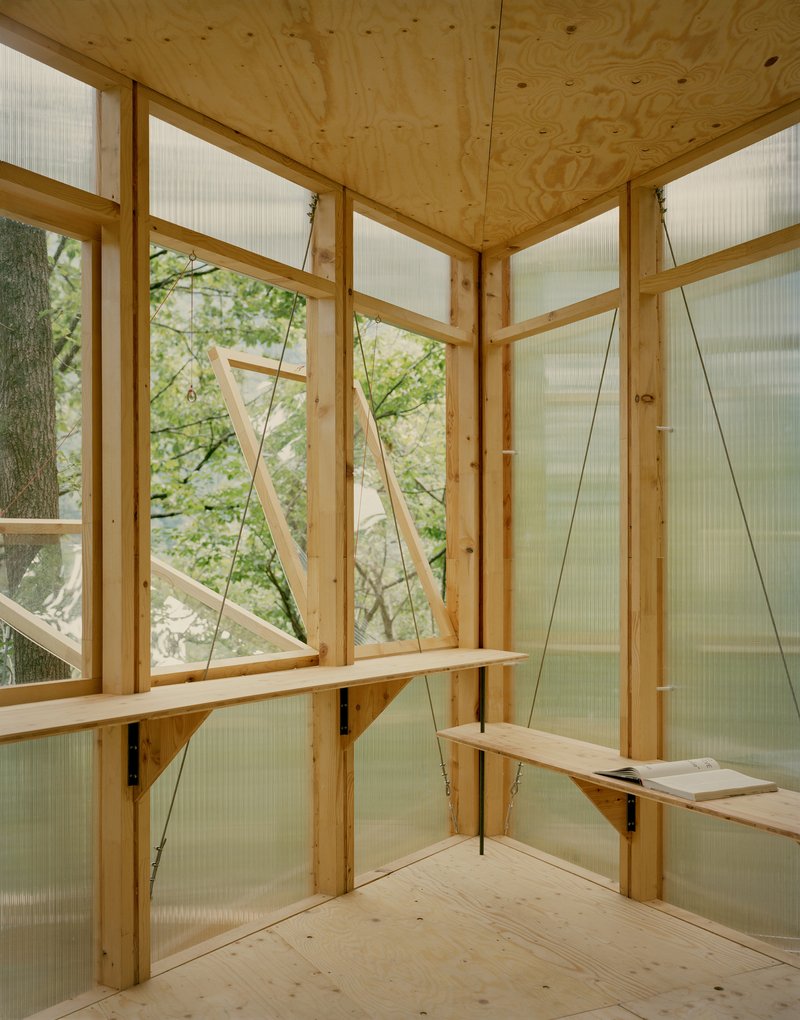
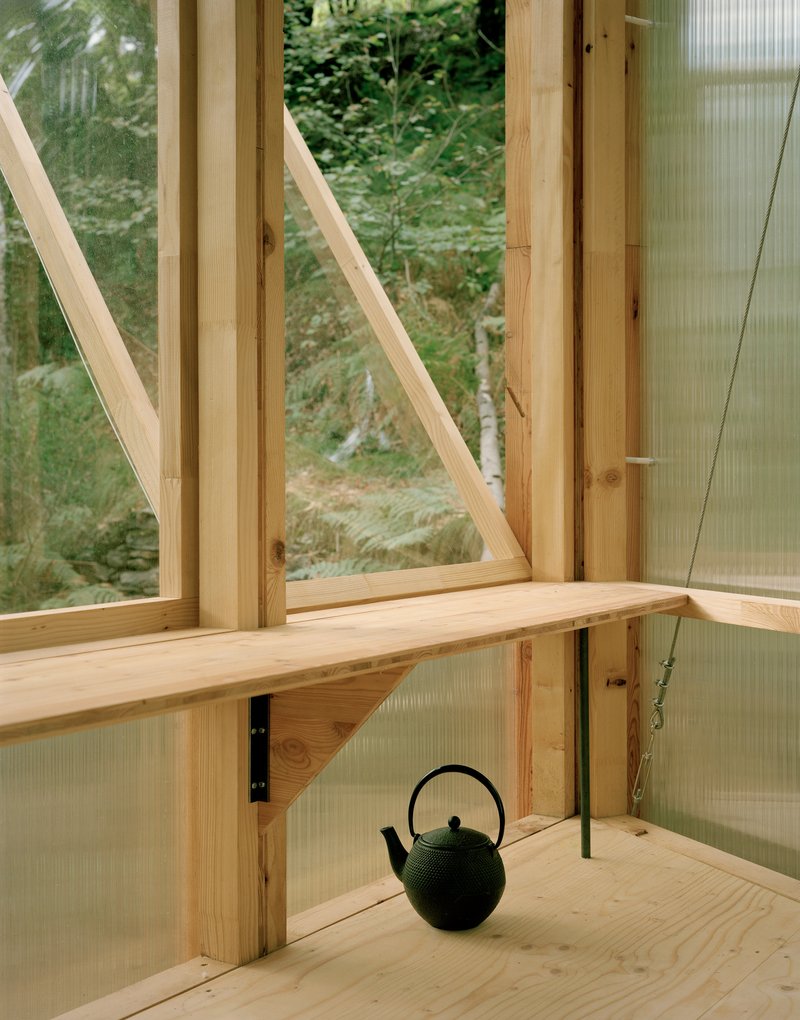
Inside, the cabin is a single compact room that contains a sleeping area, a sitting area, and a writing area. A long wooden plank spans one wall as a bench; another forms a desk. The bed is hidden beneath the floor, revealed by removing four wooden panels. When the panels are in place, the floor reads as continuous plywood, maximizing usable area during the day. When lifted, they expose a sleeping niche below. It is a piece of furniture logic applied at the scale of architecture.
The detailing is deliberately plain. Plywood surfaces, exposed diagonal bracing, suspended shelf brackets, a black cast iron teapot on the floor. Nothing is decorative, but the material palette, warm spruce and larch against the cool translucency of polycarbonate, gives the room a quiet visual richness. The diagonal timber braces do double duty as structure and spatial rhythm, breaking up the triangular volume into readable zones.
Plans and Drawings
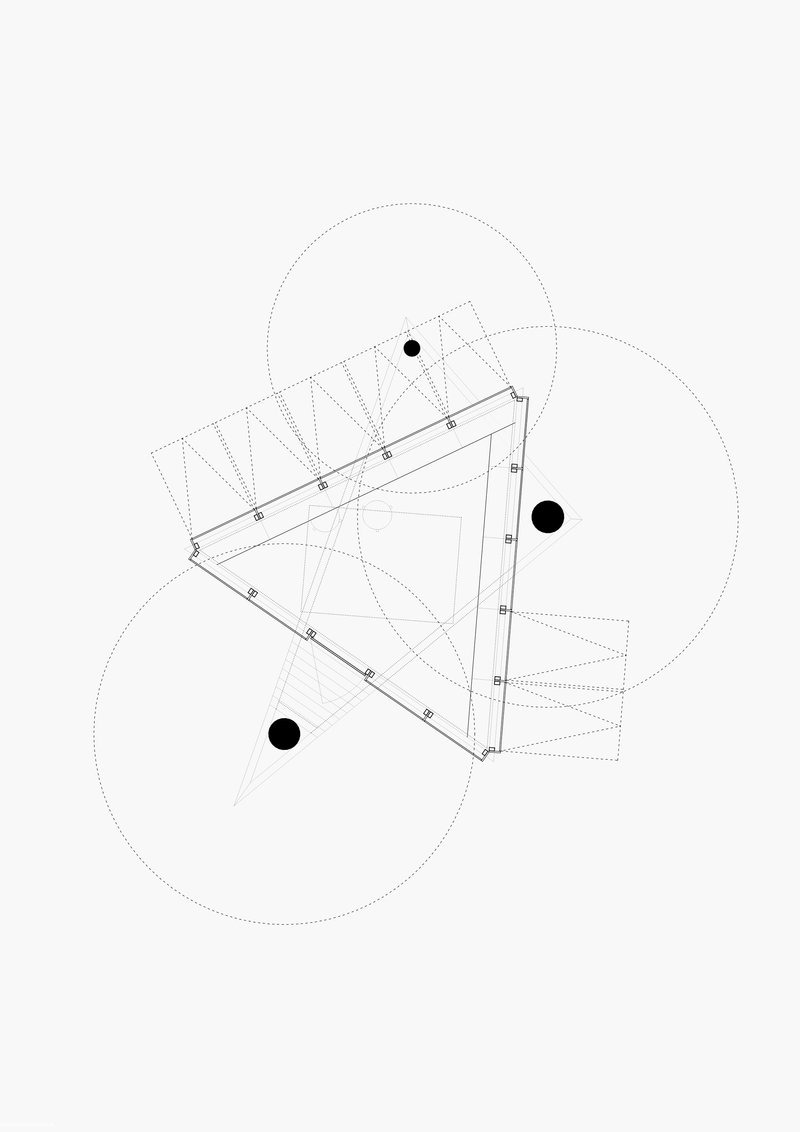
The axonometric drawing reveals the cabin's organizational clarity. Three circular tree trunks anchor the structural beams; the triangular floor plate rotates between them; diagonal bracing stiffens the lightweight frame. What reads in photographs as a delicate, almost improvised shelter is in fact a precisely calculated geometry. The drawing also shows how the three trees are not evenly spaced, meaning the triangle is not a perfect equilateral but an adjusted version that responds to the actual positions of the oaks. The architecture bends to the site rather than imposing a grid on it.
Why This Project Matters
The Writing Cabin succeeds because it treats constraints as creative material rather than obstacles. A no-foundation zoning rule becomes a suspended structure. A remote site with no road access becomes a mandate for hand-carriable components and self-build detailing. A 12 m² footprint becomes a prompt to invent convertible furniture. None of these moves are heroic; they are simply the logical consequences of paying close attention to what the site, the regulations, and the client's budget actually allow.
In a moment when cabin architecture often defaults to either luxury minimalism or performative rusticity, Petzold's project is refreshingly operational. It is not trying to photograph well (though it does). It is trying to give one person a quiet place to write, suspended among trees, heated by winter sun, cooled by summer canopy, reachable only on foot. That is a specific architectural ambition, and this cabin meets it with precision.
Writing Cabin (Casetta Tessino) by Olin Petzold. Located in Onsernone, Valle Onsernone, Switzerland. 12 m². Completed in 2024. Photography by Peter Tillessen.
About the Studio
Share Your Own Work on uni.xyz
If projects like this are the kind of work you want to make, uni.xyz is a place to publish your own, find collaborators, and enter design competitions.




Popular Articles
Popular articles from the community

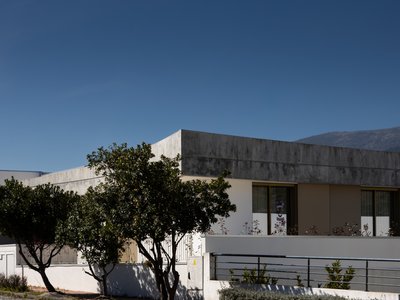
PLATAFORMArq Folds a Concrete Roof Over the Portuguese Mountains in House #474
A 220-square-meter residence in Teixoso, Portugal, wraps board-formed concrete into an angular canopy that frames the Serra da Estrela foothills.

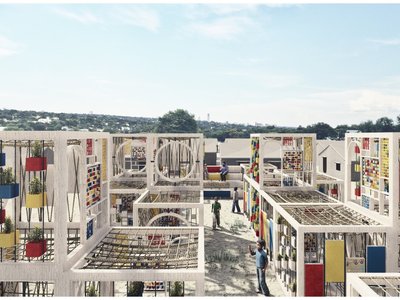
The Faith: Modular Architecture for Play, Learning, and Hope in Kutupalong Refugee Camp
A modular playground architecture project in Bangladesh where play, learning, safety, and hope rebuild childhood inside a refugee camp anew.
IKC de Geluksvogel: Sustainable School Architecture Designed for Free Movement and Digital Learning
IKC de Geluksvogel turns sustainable school architecture into a flexible Maastricht campus for digital learning, nature, and free movement.
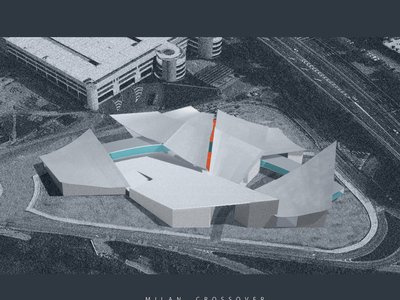
Milan Crossover: Sustainable Architecture for a New Fashion Culture in Milan
Milan Crossover transforms fashion culture through sustainable architecture, linking material libraries, remake studios, and public runways.


Similar Reads
You might also enjoy these articles
Freebird Residence by Alexis Dornier: A Tropical Modernist Sanctuary in Bali
Floating living pavilion above pool anchors H-shaped tropical villa, blending Japanese minimalism, sustainable strategies, lush landscape, and sculptural interiors.
127af Flips a Tiny Bagnolet Rowhouse Upside Down with a Handcrafted Roof Extension
A 55-square-meter terraced house on the edge of Paris gains a luminous upper living floor through lightweight timber and steel.
1.61 Design Workshop Wraps a 600-Square-Meter Café in Vietnam in Sculptural Burgundy Drama
Reden Café & Bistro pairs a helical staircase, mosaic floors, and deep red interiors to rethink Vietnamese hospitality space.

The Unbound Brain: A School Shaped by Cognitive Architecture
Cylindrical learning pods radiate like neurons from a central cortex, turning the floor plan into a spatial model of human thought.


Explore Landscape Design Competitions
Discover active competitions in this discipline




The Global Benchmark for Architecture Dissertation Awards


Challenge to design mud housing for contemporary communities
Comments (0)
Please login or sign up to add comments
No comments yet. Be the first to comment!