

Opera by the Sea: Redefining Waterfront Architecture in Estonia
A futuristic waterfront architecture concept in Estonia that merges opera, public life, and floating performance spaces shaped by the sea.


The project Opera by the Sea proposes a bold rethinking of waterfront architecture, where performance, landscape, and public life converge into a dynamic cultural infrastructure. Designed by Tian Xing Wang, Zhongtian Xu, and Yihao Ren, this shortlisted entry explores how an opera house can transcend its traditional boundaries to become an adaptive, public-facing, and sea-responsive environment.
Set against the historical Linnahall Arena in Tallinn, Estonia, the project positions itself as both a contextual response and a forward-looking intervention. While the existing arena is defined by its heavy, monolithic geometry, the proposed opera house introduces a lighter, more permeable architectural language. The building is conceived as a composition of interconnected volumes wrapped in a semi-transparent glass façade, allowing visual continuity between interior performances and the surrounding seascape.
Shortlisted entry of Opera by the sea
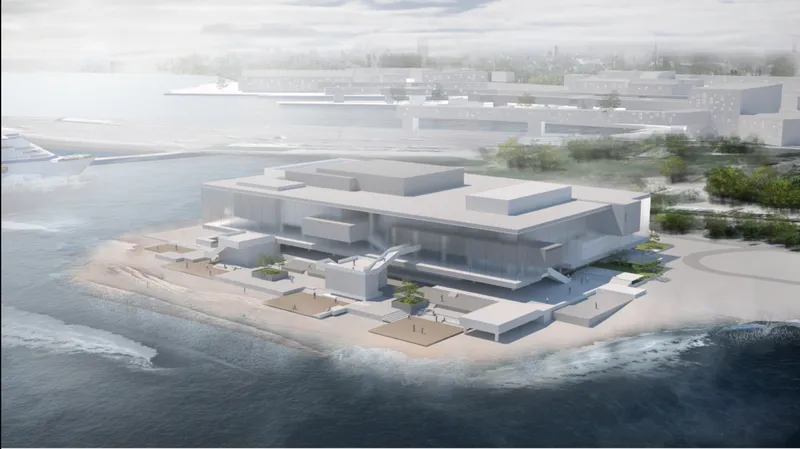

Waterfront Architecture as a Public Interface
At its core, the project redefines waterfront architecture as an interface between land, water, and people. Rather than isolating performance within enclosed auditoriums, the design extends cultural activity outward toward the coastline. A sequence of outdoor platforms is arranged along the edge of the sea, transforming the waterfront into an active performance landscape.
This approach dissolves the boundary between audience and performer. Citizens, visitors, and artists occupy the same spatial continuum, engaging with performances in both planned and spontaneous ways. The architecture becomes less about containment and more about enabling fluid interactions.
Floating Stage: Architecture Responding to Tides
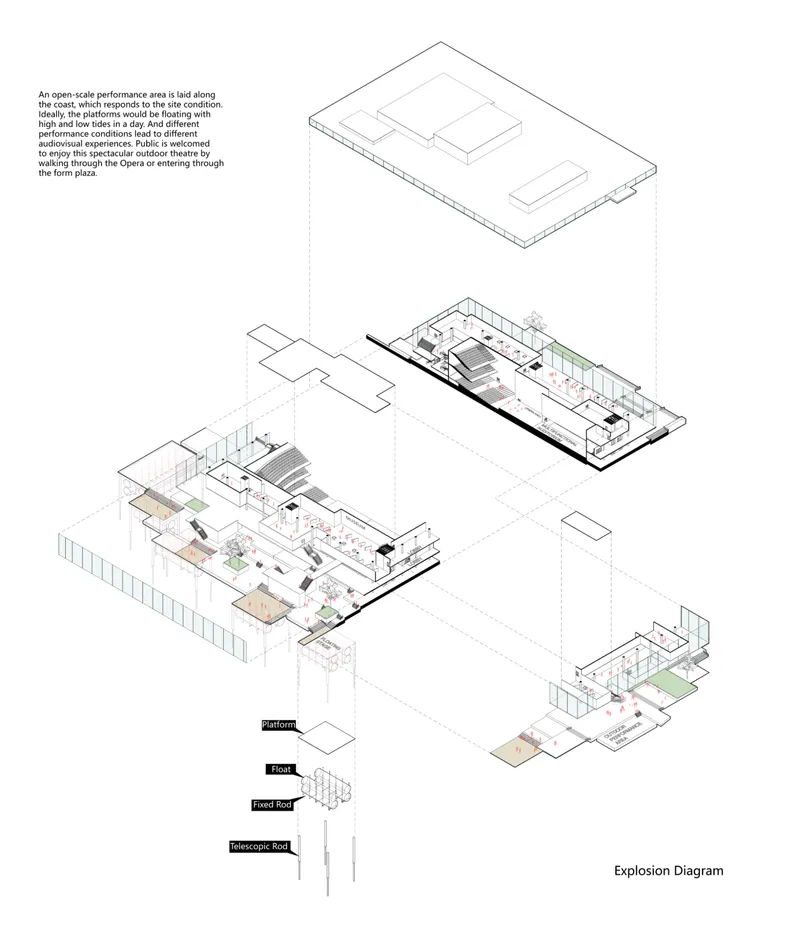
One of the most compelling innovations in the project is the introduction of floating stages. These platforms respond directly to tidal variations, creating a kinetic relationship between architecture and the sea. During low tide, performances occur on grounded platforms accessible from the shore. At high tide, these platforms rise and drift slightly, allowing audiences to experience performances from boats or adjacent piers.
This adaptive system expands the definition of performance space. It introduces variability in audience perspective, acoustics, and spatial experience. The sea is no longer a backdrop but an active participant in the theatrical narrative.
Scattered Layout and Public Circulation
The spatial organization of the opera house is intentionally fragmented. Instead of a singular, centralized mass, the program is distributed across multiple interconnected zones. Museums, public plazas, performance areas, and circulation paths are layered to create a porous and accessible environment.
This scattered layout enhances public engagement. Circulation loops connect interior and exterior spaces, guiding visitors through a sequence of cultural experiences. The design encourages exploration, allowing users to encounter performances, exhibitions, and social spaces organically.
Multifunctional Theatre Typology
Recognizing the unpredictability of future performance formats, the project adopts a flexible theatre typology. The opera house integrates multiple performance environments, including a large opera hall, a concert hall, and a black box theatre. These spaces can function independently or combine to accommodate hybrid performances.
Auxiliary spaces are strategically placed at lower levels to optimize circulation and spatial efficiency. This allows the primary performance volumes to remain adaptable and reconfigurable. The architecture anticipates change, positioning itself as an evolving cultural platform rather than a fixed institution.
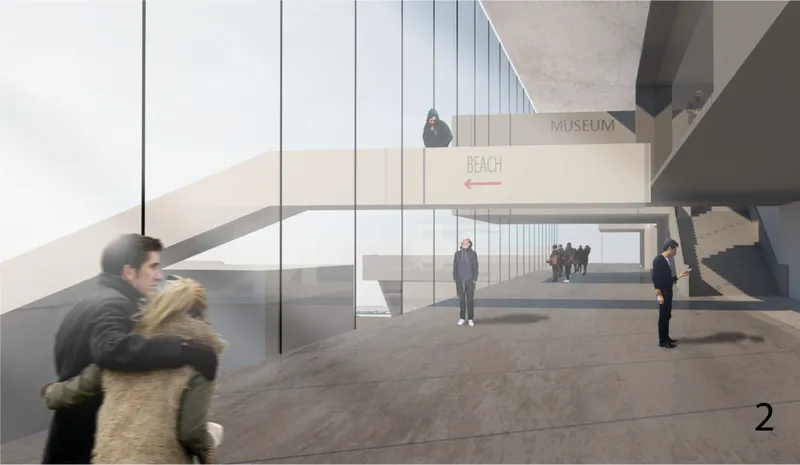
Structural Strategy and Material Expression
The structural system relies on steel columns and beams to accommodate varying spans across the building. Due to the complexity of cantilevered volumes and multi-level performance spaces, structural conversion layers are introduced at both the top and bottom of the main volumes.
Materially, the semi-transparent façade plays a critical role. It softens the visual mass of the building while enhancing its connection to the surrounding environment. Light, reflections, and silhouettes animate the façade, reinforcing the project’s relationship with the sea and sky.
Integration with Tallinn’s Coastal Context
The project carefully engages with its urban and historical context. By aligning with the linear geometry of the Linnahall Arena, it maintains a visual continuity with the existing waterfront infrastructure. At the same time, it introduces new circulation routes that connect the opera house to nearby piers and maritime pathways.
Visitors can approach the building not only from land but also from the water. This dual accessibility reinforces the project’s identity as a waterfront landmark. The opera house becomes part of a বৃহ broader coastal network, extending the cultural reach of the city.
A Future-Oriented Cultural Infrastructure
Opera by the Sea ultimately proposes a new paradigm for waterfront architecture. It is not merely a building but a system of spaces that evolve with environmental conditions and cultural demands. By integrating floating stages, multifunctional theatres, and public landscapes, the project reimagines how architecture can engage with both nature and society.
As cities increasingly turn toward their waterfronts for regeneration and cultural development, this project offers a compelling model. It demonstrates how architecture can be both responsive and inclusive, transforming the edge between land and sea into a vibrant, performative domain.


Popular Articles
Popular articles from the community


Tsunami Convergenics: Turning Catastrophic Ocean Forces into Underwater Housing Infrastructure
A speculative underwater settlement off the coast of Onagawa, Japan, treats tsunamis and typhoons as energy sources rather than threats.

Opera by the Sea Estonia: Three Shells Dissolving Architecture into Tallinn's Coastline
A winning opera house proposal replaces monumental form with interconnected shells that blur the boundary between building, park and Baltic Sea.

Cloaked Colonization: A Mobile Underwater Habitat That Moves Like a Fish
Micah Abaya's shortlisted EHC Pacific entry reimagines ocean settlement as a dispersed network of self-sustaining architectural organisms.

Faces of the Soviet Avant-Garde: Turning Moscow's Street Names into an Open-Air Museum
A network of sculptural installations across a Moscow residential district transforms forgotten architect names into spatial encounters with cultural memor

Similar Reads
You might also enjoy these articles

Eco Chapel: A Green Architecture Pavilion Designed in Symbiosis with the Forest
Eco Chapel uses green architecture to weave prayer, learning and reuse into a forest pavilion shaped by modular hexagonal canopies for life.
Kaffeebühnen: Coffee Shop Architecture Designed as a Civic Stage Between Vienna’s City and Park
Kaffeebühnen turns coffee shop architecture into a civic stage, linking Vienna’s park edge, urban life, warm timber yards, and coffee craft.
Healing Façade: Sustainable Architecture for Reforestation, Community, and Sacred Ecology in Ethiopia
Healing Façade reimagines sustainable architecture as a living wall that restores soil, catches water and renews Ethiopia's forest churches.


Urban Forest: A Vertical Ecosystem for 5,000 Workers in Singapore's Changi Business Park
Radially stacked pods and layered green decks turn a 7-acre plot into 47 acres of ecological workspace projected for 2040.

Explore Opera House Competitions
Discover active competitions in this discipline

Challenge to design mud housing for contemporary communities

Challenge to reimagine the Iron Throne

Photograph architecture without architects

Illustrate the lost glory of Angkor Wat - Render Challenge
Comments (0)
Please login or sign up to add comments
No comments yet. Be the first to comment!