

Pedro Moncayo Torres Builds a Primitive Hut from Stone and Reed Cane in Ecuador's Southern Highlands
A 175-square-meter farmstead retreat in Tarqui channels vernacular construction to sit quietly inside an endemic forest.


There is a strain of contemporary rural architecture that treats the countryside as a backdrop for sculptural objects. El Refugio, designed by PEDRO MONCAYO TORRES arquitectura with lead architects Pedro Moncayo Torres and Tatiana Pérez, refuses that posture entirely. Sitting on a farm in Tarqui, in the highlands south of Cuenca, Ecuador, the 175-square-meter house borrows its walls from the ground it stands on, its roof from the reed cane that grows nearby, and its logic from a construction tradition that predates architectural discourse. The result is not a replica of anything old but a contemporary dwelling that has internalized the rules of its place.
What makes El Refugio worth studying is its disciplined reduction of the house to three zones generated by just two volumes. A social block with a generous porch, a private block containing bedrooms and bathrooms, and the gap between them, which becomes the kitchen and barbecue area, organized around fire as the literal center of communal life. The architects describe this as a reference to the primitive hut, and for once that theoretical lineage feels earned rather than grafted on. The plan is legible, the materials do real thermal work, and the building disappears into its forested hillside without requiring any effort from the viewer to imagine it belonging there.
Two Volumes in a Misty Valley


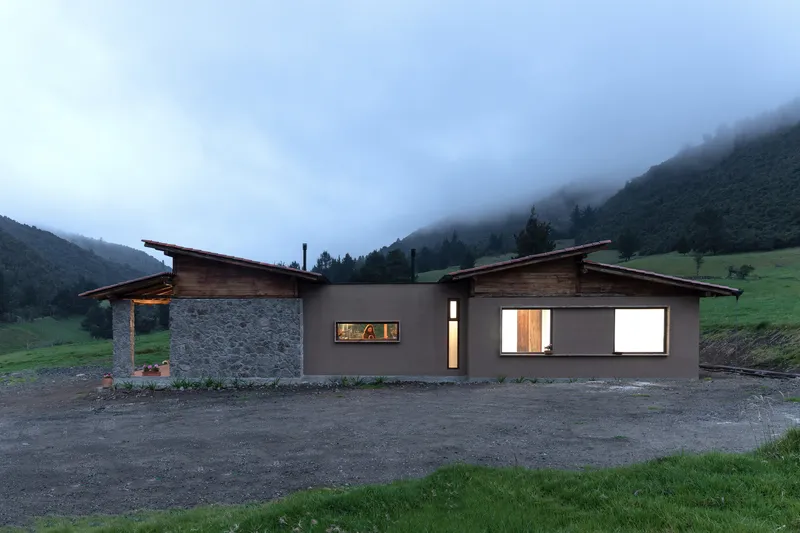
The approach from the second-order road is carefully staged. The perspective unfolds to reveal the building's low profile against the topography and endemic forest behind it. Two rectangular volumes sit slightly offset, their sloped timber roofs pitched to shed rain and extend into deep overhanging eaves. Stone columns anchor the social pavilion to the ground, while rendered walls on the private wing read as a lighter, more enclosed counterpart.
In mist, which appears to be a persistent condition in this valley, the house becomes almost atmospheric. Its fieldstone walls merge with the grey-green tones of the pasture and hillside, and the warm glow of interior lighting at dusk is the only signal that separates building from landscape. The scale is modest by intent: this is a rest space for a small family group, and everything about its footprint and massing reinforces that intimacy.
The Porch as Threshold

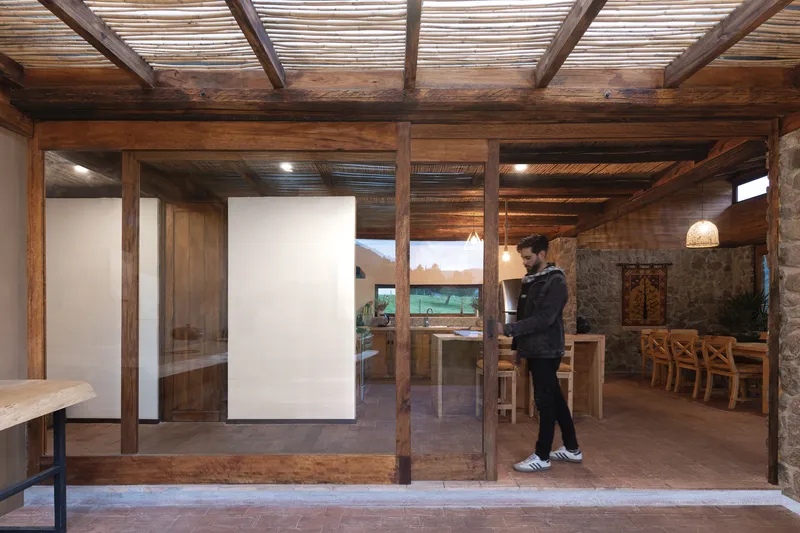

The social block leads with a porch, a covered outdoor room defined by stone columns and an exposed timber roof structure. This is the transition element between nature and house, and the architects treat it as a genuine room rather than a decorative overhang. The depth of the eave is significant: it creates a zone of shade and shelter that blurs the boundary between interior and exterior, so that arrival becomes a gradual process rather than a single threshold crossing.
Details reinforce this reading. The timber rafters meet fieldstone columns with honest, visible joinery. A sliding glass panel in the passage allows the porch to open fully to the meadow or close against wind and rain. The upward view of the eaves reveals layers of construction, with reed cane sandwiched between timber members and clay tiles above, a roof assembly that is both insulating and legible from below.
Fire at the Center
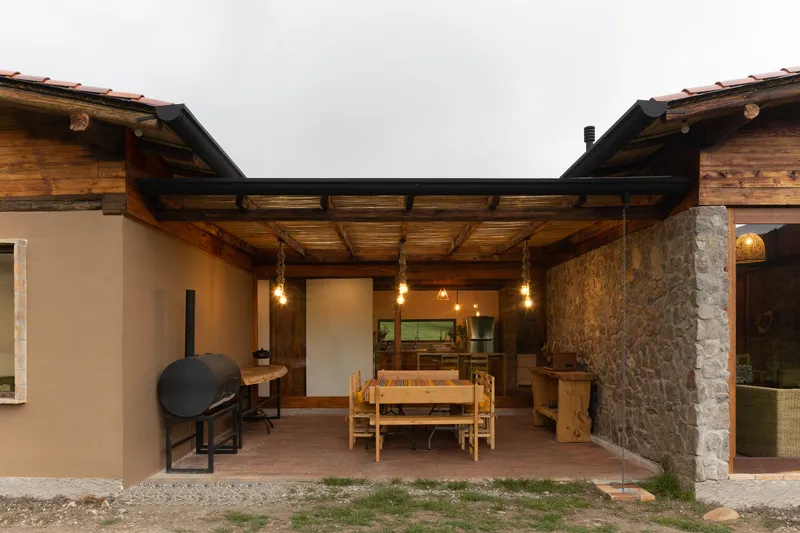

The space created by the gap between the two volumes is the conceptual heart of the project. A covered courtyard, open at its edges and sheltered by exposed timber beams, houses the kitchen and barbecue zone. A black steel flue pipe runs vertically alongside a stone wall, marking the location of the fire around which meals and conversation happen. Pendant bulbs hang from the beam junctions at intervals that feel considered but not precious.
The primitive hut reference works here because the architects don't aestheticize it. Fire is not a decorative fireplace; it is the cooking apparatus, the heat source, and the gathering point. The courtyard between volumes channels breezes while the heavy stone walls on either side store heat during the day and release it at night, a passive thermal strategy that is embedded in the plan rather than bolted onto it.
Material Honesty and Thermal Mass
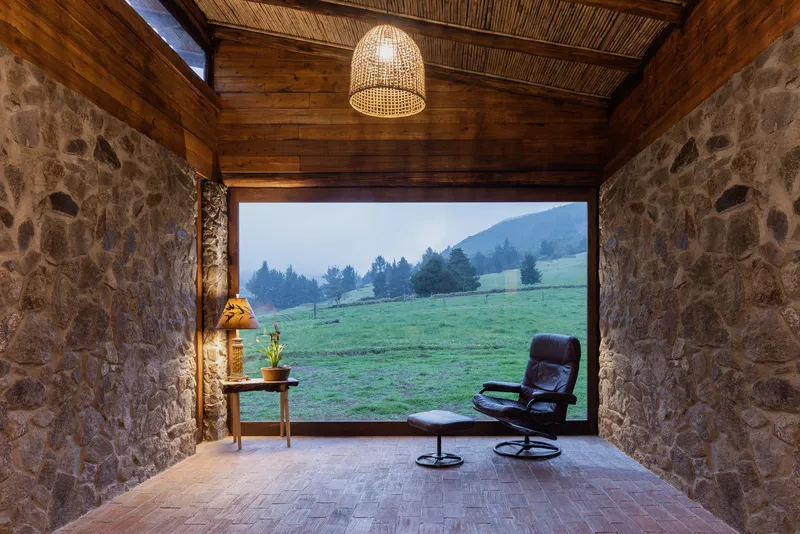


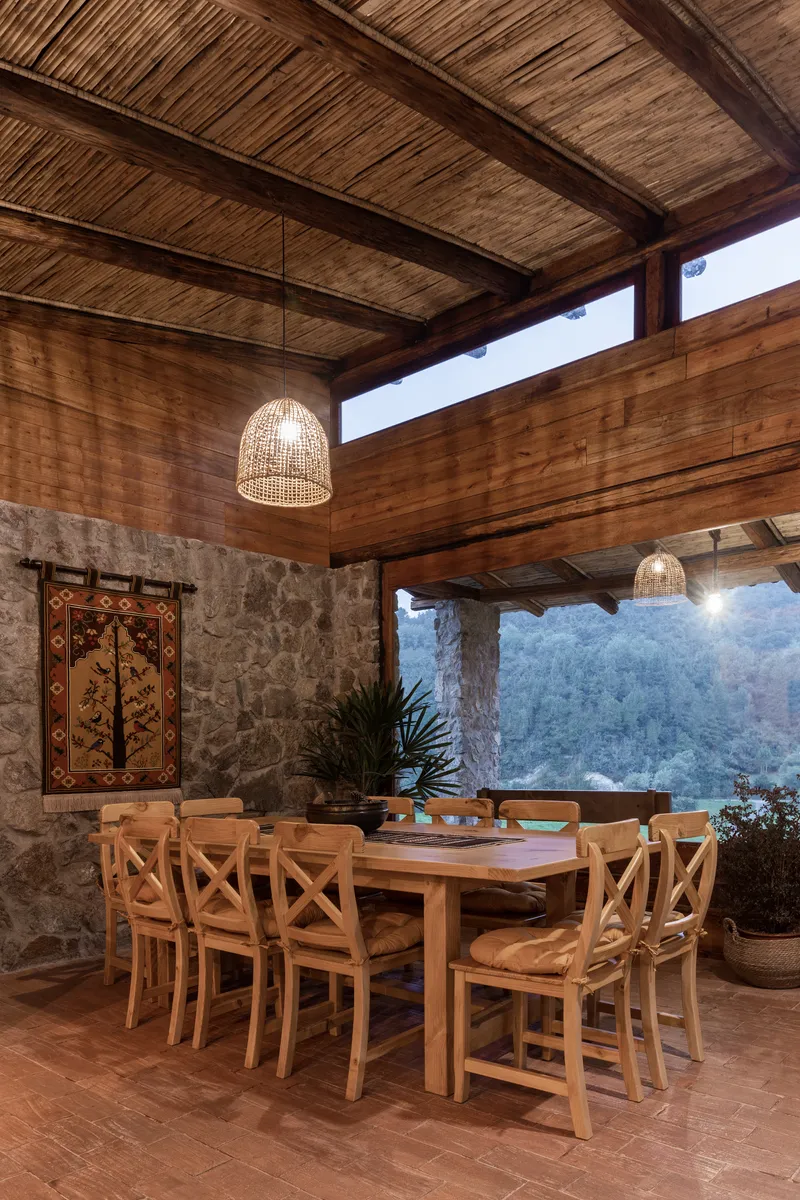
The material palette is short: local stone, artisanal brick, timber, reed cane, and clay tiles. Each does specific work. Stone walls provide thermal mass and structural weight. Artisanal bricks pave the floors, absorbing warmth during sunny hours. The woven bamboo ceiling inside the bedroom filters light into a soft, textured pattern while contributing to the roof's insulating layer. A wicker pendant lamp hangs against this ceiling, framing a horizontal opening to the misty pasture beyond.
In the kitchen, timber cabinetry lines the walls beneath a long horizontal window that puts the green pasture at eye level. The central island anchors the room for food preparation while maintaining sightlines through the house. The outdoor dining terrace uses a slatted timber ceiling to create dappled light during the day and a lantern-like glow at night. None of these choices are novel individually, but their consistency across every surface and detail gives the house a material coherence that many rural projects struggle to achieve.
Dusk and the Rear Elevation
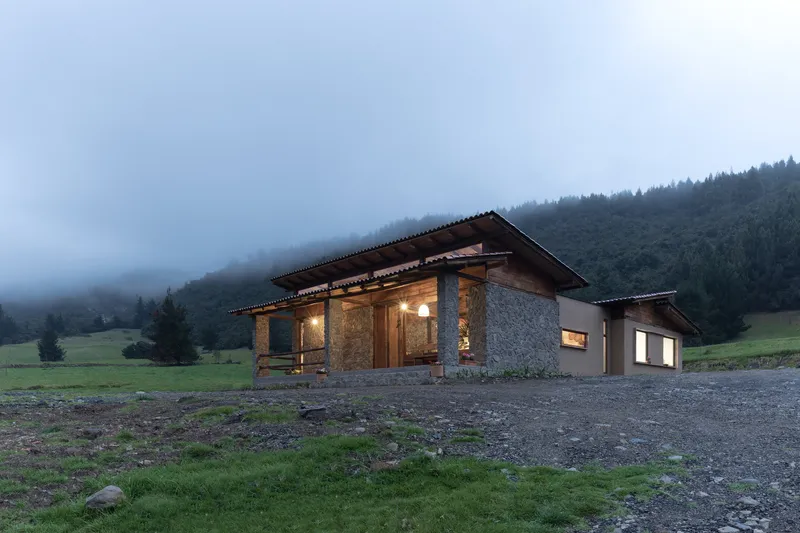

The rear elevation shows a different character: rendered walls, larger glazed openings, and a clearer reading of the two roof slopes as distinct forms. Where the front face is stone-heavy and grounded, the back is more permeable, opening the bedrooms and bathrooms to the forested hillside with a degree of privacy that the public-facing porch deliberately avoids.
At dusk, the illuminated interior becomes a warm pocket recessed beneath the wide roof. The mist amplifies this effect, turning the house into a soft lantern. It is a quality that cannot be designed with precision but that the architects clearly anticipated. By keeping the building low and its openings generous but deep-set, they ensured that light would pool inside rather than leak outward, giving the house presence without brightness.
Plans and Drawings

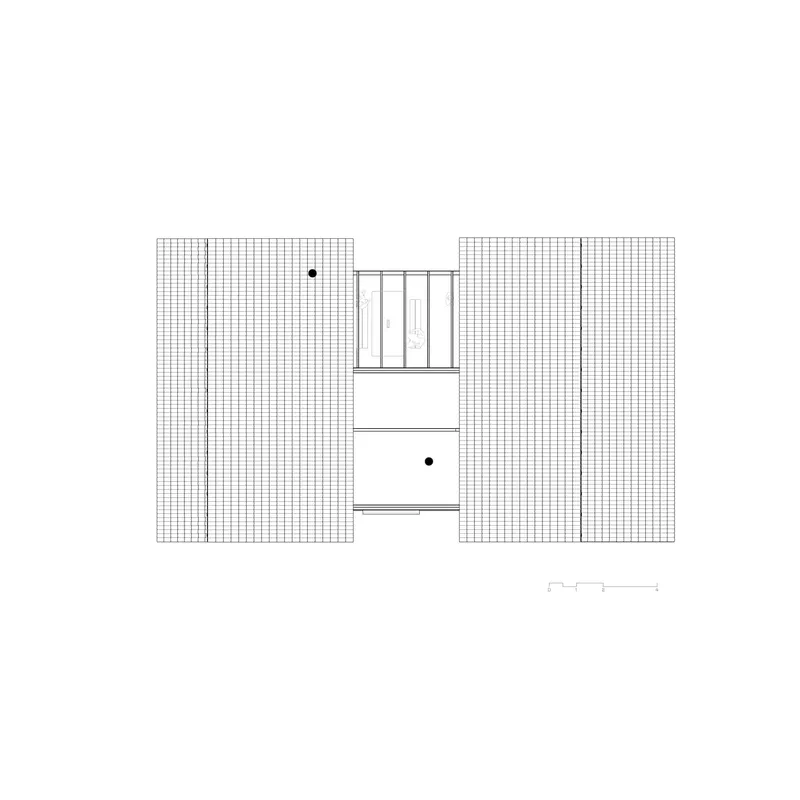


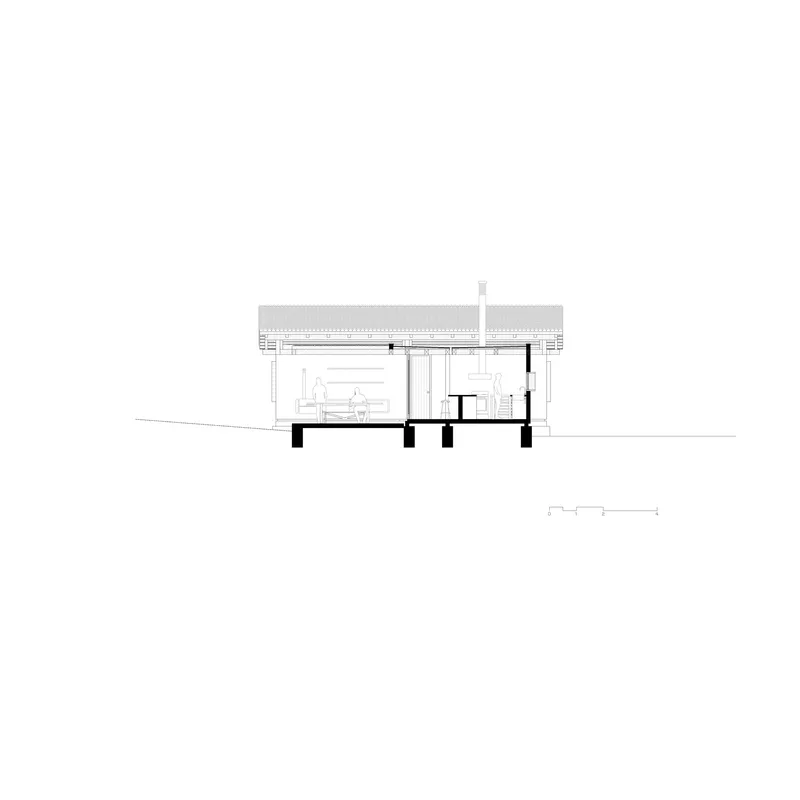


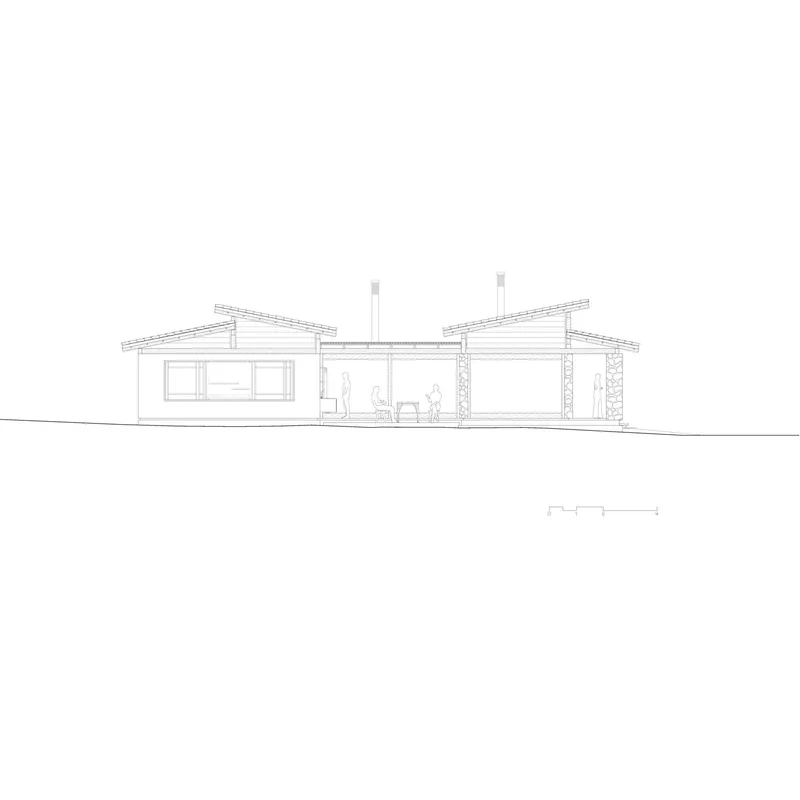


The floor plan confirms the clarity of the organizational idea. The social block holds the open living and dining area, while the private block contains three bedrooms and two bathrooms. The roof plan reveals how the two rectangular volumes connect through a central glazed link, which is the courtyard zone read from above. The axonometric drawings show the L-shaped configuration on the sloped site, surrounded by stylized trees that represent the endemic forest.
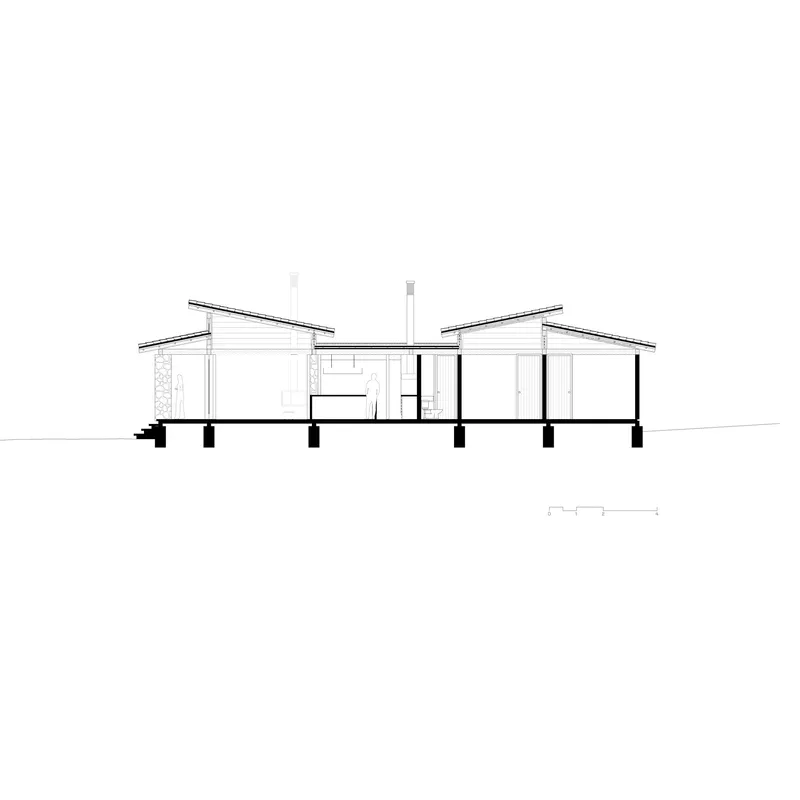
Sections are revealing. The longitudinal cut shows the relationship between the split gable roofs and the interior room divisions, with material annotations identifying stone, timber, and reed cane in their layered assembly. The transverse section exposes the pier foundations that lift the structure slightly off the sloping ground, preventing moisture ingress while keeping the building close to grade. Elevation drawings show the proportional balance between solid stone panels and horizontal openings, confirming that the building's simplicity is precisely calibrated rather than casually achieved.
Why This Project Matters
El Refugio is a reminder that vernacular construction techniques are not nostalgic choices. They are engineering strategies refined over centuries to address specific climatic conditions, and they remain effective when applied with contemporary spatial intelligence. Pedro Moncayo Torres and Tatiana Pérez have not recreated a traditional Ecuadorian farmhouse. They have absorbed its material logic and thermal behavior, then reorganized these principles into a plan that responds to how a small family actually uses a rural retreat.
The project also demonstrates that a limited palette, rigorously applied, can produce architecture with more character and presence than any amount of imported material or formal complexity. Stone, timber, reed cane, clay tiles, and fire: five elements that, in the right hands, generate a house that belongs to its valley as completely as the forest that surrounds it. In an era saturated with self-consciously "natural" architecture that relies on performance rather than substance, El Refugio earns its name honestly.
The Shelter (El Refugio) by PEDRO MONCAYO TORRES arquitectura, with lead architects Pedro Moncayo Torres and Tatiana Pérez. Located in Tarqui, Ecuador. 175 m². Completed in 2022. Photography by Nicolás Provoste C.
About the Studio
Share Your Own Work on uni.xyz
If projects like this are the kind of work you want to make, uni.xyz is a place to publish your own, find collaborators, and enter design competitions.


Popular Articles
Popular articles from the community


Tsunami Convergenics: Turning Catastrophic Ocean Forces into Underwater Housing Infrastructure
A speculative underwater settlement off the coast of Onagawa, Japan, treats tsunamis and typhoons as energy sources rather than threats.

Opera by the Sea Estonia: Three Shells Dissolving Architecture into Tallinn's Coastline
A winning opera house proposal replaces monumental form with interconnected shells that blur the boundary between building, park and Baltic Sea.

Temporary Home for Dogs: A Reversed Zoo Rethinks Animal Shelter Architecture
In Bucharest, a sinuous corridor and freed landscape flip the logic of containment, designing a shelter that works to make itself unnecessary.

Faces of the Soviet Avant-Garde: Turning Moscow's Street Names into an Open-Air Museum
A network of sculptural installations across a Moscow residential district transforms forgotten architect names into spatial encounters with cultural memor

Similar Reads
You might also enjoy these articles

Pixel Gardens: One Repeated Module Stacked Into a Terraced Social Housing Tower for Famagusta
Salem Bader's shortlisted housing tower builds a vertical neighbourhood from one repeated module, offsetting units to carve terraces, light and air.

Bao Huynh Watercolor Atelier: A Serene Art Retreat in Hội An
Bao Huynh Watercolor Atelier in Hội An blends multifunctional art spaces, sustainable design, local materials, and family-friendly living in a serene environment.

Atelier Macri Concept Store Interior Design by CASE-REAL
Atelier Macri store features a "ko" counter, walnut wood details, cork displays, blending retail, gallery, and seamless customer experiences.

Manuel Vargas Izquierdo Stadium and High-Performance Sports Center: Architectural Excellence in Jalpa de Méndez
The Manuel Vargas Izquierdo Stadium blends sustainable design, inclusive sports facilities, and cultural-inspired architecture, revitalizing Jalpa de Méndez’s public spaces.

Explore Shelter Competitions
Discover active competitions in this discipline

Challenge to design a portable theatre

Challenge to design a portable music platform

Challenge to design an open learning module for the elderly
Comments (0)
Please login or sign up to add comments
No comments yet. Be the first to comment!