

Plug & Spread Housing: A Modular Commune Designed to Outlast Kerala's Floods
Bamboo stilts, phytoremediation ponds, and phased community growth form a regenerative housing model for flood-prone Kerala.


When floodwaters recede, the damage they leave behind is not only structural but social. Families scatter, networks dissolve, and the improvised shelters that replace destroyed homes rarely account for the next inundation. The Plug & Spread Housing model attacks this cycle directly: rather than rebuilding what failed, it proposes a modular, elevated housing unit called the Plug House, designed to let water pass beneath it while anchoring a broader system of shared infrastructure, cooperative construction, and ecological restoration.
Developed by Prachi Metawala and Isha Deshpande as a shortlisted entry for HEAL+, the project responds to the devastating 2018 Kerala floods that destroyed thousands of homes and displaced entire communities. UNISDR data frames the urgency: more than 600,000 lives lost to disasters in the 21st century alone. Against that backdrop, Metawala and Deshpande's proposal moves beyond emergency relief toward a phased, regenerative commune that rebuilds housing and community simultaneously.
Bamboo Trusses Over Hume Pipe Foundations
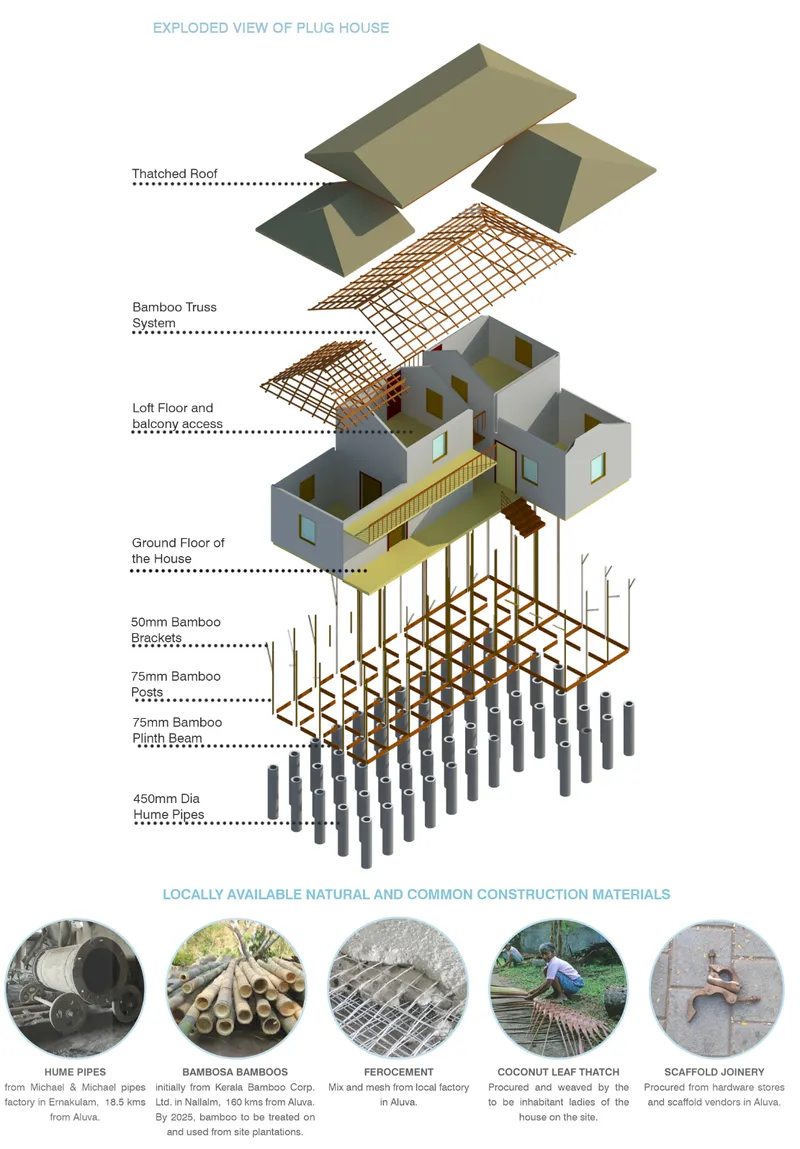
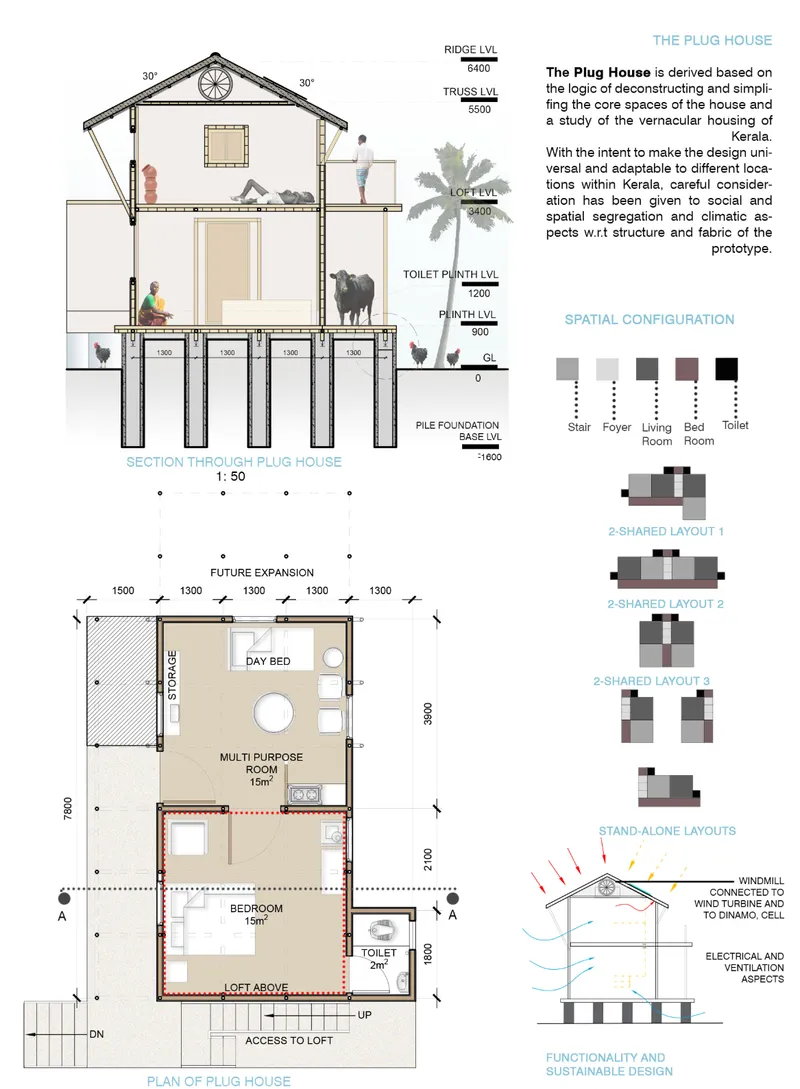
The exploded axonometric makes the construction logic legible at a glance. From the ground up: Hume pipe pile foundations anchor the structure, bamboo posts and trusses form the skeleton, ferrocement walls reinforced with wire mesh provide durability, and a coconut leaf thatch roof caps the assembly. Every material is locally procured, affordable, and replaceable. The section and plan drawings below reveal how this assembly translates into lived space: a multipurpose ground floor, a bedroom level, a loft for storage or sleeping, and basic sanitation, all elevated above predicted flood lines.
The choice of vernacular materials is deliberate and strategic. Bamboo grows abundantly across Kerala and offers a high strength-to-weight ratio suited to both seismic and flood conditions. Ferrocement, while less traditional, bridges the gap between vernacular craft and modern resilience standards. The result is a housing unit that local builders can construct cooperatively, without specialized equipment, and that remains replicable across flood-prone regions well beyond Kerala.
Designing for the Flood That Will Come
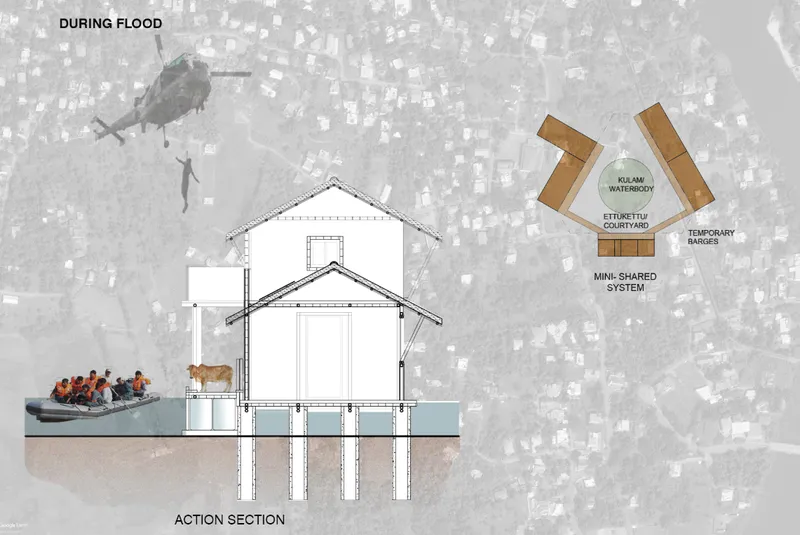
The action section drawing is striking in its honesty. It depicts the commune mid-inundation: water rising to the stilts, a helicopter overhead, residents evacuating by boat. Most housing proposals would omit this image, preferring to show the building in calm conditions. Here, showing the flood scenario is the point. The raised structures allow water to flow underneath without compromising the living spaces above, while the elevated storage areas protect food, tools, and livestock.
Flood resilience in the Plug & Spread model is not a single gesture but a layered strategy. Mitigative landscaping, including bamboo groves and mangrove plantations around the settlement perimeter, reduces the velocity and volume of incoming water. Phytoremediation ponds handle contaminated runoff after the event. The architecture survives the flood; the landscape attenuates it.
Clusters, Water Tanks, and the Shared System
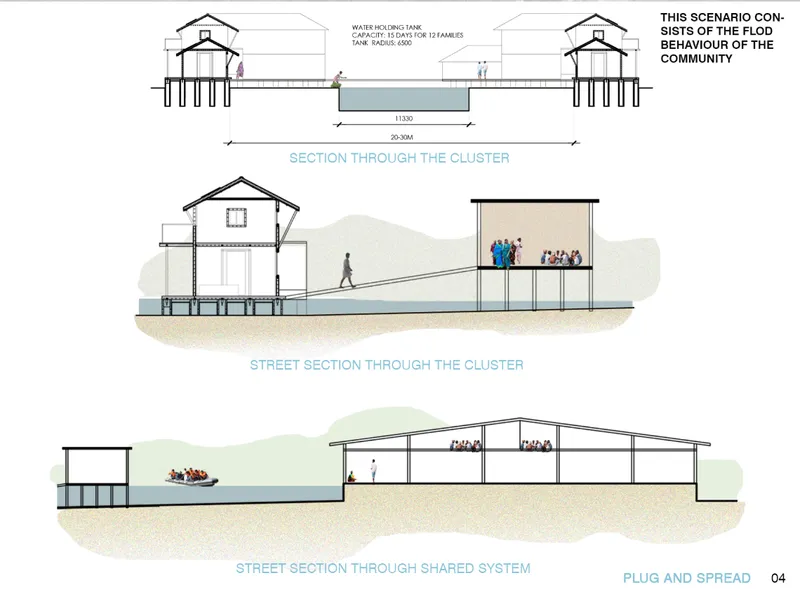
Three section drawings show how individual Plug Houses aggregate into clusters connected by elevated walkways and shared water infrastructure. Water tanks sit within the cluster framework, serving multiple households. Circulation happens above ground level, maintaining connectivity even when the terrain below is waterlogged. The drawings also reveal bamboo-structured communal warehouses and cooperative building workshops, spaces that serve dual functions as construction yards during rebuilding phases and social gathering points during stable periods.
The phased action plan gives this clustering its temporal logic. In the first phase (2019 to 2020), destroyed homes are immediately replaced with Plug Houses while partially damaged structures receive low-cost debris wall repairs. By the second phase (2020 to 2021), shared systems expand to meet construction and disaster resilience needs. The third phase (2025 to 2026) envisions fully developed clusters integrated with floating farms, biogas plants, and renewable energy systems including wind turbines and solar panels. Communities are not just rebuilt; they are incrementally upgraded.
Courtyards That Hold a Community Together
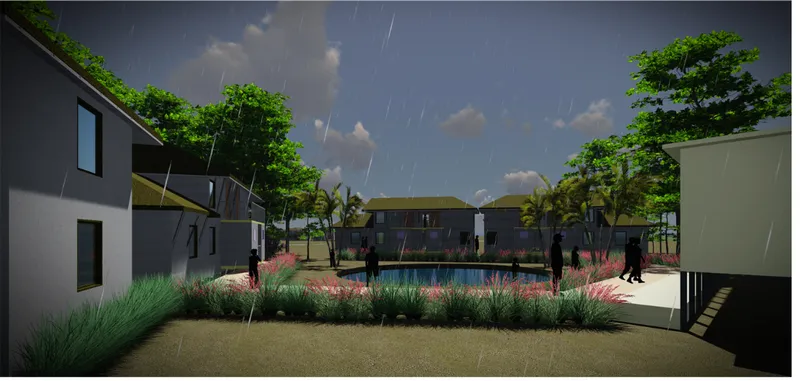
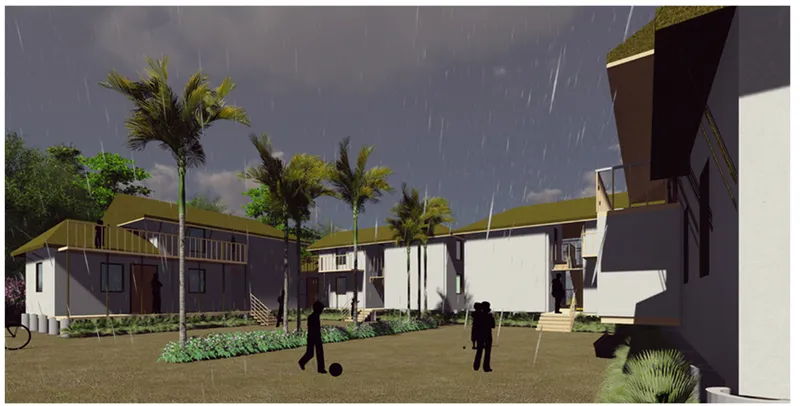
The renderings shift the register from technical to experiential. A central courtyard anchors the commune: a pool flanked by planted beds, housing units visible through a canopy of palm trees. The second image captures the same spaces during rainfall, with green roofs absorbing water and elevated walkways keeping residents connected above wet ground. These are not decorative additions. The courtyards function as social condensers, places where cooperative construction, food production, and daily life overlap.
Green roofs do more than manage stormwater. They insulate interior spaces, reduce the urban heat island effect within the cluster, and provide surfaces for small-scale cultivation. Combined with the floating farms and phytoremediation ponds embedded at the neighborhood scale, the commune approaches a closed-loop sustenance model where food, water, and energy are generated and processed on site.
Why This Project Matters
Post-disaster housing too often defaults to standardized units airdropped into devastated landscapes with little regard for local ecology, social structures, or the near certainty of the next event. Plug & Spread refuses that approach. By grounding its material palette in Kerala's vernacular tradition, phasing its growth to match community capacity, and embedding ecological systems directly into the settlement plan, the project treats resilience as a design discipline rather than an engineering afterthought.
What Metawala and Deshpande ultimately propose is a shift in how we define recovery. Recovery is not the restoration of a previous condition; it is the construction of a better one. The Plug House is not a temporary shelter waiting to be replaced by something permanent. It is the permanent thing, designed from the start to withstand repetition, adapt to growth, and foster the communal relationships that make survival possible when the water rises again.
View the Full Project
About the Designers
Designers: Prachi Metawala, Isha Deshpande
Enter a Design Competition on uni.xyz
uni.xyz runs architecture and design competitions year-round that reward proposals with spatial conviction and real site intelligence.
Project credits: Plug & Spread by Prachi Metawala, Isha Deshpande HEAL+ (uni.xyz).


Popular Articles
Popular articles from the community


LT2A and OPEN Architectes Thread a Brick and Glass High School Through a Wooded Belgian Campus
In Braine-l'Alleud, a 3,000 m² wing for Collège Cardinal Mercier pairs pale brick with a glazed colonnade, deferring to a small chapel and a dense wood.

U.GA Architects Wraps an Oval Rooftop Pool in Curved Board-Formed Concrete on Busan's Jeollidan-gil
In Busan's Jeonpo-dong, a 454 m² mixed-use block stacks a neighborhood facility, guest rooms and an oval rooftop pool inside spiraling concrete walls.

Juan García Correa, John González and Claudia Rueda Sink a Circular Amphitheater into a Manizales Engineering Building
On the La Nubia campus in Manizales, Colombia, the S1 Building folds labs and offices into a hillside of ramped lawns that double as a campus route.

Jaramillo Van Sluys Arquitectura and Urbanismo Turn a Demolished Registry Lot in Quito into an Orchard Plaza
In Quito's Centro Histórico, a 2,800 m² plaza exposes the San Agustín convent wall and redraws its lost Augustinian orchard in volcanic stone.

Similar Reads
You might also enjoy these articles


Aquadapt: An Underwater Habitat That Rewrites Its Rooms by the Hour
Curved modules ring the seabed while one shell shifts from breakfast room to cinema, farm and football pitch as residents' needs change.

Play: Fragments of Their World: Remembered Architecture Rebuilt as a Modular Playground for Refugee Camps
Tom Gardner abstracts domes, arches and towers from the homelands of displaced families into a kit of child-scaled play parts for camp settlements.
REBIRTH: A Circular Settlement Where Afghan Widows and Their Children Rebuild Life Together
A shortlisted Resile entry turns the circle into a protective ring of timber and brick, gathering homes, classrooms and gardens around a shared landscape.
The Main Dream: A Recycled Plastic Kit That Lets Refugee Children Build Their Own Playground
Thirty-centimetre interlocking cubes that connect on three axes turn play into construction, letting children author the spaces they occupy.


Comments (0)
Please login or sign up to add comments
No comments yet. Be the first to comment!