
POLYGOON Architectuur Threads a Split-Level Home Through a Funnel-Shaped Plot in Antwerp
A trapezoidal plan and bel-etage typology turn a narrow, kinked infill site in Deurne into a layered 245 m² family house.

For decades, a funnel-shaped sliver of land in Deurne served as little more than a driveway to a storage shed, presenting itself to the street as a shabby gate in an otherwise continuous row of terraced houses. POLYGOON Architectuur saw exactly the right kind of problem: a site that narrows, kinks, and refuses orthogonality, demanding a house that does the same. The result is a 245 m² split-level dwelling that accepts its trapezoidal plan as a generative constraint rather than a deficiency, turning every skewed angle into an opportunity for light, view, or spatial surprise.
What makes the project genuinely interesting is the decision to work with, not against, the local typology. Deurne's streets are lined with bel-etage houses, a split-level format that elevates the main living floor above a low garage level, keeping residents within conversational distance of the sidewalk. POLYGOON adopted this format wholesale, then threaded it through a plan that widens from an 8-metre street frontage into a progressively narrower tail. Internal angles were kept consistent and never allowed to pinch into unusable corners, a discipline visible in every floor plan. The stairwell became the organizational spine, separating acoustic zones and pulling daylight from the roof down to the ground floor.
Street Presence and the Sawtooth Crown
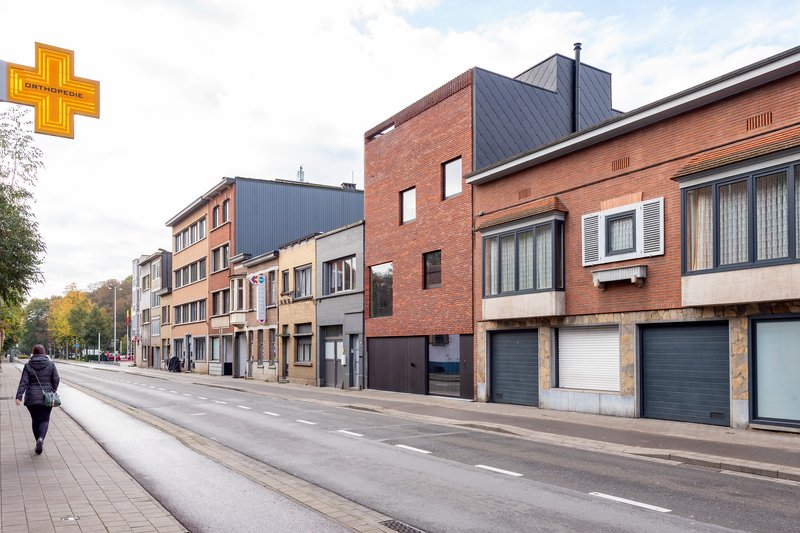
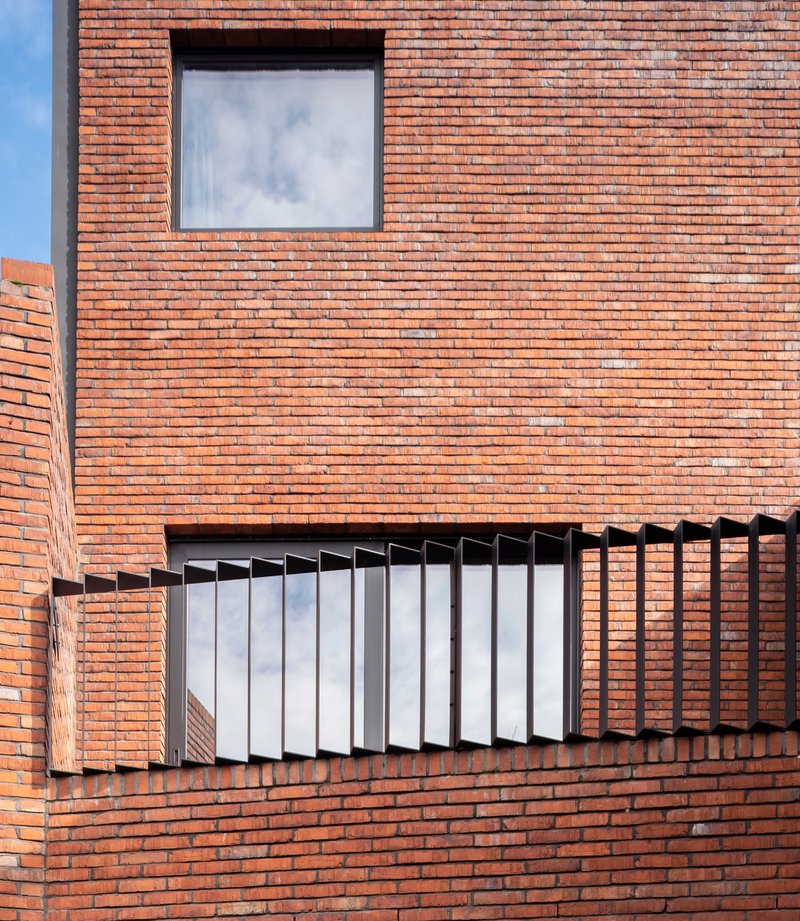
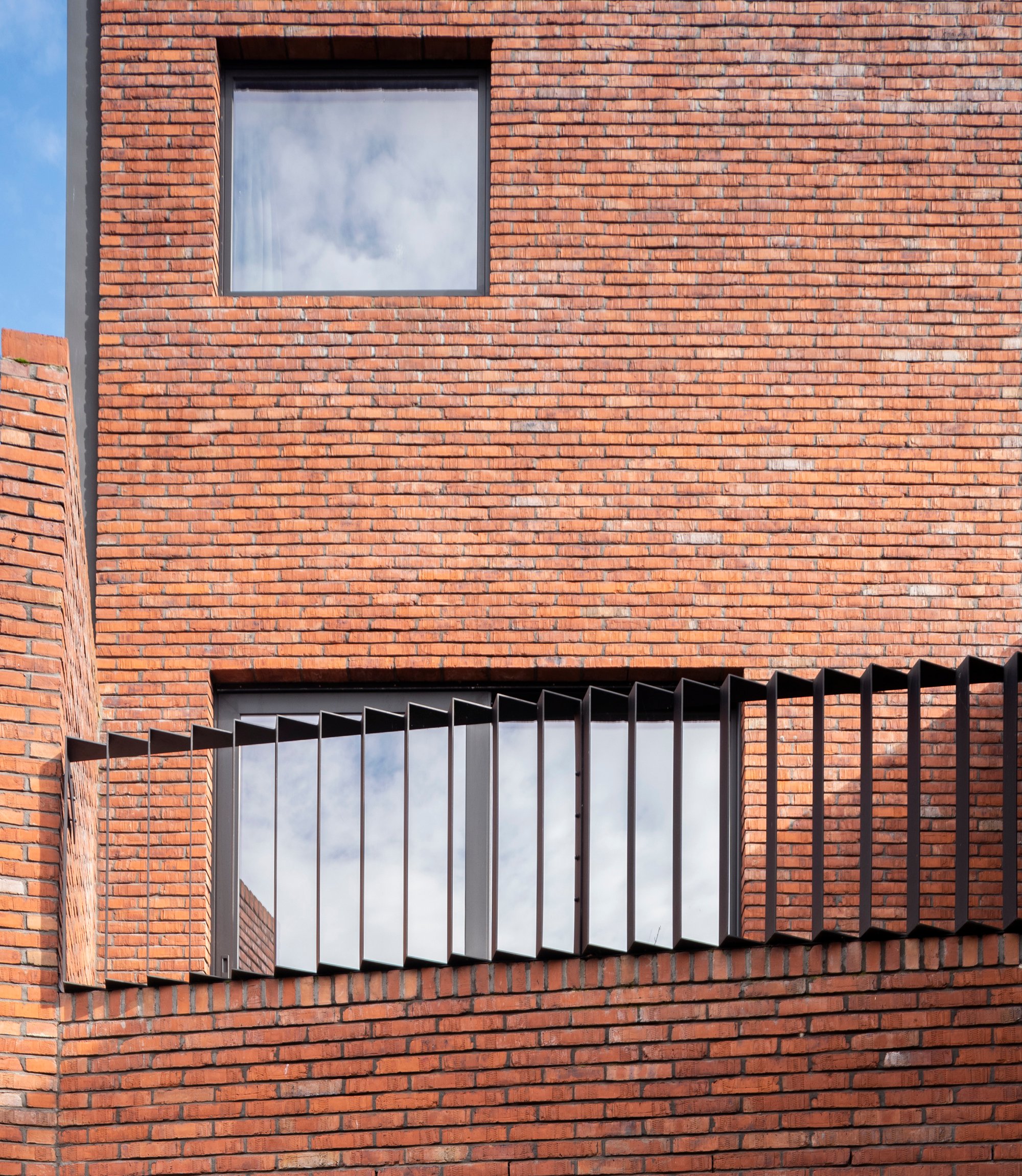
The street facade slots into its row with studied nonchalance. Orange brick, stacked square windows, and a recessed ground floor entry align with the scale and rhythm of the existing terrace. But look up: a traditional masonry sawtooth bond crowns the parapet, a detail that reads simultaneously as ornament and as a subtle signal. Behind that serrated edge sits one of the roof terraces, glimpsed only through a narrow viewing slit. The sawtooth also performs a geometric trick, reading as a continuation of the kinked party wall and thereby stitching the new house to the old street fabric without pretending the site is straight.
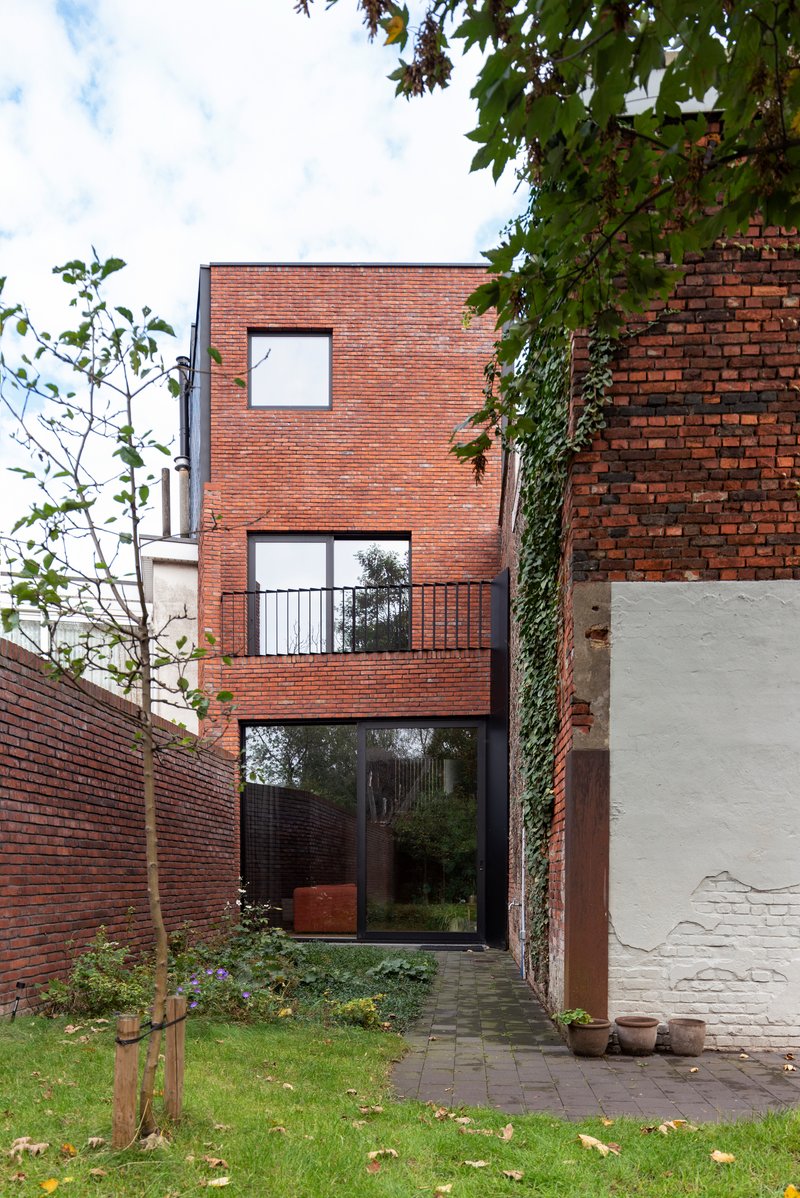
The folding white metal louvers at the upper level offer the only overt departure from the brick plane. They frame a recessed balcony opening that controls western sun and privacy in equal measure. From the rear, the house reveals its true depth: a narrow brick elevation punctuated by a glass door opens onto a newly planted courtyard garden, carved from the footprint of the demolished storage building and enclosed by high walls for privacy.
The Stairwell as Acoustic Spine and Light Shaft
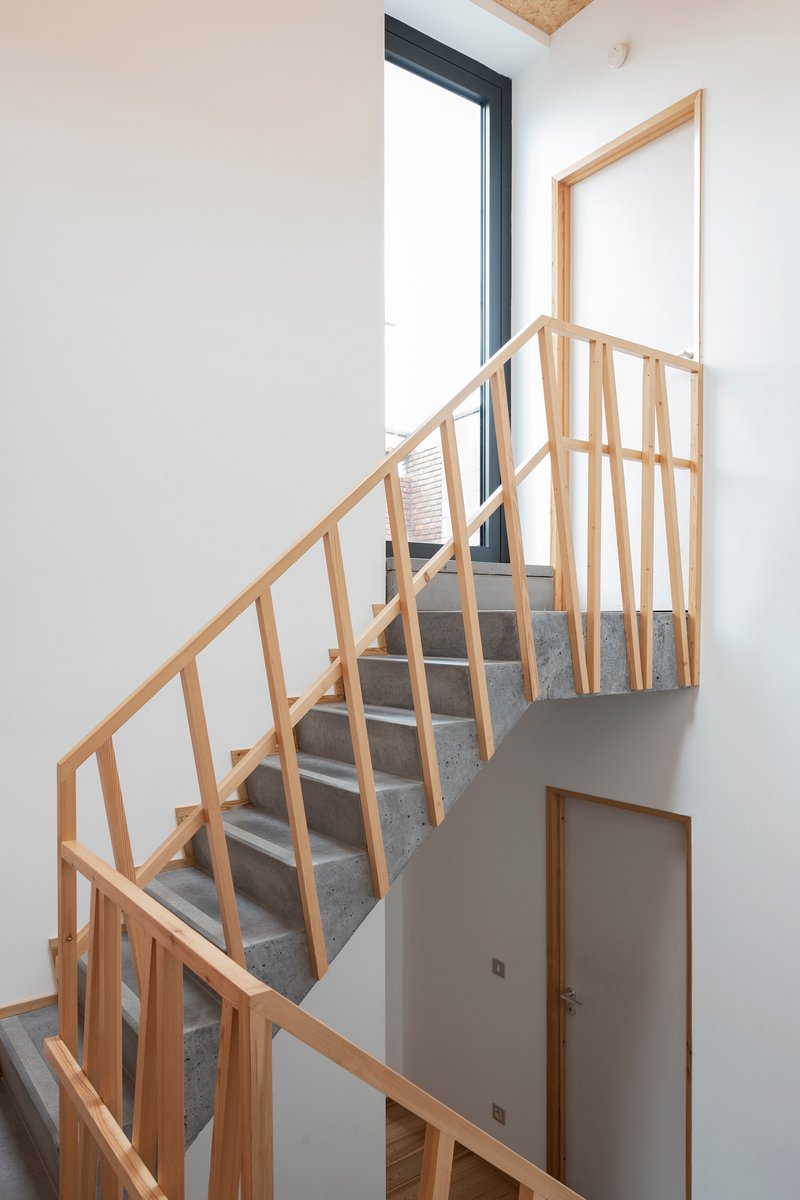
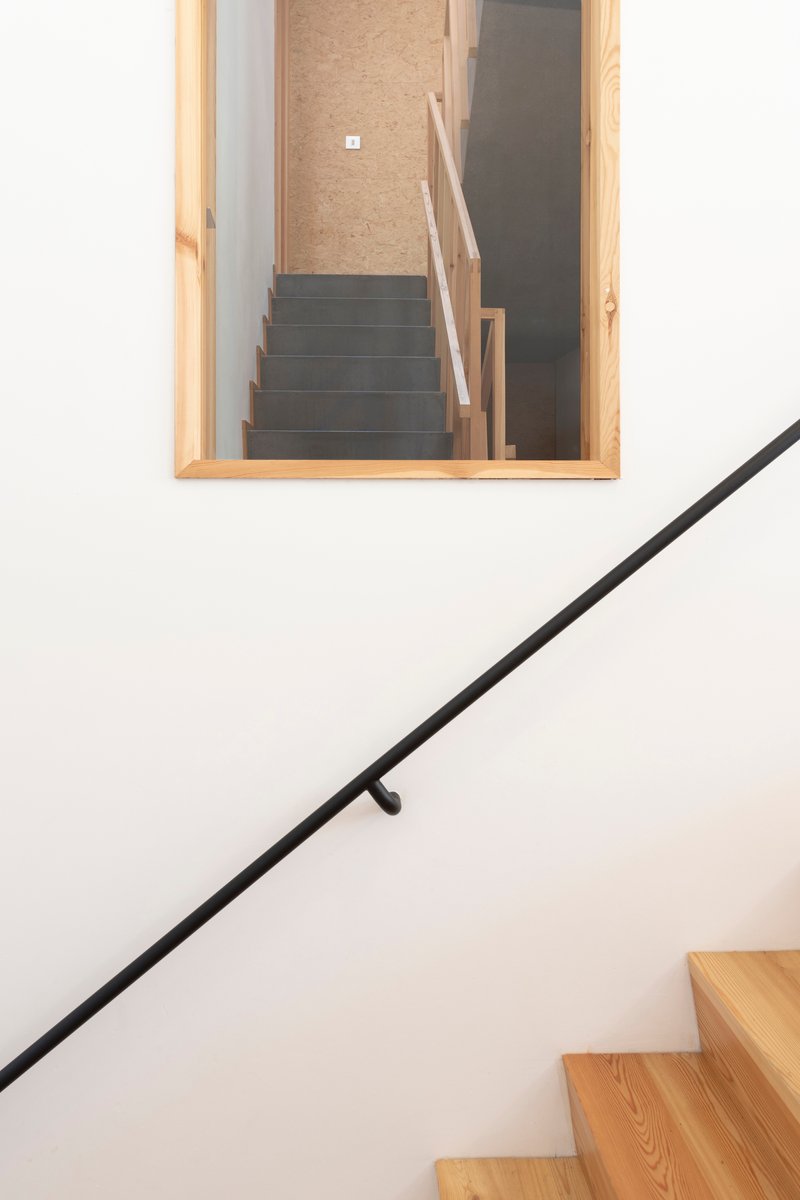
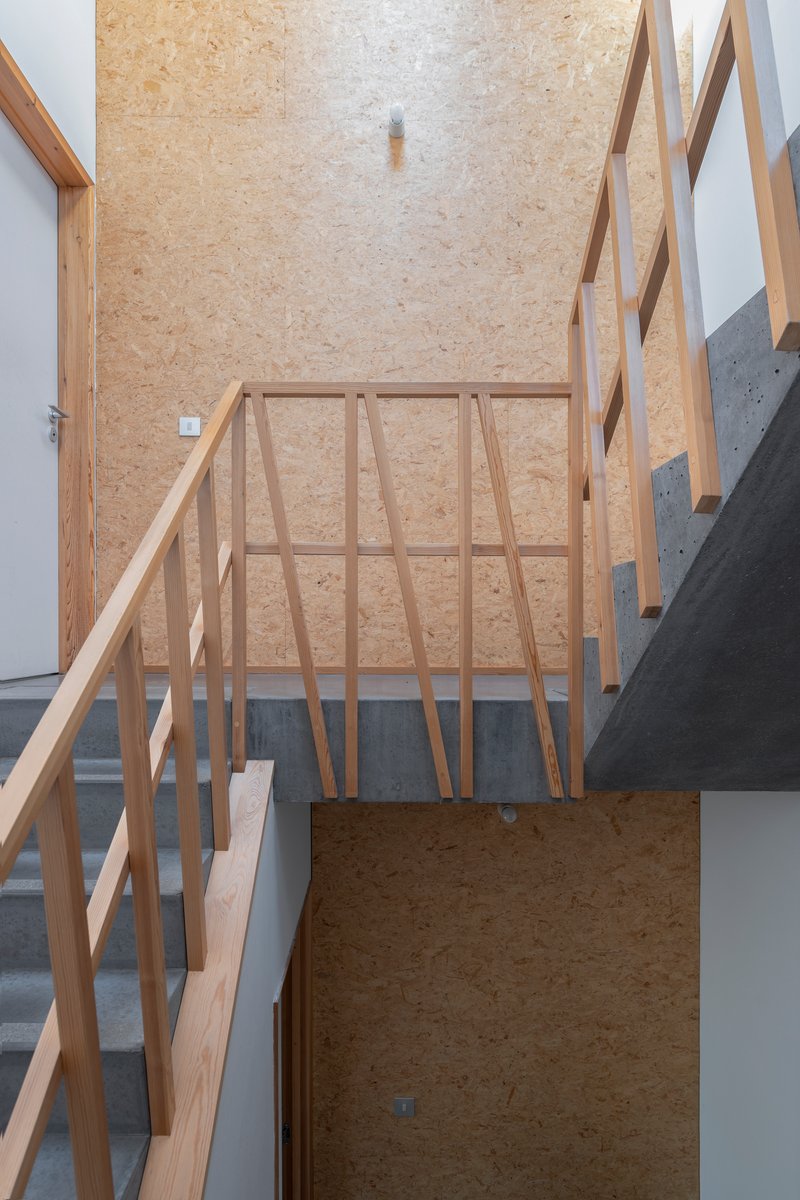
In a house this narrow and deep, vertical circulation is never just circulation. POLYGOON designed a wide stairway that changes its arrangement on every floor, creating distinct spatial experiences as you ascend. Steel stringers and timber treads sit against white walls with a black metal handrail, a material palette lean enough to let the architecture do the talking. A skylight at the top pulls daylight all the way down through the stairwell core and, crucially, redirects it into the main living space.
The stair also functions as an acoustic buffer, physically separating the music room and bedrooms on the upper floors from the open living and dining areas. This is a smart, low-tech strategy: no special insulation or double walls, just intelligent placement of a circulation volume that every house needs anyway.
Living Level: Color, Depth, and Framed Views
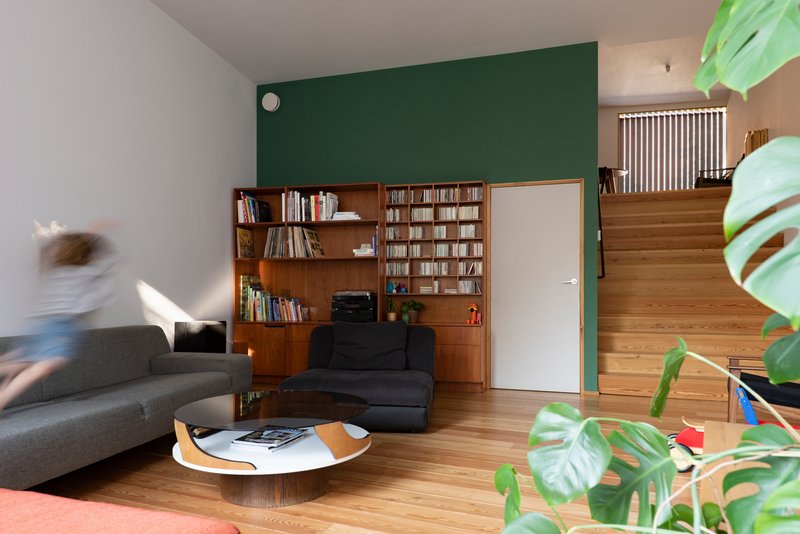
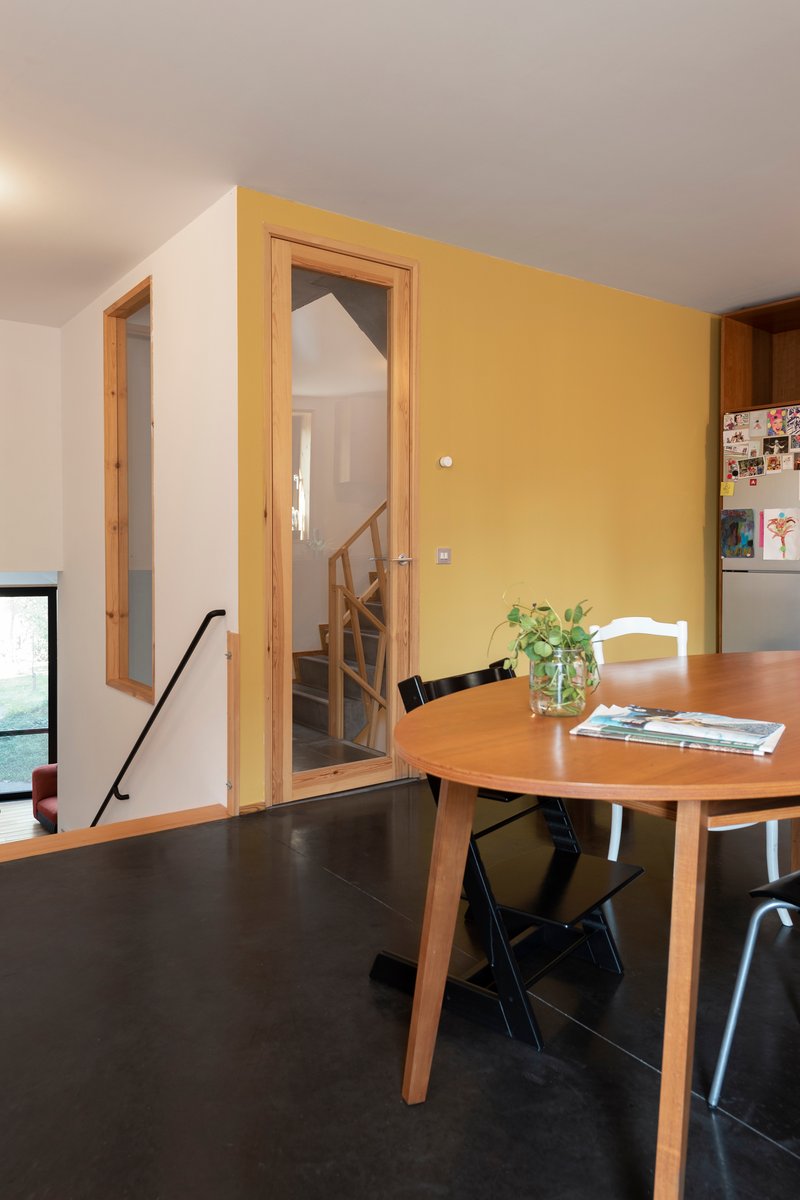
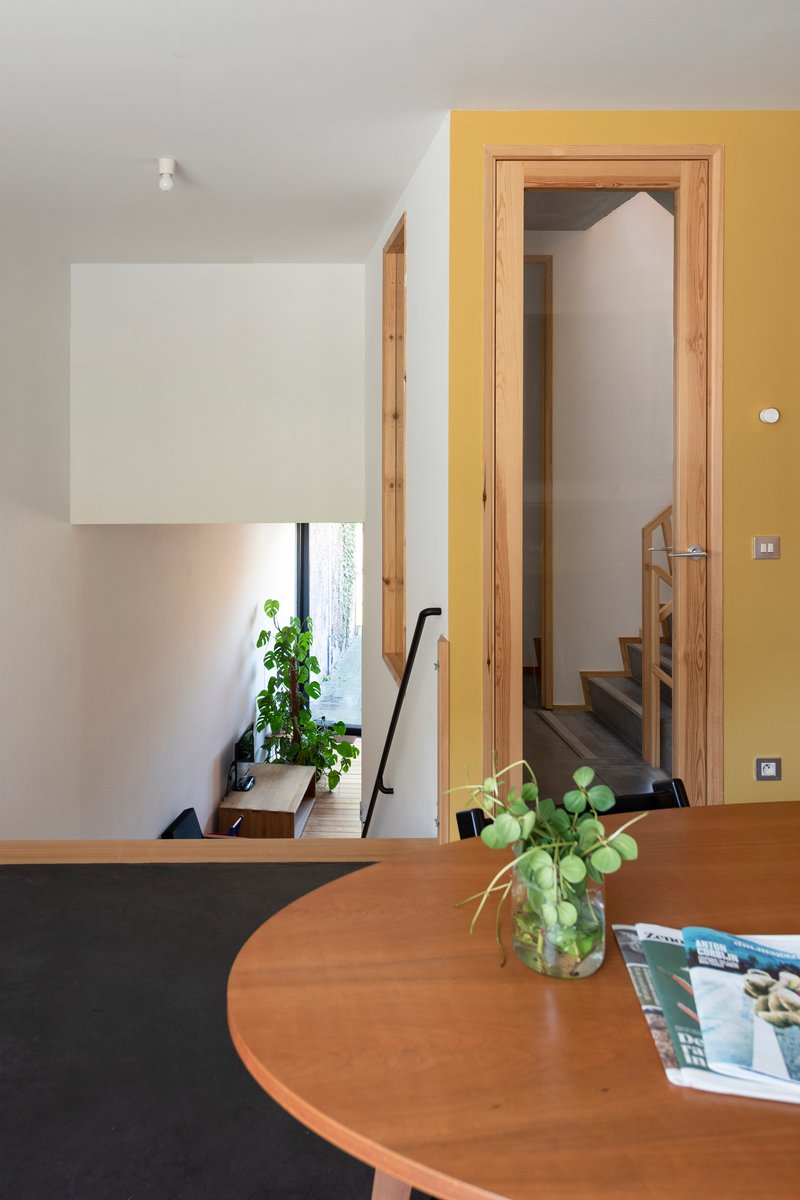
The first floor living space reveals the full payoff of the trapezoidal plan. Rooms splay outward from the stairwell, and doorways are framed in timber, creating a sequence of views that compress and expand as you move through them. A dark green accent wall anchors the sitting area while timber bookshelves line the perimeter. The dining space looks back through one of these timber frames to a planted stairwell below, collapsing the distance between garden level and living level into a single glance.
Color is used with deliberate restraint and maximum effect. A yellow accent wall behind a doorway, the deep green in the living room, terracotta tiles in the kitchen: each surface marks a threshold or a change in function. The dark concrete flooring on the first level contrasts with the warm timber floors on the upper levels, reinforcing the bel-etage split between communal and private zones.
Kitchen and Material Detail
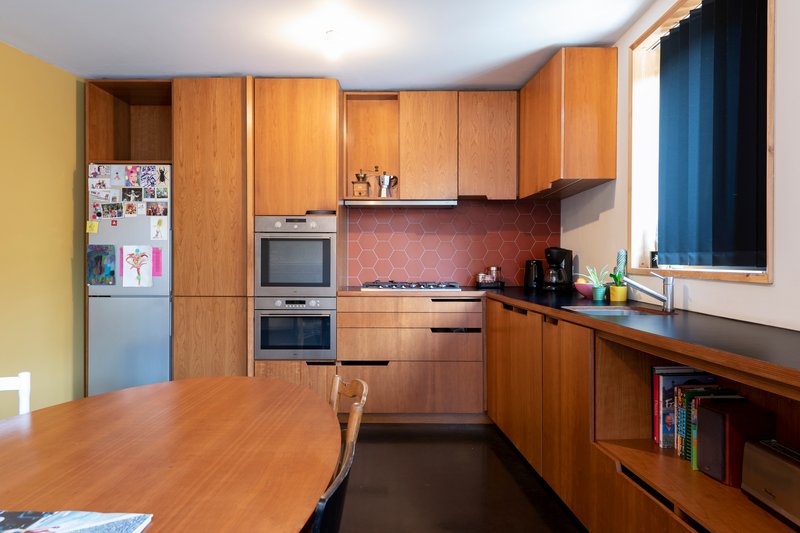
The kitchen demonstrates how carefully the architects calibrated window placement to room depth. A frameless kitchen window sits above oak cabinetry by Leo Boits, with a terracotta hexagonal tile backsplash that adds warmth without clutter. In deeper rooms, windows are placed high to wash light across the ceiling; in shallower rooms, they drop lower to frame direct views. It is a straightforward strategy, executed with discipline across every floor.
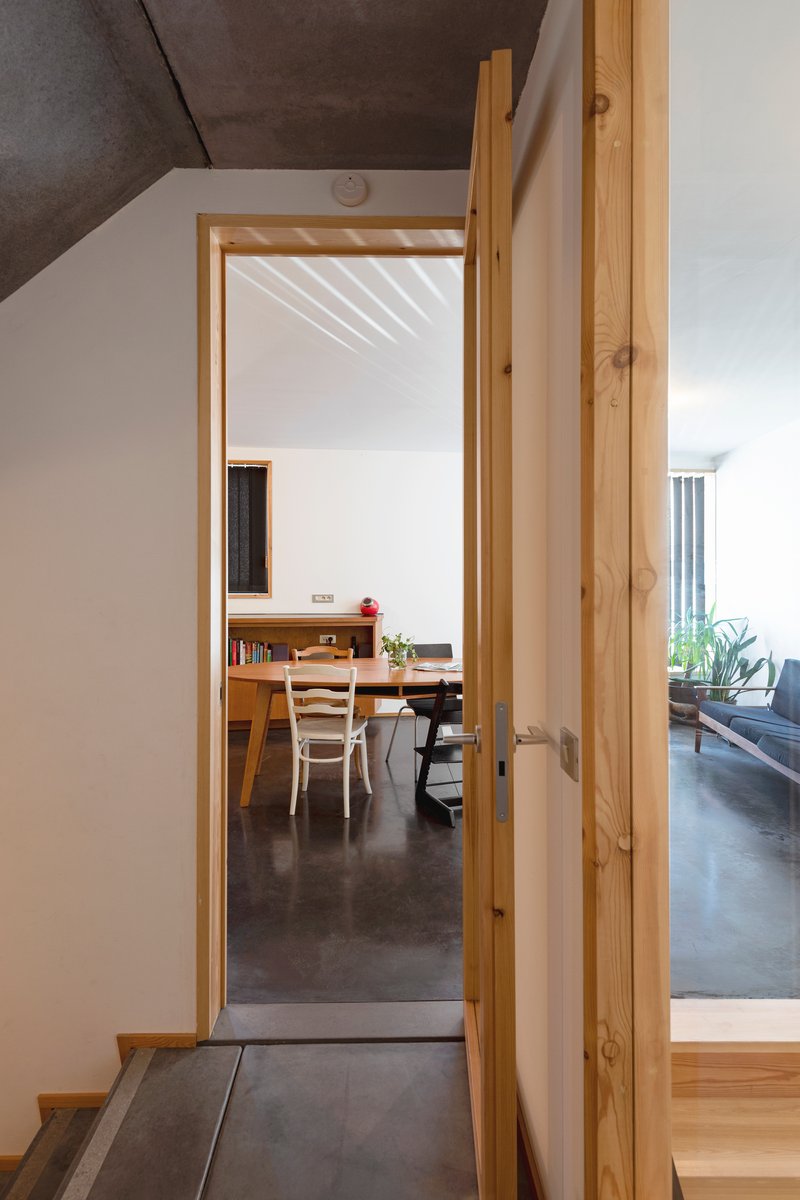
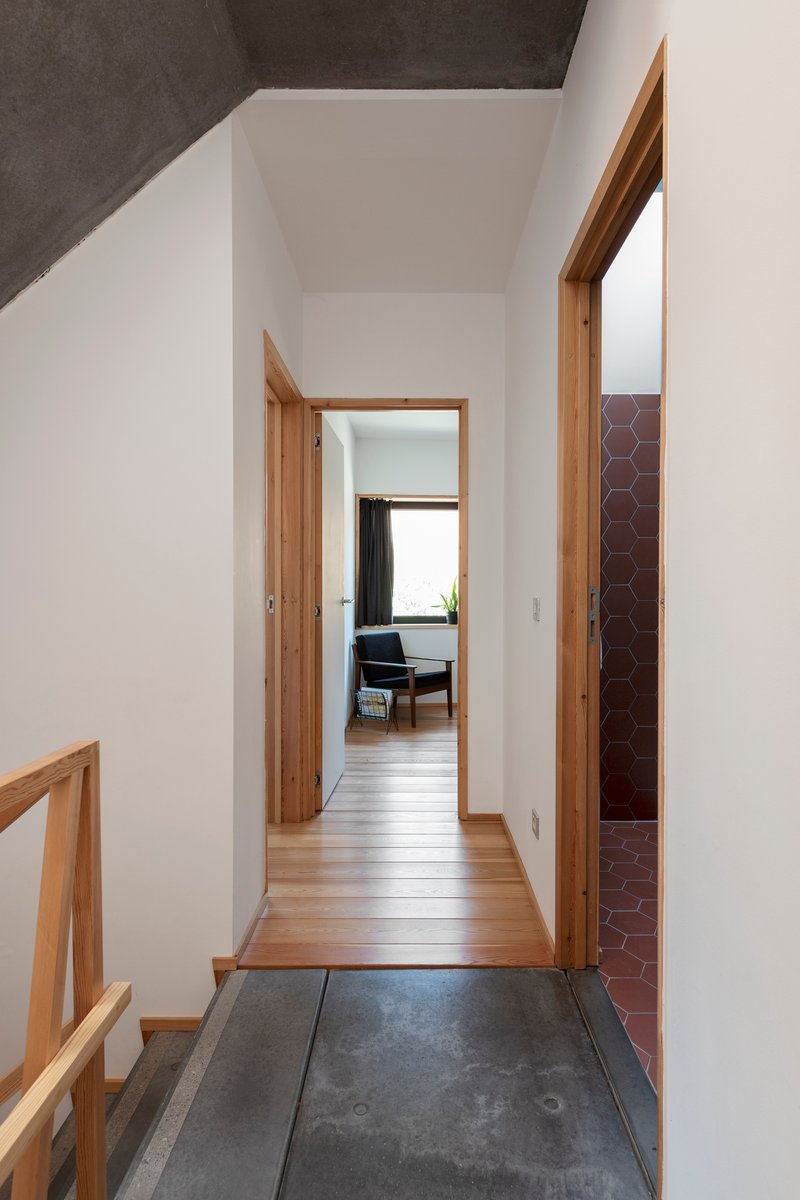
Timber-framed doorways recur throughout, their proportions shifting from floor to floor. They serve as interior thresholds, giving each room a defined edge without doors or partitions. The entry hallway transitions from dark stone to timber flooring, marking the shift from the semi-public ground level to the domestic interior above.
Private Rooms and the Dual Terraces
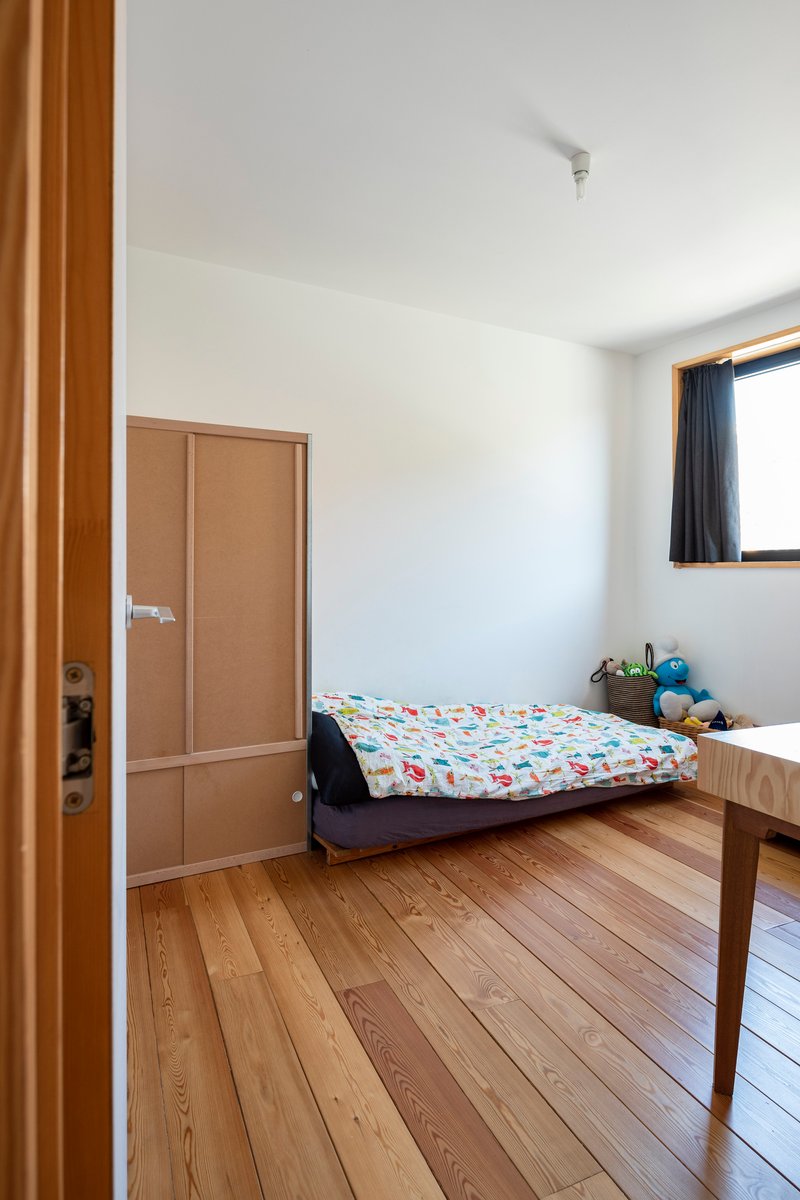
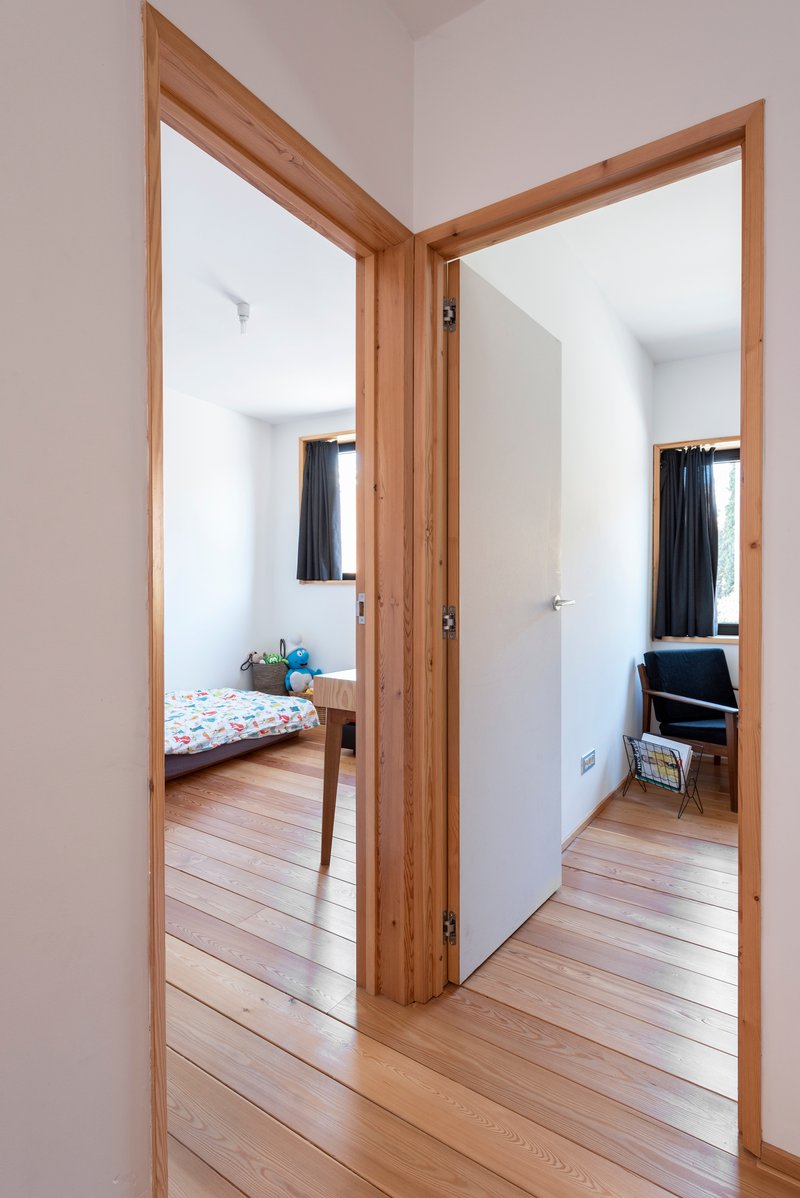
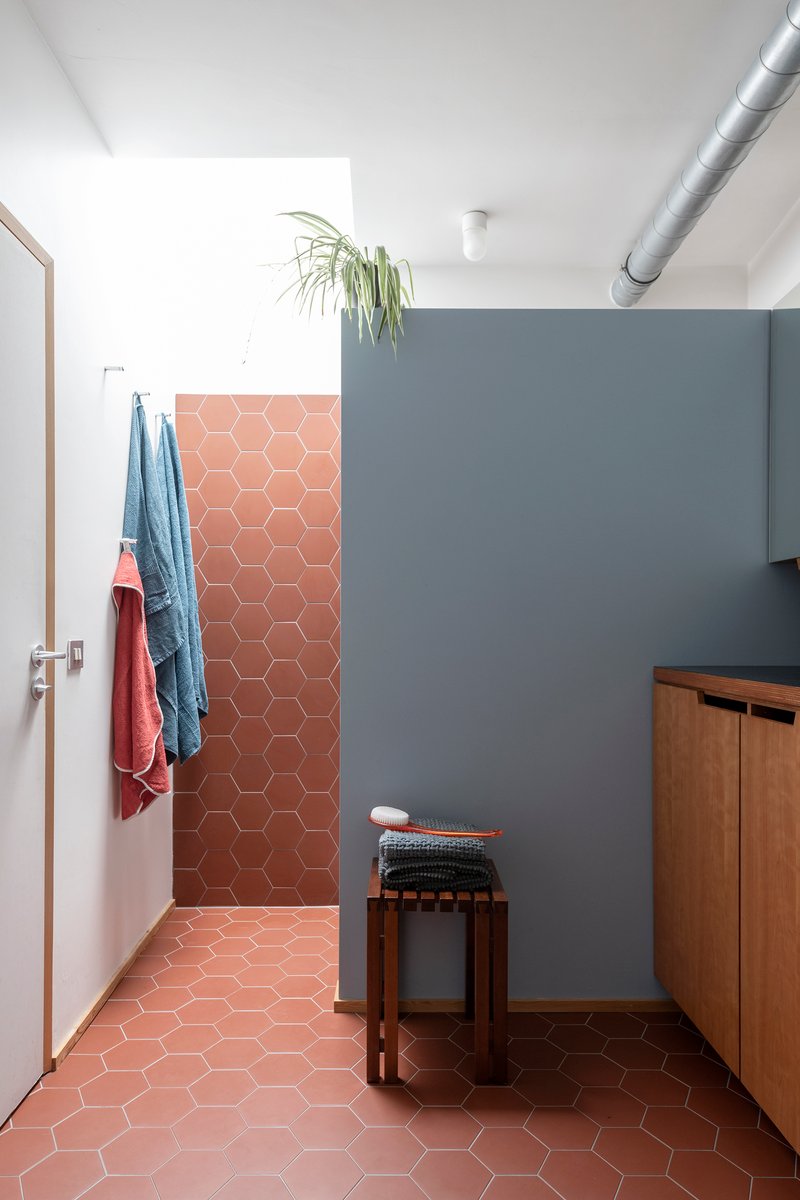
The upper floors contain bedrooms, a bathroom, a music room, and a boiler room, all arranged around the enclosed stairway. Bedrooms are compact but carefully proportioned, with built-in wardrobes and curtained windows that control light and privacy. Views through aligned doorways create a sense of depth that belies the narrowing plan. The bathroom announces itself with terracotta hexagonal floor tiles and a grey partition wall, maintaining the material language established on the living level.
At the top, the house opens to two roof terraces: one facing west and left open to the sky, the other facing east and enclosed. This dual arrangement exploits the east-west site orientation, offering morning and evening outdoor spaces with distinct characters. The sawtooth parapet visible from the street is the enclosure wall for the western terrace, a detail that collapses the distance between urban facade and private retreat.
Ground Level and Garden
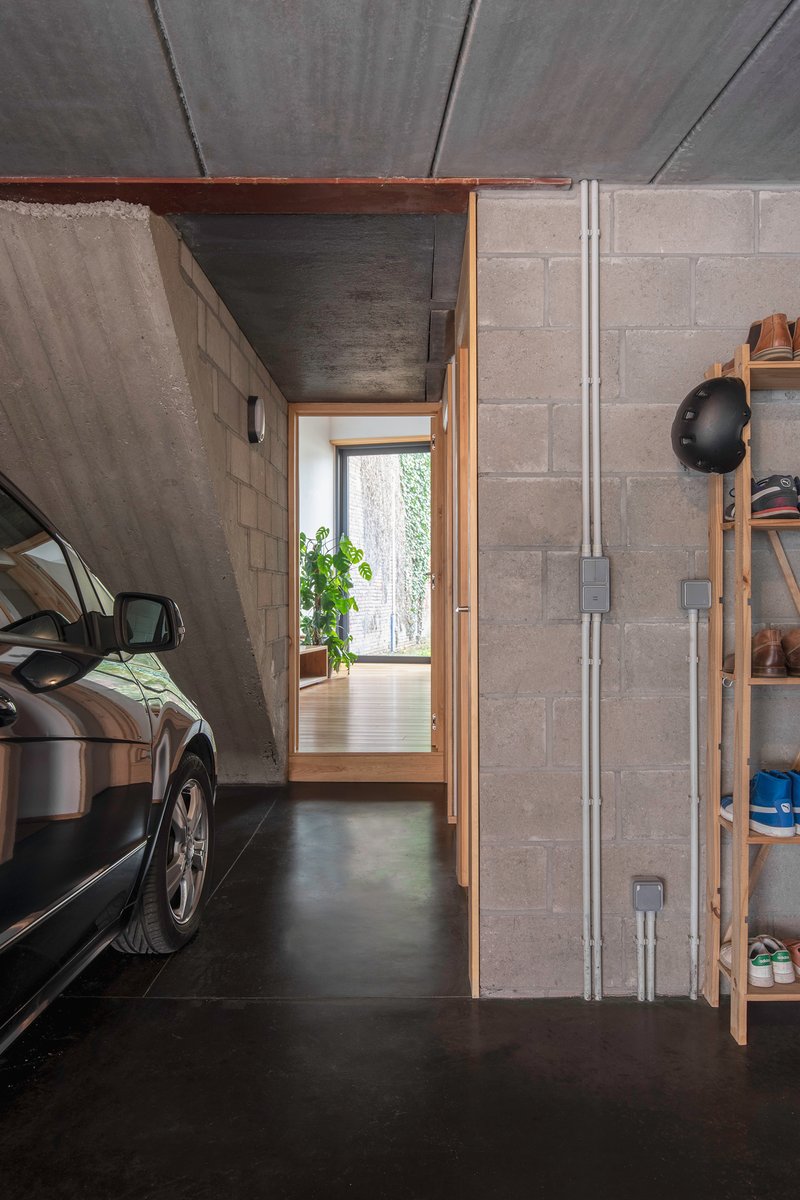
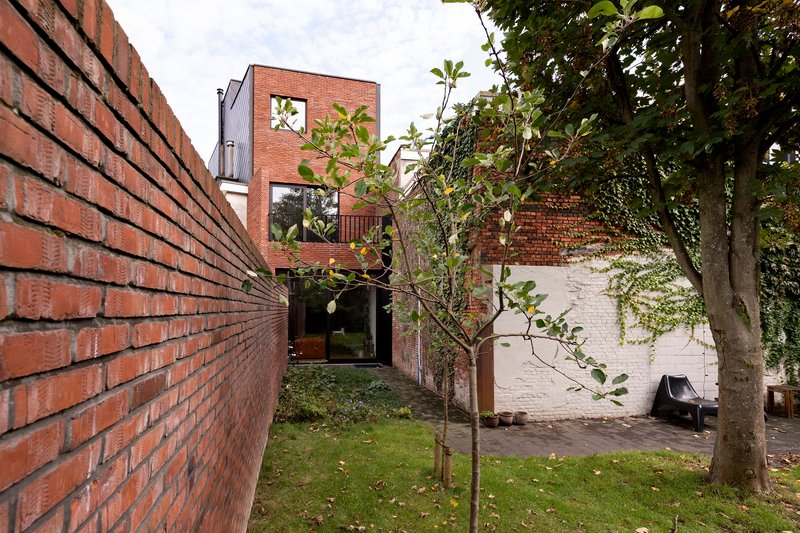
The ground floor is deliberately kept low, housing the garage, bicycle storage, and entrance. Concrete block walls and an exposed ceiling give it an unfinished pragmatism that contrasts with the refined interiors above. A doorway at the rear frames the garden in a single green rectangle, making the transition from car to courtyard feel cinematic. The garden itself is a walled square with young trees and a painted white adjoining structure, a calm outdoor room reclaimed from a previously neglected backyard.
Plans and Drawings
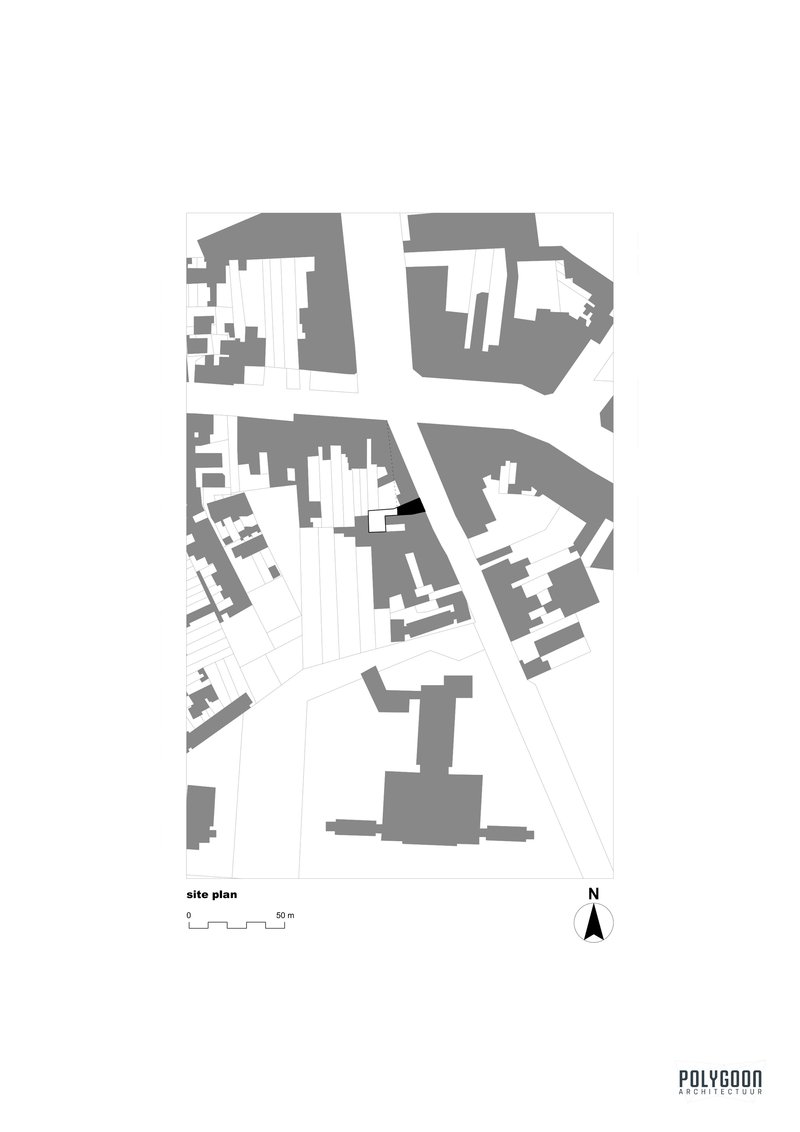
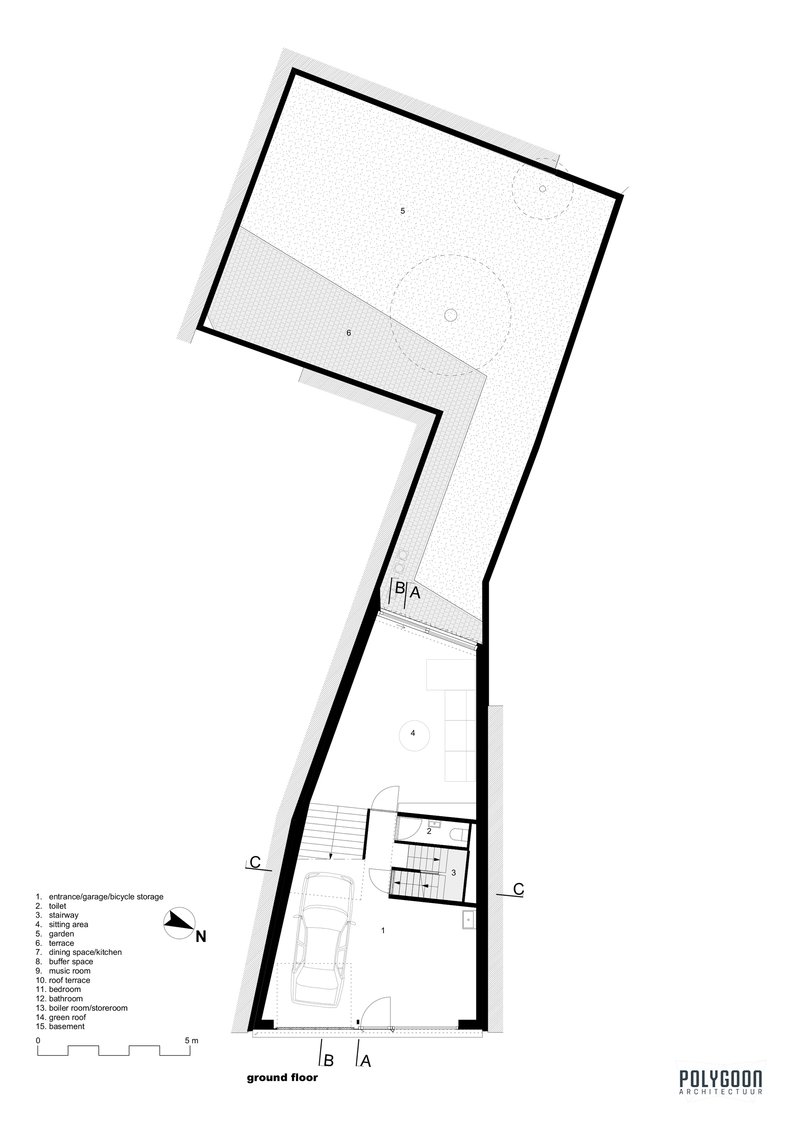
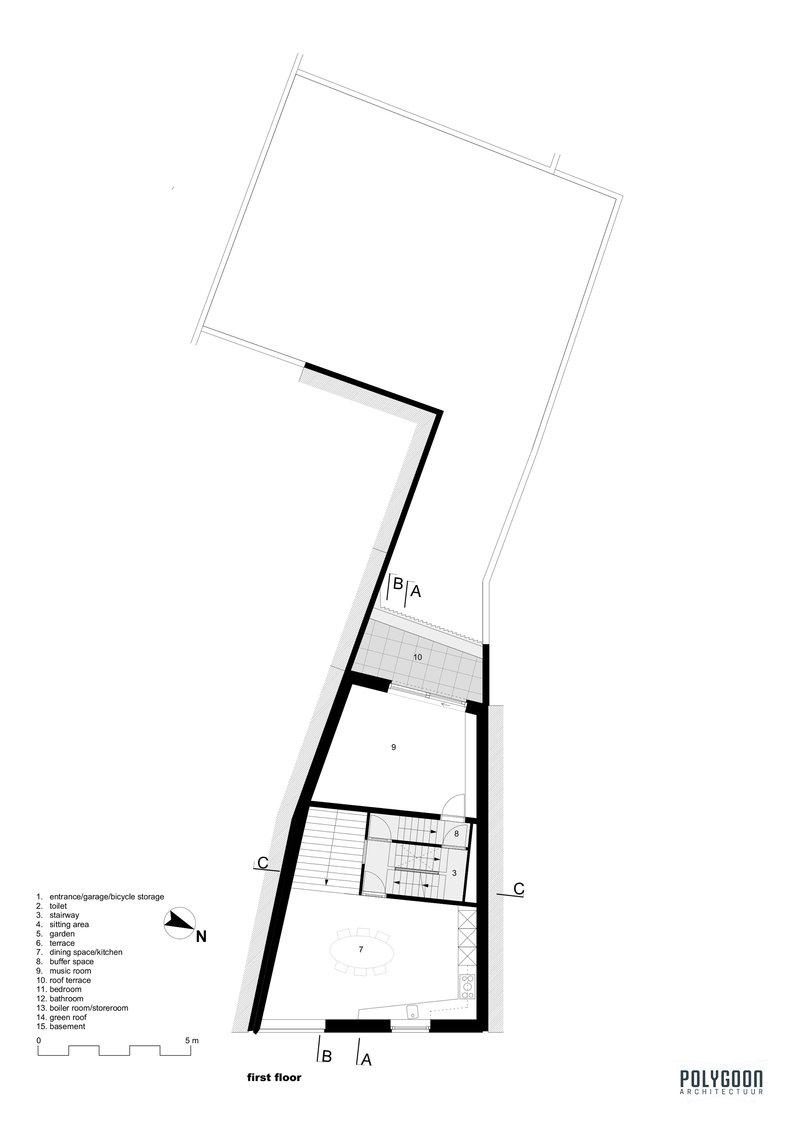
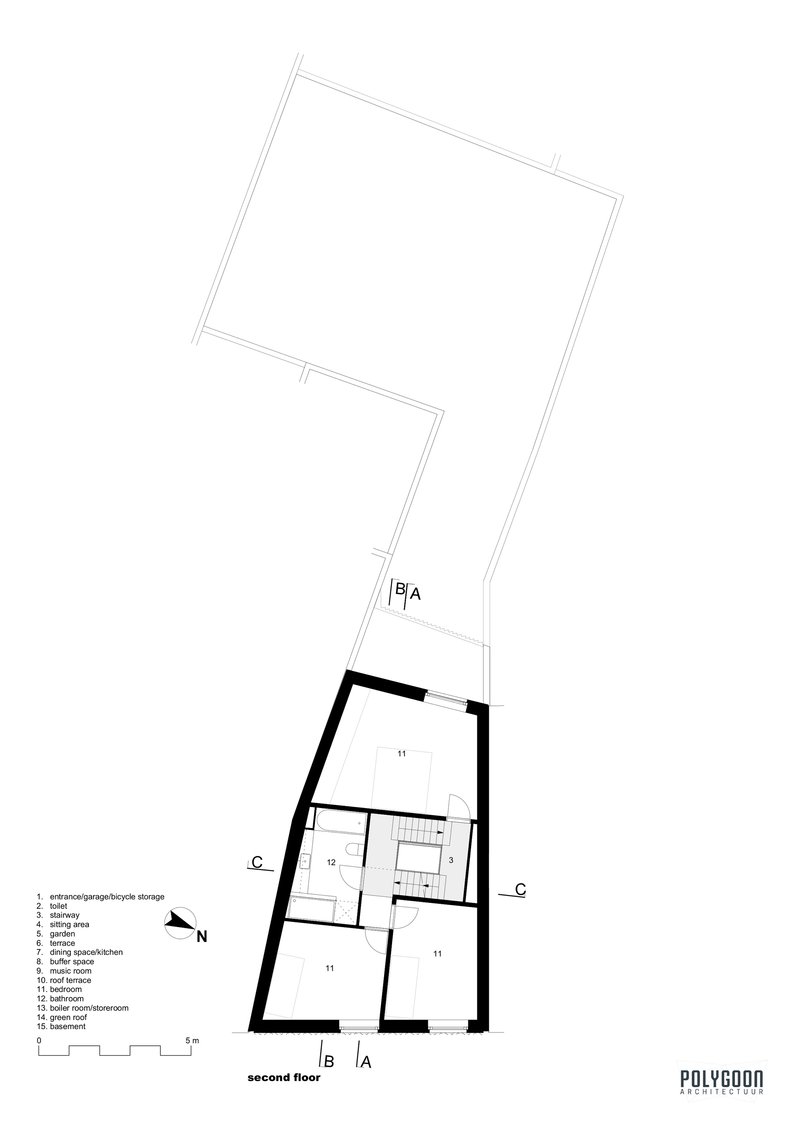
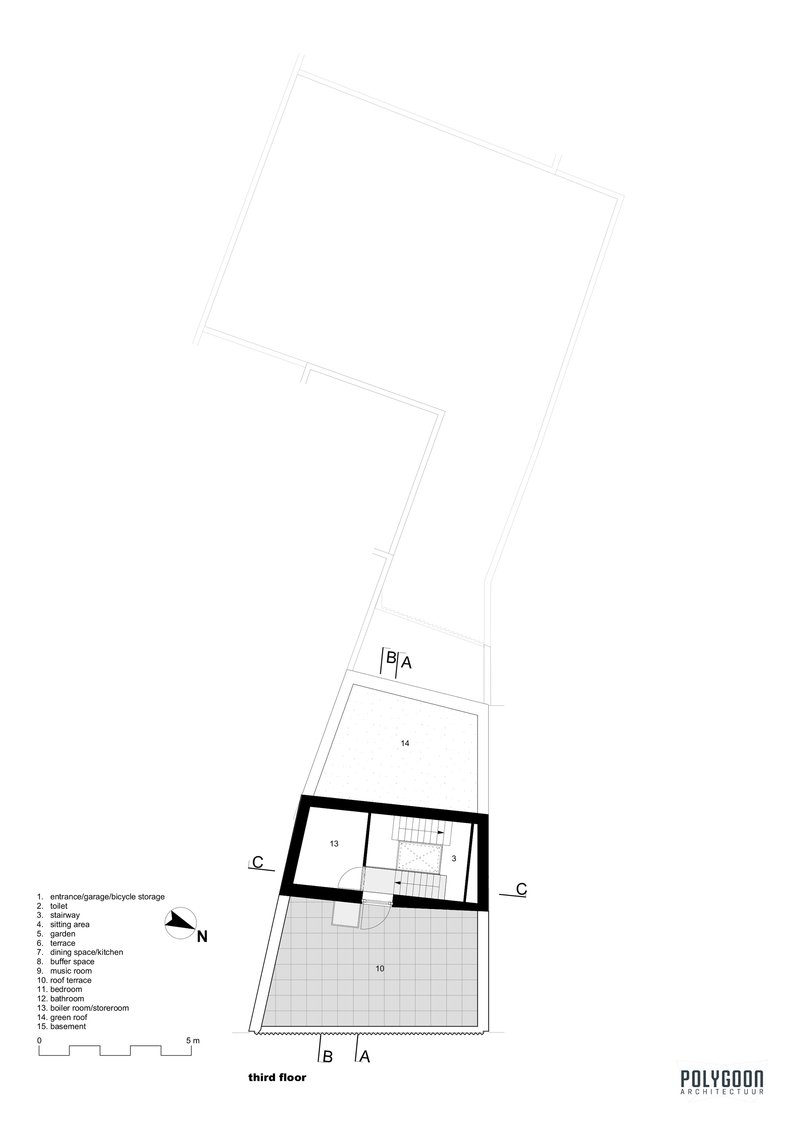
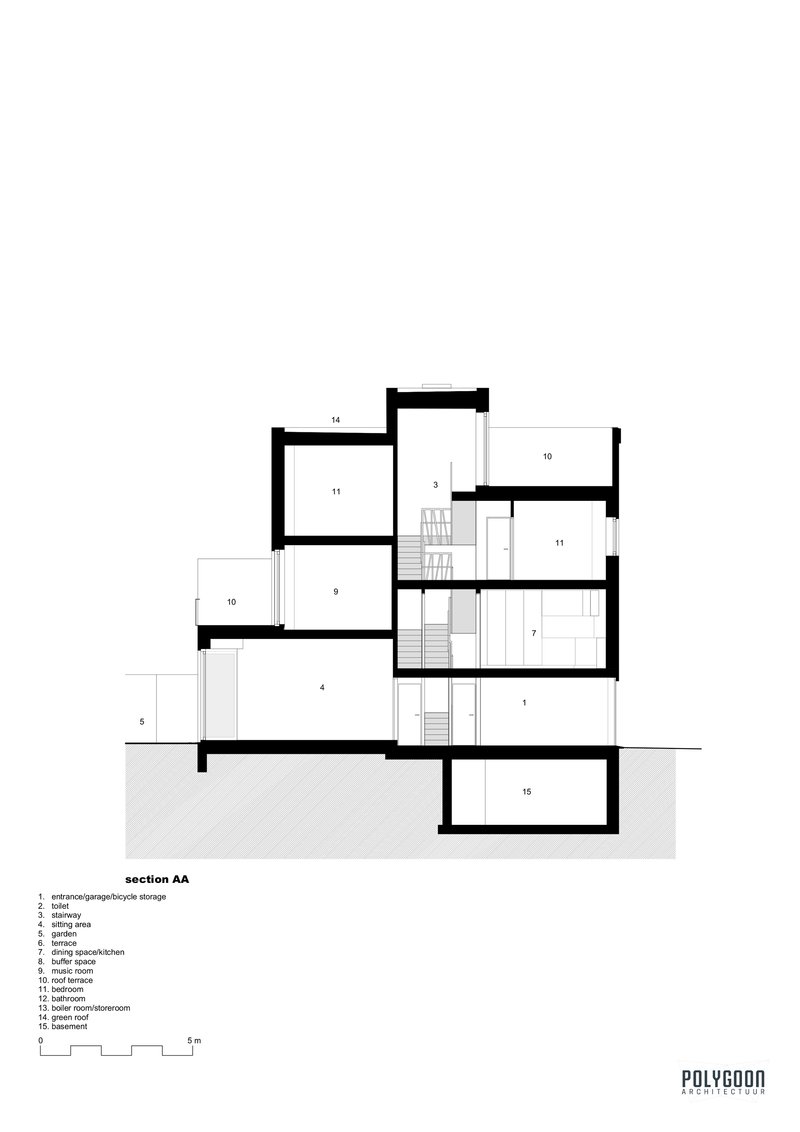
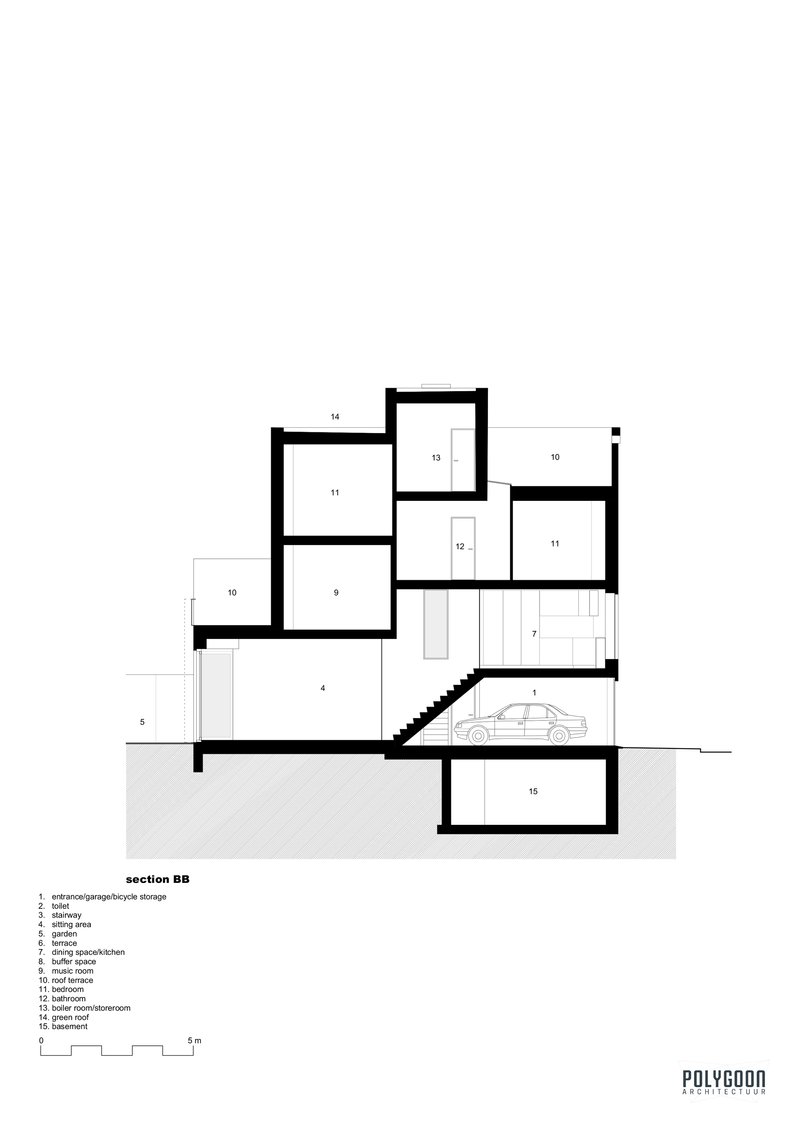
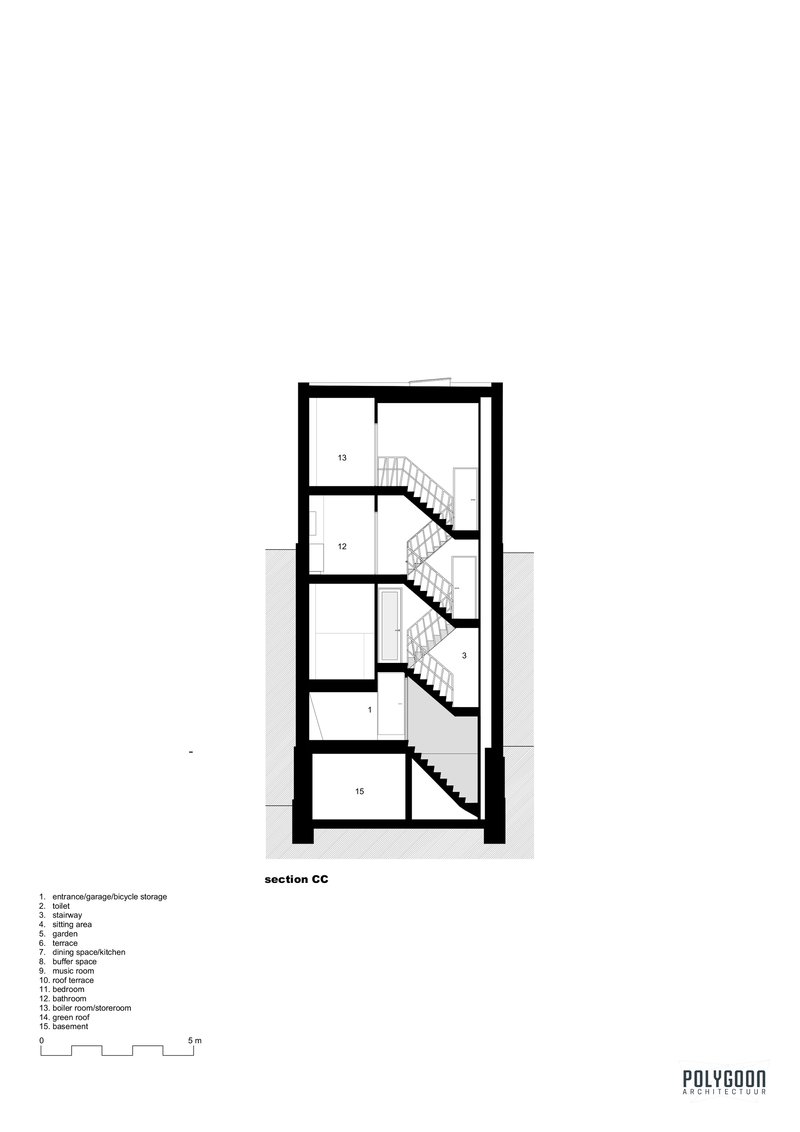
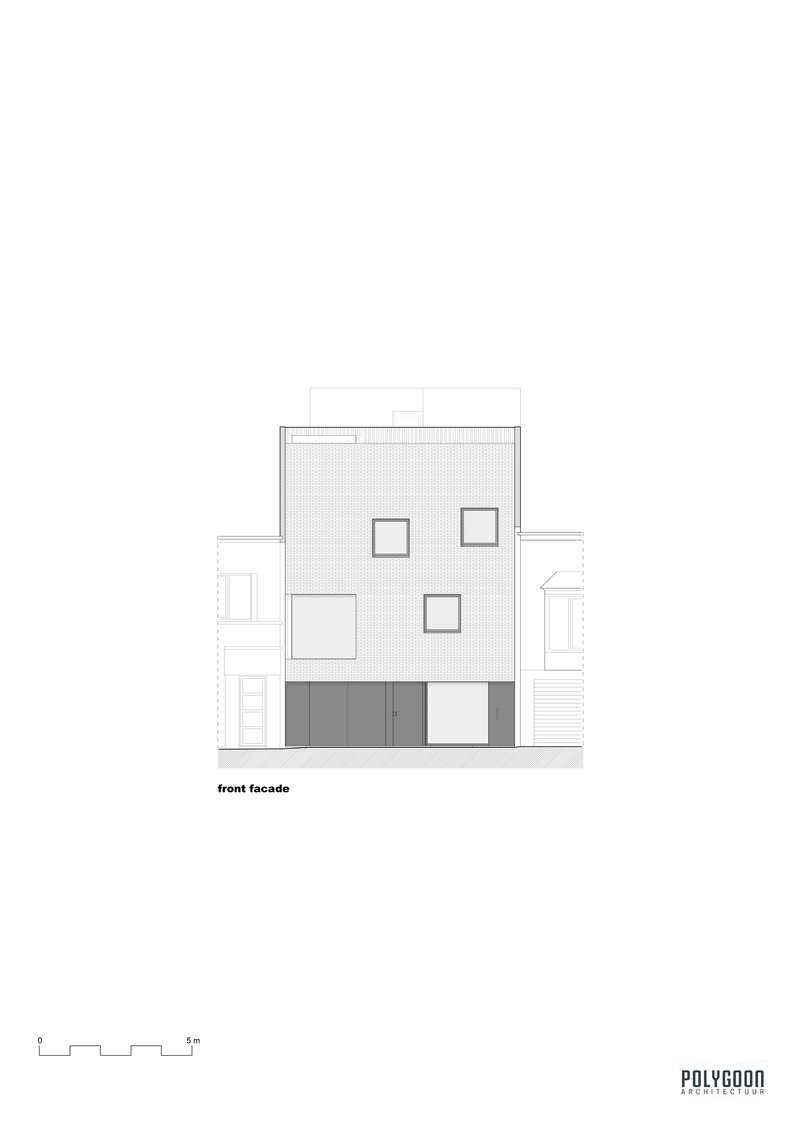
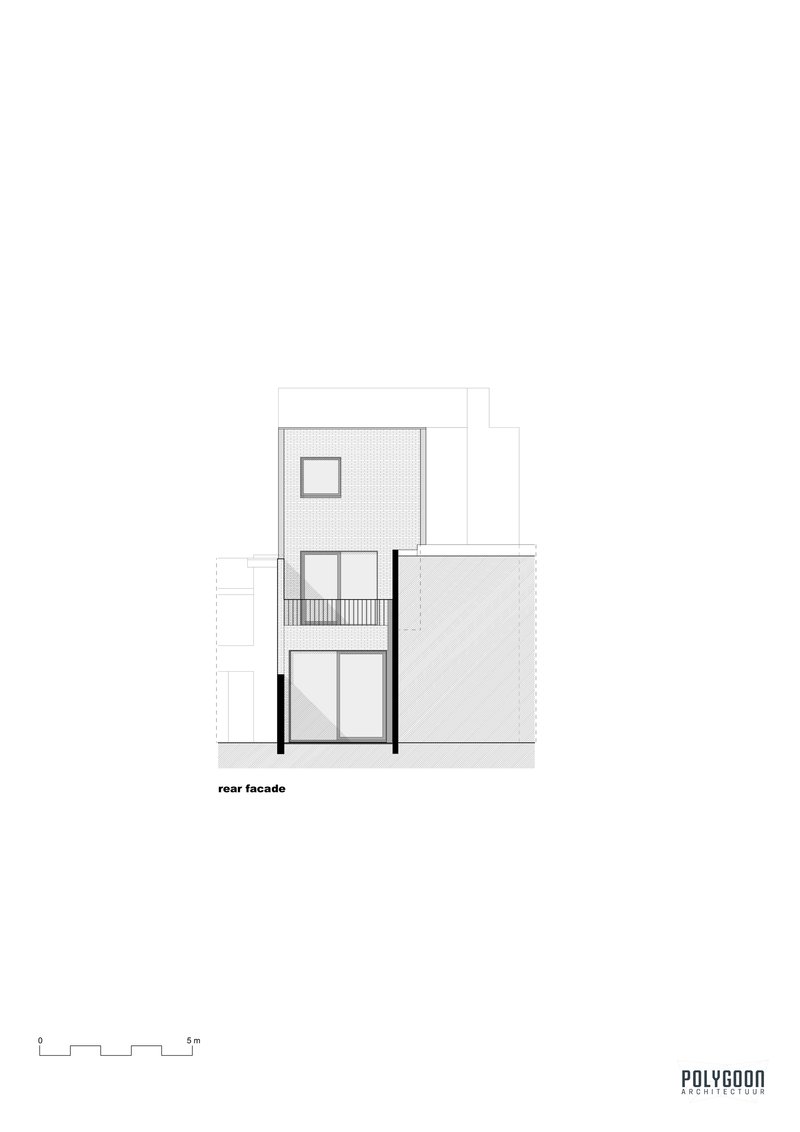
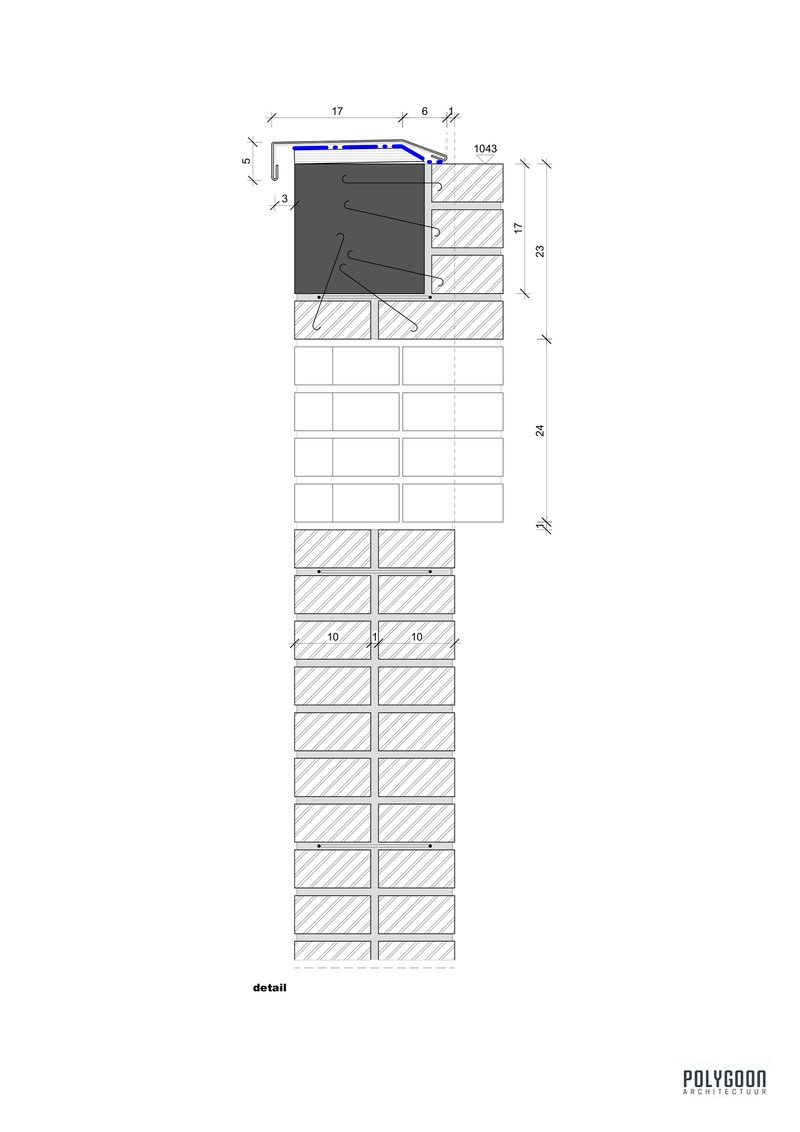
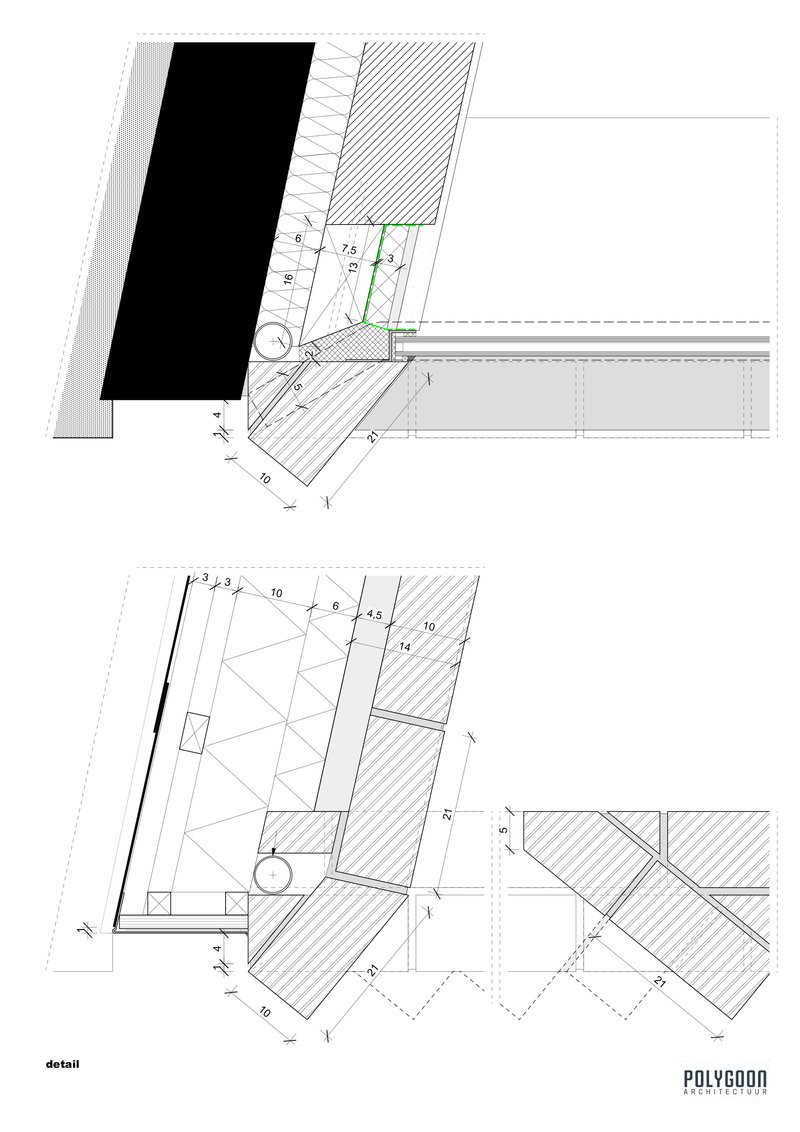
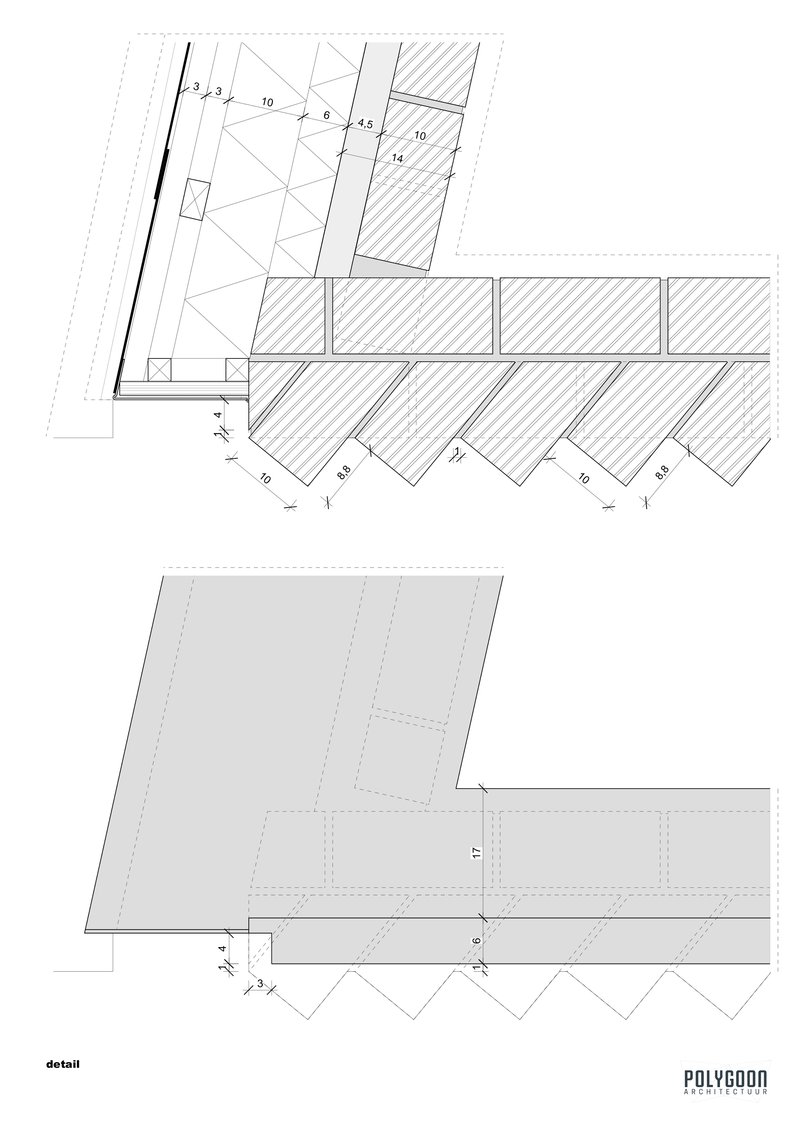
The site plan reveals the full absurdity of the lot: a trapezoid that kinks partway through its depth, narrowing toward the rear garden. The floor plans show how POLYGOON maintained consistent internal angles on every level, ensuring that no room ends in a point. The sections are perhaps the most telling drawings, illustrating the bel-etage split and the way each half-level staggers to follow the site's slope and the street's datum. Detail drawings of the sawtooth bond and the brick cladding system confirm the precision behind what reads, from the sidewalk, as a straightforward brick wall.
Why This Project Matters
Urban infill housing often falls into one of two traps: either it ignores context in favor of architectural spectacle, or it mimics its neighbors so faithfully that it has nothing to say. The Terraced House in Deurne does neither. It adopts the bel-etage typology because the typology works for this street, then deploys a trapezoidal plan geometry that could not exist anywhere else. The sawtooth crown, the calibrated window heights, the stairwell as both light shaft and acoustic buffer: these are specific responses to a specific site, not transferable gestures.
POLYGOON's achievement here is one of disciplined pragmatism. Every architectural decision can be traced back to a site constraint or a programmatic need. There is no formal excess, no gratuitous complexity. The house is 245 m² on a lot most developers would have written off, and it feels generous. That alone is a lesson worth studying: the most productive design energy is often released not by freedom, but by the tightest possible constraints.
Terraced House in Deurne by POLYGOON Architectuur. Antwerp, Belgium. 245 m². Completed 2020. Structural engineering by Planet (Sweco). Cabinetwork by Leo Boits. Photography by Jessy van der Werff.
About the Studio
Share Your Own Work on uni.xyz
If projects like this are the kind of work you want to make, uni.xyz is a place to publish your own, find collaborators, and enter design competitions.




Popular Articles
Popular articles from the community

ONA Threads Four Board-Formed Concrete Cabins Along a 260-Meter-Deep Site in Mendoza
At the edge of Argentina's wine country, a set of curved concrete lodges negotiate a razor-thin parcel between city and mountain.

The Heart of Milano: Slow Fashion Architecture for a New Circular Culture
The Heart of Milano turns slow fashion architecture into a civic landmark where learning, making, sharing, and circular culture meets daily.
R/URBAN DESIGN OFFICE Carves a Communal Living Room from a Tokyo Corporate Dormitory
In Shinagawa's Oi district, a 35-year-old reinforced concrete tower becomes a 49-unit rental residence with shared spaces that redefine cohabitation.
GGR Architectes Anchors a New Neighborhood in Frouzins with a Brick and Timber School Complex
A cruciform plan of terracotta brick and exposed wood frames four courtyards for 140 students outside Toulouse, France.


Similar Reads
You might also enjoy these articles
Freebird Residence by Alexis Dornier: A Tropical Modernist Sanctuary in Bali
Floating living pavilion above pool anchors H-shaped tropical villa, blending Japanese minimalism, sustainable strategies, lush landscape, and sculptural interiors.
127af Flips a Tiny Bagnolet Rowhouse Upside Down with a Handcrafted Roof Extension
A 55-square-meter terraced house on the edge of Paris gains a luminous upper living floor through lightweight timber and steel.
1.61 Design Workshop Wraps a 600-Square-Meter Café in Vietnam in Sculptural Burgundy Drama
Reden Café & Bistro pairs a helical staircase, mosaic floors, and deep red interiors to rethink Vietnamese hospitality space.

The Unbound Brain: A School Shaped by Cognitive Architecture
Cylindrical learning pods radiate like neurons from a central cortex, turning the floor plan into a spatial model of human thought.


Explore Landscape Design Competitions
Discover active competitions in this discipline




The Global Benchmark for Architecture Dissertation Awards


Challenge to design mud housing for contemporary communities
Comments (0)
Please login or sign up to add comments
No comments yet. Be the first to comment!