
Qukan Dissolves the Wall Between a Hokkaido House and Its Neighboring Park
A tent-fabric curtain wall replaces rigid boundaries, turning a small residential park into an extension of domestic life in Japan.


Houses that face public parks rarely acknowledge them. Privacy concerns win out, and what could be a generous relationship between domestic life and communal green space becomes a standoff of blank walls and drawn blinds. Qukan’s Opening Next to the Park House, completed in 2019 in Hokkaido, Japan, inverts that reflex entirely. Rather than fortifying the eastern elevation against a small children's park across the street, the architects removed the wall altogether, replacing it with a full-height curtain of tent fabric that can be drawn open or closed depending on mood, season, and the social temperature of the moment.
The result is a 139 m² two-storey dwelling that treats the boundary between inside and outside not as a line but as a zone. That zone, which Qukan describes as an "outer living room, inner garden," is the real subject of the project. It is a timber-framed threshold space that belongs neither fully to the house nor to the street, and its ambiguity is the source of the design's quiet power.
A Facade That Chooses Not to Be One
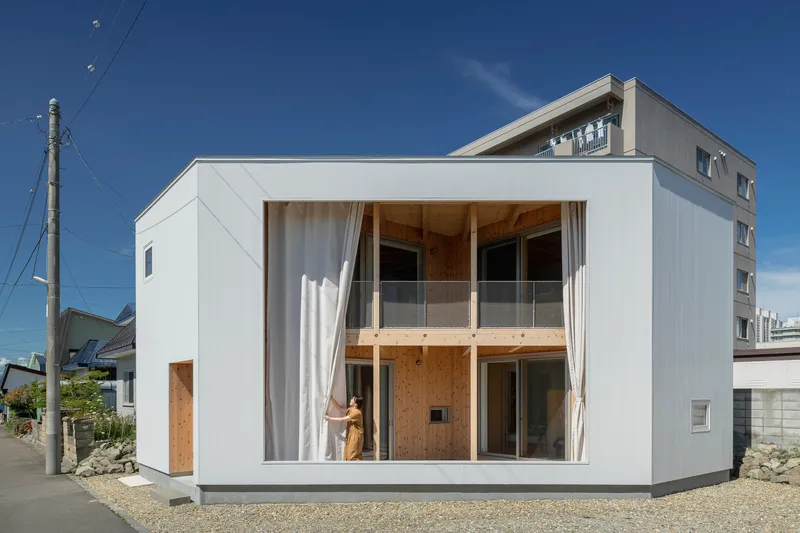
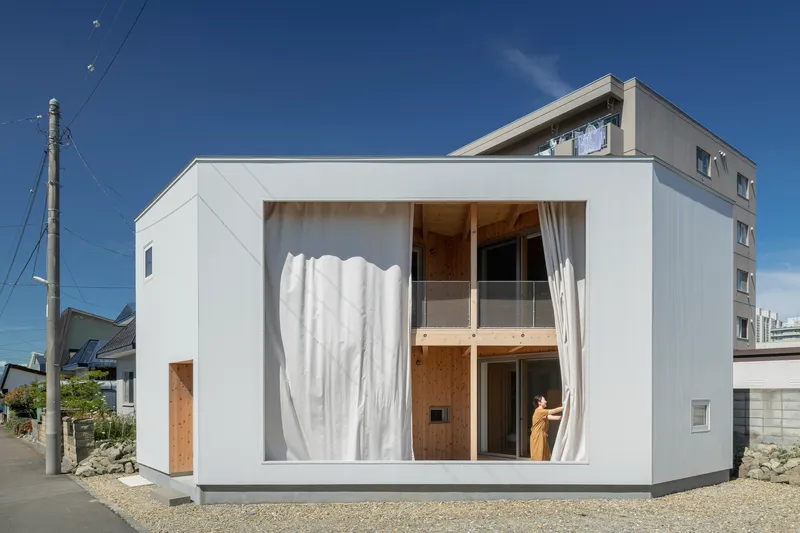
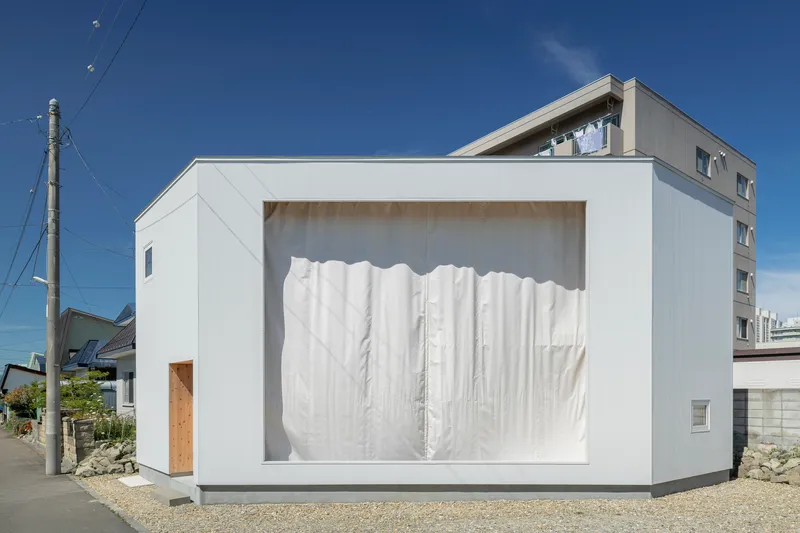
The eastern face of the house reads less as a facade and more as a stage set waiting for its curtain call. Floor-to-ceiling glazing sits behind large panels of white tent fabric that can be pulled across or tied back to timber posts. When the curtains are closed, the elevation presents a pale, diffused screen that softens light and obscures figures into silhouettes. When they are open, the interior is on full display: living room as public spectacle, park as borrowed garden.
The mechanism is deceptively simple. Tent fabric is lightweight, weather-resistant, and costs a fraction of what a motorized louver system would. But its implications are significant. The occupants are given agency over how much of the city they let in, not through the binary logic of a curtain wall with operable panels but through the analog, bodily act of pulling fabric by hand. It is architecture that demands participation.
White Volume, Residential Context
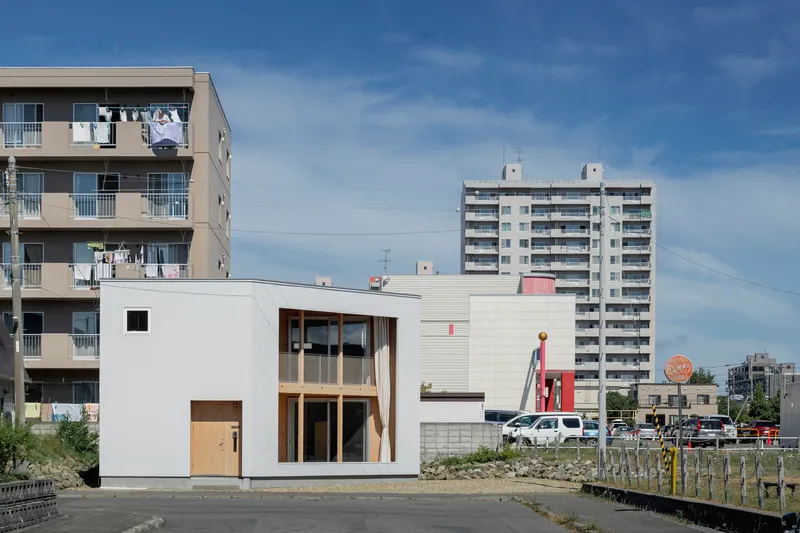
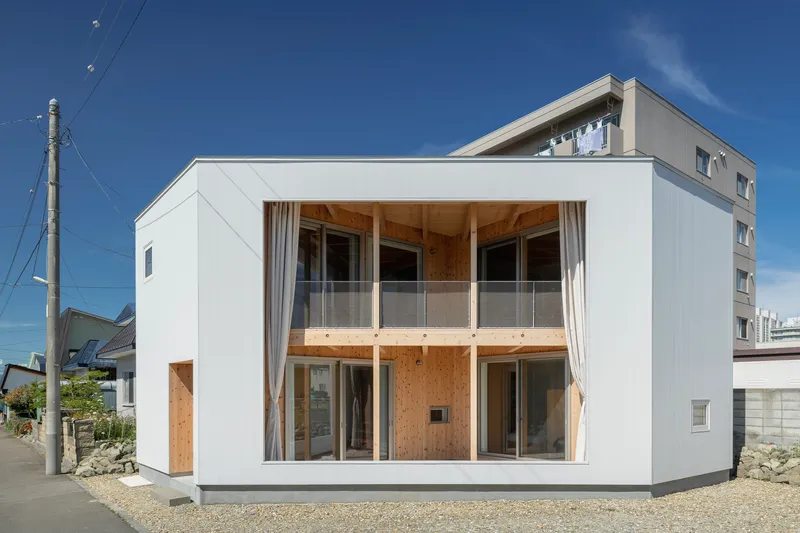
From the street, the house is a crisp white metal-clad volume sitting on a quiet residential corner. Against the backdrop of mid-rise apartment buildings and the modest scale of suburban Hokkaido, it holds its own without shouting. The double-height glazed opening on the park-facing side punctuates the otherwise restrained envelope, hinting at the spatial drama within. Plywood reveals at the frame edges give the composition warmth and signal the material strategy that governs the interior.
The white stucco and metal cladding read as deliberately neutral. Qukan seems uninterested in making a sculptural statement on the exterior. The house's argument is spatial, not formal, and the facade is honest about that: it is a container whose real invention lies in the threshold it creates between private life and the park.
The Timber Threshold
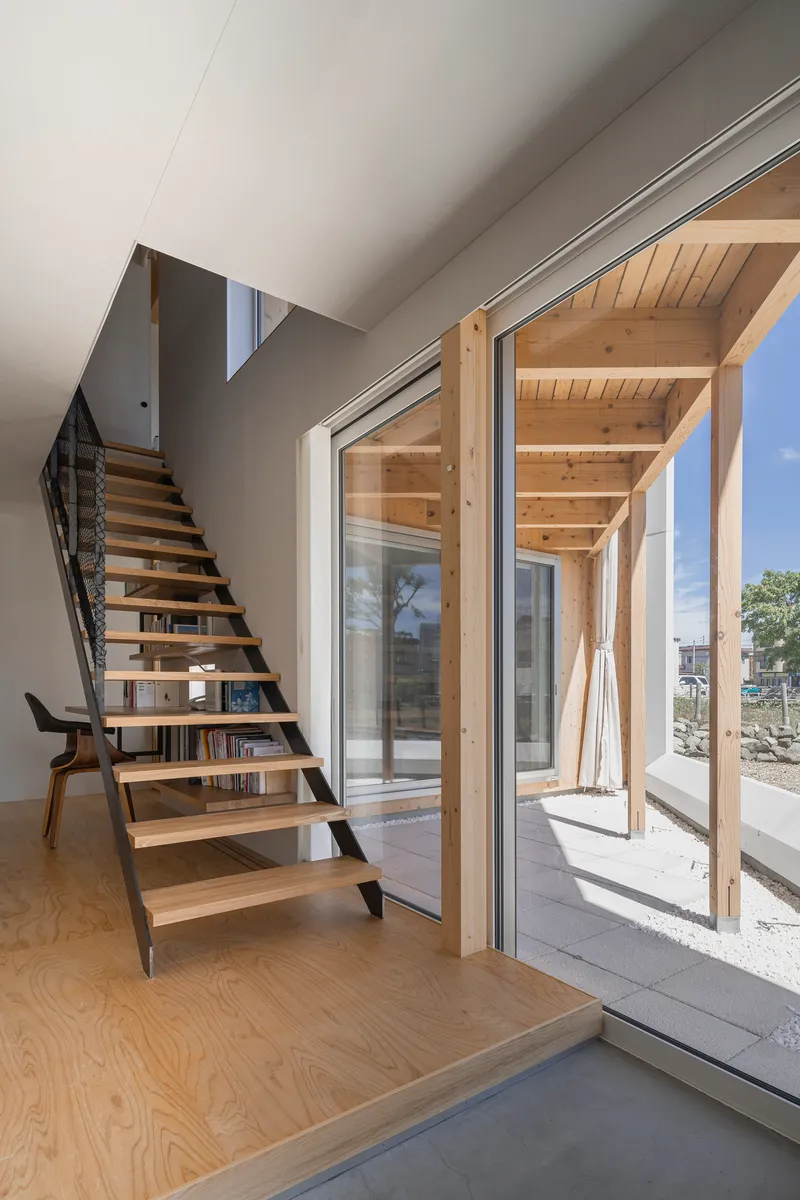
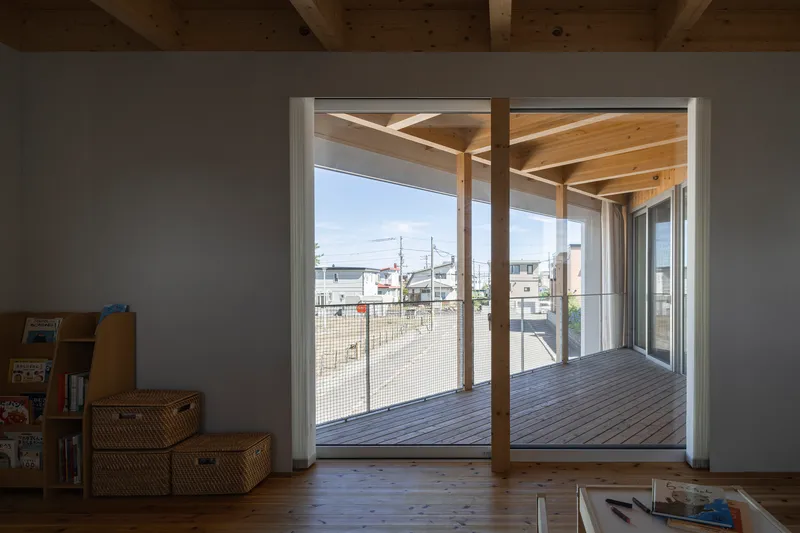
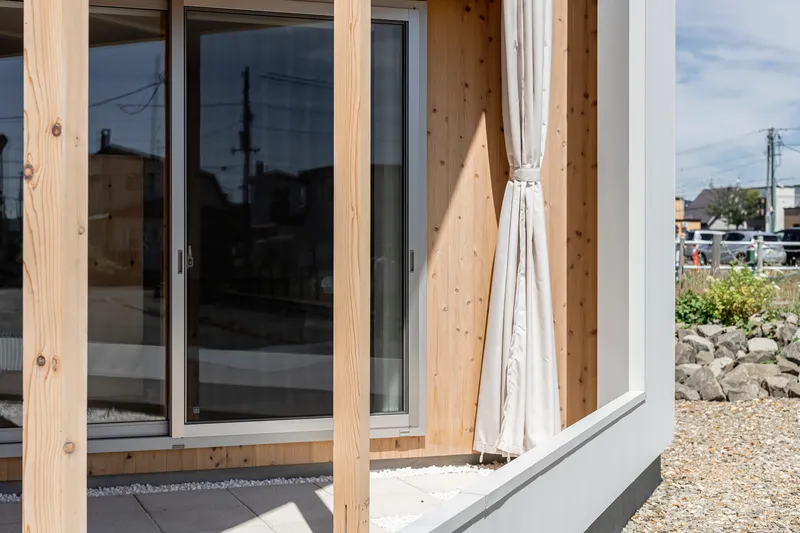
Step inside and the transition from exterior to interior is deliberately prolonged. A covered timber deck, framed by exposed posts and ceiling joists, functions as a veranda at the ground floor level and extends the living space outward. Sliding glass doors separate this zone from the heated interior, but when open, the deck and the living room merge into a single continuous surface. The gravel courtyard below acts as an inner garden, pulling daylight down into the ground floor.
The detail of tied fabric curtains against sunlit timber posts is worth pausing on. There is a tactile quality to this space that photographs almost undersell. The grain of the plywood, the texture of the tent fabric, the warmth of exposed beams: these are not decorative choices but structural ones, left visible because they communicate how the house is made. Honesty of construction becomes a kind of ornament.
Living Under Exposed Structure
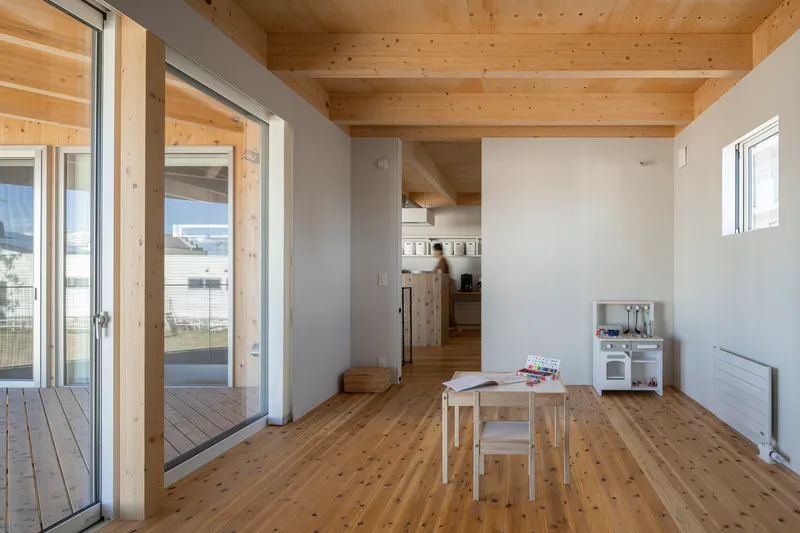

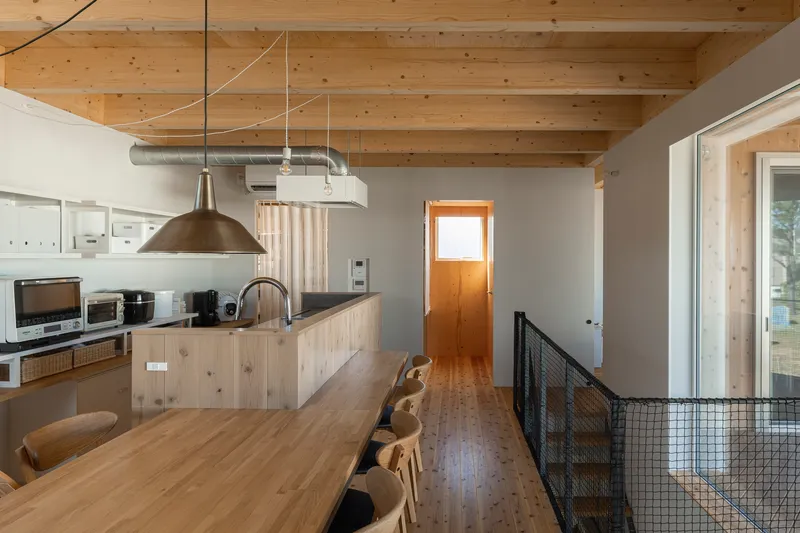
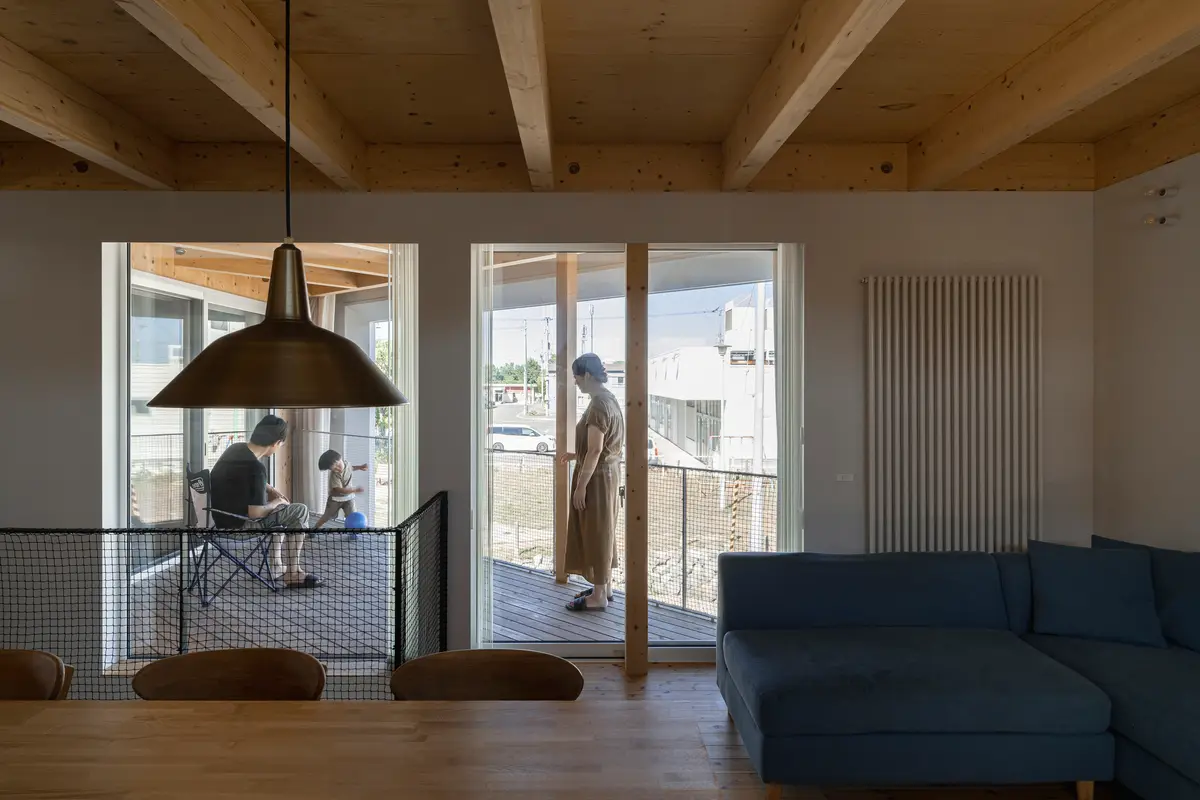
The upper floor is organized as a single open living area where kitchen, dining, and sitting zones flow into one another beneath a ceiling of exposed timber beams. A stainless-steel kitchen island anchors the cooking zone, pendant lights hang from the joists, and exposed ductwork runs frankly overhead. The palette is plywood, white surfaces, and steel, with no applied finishes competing for attention.
Wire mesh guardrails at the stair opening allow light and sightlines to travel between levels without interruption. The split-level section means that the second floor sits at a slight elevation change, creating spatial variety within what is, on plan, a compact footprint. Residents move through the house on a gentle vertical journey rather than inhabiting a stack of flat planes.
Circulation and Detail
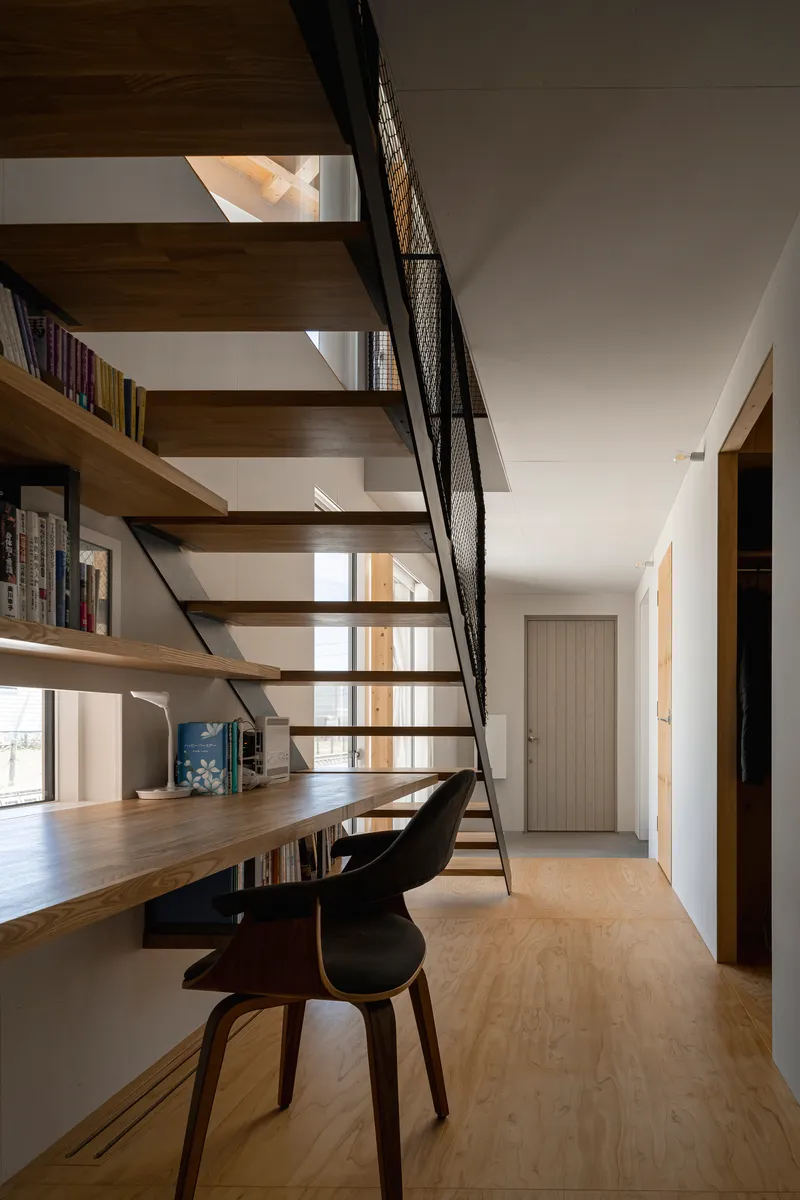
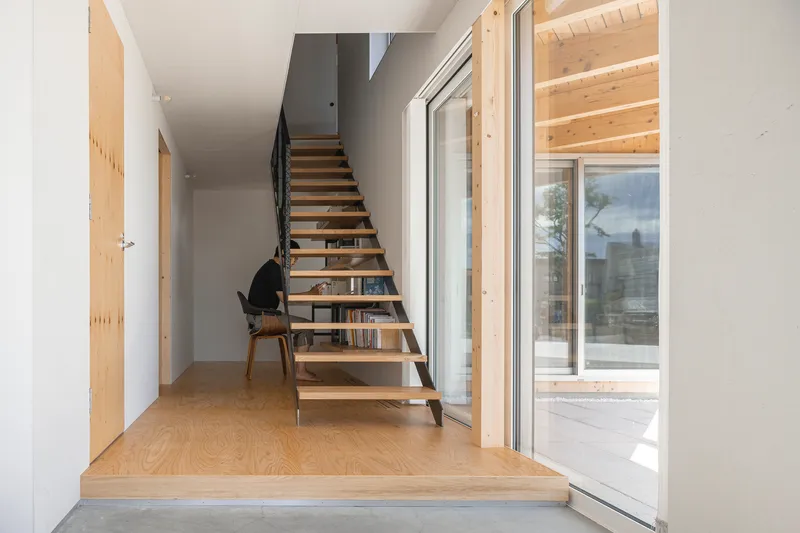

The open-tread staircase, with its black steel frame and mesh rail, is the vertical spine of the house. A built-in timber desk is tucked alongside it, turning what might be wasted circulation space into a study nook. This kind of pragmatic cleverness recurs throughout: a narrow storage corridor lined with timber shelving maximizes capacity without consuming floor area, and the compact plywood bathroom proves that material consistency can make even a tight room feel considered rather than compromised.
Service Spaces and Material Consistency
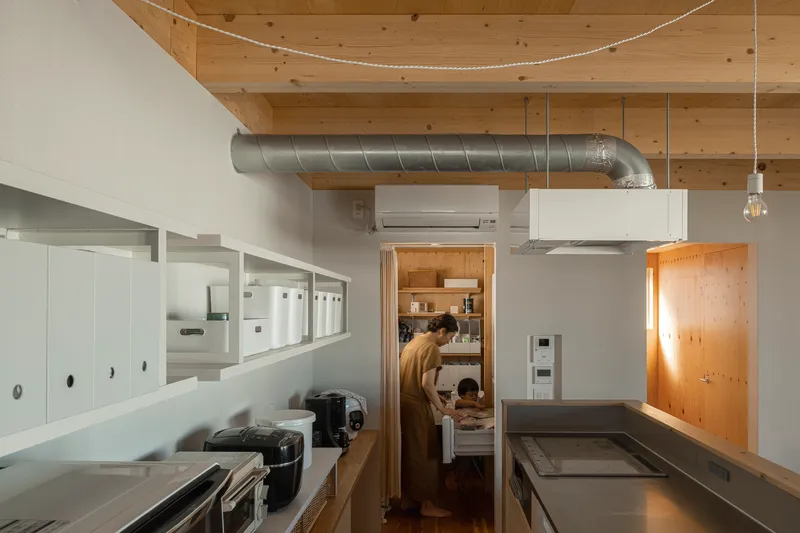
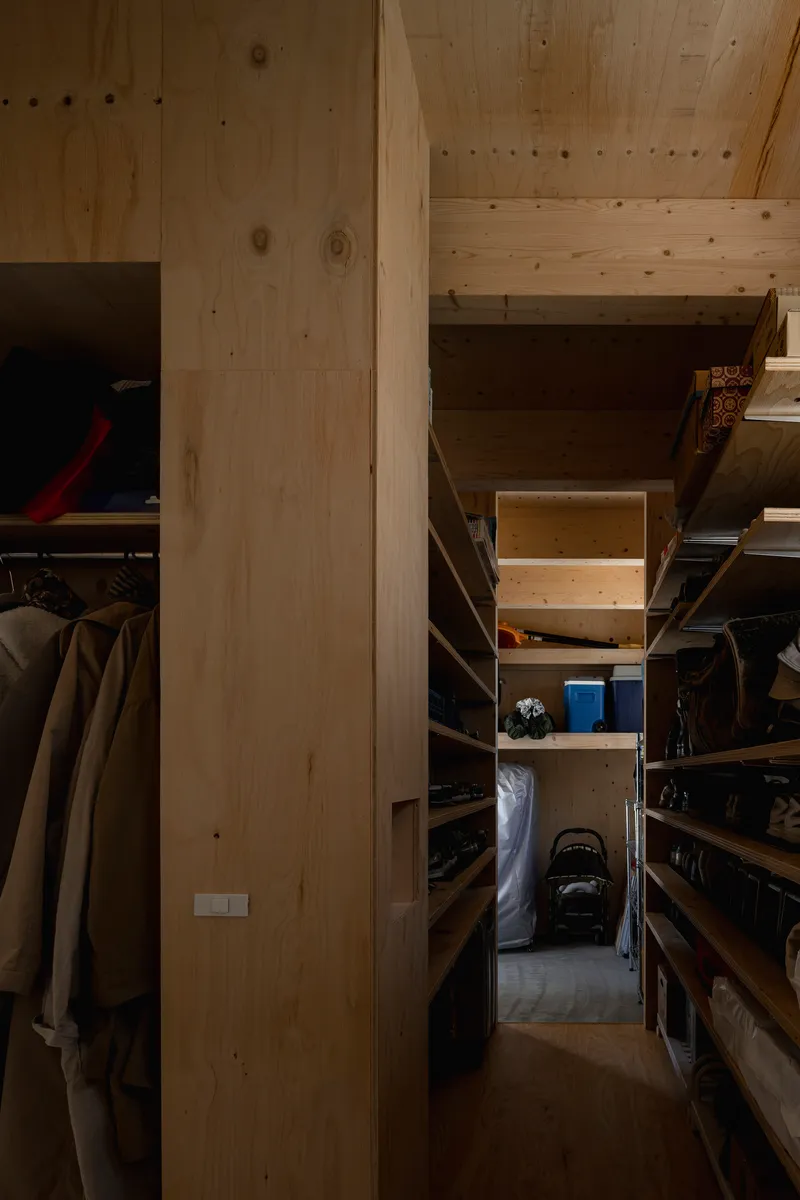
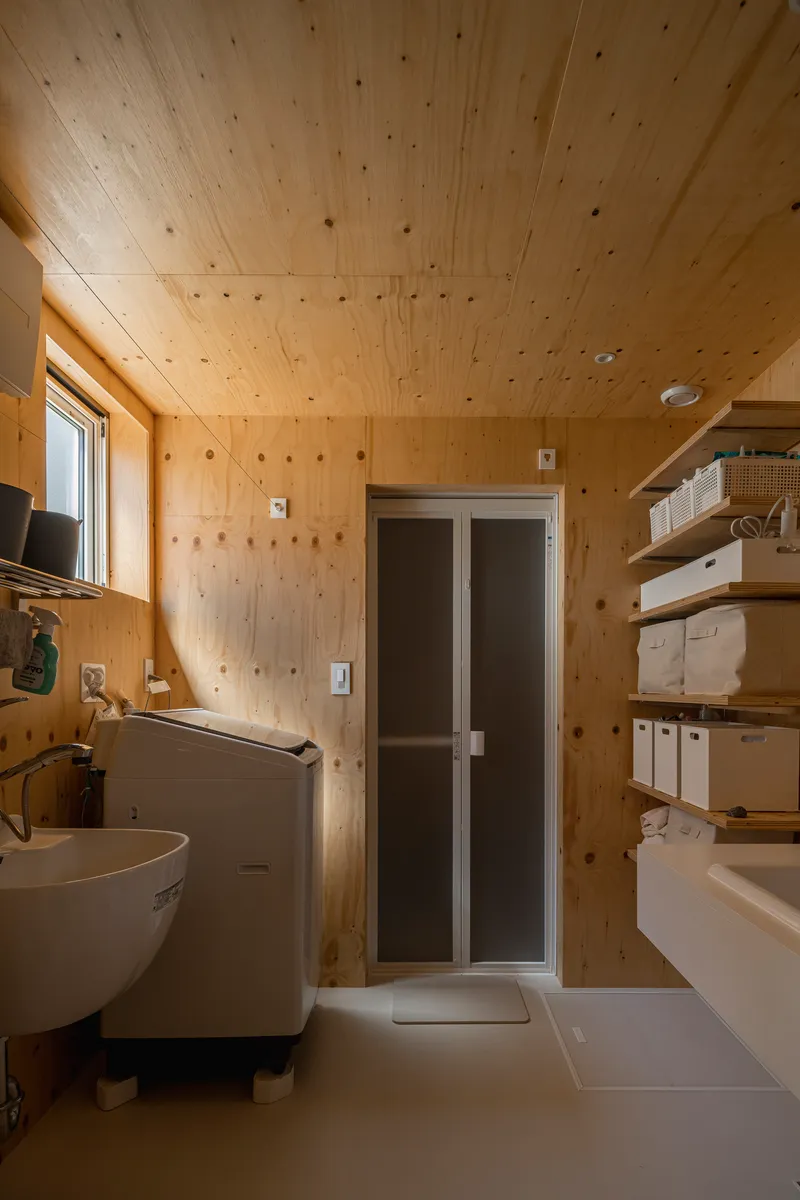
The secondary spaces, pantry, storage corridor, and bathroom, are clad entirely in plywood, continuing the material language of the primary living areas without hierarchy. A kitchen workspace with overhead exposed duct and white storage boxes sits behind the main kitchen, functioning as a service back-of-house that keeps the open plan uncluttered. The bathroom's frosted glass shower door and wall-mounted sink demonstrate that restraint and warmth can coexist in a utility room.
What impresses here is the refusal to treat secondary rooms as afterthoughts. The same care given to the double-height curtain wall is applied to a storage closet. That evenness of attention is a hallmark of residential work that will age well.
The Covered Terrace as Borrowed Landscape
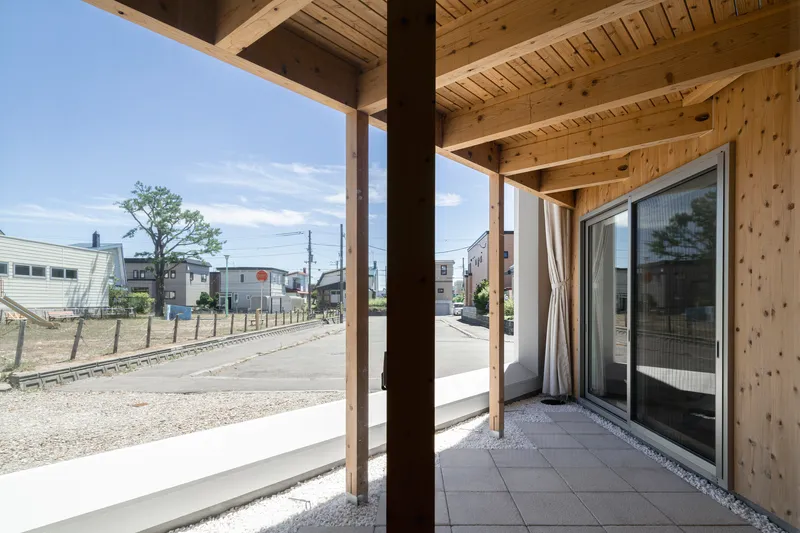
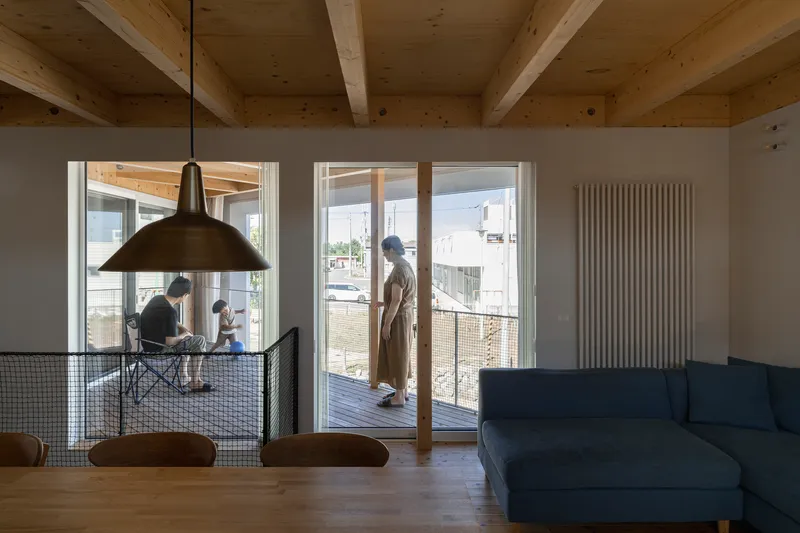
The covered terrace on the upper level looks out over neighboring houses and the gravel lot below. Timber posts and joists frame views of the surrounding residential fabric without filtering them. There is no attempt to create a private oasis; instead, the terrace embraces its context, borrowing the rooflines and sky of the neighborhood as its outlook. On a clear Hokkaido day, with family gathered at the dining table just inside the glass doors, the distinction between interior comfort and exterior exposure narrows to almost nothing.
Plans and Drawings
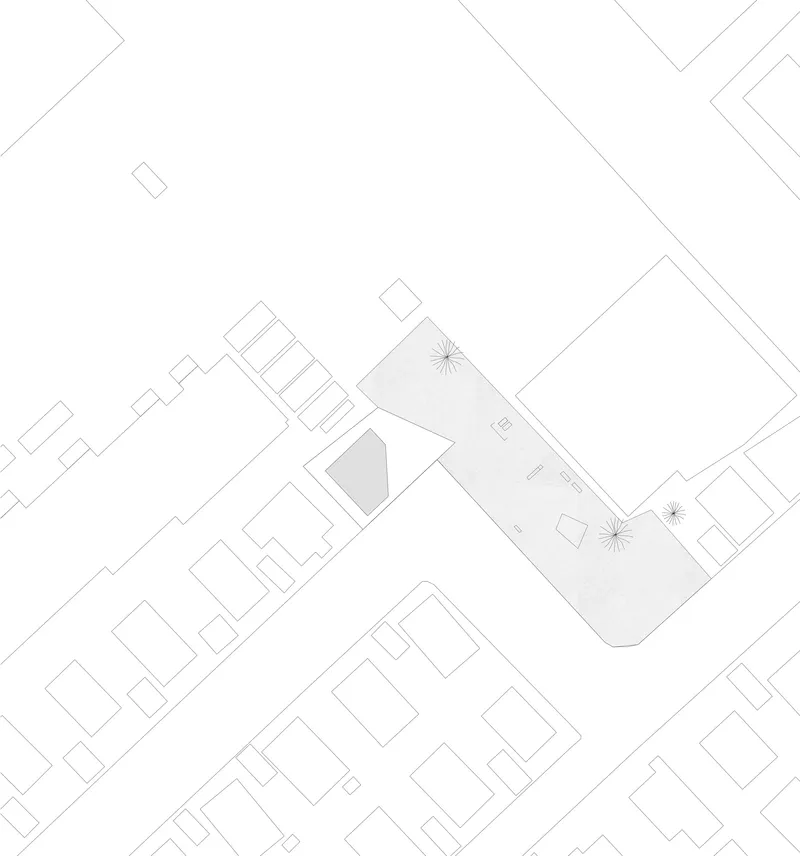
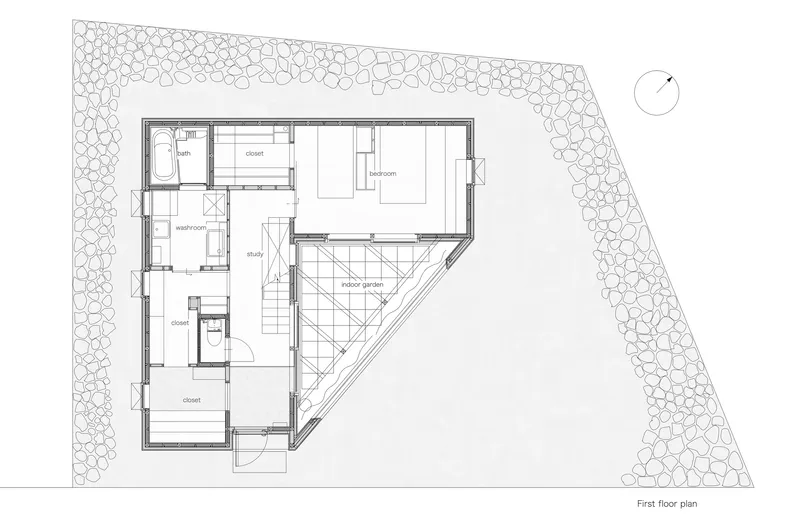

The site plan reveals the trapezoidal volume positioned at an angle to its rectangular neighbors, carving out a triangular courtyard that faces the park. The first floor plan shows the courtyard punched into the building mass with a gravel perimeter, while the second floor plan opens up into the angled outdoor living space with clerestory windows drawing light deep into the section.
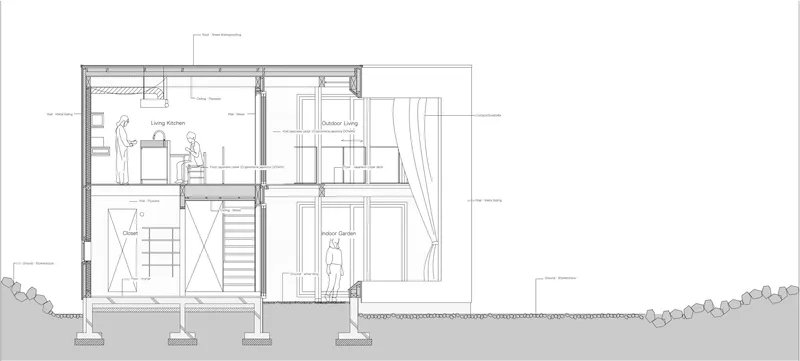
The section drawing is particularly revealing. The split-level interior is raised on concrete piers, creating a slight separation from the ground that allows ventilation beneath the floor, a sensible move in Hokkaido's climate. Figures placed at different levels illustrate the gentle vertical sequence: from the inner garden at grade, through the timber threshold, up to the main living level, and out onto the elevated terrace. The house is not tall, but its section is rich.
Why This Project Matters
The Opening Next to the Park House challenges a default assumption in residential design: that proximity to public space is a problem to be solved with walls. Qukan treats it as an opportunity, and the tent-fabric curtain wall is a low-tech, high-impact response that gives residents control without imposing a fixed condition. In a country where the relationship between private houses and their immediate surroundings is often mediated by fences, hedges, and frosted glass, this house's willingness to be porous is quietly radical.
Beyond the conceptual gesture, the project succeeds because of its material discipline and spatial generosity within a modest footprint. Every room is made from the same vocabulary of plywood, steel, and exposed structure. Every threshold is designed to slow the transition between inside and outside. At 139 m², it feels larger than it is, not through tricks of scale but because its boundaries are genuinely negotiable. That is a lesson worth carrying forward.
Opening Next to the Park House, designed by Qukan, Hokkaido, Japan. 139 m², completed 2019. Photography by Ikuya Sasaki.
About the Studio
Share Your Own Work on uni.xyz
If projects like this are the kind of work you want to make, uni.xyz is a place to publish your own, find collaborators, and enter design competitions.


Popular Articles
Popular articles from the community


Opera on the Sea: Driftwood Logic Shapes a Timber Opera House on Estonia's Coast
Trevor Orgill's opera house translates the entangled drift of floating timber into a civic building where wood, water, and music converge.


David Ortega Stacks a Two-Story Mexico City Penthouse Around a Steel Stair and a Pergola-Shaded Roof Terrace
In Colonia Roma, a 300 m² penthouse uses oak joinery, a planted steel stair and a slatted roof pergola to make a new-build apartment feel like a house.

Manzana Morphosis: Stretching Barcelona's Grid into a Living Landscape for 2050
A radical reworking of the Eixample manzana turns density into a tool for generous public space, vertical ecology, and environmental performance.

FCC Arquitectura Expands a Portuguese Granite House with a Board-Marked Concrete Wing
In Portugal, JV House pairs a cleaned-up whitewashed and granite dwelling with a timber-shuttered concrete extension, courtyards and a garden pool.

Similar Reads
You might also enjoy these articles

LAVA Architecten Gives Vocational Education a Sawtooth-Roofed Face on a Mechelen School Campus
In Mechelen, Belgium, a 2,053 m² STEM school on a 6×6 m grid turns workshops and classrooms into rooms that can be rearranged as teaching changes.

KEMA Studio Turns a Derelict Marvila Attic into a 60 m² Lighthouse Apartment Above Lisbon
In Lisbon's Marvila district, a rebuilt roof, four skylights and two plywood volumes turn an unlivable attic into a bright home facing the Tagus.

Pixel Gardens: One Repeated Module Stacked Into a Terraced Social Housing Tower for Famagusta
Salem Bader's shortlisted housing tower builds a vertical neighbourhood from one repeated module, offsetting units to carve terraces, light and air.

Bao Huynh Watercolor Atelier: A Serene Art Retreat in Hội An
Bao Huynh Watercolor Atelier in Hội An blends multifunctional art spaces, sustainable design, local materials, and family-friendly living in a serene environment.


Comments (0)
Please login or sign up to add comments
No comments yet. Be the first to comment!