
Ramenzoni House: A Long Brazilian Summer Residence
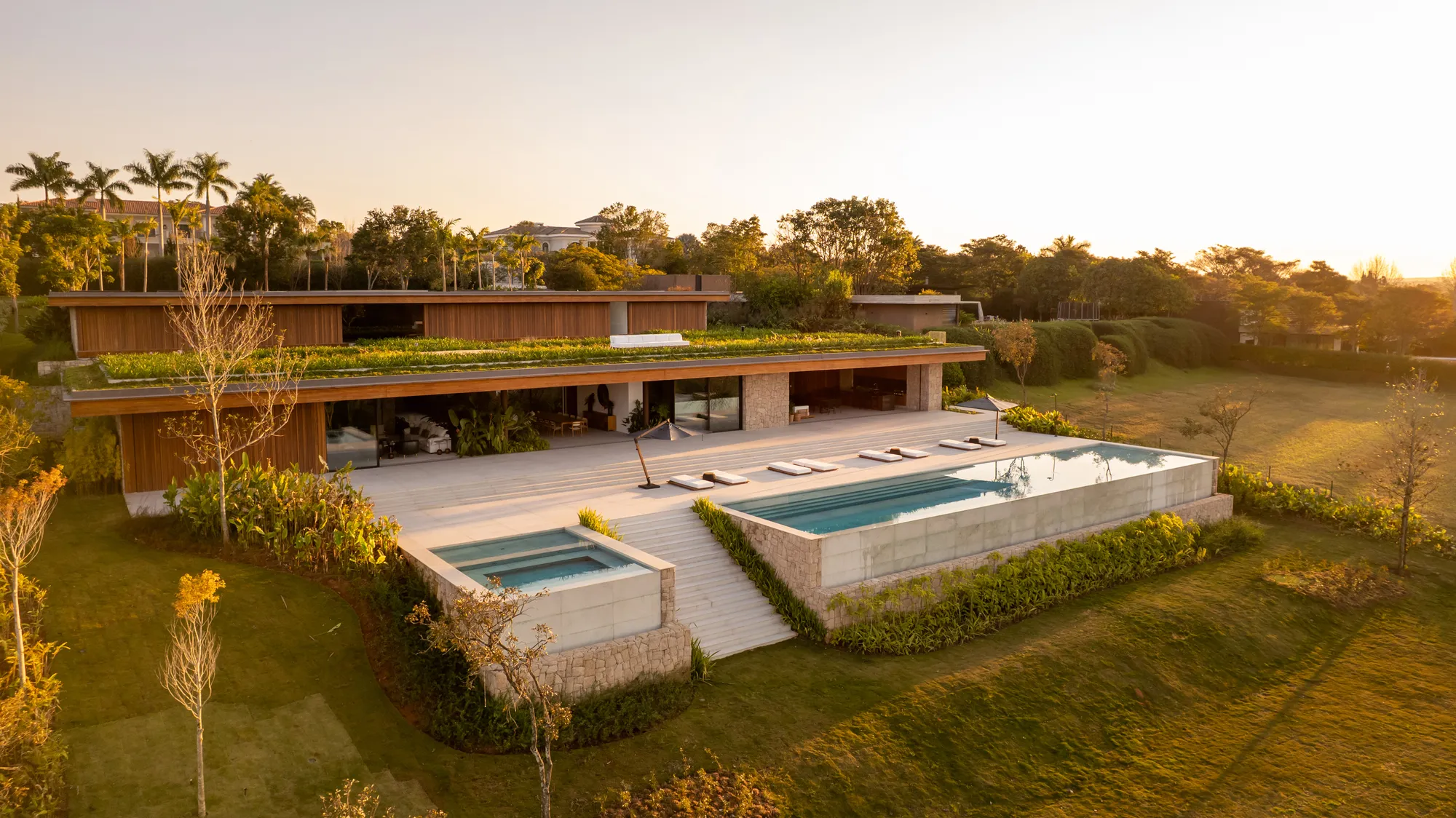
KA2R Arquitetura designed a 1,400 m² summer house in Bragança Paulista, Brazil that sits as a single long horizontal volume on the hillside.


Brazilian residential architecture has a particular relationship with landscape that is hard to find anywhere else in the world. The country has the climate, the planting, the tradition of indoor-outdoor living, and a deep bench of architects who treat the garden as an extension of the room. Ramenzoni House, a 1,400 square metre summer residence in Bragança Paulista completed in 2024 by KA2R Arquitetura, is a confident entry into that lineage.
The studio, led by Rômulo Rezende and Raíssa Rezende, designed the house as a long horizontal volume that sits quietly on the hillside and opens entirely onto the Brazilian countryside. The project is unusual in its size (1,400 square metres is a lot for a private house) and in its restraint (at that scale most projects get noisy). Ramenzoni stays calm throughout.
A Long Low House on the Hill


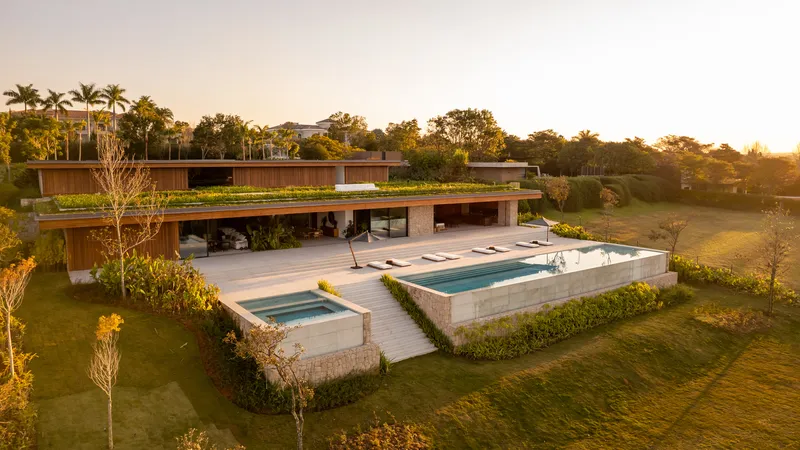
From the air, the architecture is obvious. The house is a single long horizontal volume cut into the slope of the site, topped with a planted green roof, and extended by a pool terrace that hovers just above the surrounding lawn. There are no extra pavilions, no servant wings, no decorative outbuildings. One volume, one roof, one idea.
The green roof is the clearest sustainable gesture. It insulates the interior, softens the building's visual impact from above, and continues the landscape over the top of the house. From a neighbouring hilltop, the project almost disappears. The architects have built a large house that refuses to look large.

Stone, Timber, and the Honesty of Materials
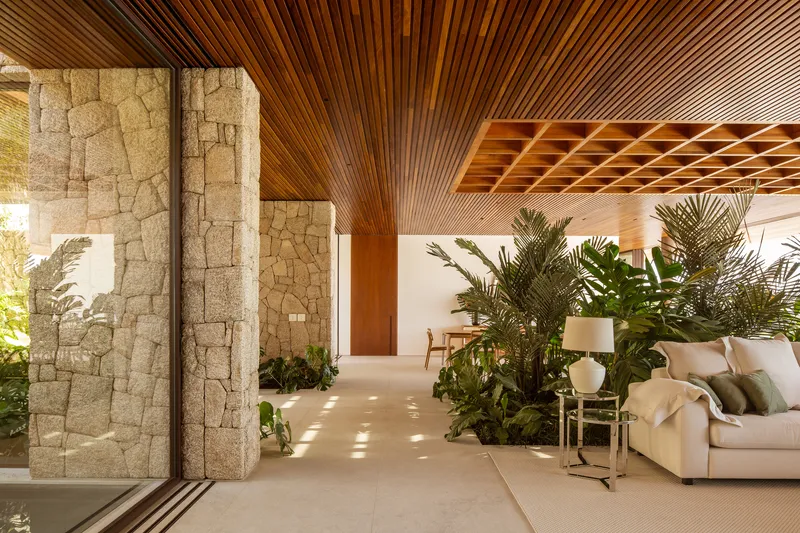
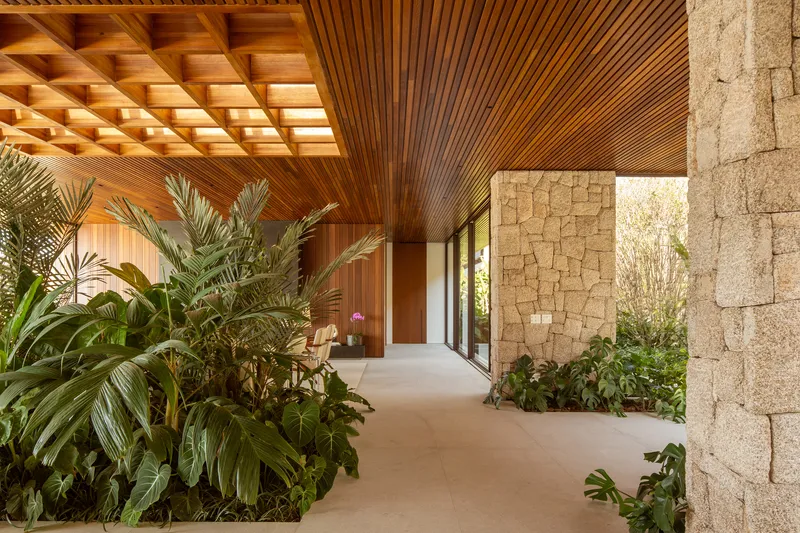

The material palette is simple and consistent. Rough stone for the structural walls and columns, timber for the ceilings and the linings of the living spaces, polished concrete or stone for the floors, and glass for everything that separates inside from outside. Each material is used for one job and left visible.
The stone is the most striking element. The walls are laid in irregular blocks with thick, flush mortar joints that expose the variation in the stone without trying to impose a pattern. This is a palette that will age well. In ten or twenty years, the stone will be darker, the timber will be silvered, and the house will look even more settled into the site.
The Coffered Timber Ceiling


Above the main living and dining spaces, the architects installed a coffered timber ceiling that is the project's most distinctive detail. The coffers are deep, square, and painted or stained in the same warm tone as the rest of the wood. Light enters through integrated slots, which means the ceiling reads as a series of glowing frames during the day.
This is the kind of move that elevates a large house from generous to architectural. A flat ceiling would have felt loose at this scale. The coffered structure gives the rooms rhythm and defines the living zones without using walls. Under the coffers, you know you are in the main room. Step beyond them, you are in a passage. The ceiling is the plan.
Courtyards and Inner Gardens


Between the main rooms, the architects cut small courtyards and inner gardens that bring daylight and planting into the centre of the volume. A narrow reflecting pool runs along one side elevation, surrounded by rough stone walls and tropical plants. Another inner garden sits between the living and dining zones, large enough to feel like a small piece of forest inside the house.
These inserts are what prevent the long single volume from becoming monotonous. Every room opens onto both the outer landscape and an inner court. Walking through the house, you never stop seeing plants. That is a specifically Brazilian idea and it is executed here with unusual care.
The Central Vestibule and Entrance Sequence
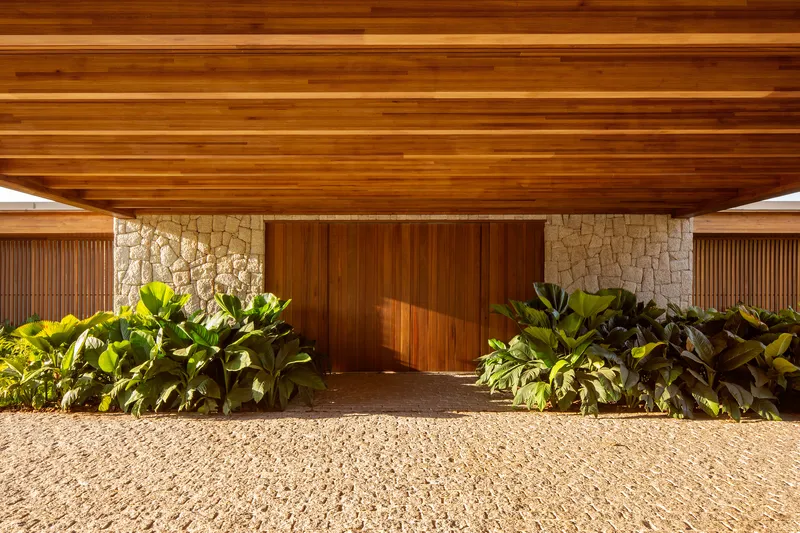

The entrance sequence is cinematic. A rough-paved path leads under a deep timber canopy supported by rough stone columns. The canopy is low, horizontal, and heavy, the kind of threshold that makes you slow down as you approach. Pass through it and you enter a narrow passage between stone walls lined with plants, lit from above by the timber ceiling.
By the time you reach the main room, you have already been reoriented. The large glass wall at the far end reveals the pool terrace, the garden, and the mountains beyond as a single panoramic view. This kind of staged entry is as old as Roman villa design, and it still works.
Indoor-Outdoor Living
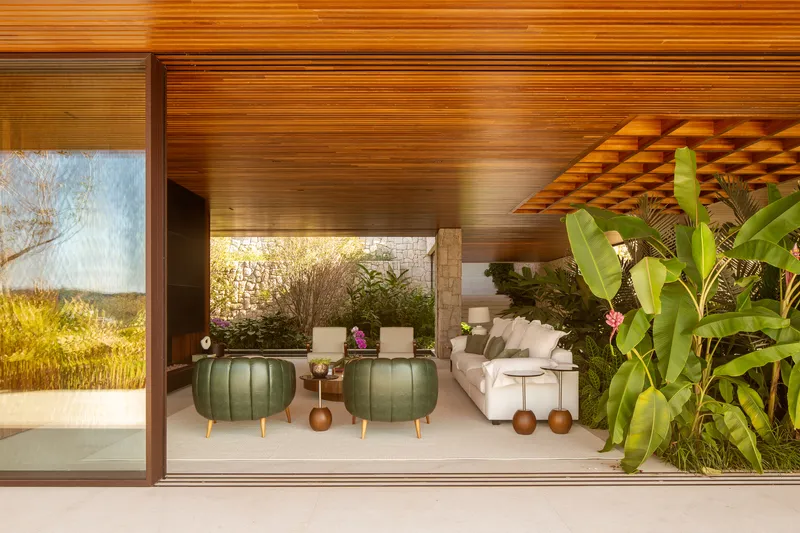


The main living and dining rooms open entirely onto the pool terrace through full-height sliding glass walls. When the glass is drawn back, the rooms become part of the terrace and the terrace becomes part of the rooms. This is the move that most indoor-outdoor projects aim for and few achieve, because it requires the ceiling, the floor, and the material transitions to all line up.
Here the architects have held the line. The timber ceiling continues from inside to outside without a break. The stone floor continues across the threshold. There is no step down to the terrace, no visible framing at the top of the sliding doors. You cannot tell where the room ends and the terrace begins. That is the point.
The Pool Terrace and the View


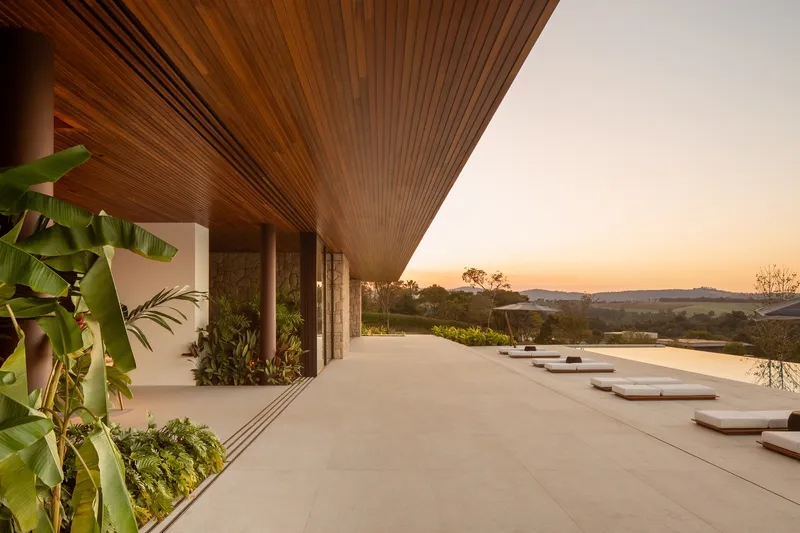
The pool terrace is the project's widest outdoor room. It runs the full length of the main volume and ends in an infinity edge that frames the distant hills. A smaller plunge pool sits at one corner, closer to the living area. A row of sun loungers, a single umbrella, and a pair of cushioned beds are enough to furnish it. The restraint is deliberate.
The lesson here is that a 1,400 square metre house does not need a cluttered terrace. The view and the water do all the work. Any additional furniture would just compete with them.
The Landscape


Landscape design by Daniel Nunes handles the planting at every scale. Palms mark key sightlines. Tropical species fill the courtyards and soften the glazed edges. Ground-cover plants stabilise the retaining walls. The landscape is not a separate layer applied after the architecture. It is the same design running through the same plan.
Slatted Screens and Light


Where the architects needed to shade an opening without closing it, they used vertical timber slats. The covered walkway between the main house and the service wing is lined with these slats on both sides, filtering the low sun and casting a rhythm of striped shadows across the floor. This is a climate-specific response that does not need mechanical shading.
Drawings
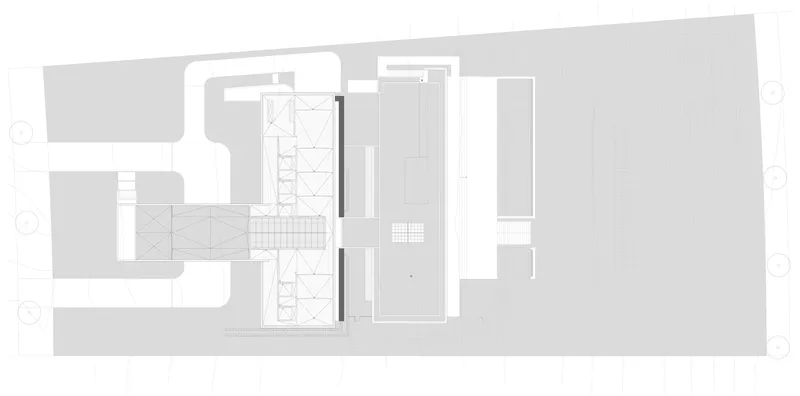
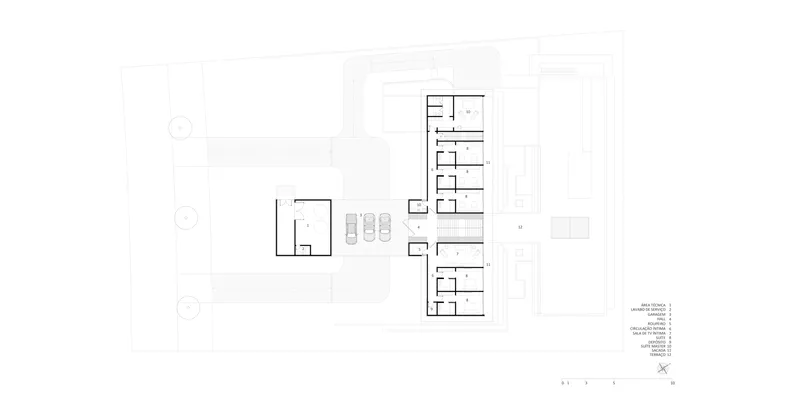
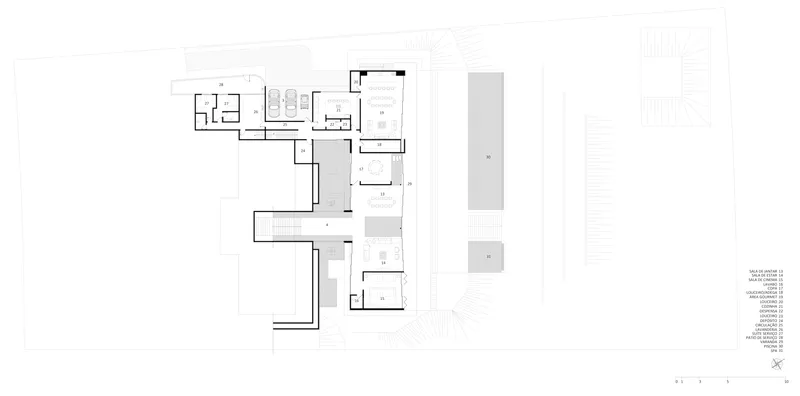
The plans confirm the project's discipline. The house is organised as a single long bar along the hillside with the main rooms on the ground floor opening toward the view, service and secondary spaces tucked behind, and a lower floor that takes advantage of the slope. The circulation is linear, the rooms are generous, and the courtyards are placed at regular intervals to bring light into the depth of the plan.
Why This Project Matters
Large private houses are one of the hardest briefs in contemporary architecture. The larger they get, the more temptation there is to make every room a statement, to collect materials like trophies, to design the house as a series of competing moments. Ramenzoni House refuses all of that. It is a long building with a clear structure, a restrained material palette, and a single strong idea about the relationship between room and landscape.
The lessons are transferable to anyone working on a large house in a warm climate: commit to a single volume, plant the roof, use local stone and timber, design the ceiling as the primary organisational element, cut courtyards into the depth of the plan, and let the view do the work. KA2R Arquitetura has put together an example that rewards careful reading, and the photographs by Carolina Lacaz capture the quiet confidence of the result.
About the Studio
Share Your Own Work on uni.xyz
If you are working on tropical residential architecture, landscape-driven houses, or large private projects, uni.xyz is a place to publish your work, find collaborators, and enter design competitions.
Project credits: Ramenzoni House by KA2R Arquitetura. Bragança Paulista, São Paulo, Brazil. 1,400 m². Completed 2024. Lead architects: Rômulo Rezende, Raíssa Rezende. Coordination: Letícia Possari. Project team: Jonathan Coutinho, Marcos Amaral. Landscape: Daniel Nunes. Construction: ACN Construtora. Structural: MDFBIM. Photographs: Carolina Lacaz.




Popular Articles
Popular articles from the community


EW PARK: Sustainable Architecture Reimagines the Future of Urban Parking
EW PARK reimagines city parking as a modular wooden tower combining automation, solar energy, electric mobility, and adaptable urban design.

The Earth Pod: 3D Printed Homes for Resilient Refugee Communities
The Earth Pod reimagines refugee housing through 3D printed homes made from clay, combining resilience, self-sufficiency, and rapid shelter.

Hill & Cross Opera: Sculptural Opera House Architecture Shaped by Tallinn’s Landscape and Identity
Hill & Cross Opera reimagines opera house architecture in Tallinn through its sculptural hill, civic plaza, glass wave and a luminous cross.

Riyadh For All: Intergenerational Urban Design for Active Aging in Rabat
Riyadh For All reimagines urban design in Rabat with intergenerational co-living, adaptive courtyards, and Moroccan cultural exchange today.


Similar Reads
You might also enjoy these articles

Bao Huynh Watercolor Atelier: A Serene Art Retreat in Hội An
Bao Huynh Watercolor Atelier in Hội An blends multifunctional art spaces, sustainable design, local materials, and family-friendly living in a serene environment.

Atelier Macri Concept Store Interior Design by CASE-REAL
Atelier Macri store features a "ko" counter, walnut wood details, cork displays, blending retail, gallery, and seamless customer experiences.

Manuel Vargas Izquierdo Stadium and High-Performance Sports Center: Architectural Excellence in Jalpa de Méndez
The Manuel Vargas Izquierdo Stadium blends sustainable design, inclusive sports facilities, and cultural-inspired architecture, revitalizing Jalpa de Méndez’s public spaces.

KAKR Buluh Awar Hall: Revitalizing Community and Ecology Through Bamboo Architecture
Community built bamboo hall revitalizes Buluh Awar village, empowering youth, restoring ecology, celebrating vernacular craftsmanship through sustainable architecture and culture.


Explore Sustainable Design Competitions
Discover active competitions in this discipline


Challenge to design mud housing for contemporary communities


Design challenge to reuse E-waste
Comments (0)
Please login or sign up to add comments
No comments yet. Be the first to comment!